




Abstract
Attempts to make free and compulsory education accessible to Indian children began a little more than a century ago. A strong consciousness for the need of free and compulsory Primary Education in India was highly moved by enactment of the Compulsory Education Act in 1870 in England. Education has been formally recognized as a human right since the adoption of the Universal Declaration of Human Rights (UDHR) in 1948. This has since then been reaffirmed in numerous global human rights treaties. Ultimately, universalization of elementary education has been one of the most important goals of educational development in India since independence. The Right of Children to Free and Compulsory Education Act (RTE Act), 2009, came into force from April 1, 2010, pursuant to the Eighty-Sixth Amendment to the Constitution of India (2002), which guarantees elementary education as a fundamental right. This article attempts to delve into the checkered history of development of the free and compulsory primary education in India under the British Raj. The history of compulsory and free primary education during the British Rule in India is an uphill journey replete with suggestions, advocacies, demands, experimentations, attempts, promises, and movements within legislative framework. The British rulers adopted a good number of policies on education, but these were framed in tune with the needs of the colonial power. Consequently, compulsory and free primary education remained an unfulfilled dream during the British Raj, in spite of the stirring efforts of the Indians.
Keywords
Introduction
The East India Company 1 received an English Royal Charter from Queen Elizabeth I on the December 31, 1600. Many European trading companies had begun their commercial activities in India before the British East India Company came to India. The English East India Company ultimately established their rule in India. Although this Company came to India as traders, they shifted their vision from economics to administrative control of India with the rise of Robert Clive and his victory at the Battle of Plassey 2 in 1757 (Riddick, 2006). Later, they had become rulers and administrators and policy makers in the landscape of economy, polity, and education in India. However, one should not suppose that there had been no educational system before the coming of the East India Company. When the British came to India and were gradually establishing themselves in Bengal, they met such a system (Ghosh, 1989). Education is no exotic in India. There is no country where the love of learning had so early an origin or has exercised so lasting and powerful an influence (Thomas, 1891).
The modern system of education came to be established in India during the British period at the cost of the traditional indigenous system. Before the British developed a new scheme of education in India, both the Hindus and the Muslims had their own systems of education. Both the systems went into oblivion gradually and suffered a setback because of political turmoil and lack of a strong centralized political authority and want of suitable patronage (Purkait, 1992). The Tols and Madrassas were the highest seminaries of learning meant for the specialists. For primary education, there were in the villages, Patsalas and Maktabs
3
where the Gurus and Maulavis imparted knowledge of the three “R’s” to the boys of the locality. There was no school for the education of the girls though the Zamindars
4
often had their daughters educated at home (Ghosh, 1989). The colonial interests of the British colored the then educational policies in India. In his book Education in British India, Arthur Howell (1872) aptly said,
Education in India under the British Government was first ignored, then violently and successfully opposed, then conducted on a system now universally admitted to be erroneous and finally placed on its present footing. (p. 3)
Let us now see how the checkered history of the free and compulsory primary education in India under the British Raj 5 was.
Methodology of the Study
The study being historical in nature involves documentary analysis. The study has been developed by exploring and analyzing comprehensively huge qualitative data obtained from both primary and secondary sources.
The Charter Act of 1813—The First Parliamentary Recognition of the Right of Education in India
Although the East India Company was established as early as in 1600, it undertook no educational activities for nearly 100 years of its existence (Nurullah & Naik, 1951). For the first time, the Company paid attention to educational matters by the Charter Act of 1698, which mandated it to maintain priests and schools in its garrisons. However, these provisions were intended for the children of the Company’s European servants than for the Indians. The development of modern system of education in India under the aegis of the Company began actually with the Charter Act of 1813, which directed through the Section 43 that
a sum of not less than one lakh of rupees in each year shall be set apart and applied to the revival and improvement of literature and the encouragement of the learned natives of India, and for the introduction and promotion of a knowledge of the sciences among the inhabitants of the British territories in India. (Sharp, 1920, p. 22)
Nurullah and Naik (1951) rightly stated that
. . . the education of the Indian people was definitely included within the duties of the Company; . . . thereby laying the foundation of the modern educational system. (p. 82)
Clause 43 of the Charter Act of 1813 assumed more importance when one remembers that in those days education was not a state’s responsibility in England, and except Scotland, no public money was spent on elementary education 6 (Ghosh, 1989). Its Clause 43 contained the first legislative admission of the right of education in India in the public revenues (Misra, 1989). However, the Charter Act made it compulsory on the part of the East India Company to extend education in India; it laid the base of state system of education in India.
William Adam’s Third Report in 1838—The Earliest Suggestion
The history of universal compulsory primary education can be traced back to the year, 1938. Although no solid efforts were made till the beginning of the 20th century, the earliest attempt during British rule for enforcing compulsory primary education was undertaken by William Adam in 1838 (Sarma, 2011), a Christian missionary who inquired into the state of vernacular education in Bengal, Bihar, and Orissa. In the third Report, Adam submitted his scheme for the improvement of vernacular education. Adam considered it impossible to introduce compulsory education at that time for more than one reason. He stated it in his report in the following words:
The next form in which Government influence may be conceived to be employed for the promotion of education is by making it compulsory and enacting that every village should have a school. I hope the time will come when every village shall have a school, but the period has not yet arrived when this obligation can be enforced. (Long, 1868, p. 254)
The General Committee of Public Instruction (GCPI) found Adam’s scheme impractical and too expensive and above all opposed to the idea of filtrating education from the upper and middle classes to the masses and, ultimately, the government rejected the proposal.
Captain Wingate, the Revenue Survey Commissioner in Bombay, 1852—A Proposal
A more direct suggestion toward the demand of compulsory education came from Captain Wingate, the Revenue Survey Commissioner in Bombay. In 1852, Captain Wingate when called upon by Government of Bombay to give his views on a proposal to levy a local fund on land revenue, recommended the levy of such cess and suggested that a part of it should be devoted to providing compulsory education to the sons of agriculturists. These proposals did not find favor with other officers most of whom opposed it tooth and nail (Aggarwal, 2002; Pathania & Pathania, 2006). Professor J. P. Naik opined that the main flaw in the proposal is its uncritical optimism. It was obviously impossible to finance compulsory primary education out of the proceeds of the Local Fund Cess only (Naik, 1942a, p. 5).
Mr. T. C. Hope, Educational Inspector of Gujarat Division, 1858—A Recommendation
Shortly afterward in 1858, Mr. T. C. Hope, the educational inspector of Gujarat proposed that a law should be passed empowering the inhabitants of any local area to tax themselves for the establishment of schools (Mukerji, 1964). Mr. T. C. Hope opposed the voluntary system of school expansion and pressed for an enactment to authorize the levy of a compulsory educational rate (Government of Bombay, 1859). The Report of the Director of Public Instruction, Bombay, for the year 1857-1858 described the opinion of Mr. T. C. Hope about the state of education during 1857 to 1858 in the following words:
that the “partially self-supporting” or persuading system, as a measure for national education, has proved a total failure . . . the best substitute appears to be a legislative enactment, to be ready applied, from year to year, to such villages as are judged to be ready for Government schools, and throwing the entire cost of the maintenance of the latter on the people themselves. (Government of Bombay, 1859, p. 433)
But this proposal was also turned down as premature. Thus, earlier suggestions or schemes for introducing compulsory primary education under the British Raj came from William Adam, Captain Wingate, and T. C. Hope. But all the suggestions were considered either premature or impractical.
Indian Education Commission (Hunter Commission), 1882—The Earliest Demand
With the enforcement of Compulsory Education Act in England in 1870, a demand was raised in India to provide similar facilities in its colonies (Juneja, 2003). Consequently, a vigorous demand for laws to be made to make 4 years of primary education compulsory was made by Dadabhai Naoroji and Jyotiba Phule from Bombay Presidency in their evidences before the Indian Education Commission, 1882, which agreed to their reason for claim and stated that
while every branch of education can justly claim the fostering care of the state, it is desirable, in the present circumstances to declare the elementary, education of the masses, its provision, extension and improvement, to be that part of the educational system to which the strenuous efforts of the State should now be directed. (Hunter Commission, p. 586)
Dadabhai Naoroji in his evidence before the Hunter Commission put forward the demand that 4 years of compulsory education should be provided to all children (UNESCO, 1984). Jotirao also pointed out in his representation to the Education Commission,
There is little doubt that primary education among the masses in this Presidency has been very much neglected . . . Government collect a special cess for educational purpose, and it is to be regretted that this fund is not spent for the purposes for which it is collected . . . I think primary education of the masses should be made compulsory up to a certain age, say at least 12 years. (Government of India, 1881, p. 142; Mali, 1989, pp. 75-76)
In the big volume of its report, which runs well over 739 pages, there is no mention of compulsory education at all. The principle of compulsion is referred to only in page number 558, where the Commission observes, “One witness advocates compulsory primary education for the city of Bombay” (Government of India, 1883, p. 558). It recommended that the management of primary schools was to be entrusted to the newly established local self-government boards. Lord Ripon was satisfied with the very recommendation of the Commission. State’s financial allocation for making primary education universal was reduced and even gradually withdrawn under this policy of local self-government introduced in India by Lord Ripon. But newly established local and municipal boards had little resources to take up this burden. Ultimately, we observed that
. . . the Commission did not recommend making elementary education compulsory, nor did they recommend making free. But they asked the local authorities to admit ascertain portion of pupils as free students on the ground of poverty in all schools managed by the local boards or municipalities. (Sen, 1941, pp. 167-168)
Establishment of Indian National Congress in 1885—Strengthening the Movement
The report of the Indian Education Commission paved the way for the organized agitation for the introduction of compulsory education. Since 1880, a number of Indian leaders began stressing the need of education for all. The establishment of the Indian National Congress in 1885 further strengthened the movement (Mukerji, 1964). In the Calcutta Congress of 1906, it was declared that it is the birthright of the people of India to get proper education. The Resolutions adopted by the 22nd Indian National Congress, held at Calcutta from December 26 to December 29, 1906, pointed out that “Government should take immediate steps for (i) making primary education free and gradually compulsory all over the country” (Report of the Twenty-Second Indian National Congress, 1907, p. iii). The movement thus initiated was kept up till 1947 (Naik, 1978).
Attempts of Sir Sahaji Rao Gaikwad of Baroda—The First Experimentation
Ultimately, credit goes to the notable Indian prince Sir Sahaji Rao Gaikwad of Baroda. He achieved what the British Government found impossible. That is why Gopal Krishna Gokhale pointed out at the time of introducing the Bill on March 16, 1911, in the Imperial Legislative Council,
Within the borders of India itself, the Maharaja of Baroda has set an event of enthusiasm in the cause of education . . . His highness began his first experiment in the matter of introducing compulsory and free education into his State eighteen years ago in ten villages at the Amreli Taluka. After watching the experiment for eight years, it was extended to the whole taluka in 1901, and finally, in 1906, primary education was made compulsory and free throughout the State for boys between the ages of 6 and 12, and for girls between the ages of 6 and 10. (Natesan, 1916, pp. 725-726)
For his greatest and remarkable contribution to the cause of compulsory education, he was often regarded as the “Prince among the Educators and an Educator among the princes.” The first organized attempt to introduce compulsory primary education in British India was, however, made in Bombay under Sir Ibrahim Rahimtoola and Sir Chimanlal Setalwad. As a result of their agitation, the Government of Bombay appointed a Committee in 1906 to examine the feasibility of introducing compulsory education in the city of Bombay. But unfortunately, this committee came to the conclusion that the time was not ripe for the introduction of compulsory education (Desai, 1953; Mukerji, 1964).
Attempts of Gopal Krishna Gokhale (1910-1912)—The Movements Within Legislative Framework
During the days of Swadeshi Movement,
7
an extensive agitation was launched for spreading education among the masses. On the contrary, a new political awakening emerged and it strongly had drawn the attention of the country to the needs of mass education. Even after 150 years of British Raj, only about 6% of the people had reached the level of literacy. This produced a surge of criticism from all corners against the existing system of education. Such criticisms found expression in a constructive manner in the attempts of the late Gopal Krishna Gokhale to force the government of the country to accept the principle of compulsory and free primary education (Basu, 1992). The first definite and vocal demand for the introduction of compulsory primary education was made by Shri Gopal Krishna Gokhale, the veteran Indian nationalist leader (Mukerji, 1964). He was also an active member of the Indian National Congress and he became a nonofficial member representing the Bombay Presidency in the British Imperial Legislative Council
8
in 1902. He made valiant efforts to make the government accept the necessity of compulsory primary education. The attempt of Maharaja Sayaji Rao Gaikwad of Baroda inspired Mr. Gokhale. On March 18, 1910, Mr. Gokhale, in moving a resolution in the Imperial Legislative Council, recommended that
a beginning be made in the direction of making elementary education free and compulsory throughout the country, and that a mixed commission of officials and non-officials be appointed to frame definite proposals. (Dasgupta, 1993, p. 124; Natesan, 1920, p. 590)
Gokhale submitted nine practical proposals to the consideration of this Council. He proposed
That following the example of the Act of 1870, we should pass an Act conferring powers upon local bodies to make elementary education compulsory in their areas. that compulsion should be only for boys and not for girls. that the period of compulsion should be between 6 years and 10 years, In any area where 33 per cent of the male population is already at school, there this principle of compulsion should be applied. that wherever compulsory education is introduced, it should be gratuitous, that the extra cost should be divided between the Government and the local bodies in the proportion of 2 to 1. that there should now be a separate Secretary for Education in the Home Department . . . a Member in separate charge of education will be included in the Executive Council. that education should now be a divided head instead of its being a purely Provincial head . . . Education should therefore be a divided charge and there should be a definite programme before the Government, just as there is a programme for railways, which should be carried out steadily year by year. that a statement describing the progress of education from year to year should be published with the annual Financial Statement. (Natesan, 1920, pp. 601-603)
The resolution was withdrawn on an assurance from the government that the whole problem would receive official attention. Although the government rejected most of the proposals of Mr. Gokhale, in the same year (1910) the Government of India created a separate Department of Education in charge of a Member of the Executive Council and asked it to devise schemes for the extension of primary education (Sen, 1941). The government, however, soon created a separate Department of Education and began to publish annual reviews of educational progress, but they ignored the principal part of the resolution on the ground that education was wholly the purview of the provincial governments (Kamat, 1970). Meanwhile, his plea for the introduction compulsory education drew wide public attention. Almost single-handedly, he had succeeded in making elementary education in India a live issue (Dasgupta, 1993). However, by introduction of this resolution, Gokhale succeeded in putting the case for compulsory education on the national agenda. If Gopal Krishna Gokhale would have been alive today, he would have been the happiest person to see his dream of “Right to Education” for the children of the country come true. It was he who, a 100 years ago, urged the Imperial Legislative Assembly confer such a right on Indian children. That goal has been realized a century later (Adhivakta Parishad, 2013; Gahlawat, 2011; Rathod, 2015).
A year later, on March 16, 1911, the Hon’ble Mr. Gokhale introduced in the same Council a small private bill “to make better provision for the extension of elementary education in India” (Mukerji, 1964, p. 70; Sharp, 1914, p. 181). In his introductory speech, he pointed out all facts and figures about other countries for comparison and made out a cogent case for what he called a “cautious measure.” He made a touching appeal to the officialdom,
My Lord, if the history of elementary education throughout the world establishes one fact more clearly than another, it is this, that without a resort to compulsion no State can ensure a general diffusion of education among its people. (Natesan, 1916, p. 726)
Mr. Gokhale also spoke that
none is greater than this task of promoting the universal diffusion of education in the land, bringing by its means a ray of light, a touch of refinement, a glow of hope into lives that sadly need them all. (Natesan, 1916, p. 620).
The bill had been drafted more or less on lines put forward by him in the preceding year, at the time of the debate on his resolution (Sen, 1941). The demands made in the bill were, however, more modest enough and humble than the resolutions placed before. The Act was to be in the nature of a permissive legislation. Mr. Gokhale attached the greatest importance to the bill was that relating to “the gradual introduction of the principle of compulsion into the system of elementary education in the country” (Natesan, 1920, p. 608). Professor Basu (1992) summarized what the bill demanded stating that
a local body might, with the previous sanction of the Provincial Government, make primary education compulsory in its area provided that thirty-three per cent of boys and girls in that area were already under instruction (showing thereby that there was sufficient demand for primary education). Even then compulsion would be only for boys between the ages of six and ten, and girls were not to be included at all. And the expenses were to be shared by the local bodies and the Provincial Governments in the ratio of one to two. (pp. 68-69)
The bill was framed on the model of Compulsory Education Acts of England of 1870 and 1876 (Kamat, 1970). Finally, Mr. Gokhale, on March 18, 1912, moved that the bill be referred to a Select Committee of 15 members of the Council for detailed examination of the clauses. This time he also urged that where education was to be made compulsory, it should be free (Sen, 1941). He emphatically urged that “. . . unless there was an Act to this effect, the local bodies would be powerless to introduce compulsory education” (Siqueira, 1952, p. 122). With all his arguments, Gokhale could not break through the government opposition. All the government members as well as some nonofficial members voted against the bill and it was thrown out, 38 members voting against and 13 voting for it (Basu, 1992). The government was not prepared to accept even these modest proposals and, by virtue of their statutory brute majority, the fate of the bill was of course sealed (Kamat, 1970). The bill was rejected on the ground that it was unnecessary, premature, unworkable, and so on. While rejecting Gokhale’s Bill, however, the Government of India promised more grants to local bodies for the encouragement of primary education and urged the provincial government to pay more attention to this subject. Most of the educated people in India began to realize the necessity of free and compulsory education . . . the movement for elementary education advanced rapidly in the country. In newly created N.W. Frontier Province, the elementary education was made free in 1912 (Rawat, 1959).
However, Gokhale had rightly predicted the result of the voting, which was already expressed in the debate in the following magnificent words:
My Lord, I know that my Bill will be thrown out before the day closes. I make no complaint. I shall not even feel depressed . . . We, of the present generation of India can only hope to serve our country by our failures. The men and women who will be privileged to serve her by their successes, will come later. (Natesan, 1920, p. 660)
Thus, a glorious chapter in the history of the fight for compulsory primary education in India under the British rule ended. However, Gokhale failed; but he failed gloriously. He, though defeated, fought heroically for several years. After all, it was really a heroic failure.
The Educational Policy of 1913—The Commitments and Promises
Although Mr. Gokhale’s attempts on 3 successive years to compel the government to pass an education bill had failed, the possibility of extension of the primary education in India gained a momentum when His Most Gracious Imperial Majesty the King Emperor, George V, in replying to the address of the Calcutta University during his visit to India, said on January 6, 1912,
It is my wish that there may be spread over the land a network of schools and colleges, from which will go forth loyal and manly and useful citizens, able to hold their own in industries and agriculture and all the vocations in life. And it is my wish, too, that the homes of my Indian subjects may be brightened and their labour sweetened by the spread of knowledge with all that follows in its train, a higher level of thought, of comfort and a health. It is through education that my wish will be fulfilled, and the cause of education in India will ever be very close to my heart. (Government of India, 1913, p. 1)
His Majesty’s statement, together with the attempts of Mr. Gokhale, forced the Government to pay more attention on primary education. The Indian Educational Policy, 1913, made a significant statement on the compulsory and free education in the words that
For financial and administrative reasons of decisive weight the Government of India has refused to recognise the principle of compulsory education; but they desire the widest possible extension of primary education on a voluntary basis, regards free elementary education the time has not yet arrived . . . in provinces elementary education is already free and in the majority of provinces liberal provision is already made for giving free elementary instruction to those boys whose parents cannot afford to pay fees. Local Governments have been requested to extend the application of the principle of free elementary education amongst the poorer and more backward sections of the population. Further than this it is not possible at present to go. (Government of India, 1913, pp. 9-10)
Ultimately, the British administrators had never looked upon education in India as a sacred duty that they had to fulfill. They looked upon the education of Indians as an object of charity and not as a duty. Charity entails no goal, nor a minimum requirement. A duty has both (Naik, 1943).
Successful Attempt of Shri Vithalbhai Patel—Leading to the Enactment of First Law
Soon after the demise of Gokhale in 1915, the campaign for compulsory primary education was again started by the late Shri Vithalbhai Patel. Mr. Patel introduced in 1917 a Bill in the Bombay Legislative Council for permitting municipalities to introduce compulsion in municipal areas of the Province of Bombay. This Bill received the ascent of the Governor-General on February 5, 1918, and the Bombay Primary Education (District Municipalities) Act of 1918 came into effect. Mr. Vithalbhai Patel was thus the main architect of getting the first Act on Compulsory Primary Education in British India passed by the Bombay Legislative Council. This is popularly known as the Patel Act, after its mover. What Gokhale tried to achieve for the entire country, Shri Vithalbhai Patel particularly achieved for Bombay. In 1917, he moved a bill in the Bombay Provincial Legislature for introducing compulsory education in the municipal areas (excepting Bombay City) of the state. It was broadly based on Gokhale’s bill with two exceptions: (a) the scope was restricted to municipal areas only, as Gokhale’s bill was criticized on the ground that rural areas were not ripe for compulsion, and (b) it did not prescribe any definite financial undertaking on the government which was left free to give or not to give a grant-in-aid. Gokhale had, however, insisted that government should bear two thirds of the entire expenditure on compulsory education (Mukerji, 1964). However, the Patel Act awakened nationwide interest in the need of compulsory primary education.
Compulsory Education in British India, 1917 to 1937: The Bloom—Period of Compulsion
The passing of the Government of India Act, 1919, ushered in an era of rapid expansion of elementary education as this Act passed education for the first time in the hands of Indian ministers. The Montagu–Chelmsford Constitutional Reforms introduced diarchy or double rule in provincial administration. Under the diarchical form of government in India, education of Indian children became a “transferred” subject, but finance remained a “reserved” subject. Under the reformed constitution, the Indian ministers enjoyed certain powers specially in the matter of legislation; but the purse strings were held by the executive councillors and the governor (Basu, 1992).
Under these circumstances, bills for introducing compulsory education were presented before every provincial legislature and soon they were passed and placed on the statute books of the country. The Montagu–Chelmsford reforms marked the end of direct colonial responsibility for education under British India. Professor Nalini Juneja (2003) recorded that from 1918 to 1930 every province in British India gets Compulsory Education Act on its Statute Book. Thus, the newly elected legislatures replied to the defeat of Mr. Gokhale. In fact, the decade 1917 to 1927 in the history of compulsory education in British India may rightly be regarded as the bloom—period of compulsion. Table 1 gives detailed information regarding them.
Compulsory Education Acts in British India.

Source. Naik (1942b, p. 12), Nurullah and Naik (1970, p. 302).
Note. P.E. = Primary Education; N.W.F. = North West Frontier.
The following statistics in Table 2 tell the tale of achievements in terms of number of areas under compulsion in the quinquennium 1922-1927.
Areas Under Compulsion.

Source. Nurullah and Naik (1970, p. 304).
However, owing to the Montagu–Chelmsford Reforms, Indian ministers were unable to effect any major changes in education because finance, a reserved subject, was under the control of the English councillors. Financial difficulties prevented the provincial governments from taking up ambitious schemes of educational expansion or improvement. Consequently, progress of Compulsory Education Act occurred in terms of legislatures. The progress of compulsion just before the last decade from the attainment of independence of the country may also be easily clear from Table 3.
Compulsory Education in British India, 1921-1937.

Source. Mukerji (1964, p. 73).
The progress between 1931 and 1937 was not very encouraging. This system of governance was later on ended with the introduction of provincial autonomy in 1937 through the Government of India Act of 1935. With the introduction of provincial autonomy, the Indian National Congress assumed the office in seven provinces out of 11. The education ministers under provincial autonomy could command far larger resources than the ministers under diarchy ever did. Although detailed plans for comprehensive expansion of elementary education were developed, the implementation was restricted because of the occurrence of the Second World War.
Wardha Scheme of Basic Education, 1937—The First National Scheme
The majority of Indian leaders were highly dissatisfied with the progress and the nature of the system of education prevalent in the country. In 1937, Gandhiji published in the Harijan a series of articles discussing his educational ideals. He wanted his scheme of education to be self-supporting, because he felt that true education should always stands on its own legs (Mukerji, 1951). In October 1937, an All India Educational Conference was called at Wardha under the presidentship of Mahatmaji shortly after his articles on educational ideas appeared in the Harijan. The conference then appointed a committee with Dr. Zakir Husain as its chairman to prepare a tentative scheme and syllabus in the light of the resolutions passed in the conference. The report of the committee was published under the title “Basic National Education” in 1938 and it is popularly known as the Wardha Scheme, because it is closely associated with Wardha. The scheme fervently mentioned a plan of 7-year (7-14) course of free and compulsory education. In 1938, this new system of education was put into practice in the six major Congress provinces, namely, Bombay, United Provinces (U.P.), Central Provinces (C.P.), Madras, Bihar, and Orissa (Mukerji, 1951).
The Central Advisory Board of Education was quick to see the great merit of the Wardha Scheme and appointed the Wardha Education Committee of Central Advisory Board of Education in January 1938 under the chairmanship of Shri B. G. Kher to examine its possibilities. The Kher Committee accepted the principle of education through activity and recommended that the age range of compulsion should be 6 to 14 years. Meanwhile, in 1939, owing to the outbreak of the World War II, and as a protest against the government’s policy of compelling India to participate in War, Congress ministries tendered resignations. Thus, the rising tide of educational expansion was for the time being stemmed by these circumstances (Rawat, 1959). However, the Wardha Scheme of Mahatma Gandhi strengthened the hope for the enforcement of free compulsory education in the country. This was also an effort toward the universalization of primary education in British India.
The Sargent Plan, 1944—Toward a Nationwide Plan
The need for providing India with a system of education in approximation to those available in other civilized countries drew the serious attention of leading educationists of the country during the last decade. Sir John Sargent, the then educational adviser with the Government of India, was asked by the Reconstruction Committee of the Viceroy’s Executive Council to prepare a memorandum on Post-War Educational Development in India (Mukerji, 1951). The Report on Post-War Educational Development in India, approved by the Central Advisory Board of Education in 1944, visualized a national educational system. The Report begins with the words “Upon the education of the people of this country, the fate of this country depends” (Government of India, 1944, p. 6). These words contain a universal demand. It remarkably provides for universal, compulsory, and free primary or “Basic” education for all children between the ages of 6 and 14 under the following two heads:
Free and compulsory junior basic education of 5 years for all children in the age group 6 to 11; and
Compulsory senior basic education of 3 years for four fifths of the children in the age group 11 to 14.
The Sargent Plan also concluded that
a system of universal, compulsory and free education for all boys and girls between the ages of six and fourteen should be introduced as speedily as possible though in view of the practical difficulty of recruiting the requisite supply, of trained teachers it may not be possible to complete it in less than forty years. (Government of India, 1944, p. 14)
The Report of the Kher Committee, 1950—The First Attempt in Free India
However, soon after the attainment of independence, the problem of evolving a national system of education was taken up for consideration. At that time, there was a general feeling in the country that the broad policies recommended by the Sargent Report were sound and acceptable, but the period covered by it was too long. A committee was, therefore, appointed, under the chairmanship of the late Shri B. G. Kher, to consider the extent to which the proposals of the Sargent Report needed modifications from this point of view and also to suggest the manner in which funds required for the program should be raised (Government of India, 1965). The Report of the Committee on the Ways and Means of Financing Educational Development in India, 1950, accepted the program of universal, compulsory, and free basic education as proposed in the Plan itself but reduced the time span, stating universal compulsory education in the age group 6 to 14 was to be provided in a period of about 15 years (1949-1950 to 1964-1965), universal compulsory education being provided for the age group 6 to 11 in two Five-Year Plans and that for the age group 11 to 14 in the Third Five-Year Plan. The Committee also recommended that
the Provinces should aim at introducing universal compulsory education for the children of 6-11 age—group within a period of ten years but if financial conditions compel, the programme may be extended over a large period but in no circumstances should it be given up. (Government of India, 1965, p. 9)
This recommendation ultimately shaped the foundation of Article 45 under the Directive Principles of the Constitution in free India, mandating that
State shall endeavour to provide within a period of ten years from the commencement of this Constitution for free and compulsory education for all children until they complete the age of 14 years.
Ever since, efforts were being made toward the movement discourse on the right to free and compulsory education from Directive Principle to Fundamental Right in the postconstitutional era. Thus, a universal system of free and compulsory primary education remained a mere dream of our educationists and nation builders till 1947 under the British Raj. Table 4 shows areas brought under the compulsory primary education by 1946 to 1947.
Compulsory Primary Education in India, 1946-1947.
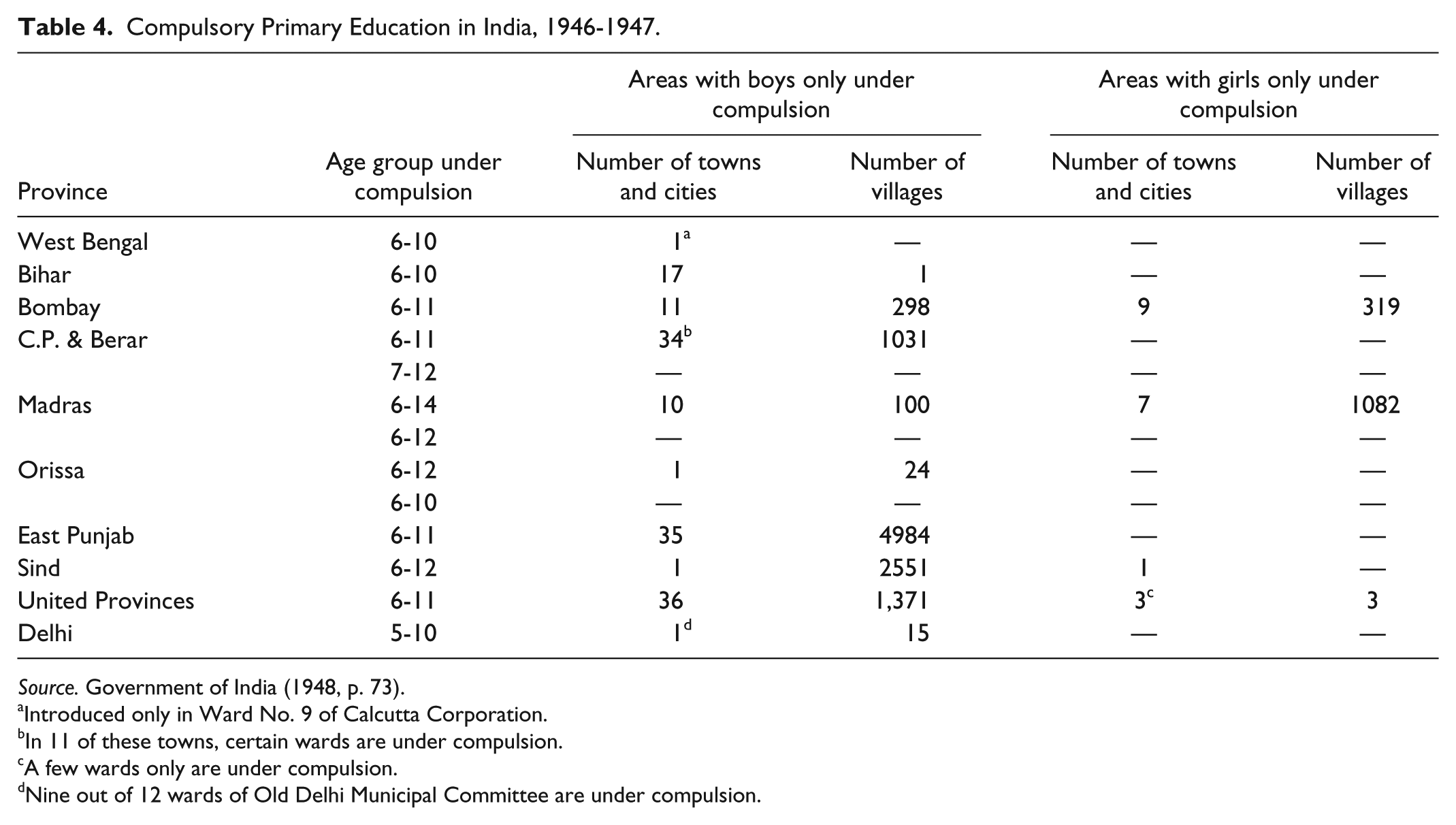
Source. Government of India (1948, p. 73).
Introduced only in Ward No. 9 of Calcutta Corporation.
In 11 of these towns, certain wards are under compulsion.
A few wards only are under compulsion.
Nine out of 12 wards of Old Delhi Municipal Committee are under compulsion.
This table also shows that compulsory primary education had not been introduced only in Assam, North West Frontier, and in Centrally Administered Areas except Delhi.
The total legislations on compulsory education during preindependence can be divided into two distinct time periods. The first period started with Gokhale’s Bill in 1911 in the Imperial Legislative Council, which though rejected, provided the genesis for legislation on compulsory education in India. The period continued up to 1919-1920 before the transfer of education to Indian ministers. With this transfer, the second phase in the history of compulsory education in India began. The Compulsory Education Acts that were passed during these two phases are presented in Table 5.
Compulsory Education Acts Passed From 1919 to 1947.

Source. Juneja (2003, p. 19); Pandey and Panda (2001, p. 25).
Note. U.P. = United Provinces.
It is clear that there has been no dearth of legislations to make education free and compulsory in India before the attainment of independence. Besides these acts, which were passed by the British India, many princely states, such as Baroda, Travancore, Manipur, and so forth, had taken the lead and initiative to provide compulsory education through legislative measures. Nearly every province passed a compulsory education act but these remained largely inoperative, mainly because local bodies were not willingly to levy special taxes to finance primary education. Under the British Raj, education was served to the Indians in the interest of their colonial power. However, the demands, efforts, and struggles by our Indians for making education free and compulsory before independence have definitely established a sound foundation that has shown a right direction during the postindependence period. Consequent upon the continued efforts of the leaders, the Government of independent India kept the provision of free and compulsory education to all children in the Constitution of India.
Conclusion
India was under the British Raj for more than two centuries, before the attainment of freedom in 1947. During the first phase of the East India Company rule, Westernized system of education for Indian subjects was not under the purview of the Company’s original policy as its main object was trade. It took no educational ventures for nearly 100 years of its establishment in 1600
Actually, the demand for free and compulsory primary education in India under the British Raj started formally just after the passing of the Compulsory Education Acts in England in 1870, 1876, and 1880 when Dadabhai Naoroji and Jyotiba Phule from Bombay Presidency, in their evidence, placed an emphatic demand for 4 years of compulsory primary education before the Hunter Commission, 1882. Since then, our Indians took the baton. What Gokhale failed to achieve for the whole of India, Shri Vithalbhai Patel achieved, at least in theory, for Bombay. Gokhale’s defeat shaped the demand for free and compulsory primary education into a national one. Since the end of direct colonial responsibility for education after the passing of the Government of India Act, 1919, the Indians got ample scope for passing Compulsory Education Acts in most of the provinces. Although the introduction of compulsion in all the Acts was left to the discretion of the local bodies, they were hardly ready to court unpopularity by levying any additional cess. With the existing provincial resources of income, the Acts could have little more than symbolic value (Dayal, 1955). Local option in the matter of compulsion was responsible for inaction. In the Report, Hartog Committee aptly opined that the responsibility for mass education rests primarily with the state and the provision of educational facilities for all classes of the community and for all areas should not be left entirely to the mercy of local authorities, who may be unwilling, either for political or other reasons, to initiate schemes by which compulsion may be financed, or who, owing to the backwardness of the area or the people, may be unable to devise suitable measures for compulsion on their own initiative (Government of India, 1929). The Montford Reforms gave only a semblance of power to the provincial ministers of education who could do little beyond making paper schemes. Indian ministers had no control over important departments like finance. The principle of compulsion was theoretically accepted in almost all the provinces and Compulsory Education Acts passed everywhere. But as the local authorities, who were mainly responsible for Primary Education, were unwilling to carry out the policy of compulsion for more than one reason, the Compulsory Education Acts generally remained a dead letter (Dayal, 1955). It can be claimed that only the concept of compulsory elementary education came to be accepted in theory and was incorporated in the laws of the land, especially after the transfer of education to Indian control in 1921 but financial difficulties prevented the Indians from taking up ambitious schemes of implementation or improvement. At last, the Sargent Plan, 1944, proposed that the universal compulsory and free education of 8 years was not possible to achieve in a time frame of less than 40 years due to paucity of trained teachers, financial burden, and ever-increasing number of children. Although the Kher Committee, 1950, after the attainment of freedom in 1947, cut down the time span of 40 (1944-1984) to 16 years (1944-1960), universal compulsory and free education remained an unfulfilled dream during the British Raj, in spite of the stirring efforts of the nationalist leaders, educationists, and politicians. Colonial interests or power within the educational policies in British India in the form of hidden agenda was the key barrier to the fulfillment of the demand of Indians. Right or demand for the free and compulsory education for Indian children under the British Raj was consistently denied and it has also been consistently delayed in free India. The colonial power shaped and guided the educational policy and the educational institutions promoted the needs of the colonizer, ignoring the aspirations of the colonized. The needs of the colonial powers always determined the development of education system in British India. Despite many recommendations and suggestions for free and compulsory primary education, colonial government always left the issue under either local self-governments or the private enterprises and philanthropic efforts. The passage to free and compulsory education in India ultimately arrives at its final destination when it became a justifiable fundamental right in the Constitution of India in 2002 and an Act in 2009 after “hundred years since Gokhale introduced his private Bill in the Imperial Assembly, seventy one years since Mahatma Gandhi gave the call for universal education in 1937; sixty one years since Independence . . .” (Raina, 2010, p. 6).
Footnotes
Declaration of Conflicting Interests
The author(s) declared no potential conflicts of interest with respect to the research, authorship, and/or publication of this article.
Funding
The author(s) received no financial support for the research, authorship, and/or publication of this article.