




Abstract
Banking and Financial Institutions (BFIs) show the growth of development of a country. Digital literacy and its development in a country depend on its use by the citizens of a country. In India, they have recently made strides in using digital technology due to fast development in the Internet technology. The recent “World Report on Disability” by World Health Organization (WHO) puts the disabled populations in the world at 15%. There are 26.81 million Indians who suffer from some form of disability. This research study critically probes the two determinants of the digital divide: (a) the accessibility of websites of banks and (b) the accessibility of financial and banking information on their websites. United Nations Convention on the Rights of Persons with Disabilities (UNCRPD) guidelines has been ratified by Government of India in 2007. The websites of 103 BFIs in India were used for the study. The research study work started on December 3, 2013; it being the World Day of the Disabled. The study aimed for evaluating the websites in terms of media tool for communication, information, services, accessibility, design, and interactive participatory features for persons with disabilities. The study showed that 26% of the websites under study and 5% International BFIs in India offered information in vernacular medium, while only seven websites of the BFIs in India passed markup validation test.
Keywords
Introduction
Banking and Financial Institutions (BFIs) show the growth of development of a country. Banking sector in India has made strides in using digital technology. Due to fast development in the Internet technology in higher income group economies, under developed and developing countries will be automatically marginalized thereby creating digital divide. And, it will affect automatically more to a person with disability.
The size of the financially excluded population in the world is enormous: Around 3 billion people in the world have less access and opportunity for formal financial services. Websites are the face of institutions, which have a global reach. According to Gerry McGovern (2006), “website reflects true face of an organization as never before” (December 5, 2013). Website creates a direct link between the organization and the customer. BFIs in India offer people help in investments, loans to increase their business, income, and worth. Persons with Disabilities (PWDs) are also consumers of products and programs of financial institutions. Many PWDs access banks through websites. They are used by BFIs in India, as an Information and Communication Technology (ICT) medium. They use their websites for financial transactions, services, and dissemination of information. According to Gerry McGovern (2006), “a website is increasingly the place where customers get that vital first impression” (December 5, 2013). Accessibility of these websites to PWDs will be the test of their global reach. All the BFIs in India offer people help in investments, loans to increase their business, income, and worth guided and monitored by Reserve Bank of India (RBI) regulations.
The History of Indian Banking and Finance Institutions
The Indian Central government had a strong control over the banking system in India. State Bank of India was the first nationalized bank which was former Imperial Bank of India. In the beginning days after Independence banking system was operated by the private banking system.
The Indian government thought that they should have a strong influence over the strong banking sector. As a result, there is a decline in productivity and a rise in nonperforming assets. After that the government thought of appointing ombudsmen to look into the problem of the organizations.
The RBI and Regulations
RBI Act, 1934, gave the provision to establish RBI on April 1, 1935, to take precautionary measures and keep a tab on the banking and finance sectors. It is an autonomous body to take decisions and for day-to-day governance. RBI will print new currency notes of different denominations depending about the requirements and keep some reserve finances of the banking sectors as security deposits for the customers in case of some eventualities or huge loss for a particular bank.
“Digital inclusion tends to be solely associated with technical accessibility issues” (Steyaert, 2005, pp. 67-68).
The Internet facilitates the creation of websites. According to Karandikar (2011), “in India the internet is arguably the most convergent medium of communication today” (pp. 32-37). Websites are a convergent medium enabling the financial institutions in India to interact and communicate with the prospective consumers and the public. Hence, accessible websites have great significance in reaching out financial programs, products, and information about financial institutions of higher standing in economics.
The National Policy on Universal Electronic Accessibility
The objective of the policy is to provide PWDs equal access to electronic and information and communication technology and services. This policy expands on the United Nations Convention on the Rights of Persons with Disabilities (UNCRPD) which India has ratified. The Union Cabinet on October 3, 2013 approved the national policy on universal electronic accessibility that recognizes the need to eliminate discrimination on the basis of disabilities as well as to facilitate equal access to electronics and ICTs. The policy will facilitate equal and unhindered access to electronics and ICT products and services by differently abled persons (both physically and mentally challenged) and to facilitate local language support for the same. This shall be achieved through universal access to electronics and ICT products and services to synchronize with barrier-free environment and preferably usable without adaptation. Differently abled persons all over the country will benefit from this policy (Press Information Bureau, Government of India, 2013).
The following strategies are envisaged for the implementation of the policy:
Creating awareness on design and accessibility of universal electronics.
Capacity building and infrastructure development.
Setting up of model electronics and ICT centers for providing training and demonstration to special educators of/and physically as well as mentally challenged persons.
Conducting research and development, use of innovation, ideas, technology, and so on, whether indigenous or outsourced from abroad.
Developing programs and schemes with greater emphasis for differently abled persons.
Developing procurement guidelines for electronics and ICTs for accessibility and assistive needs.
The Growth of ICT in India
There is an exponential growth in Information Technology (IT) in India. Personal computer (PC) penetration in India is 18 per 1,000 as per the annual report of the Manufacturer’s Association of Information Technology (MAIT), published in July 2006.
India had, as on September 2008, 45.3 million active Internet users. This is according to the I-Cube (Internet in India) study released and conducted annually by Indian Market Research Bureau (IMRB) International and Internet and Mobile Association of India (IAMAI).
This emphasizes the need for such cost-effective technology with global reach. Thus, it validates the use of websites to bridge the gap and reaching out to PWDs.
Uses and Gratification Theory (UGT)
The current study draws its theoretical base from the UGT of Elihu Katz (1959), which encourages audience-centered approach in mass communication (pp. 1-6). This theory helps us to understand why and how persons using ICT gain in terms of information and education. As a positivistic theory of communication, unlike other media effect theories, UGT is based on sociopsychological need of the audience. PWDs being part of the society uses ICT to satiate their needs, which includes financial and banking needs.
PWDs
In this research study, PWDs are those, as per the PWD (Equal Opportunities, Protection of Rights and Full Participation) Act, 1995, who are affected with blindness, low vision, leprosy-cured, hearing impairment, loco motor disability, mental retardation, and mental illness. According to this act, in India, “PWD” means a person suffering from not less than 40% of any disability as certified by a medical authority (Ministry of Law, Justice and Company Affairs [Legislative Department], 1996).
Accessibility Rights of PWDs
In India, there are 26.81 million Indians who suffer from some form of disability. The estimated population with banking or financial transaction needs in India, among the disabled, is 18,809,846 persons (i.e., 87% of the disabled population in the age group of 19 and above). It is a large number of the population who cannot be denied their rights to banking and financial inclusion. Quite often, nonaccessibility of the websites of these banking and BFIs in India become one of the reasons for this financial inclusion by BFIs (Table 1).
Disabled Population by Sex and Residence.

Article 9.2 (g) and (h) of UNCRPD especially lays down that states should facilitate access for PWDs to new information and communication technologies, especially the Internet. In fact, their report on “making mobile phones and services accessible to persons with disabilities” published by the International Telecommunication Union (ITU) in cooperation with global initiative for inclusive ICTs (ITU & G3ict, n.d.), Nirmita Narasimhan and Axel Leblois (2012) state that the Article 9 makes provisions for promoting assistive technologies and information in alternative formats (2013, December 21). In addition, Article 9.2 (f) states that signatories must promote forms of help and support to PWDs to ensure their access to information (Narasimhan & Leblois, 2013, December 21). In Article 9.2 (g), the convention outlines the mandate to ensure access to “new information and communications technologies and systems including the Internet” (Narasimhan & Leblois, 2013, December 21).
The ITC Act, 2000, of India was entirely silent on the subject of web accessibility. Since then efforts were made by various advocacy groups to increase accessibility of ICT. This resulted in the union cabinet of India passing the national policy on universal electronic accessibility. They are provided in the “guidelines for Indian Government websites, an integral part of central secretariat manual of office procedure” (Verma, Joshi, & Kalra, 2009, p. 4) prepared by National Informatics Center (NIC) and adopted by Department of Administrative Reforms and Public Grievances (DARPG).
Common man and PWDs communicate through websites of BFIs with minimum expenditure. BFIs in India cannot ignore the large consumer base with the Internet penetration increasing at the rate of about 16% every year.
Making Website for PWDs
If the parameters of a website’s communication capabilities are met by BFIs in India, like W3C compliance under markup language, then we may consider a website as “good website for disability communication.” There are various parameters to test a website’s communication capabilities. For this research, the parameters used to study the websites of BFIs in India are accessibility, design, and interactive and participatory features. Considering equal opportunities provided under the PWD Act, 1995, this research also looks into the equalization and normalization theories with respect to the Internet. 1
Objectives
The main objective of the short research study was to assess and demonstrate the qualities of websites designed by BFIs in India, in terms of information dissemination, accessibility, design, and interactive and participatory features. The study also aimed for measuring these features in all the websites selected for the study, using online validation methods already available on the Internet.
Research Questions
Does the BFI website have information dissemination features?
Does the BFI website follow the guidelines of UNCRPD with reference to accessibility, access to information?
Are the BFIs websites designed to meet the requirements of students with disabilities, such as availability of screen reader, font size increase, color change, alternate texts, and Indian Sign Language?
Do the websites of BFIs in India conform to the accessible design features such as “F” pattern (Does the website have the shape of letter “F” in their design and layout) for fast viewing of a website?
Are the websites of BFIs in India more interactive or participatory in nature for PWDs?
Method
This study aimed at requirements and qualities of a website designed by BFIs in India in terms of design, formal and accessible features, necessary precautions were taken to select the websites available on the list of BFIs as per RBI report 2013 published by the Department of Economic and Policy Research (DEPR), RBI in the year 2012-13, to assess and measure accessibility features. The specific day December 3, 2013, being “World Disability Day” was selected for studying the accessibility features of these websites, considering the maximum significance of the day in a year for PWDs in India.
In total, 103 websites of various BFIs in India were carefully studied. These BFIs were RBI accredited as per the list displayed in the website of RBI. Screenshots of the websites were also used as part of the sample. In this study, the researcher has tested 103 websites of BFIs in India for W3C compliance and assessed them. The assessment was based on the several parameters like interactivity, accessibility, and information inputs.
Same was done using the inventory of the websites and the structural analysis for tabulation of the data. As the websites followed no single standard, there was a need to standardize the website area. The screenshots of every home page of the 103 websites of BFIs in India were captured and printed.
Content analysis of the website in terms of accessibility was done online, using the web-based validator tools for accessibility. The Universal Resource Locator (URL) of the website of the BFIs in India to be tested was typed in the address slot and tested for its validation online. The results of the test were considered as data for analysis. The online free test tools provided by W3C were used for accessibility in this study. This includes validator tools for “markup validation,” “cascading style sheets validator,” “mobile validator,” “link check validator,” and “unicorn validator.”
Sampling
The present research is a survey with purposive sampling. The list of all BFIs was obtained from the annual report on the profile of banks published by the DEPR, RBI in the year 2012-13. Hence, only websites of BFIs operating in India as per the above report are selected as sample for the study. Initially, each selected website was browsed in search of various aspects of the website in terms of design, formal, functional, and accessible features. Later, they were classified into three groups: (a) those features that belonged to private sector banks (PSBs), (b) public sector banks, and (3) foreign banks (FBs) so that each accessible feature of the website collected would fall into these three groups, and a comparative study was done.
Limitations
Only 103 websites of BFIs in India were studied. This included 43 websites belonging to FBs, 40 websites belonging to PSBs, and 20 belonging to PSBs.
The websites of financial institutions which are undertakings of Government of India, including that of RBI, have been included in the PSBs.
Websites selected for the study included those BFIs which were obtained from annual report on the profile of banks published by the DEPR, RBI in the year 2012-13.
The websites have been downloaded, assessed, and analyzed only on December 3, 2013 (World Disabled Day). No updates were studied.
The accessibility of electronic documents linked with webpage is not included.
Websites in English language are selected for the study.
Analysis and Discussion
To achieve the objectives of the research of BFIs operating in India, data collected using the online research tools provided were gathered and the same were analyzed using SPSS. During the study, it was observed that all the websites of BFIs in India could be opened using the URL provided in the list of banks published by the DEPR, RBI in the year 2012-13. However, the URL of one BFI, namely, “Shipping Credit Investment Company of India” (SCIC) showed that it was a dormant website and could not be further assessed. Some of the websites had basic features of accessibility such as screen reader, font size or color change, alternative text for the visuals for the blind, and use of captions for the video or Sign Language for the Deaf (capital “D” to indicate culturally deaf).
In Figure 1 and Table 2, it may be observed that maximum number of websites of BFIs of India (43) belonged to FB category (42%). However, there were only 20 BFIs belonging to PSBs, whose websites were also part of the study.

Classification of BFIs in India.
Classification of BFIs in India.

Note. BFI = Banking and Financial Institution.
Websites of BFIs and the W3C Validation Results
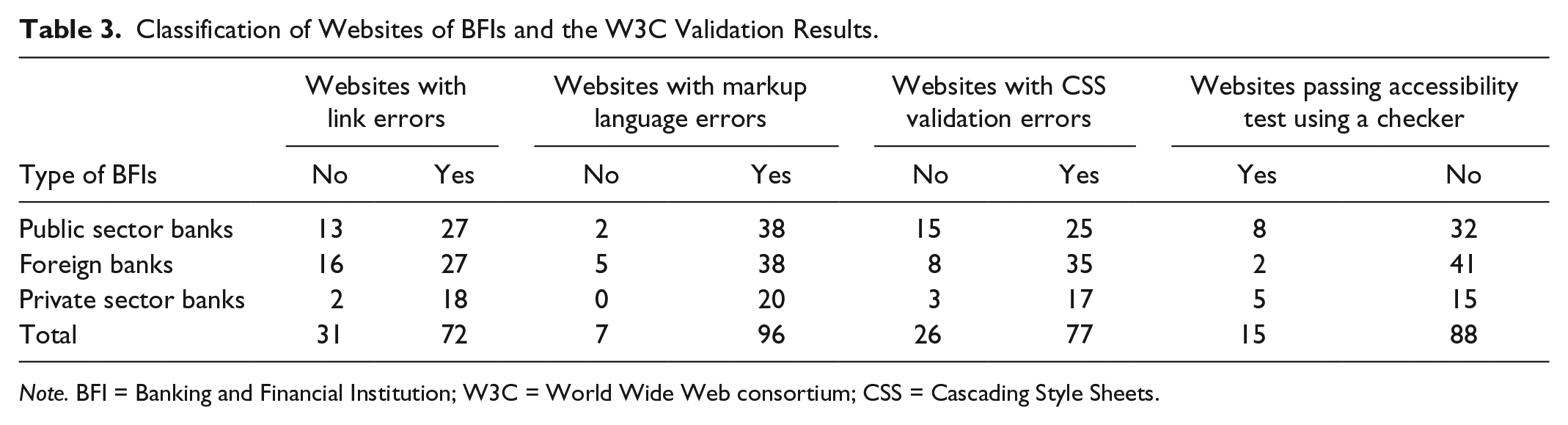
To test hypothesis and answer the research questions related to W3C guidelines followed by BFIs in India, the data gathered using the online research tools provided by W3C were analyzed using SPSS. During the study, analysis in terms of the link of the website design of the BFIs with other search engines and websites, markup language, Cascading Style Sheets (CSS) validation, and accessibility tests were done. The result of the same is depicted in Table 3.
Classification of Websites of BFIs and the W3C Validation Results.
Note. BFI = Banking and Financial Institution; W3C = World Wide Web consortium; CSS = Cascading Style Sheets.
Table 3 shows that majority of the websites (69.9%) of the BFIs in India had website link errors, thus causing problems in the links to search engines and other website links for the users. In fact, only a few (6.7%) of the BFIs in India had websites without markup errors, resulting in making the websites extremely difficult to maintain, apply style or layout, consistently across platforms.
The BFI websites were tested in terms of CSS. It was found that majority (74.75%) of the websites had errors making browsing of web pages through all the Internet and mobile phone platforms difficult to the customers, thus decreasing the use. The result of the professional website accessibility test using “A Checker” showed that only 14.5% of Indian BFIs websites passed the test, thus proving that most of the websites of BFIs are inaccessible to PWDs. However, eight BFIs belonging to public sector had passed the test ensuring the financial inclusion through their website.
Accessibility Features as Depicted in the Websites of BFIs in India
To test hypothesis and answer the research questions related to accessibility of the websites of BFIs in India, data collected using the online research tools provided were gathered and the same were analyzed using SPSS. During the study, as per the objective to demonstrate the design of the websites, an analysis in terms of the website design with “F” pattern, mobile phone compatibility, vernacular language choice, online savings bank account opening facility, mobile and the Internet banking facility, disability-specific graphics and alternative text for image, W3C compliance was done. The result of the same is depicted in Table 4.
Classification of Accessibility Features as Depicted in the Websites of BFIs in India.

Note. BFI = Banking and Financial Institution; SB = Savings Bank; W3C = World Wide Web consortium.
The researcher has concentrated on the “F”-shaped reading pattern while studying design (Nielsen, 2006). For this, the researcher has captured a screenshot of the home page of every website and overlaid “F” shape on top of it, just below the masthead of the website. However, the reading patterns of the PWDs are also being considered. Eye-tracking visualization shows that user of a website gaze at “F”-shaped pattern: two horizontal stripes followed by a vertical stripe, “F” for fast. That is how users read the website content. Their eyes move at amazing speeds in a few seconds across the website’s word, in a pattern that is very different from what one learned in school. However, website reading pattern of PWDs is a matter for research. This research study has not made an attempt in this direction. In Table 4, it may be observed that majority of the websites (66%) of the BFIs in India had “F” pattern, enabling easy reading for the users. However, only few (17%) of the BFIs in India had mobile phone compatibility, resulting in losing out a huge population unable to use the mobile phone in viewing the banking website and its facilities. Even though majority (60%) of the BFIs operating in India belonged to the public and private sector, vernacular language facility was offered by only 28% of the BFIs. Thus, losing out on rural banking customers, who might understand only the vernacular language. The disability-specific graphics or alternative text to images in the website was offered only by 9.7% of the BFIs in India, thus limiting the use of the website by visually challenged customers. Among the 103 websites of BFIs in India, only 11 website had full compliance as per the norms of W3C.
Interactive and Participative Features Depicted in the Website of BFIs in India
If website is the face of an organization in the new medium, its global reachability can be only assessed based on its accessibility. W3C compliance remains the qualification for any website that can be easily accessible by banking customers. During the research study, as per the objective, the researchers made exclusive study of the interactive and participative features of the websites of BFIs in India.
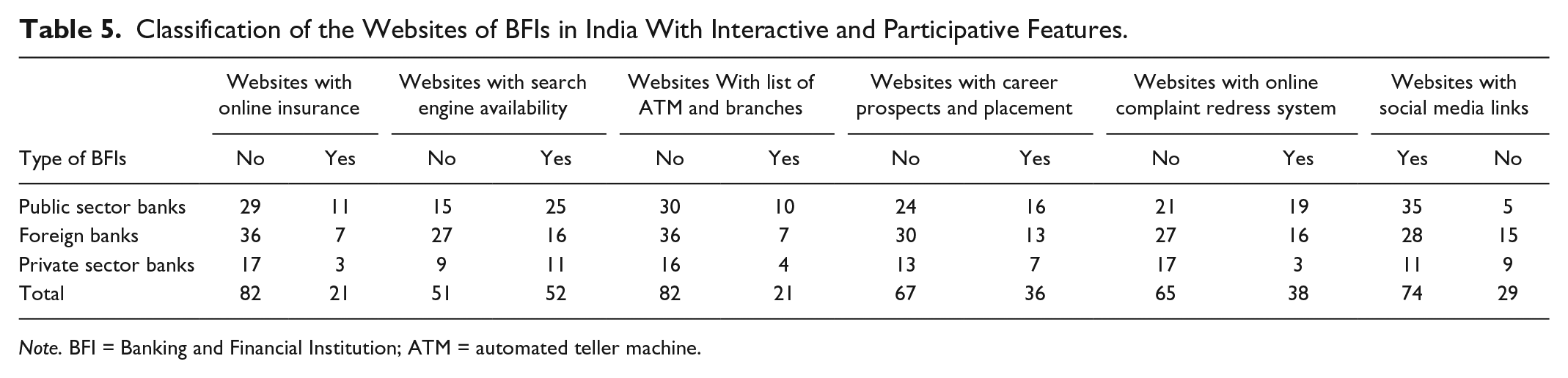
In Table 5, it is found that online insurance facility was provided only by few (20%) BFIs in India. This is another area for further research. Web accessibility for a BFI in India means those customers with disabilities can perceive, understand, navigate, and interact with the websites. Majority (71%) of the BFIs in India provided social media links to their websites increasing their reach and presence.
Classification of the Websites of BFIs in India With Interactive and Participative Features.
Note. BFI = Banking and Financial Institution; ATM = automated teller machine.
One of the good features of a website is to provide forms for visitors to contact, complaint, or to give feedback. Provision of list of ATMs (automated teller machines) and branches, online complaint redresses system, and search engine in the websites of BFIs makes it an interactive and participatory platform. This means PWDs could access the website and need not waste their time and energy travelling in search of the nearest BFIs for their financial needs solutions and transactions.
The website components have a relationship with the other. It may be at various points of usage or production. It begins at the developer level during production and then finally ends at the user level. During the process there are various components that take care of the continuous relationship between developers. It includes authoring tools, evaluation tools, content, browsers, media players, and assisting technologies.
This relationship can be explained through Figure 2 (Mathew Martin, 2009, p. 55).

Web content of BFIs of India.
Hence, it is imperative that each component is taken care to keep the relationship while designing the website. Developer should always keep in mind the end user of the website while designing the same. In the case of websites developed by BFIs in India, accessibility should be one of the main components which needs to be taken care to ensure financial inclusion for all. To enable accessibility, assistive technologies come to the rescue of the developer and the user of the website. In fact, according to Jane Seale (2010) digital inclusion is broadly understood as “a phenomenon whereby PWDs are able to access and meaningfully participate in the same financial, employment, social and citizenship activities as others.”
Conclusion
Even though there is a lot yet to be done by BFIs in India in increasing web accessibility, some laudable efforts have been made to use this new medium with global and local reach for financial inclusion. A good website of BFIs in India, to promote financial inclusion for PWDs, would include all possible features of accessibility, participation, information, and networking. These BFIs cannot afford to ignore the large population of the Internet users among PWDs. The website of Bank of India (BOI; http://www.bankofindia.co.in), one of largest public sector banks, ranks highest in terms of several accessible features available followed by the website of https://www.sc.com/.
The most surprising finding from the quantitative part of the study is that majority of the content in the website of these organizations was about information regarding the financial instruments aspects, instead of services for customers of BFIs. The front page of most of websites of BFIs in India is organizational centric. The most glaring aspect in this study is the lack of vernacular/local language version of the websites of BFIs in India. In this study, it is demonstrated that very few of the websites have the links to new interactive and social communication tools like social media links, guest books, and Really Simple Syndicate (RSS) feeds. Majority of them (63.1%) do not even have feedback or complaint form details (Table 5). Some websites of the BFIs in India are not convergent in nature. It needs mentioning that the BFIs should have a continuous interactive website with accessibility, participation, information, and networking instead of the more common “brochure” or information sites.
However, it is encouraging to note that on “World Disability Day,” that is, December 3, 2013, some of the websites of BFIs in India had accessible features. The details of the analysis and results are given in Annexure 1. The accessible features decreased the digital divide between the PWDs and the BFIs offering banking and financial services in India.
Footnotes
Declaration of Conflicting Interests
The author(s) declared no potential conflicts of interest with respect to the research, authorship, and/or publication of this article.
Funding
The author(s) received no financial support for the research, authorship, and/or publication of this article.