




Abstract
This descriptive survey study was designed to find out the utilization of e-counseling in career information dissemination among the undergraduates of the federal universities in South East Nigeria. Three research questions and three null hypotheses guided the study. The population of the study consisted of 36 guidance counselors and 64,997 undergraduates of the federal universities in South East Nigeria. The sample consisted of 1,036 participants. This is made up of all the 36 guidance counselors in the federal universities in South East Nigeria, and 1,000 undergraduates randomly selected from the various universities. In each university, 200 undergraduates made up of 100 males and 100 females were randomly selected using balloting by replacement. All the guidance counselors were used due to smallness in number. The instrument for data collection was the E-Counselling Career Information Dissemination Questionnaire (E-CCIDQ). The reliability of the instrument was established using Cronbach’s alpha statistical analysis, and reliability indices of .91, .85, and .84 were obtained for the three clusters. Data for the research questions were answered using percentage, mean, and standard deviation, while the null hypotheses were analyzed using t test statistics tested at the .05 level of significance. The research findings revealed that the universities in South East of Nigeria have e-counseling facilities and the students are very aware of e-counseling opportunities in the universities. Also, the counselors and undergraduates to a high extent utilize e-counseling in career information dissemination. Based on findings, discussions and some recommendations were made.
Introduction
One of the most dramatic advancements in this 21st century is the utilization of information, communication technology (ICT). This technology has offered opportunities in communication, among which is e-counseling, which enables counselors to provide supportive online counseling opportunities through a live webcam session, Internet chatting, messaging, Internet conferencing, emailing, and telephoning. Ani (2006) notes that the use of ICT has revolutionized access to information of the business world. In advanced nations such as the United States, the United Kingdom, and Japan, it has been experimentally found that the use of computer to complement the effort of human labor has brought about improved performance. In counseling, this shifted drastically from the conventional face-to-face counseling relationship approach to a more dynamic, flexible, and more convenient approach called e-counseling or online counseling (Ehrenfeld, 2006; Grohol, 2011; Kanini & Regehr, 2003).
E-counseling is one of the counseling opportunities introduced in the recent decades for delivering psychotherapeutic services. It is defined as therapeutic service delivered by a helping professional with electronic devices such as the Internet and audio media. It can exist in real life situations such as in the use of skype, phone conversation, chatting online, and e-messaging (Suler, 2000). Literature reveals the use of e-counseling in case studies and specific e-counseling program (Fink & Schoech, 2008).
Most communications through the Internet are in written form. Therefore, e-counseling, in which the mode of communication is often through writings via emails or a chat room, allows both the client and the therapist opportunity to pay close attention to their communication and reflect on their thoughts and feelings prior to their being expressed. This probably may be a particularly suitable way of communicating and expressing of oneself through words. Clients may also be able to communicate better in this environment as they are not affected by the therapist’s non-verbal cues (Haberstroth, Duffey, Evans, Gee, & Trepal, 2007).
Nigeria is fast growing into a computerized nation in recent years. This is seen in the rate at which students and counselors embark on utilization of e-counseling. This trend invariably makes Nigeria an Internet-oriented society, particularly in the federal universities in South East Nigeria. Although, the majority of students and counselors utilize face-to-face counseling, a good number of others utilize e-counseling. Those who utilize e-counseling sometimes tend more pressing problems, needs, and aspirations in their academic pursuits when compared with their counterparts who utilize face-to-face counseling (Kraus, Hen, Boniel-Nissim, & Shapira, 2008). However, insufficient availability of e-counseling facilities such as computer system, cellular phone, CD-ROM, Internet connection, web browser, flash drive, virus scanner, backup, scanner, Internet telephony, diskette, graphic editor, whiteboard, and Java might tend to hinder effective utilization of e-counseling in Nigerian universities just as it is with e-learning. This assertion would be determined in this study. Other hindering factors include irregular supply of electricity, inadequate procurement of ICT facilities, and poor maintenance of these facilities (Chiaha, Eze, & Ezeudu, 2013). No wonder Febbets (1999) remarked that Nigeria needed to up-grade its ICT facilities and terminals if she must compete effectively in this fast evolving ICT era.
Nevertheless, despite the limitations of these hindering factors, e-counseling utilization tends to become an important source of communication for therapy to a growing number of consumers among who are students in Nigerian universities. It offers mental health professional, which is another way of providing services to their clients (Cherry, 2014). One of the characteristics or good aspects of e-counseling is its convenience. Both the counselor and the client have the convenience of corresponding with each other at a range of variant times (Khasanshina, Wolf, Emerson, & Stachura, 2008), thus, taking away the hassle of scheduling and setting appointments, which characterize the conventional face-to-face counseling practice. In addition, e-counseling creates an opportunity for the therapists to extend their services to more clients, as appointments can be potentially scheduled over 24 hr and can reach a larger geographical region through synchronous and asynchronous e-counseling opportunities (Mallen & Vogel, 2005).
Furthermore, those individuals who are ambivalent about counseling or who may be uncomfortable with the traditional models of therapy tend to find e-counseling more convenient, comfortable, and suitable than the conventional face-to-face counseling communication. This is because of its unlimited access to information and perceived privacy for clients such as those suffering from social phobia, agora phobias, or anxiety disorders (Gedge, 2009; Gwinnell, 2003). It also ensures ethical and legal protection of the counselor and his client (Cherry, 2014, Mallen & Vogel, 2005). No wonder, Kraus et al. (2008) notes that the advantages of e-counseling is making it to be widely acceptable in the counseling field.
It is important to note that although e-counseling has been considered effective in counseling profession, it has also been criticized in terms of non-observation of verbal and non-verbal cues, from both counselor and client, difficulties in maintaining clients’ confidentiality, and security. Other criticisms include its overall effectiveness, technological difficulties, and its limits of being able to guarantee the counselor’s credibility (Elleven & Allen, 2004). Based on these, the researchers are concerned with determining the extent of utilization of e-counseling in career information dissemination among undergraduates of the federal universities in South East Nigeria.
Career information refers to any type of fact about jobs, business, occupation, profession, trade, or work obtained for use in career planning to earn a living. It is a valid and useful information given to an individual to enable him become purposeful and effective in his career-oriented profession (Omeje, 2010). Consequently, the aim of career information is to help individuals to understand themselves and the world of work better so as to function effectively in and outside it (Iwuama, 1999). In other words, it helps individuals imbibe to strategies for proper choice and management of careers so that they can have a very sound career development.
Although the imperatives of e-counseling calls for its utilization in dissemination of career information to undergraduates in the universities, the researchers are uncertain about the extent of its utilization in dissemination of career information among university undergraduates in South East Nigeria. Hence, the researchers are poised to ask the following: Do counselors utilize e-counseling in dissemination of career information to undergraduates in the universities? If they do, to what extent is this obtained? It is in view of these concerns that the study is being carried out.
Research Questions
In line with the above, these research questions were posed to guide the study.
Hypotheses
The following null hypotheses postulated were tested at the .05 level of significance.
Method
The study was carried in the federal universities in South East Nigeria. South East Nigeria has five states, namely, Enugu, Ebonyi, Imo, Abia, and Anambra states. The federal universities in South East Nigeria are University of Nigeria, Nsukka (UNN); Federal University of Science and Technology Owerri (FUTO), Michael Okpara Federal University of Agriculture Umudike, Nnamdi Azikiwe University Awka, and the Federal University Ndufu-Aike Ikwo.
The population of the study comprised all the 65,033 university guidance counselors and undergraduates in the five federal universities, South East of Nigeria. This is made up of 36 guidance counselors (12 males and 24 females) and 64,997 undergraduates (38,251 males and 26,746 females; source: academic planning unit of various federal universities in South East Nigeria for the 2013/2014 academic session). The sample of this study was 1,036 participants made up of all the 36 guidance counselors and 1,000 undergraduates selected randomly through balloting by replacement. In each of the federal university, 200 undergraduates made up of 100 males and 100 females were randomly selected from the final year students in the faculties of education, agriculture, and social sciences, while all the guidance counselors in the whole federal universities were used for the study due to the smallness of their number.
The instrument that was used for data collection was the E-Counselling Career Information Dissemination Questionnaire (E-CCIDQ) designed by the researchers. This instrument has two sections, A and B. Section A is designed to elicit bio-data information of the respondents while Section B contains 34 items put into three clusters. Cluster 1 elicits information on various e-counseling facilities available for dissemination of career information in universities. The items were placed on two-point rating scales of available (AV) and not available (NA), which were weighted 1 and 0. Cluster 2 focuses on students’ awareness level of e-counseling opportunities for career information dissemination, while Cluster 3 elicits information on extent of utilization of e-counseling in career information dissemination. The items in Clusters 2 and 3 were placed on a four-point rating scale of very aware (VA), moderately aware (MA), rarely aware (RA), and not aware (NA) for Cluster 2; and very high extent (VHE), high extent (HE), low extent (LE), very low extent (VLE) for Cluster 3. They have assigned weight of 4, 3, 2, and 1 points, respectively. Clusters 1, 2, and 3 were completed by the undergraduate students, while the guidance counselors completed only Clusters 1 and 3.
The reliability of the instrument was established using Cronbach’s alpha analysis to ascertain the internal consistency of the items and reliability. The analysis of data gave alpha coefficient values of .91, .85, and .84 for the three respective clusters.
The data collected from the study were analyzed using frequency, percentage, and mean to answer the research questions generated for the study. A criterion mean score of 2.50, which is the average of the weighted responses per item was used as decision rule for agreement or disagreement of an item. As the items of the questionnaire were positively framed, any score from 2.50 to 4.0 was an indication of agreement with the item of the questionnaire, while below 2.50 was an indication of disagreement.
Results
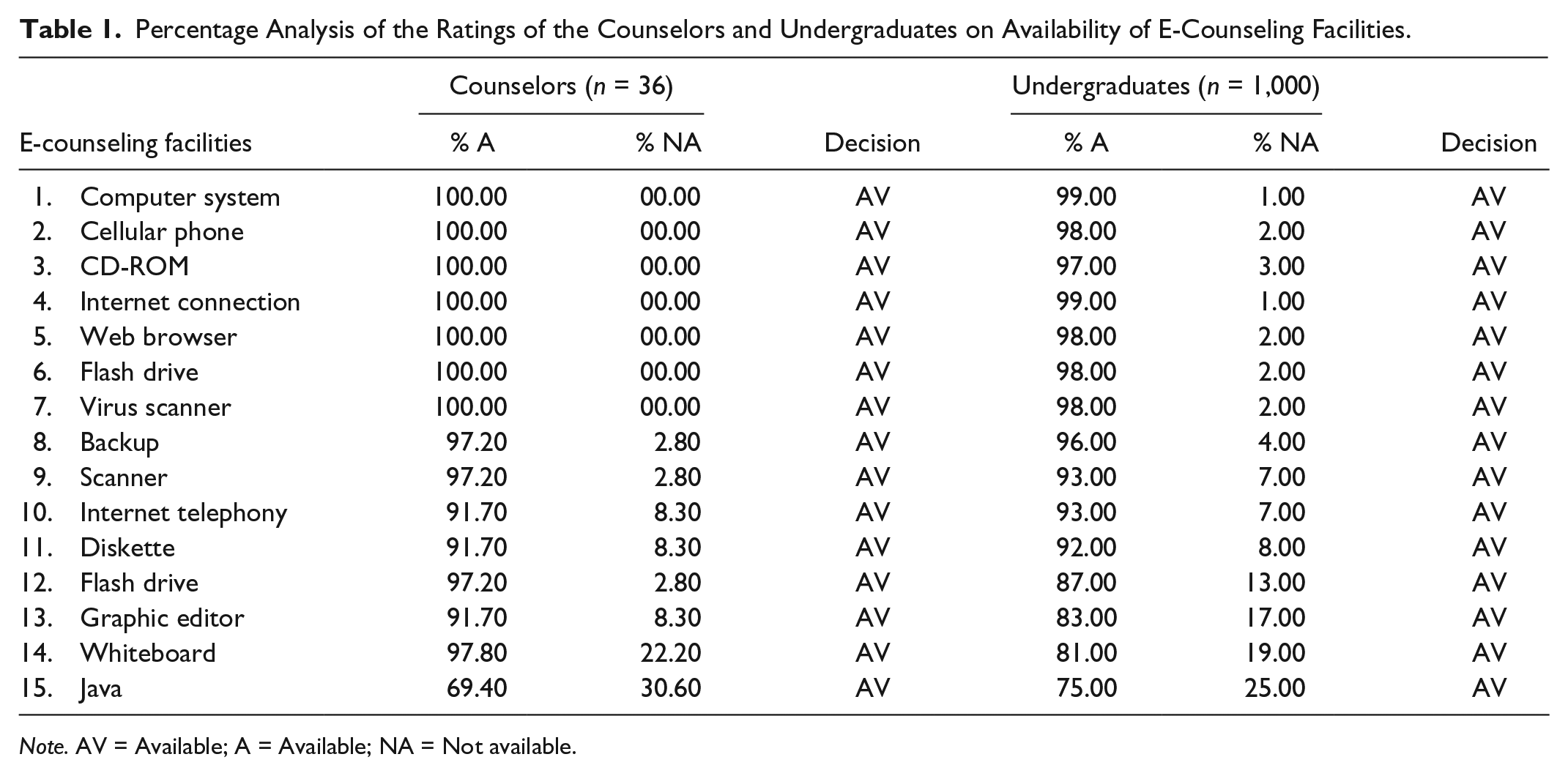
Table 1 shows the percentage ratings of counselors and undergraduates on the availability of e-counseling facilities for career information dissemination in the federal universities in South East Nigeria. The analysis reveals that the percentage ratings of both counselors and the undergraduates on the availability of Items 1 to 15 are more than 50 percentages. This, by implication, shows that all the 15 items are available e-counseling facilities for career information dissemination in the federal universities in South East Nigeria.
Percentage Analysis of the Ratings of the Counselors and Undergraduates on Availability of E-Counseling Facilities.
Note. AV = Available; A = Available; NA = Not available.
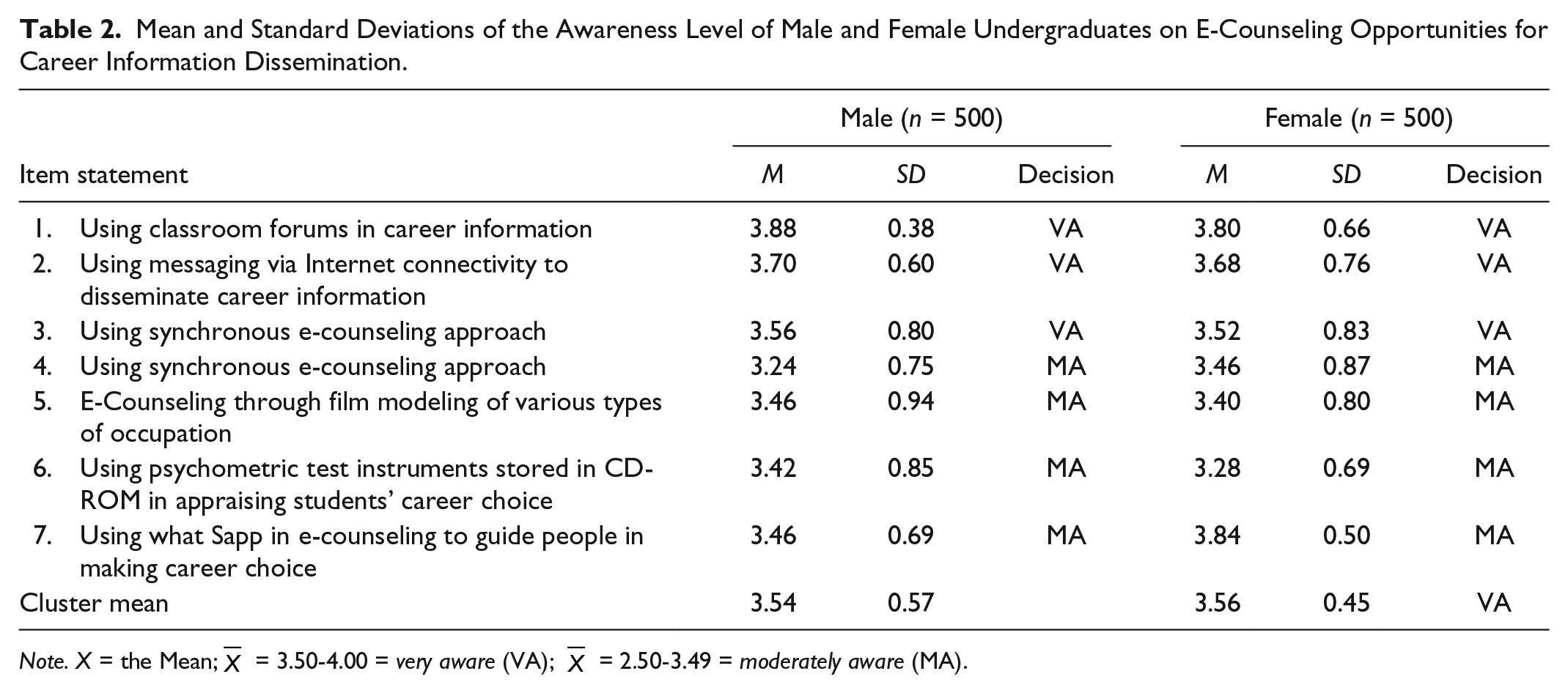
Data analysis in Table 2 shows the mean and standard deviations of the awareness level of male and female undergraduates on e-counseling opportunities for career information dissemination. The data analysis result shows that the mean ratings of both male and female undergraduates to Items 1, 2, and 3 are within the range of 3.50 to 4.00, indicating that undergraduates in the federal universities in South East Nigeria are very aware of those e-counseling opportunities. The mean ratings of both male and female undergraduates to Items 4, 5, and 7 are within the range of 2.50 to 3.49 indicating that undergraduates in the federal universities in South East Nigeria are moderately aware of those e-counseling opportunities. However, the overall mean score ratings of 3.54 and 3.56 for male and female undergraduates, respectively, imply that the students are very aware of the e-counseling opportunities. Besides, the overall standard deviations of 0.57 and 0.45 for the male and the female indicate that the ratings of the undergraduates did not vary much.
Mean and Standard Deviations of the Awareness Level of Male and Female Undergraduates on E-Counseling Opportunities for Career Information Dissemination.
Note. X = the Mean;
Table 3 shows the mean and standard deviation of the ratings of counselors and undergraduates on the extent of utilization of e-counseling in career information dissemination among the undergraduates. The analysis shows that the mean ratings of both counselors and undergraduates to Items 1, 2, 4, 5, 8, and 12 are within the range of 3.50 to 4.00, implying that both the counselors and the undergraduates to a very high extent utilize those e-counseling in career information dissemination. Also, the mean ratings of both the counselors and the undergraduates to Items 6, 7, 9, 10, and 11 are within the range of 2.50 to 3.49 implying that both counselors and undergraduates to a high extent utilize those e-counseling in career information dissemination. Similarly, the overall mean ratings of 3.31 and 3.49, for the counselors and the undergraduates, respectively, imply that both to a high extent utilize e-counseling in career information dissemination. The overall standard deviation scores (counselors = 0.28 and undergraduates = 0.52) indicate that the two categories of respondents vary much in their ratings of extent of utilization of e-counseling in career information dissemination.
Mean and Standard Deviations of Ratings of Counselors and Undergraduates on the Extent of Utilization of E-Counseling in Career Information Dissemination.

Note. X = the Mean;
Table 4 shows that the calculated chi-square value of 1.72 has a probability value of .63. Because the probability value of .63 is greater than the .05 level of significance, the null hypothesis is accepted. Thus, there is no significant difference between the ratings of undergraduates and counselors on the availability of e-counseling facilities for dissemination of career information.
Chi-Square Analysis of the Ratings of Undergraduate and Counselors on the Availability of E-Counseling Facilities for Dissemination of Career Information.

Two cells (25.0%) have expected count less than 5. The minimum expected count is .35.
Table 5 shows that the probability associated with the calculated value of t(–.338) is .74. Because the probability value of .74 is greater than .05 level of significance, the null hypothesis is accepted meaning that there is no significant difference between mean ratings of male and female undergraduates on awareness level of e-counseling opportunities for career information dissemination.
t-Test Analysis of Ratings of Male and Female Undergraduates on Their Awareness Level of E-Counseling Opportunities.

Table 6 shows that the calculated value of t(–2.040) has an associated probability value of .04. Because the probability value of .04 is less than .05 level of significance, the null hypothesis is rejected. Thus, there is a significant difference between the mean ratings of the undergraduates and the counselors on the extent of utilization of e-counseling in dissemination of career information with the mean ratings of the undergraduates being higher than that of the counselors. This implies that the undergraduates utilize e-counseling in disseminating of career information more than the counselors.
t-Test Analysis of Ratings of Undergraduates and Counselors on the Extent Utilization of E-Counseling in Dissemination of Career Information.

Discussion
The e-counseling facilities are available for career information dissemination in the federal universities in South East Nigeria.
The results displayed in Table 1 reveal the percentage of the ratings of the counselors and the undergraduates on the availability of e-counseling facilities for career information dissemination in the federal universities in South East Nigeria. The analysis reveals that the percentage ratings of both the counselors and the undergraduates on the availability of Items 1 to 15, which are computer, cellular phone, CD-ROM, Internet connection, web browser, flash drive, virus scanner, backup devices Internet telephony, diskette, graphic editor, whiteboard, and Java are more than 50%. This, by implication shows that all the items are the available e-counseling facilities for career information dissemination in the federal universities in South East Nigeria and that these e-counseling facilities are familiar to the counselors and the undergraduates. This finding is in agreement with the early study of Febbets (1999), which notes that we live in a fast-changing world, and if Nigerians must not be left behind, there is need to up-grade terminals to microcomputer, maintain them to keep pace with the technological development, which not only has significant impact on the information industry but also is an important factor in information planning.
Indeed, the result of Null Hypothesis 1 shows that there is no significant difference between the mean ratings of the undergraduates and the counselors on the availability of e-counseling facilities for dissemination of career information. It further affirms the Research Question 1 analyses on the availability of e-counseling facilities among the undergraduates in the universities. This finding is interesting as it tends to show that both the counselors and the undergraduates can identify ICT facilities and their uses. Implicitly, with the availabilities of the ICT facilities, e-counseling would be functional in the universities South East of Nigeria. Consequently, in line with Ani (2006), the availabilities of these facilities would enhance dissemination of career information through e-counseling.
Students’ Awareness Level of E-Counseling Opportunities for Career Information Dissemination
The result of data analysis with respect to the undergraduates awareness level of e-counseling opportunities for career information dissemination presented in Table 2 indicates that the male and the female students are very aware of e-cousnelling opportunities for dissemination of career information (male overall
The data analysis result in Table 5 reveals that there is no significant difference between the male and the female students’ awareness level of e-counseling opportunities for career information dissemination (t cal = 0.33, sig [2-tailed] = .74 df = 998, p = .05). This finding is interesting. That the male and the female undergraduates did not differ in their awareness level of the e-counseling opportunities for dissemination of career information indicates that they are ICT compliant gender. This finding corroborates with Khasanshina et al. (2008) that most students limited by the conventional face-to-face counseling resort now to e-counseling, which is a more convenient and faster means of communicating with a counselor.
The Extent of Utilization of E-Counseling in Career Information Dissemination Among the Undergraduates
Result of data analysis on the extent of utilization of e-counseling in dissemination of career information by counselors and undergraduate students presented in Table 3 shows that both groups of respondents utilize e-counseling in dissemination of career information to a high extent (counselors: overall
This study, in addition, reveals through the hypothesis testing result in Table 6, that a significant difference exists between the extent of utilization of e-counseling in career information dissemination by the counselors and the undergraduate respondents, with the undergraduates being higher in the utilization than the counselors (counselors:
Conclusion and Recommendations
The guidance counselors and the undergraduate students’ respondents have identified 15 e-counseling facilities such as computer system, cellular phone, CD-ROM Internet connection, web browser, flash drive, virus scanner, backup, scanner, Internet telephony, diskette, flash drive, graphic editor, whiteboard, and Java as available for career information dissemination in the universities in South East of Nigeria. Equally, the study revealed also that the undergraduate students are very aware of e-counseling opportunities for dissemination of career information. However, although both respondents are to a high extent using the identified e-counseling facilities in career information dissemination, it is also evident that females use these facilities more than males. Based on these findings, the following recommendations are made:
More e-counseling facilities should be made available in the various federal universities in South East of Nigeria for more improvement in dissemination of career information among undergraduates.
That the undergraduates utilize e-counseling in disseminating of career information more than the counselors tends to suggest that e-counseling facilities are inadequate for use by the students and the counselors. Consequently, counselors should be provided with more and stable facilities to enhance more opportunities for e-counseling with the undergraduates.
Counselors should be provided with opportunities to attend workshops and conferences where they will be exposed to more novel opportunities available in e-counseling utilization. With such exposure, they would be more knowledgeable and skilled in their usage in e-counseling opportunities.
Footnotes
Declaration of Conflicting Interests
The author(s) declared no potential conflicts of interest with respect to the research, authorship, and/or publication of this article.
Funding
The author(s) received no financial support for the research and/or authorship of this article.