




Abstract
The ethnic factor or ethnicity is noted to play a key role in protracted conflicts, which affect the social and political landscapes of modern Africa. We, therefore, examined the political behaviors in the Asuogyaman District in Ghana to unravel the complexities of cycles of conflict and resulting peace-building strategies. We collected data from 11 purposively sampled key informants and 220 randomly selected respondents using an interview guide and interview schedule, respectively. In sum, the ethnic factor has an indirect effect on political variables in the Asuogyaman District. For instance, the ethnic factor did not openly influence the choice of political party but rather, policy direction did. One major recommendation is that the government and the Asuogyaman District Assembly should put measures in place to ensure that all the ethnic groups are consulted and fairly treated as equal partners in developmental activities. This will result in peaceful coexistence and development.
Introduction
Despite the swell of independent states in the 1960s and the end of the Cold War in 1989, violent conflicts continue to increase, with some becoming protracted. Prominent among the myriad reasons given for these protracted conflicts is the ethnic factor or ethnicity (Agyeman, 2005; Nnoli, 1998), because most modern nations are multiethnic. The concept of ethnicity has become nebulous not only because it lacks a comprehensive definition but also because it is socially constructed. This article adopts Bates’ (1980), definition that “ethnic groups are, in short, a form of minimum winning coalition, large enough to secure benefits in the competition for spoils but also small enough to maximize the per capita value of these benefits” (p. 163). For this prime reason, ethnicity, like politics, is highly conflictual but socially desirable for survival. Ethnic plural societies (Furnivall, 1948, as cited in Giddens, 1989) or demotic nations (E. K. Francis, 1976) are composed of several large ethnic groupings, which while distinct from one another engage and compete in the same political and economic order (Giddens, 1989, 2009).
Consistent with the frustration-aggression theory (F-AT), where a particular group feels their attempts at satisfying their needs or achieving their goal is being frustrated by another group, violent conflicts emerge, as reiterated by Burton (1991) and D. J. Francis (2006). When the distinction between “us” and “them” becomes pronounced as stipulated by the enemy system theory (EST), conflicts tend to become protracted and ethnocentrism and negative identity proffered by the theory become evident. Moreover, the competition for access and control over resources is also underpinned by the political arena (Osaghae, 1996; Richardson & Sen, 1996). This does not augur well for peace (Osaghae, 1996), because when ethnicity is politicized, it becomes negative and leads to instability and conflicts. As groups try to advance the cause of their members, group members lend their support to political groups or are mobilized by the latter that assure them of better conditions when they assume power. This is because after elections, victorious political elites wield legitimate power to control and distribute resources. Such politicization of ethnicity has resulted in conflicts in countries such as Northern Ireland, Rwanda, Liberia, and Nigeria. Though the ethnic factor has had some positive outcomes as intimated by Busia (1968), such as the formation of ethnic associations in diasporan cities, which have subsequently advanced developmental paths in their home countries, it has been a bane more than a blessing. Agyeman (2005) cautioned that the ethnic factor will be effective and produce the right outcome “if and only if, the various ethnic groups are treated as equal partners in the nation-state” (p. 14). Consequently, for peace to prevail, there is the need to meet the needs and concerns of all ethnic groups.
Peace is an industry as intimated by Daley (2007), and therefore it is imperative that no variable is allowed to discourage both negative peace—absence of war, and positive peace—the whole strategy of peace-building, especially for countries that experience cycles of violent conflicts. The relationship between peace-building and development has been well established. Over the years, there has been a shift from the exclusivist view where peace-building is seen as “a political endeavour entered into in response to security problems for a limited time, whereas development is a long-term strategy carried out under generally peaceful conditions” (Kuhne, 1996 as cited in Smoljan, 2010, p. 234) to an inclusivist framework. The United Nations (UN) under Boutros-Ghali championed the inclusivist approach, which now considers peace-building and development to be mutually supporting procedures that are working toward a common goal (David, 1999 as cited in Smoljan, 2010, p. 235). Peace-building results in restorative justice, economic reconstruction, good governance, community development, and democracy, among others. These outcomes can be achieved through three approaches: liberal, indigenous, or a hybrid of the two.
Ghana has experienced politicized ethnically related violent conflicts, which have left some deleterious effects on the affected areas, for example, between the Dagbon Abudu and Andani gate conflicts, and the Mamprusi and Kusasi ethnic groups. In the Dagbon conflict for instance, the Abudus are known to be supported by the biggest opposition party, New Patriotic Party (NPP), while the ruling National Democratic Congress (NDC) favors the Andanis. The conflict in Asuogyaman District in 1989 between the Akwamu (an Akan ethnic group) on one hand and the Dorfor and Volo (both Ewe ethnic groups) on the other also resulted in several human casualties and destruction of properties. At that time, the Dorfor ethnic group was part of the Asuogyaman District until they were recently added to the South Tongu District.
Politics in the Asuogyaman District tends to influence the ethnic groups into adopting violent behaviors, especially before, during, and after national general elections in the district. Clashes occurred in 2000, 2004, 2008, and 2012. This politicization of ethnicity has come about from a perception that the ethnic groups are supporters or sympathizers of the two major political parties in Ghana, the NDC, and the NPP. The Ewe and the Krobo are deemed to be pro NDC while the Akan and the Guan tend to sympathize with the NPP. Therefore, the mere fact that one hails from a particular group leads to one being tagged as belonging to one political party or the other. Again, election of a Member of Parliament (MP) often degenerates into open confrontations between the groups in the district. The ethnic background of the contestants appears to be a strong deciding factor for the candidate who would be selected. The issue of legitimacy concerning who hails or does not from the district assumes centre stage because it has implications for who benefits more from the distribution of resources. Even the appointment of a District Chief Executive (DCE) frequently sparks trouble. For instance, after the 2000 general elections, a stalemate resulted between the two indigenous groups, the Akwamu and the Guan on the appointment of a DCE. A seeming calm was restored after the disputed DCE was replaced. In 2008, the indigenous groups rejected another DCE, who was from the subordinate Ewe group.
It is noteworthy that Akosombo, the hub of power generation in Ghana is located in the Asuogyaman District. Also located in the district is the Akosombo Textiles Factory, Adomi Bridge, which connects the Volta Region to Eastern and Greater Accra Regions of Ghana, and the trans-African highway. If the district is made unsafe due to conflicts, companies and households will be left in darkness and production will also be cut short as there will not be enough electricity to power the industries and supply same to Togo and Benin. Movement of people and goods through Togo and beyond could be gravely hampered if the Adomi Bridge is also deemed unsafe to use by these conflicts (Asuogyaman District Assembly [ADA], 2010).
The study, therefore, aimed to examine effects of ethnicity on the political behaviors of the people in the Asuogyaman District to unravel the complexities of cycles of conflict and resulting peace-building strategies, as they appear to be deepening the divisions that existed between the groups, and adversely affecting their lives. As intimated by Kuper (1977, p. 351), “the increasing number of general books on . . . ethnic relations reflects the continued salience of the problems generated by . . . ethnic division in contemporary societies. It reflects also the point where a comprehensive synthesis seems feasible.” We also want to ascertain the veracity of assertions made by earlier writers such as Horowitz (1985), Connor (1994), Osaghae (1996), Adjei (1998), Nnoli (1998), W. B. J. Cunningham (2001; W. G. Cunningham, 1998), and Giddens (1989, 2009), that when ethnicity is politicized, it becomes unhealthy and affects almost all aspects of life of people.
The next session deals with the theoretical and conceptual issues regarding the ethnic card in demotic nations. After the theoretical and conceptual concerns were addressed, the descriptive design was used to collect and analyze the data in “Method” section, followed by discussion of the empirical evidence in “Results and Discussion” section. The article ends with conclusions and discussions of the policy implications for government, stakeholders, and the leadership of the district.
Theoretical and Conceptual Discussions on the Ethnic Factor and Politics
Our conceptual definition expands on Bates’s (1980) definition of an ethnic group as a group of people with a common ancestry and adherence to a set of beliefs, entirely distinct from similar groups within a nation-state competing for Pareto optimality of available resources for their survival. Literature suggests that colonialism, migration, and wars of conquest were the three factors that led to most modern states becoming ethnically heterogeneous (e.g., Agyeman, 2005; Giddens, 2009). These factors compelled indigene-settler relationships between ethnic groups and have resulted by and large in deep-seated competition between the groups over limited resources (Giddens, 1989).
In the late 1980s, the United States Foreign Service came up with the EST to help explain the intricacies involved in human relationships, especially those with antagonisms attached to them. Connor (1994) adopted this theory and gave it a face-lift and international acceptance in 1994. The theory postulates that humans have a deep rooted psychological need for the establishment of allies and foes. Connor (1994) argued that this need helps humans to form groups on the basis of those that have similar looks and goals, that is, “in-group” as against the “out-group” who are considered enemies and a threat. This is not done only at group levels but also at individual levels. The ultimate determination of ethnic, national, and other group formations has its basis in this distinction between the in-group and the out-group (Ametewee, 2007).
According to W. B. J. Cunningham (2001), the EST best explains sectarian conflicts and violent clashes among and between groups throughout history. The theory presents a complexity of concepts that help to explain the phenomenon of sectarian conflicts especially ethnic conflict, among which are ethno-nationalism, negative identity and the inability to mourn (Connor, 1994). The disposition of the theory to better explain sectarian conflicts by using ethno-national or regional groups as its unit of analysis puts the theory in a better position to discuss aspects of the current study.
Ethno-nationalism is the loyalty that individuals give to both the nation and the ethnic group to which they belong within the nation (Conversi, 1993). As W. G. Cunningham (1998) pointed out and corroborated by Ametewee (2007), usually very strong and powerful emotions are associated with ethnic or national identities and the support given to them. This concept gives a wider sense of family to group members, as group members are considered as extended family members by the group member. The organization of people into such groups gives reason for competition among the groups. The competition can either be adaptive or positive, like the support for a soccer team or maladaptive or negative like the support expressed for an ethnic group or a political party. In the adaptive support, there is less or no animosity as contestations are based on capabilities, whereas in the maladaptive support, there is often animosity between the groups as they will do anything to see that the group survives (Ishaq, 2010), especially when groups come under stress politically, economically, ecologically, or militarily (W. G. Cunningham, 1998).
Horowitz (1985) stated that “in divided societies, ethnic affiliations are powerful, permeative, passionate and pervasive” (p. 5). Therefore, when a group feels that its existence is threatened, there is the tendency for the group to strike at out-groups. W. G. Cunningham (1998) asserts that the tensions take root from a history of animosity, similar to Richardson and Sen’s (1996) point that historical legacies of mistrust is at the root of the animosity and conflicts between groups. Richardson and Sen made this observation from a study conducted in Sri Lanka on the causes of the age-old conflict between the Tamil and the Sinhala ethnic groups. They realized that either group at a point in time used their control of power to maltreat and neglect the other group’s needs while they improved the condition of their own group, a Pareto optimal behavior.
The second concept, negative identity, is where the individual or group harbors resentment for the other individual or out-group due to the humiliation that they suffered from attacks on them by the out-group or individual (Connor, 1994). As a result of this, they suffer from low self-esteem and brood over the embarrassing event. They, therefore, lie in wait for an opportunity to strike at their attackers at the least provocation, to pay their attackers or enemies back for the defeat and humiliation suffered from them (W. G. Cunningham, 1998). Individuals or groups who suffer a discontinuation in their economic activities or sources of livelihood are those likely to engage in this sort of activity to restore their lost self-esteem (Ishaq, 2010). Examples include the decades-long Protestant and Catholic Northern Irish conflict (W. B. J. Cunningham, 2001) and the Mamprusi and the Kusasi conflict in Northern Ghana since 1923 (Ishaq, 2010).
According to Volkan (1984), the last concept, which is the inability to mourn, is the reaction to real or threatened loss or change. Either individuals accept the loss and move on, which he called “uncomplicated mourning” or they deny the loss and hold on to it in bitterness, which he referred to as “complicated mourning.” How to regain their loss becomes their major priority as this will aid them to restore and boost their lost self-worth. These concepts feed into the F-AT.
The F-AT of conflict was postulated by Dollard, Doob, Miller, Mowrer, and Sears (1939) and was modified and improved by Berkowitz (1962) and Yates (1962). This theory posits that individuals or groups tend to be aggressive and exhibit aggressive behavior when they feel that another person or group is frustrating their attempts at achieving their goals (Faleti, 2006). This is especially the case when the goals have to do with their needs which form the basis of the survival of the group or the individual and have to be met, as the failure to do so can result in chaos (Burton, 1991). Burton went on further to make it clear that until identity issues are resolved and people’s needs are met, instability and conflicts cannot be done away with, especially in multiethnic societies.
The perceived difference between “value expectations” and “value capabilities” creates the opportunity for anger and violence to occur (Gurr, 1970)—the whole basis of the relative deprivation theory. The needs of all groups must be met halfway so as to promote peace rather than neglecting sectors of the society, which leads to a Pareto improvement. A win-win situation, which guarantees that all groups come out with some benefit from the conflict situation, should be the target and not a zero-sum scenario. Faleti (2006) points to the fact that when important needs of the individual or group are not sufficiently met, economic and political problems will continue to grow, especially, when these groups continue to compete for their needs, including political power and other forms of control. However, the F-AT has been critiqued that aggression can be learnt through the process of socialization and that humans are not by nature aggressive (Faleti, 2006). Faleti went to add that, if an individual is socialized in a violent environment, the tendency for the person to be aggressive is high.
The idea of politicians mobilizing supporters by exploiting ethnic and cultural divisions is also not a new phenomenon (e.g., Horowitz, 1985). Competition for control over scarce resources and support of the people appears to be the ruler by which the game of politics is played in developing countries. Both the ruling government and the opposition pitch tent against each other in a bid to capture power (see Chabal & Daloz, 1999; Ekeh, 1975; Jackson & Rosberg, 1982; Lindberg, 2003; van de Walle, 2003; Wantchekon, 2003; Young & Turner, 1985). In turn, “voters seek access to state resources by allocating their electoral support to members of their own ethnic groups, who they assume will be more likely than non co-ethnics to redistribute those resources to them” (Posner, 2007, p. 1305). Similar sentiments have been expressed by Barkan (1979), Kanyinga (1994), and Posner (2005).
Ethnicity has been noted to be a pivotal element in the social and political landscapes of modern Africa (Roberts, 1999). Ethnicity comes to the fore when it is politicized, because the resulting conflicts spillover into national politics to affect the delivery of goods and services (Aikins, 2012). Political party support mobilization is one tactic to build the necessary coalitions around ethnic identities (W. G. Cunningham, 1998; Osaghae, 1996; Richardson & Sen, 1996). According to Adjei (1998), ethnicity affected voting trends in Ghana during the 1996 general elections. Citing the works of Boahen (1989) and Asamoa (1990), Agyeman (2005) proved that various governments in Ghana made political appointments based on ethnic group support, a similar happening in Malaysia and Sri Lanka (Richardson & Sen, 1996) and Zimbabwe since independence where the Mugabe administration has always appointed members of the Shona ethnic group into positions (Sithole, 1998).
Peaceful coexistence between ethnic groups requires that there are channels for ventilating frustrations and redressing complaints. This is where an inclusivist peace-building that synthesizes peace-building and development becomes supreme. The inclusivist approach to peace-building has theoretical foundations in theories of economic causes of civil war (Smoljan, 2010). However, as Smoljan notes, it is Gurr’s (1970) relative deprivation theory that highlights the perceived economic, political, and social inequalities between ethnically divided societies, which invoke the theories of the enemy system and frustration aggression. Peace-building strategies, be they liberal or indigenous or a hybrid, are pertinent to ensure a sustainable peace in multiethnic societies.
Method
The Asuogyaman District is located in south-eastern Ghana with coordinates of latitude 6° 34°N and 6° 10°N and longitude 0° 1°W and 0° 14°E. Asuogyaman in Akan means “River Bank State” because of the many towns in the district such as Akosombo, Atimpoku, and Senchi are located along the banks of the Volta Lake (ADA, 2010).
We used the descriptive design comprising quantitative and qualitative methods of data collection. Our target population focused on persons 18 years and above as the minimum voting age in Ghana is 18 years which constituted about 44,568 (55.9%) of the total district population of 81,531 (ADA, 2010). Even though Krejcie and Morgan’s (1970) sample determination table stipulated a sample size of 381 (from a population of 44,568), we selected 231 respondents based on Bamberger’s (2002) assertion that a sample size for a study does not matter much when the emphasis is on the quality of information desired. Sarantakos (2005) has also intimated that the homogeneity of a sample offers more representation than the size. Purposive sampling was used to select 11 key informants to be interviewed comprising five chiefs, the DCE and five assembly persons. The chiefs of Agyena, Anum, Apeguso, Boso, and Tortibo represented the ethnic groupings. Simple random sampling was used to select 220 respondents. This was done on a proportional basis with 32.4% coming from the Akwamu (71), 26.3% as Ewes (58), and 25.6% as Guans (56). The rest were the Krobo (12.2%, 27) and Others (3.5%, 8). They were selected using the sex composition of the district, where 47.9% of the population were male and 52.1% female ADA, 2010).
We used an interview schedule for the respondents and an interview guide for the key informants. The themes catered for the various ways the politics in the district affected the ethnic factor. While the chiefs were interviewed in their respective palaces, the Assembly persons and the other respondents were interviewed in their homes variously at Atimpoku (district capital), Dzakiti, Agyena, Apeguso, Anum, Boso, Tortibo, and Pupuni. Issues covered included the basis for choice of a political party, factors informing the political party to vote for, the basis for political appointments in the district, ethnic group clashes due to political differences, and perceptions of ethnic groups stifling each other’s activities.
The data were collected over a 1-month period. Before the fieldwork, we conducted a 1-day training at Akosombo for four research assistants who were proficient in the Ewe, Guan, Krobo, and Akan local languages of the potential respondents. We demonstrated the procedures and roles they were supposed to play on the field, which included the art of questioning, the use of a daily journal, and when to tape-record the responses after ethical issues such as anonymity, privacy, and confidentiality had been cleared with the respondents. Their services were used throughout the entire study to help with the administration and interpretation of the interview schedules. We did content and face validity checks of the instruments with two research fellows at the University of Cape Coast before doing the training. While interviews lasted between 35 and 45 min, the questionnaire administration spanned an average of 40 min. We tape-recorded interviews and also took notes during the interviews to assist in the analysis. Limitations in the study included delays in completing some of the interview schedules and the unavailability of some respondents due to the farming season and the onset of the rains.
Statistical tools such as frequencies, figures, tables, and cross-tabulations were used to present the quantitative data while narratives were used to present the qualitative data. Narratives go “beyond headlines to capture the nuance of complex situations and expose the realities of . . . violence, thus providing an understanding of conflict and an avenue to its transformation” (Noma, 2007, pp. 8-9). It is pertinent to note that all the quotes from the key informants were reported verbatim in the analysis.
Results and Discussion
Six main issues were explored with regard to how the ethnic factor affects the political life of the people in the Asuogyaman District. These were political party affiliation, voting behavior, appointments, political clashes in the district, frustration and aggression, and finally discrimination in the distribution of development projects.
Party Affiliation
Table 1 presents the responses on the political party affiliation of the ethnic groups.
Ethnicity and Political Party Affiliation in Asuogyaman District.

Source. Fieldwork, 2011.
Majority (69%) out of the 220 respondents across both the indigenes and nonindigenes admitted to belonging to a political party. This finding may suggest high political activity awareness, as more than half of them (52.6%) attributed their affiliation to ideology and policy direction. Our next finding also appears to support the popular claim that ethnicity is the main reason for choosing a political party in ethnically divided societies such as in Sri Lanka (Richardson & Sen, 1996) as shown in Table 2.
Ethnicity and Political Party Choice in Asuogyaman District.

Source. Field data (2011).
Note. NDC = National Democratic Congress; NPP = New Patriotic Party; CPP = Convention People’s Party; PNC = People’s National Convention.
Majority of the Ewes support the NDC, while almost half of the Akwamus (45.1%) are pro NPP, but not as much as the Guans (37.5%). It is not very clear the party the Krobos support from our data. We obtained a Pearson chi-square of 60.58, which is highly significant (p = .000, df = 16) and with a large effect size (Cramer’s V = .262) to suggest that ethnicity may be driving the choice of political parties in the Asuogyaman District.
These observations suggest that we should not preclude ethnicity when discussing political party affiliation in Ghana, because the issue of ethnicity is itself sensitive to discuss and this could have influenced the responses of no party affiliation as some respondents were unwilling to be tagged as members of a particular political party. It is known that ethnicity, in some cases, has led to violence rather than understanding (Agyeman, 2005). Others would also prefer to conceal these identities and not to discuss them, if need be, leading some (25.0%) of those who belonged to political parties ascribing personal reasons for affiliating with a political party. This finding is contrary to popular belief of ethnic support for parties (Adjei, 1998). The difference might be due to two reasons. Either the respondents failed to give the real reasons choosing a political party as indicated or the reasons for political party affiliation in multiethnic societies have been misconstrued.
Voting Behavior
We examined the actual voting behavior of the people of Asuogyaman to ascertain the claim that when ethnicity is introduced into politics, supporters vote along ethnic lines (Adjei, 1998; Richardson & Sen, 1996). The preceding results, however, would suggest that ethnicity may not affect voting behavior. Indeed, only 7% of 200 respondents who actually voted during the 2008 general elections attributed their voting behavior to ethnicity as shown in Table 3.
Voting Behavior and Ethnicity in the Asuogyaman District.

Source. Field data (2011).
Seventy percent voted because of either policy direction (63.2%) or party affiliation (36.8%). These observed percentages generally held true across both the indigenous (Akwamu and Guan) and subordinate (Ewe) ethnic groups. The perception of ethnic voting does not forcefully come out in Asuogyaman as it is made to seem by others such as Adjei (1998) and Richardson and Sen (1996) in Prestea and Sri Lanka, respectively, but that rather, voting behavior in Asuogyaman correlated more with party policy direction.
We further explored party affiliation (represented by the political party of the respondents) and voting behavior as shown in Table 4.
Party Affiliation and Voting Behavior in Asuogyaman District.

Source. Field data (2011).
Note. NDC = National Democratic Congress; NPP = New Patriotic Party; CPP = Convention People’s Party; PNC = People’s National Convention.
It turned out that voting along ethnic lines is not very apparent, except for about a third of PNC supporters. At least a third of party affiliates voted either on party affiliation or policy direction A Pearson chi-square of 24.75, though substantively smaller than the previous association in Table 2, was also significant (p = .016, df = 12) and with a large effect size (Cramer’s V = .203). This shows that when other issues driving voter behavior come into play, ethnicity tends to have a lesser influence.
Our findings on voting behavior challenged the assertion that election results in the Asuogyaman District have followed trends that suggest massive support from the ethnic groups which the contestants of these parties hail (Electoral Commission of Ghana, 2009), especially in the 2008 elections. The electoral results of the 1996, 2000, 2004, and 2008 presidential and parliamentary elections show that the Ewe and Krobo voted massively for the NDC because they identified with the NDC, while the Akan and a large chunk of the Guans similarly voted for the NPP because of their preference for that party (much in line with Table 2).
Although policy direction seemed to matter more to the respondents in the Asuogyaman District regarding the selection of candidates to vote for, key informants presented a contrary view. They contended that party affiliation mattered more, since the then MP, an Akwamu, won because he stood on the ticket of the NDC. This is what one key informant said:
The elections are political party affiliation and performance based and so if you do not perform, we drop you and go for another person within the party, who can perform. It is not done on ethnic basis. (June 18, 2011)
The key point is that the loser could not use the ethnic card as indicated by another key informant:
The current MP is purely an Akwamu. I can say almost 100 percent an Akwamu and then his opponent for the race, is also partly Akwamu and partly Ewe but more of an Akwamu. But because of the party on which ticket the MP stood, he happened to get the nod. Particularly, this area is full of the Akwamu and the indigenous people do not stay around. We have a mixture of different tribes most of which are the Ewe and the Krobos and truthfully, we all have the perception that the NDC is for a particular group of people and since they stay around more the NDC and the MP secured more votes from these affiliate ethnic groups to win the election and this is true as we have all seen from the results nationwide. The opponent lost though he is Ewe and Akwamu and these two groups could have made him win since they are in the majority. But the Ewe failed to vote for him because he contested the election on the ticket of the NPP. Due to this, it was only the Akan who voted for him. (July 13, 2011)
Political Appointments
Regarding political appointments, again ethnicity failed to be the driving factor, as only 21.5% of the respondents indicated that ethnic ties are influential. On the contrary, more than half (55.5%) of the respondents felt that political party ties appeared to be the main factor when political appointments were being made, as corroborated by the findings made in Sri Lanka by Richardson and Sen (1996) that political leaders appoint their cronies into position but did not support the claim that these appointments are ethnic based as they found in their study. The trend continued across the ethnic groups as all of them ranked political party affiliation as the main basis for these appointments.
We probed further for other variables that could influence these appointments. Out of the 176 who responded, 46% attributed ethnic affiliation as their second reason, followed by individual achievements and merit (29%) and political party affiliation (25%), respectively. Ethnicity is, therefore, emerging as a strong indicator for political appointments in the district, as reiterated by this key informant. She said:
When appointments are about to be made, the party considers the ethnic group from which the MP comes, in order not to have both the MP and DCE and the others coming from the same ethnic group. So the appointing authorities in consultation with the traditional heads in the district appoint another person from any of the other three ethnic groups who are indigenous to the district to become the DCE. That is also done to select the Presiding Member for the Unit Committee. (June 13, 2011)
Political Conflicts
On political conflicts, 30% out of 220 respondents indicated that they have been involved in conflicts with another person on the individual level due to political differences. This finding moderately supports Horowitz’s (1985) claim that when ethnicity is introduced into politics, it breeds violence among the people. Various reasons were given for political conflicts between respondents and members of another ethnic group. These included the ethnicity of the probable DCE or MP, the party that would win the presidential and parliamentary elections, and evaluation of the two previous governments, that is, the NDC under Rawlings or the NPP under Kuffuor as to which one contributed better to the development and well-being of Ghanaians. Others included tagging members of the various ethnic groups as sympathizers of a political party, the political party that deserved to be in office for the next term and how long it would take the party in opposition to come into office, and perception of some electorates undermining the political affiliation of others.
The major political conflict in Asuogyaman centered on which of the political parties was better and should be given the mandate to govern. Everybody believed that their party was better. The support at this stage was maladaptive as they could attack others due to their differences and intolerance as asserted by the concept of ethno-nationalism in the EST (Connor, 1994; W. G. Cunningham, 1998; W. B. J. Cunningham, 2001). A key informant summarizes the views of majority of the respondents on these ethnic disagreements on political reasons:
The misunderstandings usually occur because of insults to my party members by members of other parties. Other times, it resulted from people trying to impose their chosen candidates or parties on me because of ethnic group ties. Also some are just too arrogant to tolerate other views and they think that they have been ordained to rule or lead in this district. (July 2, 2011)
It can be said that some members in the district experienced some conflicts at the individual or personal levels, and these are worth noting as they could escalate into full scale violence at group levels if groups get involved and feel embarrassed by the mistreatment of a member.
On the ethnic group level, it turned out even less (10%) of the 220 respondents indicated that their groups had clashed with other groups and this was mainly among the Akwamu, Ewe, and Krobo ethnic groups (11.3%, 15.5%, 11.1%, respectively), contradicting the claims of Agyeman (2008) and Nnoli (1998). While these findings may not be indicative of severe ethnic and political competition between the ethnic groups, especially the Akwamu and Ewe, as made by some key informants interviewed, the peace and security of the district could be threatened depending on how these low levels of conflicts at both the individual and group levels are handled.
Recall that the Akwamus are labeled NPP sympathizers and the Krobo and Ewe branded NDC sympathizers, which our data confirm to a large extent. The deep-seated rivalry and competition that exist between the Akwamu and the Ewe could be linked to a long-standing history of mistrust at the national level and political rivalry as established by Boahen (1989) and Asamoa (1990, as cited in Agyeman, 2005). This is based on the fact that before, during and after the 2000, 2004, and 2008 presidential and parliamentary elections, the district witnessed several violent conflicts between the sympathizers of the NPP and the NDC, but these were described by many as ethnic conflicts. Such a clash erupted in 2009 when an Ewe DCE indicated that his appointment resulted in a clash between the Ewes and the Akwamus. Peace was restored after consultations and deliberations (June 23, 2011).
Legal and constitutional instruments have helped to control the tendency for ethnicity to be introduced into politics in the nation as a whole. The 1992 Constitution of Ghana bars the formation of political parties on sectarian lines such as ethnic affiliations. Article 55 of the Constitution stipulates the outlook a political party must adopt to function as such. Article 55(3) stipulates that “. . . a political party is free to participate in shaping the political will of the people, to disseminate information on political ideas of a national character.” These social and economic programs serve as motivating factors to individuals seeking to elect their leaders. This has resulted in such leaders seeking political office to mobilize their support from such ethno-political groups with the promise to advance their grievances and also make the provision of their needs their topmost priority when elected. This appeal is what the constitutional article in 55(3) seeks to control and this may support the reason why the people of Asuogyaman detest being labeled as sympathizers of a particular political party or the other.
Subsection 4 also posits that, “Every political party shall have a national character, and membership shall not be based on ethnic, religious, regional or other sectional divisions.” This provision has also made it impossible for anybody, ethnic group or any association to clearly declare support or affiliation to a particular political party and this can be a reason behind the people of the Asuogyaman District failing to admit their real affiliations to a political party and the reason behind their choice. That might also be the reason for not welcoming anybody or group tagging them with a particular party color.
Moreover, sections of the Avoidance of Discrimination Act, 1957 (Act 38) also prohibit the formation of political parties with sectorial disposition and goes ahead to stipulate sanctions against such political entities. Such organizations, under section 2 of the Act must be prohibited from operating by the Electoral Commission. This, therefore, forms the basis on which political parties are formed in Ghana. They are not formed on religious, ethnic or any other sectional lines. They assume national characteristics when they are not formed on such basis.
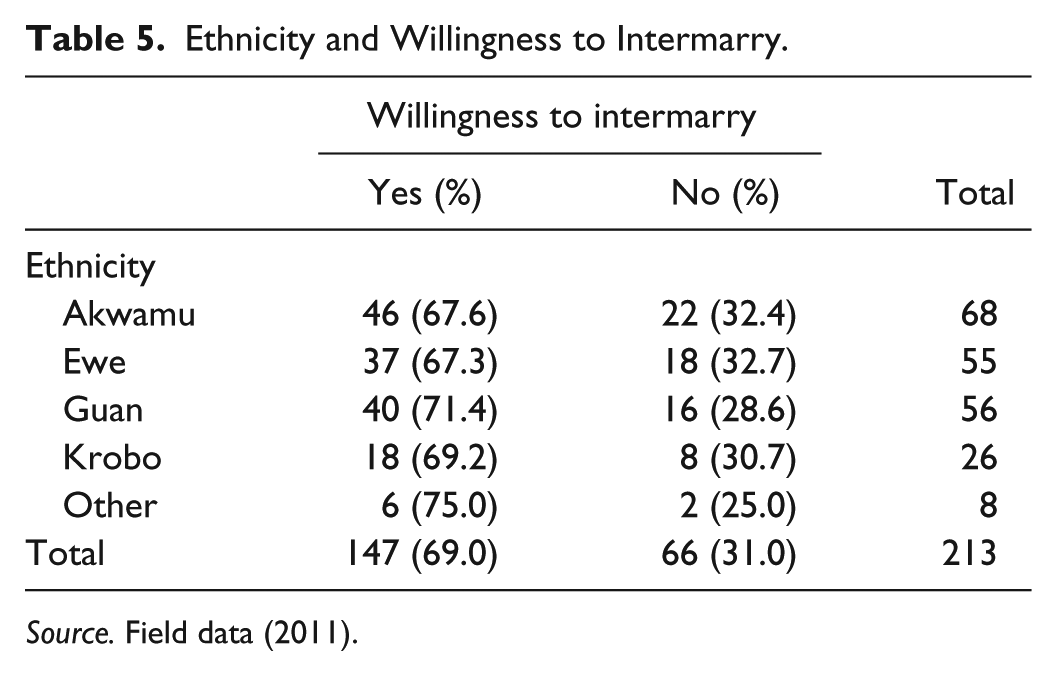
Support for the state’s efforts to promote cohesion can also be gleaned from the responses of the people of Asuogyaman with respect to intermarriages as seen in Table 5.
Ethnicity and Willingness to Intermarry.
Source. Field data (2011).
From Table 5, 69% of the members were willing to take spouses from another ethnic group. However, the tendency to intermarry was paramount among the Guan and the Krobo ethnic groups with 71.2 and 69.2%, respectively. One key informant intimated:
It is interesting to note that, as for inter-marriages, the people do marry from any of the ethnic groups. The Ewes call the Akans “Blutorwo” and the Akans also refer to the Ewe as “Ayigbefo” and make fun of each other and yet, they inter-marry. Akwamu men are always chasing the Ewe and Guan or Krobo ladies and the Ewe men also chasing the Akwamu, Anum or Krobo girls. It is the same for all the ethnic groups in the district. We always attend such marriage ceremonies always. (June 14, 2011)
A key socioeconomic characteristic that is believed to have influence on how people conceive ethnicity is education. For instance, Agyeman (1988) has intimated that education reduces sectarian and regional views and makes people view things in the national interest rather than the regional interest. One hundred and ninety-eight out of the 220 respondents had at least primary education (65 respondents had primary or junior high school [JHS] education, 63 senior high school [SHS] education, 40 postsecondary and 30 university level).
Interestingly, our data also suggested that those who were more educated were more willing to choose spouses outside their ethnic groups than those who were not (96.4%, 141 out of 147 respondents who were willing to intermarry). This can be based on the fact that, in school, there is more interaction between the members of the ethnic groups than at home or in church. The findings made here in intermarriages run contrary to the assertions made by van den Burghe (1972) that, in multiethnic societies, there tends to be a low level of intermarriages between the members of the ethnic groups. Education also makes one more nationalistic and more disposed to look beyond ethnic and other boundaries rather than being sectarian and inward looking (Agyeman, 1988). This can make the individual choose a partner from other groups other than one’s own group for marriage.
Frustration and Aggression
The major reason for frustrations in Asuogyaman District was encroachment on land among all the four ethnic groups (56.5%), especially between the Akwamus and the Guans—the indigenes, who control much of the land in the district. As intimated by a chief,
The issue about land is a major concern in frustrations in this area because land guarantees a lot of economic leverage and power to the individual or group that controls it. So do we have to sit and watch another group come in and take it from us? Anybody or group whose power and authority is threatened will do anything to stamp their authority and continue to be in control of that power. (June 31, 2011)
It is also worth noting that two Akwamus and six Ewes see their frustration stemming from dislike, the very reason for the group formation in the first place as postulated by Connor (1994) in the EST.
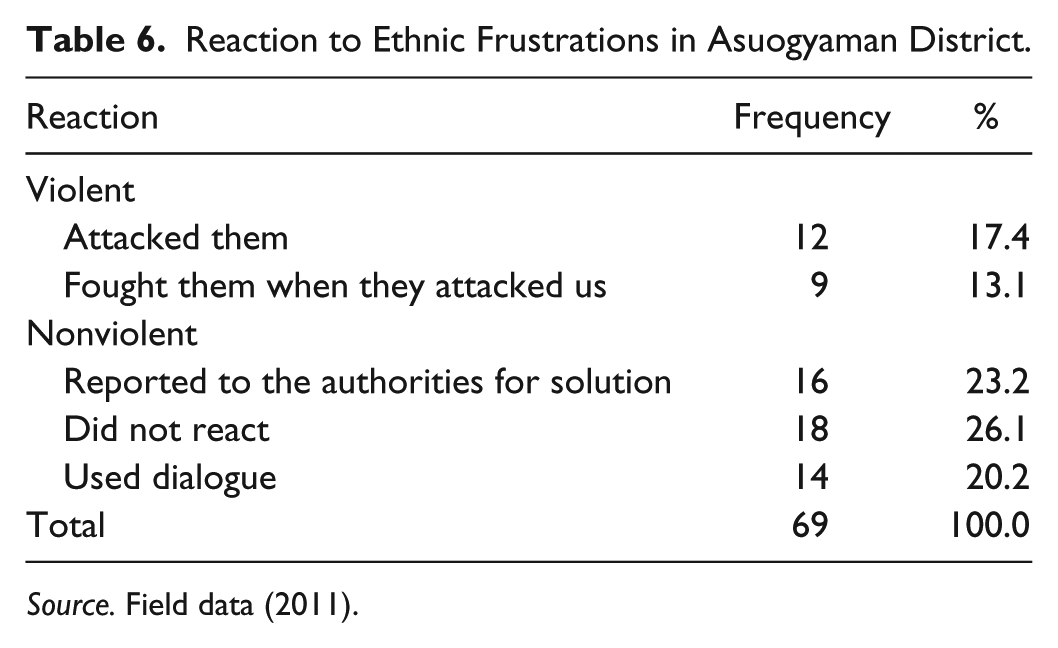
The respondents were asked how their ethnic groups reacted to the perceived frustrations. The responses are presented in Table 6.
Reaction to Ethnic Frustrations in Asuogyaman District.
Source. Field data (2011).
Table 4 suggests that the people in the Asuogyaman District did not use violent means to settle their impasse. At least, more than half (69.6%) of the frustrated people chose to use nonviolent means of settling disputes. This finding upholds the criticism of the F-AT that when alternative ways of settling disputes were available, aggression was not used and even if used, it was the last means resorted to as noted by Simmel (Simmel, 1903/2009) and Coser (1956). For Faleti (2006) man by nature was not violent but becomes violent by way of socialization.
With respect to what they will do in case the frustrations continued, 33% of the 69 respondents said they would attack the perpetrators, while two fifths would want to use dialogue to solve their problem, with about a quarter complaining to the appropriate authorities for an amicable solution to the frustration encountered from members of other ethnic groups. Peaceful solutions, such as reporting to authorities, the use of dialogue and not reacting to frustrations, might be the reason for the long-standing peace in the district as the impasse between the Akan and the Ewe in the late 1980s. As was reported by an Assembly person:
I honestly do not think that any of the ethnic groups will be attacking my people for frustrating the activities of the group and vice versa. Even if they did, what at all will be the reason? You see, there is peace in the district and the people are all one and live as brothers and sisters. Well, if any of them attacked my group, I guess we have to defend ourselves first since we have to survive first. And then after that, we can report the behaviour of the other group to the people who control activities in the district. That is the way everybody will know we were right. (July 2, 2011)
Discrimination in Development Projects
Slightly more than half of the respondents (56.8%) of the respondents claimed that there was discrimination in the provision of development projects in Asuogyaman district. However, just 17.7% of the 213 ascribed political motivations in favor of the Akwamus in the discrimination of development projects. About a similar percentage (16.8) also complained about the absence of basic amenities such as water and clinics in their group areas. While the findings make it difficult to claim that discrimination in projects exists based on the ethnic factor, it nonetheless adds support to the observations from Richardson and Sen (1996) for Sri Lanka and Malaysia and Osaghae (1996) for Liberia after independence to the end of the civil war in 1994, that when a society is ethnically divided, political office holders skew development projects to benefit members of their ethnic groups neglecting the developmental needs of their perceived enemy ethnic groups.
More importantly, such discrimination in development projects, however small, has implications for peace in terms of human security. It was the United Nations Development Programme (UNDP) that first highlighted the aspect of human security as “legitimate concerns of ordinary people who sought security—economic, food, health, environmental, personal, community and political—in their daily lives” (UNDP, 1994, pp. 22-24). As noted by Mzvondiwa (2010), “Political goods means human security in all its facets, for only when security has been sustained, does delivery of all other goods become desirable” (p. 100).
By and large, the findings of the ethnic factor in political party affiliation, voting behavior, appointments, political disturbances or clashes in the district, frustration and aggression, and finally, discrimination or unfair distribution of development projects are not very supportive of the literature. The perceptions of ethnicity affecting the political behavior of the people of Asuogyaman, which some scholars had alluded to, and supported by supposedly ethnic mobilization of the two main political parties in Ghana—NDC and NPP—are not very convincing from our data.
Conclusion and Policy Implications
From the foregoing discussion, it can be concluded that the ethnic factor did not openly influence the choice of political party by the people as policy direction was the major influencing factor. The ethnic factor also did not influence the people’s choice of a candidate to vote for, though ethnicity minimally influenced the choice of some people. Regarding appointments into political office, the ethnic ties played a role as a way of balancing the leadership of the district to enhance representation of the groups though it was rather the individual’s tie with a political party that emerged as the major consideration for such appointments in the Asuogyaman District. With respect to conflicts and other forms of violence, there have been conflicts and violent clashes among a few of the people and groups in the district based on political differences. When frustrations were experienced from other ethnic groups in the district, aggression did not immediately result. Rather, the people preferred peaceful resolutions such as dialogue and deferring to authorities though some would attack their detractors. Discrimination in development projects existed, which could be due to political considerations, suggesting on a low level that political office holders may be skewing development projects to benefit members of their ethnic groups, which is an affront to human security. Therefore, any hints about uneven distribution of development projects emanating from political machinations should be taken seriously, especially in ethnically divided societies. What we can clearly conclude is that the ethnic factor has an indirect effect on political variables in the Asuogyaman District.
We make the following recommendations toward policy making. First, as interactions between ethnic groups in multiethnic societies are not neutral, the government and other policy makers such as the ADA should put measures in place to ensure that all the ethnic groups are consulted and fairly treated as equal partners and are involved in planning developmental activities irrespective of being indigene or settler groups. This reinforces the state’s efforts to promote cohesion through the national constitution, legal instruments, and formal education. Moreover, this equity will in turn result in peaceful coexistence and development. Second, the ADA should institute programs to educate the citizens of Asuogyaman District on the merits of privileging government performance over individual ethnic group benefits not only during elections but also in the appointments of government appointees to the district. Such education could also reduce the emerging political conflicts based on party affiliation. Finally, both the District Assembly and chiefs should collaborate to design peace-building mechanisms based on the inclusivist view, as the people of Asuogyaman District show inclination to be peaceful using traditional conflict resolution methods of dialogue and deference to authority.
Footnotes
Acknowledgements
We owe gratitude to many people, whose names we cannot mention. However, we wish to acknowledge the following for their special assistance. First for providing technical inputs, Professor D. A. Agyeman and Ms. Joyce Addo, both from the University of Cape Coast. Our second thanks go to the respondents and key informants of Asuogyaman District for providing the data. Finally, to our field assistants in the persons of Godwin Osafo Ntow, George Ametefe, George Anati, and Victor Ametefe, we say many thanks.
Declaration of Conflicting Interests
The author(s) declared no potential conflicts of interest with respect to the research, authorship, and/or publication of this article.
Funding
The author(s) received no financial support for the research, authorship, and/or publication of this article.