




Abstract
We aimed to study how compound negation of conjunctions and disjunctions is understood and represented. In particular, we aimed to test time course predictions consistent with the Mental Models Theory of negation proposed in 2012 by Khemlani, Orenes, and Johnson-Laird. Consistent with this theory, we conjectured that the consideration of possibilities elicited by any given information regulates the processing of compound negation. We studied response type patterns to replicate previous findings as well as response time patterns to generate novel chronometrical evidence. We conducted a within-subjects experiment to test a set of five experimental hypotheses. We used a sentence-equivalence task. Participants were asked to find a logical equivalence for a given compound negation of a conjunction or a disjunction. Four possible response options were presented, but only one of them was correct according to sentential logic. We also tested predictions derived from theories that argue against the Mental Models Theory. The evidence resulted consistent with the model theory of negation and incompatible with alternative accounts. In particular, our results did not support the Psychology of Proof and the Dual-Process approach to negation.
Introduction
The meaning of negation seems to be clear in mathematical logic. That is, to negate means to return a complementary set of another given set (see, for example, Suppes & Hill, 1992). This meaning becomes less clear in pragmatics (Horn, 1989; Horn & Ward, 2005). That is, negation in natural language seems to be strongly influenced by conversational maxims (Grice, 1975, 1989) and contextual factors (Sperber & Wilson, 1986, 1987; Wilson & Sperber, 1994) that generate a diversity of interpretations. For instance, the implicit negation operated by scalar implicatures might promote either a logical interpretation or a conversational interpretation (Bott & Noveck, 2004). The meaning of negation becomes much more unclear in psychology, particularly in the field of reasoning research (Khemlani, Orenes, & Johnson-Laird, 2012). Although the importance and difficulty of negation has been acknowledged in psychology (Khemlani, Orenes, & Johnson-Laird, 2014; Orenes, Beltrán, & Santamaría, 2014), the most influential theories of reasoning disagree about its core syntactic, semantic, and pragmatic factors. However, important recent advances have been achieved from the perspective of the Mental Models Theory (MMT)—or model theory for short. The aim of this study is to test several time course predictions concerned with the MMT of negation (Khemlani et al., 2012, 2014). The following steps are followed: First, we analyze the main findings of the MMT concerned with negation. Second, we review relevant contributions to the subject proposed by alternative theories. Third, we describe and analyze the rationale of a straightforward paradigm to study the psychology of compound negation. Fourth, we report an experiment that replicates previous findings and contributes novel chronometrical evidence. Finally, we discuss the scope and limitations of our experiment and propose further studies.
Mental Models of Compound Negation
Wason and Johnson-Laird (1972) found that negative sentences are harder to deal with than false sentences. These authors also found that the evaluation of false affirmations requires more time than true affirmations, but the evaluation of false negations is faster than the evaluation of true negations. The MMT explained these results by applying the concept of mental models, which are defined as iconic representations of the possibilities elicited by a piece of given information (Johnson-Laird, 1983, 2006, 2010a, 2010b). The MMT suggests that human reasoning proceeds by representing possibilities and testing counterexamples to evaluate consistency (Johnson-Laird & Byrne, 1991; Johnson-Laird, Khemlani, & Goodwin, 2015) and to distinguish between biconditionals, conditionals, and intention conditionals (Juhos, Quelhas, & Byrne, 2015). An extension of the MMT that covers the meaning, representation, and use of negation has been recently proposed by Khemlani et al. (2012, 2014). According to this extension, the psychology of negation depends on the mental models’ dynamics. That is, the processing of negation would require the mental representation of a set of possibilities and subsequent inferences based on such set of representations. The construction of mental models, which are simplified representations that include implicit elements, might eventually derive in fleshing out fully explicit models, which require more processing time and more working memory consumption (Johnson-Laird, 2006). Khemlani et al. (2012) have derived from the MMT some predictions concerned with the processing of negation. Among them, we aimed to experimentally test two predictions. According to the first prediction (Khemlani et al., 2012), the negation of a conjunction might require more processing time than the negation of a disjunction. This would happen because the former is equivalent to an inclusive disjunction, which requires three mental models while the latter is equivalent to a conjunction, which requires only one mental model. These equivalences are regulated by the logical laws known as DeMorgan’s laws for compound negations of conjunctions and disjunctions (DeMorgan, 1847; Suppes & Hill, 1992). A compound sentence is a molecular expression that can be parsed into atomic sentences, which do not include connectives or the operator of negation. Conjunctions and disjunctions are examples of compound sentences. For instance, “Africa is a continent and London is a city” is a compound sentence because the conjunctive operator “and” connects the atomic sentence “Africa is a continent” with the atomic sentence “London is a city.” In a similar manner, the word “or” operates in disjunctions (Suppes & Hill, 1992). According to the MMT, the heavier the working memory load is, the poorer the performance in negation tasks would be (Orenes & Santamaría, 2014). According to the second prediction, the processing of compound negations is so difficult that the activation of some negation heuristics is highly probable (Khemlani et al., 2012). The empirical evidence collected in several experiments supports the MMT of negation using response type patterns (Khemlani et al., 2014; Macbeth et al., 2014; Macbeth, Razumiejczyk, & Campitelli, 2013; Macbeth, Razumiejczyk, Crivello, Fioramonti, & Pereyra Girardi, 2015). Khemlani et al. (2014) applied a construction paradigm to study some relevant aspects of denial. In the same line of research, Orenes and colleagues (2014) used the visual world paradigm in the context of eye-tracking methods (Orenes & Santamaría, 2014) to obtain evidence supporting the MMT of negation. We aimed in this study to provide additional chronometrical evidence by using a sentence-equivalence task based on DeMorgan’s laws of compound negation.
Other Psychological Contributions to the Study of Negation in Reasoning
The importance of negation in deductive reasoning has been extensively studied in the context of the Wason Selection Task or WST (Ball, Lucas, Miles, & Gale, 2003; Evans, 1996, 1998; Evans & Ball, 2010; Evans, Clibbens, & Rood, 1996; Evans & Handley, 1999). The WST is a conditional task that requires the verification of a given conditional rule in a set of four cards with controlled information in both sides (for a detailed description, see, for example, Evans & Over, 1996). Two prominent findings obtained with the WST were considered in our study. First, reasoning with negation is a difficult task (Evans & Lynch, 1973). Second, reasoning tasks that require the use of negation are prone to the activation of heuristics and the occurrence of biases (Evans & Over, 1996, 2005). Both of these findings are consistent with the model theory of negation (see Khemlani et al., 2012, p. 548, on difficulty, and p. 544 on processing heuristic). One of the most salient reasoning biases known as matching bias has been early discovered using the WST (Evans, 1972, 1996, 1998; Evans & Lynch, 1973). This cognitive phenomenon consists in matching some given information with a specific response in the WST. It is important to consider that the WST has been mostly studied from the perspective of Dual-Process theories (Evans & Stanovich, 2013a, 2013b), which basically distinguish between intuition and reflection. However, beyond this convergence between the MMT and the two mentioned findings generated from a Dual-Process perspective, some critical discrepancies between both theoretical points of view have been pointed out (Evans, 1993; Johnson-Laird, 1983).
Another prominent theory that provides specific predictions about the cognitive processing of compound negation is the theory known as Psychology of Proof or its computational implementation known as PSYCOP (Rips, 1994). According to this perspective, the human mind has access to logical forms as natural resources. Moreover, the ubiquitous errors that the experimental evidence shows about deductive reasoning shall be attributed to a problem of translation from natural language to mental logic and back to natural language (Rips, 2011). PSYCOP includes specific routines for compound negation. Although the MMT predicts more errors and more time consumption for the negation of conjunctions when compared with the negation of disjunctions, PSYCOP predicts the opposite inequality or no difference at all (Rips, 1994, pp. 114-118). In PSYCOP, the forward processing of a negated conjunction requires three computational steps while a negated disjunction requires five steps (Rips, 1994, p. 114). For backward processing, PSYCOP predicts four steps for both compound negations (Rips, 1994, p. 118). Forward reasoning in PSYCOP occurs when the direction of the inference goes from the compound negation to its corresponding disjunction or conjunction. Backward reasoning follows the opposite direction, that is, from a conjunction or disjunction to a compound negation under the form of DeMorgan’s laws. As the MMT and PSYCOP make opposite predictions about the same cognitive processes, we applied a neutral experimental paradigm to contribute relevant evidence to this discussion.
In sum, we have derived two working hypotheses following the model theory of negation. The first working hypothesis states that response type selection in compound negation reasoning is regulated by the construction of mental models. The second working hypothesis states that response time consumption is a function of mental models’ dynamics when reasoning with compound negation.
A Straightforward Experimental Paradigm to Study Compound Negation
To achieve a neutral and straightforward comparison between predictions derived from the MMT and alternative theories, we applied a sentence-equivalence task that was used in previous studies (Macbeth, Razumiejczyk, Crivello, et al., 2013; Macbeth et al., 2014; Macbeth et al., 2015). This task required to find a logical equivalence for a given compound negation. A logical equivalence can be defined as a biconditional tautology (see, for example, Suppes & Hill, 1992). That is, two sentences are logically equivalent when they have the same meaning or express the same idea. Table 1 shows a task example for the negation of a conjunction and Table 2 for the negation of a disjunction.
Task Example for the Negation of a Conjunction.

The correct response according to DeMorgan’s Law 1.
Task Example for the Negation of a Disjunction.
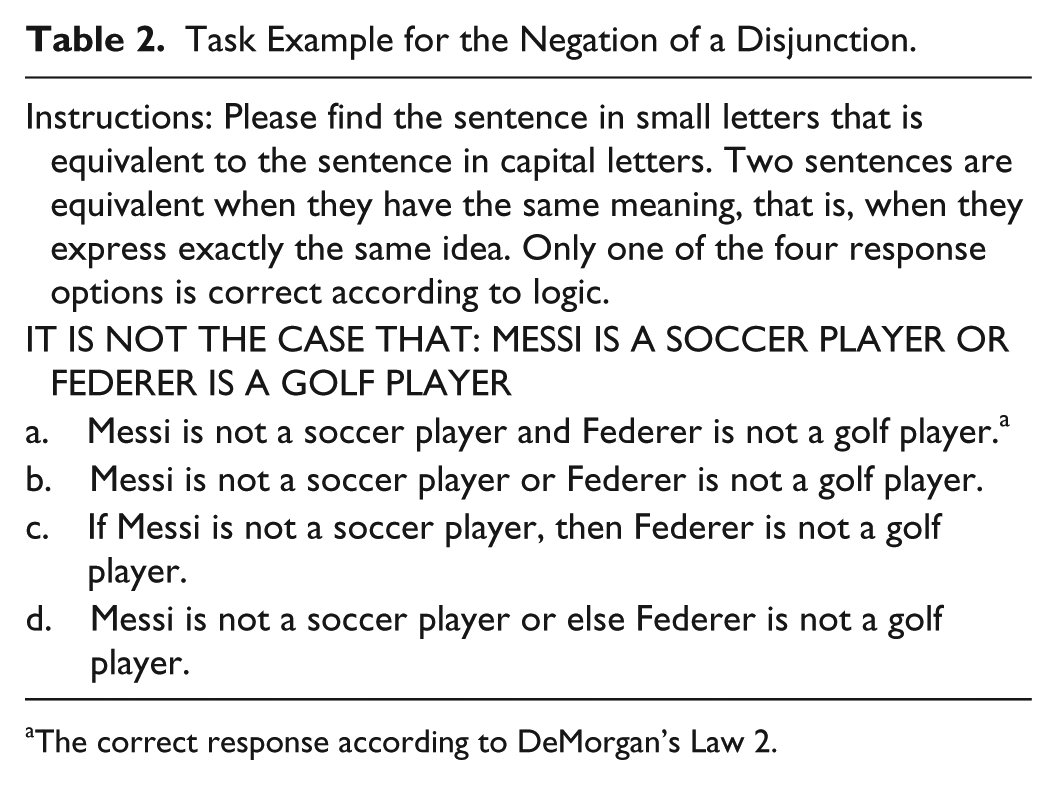
The correct response according to DeMorgan’s Law 2.
Four response options were presented. One option was the sentential equivalence for the given negation according to DeMorgan’s laws (DeMorgan, 1847). The remaining three options were not equivalences, but captured frequently observed responses (Macbeth et al., 2014; Macbeth et al., 2015) that can be accounted for by the MMT (Johnson-Laird, 2006; Khemlani et al., 2012). The full task included eight items, four concerned with conjunction and four with disjunction. DeMorgan’s laws are two formal relations between sentences. DeMorgan’s Law 1 states that the negation of a conjunction is equivalent to a disjunction. DeMorgan’s Law 2 states that the negation of a disjunction is equivalent to a conjunction. Formally, Law 1 states that “not (p and q) is logically equivalent to (not p or not q).” Law 2 states that “not (p or q) is equivalent to (not p and not q).” The letters p and q represent a sentence, which is any proposition or utterance associated to a truth value (true or false, but not both). This formal treatment of sentences was early conceived by Aristotle in his Organon (Aristotle, 1984), but such idea was mathematically developed only during the last two centuries (Mendelson, 1997). Concerning to psychology, the use of norms like DeMorgan’s laws has been recently debated (Schurz, 2014) and considered necessary in reasoning research (Markovits, 2014; Stupple & Ball, 2014).
Three nonnormative response types were constructed: a matching-bias-like response, a scope bias response, and a transformation bias response. The matching-bias-like response was inspired by the matching bias phenomenon observed in the WST (Evans, 1972, 1998). That is, selecting a matching option generates an incorrect response in our sentence-equivalence task. We constructed connectives matching response options for both laws (see Table 1, Option a; Table 2, Option b). Psychologically, this option can be considered relevant because the model theory of negation predicts heuristic processing (Khemlani et al., 2012), which might produce shallow matching responses (Macbeth et al., 2014). A scope-biased response for negation tasks was first conjectured by Khemlani and colleagues (2012, p. 544). Such a response might be caused by the spontaneous tendency to reduce the working memory load during thinking. In our task, we intended to capture this phenomenon using an exclusive disjunction sentence as a response option (see Table 1, Option d; Table 2, Option d). Such an option is incorrect because DeMorgan’s laws apply only to inclusive disjunction. A transformation bias response was additionally constructed. Such response was included to capture a possible effort for fleshing out fully explicit models, but producing a misleading result. That is, the sentences to which DeMorgan’s laws can be applied, can also be transformed into a conditional sentence according to mathematical logic (see, for example, Suppes & Hill, 1992). For example, the sentence “not p or not q” is equivalent to the conditional sentence “if p, then not q.” One incorrect transformation, which is the one we used in our paradigm was “if not p, then not q” (see Tables 1 and 2, Option c in both cases). Such incorrect transformation can be interpreted as a misleading inferential effort.
In sum, the theoretical neutrality of this sentence-equivalence task, the response options, and the registry of response types and response times as dependent variables can be understood as an appropriate paradigm to test the model theory of negation and alternative theories. Since the task requires a selection between fixed alternatives, the paradigm is adequate to test chronometrical hypotheses. Construction tasks—which do not provide options to select—make response times harder to interpret. Our paradigm can also provide relevant evidence concerned with controlled biased responses.
Method
Participants
A total of 71 students were randomly recruited at the National University of Entre Rios, Argentina. These students were undergraduates in Social Sciences: 40 were female (56.3%). The mean age was 24.11 years (SD = 4.996). All the participants gave a written informed consent before taking part in the experiment. No reward was given for participation, which was voluntary. None of the participants received formal training in logic or mathematics as part of their university curricula. All the participants were informed about the procedure, but not about the purpose of the experiment.
Materials and Procedure
One set of eight exercises was given to all the participants. These exercises were given one at a time. To conduct the experiment, we used a portable computer connected to a 21-inch LED screen. The participant was asked to sit in front of a desk. Over the desk, the screen and a response device were located. The experimenter explained verbally in a few words that the experimental instructions would be given using the screen and that all the responses would be recorded using the response device located in the same desk. The participants were told that no deception and no harm of any kind would be used in the experiment, and that they were free to interrupt the study at any moment. Four exercises were like the one presented in Tables 1 and 4 were like the one presented in Table 2. We used for both DeMorgan’s laws the full combination of truth values for the atomic sentences in capital letters, that is, true-true (TT), true-false (TF), FT, and FF. We randomized the sequence of items and the sequence of options within each item for all the subjects. All the participants completed the experiment individually. To design and conduct the experiment, we used the software PsychoPy (Peirce, 2009). A response device controlled by PsychoPy with four keys, one for each option, was used to record responses. The participant was instructed to press the key corresponding to the selected option with her or his dominant hand. Each key press was used to record in each exercise and for each participant the response type and the response time. A brief sound of 150 ms confirmed to the participant that the response was recorded. A fixation black cross was presented before each exercise during 250 ms in the center of the screen. The exercise remained on the screen until a response was recorded. No response consumed more than 60 s. A practice session of four exercises was previously introduced for all the subjects. The materials of these four exercises were not included in the subsequent experiment. The experiment was conducted at the same time of the day for each participant and lasted roughly 15 min.
Design and Analyses
A 2 (negation factor: negation of a conjunction, negation of a disjunction) single-factor within-subjects design was used in the experiment. We studied response type and response time as dependent variables. The response type was operationally defined by the four response options described above. The response time was measured in milliseconds using PsychoPy (Peirce, 2009). We applied two analysis strategies. Statistical tests of proportions were conducted to study response type. Mean comparisons based on log transformed vectors of latency measures were conducted to study response time.
Experimental Hypotheses
We derived two experimental hypotheses—H1 and H2—from the first working hypothesis concerned with response type. From the second working hypothesis concerned with response time, we derived three experimental hypotheses—H3, H4, and H5. The experimental hypothesis H1 states that the frequency of normative responses is higher for the negation of a disjunction than for the negation of a conjunction. This should happen because the negation of a conjunction requires more mental models than the negation of a disjunction (Khemlani et al., 2012). More specifically, the negation of a conjunction requires the representation of three mental models, while the negation of a disjunction requires only one mental model. H2 states that the frequency of matching-bias-like responses is higher for the negation of a conjunction than for the negation of a disjunction. This would result from the greater difficulty of the former when compared to the latter (Macbeth, Razumiejczyk, & Campitelli, 2013). H3 states that response times are faster for the negation of a disjunction than for the negation of a conjunction. This shall occur because the former requires the representation of a lesser number of mental models than the latter. This conjecture has been directly derived from the MMT of negation by Khemlani et al. (2012). H4 is concerned with the transformation bias response, which is a wrong answer for both laws that takes the form of a conditional. If the formal logic perspective in psychology—that argues against the MMT—is right, then participants who select the transformation bias response more frequently should also give slower responses than participants who select such response less frequently. Consistent with this theory (Rips, 1994), a high-demanding routine shall be required to transform a compound negation into a conditional (see inference rules in Rips, 1994, pp. 45, 85-86, 113-114, 116-119, 129). The delay produced by such mental effort should be more prominent among those participants who select this response type more frequently. The response time increase associated to a difficult mental proof construction has been explicitly predicted by Rips (1994, Figure 5.2, p. 165). H5 is concerned with the matching-bias-like response. If the Dual-Process perspective is right—against the MMT—then faster responses should be observed among participants who select the matching-bias-like response more frequently. Such acceleration should be less prominent for participants who select this response type less frequently. That is, the Dual-Process theories argue that heuristic responses—like the matching bias response in the WST—are less time-consuming answers (Evans & Stanovich, 2013a, 2013b). Consistent with such two minds rationality perspective (Evans, 2014), a similar phenomenon should occur with the matching-bias-like response in our sentence-equivalence task.
Results
Hypotheses testing for H1, H2, and H3 yielded statistical significance. H4 and H5 testing did not yield statistical significance. Concerning H1, the frequency of normative responses resulted higher (test of proportions, Z = −3.3571; p = .00078) for the negation of a disjunction (64.78%, that is, 46 participants out of 71) than for the negation of a conjunction (36.61%, that is, 26 participants out of 71). Concerning H2, the frequency of matching-bias-like responses resulted higher (test of proportions, z = 2.6409; p = .0083) for the negation of a conjunction (87.32%, that is, 62 participants out of 71) than for the negation of a disjunction (69.01%, that is, 49 participants out of 71). To test H1 and H2, we considered the proportion of individuals that gave one, two, or three responses of each type, that is, normative responses for H1 and matching-bias-like responses for H2. Only participants who gave zero responses for each type were excluded to obtain the corresponding proportions.
To test H3, H4, and H5, a log transformation was applied to the response time vectors. The statistical tests were applied to such log transformed vectors. Concerning H3, faster responses (paired samples t = 4.913; p < .001; df = 70; Cohen’s d = 0.468, about medium effect size) were observed for the negation of a disjunction (M = 4.347; SD = 0.096) than for the negation of a conjunction (M = 4.407; SD = 0.154). Concerning H4, no significant difference in response time (independent samples t = −0.116; p = .908; n = 71; Cohen’s d = 0.03, close to null effect size) was observed between participants who selected the transformation bias response more frequently (n = 39; M = 4.383; SD = 0.125) when compared with those who selected the same response less frequently (n = 32; M = 4.379; SD = 0.11). Concerning H5, the chronometrical difference between both groups resulted nonsignificant (independent samples t = 0.45; p = .654; n = 71; Cohen’s d = 0.11, close to null effect size) when comparing participants who selected the matching-bias-like response more frequently (n = 30; M = 4.374; SD = 0.109) with those who selected the same response less frequently (n = 41; M = 4.387; SD = 0.125).
To test H4 an H5, we used a median split strategy to generate a factor based on response frequency selection to make response time comparisons. Concerning H4, the split by the median of the frequency of transformation bias responses (Median = 1) produced two vectors. One of these vectors included 32 participants who did not select such response at all throughout the eight exercises. The other vector included the remaining 39 participants who selected the same response type 1 time or more times throughout the eight exercises. The dependent variable corresponded to the log transformation of participants’ latency throughout the eight responses. Concerning H5, the same median split strategy was applied to the vector of matching-bias-like frequency (Median = 3). Forty-one participants resulted below the median and 30 resulted above the median. This factor was further used to achieve the aimed chronometrical comparison. We chose the median split strategy instead of comparing the top and bottom quartiles because the former is a stronger test than the latter. Taken together, these results are consistent with the model theory of negation.
Discussion
We tested five experimental hypotheses concerned with the model theory of negation. The evidence supported such theory. Response type analysis replicated previous findings (Khemlani et al., 2012, 2014; Macbeth, Razumiejczyk, Crivello, et al., 2013; Macbeth et al., 2014; Macbeth et al., 2015) and response time analysis contributed novel findings. Taken together, these results suggest that the processing of compound negation can be understood as a complex set of psychological phenomena. The behavior of negation seems to be regulated by mental models’ dynamics. That is, negation might proceed like the construction of a complement for a given set in mathematical set theory (Khemlani et al., 2012). The temporal course of negation observed in our experiment resulted consistent with this conjecture.
Concerning our response type results, our evidence suggests that conjunctions are harder to negate than disjunctions. This would happen because the former is equivalent to a disjunction—which requires the representation of three mental models—while the latter is equivalent to a conjunction—which requires only one mental model. Such representational difference explains why the negation of a disjunction collected more normative responses than the negation of a conjunction, according to H1. The same reason explains why the negation of a conjunction collected more matching-bias-like responses than the negation of a disjunction, according to H2. Alternative formalist theories like PSYCOP predict the opposite result or no difference at all for normative responses between the negation of conjunctions and disjunctions (Rips, 1994). Concerning matching-bias-like responses, no specific prediction can be derived from PSYCOP. Further alternative accounts like Dual-Process theories have extensively studied distorted processes like the matching bias in the WST (Evans, 1998). However, no specific prediction can be derived from the two minds rationality view (Evans, 2014) when considering the differential behavior between the negation of a conjunction and the negation of a disjunction. That is, both negations seem to trigger intuitive responses followed by reflection, but no interpretation can be given to the higher difficulty of negating conjunctions when compared with negating disjunctions.
Concerning our response time results, the temporal course of negation seems to be consistent with the model theory’s predictions. The negation of a conjunction requires the representation of more mental models than the negation of a disjunction. Therefore, the negation of a conjunction consumes more time than the negation of a disjunction according to H3. Since PSYCOP can make predictions based on the number of rules that a specific reasoning task requires, we derived H4 from such formalist view. The evidence resulted inconsistent with H4. That is, no difference in response time was observed between participants who frequently gave transformation bias responses when compared to participants who gave the same response with lower frequency. This result indirectly supports the MMT because the MMT argues against logical form (Johnson-Laird, 2010a, 2010b). Concerning the temporal course of the matching-bias-like response frequency selection, H5 aimed to test a prediction derived from a Dual-Process view. The acceleration predicted for this kind of intuitive response (Evans & Stanovich, 2013a, 2013b) was not consistent with our results. This evidence also supports the MMT because the MMT argues against such specific dual theory (Johnson-Laird, 1983, see Chapter 6).
Further studies are needed to understand the specific mental models’ dynamics of the negation heuristics mentioned by Khemlani et al. (2012). Phenomena like the matching-bias-like response observed in our sentence-equivalence task seem to be robust (Macbeth, Razumiejczyk, Crivello, et al., 2013; Macbeth et al., 2014; Macbeth et al., 2015). Moreover, such response type seems to be the most frequent incorrect response in experimental tasks concerned with negation. A deeper study of this shallow response might promote our understanding of negation.
Our experimental evidence resulted consistent with previous experiments conducted by Khemlani et al. (2014) in the context of the MMT. By applying a novel paradigm, their participants were asked to select (Experiment 1) or formulate (Experiment 2) sentential equivalences for a given negation of a conjunction or a disjunction. For example, they used sentences such as “Bob denied that he wore a yellow shirt and he wore blue pants on Tuesday” (Khemlani et al., 2014, p. 4). Participants had to select response options or construct sentences consistent with the given compound. Their results showed that the negation of a conjunction is harder to deal with than the negation of a disjunction, which is consistent with a model account of negation. Our study extends these findings by providing chronometrical evidence consistent with the same theory, but using a sentence-equivalence task.
One limitation of our study is the lack of discrimination inside the response time measures (Sigman & Dehaene, 2005). That is, latencies are additive because response times are the sum of time intervals dedicated to visual inspection, long-term memory retrieval, iconic representation, inferential processing, the search for counterexamples, and so on. One way to reduce this difficulty would be to conduct eye-tracking studies (Orenes et al., 2014). Although tracking eye movements is a limited method (Anderson, Bothell, & Douglass, 2004), inspection times and fixations in areas of interest might provide valuable evidence for the psychological explanation of compound negation (Ball et al., 2003; Orenes & Santamaría, 2014).
In sum, the evidence of this study is consistent with the model theory of negation, but inconsistent with the formal logic perspective of PSYCOP. Our results also posited problems for a Dual-Process interpretation of robust phenomena like the matching-bias-like response in negation tasks.
Footnotes
Declaration of Conflicting Interests
The author(s) declared no potential conflicts of interest with respect to the research, authorship, and/or publication of this article.
Funding
The author(s) disclosed receipt of the following financial support for the research, authorship, and/or publication of this article: This work was supported by the National Scientific and Technical Research Council of Argentina (Grant PIP-CONICET11220130100765CO).