




Abstract
The article addresses the issue of basic color terms and reviews the existing publications on color terms, including in the Kazakh language. The literature in Kazakhstani linguistics on basic color terms in Kazakh has mostly an empirical character, and it relies on the authors’ personal perceptions and examples from language—fiction, dictionaries, proverbs, and idioms. Most scholars identified the following inventory of basic color terms in Kazakh: ақ “white,” қара “black,” қызыл “red,” көк “blue,” сары “yellow,” and ала “multicolored.” The aim of the present article is to elaborate a list of basic color terms in the Kazakh language through conducting an experiment among Kazakh native speakers. The experiment was held among Kazakh young people to find out which color terms they name and how they order them. The results of the experiment showed that there is some difference in the way Kazakh scholars define and contemporary young Kazakhs name basic color terms. The young native speakers of Kazakh named eleven colors, such as Ақ (white), Қара (black), Сары (yellow), Жасыл (green), Қызыл (red), Көк (blue), Қоңыр (brown), Сүр (gray), Көгілдір (pale blue), Қызғылт (pink), and Күлгін (purple).
Introduction
The aim of this article is to investigate basic color terms (BCTs) in the Kazakh language. The nomadic lifestyle of the Kazakh people in the past has found its reflection in the language; their closeness to nature formed a specific conceptual database and stipulated the difference between nomads and settled nations in the perception of the environment. The Kazakhs were traditionally engaged in breeding of domestic animals, especially horses; this reasoned a presence of numerous denominations of horse colors in the Kazakh language (e.g., Құла [ķula] “light brown,” Торы [torї] “bay,” Жирен [žiren] “chestnut,” etc.).
Color designating terms in Kazakh comprise basic colors, their derivatives, and compound words. Sadykova (2012) refers color denominations that were borrowed from other languages to the latter group, for example, Қоңырлау [ķoņїrlau] “cream,” Қара қоңыр [ķara ķoņїr] “coffee,” and so on. It should be noted that in the ancient times, the Kazakhs did not differentiate between “dark blue” and “light blue”—one word Көк “blue” was applied to denominate all tones of the sky; moreover, for a long time, the Kazakhs did not differentiate between “blue” and “green,” the color term kөk “blue” was applied to denote both of them. This phenomenon is typical to Turkic languages (Hauenschild, 2012; Kaidar, 2013; Kononov, 1978), and in the Kazakh language, it justifies the existence of a wide range of semantic meanings of the color term Көк “blue”: “dark blue,” “light blue,” “azure,” “light green,” “green,” “greenery,” “gray,” “the sky,” and so on (Kononov, 1978). It could be explained by the colors of the surrounding world of nomads—the steppe and its climatic characteristics. Cold winters with heavy snow (of blue shades) and hot summers with little rain are the most salient seasons of the year. Springs do not last long, and the green colors of scarce vegetation quickly turn into ала [ala] “multicolored,” a color of indefinite hue, saturation, and value. Also, if ones watch the steppe, they will see the infinite space where the horizon draws a vague line between the sky and the earth erasing the color boundaries between them. A later created color denomination Жасыл [žasїl] “green” was formed by a combination of the adjective Жас [žas] “young” and a suffix -ыл [їl], analogical to Қызыл [ķїzїl] “red” (Қыз [ķїz] “a girl”).
The aim of this article is to review the literature on the BCTs in different languages, including Kazakh, and also to report the results of the experiment among young native speakers of Kazakh who were asked to perform a task on writing a list of colors they know in the native language. The results of the present project have given some understanding of the current situation with BCTs in the Kazakh language and presented some valuable insights to elaborate inferences in support or refute of existing assumptions on the issue.
Literature Review
The issue of BCTs has been negotiated since the introduction of the term by Berlin and Kay (1969). In their well-known work on colors based on the research of 98 languages, they claimed that languages have maximum 11 BCTs: “white,” “black,” “red,” “green,” “yellow,” “blue,” “brown,” “purple,” “pink,” “orange,” and “gray,” and in each of languages, they appear in a fixed sequence. In other words, Berlin and Kay claim that all languages in the world have one and the same list of BCTs from which minor color terms derived. According to them, BCTs can be distinguished from nonbasic colors if they possess the following criteria: all native speakers know them, they are psychologically salient, they are prototypical, and their meanings are not derivable from the meanings of their components. Since the introduction of BCTs by Berlin and Kay, the issue of universality of color terms has been debated and even criticized. Beran (2012) questions the concept of “basic colour,” but rather assigns to it the notion of hierarchy in terms of usage frequency. He argues that the color universality theory investigates the issue syncronically; diachronicity is not taken into account. Beran also claims that comparison of colors in different languages does not reveal the same stages of evolution and displays much variety in color terms. He believes that the concept of BCTs elaborated by Berlin and Kay is relevant mostly to Western languages, not to distant ones. His argument is grounded on the provision that people live in different environment; correspondingly, their perception of the world is differently reflected in the languages they speak.
Jameson (2005) states that there are two approaches to the way colors are named and categorized—universalist and relativist ones. The former viewpoint claims that the differences in color naming and categorization are stipulated by the difference in color experience; the latter one explains the differences by social and cultural experiences of nations. One of proponents of the relativist approach is Paramei (2005) who on the basis of two Russian colors Синий [sinij] “dark blue” and Голубой [goluboj] “light blue” suggests considering the social and cultural impact on the criteria of color “basicness.”
The notion of “basicness” of color terms has been the object of numerous research; it has been studied by scholars on the basis of different languages. Some studies support Berlin and Kay’s proposition on universality of basic colors; they suggest approximately the similar number and/or order of color terms. The research done by Uusküla (2008), for example, confirmed the universal nature of basic colors terms in the Czech language; she held experiments among 52 native speakers, who performed two tasks: they wrote a list of colors and named colors “tiles.” The analysis showed that there are 11 BCTs in Czech. Davies and Corbett (1994) conducted experiments among Russian-speaking respondents, and the results confirmed the hypothesis that there are 12 basic colors terms in the Russian language; to the above-mentioned list by Berlin and Kay, Goluboj “light blue” has been included. The same type of experiment was conducted by Özgen and Davies (1998) to establish a list of Turkish color terms; their participants were 80 children and 153 adults. As a result, Özgen and Davies came to the conclusion that there were 12 basic colors terms in Turkish; among those named by Berlin and Kay, Lacivert “dark blue” has been defined and placed between “blue” and “purple.” Rätsep (2011) cautiously assigns a status of a candidate to BCTs to Lacivert “dark blue” because to check the salience of that color, additional tile was utilized in a naming task experiment among native speakers of Turkish. The same number of BCTs, as in Russian and Turkish, was found in the Greek language (Androulaki et al., 2006); on the ground of frequency, consistency and consensus of use, naming, and necessity, Androulaki et al. elaborated 12 BCTs, where, as in Russian and Turkish, there were two “blue” colors—“dark blue” and “light blue.”
There were also studies that refuted the theory of universality of BCTs. Jingyi and Urmas (2014) applied fieldwork methods, color list, and color-naming tasks and found out that there were nine BCTs in Mandarin Chinese (red, yellow, green, blue, black, white, purple, pink, and gray). Avayi and Jai (2010) claim that there are five basic colors terms in Northern Tsou (a tribe in Taiwan)—“black,” “white,” “red,” “yellow,” and “green.” Thus, the studies revealed different lists of BCTs in various languages. But Davies and Corbett (1994) claim that this diversity in no way overrules the BCTs theory because it stipulates the extension of the list due to further development of languages. According to Özgen and Davies (1998), the BCT implicitly implies that there may be more than 11 BCTs in different languages. Jraissati (2014) suggests that the color terms should be classified as universal and particular; the latter do not refer either to universal or relative ones. Lindsey and Brown (2009) examined the database of World Color Survey and came to the conclusion that the usage of colors does not depend on culture, and that universal tendencies determine the way colors are used and orderly control the process and changes in color naming.
There are opposite opinions on the role of culture in language formation. Uusküla (2006) examined colors terms in Estonian, Finnish, Hungarian, Russian, and English. The participants of the experiment had to name the colors on 65 tiles based on Ostwald’s colors system. No matter whether languages were related or nonrelated, the respondents displayed various answers; Uusküla had to conclude that colors-naming much depends on language and culture. Witkowski and Brown (1982) state dependence of the hierarchy of colors on their salience: the most salient color takes the first place in the sequence order of basic terms. Along with the salience, the scholars also note that the use of frequency and comparatively short structure of the terms make them prominent ones. They also claim that the lexical sequence is impacted by culture; in other words, the hierarchy of colors varies from language to another one depending on the nations’ living conditions, traditions, and perception of the world.
In Turkic languages, there is no unified opinion on the issue of color basicness. Kononov (1978) analyzed semantic characteristics of five color terms, such as Қара “black,” Ақ “white,” Көк “blue,” Сары “yellow,” Қызыл “red,” and Ала “multicolored.” A selection of these very colors could be regarded as an indication of the importance he laid to them. Laude-Cirtautas (1961) examined color denominations in Turkic dialects and classified them as basic and specific ones. To basic color names, she refers qara, aq, qїzїl, yašїl, and sarїy, to specific color names—ala, kök, and qїr. Also, she includes color denominations applied to domestic (especially horses) and wild animals to the latter group. It should be noted that in Modern Kazakh, qїr has the meaning of “dirt, dirty,” and it has never been referred to color names. The noninclusion of kök “blue” to the group of BCTs by Laude-Cirtautas is not appropriate to the Kazakh language; the color kök has always played a vital role in the life of nomads. The Kazakhs assigned different colors to parts of the world; Көк [kök] “blue” designated the East. Substantivized Көк denoted “the sky,” “the sanctuary of the God,” “the green grass,” and “the meadow.” As well as ala “multicolored,” it found its reflection in toponymic names, such as Köktöbe “a blue top (of a mountain),” Alatau “multicolored mountains,” and so on.
Stachowski (2010) states that there are five basic colors in Turkic languages—kara “black,” ak “white,” kyzyl “red,” jasyl “green,” and saryg “yellow.” He also finds reasonable to include kök “blue” into that group, all in all referring six colors to basic ones. A more relevant classification has been suggested by Hauenschild (2012); based on color characteristics in the Yakut language, as well as Laude-Cirtautas (1961), she distinguishes two groups of color denominations—basic and specific ones, but her classification differs in the quality and quantity of colors included. To basic ones, Hauenschild refers nine colors: qara “black,” aq “white,” qїzїl “red,” sarїy “yellow,” kök “blue,” yašїl “green,” qonїr “brown,” boz “gray,” and ala “multicolored.” To specific group of colors, she relates colors naming the animals’ coat.
In Kazakh linguistics, the assumption that culture has a big impact on colors hierarchy finds its confirmation in studies on Kazakh color terms. In the Kazakh language, there are more than 1,000 terms that designate colors; they comprise basic colors, such as Қызыл ([ķїzїl] red), Сары ([sarї] yellow), Жасыл ([žasїl] green), Көк ([kök] blue), Қара ([ķara] black), Ақ ([aķ] white); Сұр ([sür] gray); their derivatives, for example, Көгілдір ([kögildir] light blue), Сарғыш ([sargїş] yellowish); and compound words, for example, Сары қызыл ([sarї ķїzїl] orange). The literature in Kazakhstani linguistics on BCTs in Kazakh has mostly an empirical character, and it relies on the authors’ personal perceptions and examples from language—fiction, dictionaries, proverbs, and idioms. Kaidar (2013) defines six basic colors in Kazakh as the following: “white” ақ [aķ], “black” қара [ķara], “red” қызыл [ķїzїl], “blue” көк [kök], “yellow” сары [sarї], and “multicolored” ала [ala]. The assumption is done empirically, and is mostly based on the frequency of application of these colors in lexical units: phrases, idioms, and proverbs. In the earlier work on colors by Kaidarov, Akhtamberdiyeva, and Omirbekov (1992), there were mentioned two more colors—“light gray” боз [boz] and “brown” қоңыр [ķoņїr] along with the above-mentioned ones; they were referred to BCTs due to their distinct and frequent service as components of idioms. Then, according to empirical research by Kazakh scholars, the number of BCTs in Kazakh totals to eight ones which do not really match the BCTs suggested by Berlin and Kay either in terms presented or in the order of their presentation. The existence of these very colors and their lexical sequence has been reasoned by cultural, historical, and mental characteristics of the Kazakh people. Sadykova (2012) refers to BCTs nine color denominations; to the above-mentioned list of BCTs, she adds сұр [sür] “gray.” Thus, the analysis shows no conformity in relation to BCTs in the Kazakh language; the number of basic color denominations ranges from six to nine ones, and it reveals the diversity in studies done by the Kazakh scholars due to empirical nature of their research.
To sum up, in Kazakh linguistics, the notion of color “basicness” is not clearly defined by researchers; it could be assumed that the conclusions elicited from their studies are based on two main grounds: (a) they are psychologically highly salient and (b) they are most frequently used color denominations (though no frequency data have been presented) in the language of fiction, media, and oral discourse. BCTs in Kazakh mostly belong to common Turkic monosyllabic stems, those as kөk “blue,” aқ “white,” and сұр “gray,” or they are formed on the basis of Proto-Turkic stems and a suffix making up two-syllabic words, such as қара “black” and сары “yellow.” Semantically, the elaborated BCTs are perceived by researchers —Kazakh native speakers—as prototypes of existing color denominations “whose meaning is not derivable from their parts, whose signification is not included in that of another term, whose use is not restricted to a narrow range of objects, and that are psychologically salient” (Davies & Corbett, 1994, p. 66).
Method
The aim of the present study was to conduct an experiment among native speakers of Kazakh who were asked to perform a color term list task—to write a list of colors they know in the native language. It was administered to develop a list of BCTs in the Kazakh language due to their psychological salience; it is assumed that the salient ones are more frequently used and structurally simple. As far as the procedure of a questionnaire filling in took a short period of time (about 5 min), the respondents could write down the most available color terms, that is, the ones that came first to their mind.
The research question was “What are BCTs in Kazakh?” To find an answer to this research question, an experiment was conducted among two groups of native speakers of Kazakh—the experimental and the control ones. The participants of the experiment were randomly selected out of a pool of bachelor students of a Kazakhstani University. In the experimental group, a color term list task has been performed by 37 participants—16 males and 21 females; three questionnaire answers were not included in the data because one participant was not a Kazakh native speaker, and two Kazakh respondents out of 36 ones failed to write any color term in the Kazakh language; they wrote Russian color terms—20 and 32, correspondingly. To check the results from the experimental group, the control group was randomly sampled on the criterion of their linguistic proficiency in Kazakh, where 31 native speakers of Kazakh participated—10 males and 21 females; they all claimed that they knew the language on the advanced level. On the whole, the answers of 65 participants (34 + 31) were considered. The respondents were asked to fill in questionnaires that consisted of two parts; the first part elicited personal information on the respondents, and the second one provided space for writing color terms in Kazakh by the participants. The data on personal information were collected to find out how answers of the respondents differed in relation to gender, age, and so on, to get better understanding of the respondents’ background, and also to learn more about their linguistic practices (the family language, the language of instruction at school), and the knowledge of other languages.
As the data on list task from two groups were collected, it was coded, separately entered into Excel document, analyzed using descriptive analysis, and then compared. The results of the survey were analyzed according to the following criteria: color terms stated first in the list, their naming frequency, the mean position, and their corresponding rank orders. The frequency naming demonstrates the number of times a color was named by all the participants of the experiment without a consideration of its position in the lists presented. The mean incorporates all positions a color denomination was placed on average by all respondents. The rank order was given to color terms with respect to their naming frequency; in case the frequency naming was similar at two or three colors, the mean measure was taken into account. For example, color terms Ақ “white” and Қара “black” were named by all participants of the experiment (Tables 2 and 3); the mean showed that Ақ “white” was more often named in initial positions of the lists, that is why it was awarded the first rank, and Қара “black”—the second one.
The respondents of the experiment are 65 bachelor students of a Kazakhstani university with English as the language of instruction; the mean age in the experimental group is 18.9, in the control group, it is 19.3. All of them are native speakers of Kazakh. In the experimental group, 11 people finished secondary schools with Kazakh as a language of instruction, 18 participants graduated from Russian schools, and five respondents studied in mixed schools (Kazakh-Russian, Kazakh-English, Russian-English, and Kazakh-Turkish). Thirty-three respondents stated that their mother tongue is Kazakh, and one participant wrote that it was Russian. The family language of 13 respondents is Kazakh; 11 people acknowledged that in the family, they speak in two languages—Kazakh and Russian; finally, 10 participants wrote that it was Russian. Along with Kazakh and Russian, all of them stated that they know English; one student knows Italian, another one knows German, two participants know French, one respondent knows Uygur, two know Chinese, and three other ones know Turkish.
In the control group, 20 respondents stated that they finished a secondary school with the Kazakh language of instruction, whereas 11 participants graduated from schools with the Russian language of instruction. Out of 31 respondents, 21 young people indicated Kazakh as their family language, five people named Russian, and five other respondents wrote that both Kazakh and Russian are languages spoken in their families. All 31 respondents are trilingual; they know three languages—Kazakh, Russian, and English; 13 participants know other languages on different levels: Turkish (six people), Chinese (three), Korean (three), and Arabic (one). So, the respondents revealed quite diverse information about themselves, with a vivid tendency of being multilingual.
Results
All the participants were asked to write a list of color terms in the Kazakh language. On the whole, 41 different Kazakh color terms were named; two of them related to horses’ coat color: Жирен [žiren] “chestnut” and Күрең [küreń] “dark brown.” The most number of color terms was provided by an 18-year-old participant whose language profile is dominantly Kazakh—the mother tongue is Kazakh, finished the Kazakh school, and the family language is Kazakh (20). The lowest number of Kazakh terms (five) was given by a 19-year-old student who stated that she finished a mixed (Russian-Kazakh) school, the mother tongue is Kazakh, and the family languages are Kazakh and Russian. Table 1 shows color terms that were stated first in the list by representatives of the experimental and the control groups. On the whole, only five color denominations were granted the first place in the lists of respondents in two groups. The most frequently named color term in both groups was Ақ “white” (11 and 13 times, correspondingly), then it was followed by Қызыл “red” (9 times, similarly), Қара “black” (6 and 3 times), Сары “yellow” (5 and 4 times), and Көк “blue” (3 and 2 times). A slight divergence (from 1 to 3) in the number of times the colors were placed first by two groups does not break their sequence in the descending order, excluding the color Қара “black” which was named first less times by the control group than by the experimental one.
The First Stated Color Terms in the List Task.

Table 2 demonstrates the naming frequency, mean position, and the corresponding rank orders for color terms named by six or more participants of the experimental group. Color terms that were mentioned by less than six participants were not included into the list; they were mostly derived from BCTs (сұрғылт [sûrgїlt] “grayish,” сарғылт [sargїlt] “yellowish,” ақшыл [aķşїl] “pale”) and ones formed by compound words (ашық көк [aşїķ kök] “light blue,” қою жасыл [ķoyü žasїl] “dark green”).
Frequency, Mean Position, and Corresponding Rank Order of Color Terms by the Experimental Group.

The frequency shows how many respondents named each color, and the mean position shows in which position the color term was placed on average. The most frequently mentioned color terms are Ақ “white” and Қара “black”; they are followed by Сары “yellow,” Жасыл “green,” Қызыл “red,” Көк “blue,” and Қоңыр “brown.” Four color terms finalize the list with less number of mentioning—Сұр “gray,” Көгілдір “light blue,” Қызғылт “pink,” and Күлгін “purple.” On the whole, 11 color terms were most frequently named; the difference between the list of universal colors offered by Berlin and Kay (1969) and the one elaborated from the above experiment is that the term color “orange” is missing, it is replaced by Көгілдір [kögildir] “light blue.”
In the experimental group, the mean of the color Жасыл “green” is lower (4.18) than the mean of the color Қызыл “red” (3.41), but because it was named by more participants (33), it was ranked higher (Table 2). The similar situation occurred in the control groups (Table 3) in relation to Жасыл “green” (30 respondents; the mean is 4.73) and Сары “yellow” (29 people; the mean is 4.41), Қоңыр “brown” (21; 7.14) and Қызғылт “pink” (14; 7.07), and, finally, Көгілдір “light blue” (9; 8.22) and Күлгін “purple” (7; 6.57). The analysis showed that the naming order of color terms elaborated by the participants of the experiment did not depend on independent variables, that is, the gender, the family language, and the language of school instruction. The analysis revealed nonconsistency in relation to those variables, and such heterogeneity can be justified by personal preferences, associations, and experience of the respondents of both groups.
Frequency, Mean Position, and Corresponding Rank Order of Color Terms by the Control Group.
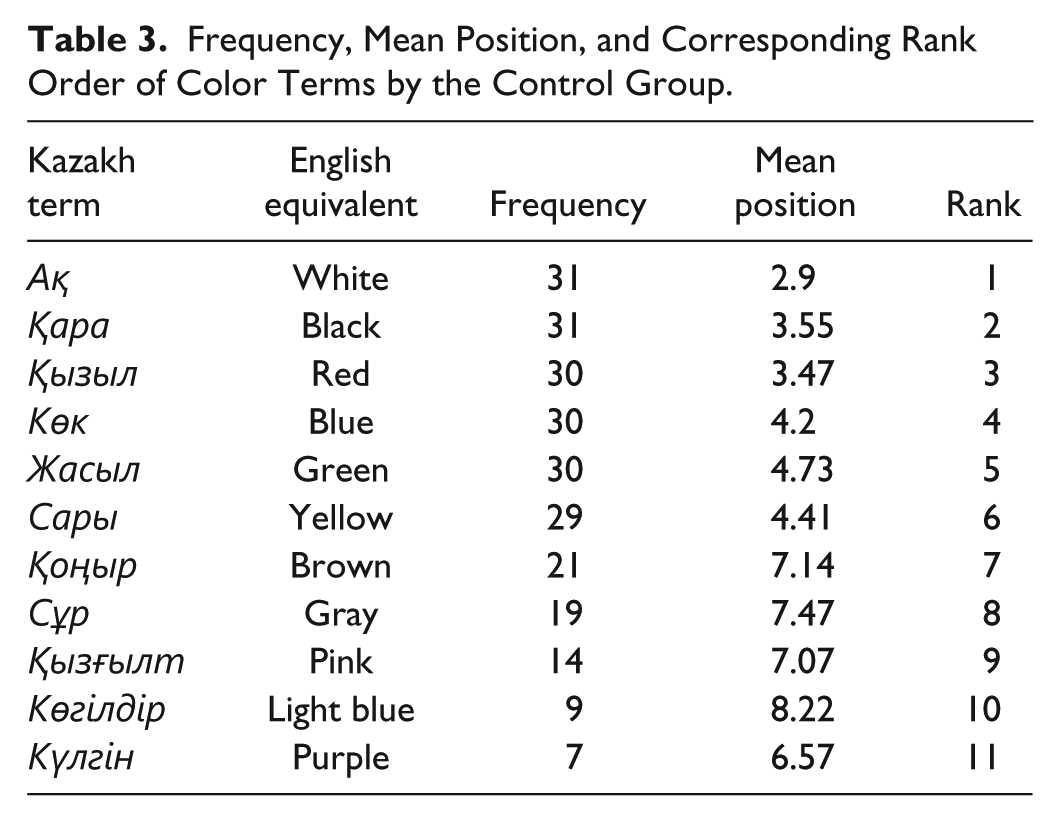
Table 3 demonstarates the naming frequency, mean position, and their corresponding rank orders for color terms named by six or more participants of the control group.
If Tables 2 and 3 are compared, it is clearly seen that the color terms named by two groups are similar. The difference is in the position order of colors placed by the respondents of two groups. Both of them named 11 color denominations, and the first two colors are the same—Ақ “white” and Қара “black” (the first and second place, correspondingly). The three other color terms have been placed similarly by the participants of the experiment group: they are Қоңыр “brown” (7), Сұр “gray” (8), and Күлгін “purple.” The rank order of four color denominations is quite diverse: Сары “yellow” (3 by the experimental group and 6 by the control group), Жасыл “green” (4 and 5), Қызыл “red” (5 and 3), and Көк “blue” (6 and 4), and two other colors—Көгілдір “light blue,” Қызғылт “pink”—just changed their places in the ranking lists of two groups (9 and 10). On the whole, the participants of the experiment defined 11 color terms that could be referred to Kazakh BCTs: “white,” “black,” “yellow,” “green,” “red,” “blue,” “brown,” “gray,” “pale blue,” “pink,” and “purple.”
Discussion
It should be noted that there is big similarity between the list of BCTs elaborated by Berlin and Kay (“white,” “black,” “red,” “green,” “yellow,” “blue,” “brown,” “purple,” “pink,” “orange,” and “gray”) and the one created by the participants of the present study (“white,” “black,” “yellow,” “green,” “red,” “blue,” “brown,” “gray,” “pink,” and “purple”); first, they both comprise 11 color denominations; second, they contain 10 similar colors. The color “orange” is missing in the list of Kazakh BCTs; instead, it is substituted by color “light blue.” The difference lies mostly in the position order of color denominations, but such case is characteristic of other languages as well (Witkowski & Brown, 1982). The results of the present study generally confirm the universality of BCTs proposed by Berlin and Kay. The Kazakh BCTs were received on the basis of answers of young native speakers of Kazakh who are mostly bilingual and even multilingual. It could be assumed that answers of elderly people who know only the mother tongue could be different.
In the experimental group, the elaborated list of BCTs may be roughly divided into two parts: the most frequently mentioned (from 34 to 31) and less frequently mentioned (from 20 to 6). There is a big frequency gap between the first seven colors (Ақ “white,” Қара “black,” Сары “yellow,” Жасыл “green,” Қызыл “red,” Көк “blue,” Қоңыр “brown”) and the following ones; the former color terms appear to be psychologically salient ones and their meanings do not derive from their parts. The second part reveals diversity in the frequency—20 times (Сүр “gray”), 19 (Көгілдір “pale blue”), 12 (Қызғылт “pink”) and 6 (Күлгін “purple”). The color of Сүр “gray” is monosyllabic in structure and belongs to common Turkic lexical database. The meanings of the remaining color terms of the second group are derivable from their parts, and they were created on the basis of stems either of the existing color terms or associated words: Көк “blue” → Көгілдір “light blue”; Қызыл “red” → Қызғылт “pink,” Күл “ashes” → Күлгін “purple.” The last color “purple” was mentioned only 6 times; it appeared to be the least salient one. In the control group, there is also a nominal division of the color list into two parts: the most frequently named six ones (from 31 to 29)—Ақ “white,” Қара “black,” Қызыл “red,” Көк “blue,” Жасыл “green,” Сары “yellow”—and the less mentioned five color denominations—21 (Қоңыр “brown”), 19 (Сүр “gray”), 14 (Қызғылт “pink”), 9 (Көгілдір “pale blue”), and 7 (Күлгін “purple”). As it is clearly seen, there is a difference in the way the young generation of native speakers of Kazakh perceive and distinguish between the most sound color terms and the less ones.
As it was stated above, the list of colors named by two groups is similar; the difference lies in the way they ordered some color denominations. It could be explained by the difference in the level of the Kazakh language knowledge by the participants of the experiment. Those who know Kazakh on the advanced level (the control group) are assumed to possess more information about notions the colors define and their cultural connotations. Those who do not know Kazakh well, vice versa, may not be aware of those peculiarities and can name colors based on associations and priorities. For example, the control group placed the color Көк “blue” (the fourth) higher than the experimental group (the sixth). It could be assumed that the knowledge of Kazakh on the advanced level allowed the respondents of the control group to grant the color a higher position due to an important role it played in the life of their ancestors. Көк defines many notions, just to name some, “the sky,” “the grass, the greenery,” “the young, inexperienced,” “tireless,” “talkative,” “lazy,” “the lightning,” and so on (Kaidar, 2013). Жасыл “green,” as a later creation, stays lower in the hierarchy of Kazakh colors which found its reflection in its placement by the control group (the fifth), which was not the case with the experimental group that positioned it higher (the fourth—Жасыл, the sixth—Көк).
The color Қызыл “red,” as well as Көк “blue,” also has different meanings; it denotes “red meat, blood, a flesh,” “grain in the barn,” “an infant, a baby,” “wine,” “phrase-monger, eloquence, oratory, talkativeness,” “trouble, quarrel,” “worn-out, exhausted,” and so on. Қызыл also denotes the realia related to the October revolution of 1917: the red—“revolutionaries,” the red corner, the red train, and so on. The control group placed Қызыл higher (the third) than the experimental group (the fifth). Сары “yellow” in the Kazakh language has a more negative connotation rather than positive one. If in Russian it is associated with “the sun,” “warmth,” and “energy,” in Kazakh, it mostly refers to more limited notions, such as “disease, sickness,” “a long-lasting event/phenomenon that could be boring,” “elderly people” (e.g., сары тіс “[sarї tis] the yellow tooth,” сары қарын әйел [sarї ķarїn əel] “a woman with the yellow stomach”). Thus, a limited knowledge of the Kazakh language and culture by the experimental group resulted in minor differences in the order colors listed by participants of two groups.
If the answers of respondents are compared with the inferences that Kazakh scholars have done on BCTs, the former revealed a lack of two color terms, that is, ала [ala] “multicolored” and боз [boz] “light gray”; they were named by only few participants (ала—3 times and боз—1 time). This could be reasoned by historical and language changes that occurred in the country. Kazakhstan was a part of the Soviet Union for more than 70 years; as a result, the Kazakhs’s way of living hastily switched from nomadic to settled one. A development of cities brought to the increase of urban population; people started losing the connection to nature after migrating from rural areas. The biggest impact was done by the language policy by the Communist Party of the Soviet Union which propagated the usage of the Russian language as a language of communication between nations. In Kazakhstan, Russian became dominant in all spheres of life, including economy, education, and even culture; the vast majority of Kazakh people did not know their mother tongue. The influence of Russian found its reflection in the creation of new words in the Kazakh language, including color denominations. The color terms that were not characteristic of Kazakhs’s way of living appeared, for example, Шие түстес [şie tüstes] “crimson,” Каштан түстес [kaştan tüstes] “chestnut,” Қою жасыл [ķoyü žasїl] “aquamarine,” and so on. The colors that were originally applied by native speakers of Kazakh lost their actuality and gradually disappeared from everyday discourse (e.g., “multicolored” ала [ala] and “light gray” боз [boz]). Thus, we can suggest that the BCTs in Kazakh have lost to some extent their relativist nature and turned to be universal due to the influence of the Russian language done during the Soviet times. This somehow confirms Beran’s (2012) proposition that color terms are mostly investigated from the synchronic perspective, and one can receive a fuller understanding of color terms evolution if he or she studies them diachronically.
It could be assumed that the Russian language (with its синий “dark blue” and голубой “light blue” color terms) has influenced the system of color terms in Kazakh due to its dominating role in the Kazakhstani society at the period of the Soviet Union and its still influential present position. In the present research, an impact of the Russian language could be traced on an example of the color term Көгілдір [kögildir] “light blue,” that is, the difference in its ranking by participants of the experimental and control groups—the ninth and the 11th place, correspondingly. The experimental group representatives ranked this color term higher than the control group due to their better proficiency in Russian where Голубой [goluboj] “light blue” has a distinct and independent position from its twin-color Синий [sinij] “dark blue.” Although, all respondents are native speakers of Kazakh, the answers of the experimental group revealed a linguistic dominance of Russian in relation to family and education discourse, that is why the respondents laid more salience to Көгілдір [kögildir] “light blue” than the control group representatives who were selected on the criteria of their advanced level of Kazakh. The color denomination Көгілдір “light blue” is a derivative from the stem Көк “blue” and suffixes –іл [il] and –дір [dir], and it has never been assigned a basic status by Kazakh scholars.
Conclusion
BCTs in the Kazakh language were empirically elaborated by the Kazakh scholars; they named different BCTs the number of which was not clearly defined. The experiment conducted among young Kazakh native speakers revealed the list of 11 color terms that could be considered to be the BCTs in the Kazakh language due to their psychological salience; they are the following: Ақ ([aķ] white), Қара ([ķara] black), Сары ([sarї] yellow), Жасыл ([žasїl] green), Қызыл ([ķїzїl] red), Көк ([kök] blue); Қоңыр ([ķoņїr] brown), Сүр ([sür] gray), Көгілдір ([kögildir] pale blue), Қызғылт ([ķїzgїlt] pink), and Күлгін ([külgin] purple). Slight differences in the way respondents of the experimental and control groups ordered the color terms could be explained by linguistic proficiency of the participants of the experiment and their knowledge of the cultural background behind color denominations. More research, with a bigger amount and wider coverage of participants, the results of which could give more accurate list of BCTs, is needed.
Footnotes
Declaration of Conflicting Interests
The author(s) declared no potential conflicts of interest with respect to the research, authorship, and/or publication of this article.
Funding
The author(s) received no financial support for the research, authorship, and/or publication of this article.