




Abstract
Newspapers influence the formation, shaping, and molding public opinion by generating debate on various issues of public interest. The “editorials” represent the voice of a daily on an issue, imply stance of the authority, and influence public opinion. The Land Boundary Agreement (LBA) of 1974 between Bangladesh and India is an issue of interests for the people of both the countries as well as the global policy makers. The newspapers of both the countries have shown their concerns through analyses, comments, and observations on the same. The present study aims at understanding the stance of the newspapers of both the countries with regard to the much-talked about LBA issue by analyzing contents and discourse of the relevant editorials of six leading dailies of both the countries. It reveals that the dailies have expressed their concerns for peaceful implementation of the LBA as well as stressed on maintaining bilateral relationship and economic progress between Bangladesh and India. Simultaneously, tone of the editorials was critical of the role of the governments and the policy makers of both the countries besides criticizing both the domestic and international political dynamics.
Introduction
Importance of news media in our daily life is being intensified. The audiences are not only satisfied with what they get instantly from the media, but they also want to know detailed aspects of public issues or affairs. Perhaps more than ever before, media and communication are the center of our everyday lives. Sometimes on our own and sometimes in the company of others, media entertain us, enable connections with friends and communities, provide interpretations of the world around us, and offer resources for the forging of identities and imaginations (Hodkinson, 2011). In the contemporary world, role of media is not only limited to serve the individual but also a given society in both the national and international arena with interpretation, observations, and suggestions on different issues and affairs. Media influence our choices, perceptions, and decisions about viewing a matter or an affair related to personal, group, and public interests.
It is needless to say that the political leaders and the governments throughout the world rely on the media for making decisions on the issues of greater public interest. Media facilitate molding public opinion on significant issues by presenting information and analysis. Media content, particularly the editorial articles of the newspapers, play a vital role in forming national as well as regional harmony. Editorials of the newspapers represent the view of the newspapers themselves on a given issue. The newspapers demonstrate their stance on the issues of public interest through arguments, interpretation, and suggestions. Thus, the policy makers are facilitated to formulate policies reflecting public perception, choices, and demands.
On June 6, 2015, Prime Ministers of Bangladesh and India drew a final shape toward implementation of the long-standing Land Boundary Agreement (LBA) for resolving 68 year’s border disputes between the countries. Prior to exchanging the final documents regarding the issue, India ratified LBA in the Parliament during early May 2015. Under the agreement, India handed over 111 enclaves encompassing 17,160 acres of land to Bangladesh and received 51 enclaves comprising 7,110 acres from Bangladesh on July 31, 2015. The enclaves, geographically scattered from the main land, inhibit about 51,000 people. Implementation of LBA has created hope among the enclave dwellers of a better life being citizens of an independent country—Bangladesh or India. These people are now expecting of enjoying their identity through citizenship and availing fundamental rights.
Experts consider this historic initiative as a milestone in developing bilateral cooperation and ensuring regional security. The newspapers of both Bangladesh and India have covered the ratification and implementation procedure of LBA significantly. The present study aims at figuring out the dynamics of editorial coverage of the leading dailies published from Bangladesh and India.
The LBA: An Overview
After partition of India in 1947, the Radcliffe Line became the border between India and East Pakistan, and following the liberation of Bangladesh in 1971, the same line became the border between the two countries. Although the demarcation of the border between India and the then Pakistan had started soon after the partition, it was not successfully carried out due to slower progress in determining the passages of the border accurately. Later, Nehru–Noon Agreement of 1958 raised some hope of demarking the border, but it was stopped by subsequent hostilities and mistrusts between India and Pakistan. The problem continued even after creation of independent Bangladesh. Bangladesh and India were able to conclude the LBA in 1974 with a view of resolving the complex border demarcation. The agreement being not ratified by India for decades has allowed to partial implementation of the same, for example, both the countries share an approximately 4,096.7 km long land boundary. Relating to Dahagram and Angarporta enclaves of Bangladesh, Article 1(14) of the 1974 LBA provides for access to these enclaves by leasing in perpetuity an area of 178 × 85 m2 near Tin Bigha. This was implemented through Letters of Exchange on October 7, 1982, between the then Foreign Minister of India and the then Foreign Minister of Bangladesh and on March 26, 1992, between the Foreign Secretary of India and the Additional Foreign Secretary of Bangladesh. Three major issues concerning (a) undemarcated land boundary of approximately 6.1 km in three sectors, namely, Daikhata-56 (West Bengal), Muhuri river—Belonia (Tripura), and Lathitila—Dumabari (Assam); (b) exchange of enclaves; and (c) adverse possessions were unsettled (Ministry of External Affairs, Government of India, n.d.).
During the visit of Prime Minister Sheikh Hasina of Bangladesh to India in January 2010, India and Bangladesh expressed the desire to reach a final resolution to the long-standing issue and agreed to address all outstanding boundary issues in accordance with the LBA of 1974. Subsequently, detailed negotiations, joint visits to the concerned areas, and land surveys were conducted, resulting in the Protocol concluded in September 2011. In finalizing the 2011 Protocol, the situation on the ground and wishes of the people residing in the areas involved were taken into account and the written consent of the concerned State Governments of India was obtained (Ministry of External Affairs, Government of India, n.d.).
Again, the protocol has not been implemented due to changing political scenario of the countries. Finally, as a result of successful diplomatic initiatives, the Parliament of India ratified the LBA through amending the constitution in May 2015. Documents related to LBA ratification and implementation were exchanged between the countries during the visit of Indian Premier to Dhaka in June 2015. Following the exchange of documents, both the countries agreed on principle to exchange the enclaves from July 31, 2015. To facilitate exchange of the enclaves, representatives of both the countries have surveyed the dwellers to determine their choice of citizenship.
Due to pending LBA issues for decades, the enclave dwellers had to undergo countless miseries. They were not entitled to receive public services of any country without citizenship. They had no educational institutions, hospitals, power supply, and other necessary social infrastructures to address their fundamental needs. Nongovernmental organizations (NGOs) were barred from working in the enclaves for improving life and livelihood status of the poor dwellers. It is easily guessed by the lifestyles and mysteries associated with the enclave inhabitants from a report of The Economist in 2011:
A few years ago, away from Cooch Behar, on the eastern border with India, I met a man who lived smack on the border between Tripura state and Bangladesh. His living room was in Bangladesh, his toilet in India. He had been a local politician in India, and was now working as a farmer in Bangladesh. As is typical in such places, he sent his daughters to school in Bangladesh, and his sons to India, where schools, he thought, were much better. To his mind, the fence dividing the two countries was of little value. But, he conceded, “at least my cows don’t run away anymore.” (“The Land That Maps Forgot,” 2011)
Roadmap to Implementation of LBA Issue
Bangladesh–India relationship roots in the liberation war of Bangladesh. India’s contribution to the emergence of Bangladesh as an independent nation has become one of the major indicators of developing, restoring, and advancing the mutual relationship between the countries. Historical understanding between Sheikh Mujibur Rahman and Indira Gandhi had led to reach an agreement of settling the unsettled land boundary between four states of India and Bangladesh in May 1974.
Bangladesh ratified the agreement in 1974 while India held back the process with an excuse of constitutional amendment to implement the same. Despite frequent assurances by Delhi, the process of implementation of the agreement was deterred by court cases against the LBA, opposition from state governments and power politics in Delhi. Delhi, it appears, was never serious to resolve the dispute. The so-called “illegal immigration,” “security,” and “economic” issues seem to have motivated Delhi to conclude the LBA (Hasan, 2015).
In January 2010, Prime Minister Sheikh Hasina visited India when the Congress-led the United Progressive Alliance (UPA) made a promise to resolve at least two outstanding issues—the LBA and the Teesta Water-Sharing Treaty. Later, Indian Prime Minister Manmohan Singh visited Dhaka in September 2011 when the Protocol related to the LBA was signed, but the UPA had no strength enough in the Lok Sabha to make the bill regarding this passed. The Bharatiya Janata Party (BJP), then in opposition, stiffly opposed the move which aired of the initiative taken by both the Prime Ministers. In 2014, BJP-led the National Democratic Alliance came to the power with two thirds majority and Narendra Modi took the charge of the premier of the country. Majority did not add strength for the Modi government for passing the LBA Bill in the Parliament in the face of opposite stand by the BJP leaders in Assam, one of the four states involved with the Agreement. At that point, Delhi thought of passing the bill excluding Assam. The Congress-led Assam government, however, strongly opposed BJP’s move to exclude the state from the process of settlement. Congress, the main opposition party in the Lok Sabha, also put its foot down and warned that it would oppose Assam’s exclusion. After bickering for weeks, a compromise was achieved between the BJP and Congress, and finally the Bill went through unopposed in both the Rajya Sabha and Lok Sabha.
What Is Editorial Coverage?
In the print media, specifically in the daily newspapers, an editorial coverage is a write-up which depicts views and stances of a newspaper on particular contemporary issues that usually include socioeconomic, cultural, political, environmental, and other subjects having significance to a larger section of the people. In a newspaper, an editorial is generally written by the editor or assistant editors or the persons assigned to do the same on behalf of the editor. The editorial writer selects a current issue having public interests, consequence, and significance; gathers relevant information on the same; finds correlation among different facts; and synthesizes, interprets, and analyzes different aspects. The main purpose of an editorial is to raise public voice for finding out solution to a particular social problem. According to F. Fraser Bond, newspaper reserves only one page and sometimes only one column to voice its own ideas, its own thoughts, and its own opinions. Bond (1955) wrote, “Ideally the function of the editorial is to inform and lead public opinion. It interprets the current news to the readers and points out its significance (p. 194).” Editorials give opinions on important social, political, economic, or legal issues of the day and intend to persuade readers to agree to a particular point of view (Sarker, 2012). In editorial, policy of a newspaper is reflected (Khandoker, 2014). Editorial means drawing a decision on an important issue within a limited, narrowed, and specific scope (Salam, 2001).
Objectives of the Study
The overall objective of the study is to comprehend dynamics of editorial stances of the selected dailies regarding the issue of LBA while the specific objectives include to
comprehend the hidden meaning of the editorial write-ups;
figure out tone of the dailies, that is, whether the tone was favoring or disfavoring LBA implementation;
comprehend depth of analysis of the issues;
explore relationship between editorial coverage and perceived political affiliation or ideologies of the dailies; and
understand the role of the editorial articles in shaping public discourse on the issue.
Major Research Questions
The principal questions of the study included the following:
Theoretical Framework of the Study
The study mainly bases on two influential schools of thoughts in the domain of media and communication studies: social responsibility theory of the press, and agenda setting and framing functions of media. The social responsibility theory of the press emphasizes on the need for an independent press that scrutinizes different social institutions and provides objective and accurate news reports as well as impartial interpretation of various phenomena. Social responsibility theory challenged media professionals’ ingenuity to develop new ways of serving their communities. It encouraged them to see themselves as frontline participants in the battle to preserve democracy in a world drifting inexorably toward totalitarianism. By helping pluralistic groups, media were building a wall to protect democracy from external and internal foes (Baran & Davis, 2012). Denis McQuail (1994) summarized basic principles of social responsibility theory of which some of the relevant aspects with the present study are as follows:
Media should accept and fulfill certain obligations to society.
These obligations are mainly to be met by setting high or professional standards of informativeness, truth, accuracy, objectivity, and balance.
In accepting and applying these obligations, media should be self-regulating within the framework of law and established institutions.
The media as a whole should be pluralist and reflect the diversity of their society, giving access to various points of view and to rights of reply.
Agenda-setting is the process whereby the news media lead the public in assigning relative importance to various public issues (Zhu & Blood, 1997). The core idea is that the news media indicate to the public what the main issues of the day are and this is reflected in what the public perceives as the main issues (McQuail, 2005). The media agenda influences the public agenda not by saying “this issue is important” in an overt way but by giving more space and time to that issue and by giving it more prominent space and time (Miller, 2002).
In the lights of these two perspectives, it has been searched out how the editorials of the selected newspapers of Bangladesh and India have considered and interpreted the LBA issue and how significantly they have undertaken the issue for analysis and presentation.
Method of the Study
The study has been conducted applying the combination of content analysis and discourse analysis method. Content analysis is a specific research approach used frequently in all the areas of the media studies. This method is popular with mass media researchers because it is an efficient way to investigate the content of the media. Walizer and Wienir (1978) defined it as any systematic procedure devised to examine the content of recorded information, whereas Krippendorff (2004) defined it as a research technique for making replicable and valid references from data to their context. Kerlinger’s (2000) definition is fairly typical: “Content analysis is a method of studying and analyzing communication in a systematic, objective, and quantitative manner for the purpose of measuring variables (p. 144).”
Riffe and Freitag (1997) found that about 25% of the 1,977 full-length research articles published in Journalism and Mass Communication Quarterly from 1971 to 1995 were content analyses. Kamhawi and Weaver (2003) revealed that content analysis was the most popular data-gathering method reported in major mass communication journals between 1995 and 1999. An informal content analysis of three journals that focus on mass communication research (Journal of Broadcasting & Electronic Media, Journalism and Mass Communication Quarterly, and Mass Communication and Society) from 2007 to 2008 found that content analysis was still a popular method, used in about one third of all published articles (Wimmer & Dominick, 2011).
Discourse analysis is a methodology for analyzing social phenomena that are qualitative, interpretative, and constructionist. It explores how the socially constructed ideas and objects are created and used in the media content. Discourse analysis focuses on media text and tries to explain how the text constructs the social reality. It deals with tools and techniques of the media used for emphasizing and de-emphasizing an issue, an individual, or a group by using metaphors, words, imposing images, and so on (Islam & Kabir, 2015). Both of the methodologies were applied to obtain in-depth findings according to their relevance while investigating such research issue.
Selection of the Sample Dailies
Six dailies—three from each of the countries, Bangladesh and India—were selected for the study. The dailies selected from Bangladesh include the Prothom Alo, the Naya Diganta, and the New Age, whereas the selected dailies from India are the Times of India, the Hindu, and the Anandabazar Patrika. These dailies have been selected based on their circulation, availability, and perceived ideological bias.
The selected dailies in brief
The Prothom Alo is one of the leading vernacular national dailies in Bangladesh owned by one of the country’s major business companies “Transcom Limited.” The political affiliation of the owner is not clear; however, the editor of the daily was leaning toward the leftist ideology previously. The Naya Diganta is one of the major vernacular national dailies too in the country which is owned by an influential leader of Bangladesh Jammat-e-Islami, one of the dominant allies of Bangladesh Nationalist Party (BNP). The daily is perceived commonly having pro-Islamic attitude and rightist ideology. Tone of the daily is strongly critical toward the ruling party Bangladesh Awami League and the government activities. The New Age is one of the major English-language dailies published from Dhaka, Bangladesh, of which the editor is perceived leaning toward the leftist ideology and critical to the ruling party Bangladesh Awami League and the government.
The Anandabazar Patrika is a Bengali-language newspaper published from Kolkata, New Delhi, and Mumbai, India by Ananda Bazar Patrika Group. According to the “Audit Bureau of Circulations,” India, the daily has a circulation of 1.16 million copies as of December 2013. According to the Indian Readership Survey (IRS) 2012, it is the only major Bengali newspaper in India and has an average issue readership of 5.8 million. Presently, the newspaper is edited by Aveek Sarkar (Anandabazar Patrika, n.d.). It is perceived that the daily demonstrates an antileftist political ideology leaning toward the rightist part of the Congress.
The Times of India is an Indian English-language daily newspaper. It is the third largest newspaper in India by circulation and largest selling English-language daily in the world according to Audit Bureau of Circulations (India). According to IRS 2012, the Times of India is the most widely read English newspaper in India with a readership of 7.643 million. This ranks the Times of India as the top English daily in India by readership. It is owned and published by Bennett Coleman & Co. Ltd., which is owned by the Sahu Jain family (The Times of India, n.d.).
The daily was sometimes perceived showing bias toward the UPA government; however, it also supported Anna Hazare campaign against the Congress-led government (Thakur, 2013). The daily Hindu, being another leading English-language daily of India, headquartered in Chennai. It is the second most circulated English-language newspaper in India with an average qualifying sale of 1.39 million copies (as of December 2013). According to IRS 2012, it was the third most widely read English newspaper in India (after the Times of India and Hindustan Times), with a readership of 2.2 million people. The Hindu has its largest base of circulation in southern India, and is the most widely read English daily newspaper in Kerala and Tamil Nadu (The Hindu, n.d.). The daily is perceived sympathetic toward the leftist political ideology supporting the Communist Party of India (Marxist) (Thakur, 2013).
Selection of the Editorials
After a long pause, the LBA issue became a media buzzing in May 2015 when the agreement was being tabled in the Indian Parliament for ratification. The issue came to a bilateral settlement through the visit of Indian Prime Minister in Dhaka during early June of 2015. Considering this timeline, the editorial articles published during May 1 to June 15, 2015, came under the study. During the period, the selected dailies had published 21 editorials. Of the editorials, nine were published in the dailies selected from India while the remaining ones were from Bangladesh. Table 1 shows the titles of the editorials that underwent analysis:
List of the Editorials on Bangladesh-India LBA Published in the Selected Dailies During the Study Period.
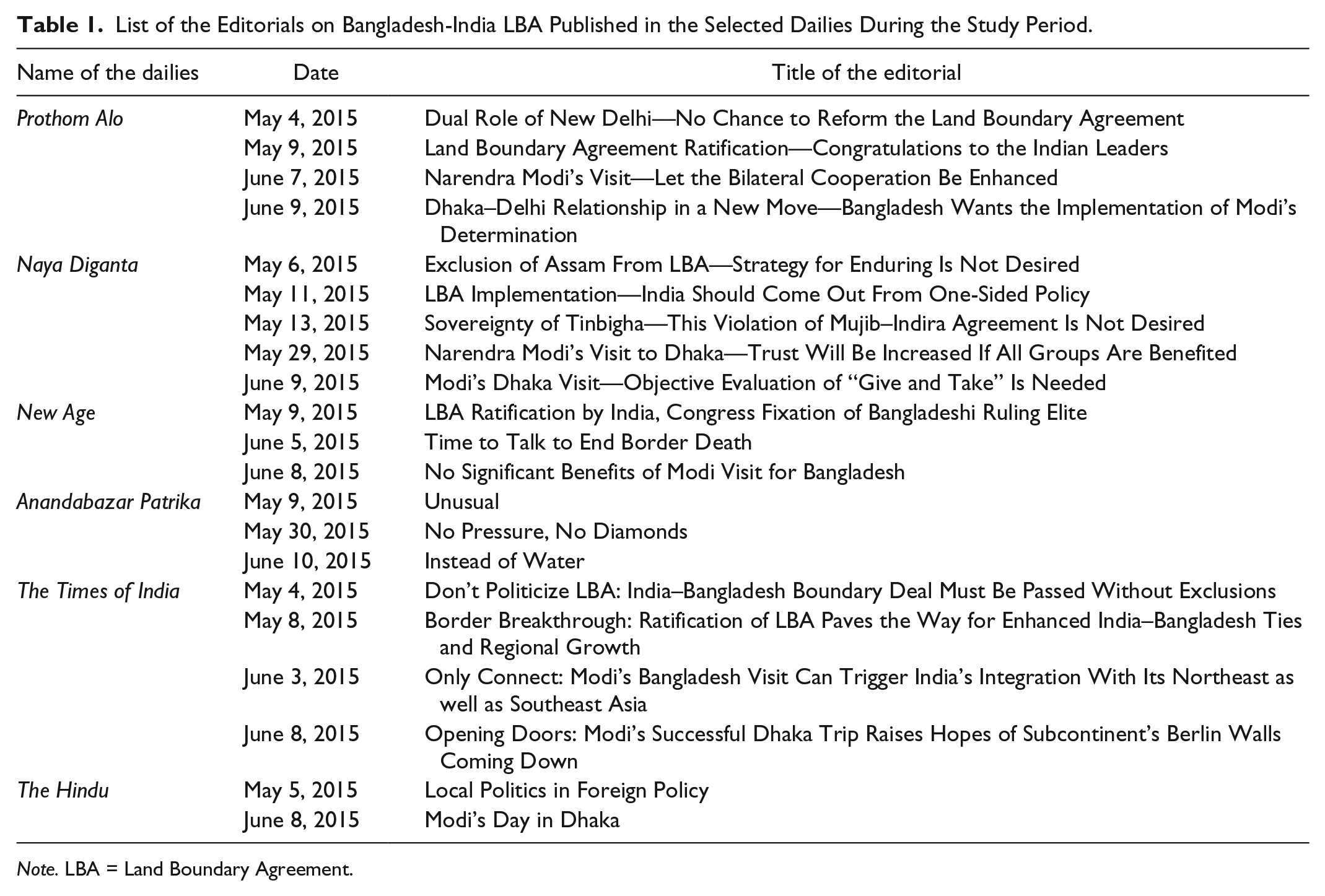
Note. LBA = Land Boundary Agreement.
Findings of the Study
The Prothom Alo
Editorial tone of the daily was critical to both of the governments—India and Bangladesh—as well as the policy makers for pending the issue. Dilly-dally of the Indian government and policy makers have been criticized boldly for not stepping forward to implement the LBA. The daily criticized India for not implementing the protocol signed during the visit of Manmohan Singh in 2011. Exclusion of Assam at the initial phase of tabling the amendment bill of LBA implementation by the Modi government has been critically viewed by the daily.
The editorial article titled, “Dual Role of New Delhi—No Chance to Reform the Land Boundary Agreement” published on May 4, 2015, criticized the initiative of putting forward the approval of the amendment bill by the Modi government in the face of opposition of the Assam BJP and termed the process as unacceptable. The tone of the article went for an inclusive solution to the issue. Similarly, the article viewed the role of the Bangladesh government in this regard as “ambiguous and weak.” In the article, it was questioned, “Which one is more important for the government—Modi’s visit or implementation of the agreement?”
Silence of Bangladesh Government regarding putting forward the issue has been also criticized in the editorial coverage. The editorial article titled, “Land Boundary Agreement Ratification—Congratulations to the Indian Leaders,” published on May 9, 2015, highly acknowledged the contribution of the Indian Prime Minister, Leader of the Opposition, and the Chief Ministers of the provinces concerning to the enclaves. Special thanks were paid to the Chief Minister of Assam. The article also implied on the sensible resolution of the pending Teesta water sharing deal. Apart from effective implementation of LBA, the daily has stressed on the rehabilitation of the inhabitants of the geographically scattered enclaves who were deprived of the citizen rights for 68 years.
The Naya Diganta
The editorial tone of the daily was strongly critical toward India’s policy. The daily boldly criticized initial step of the Modi government for tabling the amendment bill of LBA excluding Assam in the face of Assam BJP’s claim of losing land due to the implementation procedure. However, opposing the BJP’s statement, Assam’s Chief Minister outlined the real scenario of land distribution where it was depicted that the claim of BJP regarding losing of land was not true. Modi government did not pay heed to Assam BJP’s statement rather relied on the Chief Minister’s speech and included Assam in the process of LBA implementation through the parliamentary process of voting on the bill regarding the issue. The editorial published on May 11, 2015, explains that India always remains sincere to its own interests. The daily calls India to move from its one-sided stance regarding settlement of the bilateral issue. The editorial indicates Farakka issue too.
On May 13, 2015, the daily published an editorial where apprehension of losing sovereignty of “Tin Bigha Corridor” was felt due to continuous surveillance of Border Security Force (BSF) on the passage of the Bangladeshis though the corridor is leased to Bangladesh for 99 years. The editorial article titled, “Exclusion of Assam From LBA—Strategy for Enduring Is Not Desired,” published on May 6, 2015, emphasized that India should shun the intention of one-sided benefit and authoritative attitude in the interest of maintaining good relationship with Bangladesh. The article mentioned, “Unfortunately, Bangladesh is being often deprived of having rational and sympathetic attitude from India.” The daily, in this article, expressed its concern of security for the critics of Indian policies in Bangladesh.
In an editorial published on May 29, 2015, the daily indicated that the ruling Awami League has a big agenda to maintain good relation with Modi government for its wholehearted support to sustain in the power. Apart from these, the daily poured efforts to link between the speeches of some influential leaders of Awami League and apprehension of losing sovereignty of Bangladesh. The tone of the editorial implicated that two countries (Bangladesh and India) were turning together into one state.
The New Age
The daily was thoroughly found critical toward the stance of both the governments—Bangladesh and India—regarding delayed ratification of the long-pending LBA by the Indian Parliament. In an editorial titled, “LBA Ratification by India, Congress Fixation of Bangladeshi Ruling Elite,” the daily criticized the ruling party of Bangladesh, Awami League for its perceived dependence and preference to Congress for settling the LBA issue with India. At the same time, the daily toned that the BJP government promised more than the Congress to Bangladesh regarding settling bilateral disputes and preserving mutual relationship that developed around India’s support to the liberation war of Bangladesh. The daily suggested Awami League to keep pace with the reality rather than being obsessed to the political party, the Indian National Congress.
The daily voiced to establish linkage with the Awami League’s initiatives of LBA implementation and other bipartite relationship with India as a means of gaining support from the country to “cling to power.” The daily criticized the effort of BNP to gain support from India with a hope for its return to state power. The daily was critical toward the border killing by the BSF of India and India’s position regarding water sharing of the River Teesta. The daily rated Modi’s visit to Bangladesh as an insignificant event for the country.
The Anandabazar Patrika
The overall stance of the daily was in favor of the LBA issue though it has poured efforts to give a satirical analysis in some of its content. The tone of satire was mostly limited to Mamata and Modi’s political game and attitude. The daily elaborated how Modi managed Mamata to stand by his side during his visit to Bangladesh apart from emphasizing on political differences between the Chief Minister of West Bengal and the Prime Minister of India. The daily implicated the failure of Manmohan Singh in managing Mamata on the issue. The editorial tone of the daily emphasized on cooperation, coordination, and mutual understanding between the states and the central government of India. Dynamics of Assam issue in the process of LBA settlement amid ideological differences among political parties also got importance in the editorial coverage. The daily presented political analysis regarding differences and amity between Modi and Assam BJP. Political “gain–loss” has been also stressed over inclusion of Assam in the process of LBA settlement between India and Bangladesh.
The editorial article titled, “Unusual,” published on May 9, 2015, said,
To what extent the votes of BJP will decline in Assam due to the agreement with Bangladesh is not clear at all, if it declines, it will be a minimal loss. The ratification and implementation of the LBA will not only lessen the sufferings of the enclave dwellers but also pave the way of resolving a long pending issue and reinforce bilateral relationship with Bangladesh.
One of the mentionable aspects of the editorial coverage of the daily was to give credit to Modi government for his political gain over inclusion of Assam in the ratification process. As a result of such inclusion, Modi was able to manage the main opposition Congress’s support in the Parliament which was highly appreciated by the daily. Modi’s political stance, leadership, decisions, and determination were analyzed as positive and effective in the process of LBA ratification.
The Times of India
The daily thoroughly favored the process of LBA ratification. The daily urged the Modi government to implement the LBA without any delay and excuse. The editorials of the daily showed a great concern for boosting up regional development and mutual relationship through proper implementation of the LBA. The daily in its one editorial write-up stated, “Needless to say, operationalising LBA will give a tremendous boost to India-Bangladesh relations. With ratification of the agreement, the goodwill generated should propel both sides to settle other outstanding issues such as Teesta river water sharing and transit rights.” The daily wrote “must stop playing politics and ratify LBA without any exclusion” aiming at the Modi government. On May 8, an editorial titled, “Border Breakthrough: Ratification of LBA Paves the Way for Enhanced India–Bangladesh Ties and Regional Growth,” was written of which the tone of the words has expressed strong urge for LBA ratification and implementation. The daily also stressed on full ratification of the LBA as envisaged by New Delhi and Dhaka in their 2011 agreement. In one of its editorials published on June 8, 2015, the daily rated Modi’s visit to Dhaka as very successful one which “raises hopes of subcontinent’s Berlin wall coming down.”
The Hindu
The daily termed the LBA issue as a “Political Game” between the countries, political parties, and leaders. The tone of the editorial of the daily was also in favor of resolving the enclave issue that triggered from lack of consensus regarding LBA settlement between India and Bangladesh. The daily in its editorial viewed the enclave issue as an uncertainty and misery for 51,000 people of both the countries. The Hindu advocated for the inclusion of Assam in the process of LBA settlement. The daily, however, pinched Modi government and tried to link the LBA issue with the provincial politics and election. The editorials of the daily strongly criticized India’s delay in terms of taking on positive measures in regard to find a solution to the issue. The daily recognized the issue as a matter of India’s credibility to Bangladesh too and stressed on promotion of friendly relationship with the neighborhood through peaceful resolution of the same.
The editorial article titled, “Local Politics in Foreign Policy,” published on May 5, 2015, clearly implies that the Government of India should have minimized the “lapse of communication” with Bangladesh regarding the revised plan of the amendment bill regarding the LBA ratification. In the same article, the delays of India at different stages were marked and said, “Each of these delays don’t just put off an agreement to resolve a crucial issue between India and Bangladesh, they chip away at India’s credibility in the neighbourhood.”
Analysis of Findings
Both Naya Diganta and the New Age were found expressing the views almost in similar manner. Editorial tone of both the dailies was critical toward both the government of India and Bangladesh. The Naya Diganta endeavored to establish a relationship of the ruling Awami League with the Government of India, especially with Modi’s administration for availing support to remain in the state power. On the contrary, the daily tried to represent the government and policy makers of India concentrating on their own interests rather than considering bilateral relationship with Bangladesh. The New Age, conversely, put more emphasis on the role of the Indian government for not resolving the lengthy LBA issue. The editorials were found critical to point out India’s responsibilities for pending the issue for decades. The editorials of the Prothom Alo have concentrated on event and issue-based development of the LBA ratification and implementation process. The daily was critical toward both the government of India and Bangladesh in regard to resolving the bilateral issue. However, pro-Bangladesh and pro-people attitude of the editorial contents were reflected while the tone of criticizing India’s role was predominant.
The Times of India was found possessing an attitude toward the betterment of the people of both the countries rather than the political and diplomatic gain over LBA issue. The editorial focus of the daily laid on bilateral relation, regional economic growth, peaceful coexistence, and mutual understanding between the countries. The daily advocated for maintaining a friendly relationship based on mutual trust and benefits through settling down the issue. The daily, even being published from India, has boldly criticized Indian policies and the political dilemma surrounding ratification and implementation of the LBA as well as urged the Indian government to quicken the process of resolving the prolonged enclave crisis.
The Hindu has expressed almost similar type of notion showed by the Times of India. Editorial tone of the daily in analyzing the facts concerning the LBA and enclave issues can be rated as liberal. The daily, like the Times of India, showed its stance toward maintaining a bilateral relationship through peaceful and quick settlement of the long-drawn-out LBA issue in the interest of the regional development. The daily seemed critical to the delay of India’s policy makers in resolving the issue. Satire.
Apart from the above two dailies, the Anandabazar Patrika, was somewhat different in viewing the issue and showing its standpoint. Tone of the editorial coverage of the daily seemed light and satirical. The editorial write-ups were found paying more attention on the interpretation of the political dynamics and relation between the political parties of India rather than pouring deep concentration on the LBA issue itself. Debates over the power, politics, and influence structures between the central and provincial government and the political parties of India were emphasized in the editorials. However, the daily’s bias toward steering on mutual relationship and interest between Bangladesh and India was visible.
Conclusion
The editorial stance of the dailies can be rated upholding both the national and bipartite interests on the whole. Presentation and analysis of the facts in the editorials were linked with the political and ideological affiliation of the owners and the editors of the dailies. For example, the Naya Diganta, perceived as the rightist daily having direct political and ideological affiliation with Bangladesh Jammat-e-Islami, critically portrayed the issue emphasizing the government’s reported attachment with India for sustaining into power. The editorials of the Prothom Alo were written with moderate balancing between facts and public interest. The daily tried to analyze the situations around the LBA issue considering the political dynamics of both the countries rather than blaming any government blindly. On the contrary, the New Age perceived as one of the dailies having leftist ideology was more critical to India’s role in settling down the issue. The Indian dailies were found expressing different tones too. The Anandabazar Patrika was found more critical to Mamata’s administration while the Times of India and the Hindu were critical toward the policies of the Government of India. The aforesaid analyses facilitate to conclude that the Indian dailies played more versatile role through liberal presentation of the content, neutralized analysis, and call for the greater welfare of the people of both the countries.
Footnotes
Declaration of Conflicting Interests
The author(s) declared no potential conflicts of interest with respect to the research, authorship, and/or publication of this article.
Funding
The author(s) received no financial support for the research, authorship, and/or publication of this article.