




Abstract
College students’ intercultural competence (ICC) has become a focus of many higher education institutions. Yet, more work can be done to explore what variables play a role in this complex and multifaceted process. The current study investigated the association between the outcomes (i.e., cognitive, intrapersonal, and interpersonal domains of ICC), cultural identity (i.e., majority group and international status), personality traits (i.e., extraversion, agreeableness, conscientiousness, neuroticism, and intellect/imagination), and social exposure (i.e., racial/ethnic and international diversity of friendships) for a culturally diverse sample of 179 incoming college women. After controlling for the cultural identity, personality traits, and social exposure variables, majority group status and intellect/imagination significantly predicted students’ openness to considering varied cultural perspectives (i.e., cognitive knowing). Findings indicated that White students had higher scores on the Cognitive Knowing subscale of ICC compared with students of Color. In addition to social cultural exposure, conscientiousness remained as a significant predictor of cognitive knowledge (i.e., factual knowledge, understanding, and awareness of various cultures) after controlling for all the other variables in the model. Extraversion and neuroticism persisted as a significant predictor of the intrapersonal identity and self-awareness component of ICC. Next, agreeableness and racial/ethnic diversity of friendships were key predictors of intrapersonal affect or cultural-emotional intelligence and attunement. Intellect/imagination, racial/ethnic, and international diversity of friendships all significantly predicted interpersonal sociocultural interaction. Finally, agreeableness and racial/ethnic diversity of friendships was linked with the social responsibility component of intercultural competence. The findings and their implications for higher education are discussed.
The world is becoming increasingly complex, interconnected, and interdependent. Global issues become local problems, and the steps taken to address these problems have global resonance. More than ever, college students must develop self-awareness and interpersonal competencies to function productively in this era of rapid globalization (Altbach & Knight, 2007; Jones & de Wit, 2012). These competencies can have both macro and micro impacts. Global educational experience can bolster students’ global citizenship, engagement, and advocacy for social justice (Clarke & Drudy, 2006; Gibson, Rimmington, & Landwehr-Brown, 2008). It is also related to higher levels of self-awareness (Chao, Okazaki, & Hong, 2011), creativity, and self-expression (Leung, Maddux, Galinsky, & Chiu, 2008). Cultural heterogeneity in higher education has been associated with institutional benefits such as improved student retention and overall satisfaction with their university (Chang, 2001).
As colleges seek to foster students’ intercultural awareness and skills, they must acknowledge the complex relationship between an array of factors such as students’ personality, gender, race, ethnicity, and social relationships. Recent research highlights the intersectional nature of cultural competence development and emphasizes the role of an individual’s own identity and background in how they perceive others (Wright, 2015). These intraindividual and interindividual variables play key roles in cultural attitudes and assumptions (Arthur & Bennett, 1995; Caligiuri, 2000). Interestingly, a field that focuses on cross-cultural understanding has often minimized these factors and focused more on general intercultural competence (ICC) without integrating an exploration of how individual differences, such as race and immigration status, may inform ICC.
Defining ICC
ICC has been defined multiple ways. It can be conceptualized as “the process of learning a new culture and its language and behaviors in an effort to understand and empathize with the people of the culture and to live among and interact successfully with them” (Sorti, 1990, p. 6). Darla Deardorff’s (2006b) Intercultural Competence Framework and Model highlights the intergroup attitudes, knowledge, and skills that help individuals “interact successfully with those from different cultures.” Abe and Wiseman’s (1983) seminal work identified abilities (e.g., the ability to deal with unfamiliar situations) that fit into interpersonal relationship-building, effective communication, or psychological stress-management domains. Chen and Starosta (2000) group ICC into three affective and applied components that include (a) sensitivity: the ability to notice, appreciate, and understand cultural differences; (b) awareness: understanding the impact of culture on interactions; and (c) skills: applied abilities that facilitate effective intercultural interactions.
Looking more at the intellectual process, Hunter, White, and Godbey (2006) frame global competence (a specific type of ICC) as a cognitive process that allows for effective cross-cultural encounters including the necessity of “having an open mind while actively seeking to understand cultural norms and expectations of others, and leveraging this gained knowledge to interact, communicate, and work effectively outside one’s environment” (p. 270). Their definition underscores both the internal (personal traits and attitudes that help one effectively interact across cultural boundaries) and external readiness (knowledge and skills gained through education and life experience) that precipitates interculturally competent contact. Others have focused even more on personality traits and disposition. Chiu, Lonner, Matsumoto, and Ward (2013) investigate the set of individual characteristics and traits within a person that, when manifested, ease intercultural relationships, while Matsumoto and Hwang (2013) examine knowledge and applied skills that demonstrate competence.
The current study hones in on ICC development in women college students, primarily how their individual, internal traits and intercultural experiences shape cognitive, intrapersonal, and interpersonal facets of ICC. We seek to explore the association between students’ internal traits and their intercultural skills and intergroup attitudes. Drawing from these various terms and models, we will use the term intercultural competence that refers to students’ awareness of, knowledge about, and skills needed to interact and communicate effectively with individuals from a different country than one’s self-identified home country (Deardorff, 2006b; D. W. Sue & Torino, 2005).
ICC Development in College Students
Developing and nurturing ICC is essential to the education process and is certainly intertwined with and affected by multitude aspects of college life. ICC has been linked with favorable outcomes for students’ learning such as more reflective self-awareness (Chao, Okazaki, & Hong, 2011) and stronger critical thinking skills (Chiu & Hong, 2005).
Moreover, the higher education environment lends itself to ICC development for several reasons. For one, the college years often coincide with a developmental period—emerging adulthood—that occurs between the ages of 18 and 25 (Arnett, 2000; Gurin, Dey, Hurtado, & Gurin, 2002). Throughout this dynamic time of exploration and growth, young people work to establish their independent sense of selves as adults (Arnett, 2000). Emerging adults form views about themselves and others while exploring their values and worldviews (Eccles, Templeton, Barber, & Stone, 2003). Because of this, higher education institutions (HEIs) have a powerful opportunity to impact students’ cultural competence development in a lasting way (Kitsantas, 2004).
Global learning initiatives and communication exchanges infused into the college curriculum can promote the enrichment of students’ understanding about global issues through recognition of commonalities between their own lives and their cohorts from other cultures (Patterson, Carrillo, & Salinas, 2012).
Personality Traits and ICC
The five-factor model (FFM) of personality includes five different characteristics that can be used to describe individuals’ personalities (Digman, 1990; Ewen, 1998). It describes a person’s tendency to embody the following characteristics:
Extraversion: an outward focused and tendency toward being outgoing.
Neuroticism (sometimes labeled Emotional Stability): a tendency toward anxiety, moodiness, and preoccupation.
Intellect and Imagination (sometime labeled Openness): an appreciation for and willingness to engage with new experiences and ideas.
Agreeableness: a general attitude of compassion, caring, and cooperation with others.
Conscientiousness: a tendency toward organization and thoughtfulness.
The FFM has been found to be one of the most stable, consistent ways to classify personality traits, with persistence over time and validity across age, language, gender, and cultural groups (Barrick & Mount, 1991; Costa & McCrae, 1992; Digman, 1990; Ewen, 1998)
The association between personality traits (i.e., an individual’s enduring and habitual patterns of thought, feeling, and behavior) and ICC has yielded mixed results (Ward, Leong, & Low, 2004). Ang, Van Dyne, and Koh (2006) find an association between business undergraduates’ agreeableness, extraversion, and intellect imagination and facets of the four-factor model of cultural intelligence (defined as the skills to engage effectively in novel situations with significant diversity). Findings reveal that individuals high in agreeableness are not only accommodating and receptive to foreign experiences, but they are also skilled at minimizing manifestation of conflict escalation in social contexts. Needless to say, they are often perceived as more likable because of their supportive and prosocial behavior (Penner, Dovidio, Piliavin, & Schroeder, 2005). Some research has suggested that extraverts are more likely than introverts to initiate social interactions with people from diverse backgrounds (Liu & Huang, 2015; Mooradian & Swan, 2006)
It is worth bearing in mind that personality traits often interact with myriad factors inherent in the social context. Even if personality traits do not directly determine the degree of an individual’s intercultural competency, they indubitably shape the way people respond to their situational variables in a way that may affect people’s attitudes and behaviors (Weiss & Adler, 1984). While some aspects of ICC may be innate and ingrained (Benahnia, 2012), it is likely that students can increase ICC learning about and being exposed to cultures other than their own.
Social Exposure and ICC
HEIs’ study abroad opportunities are perhaps the most recognized social exposure venues for students to gain ICC (Deardorff, 2006a; Williams, 2005b). Various factors including, race, ethnicity, and socioeconomic status may impact students’ decisions about studying abroad. This is particularly true for people of Color and first-generation college students (Shaftel, Shaftel, & Ahluwalia, 2007). For example, although Black students make up 16% of U.S. postsecondary enrollment, they comprise only 5% of students who study abroad (NAFSA, 2013). Moreover, Open Doors (2012) reports that 289,408, or 9% of all undergraduate students in the United States, participated in study abroad programs during the 2012-2013 academic year. Also, many students hesitate to leave campus because some institutional policies make credit transfer difficult, resulting in a negative impact on students’ trajectory toward graduation (Shaftel et al., 2007).
Moreover, there are rich opportunities to incorporate global learning across the undergraduate experience. In particular, as the student body becomes more diverse, social relationships can play an important role in ICC development (Pohl, 2015). Social relationships, friendships, and interactions with people from varied backgrounds and cultures have been posited to be the most impactful aspects of the college experience (Astin, 1993), as it may attune students to divergent viewpoints breaking down cultural barriers and unshackling their mind from ethnocentrism that debilitate intercultural competency. Thus, the presence of diversity of friendships may play a pivotal role in students’ attitudes and competencies necessary to thrive in an increasingly heterogeneous world.
In a time of developmental growth and exploration, college students often encounter more diversity than they ever have before (Arnett, 2000; Gurin et al., 2002). During the developmental period of emerging adulthood, college students’ peer relationships play a vital role in identity formation (Brown & Larson, 2009; Laursen & Williams, 1997; Seiffge-Krenke, 2013). As young people move from adolescence to young adulthood, social relationships help shape their lasting worldviews, values, and beliefs (Gurin et al., 2002). Globally related social relationships during college offer students an ongoing venue to practice understanding and apply their developing cross-cultural skills.
The Current Study
Interest in ICC in higher education has expanded greatly in recent years (Parkinson, 2009; Sperry, 2012; L. Turner, 2005). Yet, much of the research struggles to isolate what specific college experiences contribute to college students’ ICC development. Developing ICC requires time and opportunities for refinement (Hammer, Bennett, & Wiseman, 2003; Lee, Poch, Shaw, & Williams, 2012). Thus, it is crucial to learn how precollege involvement and interactions affect incoming college students’ worldviews and their intercultural competencies at baseline. The current study utilizes baseline data that capture an incoming portrait of these college women participants. This exploratory study will form the foundation of follow-up, longitudinal research that will help identify how students change over time. It will also help illuminate key variables that may contribute to ICC development.
This type of research can help the field better understand the role of students’ background, individual characteristics (such as personality traits), and experiences on ICC development (Magala, 2005; D. W. Sue, 2001). The study will examine the associations among various variables: college women’s cultural identity (majority group status, international status), personality traits (extraversion, agreeableness, conscientiousness, neuroticism, intellect/imagination), social cultural exposure to culturally different others (racial/ethnic and international diversity of friendships), and six facets of ICC. We hypothesize that there will be differences in the ICC outcomes of interest, such that students of Color and international students will have higher scores on the various domains than their peers. We also predict that extraversion and agreeableness will be related to the interpersonal social interaction domain of ICC and that intellect/imagination will be associated with the cognitive domains of ICC. Finally, we hypothesize that participants who have greater social exposure to individuals from different cultural backgrounds will also have higher levels of intrapersonal affect and interpersonal social interaction aspects of ICC. This exploratory study will serve as a first step to guide future research. The results will be used to shape recommendations for future assessment and data collection and help identify areas of focus for further review.
Method
Participants
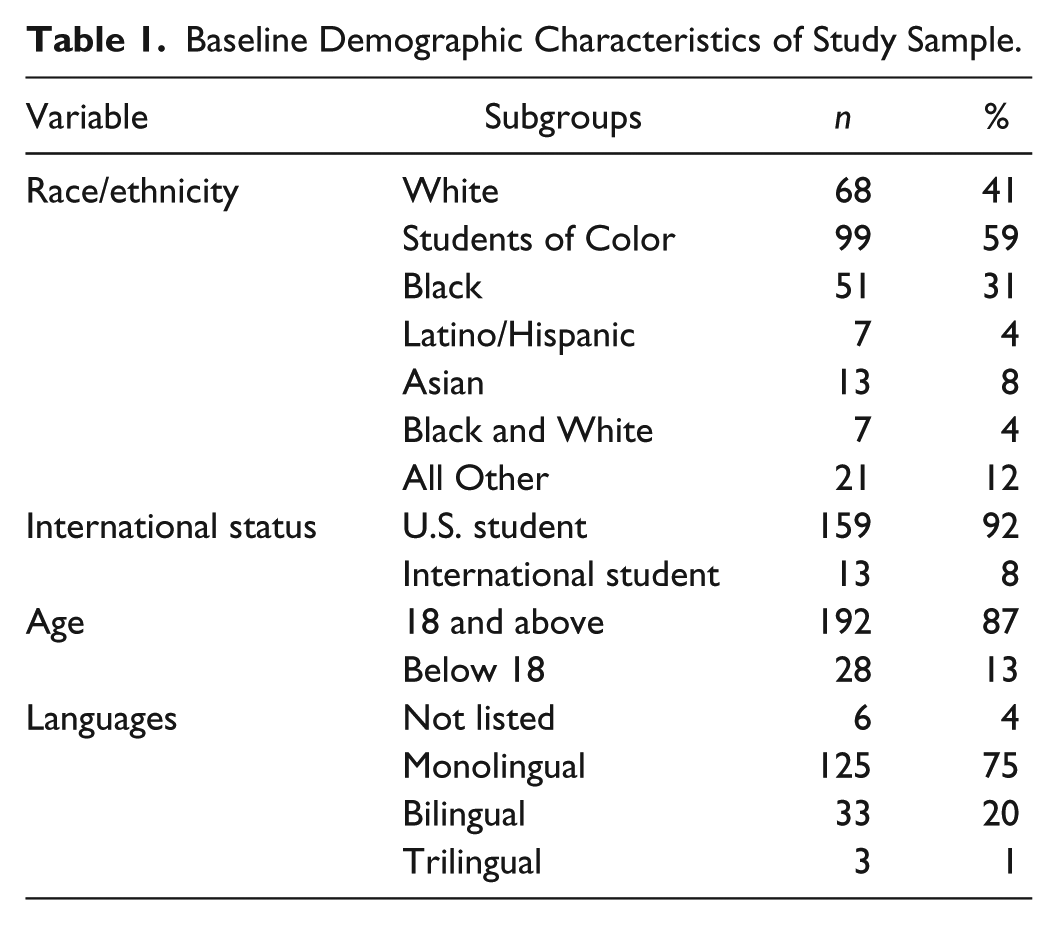
The sample included the entire incoming class of students at a small, private, liberal arts, all-women’s college in the Southeastern United States. Of these 279 entering students, 236 started the survey (84% of participants contacted) and 179 finished it (64%). Ninety-five percent of participants were attending college for the first time, and all identified as first-year students. The racial/ethnic composition of the sample was representative of the college with 41% self-identifying as White only, 31% as Black, 8% as Asian, 4% as multiracial (Black and White), and the remaining 16% identifying as another racial/ethnic group. Ninety-two percent of the college women in this sample identified the United States as home. Table 1 includes a more thorough breakdown of the sample and its racial/ethnic and language background. The college launched a comprehensive initiative, Summit, in the fall of 2015. Summit reinvents the liberal arts curriculum to focus on leadership development and global learning throughout a student’s college tenure. Summit fortifies the current mission of the college of educating “women to think deeply, live honorably and engage the intellectual and social challenges of their times.”
Baseline Demographic Characteristics of Study Sample.
Procedures
These baseline data were collected in early August of 2015 before students arrived on campus and began participation in Summit. At the point of data collection, 279 of the enrolled students were contacted with a link to complete the survey using Qualtrics online survey software. Initial recruitment and reminder messages were sent via electronic mail to the students’ college-affiliated addresses. Additional messaging about the survey was posted on the incoming class’ official Facebook page. The survey questionnaire took an average of 10 min to complete.
Measures
Cultural identity variables
The study incorporated two facets of cultural identity—majority group status (i.e., Person of Color or White) and self-reported home country (i.e., international status)—to better understand how ICC may differ between these groups. We utilized self-reported home country as opposed to other proxies (e.g., international student status), to enable students’ to report their own identity and categorize themselves. For example, although a student may hold a passport from the United States, they may self-identify Kenya as their home country having grown up there with their family.
Personality traits
The 20-item mini-International Personality Item Pool (mini-IPIP) was utilized to assess students’ personality traits (Donnellan, Oswald, Baird, & Lucas, 2006). This brief measure was modified using items from the longer International Personality Item Pool and examines Big Five personality traits (extraversion, agreeableness, conscientiousness, neuroticism, and intellect/imagination). Participants respond on a Likert-type scale (1 = very inaccurate, 2 = moderately inaccurate, 3 = neither inaccurate nor accurate, 4 = moderately accurate, and 5 = very accurate) indicating how many statements portray them as they are now. Sample statements to which participants rate their agreement include “am the life of the party” (extraversion), “sympathize with others’ feelings” (agreeableness), “make a mess of things” (reverse-coded, conscientiousness), “get upset easily” (neuroticism), and “am not interested in abstract ideas” (reverse-coded, intellect/imagination).
For this study’s sample, the Extraversion subscale exhibited good reliability with a Cronbach’s alpha of .84, and there was acceptable reliability for the Agreeableness (α = .68), Conscientiousness (α = .69), and Neuroticism (α = .64) subscales. The reliability of the Intellect/Imagination subscale (α = .59) was poor for this sample (Nunnally & Bernstein, 1994).
Social cultural exposure
Students reported the racial/ethnic and international diversity of their friendships using a sliding scale. This scale ranged from 0 (totally homogeneous with no racial ethnic/international diversity) to 100 (totally heterogeneous with each friend from a different international background).
Dimensions of ICC
ICC was measured using the New Student Form version of the Global Perspectives Inventory (GPI; Braskamp, Braskamp, & Engberg, 2014). This scale assesses the holistic development of a global perspective with three dimensions (each with two subscales) that assess different facets of ICC: (a) cognitive (Knowing and Knowledge subscales), (b) intrapersonal (Identity and Affect subscales), and (c) interpersonal (Social Responsibility and Social Interactions subscales).
Within the cognitive dimension, the Knowing subscale assesses the “degree of complexity of one’s view of the importance of cultural context in judging what is important to know and value,” whereas the Knowledge subscale explores the “degree of understanding and awareness of various cultures and their impact on our global society and level of proficiency in more than one language.” In the intrapersonal dimension, the Identity subscale assesses “level of awareness of one’s unique identity, sense of purpose, and degree of acceptance of one’s identity,” and the Affect subscale explores “level of respect for and acceptance of cultural perspectives different from one’s own and degree of emotional confidence when living in complex situations.” For the interpersonal dimension, the Social Responsibility subscale examines the “level of interdependence and social concern for others,” and the Social Interactions subscale captures the “degree of engagement with others who are different from oneself and degree of cultural sensitivity in living in pluralistic settings” (“GPI Dimensions,” 2015).
The New Student form is utilized to collect baseline information from incoming first-year students and includes items related to students’ academic and cocurricular high school experiences. Students responded to 35 items using a 5-point Likert-type scale (1 = strongly disagree, 2 = disagree, 3 = neutral, 4 = agree, and 5 = strongly agree) on questions related to their own cultural identity and feelings toward those who are culturally different. Sample items included “Some people have a culture and others do not,” “I see myself as a global citizen,” and “I frequently interact with people from a different race/ethnic group than my own.” The Cognitive Knowing subscale had a poor Cronbach’s alpha of .54, and the Cognitive Knowledge subscale had an acceptable reliability (α = .71). Within the intrapersonal dimension, the Identity and Affect subscales’ reliability were acceptable (α = .67; α = .62). Finally, for the interpersonal dimension, the Social Interaction and Social Responsibility subscales were also acceptable (α = .65; α = .71; Nunnally & Bernstein, 1994).
Analysis plan and justification
This exploratory study will help identify possible associations between college women’s cultural identity, personality traits, social cultural exposure, and the three subscale dimensions of ICC. We will also examine potential variations related to students’ cultural identity variables (i.e., majority group status, international status). To do this, first, we will use a MANOVA to check for differences in the outcomes based on the identity variables. Next, given the lack of a theoretical model linking the variables of interest, we will employ the use of stepwise linear regressions. We will progressively add cultural identity variables (Step 1), personality traits (Step 2), and social cultural exposure (Step 3). We will run six separate linear regressions for the ICC outcomes of interest: (a) cognitive knowing, (b) cognitive knowledge, (c) intrapersonal identity, (d) intrapersonal affect, (e) interpersonal social interactions, and (f) interpersonal social responsibility.
Results
Preliminary Analyses
The data were screened and checked for their accordance to several assumptions. These assumption checks evaluated (a) the ratio of participants to independent variables, (b) independence, (c) collinearity in coefficients, (d) outliers, (e) leverage, and (f) normality. For the first assumption, we found that we had at least five participants for each of our seven independent variables, satisfying this condition. We also found that our residuals were independent with a Durbin–Watson score of 1.92. Regarding collinearity in the coefficients, none of the values exceeded .90, suggesting that they were not overly correlated. We also did not find multicollinearity or singularity, with no items highly loaded on the same dimension. However, we detected outliers in the data and removed cases that exceeded a Mahalanobis distance of 14.067 or a Cook’s value of 1.00 for future analyses. In addition, we removed cases with leverage scores greater than .10. Univariate normality values were assessed through visual inspection of histograms and evaluation of skewness and kurtosis. These values fell within limits for all groups (<1.0), and the histograms demonstrated moderately normal form. Table 2 includes correlation and descriptive information for the sample.
Study Variable Descriptives (n = 172).

ANOVA
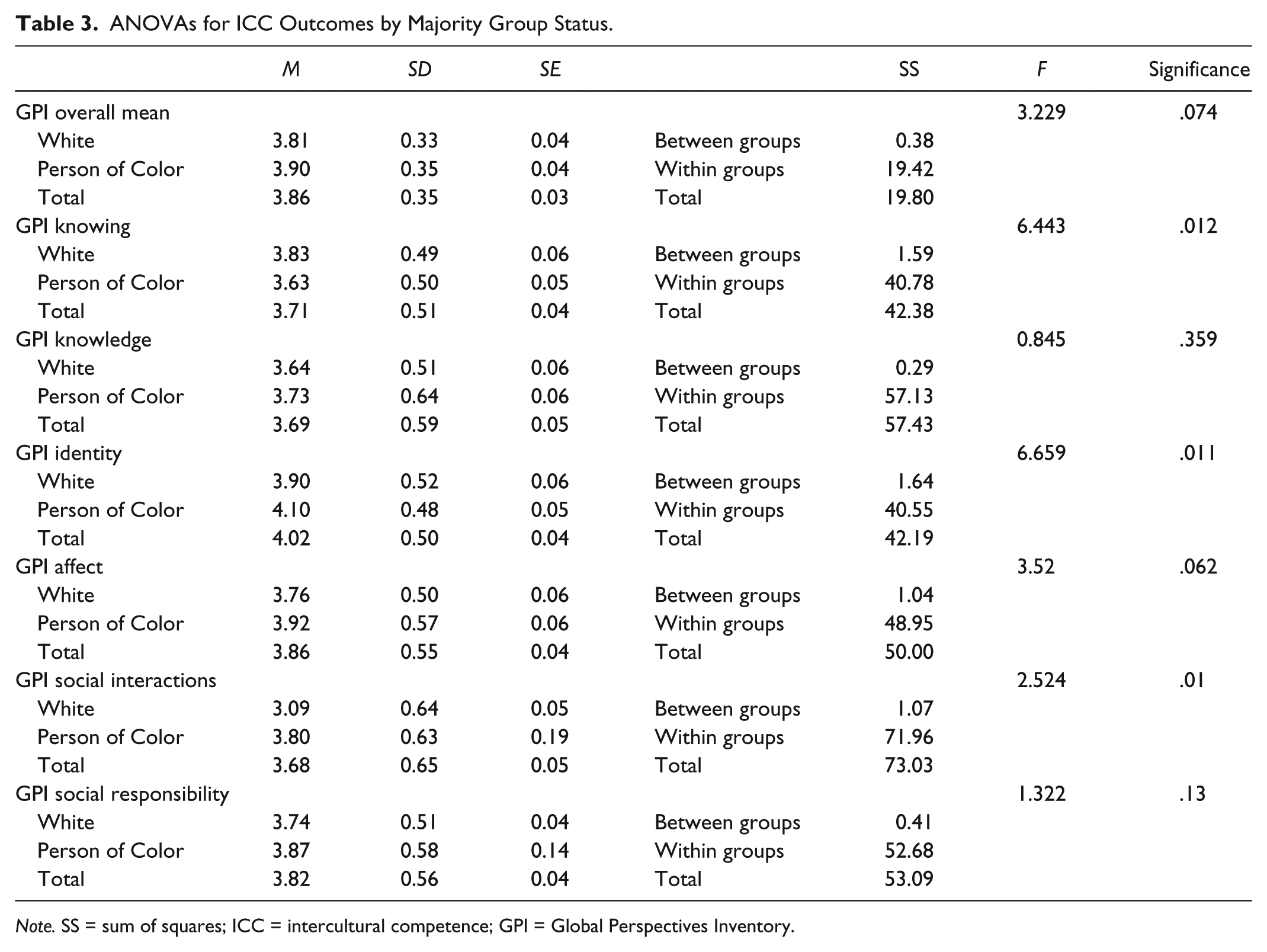
Next, two analyses of variance (ANOVAs) to test for potential differences in the outcome variables by (a) international status and (b) majority group status were performed (see Table 3). As a note, we dummy-coded the culturally identity variables. For majority group status, White students were coded with a 0, whereas students of Color were coded with a value of 1. For international status, students who identify the United States as home were coded with a 0 and those with another home country were coded with a 1.
ANOVAs for ICC Outcomes by Majority Group Status.
Note. SS = sum of squares; ICC = intercultural competence; GPI = Global Perspectives Inventory.
We found no significant differences in any of the outcomes based on international status. We did find differences in the three facets of ICC based on majority group status. White students had higher Cognitive Knowing scores (M = 3.83, SD = .49) than students of Color (M = 3.63, SD = .50), F(1, 165) = 6.44, p = .012. Students of Color had greater Intrapersonal Identity scores (M = 4.10, SD = .48) than White students (M = 3.90, SD = .52), F(1, 165) = 6.66, p = .011. Finally, students of Color had greater Interpersonal Social Interactions scores (M = 3.80, SD = .63) than White students (M = 3.51, SD = .64), F(1, 170) = 8.291, p = .005.
Stepwise Linear Regressions
We ran six separate stepwise linear regression models to explore the outcomes of interest: college women’s cognitive knowing (Model 1) and knowledge (Model 2), intrapersonal identity (Model 3) and affect (Model 4), and interpersonal social interactions (Model 5) and social responsibility (Model 6). In both models, the same variables were added in each step to enable comparisons across models. Cultural identity variables were added in the first step, personality traits in the second, and social cultural exposure in the third.
In the first model with the outcome of cognitive knowing, the final R2 of .13 suggested that 13% of variance in this facet of ICC was explained by these variables, F(9, 142) = 3.26, p = .001. In Step 1, majority group status had a significant main effect (β = −.25, p = .002). White students had higher scores on this subscale (M = 3.83, SD = .49) than students of Color (M = 3.63, SD = .50). In the second step, with the addition of personality characteristics, majority group status (β = −.23, p = .005) and intellect/imagination (β = .21, p = .013) remained as significant predictors. In the final step, social cultural exposure variables were added. Majority group status (β = −.26, p = .002) and intellect/imagination (β = .20, p = .019) significantly predicted the cognitive knowing facet of ICC (see Table 4).
Stepwise Linear Regression Predicting Models 1 and 2—Cognitive Knowing and Knowledge.

p < .05. **p < .01.
In the second model for the outcome of cognitive knowledge, the final R2 of .20 suggested that 20% of variance in this aspect of ICC was explained by these variables, F(9, 142) = 4.96, p < .001. In Step 1, none of the cultural identity variables had a significant main effect. In the second step, with the addition of personality characteristics, extraversion (β = .18, p = .033) and conscientiousness (β = .19, p = .027) were significant predictors. In the final step, social cultural exposure variables were added. Conscientiousness (β = .17, p = .033) and the international diversity of friendships (β = .30, p = .001) significantly predicted the cognitive knowledge facet of ICC (see Table 4).
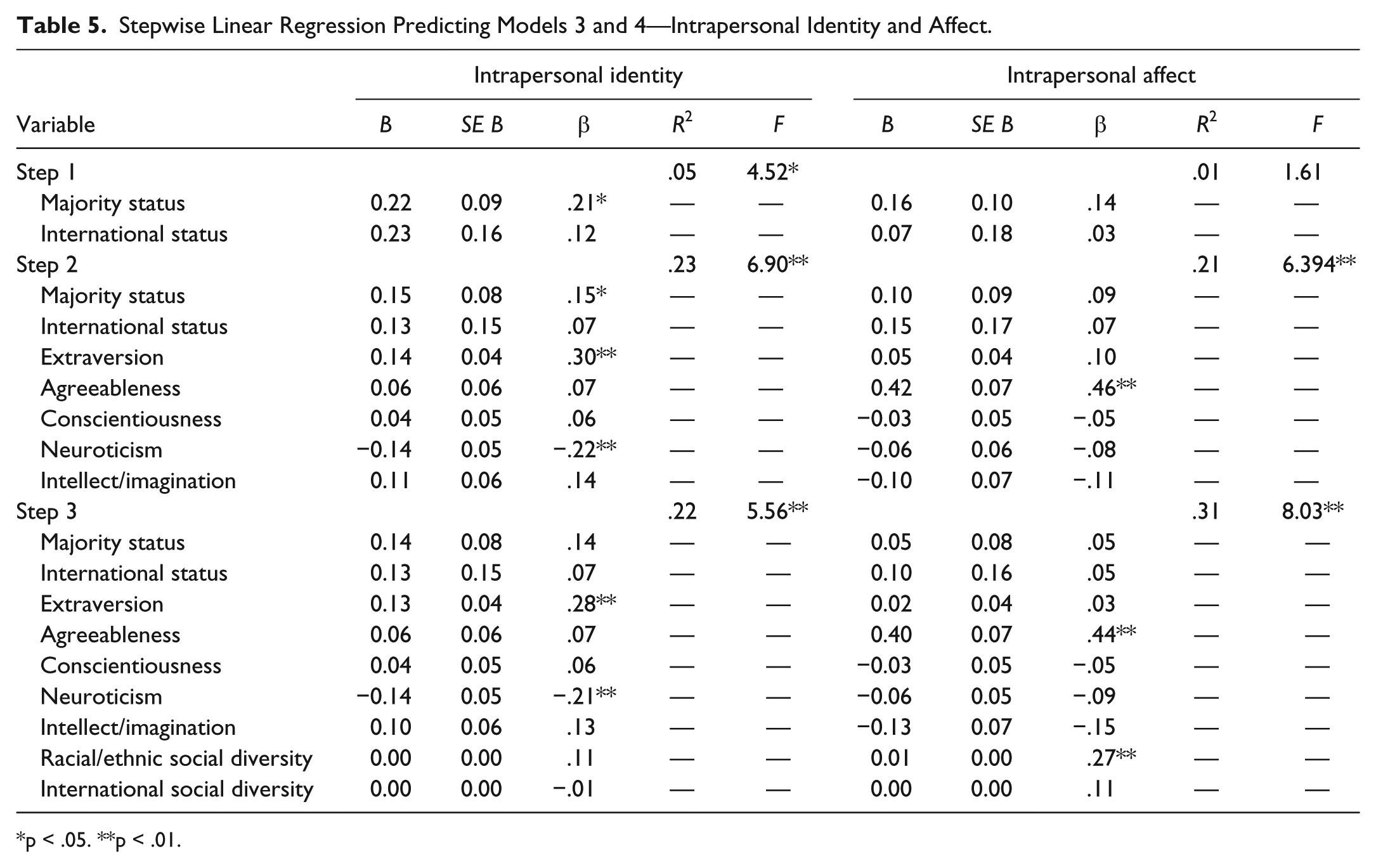
In the third model, with the outcome of intrapersonal identity, the final R2 of .22 suggested that 22% of variance in this element of ICC was explained by these variables, F(9, 142) = 5.56, p < .001. In Step 1, majority group status had a significant main effect (β = .21, p = .012). Students of Color had higher scores on this subscale (M = 4.10, SD = .48) than White students (M = 3.90, SD = .52). In the second step, with the addition of personality characteristics, majority group status (β = .14, p = .054), extraversion (β = .30, p < .001), and neuroticism (β = −.22, p = .005) remained as significant predictors. In the final step, social cultural exposure variables were added. Extraversion (β = .28, p = .001) and neuroticism (β = −.21, p = .006) significantly predicted the intrapersonal identity facet of ICC (see Table 5).
Stepwise Linear Regression Predicting Models 3 and 4—Intrapersonal Identity and Affect.
p < .05. **p < .01.
In the fourth model, with the outcome of intrapersonal affect, the final R2 of .31 suggested that 31% of variance in this element of ICC was explained by these variables, F(9, 142) = 8.03, p < .001. In Step 1, there was no main effect. In the second step, with the addition of personality characteristics, agreeableness (β = .46, p < .001) was a significant predictor of intrapersonal affect for ICC. In the final step, social cultural exposure variables were added. Agreeableness (β = .44, p < .001) and racial/ethnic diversity of friendships (β = .27, p = .001) significantly predicted the intrapersonal affect aspect of ICC (see Table 5).
In the fifth model, with the outcome of interpersonal social interaction, the final R2 of .41 suggested that 41% of variance in this element of ICC was explained by these variables, F(9, 142) = 20.64, p < .001. In Step 1, there was a main effect for majority group status (β = .16, p < .056). In the second step, with the addition of personality characteristics, extraversion (β = .16, p = .046) and intellect/imagination (β = .24, p = .004) were significant predictors of interpersonal social interaction for ICC. In the final step, social cultural exposure variables were added. Intellect/imagination (β = .17, p = .005), racial/ethnic diversity of friendships (β = .54, p < .001), and international diversity of friendships (β = .22, p = .001) significantly predicted the interpersonal social interaction aspect of ICC (see Table 6).
Stepwise Linear Regression Predicting Models 5 and 6—Interpersonal Social Interaction and Responsibility.

Note. GPI = Global Perspectives Inventory.
p < .05. **p < .01.
In the sixth and final models, with the outcome of interpersonal social responsibility, the final R2 of .30 suggested that 30% of variance in this element of ICC was explained by these variables, F(9, 142) = 7.66, p < .001. In Step 1, there was no main effect. In the second step, with the addition of personality characteristics, extraversion (β = .17, p = .027) and agreeableness (β = .43, p < .001) were significant predictors of interpersonal social responsibility for ICC. In the final step, social cultural exposure variables were added. Agreeableness (β = .41, p < .001) and racial diversity of friendships (β = .26, p = .002) significantly predicted the interpersonal social responsibility aspect of ICC (see Table 6).
Discussion
Our study explored the complex relationship between cultural identity variables (i.e., majority group and international status), personality traits, social cultural exposure, and different facets of ICC. Research on ICC highlights the complex interplay between individual traits (e.g., race/ethnicity), internal characteristics (e.g., cognition, self-knowledge), and experiences (e.g., study abroad) that can impact how individuals develop cultural knowledge, skills, and awareness (Deardorff, 2006a). While prior research has examined these variables separately, our study sought to synthesize these different components to explore the roles they may play in students’ ICC development process more holistically. Moreover, we aimed to consider different aspects of ICC—the cognitive, intrapersonal, and interpersonal domains that comprise this complex construct.
Differences by Cultural Identity
Contrary to our hypothesis, considering the cultural identity variables of interest for this study, we found no differences in any of the ICC outcomes of interest (cognitive knowing and knowledge, intrapersonal identity and affect, interpersonal social interactions and social responsibility) by international status after running a one-way ANOVA. This may be because of the small sample of international students included (n = 15, 8%). In contrast, we did find difference based on majority group status.
Students of Color had higher scores on the Intrapersonal Identity and Interpersonal Social Interaction subscales compared with White students. The Intrapersonal Identity subscales measure students’ awareness and acceptance of their own identity, with items such as “I know who I am as a person” and “I have a definite purpose in my life.” The Interpersonal Social Interaction subscale measures students’ sensitivity toward and engagement with culturally different others, with items such as “I am open to people who strive to live lives very different from my own lifestyle” and “Most of my friends are from my own ethnic background” (reverse-coded). White students reported higher levels of ICC Cognitive Knowing—a sort of cultural critical thinking subscale that assesses students’ ability to consider multiple perspectives and cultural contexts when evaluating information—when compared with students of Color. This difference persisted in the stepwise regression that we ran for the outcome of ICC Cognitive Knowing. We discuss possible explanations for this finding in our discussion of that model.
Social Cultural Exposure
For the models below, racial/ethnic diversity of students’ friends was associated with intrapersonal affect, interpersonal social interaction, and interpersonal social responsibility elements of ICC. In addition, international diversity of friendships was linked with the cognitive knowledge and interpersonal social interaction aspects of ICC. Considering intergroup contact theory (Pettigrew, 1998), students may develop a more globally inclusive worldview through ongoing, meaningful, and cooperative scenarios that arise in cross-cultural friendships. They may also develop emotional and affective investment in ICC. By developing these friendships, they are challenged to think more complexly about others’ cultural contexts and practice. Conversely, interculturally competent individuals may simply have more success in forming cross-cultural relationships. More likely, it is some combination of both of these interpretations: Students with higher skills make more internationally diverse friends and through these relationships develop more skills that increase the likelihood that their friend groups will be more internationally diverse.
Exploratory Models for Different Facets of ICC
The major aim of this study was to use exploratory analyses to develop a preliminary model of factors and examine these factors association with different aspects of ICC. Our study found that a constellation of cultural identity, personality traits, and social exposure variables predicted different ICC outcomes.
Cognitive knowing
Majority group status and intellect/imagination significantly predicted students’ openness to considering varied cultural perspectives (i.e., cognitive knowing). White college women in this sample had higher scores on this subscale than students of Color. It is possible that White students reported higher levels of cognitive knowing for several reasons. One potential explanation is that White students often have had more exposure to international travel experiences than people of Color. White U.S. students and families are more likely to go abroad for educational, leisure, and business-related excursions than their peers of Color (Murray Brux & Fry, 2009). This may shape the way they conceptualize and critically engage with other cultural viewpoints. These lived, travel-based exposure opportunities may provide a cognitive framework for critical cultural thinking.
Intellect/imagination or openness seamlessly relates to the construct of cognitive knowing, which focuses on the way people creatively and critically engage with varied cultural perspectives. Those students with higher intellect/imagination can be more open and willing to engage with novel ideas, such as investigating and thinking about the role of varied cultural viewpoints and philosophies. Inversely, higher levels of this critical cultural awareness may contribute to heightening students’ intellect/imagination and openness. The more students take other cultural views into account, the more likely they may be to be open to the new and abstract. Future longitudinal and qualitative research can investigate the causal relationships among these variables and intentionally query more deeply about the role of majority group status and intellect/imagination in ICC cognitive knowing.
Cognitive knowledge
In addition to social cultural exposure, conscientiousness remained as significant predictors of cognitive knowledge after controlling for all of the other variables in the model. This aspect of ICC comprises the factual knowledge, understanding, and awareness of various cultures and their role in the world. A sample item, “I am informed of current issues that impact international relations,” requires students to be thoughtfully aware of and actively engaged with current events. Conscientious individuals are more likely to be thorough, thoughtful, and vigilant. These traits may enable students to attend to current events and information and maintain and value this knowledge.
In contrast, acquiring more culturally related knowledge may increase students’ self-perception that they are thoughtful and efficient. Future research can examine how culturally related experiences, especially during the more malleable identity period of emerging adulthood, shape students’ perceptions of their own personality traits.
Intrapersonal identity
Of all the included variables, extraversion and neuroticism remained significant as key predictors for this aspect of ICC. Given that an extraverted person is characterized by their focus on the external world (Jung, Hull, Baynes, & Adler, 1971; Smillie, 2013), it is somewhat surprising that this trait predicted one of the most self-reflective aspects of ICC. It is possible that the GPI items for this facet captures one’s willingness to brave social situations and interactions characterized by risk and ambiguity—something extraverted individuals may be more likely to do. For example, the three most highly loaded items on this subscale query a willingness to “defend my own views when they differ from others,” “explain my personal values to people who are different from me,” and “put my beliefs into action by standing up for my principles.” Those who engage more openly with others may also have higher scores on this domain that focuses on the enactment of identity rather than a more self-reflective, internal construct of identity. Regarding neuroticism, students who report more “high-strung,” moody, and emotional feelings may also be less likely to endorse statements describing a clear sense of self. For this subscale, items such as “I am developing a meaningful philosophy of life,” and “I know who I am as a person,” may be less likely to be associated with higher levels of self-reported neuroticism.
Intrapersonal affect
The Intrapersonal Affect element of ICC focuses on “level of respect for and acceptance of cultural perspective different from one’s own and . . . emotional intelligence important in one’s processing encounters with other cultures” (Braskamp et al., 2014, p. 8). With this in mind, it is not surprising that agreeableness and the racial/ethnic diversity of friendships were key predictor variables for this facet of ICC. Students with higher levels of kindness, cooperation, and warm consideration may also excel in this more affective, emotion-driven aspect of ICC. Inversely, developing more intercultural affective skills may also lead students to be more agreeable, warm, and emotionally responsive. Regarding racial/ethnic social diversity and its association with intrapersonal affect, students with culturally diverse friends may also be more likely to feel invested in and an emotional, active connection to culturally different others. These culturally diverse friendships may reciprocally enable students to develop the more affective elements of ICC and also lead them to have more success in intercultural friendships in a feedback loop that self-perpetuates.
Interpersonal social interaction
It is not surprising that 41% of the variance in the model predicting interpersonal social interactions was accounted for by the cultural identity, personality, and social exposure variables included in the model. Specifically, self-reported, intellect/imagination, racial/ethnic, and international diversity of friendships all were significantly associated with interpersonal social interactions after controlling for all other variables. Given that the social interaction scale measures students’ willingness to engage with those different than oneself and sensitivity to cultural pluralism, it makes sense that cultural diversity of friendships was strongly associated with this outcome. Intellect/imagination may be associated with ICC social interaction given that this domain captures one’s willingness to see the world from different perspectives and relate in an open way. Participants with higher scores on intellect/imagination (sometimes called Openness or Openness to New Experiences) are often able to engage in new, abstract situations. Given that cross-cultural friendships are often characterized by new experiences, points of view, and some ambiguity, students who are more receptive and broad-minded may thrive in these scenarios.
Social responsibility
Agreeableness and racial/ethnic diversity of friendships significantly predict this element of ICC. Students who score higher on the domain of agreeableness are characterized by their prosocial traits such as being caring, engaged, and collaborative. These traits relate well to the construct of ICC social responsibility which highlights the respondent’s “level of interdependence and social concern for others” (Braskamp et al., 2014). Moreover, students who view themselves as socially engaged and conscious may also be more likely to have culturally diverse friendships. As students engage in culturally diverse relationships, they may develop more interest and investment in acts of social responsibility, particularly advocating for others as emblematized in items from the Interpersonal Social Responsibility subscale, “I work for the rights of others” and “I put the needs of others above my own personal wants.” While longitudinal research would be needed to better understand this developmental process, ongoing, meaningful social relationships with culturally different others may contribute to students’ openness to stepping outside of themselves and their own perspectives. This in turn may encourage students to work toward broader goals and equity.
Limitations
Results from this preliminary study must be interpreted cautiously in light of some limitations. First, the study employed a convenience sample at a single-gender institution in the Southern United States. This potentially limits the findings’ generalizability to the wider college student population. In addition, the Intellect/Imagination subscale of the mini-IPIP used to assess personality characteristics had low reliability in our sample (α = .59), as did the Cognitive Knowing subscale (α = .54). Moreover, given that the study was exploratory in nature to assess the viability of a larger project, the limited sample size presents issues of power and the ability to control for possible confounding variables. Given the success of this pilot project, future research will recruit a large, multi-institutional sample from different HEI types across the United States and world. The study also relied on self-reported survey data that can be influenced by various factors including participants’ desire to present themselves in an overly positive light, idiosyncratic response tendencies, or confusion about survey questions. Finally, the study is cross-sectional and at this point can only speak to associations between variables without directionality. Future research will incorporate experimental and observational data within a longitudinal design to better understand students’ responses and experience over time.
Implications and Future Directions
Our findings highlight the importance of identifying specific aspects of ICC to attend to for programming and assessment goals. Based on the results from the current study, it is essential that HEIs interested in ICC development attend to students’ ICC development holistically. No one identity, personality trait, or social exposure variable was a “magic bullet,” associated with all elements of ICC. Instead, different variables predicted various aspects of ICC.
Moreover, trip leaders and faculty members can incorporate activities where students explore their identity and personality traits. This may help increase students’ cognitive, intrapersonal, and interpersonal elements of intercultural competence. Those interested in college students’ cultural competence must focus on relationship-building while learning about a new and different cultural context. Institutions can explore building meaningful and ongoing cross-cultural relationships on campus and when students travel abroad. To this end, HEIs can develop intentionally diverse orientation groups, living and learning environments, and provide scaffolding for cross-cultural social engagement on campus. While abroad, trips and activities may focus on social events, collaboration, and teamwork between study abroad students and students from the host country.
Results from this exploratory study are an encouraging first step to better understand the complex process of college students’ ICC development. This study indicates that although there is a wide swath of literature on ICC and college students, much remains to be studied. Future research will build from these key findings to better understand how cultural identity, personality traits, and relationships shape the way students develop in globally contextualized societies.
Footnotes
Declaration of Conflicting Interests
The author(s) declared no potential conflicts of interest with respect to the research, authorship, and/or publication of this article.
Funding
The author(s) received no financial support for the research, authorship, and/or publication of this article.