




Abstract
Given increasing scholarly recognition of the need to better understand the factors that influence identification with or participation in social movements, we build upon recent work that integrates public opinion methods and analytical techniques into social movements research. Specifically, we revise an existing measure of environmental movement identity into a general measure of identification with a broad range of movements. Our analyses show that this new instrument captures meaningful variation across levels of identification with 20 major U.S. social movements and also helps distinguish among three movement identity clusters that largely align with key movement families. Furthermore, we provide strong evidence that our instrument has construct validity, as selected predictors explain variation in the three movement identity clusters in ways expected by previous research. We close by proposing an agenda for future research that helps advance our understanding of public support for or engagement with social movements.
Introduction
In recent decades, several scholars have called for more sustained scholarly attention to the roles of public support (and public opinion more generally) for social movements (Burstein, 1998; Giugni, 1998; McCright & Dunlap, 2015; Stern, Dietz, Abel, Guagnano, & Kalof, 1999). These calls seem motivated by two developments in the field. One is our increasing recognition that the social context in which movements operate facilitates or inhibits their emergence, mobilization, and outcomes. Indeed, the mass media and public opinion provide support or opposition for a movement, thus opening or closing windows of opportunity for action (e.g., Beaford, Gongaware, & Valadez, 2000; Neidhardht & Rucht, 1991). Another is our increasing recognition that we need to better understand those factors that influence identification with and participation in movements (e.g., Klandermans, 2000; McCright & Dunlap, 2008a; Zald, 2000a, 2000b). Here, public opinion signifies the potential pools of citizens who may be converted from adherents into activists in movements—or from unsympathetic to them into activists against them (e.g., Hunt, Benford, & Snow, 1994; Stern et al., 1999).
One reason that social movement scholars have been slow to investigate the roles of public support for social movements is the paucity of measurement instruments, empirical data, and analytical techniques suitable for facilitating such research. In recent years, McCright and Dunlap (2008a, 2015; Dunlap & McCright, 2008) have begun to remedy this by developing and validating a measure of social movement identity for the environmental movement. They argue that a generic, revised version of this measure may be efficacious for examining identification with a broad array of movements, especially when it is embedded within a nationally representative survey. Such a revised measure would facilitate investigation of overlapping support for (or opposition to) multiple movements, allowing further contributions to cross-movement research (e.g., Minkoff, 1997; Van Dyke, 2003).
In this study, we showcase a generalized version of the social movement identity measure first presented by Dunlap and McCright (2008). Our social movement identity instrument may be useful for scholars interested in examining public support as a movement resource or as an indicator of potential activists or opponents. We demonstrate the efficacy of our instrument by investigating identification with 20 major U.S. social movements within a diverse sample of the American public. Following the lead of McCright and Dunlap (2008b), we first examine the clustering of different social movement identities. We also examine the demographic, social, and political bases of these social movement identities. Influenced by work on values (e.g., Gecas, 2000; Stern et al., 1999) and morals (e.g., Jasper, 1997)—as well as related work on emotions (e.g., Jasper, 2011)—in social movements scholarship, we further examine how values orientations and moral intuitions influence social movement identities.
In the next section, we briefly review the relevant scholarship by McCright and Dunlap (2008a, 2015; Dunlap & McCright, 2008), who introduce and validate the social movement identity measure that we extend here. As our contribution primarily focuses on instrumentation and analytical techniques, we abstain from a wider theoretical or conceptual discussion about identity and social movements, which Dunlap and McCright (2008) and McCright and Dunlap (2015) review. In subsequent sections, we describe our study participants, the social movement identity instrument, and the other measures used in our study. After discussing our results, we sketch a future research agenda for using this social movement identity instrument to improve our understanding of understudied rank-and-file movement members, sympathetic adherents, and unsympathetic opponents in the general public.
Developing a Measure of Social Movement Identity
Despite the increased attention to identity in the social movements literature in recent decades (e.g., Hunt & Benford, 2004; Johnston & Klandermans, 1995; Laraña, Johnston, & Gusfield, 1994; Stryker, Owens, & White, 2000), the concept remains rather ambiguous (see, for example, Jasper, 1997, p. 85; Snow & McAdam, 2000, p. 41). To promote conceptual clarity and empirical precision, Dunlap and McCright (2008) examine selected frameworks that enumerate key dimensions of identity (e.g., Gamson, 1991; Hunt et al., 1994; Jasper, 1997; Johnston, Laraña, & Gusfield, 1994). They are persuaded by the logic and empirical utility of Jasper’s (1997) typology of personal, collective, and movement identities and Hunt et al.’s (1994) typology of protagonist, audience, and antagonist identity fields. Briefly, Dunlap and McCright (2008) argue that a social movement identity measure that taps movement identity as conceptualized by Jasper (1997) and also captures the different identity fields conceptualized by Hunt et al. (1994) will facilitate the type of empirical research on public support and opposition to social movements that other scholars have been calling for (e.g., Burstein, 1998; Giugni, 1998; Stern et al., 1999).
Using survey data from a nationally representative Gallup Poll in 2000, Dunlap and McCright (2008) introduce and validate a measure of environmental movement identity. They use responses to the survey item—“Thinking specifically about the environmental movement, do you think of yourself as: an active participant in the environmental movement; sympathetic towards the movement, but not active; neutral; or unsympathetic towards the environmental movement?”—to differentiate across the following environmental movement identities: unsympathetic, neutral, sympathetic but not active, and active participant. Dunlap and McCright (2008) find this single-item measure of environmental movement identity to be moderately associated with membership in environmental movement organizations, evaluations of the environmental movement, and pro-environmental behaviors.
McCright and Dunlap (2008a) extend the Dunlap and McCright (2008) study while analyzing 6 years of Gallup data from 2000 to 2006. They investigate how this single-item indicator of environmental movement identity is associated with key characteristics of environmental problem belief systems within the U.S. public, building upon earlier scholarship on the movement-related belief systems of organizational leaders. Briefly, McCright and Dunlap (2008a) find that “the environmental problem belief systems of self-identified active participants in the environmental movement exhibit greater consistency, greater consensus, and less position extremity than do those of individuals unsympathetic to the environmental movement” (p. 651).
Most recently, analyzing data from a March 2000 Gallup Poll, McCright and Dunlap (2015) compare the relative performance of two measures of environmental movement identity: a variant of Pichardo Almanzar, Sullivan-Catlin, and Deane’s (1998) “self-identified environmentalist” and Dunlap and McCright’s (2008) “environmental movement identity.” They find that Dunlap and McCright’s (2008) environmental movement identity indicator more strongly predicts environmental organization membership and affect toward the environmental movement than does Pichardo Almanzar et al.’s (1998) self-identified environmentalist indicator, while the latter more strongly predicts self-reported pro-environmental behaviors than does the former. They argue that a slightly revised version of Dunlap and McCright’s (2008) self-reported indicator of social movement identity may help scholars investigate identification and engagement with a broad array of social movements via surveys of nationally representative samples of the public—achieving wide generalizability and further embedding public opinion scholarship into social movement research.
In this study, we revise the Dunlap and McCright (2008, p. 413) measure in two ways they suggest. First, we include an “active opponent” response category to mirror the “active participant” category. This will allow us to capture those individuals who are actively opposing—not just unsympathetic toward—a movement. Second, we revise the question stem and response categories so they can apply to any movement and not just the environmental movement. We demonstrate the efficacy of this revised social movement identity instrument by investigating identification with 20 major U.S. social movements within a diverse sample of the American public.
The Study
Participants and Procedures
We tested our social movement identity instrument via an online survey administered to a modestly sized U.S. convenience sample. Briefly, we administered our survey via SurveyMonkey to participants we recruited via Amazon Mechanical Turk (AMT), a crowdsourcing website where “requesters” solicit “workers” to perform “human intelligence tasks” (HITs) for pay. AMT has emerged as a practical way for recruiting a large number of participants from a reasonably wide cross-section of the general public either for conducting online experiments (e.g., Clements, McCright, Dietz, & Marquart-Pyatt, 2015) or for designing and testing new measurement instruments (e.g., Allen, Dietz, & McCright, 2015) across the social sciences (e.g., Goodman, Cryder, & Cheema, 2013; Levay, Freese, & Druckman, 2016; Paolacci & Chandler, 2014; Stewart et al., 2015; Weinberg, Freese, & McElhattan, 2014). To solicit a broad cross-section of research participants and minimize self-selection by AMT workers highly engaged with different social movements, we advertised a HIT titled “Your Attitudes About Important Social Issues in the US.” We limited participation to adults residing in the United States.
Our survey was completed by 542 U.S. residents on May 23, 2015. Respondents earned US$1.00 for completing the survey, which took slightly less than 8 min on average. Compared with a representative sample of the U.S. general public, our AMT convenience sample is younger, more highly educated, more liberal, and less religious (see Table 1). In addition to our social movement identity instrument, the survey included typical questions about respondents’ demographic, social, and political characteristics as well as questions we used to measure their values orientations and moral intuitions.
Description of Study Sample.

Note. Standard deviation is given in parentheses.
Measures in the Study
Near the end of the survey, respondents answered the following question:
Many social movements in our nation try to influence government policy, business practices, and/or social and cultural norms. Below is a list of 20 US social movements that have been active in recent decades. Please indicate how, if at all, you identify with each social movement.
1
Their response categories (with coding) were as follows:
I’m an active opponent of this movement (1);
I’m unsympathetic toward the movement, but I don’t actively oppose it (2);
I’m neutral toward this movement (3);
I’m sympathetic toward the movement, but I’m not active in it (4); and
I’m an active participant in this movement (5).
The order of these 20 movements was randomized so that respondents saw the items in different orders. Nonresponse across these 20 items was rather minimal; most items had only one or two cases with a missing value, and no item had more than five cases with missing values. To maintain sample size when creating our scales, we assigned missing values to the median category for that specific item.
The results of exploratory factor analysis (described in the “Analytical Techniques” section) informed our creation of three social movement identity scales, which we formed by averaging respondent’s answers to similar items. One measure, progressive movement identity (Cronbach’s α = .83), taps identification with the rights-based and other progressive social movements: animal rights, antinuclear, civil rights, environmental, gay and lesbian rights, gun control, labor, peace, pro-choice, and women’s rights movements. Another measure, traditional and Christian movement identity (α = .81), captures identification with general conservative movements and the Christian Right: anti-immigration, antipornography, Christian Right, pro-life, and Tea Party movements. A final measure, masculinist and libertarian movement identity (α = .68), taps identification with conservative masculinity and property rights movements: libertarian, men’s rights, militia, Promise Keepers, and property rights movements.
We measured respondents’ values orientations using the Schwartz approach (Dietz, 2015; Schwartz & Bilsky, 1987), as modified by Stern, Dietz, and Guagnano (1998); Steg and de Groot (2012); and Dietz (2015). Respondents indicated the importance (from “not at all important” = 1 to “of supreme importance” = 7) of several brief value statements as a guiding principle in their lives. The order of these items was randomized. The full list of value statements appears in Table SM1 in the Supplementary Materials. Informed by the results of exploratory factor analysis, we created four values orientations scales by averaging respondents’ answers to similar items: openness to change (α = .68), traditionalism (α = .66), self-interest (α = .82), and humanistic altruism (α = .79).
We measured respondents’ moral intuitions using the Moral Foundations Questionnaire (Graham, Haidt, & Nosek, 2009), which consists of two related questions assessing the kinds of moral intuitions people use when making decisions about right and wrong. Respondents indicated the relevance (from “not at all relevant” = 1 to “extremely relevant” = 6) of several brief moral considerations when deciding whether something is right or wrong, and they expressed their judgment (from “strongly disagree” = 1 to “strongly agree” = 6) about several statements. The order of these items was randomized within each question. The full list of relevance items and judgment items appears in Table SM2 in the Supplementary Materials. Again after exploratory factor analysis, we created five moral intuitions scales by averaging respondents’ answers to similar items: care (α = .70), fairness (α = .67), in-group loyalty (α = .75), authority (α = .77), and purity (α = .86).
Table 1 describes the demographic, social, and political variables we used in our analyses. Gender (“female” = 1) and race (“White” = 1) were measured with dummy variables. Age varied from “18-29” = 1 to “60 or older” = 5. Education was measured by the highest degree earned: “high school diploma or GED equivalent” = 1 to “graduate/professional degree” = 4. Income was measured as approximate yearly household income: “less than $25,000” = 1 to “$100,000 or more” = 5. We measured religious affiliation with two dummy variables (“Christian” and “non-Christian”) using “non-religious” as the reference category. Religiosity was measured as frequency of attendance of religious services: “never” = 1 to “once a week or more” = 5. Finally, we again used exploratory factor analysis to help create an ideology scale (Cronbach’s α = .92), by averaging respondents’ answers to three items meant to tap political, social, and economic dimensions of ideology: “very conservative” = 1 to “very liberal” = 7. 2
Analytical Techniques
We conducted our analyses in three stages with IBM SPSS 19. First, we examined the dimensionality of the 20 social movement identities to determine whether any identity clusters emerge. We performed this via principal components analysis with Promax rotation with Kaiser Normalization. As we mentioned in “Measures in the Study” section, these factor analysis results identify three distinct social movement identity clusters. Second, we explored the percentages of our respondents who reported different levels of identification with the 20 social movements in our study.
Third, we performed a series of ordinary least squares (OLS) regression analyses to examine the demographic, social, political, and cultural bases of the three social movement identity clusters. For each social movement identity cluster, we performed a three-block nested OLS regression analysis, adding demographic, social, and political characteristics in the first block, values orientations in the second block, and moral intuitions in the third block. We examined the results of these regression analyses to determine the extent to which the measures that emerge from our social movement identity instrument have construct validity (Babbie, 1995; Singleton & Straits, 1999). Throughout, we report conventional significance levels, but as this is a convenience sample, p values are probably best interpreted as a comparison of the effects of a particular independent variable to the potential effects of a purely random variable.
Results and Discussion
Three Social Movement Identity Clusters
The results of our principal components analysis support the existence of three distinct social movement identity clusters. Three factors have eigenvalues greater than 1 and factor loadings greater than 0.4. Furthermore, these three factors have substantial face validity. Table SM3 in the Supplementary Materials displays the factor loadings and eigenvalues from our principal component analysis.
Our results show that respondents’ identification with the 10 left-leaning social movements hangs together as one progressive movement identity cluster. This cluster consists of movements from the 1960s to 1970s’ protest cycle focused on extending rights to historically marginalized, oppressed, or disenfranchised groups; flattening hierarchy; and reducing violence. Despite conflict and competition among the leaders, organizations, and funders of left-leaning movements (often discussed as “identity politics”) (e.g., Bernstein, 2005; Schlesinger, 1991), our analysis indicates that laypeople in the general public seem to identify with this group of movements in a coherent manner. Analyzing nationally representative survey data from spring 2000 on Americans’ agreement with the goals of a similar group of movements, McCright and Dunlap (2008b) find evidence of a progressive social movement ideology centered on a rights master frame. Even though we examine movement identity and not agreement with movement goals, our results nevertheless help confirm the existence of a progressive social movement family in the minds of the general public.
Identification with the 10 right-leaning social movements in our study separates into two distinct clusters, one representing a traditional and Christian movement identity and the other tapping a masculinist and libertarian movement identity. Movements within the former cluster represent a more traditional and populist conservatism, which promotes fundamentalist moralism and nativism and also includes the right wing rage of Tea Party activism in recent years. Movements within the latter cluster represent a conservatism focused more specifically on preserving and promoting traditional views of masculinity, free market fundamentalism, and patriarchal property rights. To illustrate, this movement identity cluster likely captures such related activism as the male-dominated Alt-Right Internet community, property disputes in the Western United States ranging from the 1970s’ Sagebrush Rebellion to the recent conflicts at the Cliven Bundy ranch in Nevada and the stand-off at a wildlife refuge headquarters in Oregon, and the vigilant antistatism of many male advocates of Internet-based cryptocurrency (e.g., Bitcoin).
Levels of Identification With 20 Social Movements
Table 2 shows the percentages of respondents at each level of identification with each of the 20 social movements. We have grouped these movements into their three clusters from the previous section. As our data come from a convenience sample that skews younger, more liberal, and less religious than the U.S. general public, we do not present these percentages as estimates of population characteristics. Rather we offer them to show the variation in identification with multiple movements that can be captured with our social movement identity instrument—variation that likely may prove efficacious in explaining movement-related attitudes, beliefs, and behaviors. As McCright and Dunlap demonstrate with nationally representative data, such a measure of social movement identity for the environmental movement does help explain self-reported membership in environmental organizations and self-reported environmental behaviors (Dunlap & McCright, 2008) as well as movement-related belief systems (McCright & Dunlap, 2008a)—even better than does a self-identified environmentalist measure (McCright & Dunlap, 2015).
Percentage of Respondents Reporting Identification With 20 Social Movements in the United States (N = 542).
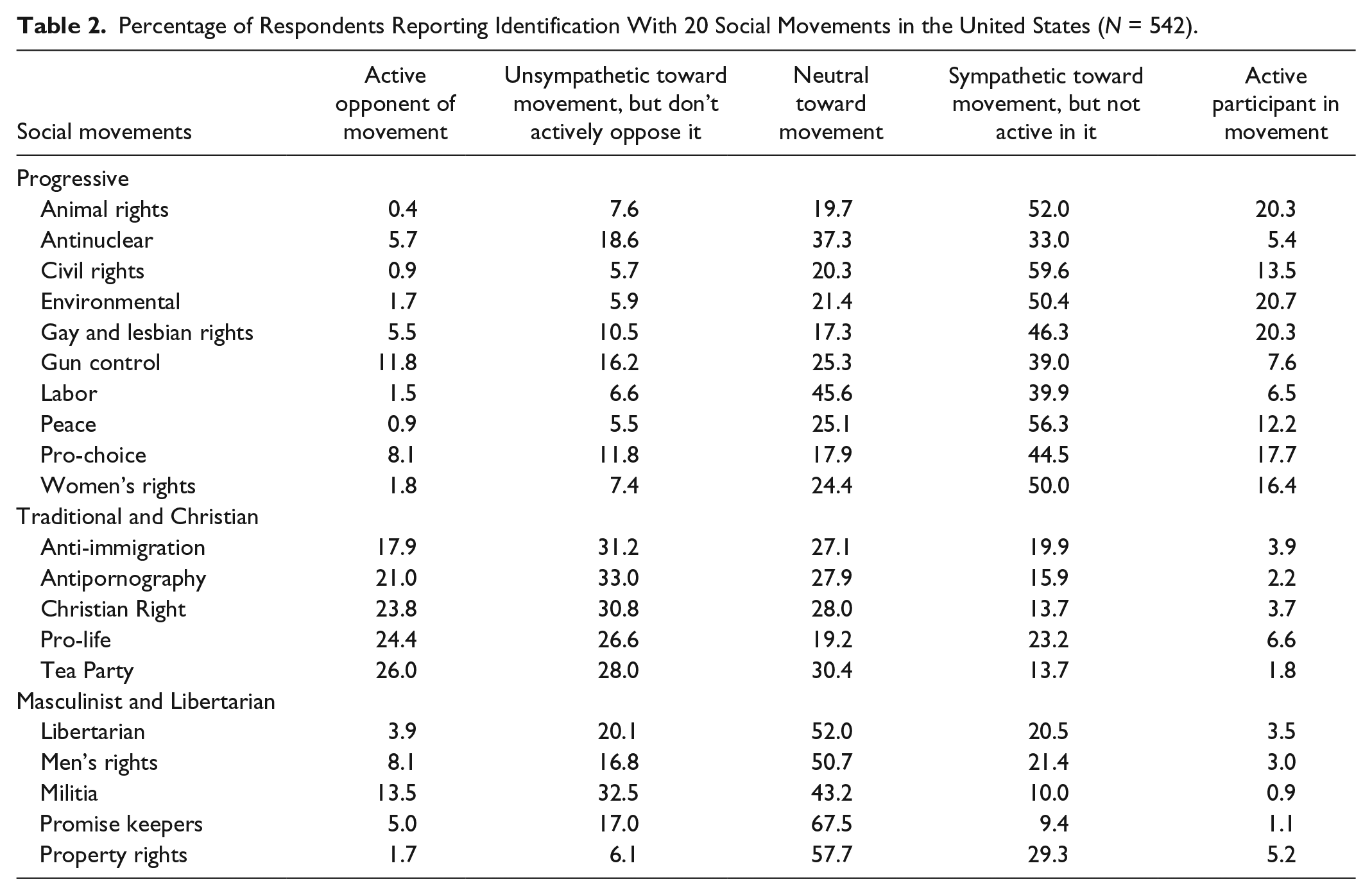
Given this earlier work on the environmental movement and the fact that the Gallup Organization continues to include a version of the environmental movement identity measure in its surveys, we first briefly discuss the percentages for the environmental movement identity. As a point of comparison, in its March 2015 Environment Poll (which was administered 6 weeks prior to our survey), Gallup reports that 16% of its nationally representative sample identifies as an active participant in the environmental movement, 41% identifies as sympathetic toward the movement but not active in it, 30% identifies as neutral toward the movement, and 11% identifies as unsympathetic toward the movement (with 1% reporting “no opinion”). The percentages for the environmental movement in Table 2 differ only somewhat from these. In our study, 20.7% of respondents identify as active participants in the environmental movement, 50.4% identify as sympathetic but not active, 21.4% identify as neutral, and 7.6% identify as unsympathetic toward or active opponents of the environmental movement. These more pro-environmental percentages are most likely due to greater percentages of liberals and younger adults in our sample than in the general public—as these two groups tend to report high levels of environmentalism (e.g., Dunlap, Van Liere, Mertig, & Jones, 2000; Dunlap, Xiao, & McCright, 2001). This comparison offers at least modest evidence that this social movement identity measure can distinguish different levels of identification with a social movement in what we argue is a meaningful way.
A few key patterns in Table 2 warrant some discussion. First, not surprising given the nature of our sample, we see stronger identification with left-leaning or liberal movements than with right-leaning or conservative movements among our respondents. Between 38.4% and 72.9% of our respondents indicate that they are sympathetic toward or active participants in a liberal movement, yet only between 10.5% and 34.5% of our respondents report being sympathetic toward or actively participating in a conservative movement.
Second, patterns of identification within the group of 10 left-leaning movements seem to align with the salience and/or mobilization of these movements in recent years. For instance, the three left-leaning movements with the lowest percentages of sympathetics or active participants either emerged prior to the 1960s to 1970s’ rights-based protest cycle (labor movement: 46.4%) or are movements relatively circumscribed in their focus (antinuclear movement: 38.4%; gun control movement: 46.6%). The remaining seven movements, which have more substantive origins in this rights-based protest cycle each enjoy clear majorities of sympathetics or active participants. Indeed, the three left-leaning movements with the highest percentages of active participants—approximately 20% for the environmental, animal rights, and gay and lesbian rights movements—each have experienced considerable mobilization and have garnered much media coverage in recent years.
Third, very low percentages of our respondents are active participants in the 10 conservative movements, and only relatively small percentages are sympathetic toward these movements. Distinguishing the five masculinist and libertarian movements from those traditional and Christian movements reveals another interesting pattern. Although majorities of our respondents are either unsympathetic toward or active opponents of the five traditional conservative movements, near majorities or majorities are neutral toward the five masculinity-based or libertarian movements—suggesting less public familiarity with this latter group of movements.
Demographic, Social, Political, and Cultural Bases of Three Social Movement Identity Clusters
We now turn to the results of our three-block nested OLS regression analyses that help us identify the demographic, social, political, and cultural bases of the three social movement identity clusters. Tables SM4 to SM6 in the Supplementary Materials display the full results of this regression analysis for each cluster, respectively. Table 3 presents the results of the final OLS regression model for each cluster. The average variance inflation factor (VIF) in the full models is 1.79, with the highest VIF of 2.90 for the authority moral intuition, indicating no substantial problems with multicollinearity.
Coefficients (and Standard Errors) From OLS Regression Models Predicting Three Social Movement Identities (N = 527).

Note. The reference category for religious affiliation is “non-religious.” OLS = ordinary least squares.
p < 0.05. **p < 0.01. ***p < 0.001.
The first model in Table 3 explains approximately 56% of the variation in identification with progressive social movements. As Table SM4 indicates, gender and political ideology alone account for about four fifths of this explained variance. Females and liberals report much stronger identification with these progressive social movements than do their male and conservative counterparts. Furthermore, altruism toward other humans and a moral intuition of nurturing care each has a moderately strong positive effect on progressive social movement identity, while a purity moral intuition of abhorrence for things perceived as disgusting has a small negative effect.
The second model in Table 3 explains approximately 58% of the variation in identification with traditional and Christian social movements. As indicated in Table SM5, a small set of demographic, social, and political variables account for about 85% of this explained variance, with political ideology having the strongest effect of these variables. Briefly, females, lesser educated adults, less wealthy adults, more religious individuals, and political conservatives report stronger identification with these traditional and Christian conservative movements. Also, openness to change has a small negative effect and traditionalism has a small positive effect on identification with these movements. Furthermore, abhorrence for things perceived as disgusting (a purity moral intuition) has a moderately strong positive effect on identification with these conservative movements. 3
The third model in Table 3 explains approximately 21% of the variation in identification with masculinist and libertarian social movements. As Table SM6 indicates, three social and political variables account for slightly more than half of this explained variance. Lesser educated adults, less wealthy individuals, and conservatives report stronger identification with these movements than do their respective counterparts. In addition, a traditionalist value orientation and in-group loyalty (tribalism) and purity moral intuitions each have weak positive effects on this masculinist and libertarian movement identity. Interestingly, both ideology and purity have a considerably stronger influence on traditional and Christian movement identity than on masculinist and libertarian movement identity.
Overall, these results provide reasonably strong evidence that the measures from our social movement identity instrument have construct validity (Babbie, 1995; Singleton & Straits, 1999). Briefly, our measures of social movement identities are related to other key conceptualizations in theoretically expected ways. Liberal ideology has a much stronger influence on the first two clusters (positive for progressive movement identity and negative for traditional and Christian movement identity) than on the third cluster (negative for masculinist and libertarian movement identity), confirming our expectation that this third cluster is centered more on masculinity and property than on traditional political conservatism.
In addition, the strong positive effects of humanistic altruism and a moral intuition of care on progressive social movement identity confirm that the latter is capturing an other-centered concern for improving the condition of marginalized or oppressed others that is central to progressive social movements. Also, the strong positive effects of a moral intuition of purity (a concern for sanctity) and religiosity—as well as the weak negative effect of openness to change and weak positive effect of traditionalism—on traditional and Christian movement identity confirm that the latter is representing a concern for promoting the social and cultural conservatism that is central to traditional and Christian movements.
Furthermore, the fact that purity has a much stronger positive effect on traditional and Christian movement identity than on masculinist and libertarian movement identity confirms that the latter identity cluster is less aligned with traditional conservatism, while the former identity cluster is more aligned with fundamentalist moralism and nativism. Finally, the negative effects of socioeconomic status (education and income) and the positive effects of traditionalism and a moral intuition of in-group loyalty on masculinist and libertarian movement identity confirm that the latter is tapping a concern for protecting the market-based patriarchal power that has eroded in recent decades due to macro-level economic shifts that is central to masculinist and libertarian movements.
Conclusion
We showcased a revised version of the social movement identity instrument first presented by Dunlap and McCright (2008) and demonstrated the efficacy of this revised instrument for investigating identification with 20 major U.S. social movements. Briefly, even though scholars may use this instrument to examine identification with individual movements, we chose to demonstrate how this instrument may help us understand identification with social movement families. We found strong evidence of three social movement identity clusters—progressive movements, traditional and Christian movements, and masculinist and libertarian movements—that align with recognizable movement families in the United States. We also showed that our instrument captures meaningful variation across the levels of identification with these 20 social movements. Furthermore, we provided strong evidence that our instrument has construct validity, as selected predictors explained variation in social movement identities in ways expected by existing theory and previous research.
Of course, there are opportunities for further improvement of our instrument. First, to guard against overestimating active participants and active opponents, scholars could provide a few examples of behaviors that would be considered active participation and active opposition. Second, rather than providing the name of a social movement, scholars instead could provide a brief description of the movement (or perhaps include both). Offering a brief description may reduce the likelihood that respondents are influenced by name-related associations. Third, in many samples, it is possible that some respondents will not have heard of some movements. To accommodate this, we suggest considering the addition of another response category to capture this. Fourth, we urge scholars to use our instrument in conjunction with established self-reported measures of movement behaviors and movement organization membership. Doing so provides further opportunities to validate our instrument and advance the social movements scholarship.
We end by proposing an agenda for future research that uses the social movement identity instrument showcased above to investigate understudied rank-and-file movement participants, sympathetic adherents, and even unsympathetic opponents in the public. Such scholarship may complement the typical strategy of analyzing key leaders of movement organizations or other samples of known activists. Also, other researchers should feel free to populate this instrument with those social movements of interest to them.
First, this instrument allows scholars to analyze key characteristics of individuals across different social movement identity levels. Such characteristics may include beliefs about movement goals, support for movement strategies, and trust in the responsiveness of political authorities. For instance, McCright and Dunlap (2008) discover substantial differences across active participants, sympathetics, neutrals, and unsympathetics vis-à-vis the environmental movement in the consistency of their beliefs about environmental problems.
Second, administering this social movement identity instrument to a nationally representative sample would allow scholars to examine the extent to which participation in, or mere support for, some movements is associated with the same for other movements, helping extend earlier research on activists’ involvement with multiple movements (e.g., Van Dyke, 2003). Such work should examine not only public support for and engagement with left-leaning social movements but also should examine the same for right-leaning movements, which tend to be understudied in the social movements literature. Furthermore, scholars may use this instrument in work examining how citizens across the left-right political spectrum differentially consume and contribute to politically framed, movement-related social media.
Third, including this social movement identity instrument in panel surveys would allow us to monitor the extent to which citizens’ participation in, support for, or opposition to social movements vary over time, complementing Minkoff (1997). Indeed, merging such survey data with relevant contextual data on, for example, movement-related media coverage or the presence of elite allies and opponents would facilitate analyses of how different contextual factors influence social movement identity across space and over time. Finally, this instrument enables an examination of the social, political, and cultural bases of social movement identities among the general public. This would allow us to investigate the breadth or narrowness of support for or opposition to different movements and whether such support or opposition diffuses to a broader base over time.
Footnotes
Acknowledgements
The authors have gained inspiration from Xavier Quinn, Nick Styles, Parker Barnes, John Hobbes, Anthony Hubbard, Lincoln Rhyme, Alonzo Harris, Matt Lee Whitlock, Keith Frazier, Doug Carlin, and Robert Trench.
Declaration of Conflicting Interests
The author(s) declared no potential conflicts of interest with respect to the research, authorship, and/or publication of this article.
Funding
The author(s) disclosed receipt of the following financial support for the research, authorship, and/or publication of this article: The research leading to these results was partially supported by Michigan State University AgBio Research.
Notes
Author Biographies
References
Supplementary Material
Please find the following supplemental material available below.
For Open Access articles published under a Creative Commons License, all supplemental material carries the same license as the article it is associated with.
For non-Open Access articles published, all supplemental material carries a non-exclusive license, and permission requests for re-use of supplemental material or any part of supplemental material shall be sent directly to the copyright owner as specified in the copyright notice associated with the article.
