




Abstract
Essential service organizations fulfill critical roles in maintaining public health during a disaster; therefore, business continuity planning is paramount to ensure continued functioning of core operations during a disruption. Business continuity planning is typically oriented around a predict and prevent approach. Asset-mapping activities have the potential to balance the predominantly risk-based approach by focusing on strengths and capability already present within organizations. The purpose of this study is to identify a suite of organizational-level assets that support resilience, and to contribute to the empirical evidence base for business continuity planning. Two focus group consultations with essential service organization representatives (n = 22) were held in Ottawa, Canada, in March and April 2014, using the Structured Interview Matrix facilitation format. Inductive analysis was used to identify eight emergent themes that highlight the importance of organizational-level assets and their contribution to adaptive capacity. Leadership and culture in adopting and promoting preparedness strategies were predominant themes, as well as the importance of communication and connectedness across micro, meso, and macro levels. A suite of 25 assets were identified and grouped into seven categories: (a) awareness, (b) human resources, (c) information and communication, (d) leadership and culture, (e) operational infrastructure, (f) physical resources, and (g) social capital. This evidence base can be used as a template to guide asset-mapping activities, and support organizations engaging in business continuity planning.
Introduction
Disasters, such as the 2015 earthquake in Nepal, Superstorm Sandy in 2012, and the 2013 train derailment and explosion in Lac Mégantic (Quebec), are reminders of the need for communities to engage in preparedness initiatives to enhance resilience in a disaster. When a disaster occurs, communities rely on essential service organizations to respond to the changing context and assist with minimizing negative impacts of the event; this includes protecting critical infrastructure, sustaining supply chains, and maintaining population health (Tosh et al., 2014).
Disaster risk reduction is recognized as a global priority to be addressed at local, national, regional, and global levels (United Nations Office for Disaster Risk Reduction [UNISDR], 2015). The Sendai Framework for Disaster Risk Reduction 2015-2030, adopted by the UNISDR (2015), identifies organizational resilience as a priority investment for disaster risk reduction at global and regional levels, “to increase business resilience and protection of livelihoods and productive assets throughout the supply chains, ensure continuity of services and integrate disaster risk management into business models and practices” (p.17).
Organizational resilience is the ability of an organization to resist, absorb, recover, and adapt to the altered environment following a disaster (Kahan, Allen, George, & Thompson, 2009; McManus, Seville, Vargo, & Brunsdon, 2008). Business continuity planning (BCP) is a strategy used to promote organizational resilience, by enhancing the capacity of an organization to persist and maintain business operations during a crisis (Speight, 2011). BCP is important not only for ensuring availability of health and social services but also for maintaining infrastructure, efficiency in supply chains, and ensuring stability in the economy (UNISDR, 2015). However, there is a paucity of empirical studies on BCP, with much of the literature founded on discussion papers and government documents (Duncan, Yeager, Rucks, & Ginter, 2011; Public Safety Canada, 2015).
The terminology around BCP as a preparedness activity has shifted in recent years to reflect the range of organizations in a community. Continuity of operations planning (COOP) represents an inclusive term, to represent the public sector, non-governmental organizations, and private businesses, recognizing that maintaining operations is the focus for many types of organizations (McManus et al., 2008). Business continuity is often referred to as a subconcept within COOP. In this study, we have chosen to use BCP because of its use by the International Organization for Standardization (ISO); however, we use it interchangeably with COOP, with the assumption that business continuity is important for any essential service organization, regardless of whether the systems operate under a business model or public service mandate.
Traditional approaches to BCP emphasize risks and vulnerabilities confronting the organization, rather than resources and assets which support resilience (Speight, 2011). However, an assets-oriented lens considers both assets and risks in combination, and emphasizes those elements that enhance resilience (Antonovsky, 1996; Lindström & Eriksson, 2010; Moser & Satterthwaite, 2008). Morgan and Ziglio (2007) propose an asset model as a systematic framework for synthesizing asset-based approaches for public health. Application of an asset-oriented lens to disaster management and organizational resilience is a novel approach that emphasizes the identification and mobilization of assets to support adaptive response and recovery, compared with traditional approaches focused on vulnerabilities (Moser & Satterthwaite, 2008; O’Sullivan, Corneil, Kuziemsky, & Toal-Sullivan, 2015).
In this article, we describe a substudy of a larger project focused on identifying a suite of organizational-level assets to support resilience in essential service organizations. The intent is to address the gap in empirical evidence on strategies to promote BCP, while applying an asset-oriented lens. In the sections to follow, we present a review of literature, detailed methods of our approach, emergent themes, and discuss these findings in terms of the broader literature and implications for practice.
Literature Review
Several bodies of literature informed the research design for this project, including organizational resilience, BCP, and asset-based approaches. Key issues related to each of these areas are discussed below.
Organizational Resilience
In a disaster context, resilience refers to the ability of an individual, organization, or community to resist, absorb, adapt, and recover toward a better state (Kahan et al., 2009; McManus et al., 2008). Increasingly, it is recognized as an important strategy to promote community resilience, and organizational success following a disaster (Bhamra, Dani, & Burnard, 2011; Lee, Vargo, & Seville, 2013). Burnard and Bhamra (2011) define organizational resilience as “the ability [of an organization] to withstand systematic discontinuities as well as the capability to adapt to new risk environments” (p. 5583).
Research within the Resilient Organisations Research Programme in New Zealand focuses on developing tools to benchmark resilience (Lee et al., 2013). This body of work includes a grounded theory study where McManus et al. (2008) suggest organizational resilience consists of three factors (situation awareness, management of keystone vulnerabilities, and adaptive capacity), each associated with five indicators. These factors were further tested, and a new model of organizational resilience was developed, consisting of two factors: adaptive capacity and planning (Lee et al., 2013; Stephenson, 2010). This model highlights the relevance of BCP to organizational resilience.
BCP
Public Safety Canada (2015) describes BCP as “a proactive planning process that ensures critical services or products are delivered during a disruption” (para. 7). Planning involves consideration of all phases of a disaster, and the tasks and strategies for risk reduction, readiness, response, and recovery (Kerr, 2007; Speight, 2011).
Following a disaster, there tends to be a disproportionate focus on business failure, compared with success (Duncan et al., 2011; Lee et al., 2013). However, Childs Capital LLC, a business located in New York near the World Trade Center in 2001, attributed its survival to contingency plans put in place prior to the 9/11 attacks. Their BCP strategies included having data backed up off-site and the ability to access it remotely (Duncan et al., 2011).
Several standards have been developed worldwide to guide BCP. Some of the well-known standards include ASIS International, ASIS SPC 1-2009; Australia/New Zealand Standard, AS/NZS 5050; British Standards Institute, BS 25999; Canadian Standard, CSA Z1600; and National Fire Protection Association, NFPA 1600:2010 (Professional Evaluation and Certification Board [PECB], 2012). In 2012, due to a global interest in having a single international standard, the ISO introduced ISO 22301, Societal Security—Business Continuity Management Systems—Requirements (PECB, 2012).
Within these standards, BCP is recognized as a multistep process—all oriented toward creation of an individualized plan, specific for the context of an organization. In general, BCP involves an understanding of the organization (i.e., risk assessment), selecting strategies, developing a plan, and testing and evaluating the plan (Kerr, 2007; PECB, 2012; Tammineedi, 2010). A white paper on ISO 22301 produced by the Professional Evaluation and Certification Board in 2012 provides a comprehensive overview of key business continuity elements of some of the well-known standards (p. 8).
Asset-Based Approach
The asset-based approach draws on several existing concepts and theories, such as social capital (Putnam, 2000), resilience (Barnard, 1994), coping (Amirkhan, 1990), and self-efficacy (Lennings, 1994), to name a few (Morgan, 2012). Moser and Satterthwaite (2008) highlight how asset-portfolios are key to reducing risk, because assets represent adaptive capacity. The recognition and credibility of the health asset approach is enhanced by these empirically established theories that move beyond identifying risk factors and recognize the value of health-promoting resources (Morgan, Davies, & Ziglio, 2010). Despite this progress, there has been a lack of a coherent theoretical framework used to guide health promotion and evidence-based public health research (Antonovsky, 1996; Morgan & Ziglio, 2007).
Morgan and Ziglio (2007) define a health asset “as any factor (or resource), which enhances the ability of individuals, groups, communities, populations, social systems and/or institutions to maintain and sustain health and well-being and to help reduce health inequities” (p. 18). Assets exist at the individual, group, community, and/or population level; and can come from various domains, including genetics, social and physical environments, and health services (McLean, 2011; Morgan & Ziglio, 2007).
One model that has received recognition in health promotion literature is the Asset Model for Health, developed by Morgan and Ziglio (2007). It draws upon three existing concepts around theory, action, and evaluation. The first incorporates the Theory of Salutogenesis (Antonovsky, 1996), focusing on factors that contribute to health, well-being, and in the context of an organization, optimal functioning. The second component of the model is asset mapping, outlined as an intervention activity. Asset-mapping was first described by Kretzmann and McKnight (1993) as a community organizing activity. It has evolved over the decades to an important strategy in asset-based community development to identify existing capabilities and determine solutions to build upon them (McKnight, 2010). Asset-based approaches take on the general aim to identify and mobilize assets that can be used together and in various combinations. In doing so, individuals and organizations can more effectively use their assets in a sustainable way, compared with the deficits approach (McLean, 2011). This understanding and generation of creative solutions was experienced by participants in the EnRiCH intervention, who reported enhanced awareness and motivation to act after participating in a community asset-mapping intervention (O’Sullivan et al., 2015).
The final component of the asset model is to evaluate programs and initiatives that were implemented in the previous step, the action phase. Evaluation is important for not only measuring program success, but also in demonstrating the asset-based approach is worthwhile investing in (McLean, 2011; Morgan & Ziglio, 2007). To evaluate, there is a need for indicators (McLean, 2011). Indicators are important for evaluating program success and for developing the “salutogenic” evidence base (Morgan & Ziglio, 2007). Indicators are effectively a representation of what is considered successful, whether it is a resilient organization or a healthy individual. Therefore, the development of indicators is critical for the testing of the asset-based approach and for demonstrating effectiveness (Foot, 2012).
Method
Research Design
This study used a qualitative case study design to obtain in-depth understanding of preparedness within essential service organizations in Ottawa, Ontario. This study is part of a 5-year community-based participatory research (CBPR) project focused on identification of resilience strategies and indicators for organizational resilience among essential service organizations (O’Sullivan, 2011). Ottawa was chosen as the data collection site because of interest from community partners who are part of a collaborative network called The EnRiCH International Collaboration, which emerged from a previous project that used asset mapping as a community engagement strategy to promote preparedness among high-risk populations. The partnership was crucial in generating interest and participation in the focus groups.
The rationale for adopting a qualitative case study design for this study was threefold. First, because there is little empirical work on organizational resilience and BCP in the literature, an exploratory approach was necessary. Second, qualitative methods allowed for the flexibility needed to obtain a holistic understanding of the assets that enhance organizational resilience (Creswell, 2013). Third, case studies allow for in-depth, rich descriptions, a high degree of contextualization, and detail of analysis (Creswell, 2013). To ensure this was achieved, both interviews and focus group data were collected. Details of the data collection protocol are described below.
Recruitment
The research protocol was approved by the University of Ottawa Research Ethics Board, on January 15, 2014. A recruitment letter was distributed via email to community partners within The EnRiCH International Collaboration (O’Sullivan, 2011), who forwarded the letter to members in their respective networks. The recipients were asked to contact the first two authors if they were interested in participating in this study.
Participants were recruited from essential services organizations in both the public and private sectors. Managers and staff, 18 years or older, who could participate in a focus group conducted in English, were invited to participate. Interested participants were asked to sign a consent form prior to participating in the study. Their involvement in the study included participation in one focus group and two individual semi-structured interviews.
Essential services are typically a class of services which governments set special restrictions on, such as the inability to strike. In Canada, the Public Service Labour Relations Act (PSLRA), Statutes of Canada (2003, c. C-49) defines essential services as “a service, facility or activity of the Government of Canada that is or will be, at any time, necessary for the safety or security of the public or a segment of the public” (Section 4.1). As this definition is restricted to services provided by the federal government, for the purposes of this study, we expanded it to include services provided by organizations in the public and private sector which influence the safety, security, and health of individuals and communities. Therefore, in this context, essential service organizations included those offering advocacy, assistive device services, communications, community support, consultation services, education, emergency services, home care, health care, infrastructure, and rehabilitation.
Data Collection and Analysis
Each participant was asked to attend one focus group, which was facilitated using the Structured Interview Matrix (SIM) technique (O’Sullivan et al., 2015). The SIM technique is a method used in different research contexts, to promote engagement during consultation sessions. As a method for qualitative research, it enables generation of rich data from a large sample of people (up to 40), while promoting inclusion and reducing power differentials. A process evaluation of this method by our team showed it enhances awareness and stimulates solution-oriented thinking among participants (O’Sullivan et al., 2015). All of these features of the SIM method align with principles of a CBPR approach (Israel, Eng, Schulz, & Parker, 2013). Some of its applications have included consultations with nurses about support mechanisms needed during large-scale outbreaks (O’Sullivan, 2009), community engagement to support emergency preparedness among high-risk populations (O’Sullivan et al., 2015), social media use in public health (Khan & Tracey, 2017), and development of an emergency preparedness framework for public health (Khan, Nayani, & Schwartz, 2017).
For this project, we hosted two SIM focus groups; participants were asked to attend one of them. Each focus group was 2 hr in duration, and focused on four questions related to organizational assets, resilience, and engagement strategies. In this article, we present findings related to the following two focus group questions: (a) What is needed for an organization to be considered resilient in the event of a disaster? and (b) What are the key assets/resources in your organization that contribute to business continuity in the event of a disaster?
The SIM focus groups were facilitated around three steps (O’Sullivan et al., 2015). In Step 1, participants were divided into four groups and each was assigned a question. There were six rounds of interviews where participants were asked to interview individuals from other tables and document responses as field notes. In Step 2, participants returned to their group and discussed the responses to their question. Audio-recorders were placed at each of the tables where discussions ensued. Step 3 was an audio-recorded, facilitated discussion with the whole group where each table presented a summary of the responses to their assigned question. The SIM data from the three steps include the field notes taken by the participants, and the audio-recordings from each table.
In addition to the focus groups, each participant was asked to participate in a semistructured phone interview, approximately 60 min in duration, before and after the focus group. The interviews were audio-recorded and field notes were taken by the interviewer to supplement the recordings. Interview questions were pilot-tested with community partners familiar with emergency management and essential service organizations (see the appendix for interview guide).
Data analysis involved transcribing audio-recordings and field notes, developing a coding grid, coding the transcripts, and conducting content analysis to identify emergent themes. An inductive approach for identify emerging themes was used (Hsieh & Shannon, 2005). Three coauthors developed the coding grid. Initial coding was done to gain a comprehensive understanding of what was being said (Charmaz, 2006) and produced 219 descriptive codes. Duplicates were removed and the remainder were synthesized into 11 abstract codes (Charmaz, 2006). Definitions and inclusion criteria in the revised coding grid were based on the development of each code, tracing back to the initial descriptive codes.
All transcripts were coded by (ST) using the NVivo 10 software (QSR International Pty Ltd., 2012). To ensure reliability, coding was confirmed by (EG) periodically throughout the entire coding process. A memo was made for each transcript, to summarize the information and highlight emerging themes. After reviewing the notes, the coding reports were analyzed to develop the themes and identify representative quotations. Theme development and the final results were agreed upon, using a consensus approach, by all the authors.
Results
A total of 23 participants were recruited, and later one participant withdrew from the study, resulting in a total of 22 participants being included in the study. Each focus group had 10 participants. Interviews were conducted with 21 participants prior to and 19 participants following the focus groups. The lead community partner attended both focus groups, and three participants were interviewed but did not participate in either focus group. Table 1 summarizes the participant demographics, including the type of organizations that were represented and the positions held by the participants. Of the participants, 15 were female and seven were male. In this section, results are presented as eight emergent themes, which focus on enhancing adaptive capacity, culture, and connectedness. Each theme highlights organizational-level assets contributing to the enhancement of business continuity and organizational resilience.
Participant Demographics.

Quotations are provided as supporting evidence, referencing the participant number (e.g., P1 through P22) and the data source (e.g., I2: Interview 2 and FG1: Focus Group 1).
Theme 1: Situational Awareness and Asset Literacy Contribute to Adaptive Capacity
Situational awareness across all levels (micro, meso, and macro) was highlighted as an asset to inform an organization about how to adapt to its current context, promoting resilience. For example, one participant explained the importance of being aware of changes in the home care sector.
You need to look out, be aware of what’s happening . . . If you don’t pull your head out . . . and look at what’s happening on a provincial level . . . I think you’re missing some pretty big information. Read your reports, attend coalition meetings, hear how the environment’s changing and structure yourself so that you can move along with it. (P1-I2)
Participants identified knowledge of organizational risks and needs as important for contributing to preparedness, prevention and mitigation strategies. For example, understanding the top hazards in the community, such as earthquakes, allows organizations to integrate targeted mitigation measures into their plan.
I sit at the emergency management working group, and we’re developing continuity of operations plans, and our next step is developing a comprehensive business continuity plan. That will be all of us sitting at the table identifying the top seven potential hazards . . . and outlining a plan for each of these hazards as to how we can maintain business continuity. So, that’s dealing with stakeholders internally and externally, training staff, and being aware of what impact those hazards will have . . . and how we can best mitigate those. (P3-I2)
Situational awareness is not limited to risks, and includes awareness of assets and how they can be activated during a response. Asset literacy (O’Sullivan, Kuziemsky, Corneil, Lemyre, & Franco, 2014) refers to awareness of organizational assets, their value in a given context, how to mobilize them when needed, and having confidence and motivation to activate them. The combination of these components contributes to an adaptive response.
At the focus groups, the role of the private sector was discussed. Partnerships with private sector agencies were identified as potential assets, as they could provide financial support, human resources, or connections with the community. However, there was a gap in moving from awareness of the potential asset, to mobilizing the private sector to engage in activities.
One of the questions [at the focus group was] about “what do you see as the role of private sector,” and it just threw people. None of the organizations saw any role, or had ever thought of it and this is a huge resource waiting to be tapped . . . You need to have agreements and know who to call, and what they can give you and what you’re going to need . . . (P12-I2)
The participant explained how others had not been aware of the role of the private sector prior to attending the focus group. From the interaction during the SIM session, participants became aware of the private sector as a potential asset, which they can relay to their organization, and in turn enhance their organization’s asset profile.
With a continuously changing context, situational awareness and asset literacy support adaptive response. In addition, awareness of risks, assets, and the state of the environment enhances an organization’s ability to be proactive with preparedness and prevention strategies. Not all assets are known, and it is important for an organization to be open to potential assets and understand how to move from a state of awareness to activation. A summary of the identified assets related to this theme is presented in Table 2.
Assets Associated With Theme 1 (Situational Awareness and Asset Literacy).

Theme 2: Investing in People Enhances Organizational Adaptive Capacity
Human resources were identified as primary assets within essential service organizations. Participants explained that human resources are necessary for carrying out tasks, and they emphasized that responders within the health care field are dedicated and care about others.
People who work here are doing it out of genuine compassion, and wanting to be involved, as opposed to doing it for any other reason. It’s not a lucrative position. I think that’s one thing in terms of organizational resilience, people stick around. (P5-I1)
Participants also identified that investing in safety, personal fulfillment, and training contributes to adaptive response. For example, personal preparedness among staff is encouraged so they are able to attend work, knowing their family is prepared. Providing personal protective equipment, and other supplies to fulfill their roles, demonstrates respect for human resources. Training and cross-training develops knowledge and skills to respond to unexpected situations; it is important that staff be able to “think outside the box” and develop innovative solutions rapidly.
We don’t have a lot of stuff—our key asset is our people and the key tool that we use is knowledge . . . They’re well trained and they’re knowledgeable . . . that even when the unexpected happens it’s not going to throw them. (P12-I1) Creative staff, I think that would be the key thing—people who can think outside the box under time pressure . . . We had a furnace break not too long ago. Everybody kind of figured their way through it without anybody needing to tell them what to do . . . They couldn’t be in the office, it was too cold, so some people had to go to programs, some people worked from home, some people, did whatever they needed to do. (P1-I1)
A summary of the identified assets related to this theme is presented in Table 3.
Assets Associated With Theme 2 (Investing in People).

Theme 3: “The Plan Is Important . . . But Resilience Is the Ability of an Organization to Adapt”
Participants referred to plans being important assets, as they symbolize preparation for disasters. However, it was also recognized that plans do not anticipate all situations, and flexibility is necessary. Plans, processes and policies provide a way to navigate a disaster; these upstream preparations can save time and allow for time to determine next steps when an event occurs.
Having that confidence that you’ve got the first ten minutes or the first couple of hours, or five hours taken care of and then you can start into action. Where if you don’t have anything in place you’re just flummoxed, you don’t know where to start. (P12-I2)
In the event of increased needs or system failures, back-ups of equipment, data, communications, facilities, and staff were perceived to be important. For example, a back-up generator was identified multiple times because of its critical role in maintaining minimum levels of operations; however, testing and maintenance are also necessary.
The emergency generator in all our big buildings, they all came on . . . But emergency generators are there to last 12 to 20 hours. One of the things that no one had factored in prior to that was the fact that you do testing every month of the emergency generator, but nobody registered the level of the oil. So, although you’re expecting 20 hours, all of the sudden you realize you only had six hours. (P21-I2)
Flexibility of organizational structures and processes was identified as a key asset enabling organizations to adapt. Flexible processes allow for quick and immediate decisions by both leaders and staff. Several participants explained the need for streamlining or limiting bureaucracy during a response.
If you’re in an organization that has a lot of processes and bureaucracy . . . looking at the way those can be streamlined and the processes made more fluid and responsive during an emergency so that you’re empowering people that have the ability and the training to make decisions they can do without the bureaucracy, because that gives you the flexibility and the adaptability. [During a disaster] you don’t have time to go through the normal bureaucracy. (FG1)
Flexibility of staff and resources is also important for shifting operations to core critical functions. Cross-training promotes knowledge of the organization and ability to change or fill in roles, so staff are capable of helping in multiple areas. Reallocation of resources, such as equipment, to core critical functions also allows an organization to activate existing assets.
Decentralization of staff and facilities was also mentioned for an adaptive response. One participant explained they have equipped their staff with technology to work outside the office to “allow them to work anywhere, anytime, anyplace.” Decentralizing operations to different geographic locations also enhances adaptability.
Hands-down, I think the biggest factor that we have . . . is that we’re decentralized. We’ve got a building in the West-end, we’ve got [stores] throughout the city. Even my program vehicles, I keep them in two different buildings. We’ve got tons of options in terms of where we work, what we do . . . (P15-I1)
Several structural elements were deemed important for promoting resilience during a disaster, as seen in Table 4. Plans and back-ups favor a tight structure, while flexibility and decentralization are loose; however, both were identified as important, suggesting a balance is needed.
Assets Associated With Theme 3 (Adaption Policies).

Note. BCP = business continuity planning.
Theme 4: Continuity Plans Are Living Documents and When They Are Embedded in Organizational Culture, They Become “The Norm”
COOP was identified as important for promoting organizational resilience; however, for plans to be relevant, they must be continuously reviewed and updated. Plans are referred to as “evergreen,” “living and breathing,” and “organic,” representing changes in the organization and needed investments to ensure the plan’s integrity.
The maintenance is something I just have to make a priority. It’s a living, breathing thing, right? It’s an organic thing. It needs to be up-to-date because we could change something as basic as our IT provider and if that doesn’t get reflected in the business continuity plan, then who knows how long it will take us to contact our account rep. (P15-I1)
When the plan is embedded in organizational culture, updating the BCP becomes part of normal organizational practice. This means the BCP is integrated into daily activities, so when a change is made, the response includes updating the plan. Conversely, this could also mean the plan is taken into consideration prior to making changes.
If we can get it as part of the culture that means every time something changes within a department . . . or service, or something that might impact the plan, it’s going to get known right away in advance or it even becomes part of the consideration when making changes. When that is always on your mind, [BCP] is always considered when a change comes and the update would be automatic. (P22-I2)
Exercises facilitate practice, and promote awareness of the plan, knowledge of collective roles and responsibilities, and provide an opportunity for members of the organization to become comfortable with the plan. Thus, when the BCP is activated, the response will be more reflexive, allowing the organization to shift from one mode of operation into another with ease. This concept is also emphasized through in-flight safety demonstrations and fire drills.
Our approach was similar to a fire plan in that exits are clearly marked, that we do rehearsals and drills . . . everybody knows their role. Why can’t we apply the same principle to business continuity? It should be simple and should be almost like a reflex by the time something happens. (P15-I1)
Fire drills are common practice within organizations and are considered a “normal” experience throughout the year. Participants from organizations who activate their BCP often indicated a similar phenomenon occurs, and testing the BCP is normal practice.
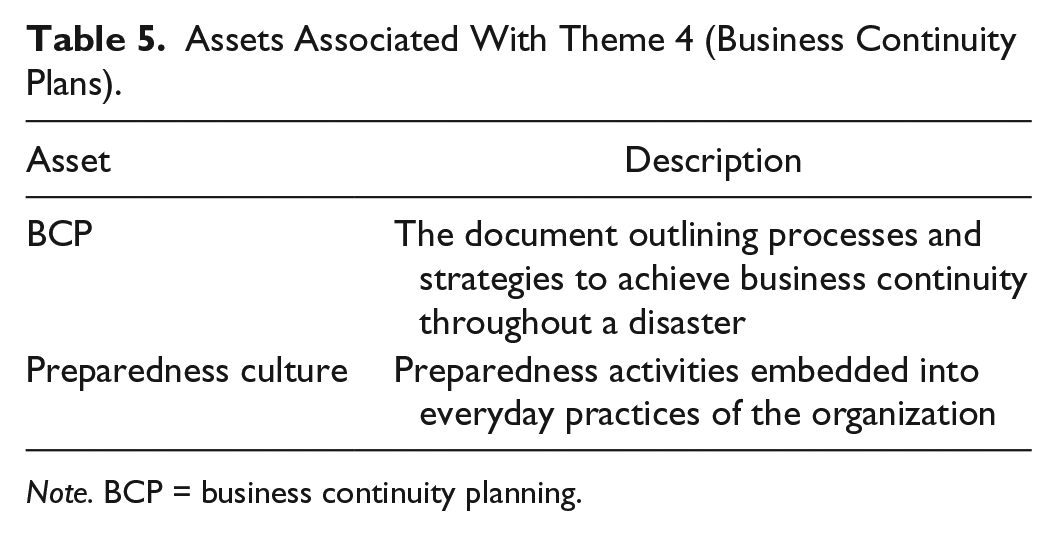
Despite identifying the above information as important for organizational resilience, several participants indicated their organization does not have a BCP; it is viewed as an extra that draws on funding and human resources, which are limited. Many participants suggested there is already a struggle in surviving day-to-day activities. A few participants noted that their organizations have designated staff for BCP, but it is difficult to achieve buy-in from the whole organization. Thus, buy-in and resources are necessary for initiating and integrating BCP into the organization. In Table 5, the existence of a preparedness culture in an organization is presented as an asset.
Assets Associated With Theme 4 (Business Continuity Plans).
Note. BCP = business continuity planning.
Theme 5: A Culture That Celebrates Experience, Expertise, and Regards Mistakes as Opportunities for Learning, Provides a Safe Environment for Sharing Information
Information allows organizations to make critical decisions, and improve current practices. An organizational culture which accepts experiences, expertise, and mistakes facilitates flow of information (see Table 6 for descriptions of assets). Experience with disasters provides valuable information about the level of preparedness of an organization. The organizations represented in this study ranged in levels of preparedness from having no plans at all and never considering it, to having plans and recognizing areas of improvement, and having confirmed the effectiveness of the plan. Participants noted that embracing mistakes was important, as long as they were not made again. They also explained that lessons learned are identified in debriefs; however, often no corrective action takes place.
Lessons learned is probably the catch phrase that is so overused because we don’t. Typically you see—when you see this little bit about lessons learned and from previous experiences they’re always the same . . . We learned the same things which is obvious that we didn’t. (FG2)
Assets Associated With Theme 5 (Experience, Expertise, and Learning Culture).

Lack of experience with disasters, or an effective response with minimal to no damage, can promote a false sense of security. Participants explained that this can lead to delayed development of plans, or a belief that the City is responsible. However, a disaster occurring within an organization, or a similar one, can trigger motivation toward developing a BCP.
We don’t have an official business continuity plan in place. We do actually have a working group that is working on that due to a server went down when there was a flood and we had no internet access for three days. That kind of triggered that we didn’t actually have a proper business continuity plan. (P8-I1)
Expertise is a valuable asset which can be used to improve plans and response. Openness to expertise can allow an organization to recognize areas of opportunity. One participant from the transportation industry explained how the area has extensive knowledge in communications, which could be applied to educational institutions. Expertise can also be recognized within an organization.
I think when you have a breadth of skill sets [in your organization], you can draw on that expertise during an emergency and say, “Okay, well, what would you do?” And then come up with different ideas to deal with different scenarios. We have . . . expertise in a whole bunch of different areas, engineering and whatever. It’s being able to draw on those resources and utilize them at the time of need. (P21-I2)
When staff are encouraged to demonstrate their skills, it creates an opportunity to learn, and provides a safe environment to learn from mistakes. Training and exercises offer a controlled environment that allows staff to practice their skills and identify areas of improvement.
It’s kind of like learning an instrument in that you can’t just show up at a concert and pick up a guitar and expect to just kill it. You have to practice . . . Training is key . . . it provides learning opportunities, it provides room for error in a controlled environment and gets people thinking about things they typically don’t think about . . . (P15-I1)
A “no-blame, no-shame” culture is important in providing a safe environment where staff can come forward with mistakes. However, some participants suggested punishment and embarrassment strategies to engage organizations in BCP. Participants who supported an open and positive culture explained that intervention strategies aimed at embarrassment and singling people out, or shaming them, do not encourage information sharing; an organization which addresses mistakes as learning opportunities encourages staff to report gaps.
You might have a blame culture where people are punished when they make mistakes. You want to change that so there’s no-blame no-shame, [and] people will actually report . . . it’s a really important aspect of business continuity where people are reporting on the mistakes they make. And it’s more resilient when people are trusting and communicating and sharing information. (P20-I2)
Theme 6: Organizational Resilience Is Supported by Transformative Leadership
Transformative leadership is a model of leadership with a moral commitment to both the organization and stakeholders (Caldwell et al., 2012). This form of leadership was mirrored throughout discussions in interviews and focus groups. Leadership was identified as a key asset necessary for supporting BCP efforts, staff, and a learning culture; as well as demonstrating commitment to organizational success by investing time to understand the whole organization and make informed decisions.
Buy-in from senior management is important for supporting the integration of BCP into organizational culture. However, acknowledgment of the importance of a plan must be followed with action.
It comes down to the leadership . . . It needs to be a priority, not just in words, but in action. They need to . . . commit those resources to developing plans. And that comes from the top. And they need to be convinced that it’s worth it. (P22-I2)
Transformative leadership demonstrates commitment to stakeholders through, for example, financial support while also investing in the organization’s long-term survival. Transformative leadership is about knowing the value of others and providing them with opportunities to succeed. In the event of a disaster, many leaders emerge, and it is the responsibility of senior leaders to recognize their own roles and those of others during a response. Participants explained that senior leaders, such as the CEO or president, are there to motivate the organization and speak with the media, while allowing the designated incident commander to direct the response.
It’s a very conflictual situation, and technically a president should be there to support people, he should be there in front of the camera saying, “Yes, we’ve gone through this terrible event, and we’re sorry for the loss.” But he’s there to boost the people’s morale and get things going, but he’s not there to manage the event. To me that’s something that sounds so small in the whole context of this, but it’s crucial [for response]. (P21-I1)
Senior leaders who do not allow room for others to lead can trigger confusion and interrupt the response. One participant explained, a senior member was detrimental to the response as they demonstrated their power, stopping an evacuation.
Halfway through our evacuation it was called off by somebody more senior and the person senior on this site did not know who or why, so that didn’t go well. (P6-I2)
Respecting the decisions of the individual running the response helps reduce confusion. For example, staff have important roles in adopting BCP into the organizational culture, as they are responsible for engaging in BCP exercises and training activities. The incident commander must recognize and empower champions, while making timely decisions during an event.
You have to have leadership that can function under stress, make good decisions, and make them quickly, and stand by them, and not defer, delay, ponder, send a committee . . . So, you have to have leadership somewhere in the organization that is comfortable in a crisis, in an emergency of making decisions, standing by them, and has flexibility to do things outside the box and differently in order to get through something. (P12-I2)
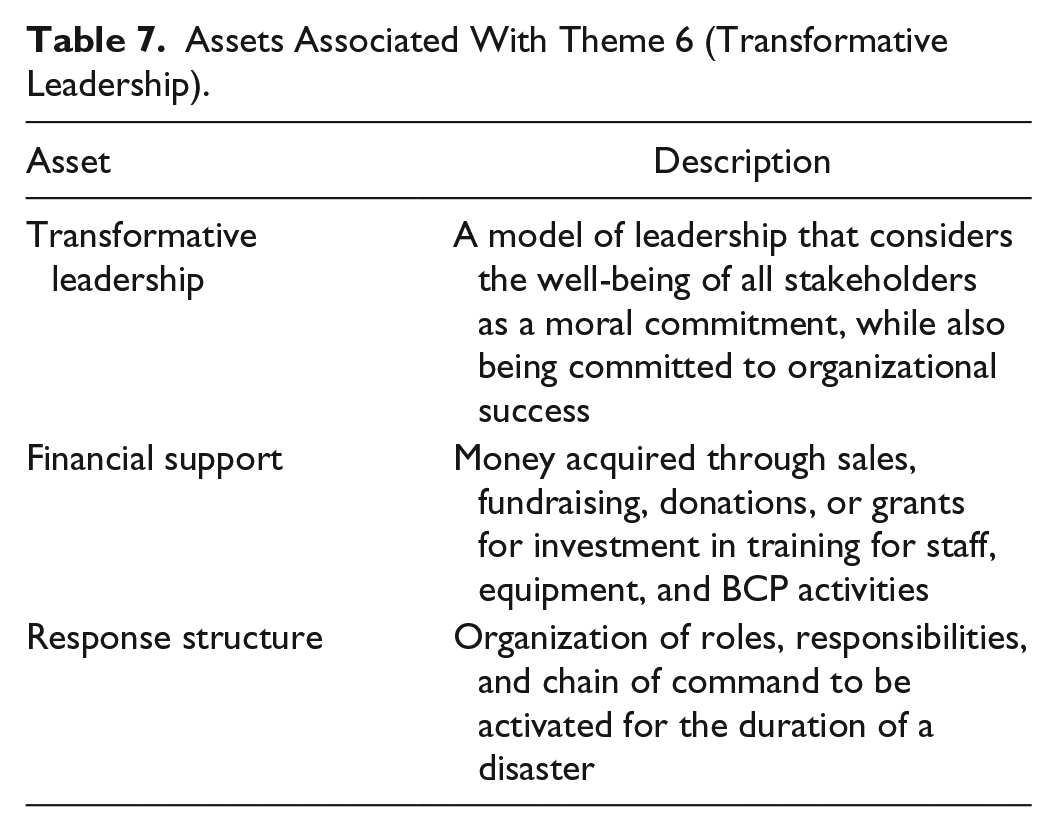
Should an error occur, one participant explained that leadership should acknowledge the mistake and assume responsibility, which can garner respect from stakeholders. Transformative leadership is important for embedding the BCP into organizational culture, financially supporting preparedness activities which can benefit staff preparedness and organizational resilience, and motivate individuals to demonstrate skills (see Table 7 for description of assets).
Assets Associated With Theme 6 (Transformative Leadership).
Theme 7: Collaborative Practice Requires Awareness of the Optimal Balance Between Working With Others and Working Alone
Collaboration is a necessary, but strategic process contributing to BCP. Participants discussed several aspects of collaboration, recognizing the different levels and types of collaboration, as well as the timing of interactions. It is the responsibility of the organization to recognize when to engage in collaborative activities and when to work alone, to ensure the best use of energy. Participants explained that collaboration occurs at different levels between (a) individuals in the organization, (b) departments in the organization, and (c) the organization and external community partners. Collaboration provides a way to share resources, information, and expertise, particularly during planning and response, when it is necessary for departments to come together to maximize their resources.
. . . if it affects the entire [organization] then we would . . . try to bring all the [departments] together so that resources can be maximised rather than approaching it as just silos so that we don’t waste resources in duplicating things. (P22-I2)
This can also be realized in partnerships and networks between organizations. Equipment, manpower, and buildings are identified as assets which organizations can offer to help one another. Participants also identified that the sharing of information, such as their plans, is important for ensuring the system is connected.
I think the common theme was everybody spinning their own wheels where we could all be spinning them together. Working together as a team and ensuring safety in numbers . . . Let’s say we’ve got extra blankets and you’ve got extra water then we can all, you know, pool our resources and work together as opposed to alone. (P6-I2)
While participants acknowledged the benefits of working collaboratively with others, they explained that some instances call for the organization to focus on taking care of itself. This includes preparing staff, ensuring the safety of clients, and confirming core critical functions are operating. Once an organization is capable of being self-sufficient, it can reach out to others. This point is highlighted in this exchange from one of the focus groups:
-The basic caregiving principle, which is sort of a source of what this is, is that you put your own oxygen mask on first. -Yes. -So you have your own—to take care of yourself, and then you reach out to others, right? . . . take care of your own personal business so then you could work at the corporate side of things and then reach out to the community. (FG1)
It is important to note that there is a balance between working together and working alone. Some cases require the organization to shift its focus more internally because they are struggling to survive. Two participants from organizations directly interacting with clients on a regular basis, emphasized that during an emergency the community itself can be an asset as the people within it are connected and take care of each other.
An organization in crisis must also recognize when they can rely on their partners to support them. The fire that occurred at the local cheese factory was provided as an example of collaboration at one focus group. Participants explained that following the fire, competitors stepped forward to offer their facilities to help ensure continued operations. Although these are not typical partnerships, the competitors offered their facilities and rearranged their schedules so the cheese factory could stay in business. This example demonstrates the importance of recognizing when to work alone and when to work together to ensure the most beneficial use of energy. Table 8 offers a description of assets associated with collaboration.
Assets Associated With Theme 7 (Collaborative Practice).

Theme 8: Communication Sets the Stage for Common Understanding
Communication with staff, partners, and the community is critical throughout a disaster to ensure all stakeholders are informed and aware of their roles. Achieving effective communication at all levels requires consideration of several components. A robust communication system with multiple forms of communication, such as telephone, email, text, television, and radio, is important for reaching all stakeholders. Reaching staff was of particular concern due to the nature of essential services, where staff may be out working in the community.
When there is a pandemic or emergency it’s really hard for us to connect with our workers when they’re out in the community because if the servers are down, everything’s down . . . I guess that’s the negative part is people are all scattered so the communication, when something does happen, can take longer. (P23-I2)
Communicating the BCP to staff prior to an event, through training and exercises, helps promote rapid response. A simple document staff could pick up at any moment and understand was preferred to a lengthy, theory-ridden BCP document. One participant noted BCP has its own language and terminology which can be a “turn off” for staff and organizations. To encourage uptake, the message and BCP material should adopt the language of the organization. However, common language across all organizations is important for collaborating during a response.
I was on the pandemic committee . . . we worked on mostly communications . . . It seems to be a problem . . . and that is getting the language together. That the fire department, when they say we have a level one threat or a level five threat, it means the same for them as it does for the police, as it does for the university, as it does for the man on the street. That kind of communication isn’t in place yet. (P19-I1)
Setting expectations and vocalizing assumptions with partners in advance was addressed several times by participants as important for creating common understanding of responsibilities and priorities. Formal agreements, contracts, and memorandums of understanding (MOUs) function to clearly outline expectations and ensure compliance, as there are legal implications. Without consultation prior to an emergency, energy and resources can be misplaced, priorities unclear, and confusion can occur.
We have emergency plans, business continuity plans . . . but those plans are not as valid if we don’t include our private partners. We can say [the city] will do many things, but . . . if we just assume we’re going to get power sent to us first, or if all the power goes out we’re going to get gasoline sent to us first to power our generators, and we haven’t talked to the [hospital] who says, “No, we’re actually a priority,” if we don’t talk to those people then we’re making a lot of assumptions which could cause a lot of confusion in the case of an emergency. (P3-I2)
Due to direct interaction essential service organizations have with clients and the public, maintaining communication is important for checking the status and safety of the clients, and relaying information and instructions to the community. Although, open, two-way communication was deemed important, participants explained that portraying a sense of composure can support a calm response.
The outside . . . of the business looks like nothing’s wrong, but behind the scenes we all know that the servers’ down, or that all that’s going on. (P8-I1)
The media was also identified as a powerful asset as it can help generate positive publicity for an organization. Public recognition was described as an indicator that their organization had bounced back following a merge. Furthermore, positive publicity can be wagered to encourage large, for-profit organizations with vast amounts of resources to help during a response. Table 9 provides a description of communication, agreements, and the media as an asset.
Assets Associated With Theme 8 (Communication).

Note. MOU = memorandum of understanding.
Discussion
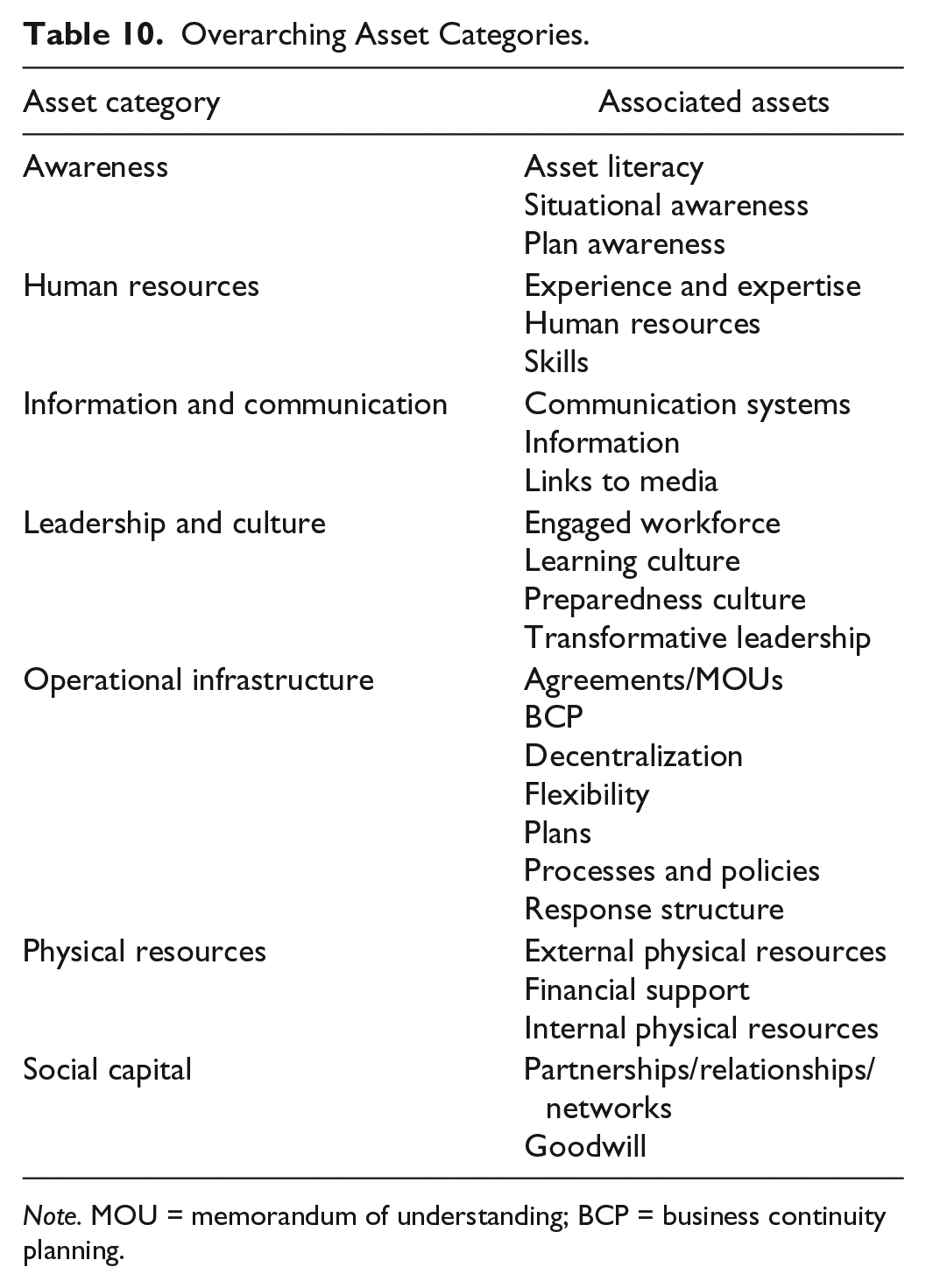
This study aimed to identify what essential service organizations consider important for their resilience and the key assets that contribute to their business continuity in the event of a disaster, shifting the focus from risks to assets. The results show that participants recognized the importance of investing in assets that can support organizational resilience. A total of 25 organizational-level assets emerged from the data and were shown in Tables 2 through 9. This list is extensive, therefore we grouped them into seven overarching categories to support application in organizational asset-mapping activities (see Table 10).
Overarching Asset Categories.
Note. MOU = memorandum of understanding; BCP = business continuity planning.
Assets have been categorized in the literature in several ways, including system levels such as: Individual, association, organization, and community (Foot & Hopkins, 2010; Morgan & Ziglio, 2007). This article focuses on organizational-level assets; however, it was recognized that individual assets can enhance organizational adaptive capacity. With this perspective, the total combination of individual assets within an organization contributes to the collective asset profile of the organization at any given time. These findings support the argument of Moser and Satterthwaite (2008) that asset identification is part of adaptive capacity and is essential for reducing disaster risk.
Morgan and Ziglio (2007) suggest categorizing assets as primary, secondary, and potential building blocks. This form of asset categorization aligns within the results of this study. Primary assets were those located and controlled by the organization. An example includes physical resources, such as equipment, supplies, and buildings owned by the organization. Secondary assets were located within the organization but controlled by an external body, such as earmarked funding given to an organization with conditions on use. Finally, potential assets exist outside of the organization and are controlled by an external body. As seen in Theme 7 on collaborative practice, organizations within the community represent a plethora of potential assets. The cheese factory fire was an example demonstrating the importance of partners who emerge in a time of crisis. After the fire, competitors offered their facilities, and as a result shifted the asset profile of the factory. This example demonstrates how quickly an organization’s asset profile can change, highlighting the dynamic state of assets, and the importance of recognizing BCP as an ongoing practice.
The empirically derived list of key assets presented here can be applied to help guide asset-mapping activities. It is important to note that assets are dynamic, and they can shift after an interaction or experience. Asset-mapping activities help build awareness of assets and the dynamic systems in which they are situated (Foot, 2012), contributing to asset literacy across multiple levels (O’Sullivan et al., 2014). In addition, asset-mapping activities provide opportunities for community development and sustainable initiatives (Puntenney, 2000). Thus, to help engage organizations in BCP, orienting continuity planning around an asset-based approach enhances the identification of capacity, while motivating and empowering people within the organization to engage in the process.
This study provides valuable considerations and lessons from essential service organization professionals, ranging in their experience and their involvement in BCP. Challenges arise between organizations using different BCP terminology, hindering their ability to effectively collaborate. In Theme 8, it was recognized that terminology differs across sectors and fields (e.g., COOP versus BCP), making it difficult for essential services to understand and adopt BCP practices. The information presented here suggests there is a need to adopt the language of the organization when trying to promote BCP, and to invest in collaborative practice to align BCP terminology across all essential service organizations.
Findings from this study highlight the importance of culture in adopting and maintaining BCP activities. When BCP is embedded in organizational culture, it becomes part of “the norm”; and subsequently, the plan may be updated more regularly and activation may be more automatic. Buy-in from top management was recognized by the participants in this study as important for supporting the integration of BCPs into organizational culture. This point supports arguments presented by Adamou (2014) which suggest a culture of preparedness—supported by upper management—is essential for full implementation of BCP practices. Bakar, Yaacob, and Udin (2015) suggest that robust businesses have continuity embedded within existing practices. In our study, participants acknowledged the importance of following plan development with action; such as allocating physical and financial resources to BCP activities. This mirrors the concept of “commitment to resilience,” focusing on prioritizing resilience to ensure resources are available (Stephenson, 2010).
Practical Implications
For BCP and asset-mapping activities to be successful, we have provided a list of recommendations, based on the emergent themes.
Identify assets in advance and know how to activate them,
invest in staff training and personal preparedness,
create flexibility in your plan,
gain top management support by aligning BCP with strategic directives,
allow leaders to emerge during a response,
embed preparedness activities into everyday practices, and
set out assumptions, expectations, and terminology with partners in advance.
These recommendations have potential implications for practice. Knowing assets in advance could allow organizations to apply them in a timely and creative fashion. Personal preparedness is important for staff attendance at work. Internal and external training and exercise opportunities can support the development and maintenance of a preparedness culture among staff and management. This can also contribute to the flexibility in a plan. Plans provide structure and initial actions; however, the organization needs to be adaptive for unexpected incidents.
Top management buy-in is important for preparedness, particularly for securing time and resources. In this study, transformative leadership was seen as an asset in part because it enables staff to emerge as leaders and champion preparedness activities. Embedding preparedness activities into practice could facilitate BCP as part of the norm.
Finally, communicating with partners about expectations, assumptions, and terminology has potential to minimize confusion during a response to a disaster.
Concluding Remarks
In this article, eight themes emerged, focusing on the overarching concepts of adaptive capacity, culture, and connectedness. From these themes, seven categories of assets (Awareness, Human Resources, Information and Communication, Leadership and Culture, Operational Infrastructure, Physical Resources, and Social Capital) were identified for their contribution to organizational resilience in the event of a disaster. By identifying assets for organizational resilience, this study contributes to the evidence base which can be used as a guide for asset-mapping activities targeted at enhancing organizational resilience. Due to the role of essential service organizations in maintaining public health and well-being, it is important for organizations to invest and engage in upstream disaster preparedness activities.
Disaster preparedness and planning activities are predominantly approached from a risk-based lens (Bakar et al., 2015). Identification of assets is emphasized by Morgan and Ziglio (2007) as an important component of health promotion, and enhancing capacity to maintain health. Throughout a disaster, assets are mobilized to assist with downstream response and recovery activities; however, it is important to invest in upstream prevention/mitigation and preparedness activities to build capacity to support response and recovery (Moser & Satterthwaite, 2008; O’Sullivan et al., 2014). This article redresses the balance of risks by offering a suite of assets for organizations engaging in preparedness activities, including BCP.
This research has practical implications for essential service organizations engaging in BCP and asset-mapping activities for disaster risk reduction. We recommend organizations to identify assets in advance, prepare and engage staff and stakeholders, and invest in a culture of preparedness to support a resilient downstream response. Considerations are also necessary during the response and include being flexible with your plan and allowing leaders to emerge.
Limitations exist in this study, specifically relating to generalizability and participant mixture. First, the findings are specific to essential service organizations in the Ottawa community, limiting generalizability of the results to other settings. Second, the study sample (n = 22) was recruited through snowball sampling methods and resulted in a wide range of experience with BCP among participants. Essential service organizations were defined broadly to include organizations providing services which are necessary for the continued functioning of individuals with functional limitations. Due to the broad range of participant experience with BCP, some participants found it difficult to participate at the focus group. This may have influenced the results as the more experienced participants may have informed nonexperienced participants with their own perspectives and biases. However, as a CBPR study, this educational component is an important outcome of participating in the SIM sessions. As a next step, it would be beneficial to validate the asset list presented in this study. Future studies could refine the list of assets and potential indicators, testing their effectiveness in BCP processes.
Footnotes
Appendix
Acknowledgements
The authors acknowledge the contribution of the community partners, the participants who attended the focus groups and engaged in interviews, as well as members of the research team, Wayne Corneil, Elizabeth Gagnon, Evelien Janssen, Sarah-Nicole Simard, Ranim Abdalla, and Graeme Pearson.
Declaration of Conflicting Interests
The author(s) declared no potential conflicts of interest with respect to the research, authorship, and/or publication of this article.
Funding
The author(s) disclosed receipt of the following financial support for the research, authorship, and/or publication of this article:: This study is funded by the Ontario Ministry of Research and Innovation, through an Early Researcher Award given to Dr. Tracey O’Sullivan.