




Abstract
Immigration in recent years has dramatically increased, especially in Europe. Countries have been coping with it in different ways, and this suggests that certain policies and approaches may work better than others. As a fact, a successful integration starts with the education system. This study investigates how the teacher’s approach toward his or her class influences the development of different ways of thinking in the students. Thirty-four primary school teachers were interviewed to identify which teaching approach they uphold among transmissive, constructivist, and enactive teaching. Then, a connection was searched between teachers’ beliefs and the average scores obtained by their 659 students in critical, creative, metacognitive, emotional, and contemplative thinking tests. The hypothesis argues that a more inclusive approach, such as enactivism can be an efficient strategy, as it views diversity as an asset rather than as a problem. Hence, this study attempts to demonstrate that enactive teaching is an effective approach that everyone should consider as it can help both native and immigrant students.
Introduction
Immigration: A Great Challenge for the European Union (EU)
Between 2000 and 2012, the immigrant population in the EU and the OECD (Organisation for Economic Co- operation and Development) has increased by more than 30%. By 2013, one person out of ten living in those areas was not native. Therefore, all countries involved decided to put the issue of immigration as well as the integration of these people and their children high in their policy agenda (OECD & EU, 2015).
Since 1999, the EU institutions have progressively developed an interest in controlling migration flows. Then, after the 2009 Treaty of Lisbon, all state members have been trying to conform their migration policies with decisions taken by the European Parliament, the Council and Qualified Majority Voting. As a matter of fact, the European Migration Governance is a complex mixture: It involves “multileveled governance” ruled by multiple players and institutions, which operate at different levels (on local, national, European, and international scales) and with different goals. Dealing with the topic is quite delicate as different national and international laws cope with different types of migration, and the structures of migration governance are bent by contradictory constraints of openness and closure according to the country regulations. This fragmentation of national migration welfares has forced state members to cooperate. However, two main points of conflict have appeared so far, a North–South dispute given both by the migration and the refugee crisis in the Mediterranean and an East–West conflict over the free movement in an extended Europe (Hampshire, 2016).
Nonetheless, the discrepancy is enlarged also by the different kind of immigrant populations received by each country. These populations differ largely in terms of size, length of residence, age, education level, language, origins—either from high- or low-income countries. Because of these background characteristics, four groups of EU countries can be identified: Luxembourg, Switzerland, the United Kingdom host significant numbers of both recent and long-settled migrants; Austria, Belgium, France, Germany, the Netherlands host the so-called “guest workers,” mainly flows of low- educated people; Denmark, Finland, Norway, Sweden mostly receive humanitarian immigrants. Finally, Greece, Italy, Portugal, Spain—if at the beginning of last century they were destinations of large numbers of labor migrants who came to fill low-skilled jobs, now they represent the European external bound crossed by the victims of Arab Spring who are willing to enter in Europe (OECD & European Union, 2015).
Integration: A Great Challenge for Schools
The link between education and migration is central in the context of European economic development, social cohesion, and stabilization of democratic cultures. The education of children, adults, and communities plays such a crucial role in the process of integration to become one of the main functions in the school system (Heckmann, 2008). “Many children with an immigrant background face enormous challenges at school” (OECD, 2015b, p. 1). In other words, they quickly have to adjust their entire life to the new context: different academic expectations, a new language, new friends, and nonetheless, a new social identity. These difficulties in integrating into a new society are magnified by the risk of segregation, especially in those countries where immigrants are gathered in poor neighborhoods (Kleijnen, Huysmans, & Elbers, 2015). On one hand, the diversity that characterizes school classes can reveal fragility, but on the other hand, it can spur resources and talents, which come from different life experiences. As a consequence, the mere presence of immigrant pupils is not a sign of educational risk of failure (Iniziative e Studi sulla Multietnicità [ISMU], 2015).
By observing the performance gap between immigrant and nonimmigrant students, we can see that there are large differences across countries, and this suggests that a valuable policy can play an important role in clearing such disparities.
Immigrant students have the potential to perform as well as non-immigrant students, despite the dual challenges of integration and socio-economic disadvantage. Education systems have to play a role in ensuring that immigrant students make the most out of the opportunities schools offer. (OECD, 2015a, p. 2)
However, each country has its own characteristics and its own history, hence it relates to the phenomenon of immigration providing different strategies—mainly in regard to the integration of newcomers—which can be more or less successful.
The Italian Situation
Due to the history and geography of Italy, which considerably differ from other European countries, there are some aspects to consider when dealing with immigration in our country.
First of all, Italy did not become a unitary state until 1861, therefore causing complexity in the study of migration in the periods prior to the second half of 1800. Unlike other European countries, which mainly invested in policies of colonial intervention, Italy has been a country that has experienced periods of high emigration during most of its history (Rosoli, 1978). As a matter of fact, immigration really began in Italy around the end of the seventies, when the government first took a decision about migration, “against general trend.” Whereas other European countries responded with an increased severity of regulations toward immigration to the great exodus from the Balkans and to the rise in inflows from Africa and Asia, Italy chose to maintain an “open doors” policy (Colombo & Sciortino, 2004). Since that point, immigration in Italy has constantly been increasing, slowly at first, then faster and faster (Ministero del Lavoro e delle Politiche Sociali, 2012). However, the reason why Italy has become one of the main places where immigrants arrive is obviously related to its geographical features. First of all, being a peninsula, most of the Italian territories are highly exposed and this makes a difference from other European countries, which can be easily controlled. Second, Italy is located right in the middle of the Mediterranean Sea and it is the first border to Europe; hence, Italy ranked as the fifth country in the EU for immigrant population in 2015 (with 5.8 million immigrants). As a result, 9% of students in Italian schools have not had the Italian citizenship yet (ISMU, 2015), and this is an important fact for what concerns this study.
In other words, the situation in Italy can be summarized as complex: The country is dealing with migration as a recent and unmanageable phenomenon; it receives a wide variety of ethnic groups (more than 191) of which virtually no one speaks Italian, and it houses a large number of foreigners of first and second generation. Nonetheless, the greatest concentration of immigrants are settled mainly in the Northern regions of the country, meaning that they are not well distributed across the territory or concentrated in large cities as in other European countries. In addition, according to the UN High Commissioner for Refugees (UNHCR), they are all people with a low sociocultural profile on average, made up of both migrants in search of work and political refugees (UNHCR, 2015).
As a matter of fact, by abiding to the “open door” policy of the ministry (Ministry of Education, University and Research [MIUR], 2006, 2014), school integration is an inviolable right for every child who needs to be properly welcomed into his or her new class. No issue can prevent the child to be properly settled, neither the irregular state of the pupil’s family, nor if the school year has already started.
Education Strategies
Education Policies
Schools should be the main place where intercultural skills and the ability to dialogue in tolerance and respect with other cultures are developed; these attitudes are indispensable in our modern society (Council of Europe Ministers of Foreign Affairs, 2008). Educational programs that address the cognitive and psychosocial needs can be successful against social exclusion. “Immigrant students can become a vital part of education systems and a valuable resource for their host country” (OECD, 2015a, p. 4).
Since the nineties, the European Commission has been pursuing initiatives to support the intercultural coexistence as well as the fight against racism and the abolition of disparities. These proposals, addressed to policy makers, administrators, educators, medias, and to civil-society organizations, promote slogans as “All Different—All Equal” (Council of Europe Ministers of Foreign Affairs, 2008). Overall, it is evident that every form of segregation in the school would prevent the education system to succeed in one of its main objectives: to create social inclusion, friendship, and societal bonds, primarily among the first generation of immigrant pupils (European Commission, 2008). These students do not need a particular education designed especially for them. They would take instead more advantage from a new representation of the class: The school should identify them as an integral part of the system and not as a problematic minority. The preliminary stages of “welcome” and “integration” are essential, but they are not enough. It is necessary to go further, toward the “inclusion phase.” We have to recognize foreign children as real components of the class and not as guests (Favaro, 2010).
The analysis produced by the Italian MIUR (Ismu, 2013, 2014, 2015) highlights the continuous and significant improvement of the immigrant students’ performance in Italy. Although still marked, the indicators related to the admission rates, school delay, final exams results, and assessment of skills show a gap between Italian and foreign students that is nowadays decreasing. It is a very complex phenomenon and it is difficult to determine its causes. It is worth to analyze it: Is this improvement determined by natural mutations, such as the increasing number of pupils born in Italy but without Italian citizenship? Or, alternatively, does it depend on the actual effectiveness of integration strategies applied by teachers? In any case, it seems to show that what schools have done so far— promoting the inclusion of immigrant students—is giving encouraging results.
Teaching Approaches
There is another hidden change that is taking place, which is not managed by any government or reported by any official statistics: the change in the approach that teachers show toward their students (Coin, 2016). Different expectations and attitudes of the participants can consistently affect the climate and the interactions in the classroom; in other words, it is a delicate balance that can be easily compromised by an internal or external intervention. “Teachers’ beliefs represent the rich store of knowledge which involve their instructional planning and practices. Hence, a better understanding of teachers’ educational beliefs is essential to influence and improve teaching practices and the potential success of educational reforms” (Sang, Valcke, Braak, & Tondeur, 2009, p. 363).
It is important to consider that teachers do not adopt their techniques according to the class’ needs only, but also according to their beliefs and affinities: all information acquired in training courses, their practice, their own experience as students, previous activities with other classes, and their personal experience outside the school. All these features form the teacher’s convictions and beliefs, which are deeply rooted in their life and are difficult to be replaced, despite the constant update given by training courses.
In 2009, Teaching and Learning International Survey (TALIS) examined a variety of teacher’s beliefs, practices, and attitudes, considered to be important to understand and improve educational processes (OECD, 2009). Researchers observed teachers’ approaches in several countries, dividing them in “direct transmission beliefs about learning and instruction” and “constructivist beliefs about learning and instruction.” These dimensions of belief are well established in educational research and are part of the literature of Western and non-Western countries (Kim, 2005; Sang et al., 2009; Woolley, Benjamin, & Woolley, 2004).
Based on a behaviorist model, the transmissive approach is also labeled as “teacher-centered” or “subject matter oriented.” Students play a passive role as they have to imitate the teacher’s actions to bring their performance closer to the standard level. “These beliefs are adopted by teachers who are focused on transmitting their knowledge, arranging well-organised teaching plans and adopting step- by step teaching methods” (Sang et al., 2009, p. 365). According to this model, diversity (of knowledge, cultures, and skills) is seen as an obstacle to the achievement of consistent performance. Although there are limitations in this approach, it is well spread and quite common, especially in Italian high schools (Bottero, 2013). In fact, results from TALIS survey show that Italy is the only country where the adoption of the transmissive approach is stronger than the constructivist one (OECD, 2009).
The constructivist approach, instead, is known as “student-centered” approach. It suggests that every student has to follow an own path of learning, with the teacher accompanying him or her as a guide, arranging tools, techniques, and strategies tailored on the student’s characteristics; according to this model, diversity is a challenge and teachers have to cope with an increasingly wide variety of needs. As a matter of fact, this line of thinking is common to various training courses and is currently the most used in Italian primary schools (Varani, 2004).
Some authors (Proulx, 2008; Riegler, 2005; Villalobos, 2013) suggest a step forward has been taken toward these approaches. When Maturana and Varela proposed their “theory of autopoietic systems” (Maturana & Varela, 1984), later developed in the variant known as “enactivism” or “enactive cognitive science” by Varela, Thompson and Rosch (Varela, Thompson, & Rosch, 1991) something new
began. In other words, the mind was no longer conceived as the “classic sandwich” consisting of perception (input), cognition (information processing), and agency (output), but rather something encompassing complex circular interactions between the brain, the body, and the environment (Vörös, Froese, & Riegler, 2016). No longer perceived as the ability to derive world models reworked for thinking, cognition was also perceived in a different way: a system that is constantly engaged in contexts of action and requires fast processing information through a constant sensorimotor exchange (Stewart, Gapenne, & Di Paolo, 2010). However, several points of conflict divide enactivism from previous theories: mainly the problem of (anti)representationalism, the role of self-organization and self-maintenance (autonomy) in the constitution of cognition, the exact nature of embodiment and its role in the brain–body–world dynamics (Vörös et al., 2016).
Although the philosophical current of “enactivism” has been known for several decades, its “connection” to education has only recently been investigated (Begg, 1999, 2013; Frauenfelder, Rivoltella, Rossi, & Sibilio, 2013; Rossi, 2011; Rossi, Prenna, Giannandrea, & Magnoler, 2013). For this reason, it is not very well common among teachers and no training courses still deal with it. According to this perspective, the class is a space where students and teachers live together and exchange their knowledge and structures; the interaction between the learning subject and the environment—teachers and students included—creates “co-emergencies” and produces the “structural coupling” (Maturana & Varela, 1984). Participants create a relationship characterized by interdependence, in which it is not possible to recognize direct action of an individual on another but only reciprocal perturbations and compensations (Rossi et al., 2013). Rossi in fact gives a description of some of the fundamental concepts of “enactivism.” It is important to list some of them: autopoiesis, when the system evolves by itself, so pupils learn according to their prior knowledge; structural coupling, namely, the relationship between the individual and the environment, so between the teacher and the class and vice versa; circularity, pupils and teachers influence each other; cognition, viewed as the essence of every pupil’s action, not as a function to be activated; knowledge, seen as shared production and coemergency; action, pupils and teacher act to exchange their knowledge; environment, seen as a sort of trigger, especially when a simple question creates that imbalance, which harms the process of knowledge; eventually, structural determinism, as it is not possible to accurately predict what reaction follows an action, considering that the trajectories created by the system are various and independent.
As a matter of fact, the teacher is no longer the one who holds the knowledge and has the task of transmitting it to the “tabula rasa pupils,” but becomes the coordinator of a process of growth. All participants are equally involved, no matter what is the starting and the arrival level of each student. In this context, diversity is an asset, for every contribution enriches the growth of all. To provide a good sample, we shall consider a typical enactive lesson, in particular the “anticipation of the curriculum” (Begg, 2013): The teacher is willing to follow the variety of directions and multiple trajectories that a dialogue on a topic may take in response to a “legitimate question” (Bocchi & Damiano, 2013). Let us pretend there is a discussion taking place in the peer group. According to the enactivist tendency, the discussion will ensure pupils use a simple lexicon, less complicated than the teacher’s one. So children who show difficulties in the use of language can better understand; this way encourages the participation of children with expressive difficulties, those who are often inhibited in formal evaluation contexts, such as the classic oral exam: As a matter of fact, they may feel freer to intervene in a conversation with their classmates. In addition, the teacher will have the opportunity to coordinate the speech turn, allowing everyone the time to share opinions, both respecting the pupils’ inclinations and personal skills and taking into account the prior knowledge and personal perspectives, as the enactive dialogue has the advantage of starting from experiences and emotions.
The Study
Research Questions
The goal of this study is to check the most widespread approaches in the Italian primary school. Mainly, to understand whether a change is taking place in classes composed by students from different nationalities. Is there a tendency for teachers to apply innovative approaches similar to the enactive method? Besides, are there correlations between teachers’ personal characteristics (e.g., age, years of teaching, previous work experience, extracurricular activities) and the educational approach they use? This could help to better understand the factors that could facilitate or hinder the spread of this approach. And last, but not least, we are willing to explore how the teacher’s approach influences the development of students. In other words, the aim is to detect the following:
a tendency of teachers’ attitude and belief toward an innovative approach, as the enactive one;
correlations between teachers’ biographical characteristics and the teaching approach they use; and
correlations between the teachers’ educational approach and the average scores of pupils in critical, creative, metacognitive, emotional, and contemplative thinking tests.
Materials and Procedure
This study adopted a combination of qualitative and quantitative research methods. In the first part of the assessment, information about some aspects of classroom life was collected through a semistructured interview administered to the teachers. After some questions about themselves (age, years of teaching, general work experience, and hobbies), about their classes (number of pupils, immigrant pupils, pupils with special educational need [SEN], and major difficulties within the class), and about their work environment (classroom areas, arrangement of furniture, tools and activities), they were asked to fill out a survey and show their opinions. Their answers were accurately examined, in particular through the frequency analysis technique (Gemini & Russo, 1998; Zhang & Wildemuth, 2005), to find out their profile of approach and answer to the first point of inquiry (a).
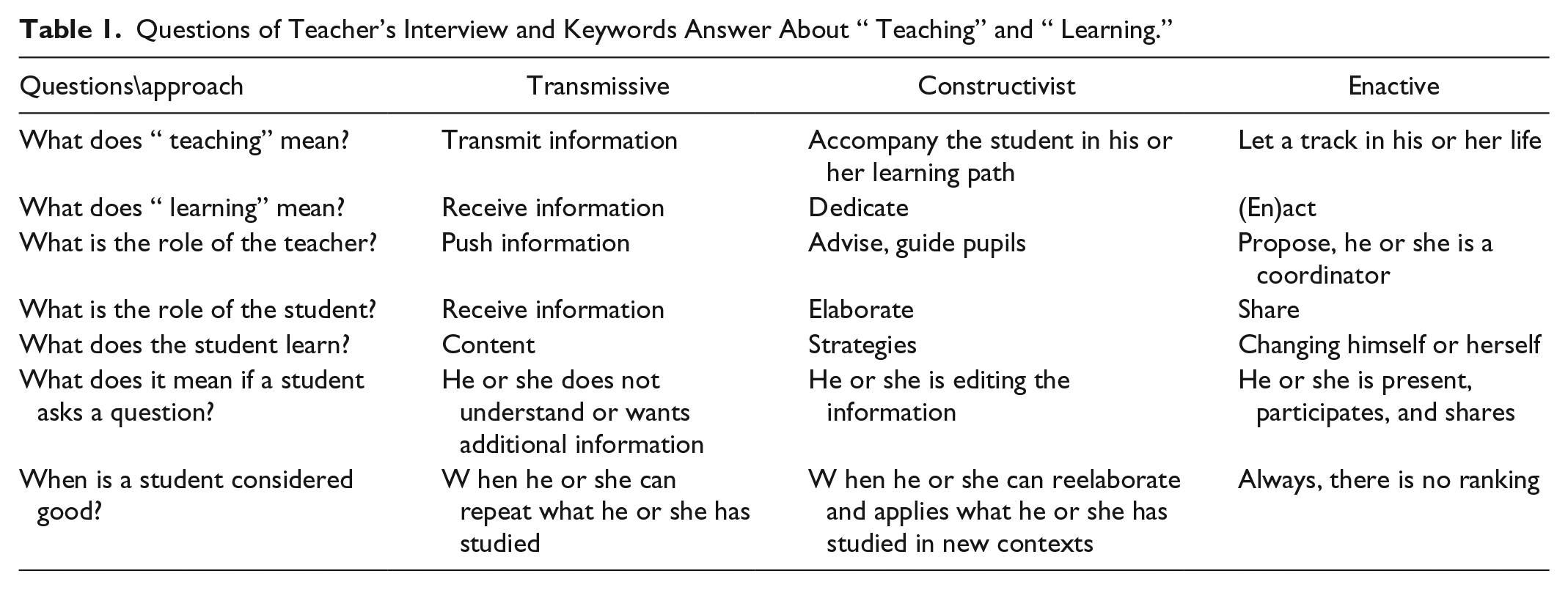
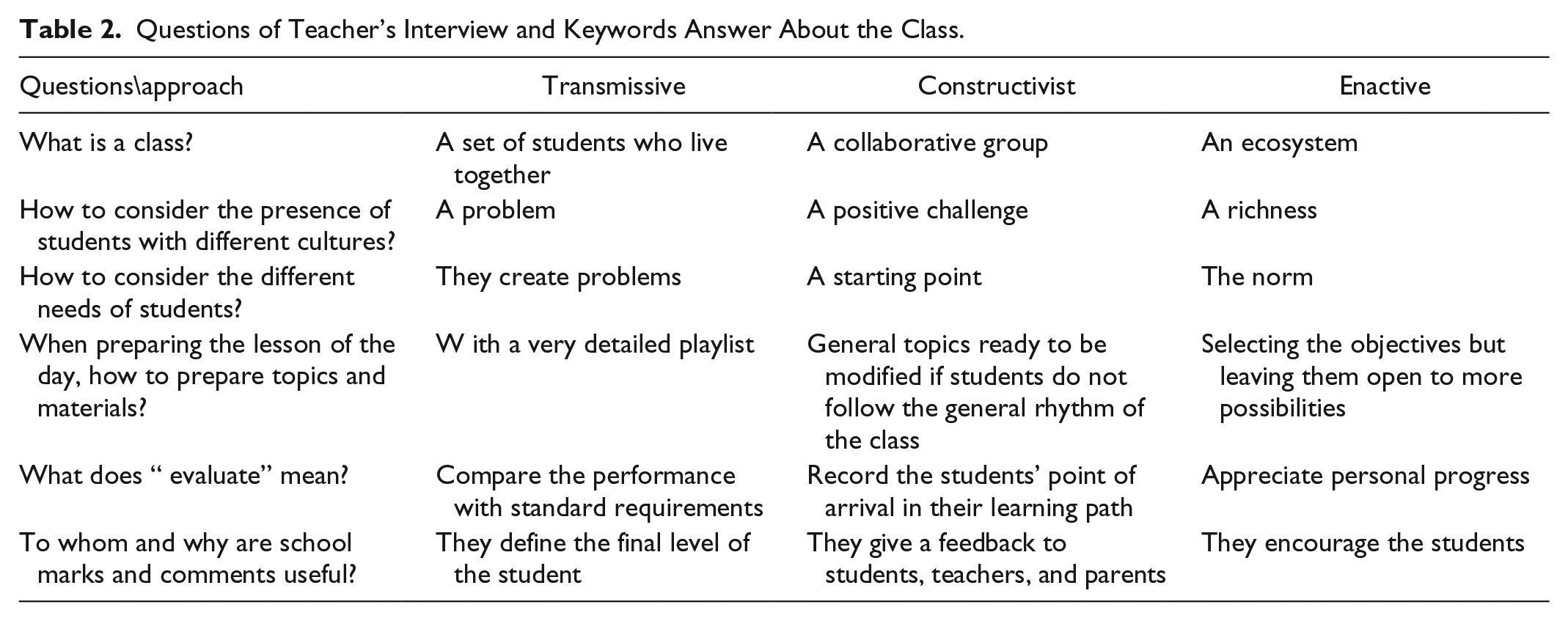
Tables 1 and 2 enclose the categories of questions and some sample of teachers’ answers related to each approach. Before submitting the survey, a brief review of the literature was conducted to identify key concepts that better than others distinguishes the three approaches (Begg, 1999, 2013; Duffy & Cunningham, 1996; Ertmer & Newby, 1993; Hoover, 1996; Kim, 2005; Li, Clark, & Winchester, 2010; McGee, 2005, 2006; Proulx, 2004, 2008; Proulx & Simmt, 2013; Rossi, 2011; Santoianni & Striano, 2003; Von Glaserfeld, 1989).
Questions of Teacher’s Interview and Keywords Answer About “ Teaching” and “ Learning.”
Questions of Teacher’s Interview and Keywords Answer About the Class.
Through appropriate statistical surveys carried out by SPSS software, correlations have been searched to investigate whether the teaching approach designated by the teacher depends both on the particular features of the class and on the biographical profile of the teacher, to answer to the second query (b).
In the second part of the study, the pupils were given three questionnaires and a test to assess their current ability level according to five different “forms of thinking”: critical thinking, creative thinking, metacognitive thinking, contemplative thinking, and caring thinking. This list, developed by Andy Begg (2013), takes into consideration the reaction of students when facing different teaching approaches. In particular, one questionnaire and the test were taken from the available literature, that is, “Io e la mia mente” (Me and my mind) for metacognitive thinking (Friso, Dusi, & Cornoldi, 2013) and “The Creativity Assessment Packet” by Frank Williams, Italian version, for creative thinking (William, 1994). The other two questionnaires were created on purpose for this study.
To answer the third inquiry (c), ANOVA was conducted to find out possible relations between the teachers’ approach and the developmental level that their pupils show in the above-mentioned thinking forms.
Participants
Thirty-four teachers and their 659 pupils took part in the project. They are all from the third, fourth, and fifth year of primary school in five institutions in the districts of Brescia and Venice. These cities in particular are part of two regions of Northern Italy with the highest number of immigrant students. Nonetheless, primary schools include the largest number of students without Italian citizenship and often welcome a large number of children newly arrived in the country.
All teachers interviewed were female, aged between 27 and 62 years, with an average age of 49 years and an SD = 9.5 years. They are all experienced teachers, with a range of 6 to 42 years of service, with an average of 27 years of teaching and an SD = 9.7.
The children belonged to different classes (11 third year, 11 fourth year, and 12 fifth year) ranging from 8 to 11 years in age. All classes were invited to participate and the pupils’ distribution among classes is shown in Table 3.
Distribution of Participant Among Classes.

Unfortunately, at the time when the test was handed in, some children were absent or lacking of parental permission. Other pupils were excluded from the final calculation as unable to complete the test because of cognitive or linguistic problems. Six hundred fifty-nine children composed the final group of participants.
Results
Considering the teachers’ answers, it is clear they recognize the problem related to the presence of pupils with different backgrounds. According to the 47% of teachers, the most common difficulty is the gap in children’s skills, knowledge, language, and values. A teacher explains,
My class is tough, because there are many children who have different learning timings and modalities. At the beginning, their level was very different and so it was really difficult. There are two or three leading children and the others follow. It is hard to have so many children who need an individualized path and compensatory instruments.
Another one adds,
There are communication difficulties because of their lexical and syntactic deficiency; their socio-cultural context is not enough “stimulating”: children live very few extra-curricular experiences. In my class, there are students with a very low level of comprehension and are seldom using the Italian language. Features of the class: 7 immigrant students (one pupil acquired the Italian citizenship two years ago), 3 pupils with a foreign mother. I do not consider the composition of the class as a problem, but it is certainly a significant aspect when structuring the lesson.
Teachers appear very sensitive about this theme: They tell about their frustration when faced with children’s needs they cannot satisfy:
It is difficult. One of the biggest difficulties is to be able to be efficient for everyone and many times there is a sense of guilt when you can’t do the children’s best, for lack of time and resources or because sometimes parents obstacle the teacher’s job and this is really sad,
enlightens a teacher.
The teachers’ will to help these pupils is noticeable: A great majority of them (67%) admit an approach focused on individual differences, such as constructivism. A certain percentage (20%) is looking for a more inclusive approach, which has the features of enactivism (Figure 1). If we consider that nobody has had any formal training for it, there is a large percentage of teachers who choose this approach. Only the remaining 9% remain anchored to a transmissive approach, which does not consider individual differences. As a matter of fact, the first inquiry about the tendency of teachers’ attitude and belief toward an innovative approach is well confirmed.
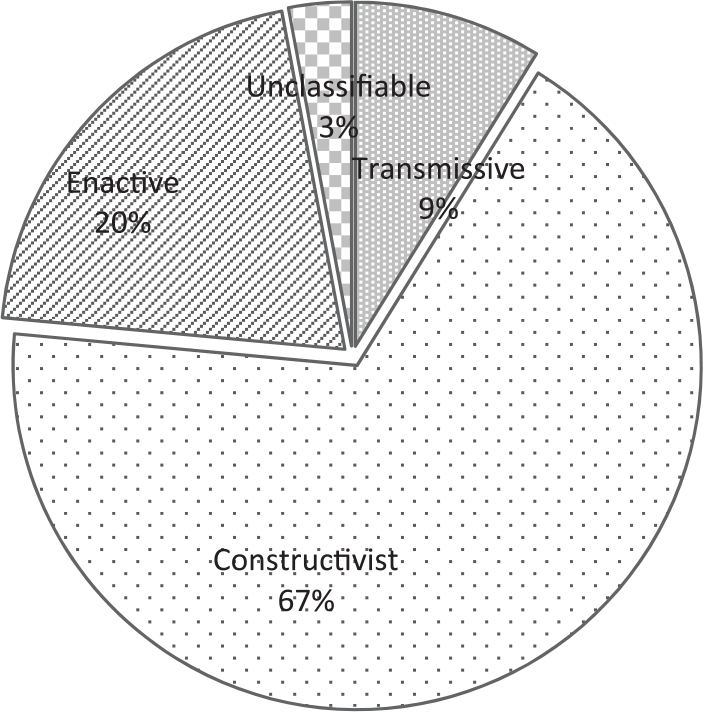
Percentage of teachers’ approach profile.
The questions that received the greatest number of enactive answers were “What does ‘teaching’ mean?” and “How to consider the presence of students with different cultures?” (Figure 2). Very common replies to the first enquiry were “Establish a relationship with the students that always develop the desire to learn” and “Create the conditions for a mutual learning.” Many teachers (60%) used in their sentences words such as “Leave a mark,” “Training,” and “Grow emotionally,” which are usually linked to the enactive approach. Similarly, a great number of teachers (67%) affirm that the presence of immigrant children is “A wealth, an opportunity for discussion and growth.” A teacher said,
It is an enrichment. It poses us, teachers, in front of different situations and makes us realize how lucky we are in some aspects of our life and less in others, because we often overlook the value of what we have.

Distribution of answer per approach.
There is no relation between the teacher’s work or place of living and her approach. The choice of approach, instead, is independent from factors such as location and size of the school, size and composition of the class, and her personal features. It disconfirms the second inquiry and suggests that enactive teaching is an approach that everybody can practice.
The results from the analysis on the average score obtained by the children show a prominent odd (Figure 3): The pupils, who study with an enactive teacher, have significantly higher test scores1 (p < .05). This is evident in all class levels and for all thinking forms, especially for creative and metacognitive thinking (p < .01). According to Begg (2013), it is probable that enactive teaching promotes a more balanced development of different forms of thought.

Comparing average pupils’ scores in the different teaching approaches.
A little gap persists between native and immigrant groups of students but anyway the average score is higher than in other classes (Figure 4). These data confirm that the enactive approach shows positive effects on both the two groups. The difficulties for the class due to the presence of immigrant pupils follow a strange trend: This difficult situation tends to increase when a great number of immigrant students compose the class, still less than a half of the total number of pupils.
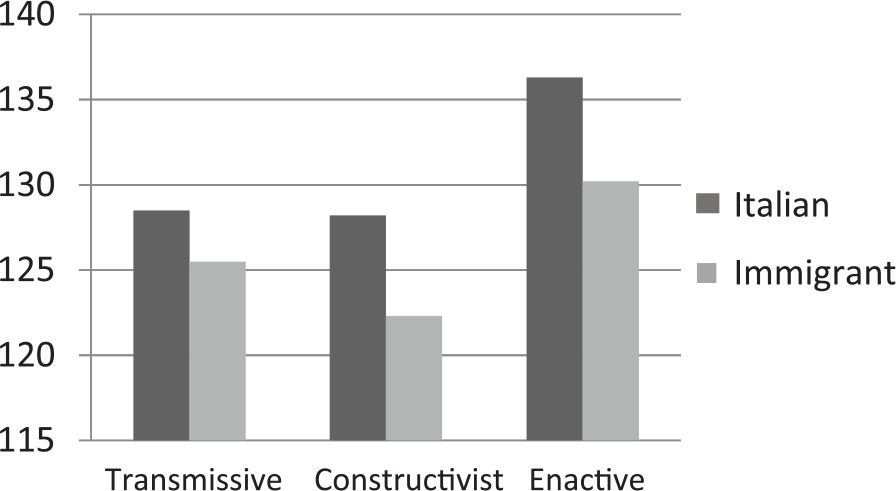
Effects of teaching approach on the pupils’ score.
A particular phenomenon happens in this situation: When the number of foreign children is low (less than five pupils), the average scores of the tests are higher (Figure 5). If there is an intermediate number of immigrant pupils, the average scores of the tests become very low, but if the number of immigrant students exceed half of the class, they show a slight recovery.
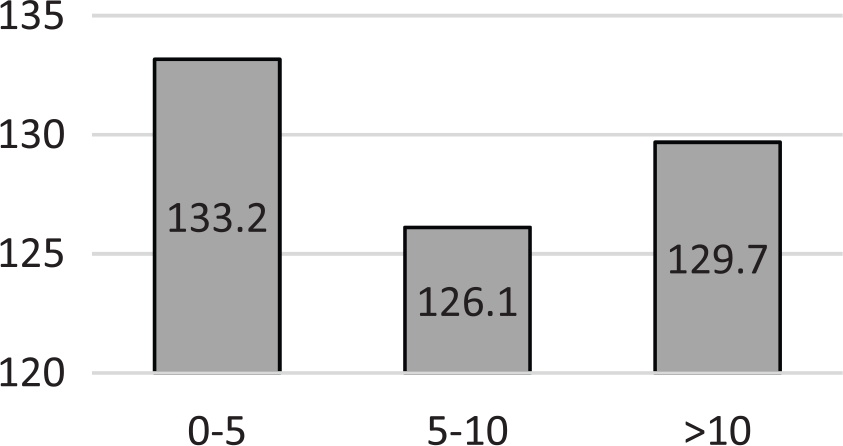
Effect of presence of immigrant pupils on the average scores.
Many teachers tried to explain this trend. They suppose that in the first case, the teacher expects the immigrant pupils to adapt to the class level. Conversely, in the third situation, the teacher adapts herself and her instructional method to the class’ needs. The second case is quite interesting: The teacher has to choose whether to help the disadvantaged children or to carry the rest of the class forward. However, this choice is pointless, as simply by following an inclusive approach such as enactivism can prevent her from having to make that choice. The enactive approach is quite effective in all cases, but a significant difference of scores (p < .01) is achieved especially when the classes host an intermediate (between 5 and 10) or higher number of immigrant students, exceeding 10 (p <.05; Figure 6). It is important to emphasize this fact, because it reflects the condition of most of the classes involved in the study.

Effect of teaching approach on classes with different number of immigrant pupils.
Discussion
A profound change is taking place in Italian schools: The population of pupils is changing, and with it, the way teachers approach students. Classes are now made up of children with different cultures, languages, knowledge, and skills, and the criteria to consider them as a uniformed group are changing. This transformation is followed by a change in the educational action exercised by the teachers, as confirmed by the data relating to the first hypothesis (a). The teacher recognizes that it is no longer appropriate to continue practicing traditional models of transmission, because these approaches consider the class as a homogeneous group of pupils and are no longer functional to the current environment. However, it is not possible to devote attention to each student’s individual process, such as suggested by constructivism. Designing individualized learning paths for each student becomes an excessive and unrealistic burden for the teacher; teachers spontaneously recognize that they should not seek the solution to this problem in specific integration strategies, trying to standardize immigrant students to the class, mostly unsuccessfully. Despite this, “People often resist change due to the cognitive dissonance related to their previous beliefs and behaviours. Conscious effort and perseverance are needed for a real change to take place” (Sandu, 2015, p. 2); as a consequence, the changing in their approach is slow to happen. A teacher explains the actual process of transition with these words: “In order to survive in an environment that changes all the time, you need to adapt quickly and change perspective, rather than fight to try to keep things as they were.”
The school system needs a new vision of the class group, which values each participant as a personal addition. Most teachers identify (as Figure 2 showed and the result paragraph explained) cultural difference as a source of enrichment for the entire class, abandoning the search of homogeneity for the benefits diversity can bring in the entire group.
The concept of “education” is, thus, changing: This process is no longer defined as the transmission of contents, as driving through a designated route but aims at “leaving a sign,” “growing emotionally,” and “establishing a relationship,” which can be summed up as a more global training: This perspective is actually wider and constitutes the basis for personalized learning, which considers the individual differences of each pupil. To do so, teachers must trust “the possibility of a cosmopolitan community where individuals from varying locations and beliefs engage in relationships of mutual respect” (Sparapani, Callejo Perez, Gould, Hillman, & Clark, 2014, p. 2).
The results about the second hypothesis (b) reveal that there were no significant correlations between the teachers’ approach and the institute’s or class’ characteristics. Moreover, teachers carrying on the enactive profile are equitably distributed according to the institute size, location, and class composition: These data suggest that this approach is potentially practicable by any teacher, without limitations related to the work context. The teacher’s personal features indicate, however, that young teachers with a high level of experience welcome the enactive approach. Probably, they need a certain degree of confidence and classroom management skills to undertake activities that leave pupils the freedom of expression and choice. This fact is confirmed by the OECD data:
Years of professional experience have a significant clear effect on teaching practices. . . . Indices on participation in co- operative activities are positively associated with on-the-job experience. . . . However, for classroom disciplinary climate and self-efficacy, consistent effects are found. . . . In a majority of Countries experienced teachers report a better classroom climate. (OECD, 2009, p. 115)
The teachers who understand this critical step aim to break down any kind of cultural and personal barriers in the classroom. The emphasis is on evaluating the person, heedless of their social hierarchy or their nationality of origin. In the classrooms of teachers who have spontaneously developed an enactive approach, the personal contribution of each pupil is recognized and valued, and children feel free to express themselves and to participate. They are, thus, creating environments rich in incitements and positive relationships.
The outcomes of the third assumption (c) show that pupils who study with an enactive teacher have significantly higher test scores. However, we investigated only teachers’ beliefs without going deeper into the activities they effectively conduct in the classroom; nonetheless, teachers affirm there is a great difference between what they would do and what they can do with the pupils. Limited resources, strict regulations, and little collaborative colleagues do not allow them to realize their proposals. As remembered by Sang (Sang et al., 2009), what a teacher believes is really powerful in its impact on the students, even when it is not followed by the teacher’s action. As OECD’s researches argue (OECD, 2009), historical, social, and pedagogical features influence the outcome, producing differences at a national, local, and personal level. However, if only the teacher’s beliefs produce positive effects on students, we can imagine how positive the result is when intentions become concrete actions.
The respect, the equality, and collaboration among peers on the base of the enactive approach allow both native and immigrant students to develop their potential. Through this approach, the teacher helps students to participate and to express themselves, preventing them from having to make uncomfortable choices.
Conclusion
In the last decade, we used to think about “learning” as something that happens or should happen in a place where a teacher transmits notions. Some scholars have overlooked the concept, dealing with a new idea of “here and now,” where the learning process, the context, and the teacher’s approach are crucial in determining the student’s performance (Di Tore & Corona, 2016). “Learning today is no longer related to the ‘classroom’ as the physical environment; it is instead an ‘across spaces’ place characterized by the possibility to build serendipitous, pervasive and seamless experiences” (p. 421), the authors explain.
A small part of the Italian scientific community involved in educational research is following this alternative direction. They give meaning and value both to the context and to the teacher’s approach as their main object of investigation of the learning process (Aiello, Carenzio, Di gennaro, Di Tore, & Sibilio, 2013; Aprile, 2012; Francesconi & Tarozzi, 2012; Frauenfelder et al., 2013; Giaconi, Rodrigues, Rossi, Aparacida, & Vastola, 2013; Prenna, 2014; Rivoltella, 2012; Rossi, 2011; Rossi et al., 2013). Some of them belong to the TincTec group (Research Center of Teaching and Learning, Inclusion, Disability, and Educational Technology) of Macerata. They also are establishing relations with the Swiss research group led by Marc Durand of University of Genève and with the research group led by Maurizio Sibilio (Università degli studi di Salerno) and the Pier Cesare Rivoltella (Università Cattolica del Sacro Cuore di Milano) in Italy. Together, they formed the Società Italiana di Pedagogia (Italian Society of Pedagogy) Nonlinear Trajectories group, investigating about emerging issues in the educational research, for example, enactivism, simplexity, and neuroscience. A lot of their works are dedicated to outline the typical features of enactive education (Prenna, 2014; Rossi, 2011; Rossi et al., 2013), whereas some others are focused on the teachers’ perspectives (Rossi & Pezzimenti, 2015).
The above study contributed to this very study, showing the spontaneous diffusion of a new approach among primary school teachers and highlighting its positive effects on pupils. Unfortunately, there is a lack of literature available, and based on enactive teaching in schools, therefore, it was not possible to compare this study with other experiences in different contexts.
This search considers certain classes selected by region, area, size of the institution, and age of pupils, but it would be very interesting to further investigate the phenomenon within a larger group of participants, carrying on a study in a broader perspective. There are many questions, in fact, that remain open; thus, it would be worth conducting longitudinal and cross-sectional studies to find out more details about this topic.
New analysis could provide more information about the evolution of this shift of approach, which is currently at the beginning of its development: How far reaching is this change of approach in Italy? What is happening in other countries? Will the number of teachers who choose to apply the enactive approach increase? Will this change have a spontaneous evolution or will it need an appropriate refresher training course? Will the positive results obtained by the children who have an enactive teacher persist even in following school levels? What educational path will these children face throughout their school career?
The hope is that this research could help to shed light on the complex changes that schools are experiencing. Recognizing a clear and effective approach in the spontaneous work of teachers can contribute to reinforce this new change, which has been proved as worthy in this particular context. All positive experiences, some of them extremely spontaneous, should not remain hidden or localized. Sharing good practice is highly important, because they constitute samples for new opportunities and policies. If Rossi (Rossi & Pezzimenti, 2015) was mainly interested in enactivism for preservice teachers, it is a fact that even teachers in service show curiosity upon this matter. In conclusion, outlining and spreading the principle and practices carried on so far could help many people, especially those who “live” the school to be aware when in contact with cultural diversity.
Footnotes
Declaration of Conflicting Interests
The author(s) declared no potential conflicts of interest with respect to the research, authorship, and/or publication of this article.
Funding
The author(s) received no financial support for the research, authorship, and/or publication of this article.