




Abstract
The present study examines the impact of family risk factors (e.g., migration background, poverty) in early childhood on children’s numeracy skills during preschool in Germany, and if these relations are mediated through the quality of the home learning environment. The data used for this research were collected using the longitudinal study BiKS-3-10 which followed 547 children from the first (average age: 3 years) to the third year (average age: 5 years) of preschool. The hypothesized mediation of quality of the home learning environment can only be interpreted using the home learning environment scale for cognitive promotion. In contrast, the quality of the home learning environment, specifically family support factors, is related neither to children’s development in numeracy nor to family risk. The results highlight the impact of early risk factors on children’s competencies and the mediating role of the quality of the home learning environment.
Background
It is well known that the home learning environment (e.g., home literacy, home numeracy, supportive climate) in preschool years is important for later development and school success (Anders et al., 2012; European Child Care and Education–Study Group [ECCE-Study Group], 1999; Lehrl, Ebert, Roßbach, & Weinert, 2012; Niklas & Schneider, 2012). Recent discussions about early childhood education underline the quality of stimulation, especially the promotion of precursors to reading and mathematics (Kleemans, Peeters, Segers, & Verhoeven, 2012; LeFevre, Polyzoi, Skwarchuk, Fast, & Sowinski, 2010; Niklas & Schneider, 2012; Skwarchuk, Sowinski, & LeFevre, 2014), and ask how they can be supported by the family to foster children’s competencies (for mathematical development see Blevins-Knabe & Berghout Austin, 2016). Most of these studies are in line with the bioecological theory by Bronfenbrenner and Morris (1998) that mentions proximal processes of the home learning environment (e.g., low cognitively stimulating parenting, low maternal sensitivity) as the “engines of development” (p. 996). The above-named studies found that the quality of the home learning environment matters: children experiencing a supportive climate and structure as well as better cognitive stimulation at home get higher scores in early literacy and numeracy tests, and this advantage continues into later ages. Moreover, children’s cognitive development and school career are also influenced by characteristics of the preschool environment, especially by the quality of the preschool, but to a smaller extent than the influences of the family (Tietze et al., 1998). Children enrolled in high-quality preschools all show better cognitive competencies than children from low-quality preschools (Belsky et al., 2007; Burchinal et al., 2009; Sammons, Anders et al., 2008; for an overview, see Gorey, 2001). This is particularly true of children from low-income or disadvantaged families who benefit especially from high-quality preschools in their development (e.g., Anders et al., 2011; Bassok, French, Fuller, & Kagan, 2008; Bierman et al., 2008). Thus, the influence of the home and preschool environment needs to be analyzed simultaneously, because the two environments interact in modeling children’s development (e.g., Anders et al., 2012). However, the quality of the home learning environment has proven to be important for child development over and above early institutional (preschool or kindergarten) influence (Lehrl et al., 2012). Thus, this article mainly focuses on the influence of the home learning environment on child development rather than on preschool quality. Furthermore, it is well documented that the quality of stimulation at home is influenced by structural characteristics of the family (e.g., maternal education, migration background, income), but these aspects do not completely determine home learning environment (Kluczniok, Lehrl, Kuger, & Rossbach, 2013; Niklas, Möllers, & Schneider, 2013). These studies all conclude that low quality of stimulation at home is moderately associated with low socioeconomic status and low parental education (Bornstein & Bradley, 2008; for an overview, see Totsika & Sylva, 2004). These structural characteristics can also be seen as risk factors of child development. Risk factors are often defined as biological and environmental conditions that increase the likelihood of negative outcomes (Klebanov & Brooks-Gunn, 2006). Children experiencing multiple family and social risk factors (e.g., migration background, poverty, low maternal education, single-parent household) early in their life perform poorer on tests scores than children exhibiting fewer risk factors (Burchinal, Roberts, Hooper, & Zeisel, 2000; Foster, Lambert, Abbott-Shim, McCarty, & Franze, 2005; Laucht, Esser, & Schmidt, 2000; Miller, Farkas, & Duncan, 2016; Mistry, Benner, Biesanz, & Clark, 2010; Sammons, Sylva et al., 2008; Seifer, Sameroff, Baldwin, & Baldwin, 1992; for an overview, see Evans, Li, & Whipple, 2013). Studies have found that the relationships between family risk factors and children’s reading and mathematics achievement are more pronounced during early childhood (Duncan, Yeung, Brooks-Gunn, & Smith, 1998) than later on, but may not diminish in the early grades (Lee, & Burkam, 2002; West, Denton, & Germino Hausken, 2000). This raises the question of whether an early high-quality home learning environment, including cognitive stimulation as well as a warm and supportive climate at home, might mediate the influence of early risk factors on child development during preschool.
Analytic Approaches Examining the Relationships Between Family Risk Factors and Child Development
Before addressing the research question, first different approaches to analyzing the relationships between family risk factors and children’s development are examined (Ackerman, Izard, Schoff, Youngstrom, & Kogos, 1999; Burchinal et al., 2000; Sameroff, Seifer, Baldwin, & Baldwin, 1993). Rathbun, West, and Walston (2005) summarized these as “additive factors or multiple predictor approach” (p. 3) and “composite or cumulative risk index approach” (p. 3). With the first approach, individual risk factors are used as predictors of children’s development in multivariate models to analyze the unique effects of each risk factor. However, Rathbun and colleagues (2005) mentioned the loss of statistical power to detect significant relationships, which might be problematic when the sample is small and, simultaneously, the number of individual risk factors is large. Another drawback is the potential for overlap or correlation among predictors, the consequence being that meaningful relationships of individual risk factors cannot be identified. There is broad research adopting this approach of analyzing a wide variety of single indicators of early risk (e.g., mother’s education level, migration background, poverty, single-parent household) on child development (e.g., Burchinal et al., 2000; Rathbun et al., 2005). To illustrate this research, the results of Rathbun and colleagues (2005) show that all included single-risk indicators (mother’s education level, migration background, poverty, and single-parent household) were (mostly negatively) associated with children’s initial achievement in U.S. kindergarten classes and their development in reading and mathematics over the first 4 years in school.
According to Rathbun and colleagues (2005), the second approach builds a single, multiple risk index based on dichotomous risk ratings, which is used as a predictor of children’s development. This approach assumes that the effects of biological, environmental, and social risk factors on child development do not act separately, but in combination with each other (Rutter et al., 1997). Thus, this approach enables the simultaneous consideration of multiple risk factors within a single variable, which is especially appropriate with small sample sizes. However, with the implementation of this approach, specific relations between risk factors—alone or in combination—and child outcomes cannot be detected. Large longitudinal studies adopt this second approach when analyzing the influence of a cumulative risk index on different child outcomes, including the Early Childhood Longitudinal Study-Kindergarten (ECLS-K; e.g., Rathbun et al., 2005; West et al., 2000), the Effective Provision of Preschool Education Project (EPPE; e.g., Hall et al., 2010; Sammons, Sylva et al., 2008), the National Early Head Start Research and Evaluation Project (e.g., Mistry et al., 2010), the National Institute of Child Health and Youth Development Study of Early Child Care and Youth Development (NICHD Study; e.g., Dearing, McCartney, & Taylor, 2009), and others (e.g., Brown & Ackerman, 2011; Burchinal et al., 2000; Chang, Shelleby, Cheong, & Shaw, 2012; Miller et al., 2016; Sameroff, Seifer, Zax, & Barocas, 1987; Seifer et al., 1992). The primary result of this research is that multiple disadvantaged children had poorer outcomes than other non- or less disadvantaged children (for an overview, see Evans et al., 2013). However, the diversity among risk factors (e.g., number of included risk factors, measures) makes it difficult to compare results across studies.
Mediating Factors: Home Learning Environment
The question, therefore, is whether these negative associations between early risk factors in the child’s life and the child’s development might be reduced by a high-quality home learning environment. Research on this topic is inconsistent. Mistry and colleagues (2010) found that risk exposure (measured by a cumulative risk index including seven variables) was partially mediated by indicators of the home learning environment, namely, the language/literacy stimulation and maternal warmth/responsiveness. Baker and Iruka (2013) concluded that the home learning environment mediates the association between maternal psychological functioning (risk experiences in terms of parental stress and maternal depression) and children’s school readiness in terms of math achievement. The results show that the home learning environment (broadly assessed by literacy-related items, items related to physical activities and to creativity) is an important mediator between maternal parenting stress and math achievement in kindergarten. The study by Yeung, Linver, and Brooks-Gunn (2002) focused on how the risk factor “income” is associated with children’s cognitive (applied problems, letter-word) and social outcomes (externalizing behavior) testing for potential mediating effects of parental investments (e.g., cognitively stimulating materials, activities with child) and family processes/stress (e.g., warm parenting). They found a mediating effect of parental investments on applied problems and externalizing behavior (no mediating effect for letter-word) as well as a mediating effect of parental investment and family processes/stress on externalizing behavior. The study indicates that different mediating mechanisms are at work for different child outcomes. Burchinal, Vernon-Feagans, Cox, and Investigators Key Family Life Project (2008) extended these results and show the negative impact of risk exposure on child development, and that potential mediators of the home learning environment can also be detected for infants (15 months old) from rural low-income communities in the United States. Based on a German longitudinal study, Lehrl and colleagues (2012) found that the home learning environment (measured as home literacy) mediated the influences of social background factors of the family (socioeconomic status and parental native language) on emergent literacy competencies of children.
Analysis of the research indicates that there is empirical evidence to support the assumption that a high-quality home learning environment plays a mediating role on the associations between risk exposure in early childhood and later child outcomes. However, the research assumes multiple mediating mechanisms of the home learning environment influencing child outcomes and there is diversity among risk factors which makes it difficult to compare the research.
The Present Study
The present study examines associations among family risk factors during early childhood and children’s numeracy skills at the end of preschool in Germany, and if these relationships are mediated through different aspects of the quality of the home learning environment (see Figure 1). The rationale for focusing on numeracy skills is that preacademic mathematical skills are highly predictive for later success in mathematics (Duncan et al., 2007; Jordan, Glutting, & Ramineni, 2010) as well as for later reading achievement (Lerkkanen, Rasku-Puttonen, Aunola, & Nurmi, 2005). It can be assumed that family support and cognitive stimulation at home could be protective factors against early risk exposure (Fergusson & Horwood, 2003; Werner, 2005). In accordance with the above-mentioned composite risk index, the current study created a cumulative risk index based on nine variables indicating the number of risk conditions present in the child’s early life.

Proposed model of mediation.
Method
Design of the BiKS Study 1
The study was conducted within the interdisciplinary research group BiKS (Bildungsprozesse, Kompetenzentwicklung und Selektionsentscheidungen im Vorschul- und Schulalter/Educational Processes, Competence Development and Selection Decisions at Preschool and School Age) which is funded by the German Research Foundation (DFG). The longitudinal study BiKS-3-10 (beginning of preschool to 5th grade) analyses how learning environments in the family setting as well as institutional settings (preschool and primary school) differentially influence children’s development (Schmidt, Smidt, & Schmitt, 2009; von Maurice et al., 2007). At present, this study is the only longitudinal study in Germany that focuses on global and domain-specific quality of stimulation in family, preschool, and primary school on early childhood competence development in a broad and comprehensive way using different methods (e.g., observations, standardized tests, questionnaires). Thus, the study is well suited to analyze the relationship between early risk factors, home learning environment, and children’s numeracy skills. Since 2005, BiKS-3-10 has followed the competence development influenced by educational processes of 547 children in Germany who attended 97 preschool classes in two federal states (Bavaria and Hesse). To reflect a diverse sample, preschools in metropolitan, urban, and rural areas were recruited. Within each preschool center, one classroom was selected at random. Preschool teachers and families with children due to be enrolled in elementary school in fall 2008 were asked for consent to participate in the study. Data used in this analysis were collected at three time points (fall/winter 2005/2006: age of children: M = 44.7 months, SD = 5.0; fall/winter 2006/2007: age of children: M = 55.9 months, SD = 4.4; fall/winter 2007/2008: age of children: M = 67.6 months, SD = 4.2). Thus, the entire preschool phase is covered. The sample size for the present analyses is n = 451 children with at least one valid outcome measure and predictor.
Measures
All measures used in the analyses are described as follows. In addition, Table 1 provides summary descriptive information for all variables used.
Descriptive Data for All Study Variables.
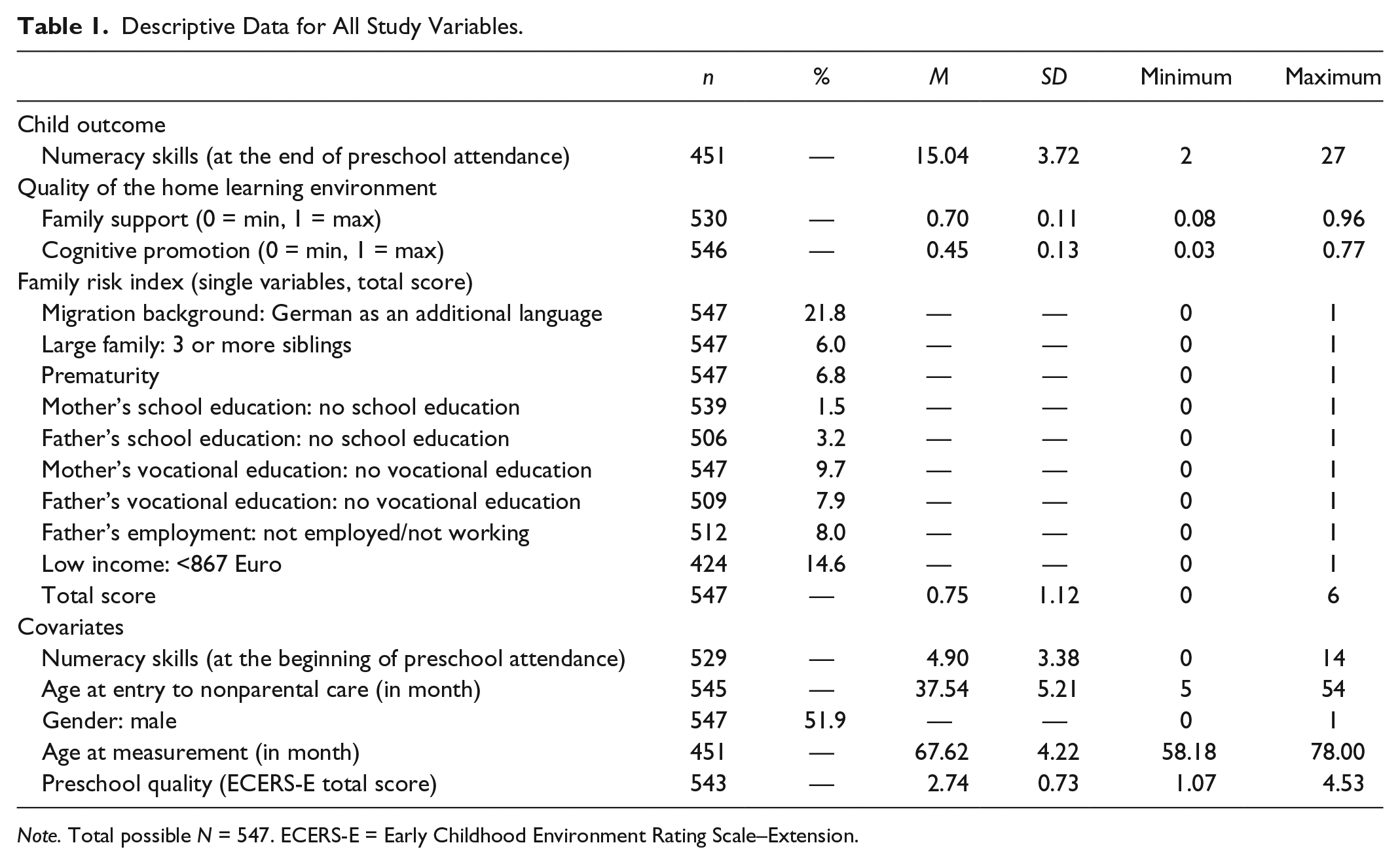
Note. Total possible N = 547. ECERS-E = Early Childhood Environment Rating Scale–Extension.
Outcome measure: Early numeracy skills
Early numeracy skills over the investigated preschool period were assessed by the subscale “arithmetics” of the German version of the Kaufman–Assessment Battery for Children (K-ABC, Melchers & Preuss, 2003), an internationally well-known and established standardized test. This scale measures children’s skills in counting, identifying numbers, knowledge of shapes, and understanding of early mathematical concepts like addition or subtraction. The subscale “arithmetics” covers numeracy skills that are considered to be predictive of later mathematics achievement (Dornheim, 2008; Jordan et al., 2010). However, the K-ABC, like other mathematics test, requires not only numeracy but also language skills (Abedi & Lord, 2001). It might be argued that adequate language skills are a prerequisite for the acquisition of mathematical knowledge (Aiken, 1972). The test items are embedded in a story about a family visiting a zoo, which is presented verbally with accompanying pictures. The test is organized into sets of three to five items of increasing difficulty. In Sets 1 and 2, the child has to count objects, identify numerals up to 10, and identify two-dimensional shapes (e.g., point to a triangle). In Sets 3 and 4, the child has to solve various numerical problems in the number range up to 10: comparing quantities of pictured objects (e.g., “Are there more children or more seals?”), understanding numbers as symbols (e.g., “What number is missing here?”), and solving verbally presented subtraction problems supported by pictures. In Sets 4 and 5, the child has to read numbers greater than 10, solve verbally presented arithmetic problems (subtraction and addition) that cross the “10” boundary, and do simple multiplication and division tasks (e.g., “The zoo has twice as many giraffes as goats. The zoo has five goats. How many giraffes are there in the zoo?”). From Set 6, children’s skills in dealing with numbers higher than 100 and with scale units are assessed, as well as their ability to solve more complex multiplication and division tasks embedded in the story. Children score one point for each item answered correctly. For the analyses, the outcome measures at the end of preschool attendance (age of child: M = 67.6 months, SD = 4.2) were used as raw scores. Internal consistency (Cronbach’s α) for this scale is .64.
Predictors
Family risk factors
Nine indicators of risk factors are included representing biological, economic, human capital, and demographic risk conditions (Klebanov & Brooks-Gunn, 2006). The items are selected drawing upon the literature and prior research on early risk factors (Burchinal et al., 2000; Laucht et al., 2000; McCartney, Dearing, Taylor, & Bub, 2007; Mistry et al., 2010; Sameroff et al., 1987; Sammons et al., 2008). All items are assessed through the parent interview at the beginning of the study. The risk index was computed as a count risk score assessing the number of family risk factors. Like other structural aspects of the family, the risk factors often covary and interrelate and are usually represented by a cumulative risk index reflecting the risk exposure (Rathbun et al., 2005). For each indicator, families received a score of 1 if they met or exceeded the risk threshold described for each indicator, and a score of 0 if they fell below. The total risk score ranges from 0 to 9 and indicates the extent of risk in the families. The following items were used:
Migration background (mother tongue): German as an additional language = 1, German as mother tongue = 0 (demographic risk condition)
Large families (children with three or more siblings): More than four children in the family = 1; less than four children in the family = 0 (demographic risk condition)
Premature birth: Prematurity = 1, no prematurity = 0 2 (biological risk condition)
Mother’s school education: No school education = 1, low/middle/high school education = 0 (human capital risk condition)
Father’s school education: No school education = 1, low/middle/high school education = 0 (human capital risk condition)
Mother’s vocational education: No vocational education = 1, vocational education = 0 (human capital risk condition)
Father’s vocational education: No vocational education = 1, vocational education = 0 (human capital risk condition)
Father’s employment: unemployed/not working = 1, employed/working = 0 (human capital risk condition) 3
Income: <867 Euro = 1, >867 Euro = 0 4 (economic risk condition)
For each family, the number of risk factors with valid data was determined. The majority of families in the sample (72.4%) had valid data for all nine risk indicators, and 19.9% of the families had valid data for eight risk indicators. The minimum was four valid indicators (= 0.2% of the sample).
Quality of the home learning environment
To cover general and domain-specific quality of the home learning environment, two scales were chosen indicating the level of warm and supportive processes in the family as well as the level of cognitive stimulation in early numeracy and literacy. The measures are common methods assessing the quality of the home learning environment across other longitudinal studies (e.g., EPPE, NICHD; for an overview, see Blevins-Knabe, 2016). The used instruments have also been fed into other national (e.g., National Educational Panel Study [NEPS]; Linberg, 2017) and international projects (e.g., Peixoto et al., 2014). For this study, items were combined from the Home Observation for Measurement of the Environment-Early Childhood (HOME-EC; Caldwell & Bradley, 1984) as well as from a family observation method called Family-Rating-Scale (Familieneinschätzskala [FES], Kuger, Pflieger, & Roßbach, 2005) measuring the quality of general and domain-specific instruction during a semistandardized book reading task for the primary caregiver (96% were mothers) and children (Kluczniok et al., 2013). For the following analyses, the scales were standardized to have a potential range from 0 to 1 and were derived by taking the means of the three time point measurements (t1: first year of preschool attendance; t2: midterm of preschool attendance; t3: last year of preschool attendance) to cover the entire preschool phase.
Family support
The nine items in this scale refer to the parents’ actions supporting the overall socioemotional interactions within the family (e.g., the parent talks to the child in appropriate language; parent also interacts nonverbally with the child). Internal consistency (Cronbach’s alpha) for this scale is 0.45 (t1), 0.48 (t2), and 0.51 (t3), 0.58 for the composite score of the entire preschool phase. Because of the theoretically intended heterogeneity and variety within the items that build the scale of family support, the internal consistency is rather low.
Cognitive promotion
The 21 items in this scale include numeracy- and literacy-related activities as well as materials supposed to stimulate numeracy and literacy (e.g., toys to teach colors and shapes, stimulation to learn digits, stimulation to learn the alphabet, and children’s books). These activities are characterized by rich language interactions and the promotion of literacy and numeracy skills. The Cronbach’s alpha of this scale is .75 at t1 and t2, .77 at t3, and is .89 for the composite scale representing cognitive promotion during the entire preschool phase. Previous analyses of two separate scales (cognitive promotion in literacy, cognitive promotion in numeracy) showed positive effects of both scales on numeracy skills at age 3 with a stronger effect of literacy promotion (Anders et al., 2012). Lehrl, Kluczniok, and Rossbach (2016) reported a significant positive influence of the home learning environment scale on children’s math development through elementary school. Thus, the measure is also predictive in the long-term run. Moreover, this measure is also used in a comparative study in Portuguese and German families with preschool-aged children by Peixoto and colleagues (2014) showing cross-cultural validity. As a result of which the outcome measure of the present study focuses not only on numeracy but also on language skills, a combined scale was used.
Covariates
Some variables influence child development as well as the home learning environment. Thus, in the following analyses, the age of the child at first entry to nonparental care (in months), the preschool quality (1 = inadequate quality, 7 = excellent quality; total score of the German version of Early Childhood Environment Rating Scale–Extension [ECERS-E]; Sylva, Siraj-Blatchford, & Taggart, 2003; Cronbach’s α = .69), the child’s gender (0 = male, 1 = female), and the children’s initial achievement on the K-ABC subscale “arithmetics” are assessed for control when children were approximately 45 months old. This is a common method used to analyze the contribution to children’s development controlling for prior numeracy skills and significant child characteristics (Sylva, Melhuish, Sammons, Siraj-Blatchford, & Taggart, 2004). As an intake factor for numeracy skills at the end of preschool attendance, the numeracy skills at Wave 1 (initial achievement) were used. Thus, the results can be interpreted as progress over the whole preschool years.
Data Analysis
In the first step, descriptive data for all considered variables were compared to get an impression of the sample’s composition. In the next step, bivariate intercorrelations of the numeracy skills, the risk factors, and both indicators of the home learning environment were reported to analyze how they relate to each other. Path analyses (using AMOS) were then performed to analyze the significance of the children’s early experience of risk in predicting later numeracy skills at the end of preschool attendance and whether these associations are mediated by general and domain-specific aspects of the home learning environment, assessed during preschool. All continuous variables were z-standardized before being included in the multivariate analyses.
Missing data are a potentially serious problem in all large-scale longitudinal studies; in this study, missing data ranged from 0% to 22%. To deal with missing data, the full information maximum likelihood (FIML) approach (Arbuckle, 1996) was chosen that is implemented in AMOS and uses valid information of all observations for model estimation.
Results
The present study investigates whether family risk factors during the early childhood correlate with children’s numeracy skills at the end of preschool in Germany, and whether these relationships are mediated through global and domain-specific aspects of the home learning environment while controlling for child and family background factors. A summary of the descriptive statistics for the child outcomes, the home learning environment, the risk index, and the covariates is given in Table 1. Tables 2 and 3 present the bivariate correlations and intercorrelations for the variables. Table 4 shows the results of path models displaying path coefficients testing the mediation role of the home learning environment for child outcome at the end of preschool.
Bivariate Correlations Among Cumulative Risk Index, Home Learning Environment, and Child Outcome.

p < .05. **p < .01. ***p < .001.
Intercorrelations Among Cumulative Risk Index, Home Learning Environment, Child Outcome, and Model Covariates.

p < .05. **p < .01. ***p < .001.
Tests of Mediation (n = 451).

Note. Standardized coefficients are displayed.
p < .05. **p < .01. ***p < .001.
Descriptive Data
The means presented in Table 1 show that numeracy skills on average grow over the preschool years. Looking at the overall means of both indicators of the quality of the home learning environment (family support and cognitive promotion; possible range: 0-1), the mean values indicate higher average scores for the family support scale (M = 0.70; SD = 0.11) as compared with the cognitive promotion scale (M = 0.45; SD = 0.13). Parents’ actions supporting the overall socioemotional interactions within the family may occur more often compared with the cognitive promotion of early literacy and numeracy skills (e.g., counting with the child) during preschool years in the participating families. With regard to the risk index, the total score at measurement point 1 (first year of preschool attendance) is on average M = 0.75 (possible range: 0-9; SD = 1.12). The risk index displays sufficient variance as can be seen from the minimum and maximum (min = 0, max = 6), indicating a broad variety of risk exposure in the families. More than three quarters of the BiKS-families (82.4%) have at least one risk factor present. Finally, Table 1 presents the descriptive information for all covariates and the percentage values of the single-risk items (e.g., 21.8% of the sample have migration background).
Moreover, it can be seen that the sample is well distributed. For example, the sample consists of children with high risk experiences and high cognitive promotion or high family support and vice versa.
Intercorrelations
Table 2 presents intercorrelations of family risk, children’s numeracy skills at the end of preschool, and both indicators of the home learning environment. The risk index negatively correlates with the quality of the home learning environment (family support and cognitive promotion) as well as with the children’s competencies. Consistent with our expectations, the more risk factors in early childhood, the worse the quality of the home learning environment, and the worse the later numeracy competencies. Both scales measuring the quality of the home learning environment (family support and cognitive promotion) display medium intercorrelations.
Furthermore, Table 3 displays the correlations between the family risk factor, the children’s numeracy skills, both indicators of the quality of the home learning environment, and the model covariates. Although the variable indicating the initial numeracy skills is associated with risk index, domain-specific quality of the home learning environment, and competencies at the end of preschool, the covariate age at entry to nonparental care and the gender of child are not correlated with these variables. Age at measurement and preschool quality are related to numeracy skills at the end of preschool attendance.
Path Analyses
The main research question intended to examine the associations among early family risk and children’s numeracy skills at the end of preschool in Germany, and to examine whether these relations are mediated through different aspects of the home learning environment. According to Baron and Kenny (1986) and Holmbeck (1997), four conditions must be met for a mediator variable: first, the predictor (risk index) must be significantly associated with the hypothesized mediators (family support and cognitive promotion). Second, the predictor (risk index) must be significantly associated with the dependent measure (numeracy skills) without controlling for the hypothesized mediators (family support and cognitive promotion). Third, the mediators (family support and cognitive promotion) must be significantly associated with the dependent measure (numeracy skills). Fourth, the impact of the predictor (risk index) on the dependent measure (numeracy skills) is less after controlling for the mediator (family support and cognitive promotion). The individual steps testing the mediation are described in detail below.
The risk index is significantly associated with the both hypothesized mediator variables (family support: r = −.16***; cognitive promotion: r = −.27***; first condition), controlling for the model covariates. The less early risk factors the child experienced the better the family support and cognitive promotion in literacy and numeracy skills.
In Table 4, the standardized coefficients are displayed for the dependent variable. Model 1 presents the second condition of testing the mediation role of the home learning environment. The early risk index is significantly associated with the child’s later numeracy skills (β = −.11*) without controlling for the hypothesized mediators (family support and cognitive promotion), but controlling for model covariates. Children with higher risk exposure during early childhood display lower numeracy competencies at the end of preschool. The next two models (Models 2a and 2b) tested whether the both hypothesized mediators (family support and cognitive promotion) are significantly associated with the progress of numeracy skills through preschool. This is only true for the scale cognitive promotion (β = .13**, see Model 2b) and not for the scale family support (β = .07, see Model 2a). Children whose parents offer better cognitive promotion in literacy and numeracy during early childhood get higher scores on numeracy skills at the end of preschool. In Models 3a and 3b, the last condition is tested. The impact of the early risk index on numeracy skills at the end of preschool is marginally less after controlling for the mediator variable family support (β = −.10*, see Model 3a). The impact of the risk factors on the numeracy test scores at the end of preschool is less and loses significance under control of the mediator variable cognitive promotion (β = −.08; see Model 3b). Baron and Kenny (1986) indeed noticed that it would be unusual in social science for this effect to be reduced from significance to zero. Therefore, the degree to which the effect is reduced (e.g., the change in regression coefficients, loss of significance) is an indicator of the potency of the mediator (Holmbeck, 1997, p. 602). Thus, it can be assumed that the quality of the home learning environment regarding cognitive promotion is a mediator variable for the association between early risk factors and later child outcomes. The Sobel (1982) test also indicated a significant indirect path (z = −2.55*). In Model 4, the whole model with all analyses variables is displayed. As can be seen, the impact of the risk factors on the numeracy test scores is less and loses significance under control of the both indicators of the home learning environment and model covariates (β = −.08). The scale family support is not significantly associated with the numeracy skills (β = .02, see Model 4). However, the scale cognitive promotion shows a significant influence on numeracy test scores controlling for family support and model covariate (β = .11*, see Model 4). This result highlights the importance of a high-quality cognitive stimulation as a protective factor against risk.
Altogether, the results showed that the subset of predictors explained about 30% of the variance in numeracy skills. This finding is in agreement with research that has shown moderate explained variances in early numeracy skills (e.g., Anders et al., 2012; Niklas & Schneider, 2012; Yeung et al., 2002).
Discussion
The study examined the influence of early family risk factors on children’s competencies in numeracy during preschool, and examined whether these associations are mediated by two indicators of the home learning environment (family support and cognitive promotion), controlling for several background factors. Thus, the study provided insight into the complex interplay of cumulative risk factors, quality of the home learning environment, child and family background factors, and numeracy competencies in the early childhood in Germany. Results revealed that children with higher risk exposure at the beginning of preschool also experienced lower family support and cognitive promotion in literacy and numeracy skills. Moreover, these children achieved lower gains in numeracy skills through preschool indicating disparities among children even at an early age. This replicated the results of other studies (e.g., Burchinal et al., 2000; Foster et al., 2005; Marcella, Howes, & Fuligni, 2014; Mistry et al., 2010; Sammons, Sylva et al., 2008). Furthermore, children experiencing better cognitive promotion in early literacy and numeracy skills at home showed higher levels of numeracy competencies at the end of preschool even taking into account the influences of a set of covariates. This result is also in alignment with the previous literature that highlights the importance of a high-quality home learning environment for mathematical development in general and especially high-quality domain-specific stimulation at home (Anders et al., 2012; ECCE-Study Group, 1999; Kleemans et al., 2012; Niklas & Schneider, 2012; Skwarchuk et al., 2014). In contrast, the other indicator of the home learning environment, the scale family support, representing an overall socioemotional interaction climate within the family, was not associated with child development in numeracy indicating no mediating influence. This result is in line with the study by Klebanov and Brooks-Gunn (2006) that reported no effect of psychological risks including low social support within the family on cognitive test scores at 3 through 8 years of age. However, this result also differs from previous studies which demonstrate links between the family climate and children’s academic success (Unger, McLeod, Brown, & Tressell, 2000). Moreover, Mistry et al. (2010) found that risk exposure during early childhood mattered for mathematical development and was partly mediated through parental warmth/responsiveness (similar Burchinal et al., 2008). To sum up, this strengthens the assumption that cognitive promotion can be a protective factor against early risk exposure of numeracy skills whereas family support is not. There may be, however, a small possibility that there is a methodical issue due to the rather low internal consistency of the scale family support representing the theoretically intended heterogeneity and variety of this scale. Hence, it remains to be examined whether these effects are also present at socioemotional outcomes (e.g., behavior problems) as Yeung and colleagues (2002) illustrated.
Practical Implications
Against the background that early childhood is a period representing high academic risk for disadvantaged children, the reported results also point to practical implications: The study shows the importance of domain-specific stimulation at home for children’s cognitive competencies and the fact that a high-quality home learning environment (e.g., book reading to the child, playing with numbers and letters) might have a protective effect for high-risk children. However, not all parents may know how to best support their children and may need assistance in offering a high-quality domain-specific learning environment as reported by Skwarchuk (2009). This knowledge could help to specify family education programs in accordance with families’ preconditions and to adapt them even more effectively to the families’ individual situations. In this context, Vandermaas-Peeler, Nelson, Bumpass, and Sassine (2009) proposed family education programs that incorporate numeracy-related discourse in the family’s daily routines (e.g., during mealtime, bath time, and bedtime) to improve children’s numeracy development. Moreover, such family education programs should be low-threshold offers, easily accessible to reach as many parents as possible. The problem with this is that family support programs also encounter their limits because some parents from all populations are not responsive to such programs (Mühling & Smolka, 2007; Wilke, Hachfeld, Höhl, & Anders, 2014). “Open meetings” and “child and family centers” could provide a useful opportunity to reach such at-risk families. Blok, Fukkink, Gebhardt, and Leseman (2005) reasoned that combined programs that include early childhood care and education and family support service are most effective for children’s development. In Germany, such child and family centers are quite a new development in early childhood care and education institutions. Originally, this concept comes from the “early excellence” or “children’s centres” from England (Smith et al., 2014). These child and family centers are designed to provide support, counseling, and training for parents and thereby to foster children’s development indirectly, in addition to the direct care which preschool already provides for children (Stöbe-Blossey, Mierau, & Tietze, 2008). These centers should strengthen parents in their perception of education and child rearing and should contribute to an increase in quality in preschools, thus further reducing inequalities in child development. In addition, partnerships with social service agencies would help to better serve children at risk and their families. Thus, for future research and practice, it will be the major task to meet this challenge and evaluate and develop further various family education programs.
Limitations
Although the present study has a number of important findings, there are also limitations. First, all analyses were tests of association not causation. This study adjusted for the children’s numeracy skills at the beginning and end of preschool, but this analysis strategy does not allow to make causal inferences. Second, to better understand the results concerning the risk index, it is informative to reconsider how risk was defined in the current study. In contrast to a single-item approach, a “composite or cumulative risk index” (Rathbun et al., 2005, p. 3) was chosen (for an overview of the measurement, see Brown & Ackerman, 2011). The motivation for this approach was that children experience different risk factors as whole risk in their early lives which influences their development. So a simultaneous consideration of multiple risk factors within a single variable seems to be more appropriate, especially with the limited sample size. Burchinal et al. (2000) also favored a risk index approach when a large number of risk variables are used, as is the case in the current study, which combined nine items within a risk index. The limitation concerns the possibility that a different selection of risk factors in our risk index might yield somewhat different findings. Moreover, some studies (Burchinal et al., 2008) favor a cumulative risk index measured as the mean of risk variables yielding stronger effects on child outcomes than when measured as the count of risk factors. The risk index was also computed as the mean of the standardized nine risk variables with similar results. Thus, the cumulative index in the present study seems to be appropriate.
Third, another major point of discussion is the question of whether preschool quality could be a mediator of early risk experiences. It is well documented that high preschool quality fosters child development, especially the development of disadvantaged children (Anders et al., 2011; Bierman et al., 2008; Gorey, 2001). Thus, preschool quality is controlled for in all analyses to account for quality differences in early child care. Nevertheless, further studies should analyze whether preschool quality might influence the association between risk exposure and child development accounting for the home learning environment as an important context of a child’s early life. Moreover, whether and how the quality of the preschools embedded within socially disadvantaged urban areas may account for some effects on the development of children at risk (as shown by McCoy, Connors, Morris, Yoshikawa, & Friedman-Krauss, 2015) should be examined.
Fourth, the outcome measure represents a limited assessment of numeracy skills during preschool. It focuses only on a part of basic numeracy skills like counting and identifying numbers. Consequently, the results cannot be transferred to mathematical competencies in a comprehensive sense.
In conclusion, the present study examined the impact of family risk factors (e.g., migration background, poverty) in early childhood on children’s numeracy skills during preschool in Germany, and whether these relations are mediated through the quality of the home learning environment (family support, cognitive promotion). The results highlight the impact of early risk factors on children’s numeracy competencies and the mediating role of the cognitive promotion at home.
Footnotes
Declaration of Conflicting Interests
The author(s) declared no potential conflicts of interest with respect to the research, authorship, and/or publication of this article.
Funding
The author(s) disclosed receipt of the following financial support for the research, authorship, and/or publication of this article: The author acknowledged funding by the German Research Foundation (DFG) supported open access fonds of the University of Bamberg.