




Abstract
This article analyzes the relationship between Korean mothers’ beliefs about early childhood English education and preschoolers’ attitudes toward English learning. English experiences in the home were also projected to be significantly related to the aforementioned factors. Participants consisted of 159 mother–child pairs in South Korea. This study yielded three main results. First, correlations were found between the mothers’ education level and all three factors, while the fathers’ education and family income levels correlated only with preschoolers’ English experiences at home. Second, the subfactors of the mothers’ beliefs, the preschoolers’ home English experiences, and their attitudes toward learning English were revealed to be partly related. Third, the study showed that preschoolers’ English experiences at home mediated the relationship between the mothers’ beliefs in the importance of English education and the preschoolers’ attitudes. In effect, while the mothers’ beliefs about early childhood English education did not directly affect their children’s attitudes, indirect effects were found to be mediated by English experiences at home. Based on these results, we propose that it is necessary for parents to create a rich language environment in the home that engenders in children positive foreign language learning attitudes.
Keywords
Introduction
The growing phenomenon of early childhood English education is found in most East Asian countries, particularly in South Korea, which is the focus of this study. Statistics reveal that in South Korea, the average monthly private English expenditure per child has been steadily rising (Statistics Korea, 2018). This so-called “English Fever,” which influenced the introduction of English education into elementary schools, has now spread its influence to preschool-aged children (Lee & Lee, 2015).
However, we are now beyond the naïve view that teaching assures learning. Constructivism emphasizes one more thing, the will of the learner, as the main variable of learning effect. For successful English learning, we should consider not just the rich environment (e.g., mothers’ beliefs or English experiences), but also the learner’s engagement (e.g., preschoolers’ attitudes). Then how do these variables relate to each other? In this study, we investigated the influence of mothers’ beliefs about early English education and diversified home English experiences on preschoolers’ attitudes toward English learning.
Background
English Education in Korea and Parental Beliefs About Early English Education
A 2016 report by the Korean Ministry of Education estimated the annual value of the English education market for preschoolers to be over 250 billion Korean won (Ministry of education, 2016). More than half of Korean parents believe that English education is necessary from early childhood (Lee, 2006), and the age at which English education starts for Korean preschoolers is ever decreasing (Ma, 2016). A panel study on Korean children from 2008 to 2013 identified 1-year olds who had already begun English education programs (Yi et al., 2015). It also showed a concurrent increase in the rate of children studying English using workbooks at home and participating in English extracurricular activities at childcare centers or other English programs. These findings in Korea concerning early childhood English education are in line with those found in other East Asian countries (Butler, 2015).
As shown above, currently, most Korean preschoolers experience English education in their kindergartens or childcare centers. On average, English classes are offered at least once or twice a week for 30 to 40 min. Some children are enrolled in “English kindergartens” (i.e., English immersion institutions) where they spend 3 to 6 hr a day communicating only in English. In addition to regular institutions, there are also private home tutors and other after-school programs (Ban & Seo, 2009). Research has shown that mothers who chose an English immersion institution typically held stronger beliefs in the benefits of early childhood English education (Hwang & Choi, 2017).
The parental demand for English educational institutions can be seen as a result of their beliefs in the importance of English education. Stipek et al. (1992) found that parents’ beliefs affect the starting age, educational methods, and programs for early childhood English education. In addition, the increase in immersive early childhood English education can be attributed to parents’ recognition that learning English in an English-as-a-second-language (ESL) environment is more effective in improving children’s language proficiency than in an English-as-a-foreign-language (EFL) environment (Song, 2005). Most mothers also believe that learning English is much more effective when children are younger. As the early English education frenzy is a phenomenon dominated by mothers, we can say that mothers’ beliefs have a great influence on preschoolers’ English education. In the same vein, a number of studies have shown that mothers have a stronger impact than fathers on children’s English education (Lee & Woo, 2008).
Preschoolers’ English Experiences
Parental beliefs about early English education may directly affect the children’s type of English experiences. In most cases, parents opt for institutional English education programs. According to Chang and Lim (1999), mothers perceived that it would be more appropriate to have English education at an institution than at home. Mother’s choice was shown as the primary factor leading to English education for young children, followed by the influence of media or advertising, and finally the child’s choice. In other cases, however, mothers were in favor of English education at home and were actively involved in helping children with learning English (Kim, 2009) or using English media such as CDs, and videos, and digital pens (Choi et al., 2020; Kang et al., 2019; Yook, 2004). Some mothers also strove to provide additive ESL experiences such as taking their children to English villages or finding other opportunities for their children to converse with native English speakers. (English villages are language education institutions which aim to create a language immersion environment for students in their own country. The concept is run as a commercial venture in Spain and Italy, Poland, and Hungary and is quasi-governmental in South Korea.)
As the technological literacy of young children develops, the expansion of learning device markets is also noticeable. Many preschoolers learn English by using applications on tablets, PCs, and smartphones, as well as through traditional audio and video resources, which is related to the tendency to emphasize the necessity to acquire the pronunciation skills of “native speakers” (Song et al., 2011). Such devices and software also facilitate children’s active participation as these programs are directly manipulated by hand and advantageous for keeping children’s attention as they have short intervals between stimulus and response (NAEYC, 2012). Through these kinds of media, a child can have fun while learning vocabulary, native pronunciation, and colloquial expressions. Therefore, the latest learning devices are likely to provide valuable learning experiences and enhance learning motivation in young children.
Important Factors for Children’s English Learning
Based on this existing research, we can assume that mothers’ beliefs concerning early childhood English education affect preschoolers’ English learning. However, in determining the effectiveness of English education, we must also account for how children perceive the learning process. Recent studies have found that many students who were forced into English education from childhood have lost their language learning motivation (T. Kim, 2012). A high preference for English-related activities and a strong motivation for learning English are beneficial for long-term learning.
Scholars have reported many variables that influence children’s ESL acquisition, such as the amount and quality of English exposure, general language ability, personality, and attitudes regarding English education (Paradis et al., 2012). According to previous studies, a learner’s attitudes are the most important factor that determines the success in learning (Gardner & Maclntyre, 1991; J. Lee, 2015; Masgoret & Gardner, 2003; Tudor, 1996). Unlike adults, preschooler’s L2 acquisition is generally achieved through implicit rather than explicit education (DeKeyser, 2003; Park et al., 2019). In general, preschoolers in ESL environments are naturally motivated when learning English to interact with their peers (Paradis et al., 2012). However, in Korea, as children are learning in an EFL rather than an ESL environment, children do not have that motivation, so other methods are required to boost their motivation.
Children’s interest in learning can be measured through their level of preference for actual learning activities. J. Kim (2002) found that if children did not enjoy a learning activity, they were unable to focus and would quickly lose interest. Moreover, they were consequently more likely to perceive learning as difficult. Preschoolers learn more intensely and successfully when they are interested (Harmer, 1991; Hong, 2006). Therefore, voluntary learning, which is linked to English activity preference, is important for preschoolers’ English education.
We have established that attitudes are a very important factor in language learning. Yet, little is known about preschoolers’ learning attitudes due to the difficulty of measuring it. Previous studies have collected children’s data through parental questionnaires; however, parents’ responses may contain biases. Thus, it is through the preschoolers themselves that we can obtain the most accurate and honest answers.
The Current Study
The purpose of this study is to investigate the possible relationships between three factors: (a) mothers’ beliefs about early childhood English education, (b) preschoolers’ English experiences at home, and (c) preschoolers’ attitudes toward learning English. We analyzed mediating effects by proposing a research model that investigates to what extent the mothers’ beliefs influence home English experiences, and how these experiences, in turn, affect children’s attitudes toward English learning.
To this purpose, we propose the following three research questions:
Method
Participants
We conducted surveys with 165 mothers and interviewed 165 children from 14 childcare centers and kindergartens selected in Seoul, Incheon, Daejeon, Gyeonggi, Chungnam, Jeonbuk, Gyeongnam, Gyeongbuk, and Gangwon, South Korea. These childcare centers and kindergartens were non-immersion institutions that only facilitated English lessons and activities two to three times per week for 30 to 40 min each. The final analysis included 159 pairs of mothers and their children (87 males and 72 females), excluding some deficient responses. The greatest proportion (69%) of children had parents who had received university-level education. For participants’ monthly income, 78% earned an average of 3 to 6 million Korean won, revealing that most children were from middle-class families. 1 For participating children, the average starting age of their English education was 3.7 years (MD = 0.95) with an average duration of 23.3 months (MD = 13.75).
Measures
Mothers were asked to complete a self-reporting questionnaire on their beliefs regarding early childhood English education and the frequency of their children’s exposure to English at home. We conducted surveys through interviews to measure preschoolers’ attitudes toward English learning (English activity preferences and learning motivation). Research tools adopted in this research are as follows.
Mothers’ beliefs about early childhood English education
Mothers’ beliefs were measured using a modified version of S. Song’s Q-set (2005). Cronbach’s α for 24 items was .839 after the measure was revised and condensed from the original set (50 items) (see Table 1). The 24 extracted items are those that most correspond with the intention of this study. The face validity of the revised scales was examined by reviews from three child development experts. Responses were chosen from a 4-point Likert-type scale ranging from Strongly disagree to Strongly agree, with the scale including two subfactors of beliefs: benefits of early childhood English education and benefits of using various teaching methods. 2 The first subfactor elicited beliefs in the areas of cognitive, emotional, and economic development; academic achievement; and acceptance of other cultures. The second subfactor investigated preferences regarding educational resources such as games, picture books, songs, internet materials, and other nonconventional approaches.
Scale for Mothers’ Beliefs About Early Childhood English Education.

English experiences at home
We surveyed the initial age of English education, duration, experiences outside of the preschool, and the frequency of English experiences provided at home. The frequency scale’s items were modified to suit the actual practices of Korean families, using Katzir et al.’s “Child and Family Literacy Practices” (2009) as a base. Each item/activity was rated using a 5-point scale of frequency. The eight survey items (Cronbach’s α = .821) concerned parental teaching (4 items), facilitated ESL experiences (3 items), and technological device use (1 item) (see Table 2).
Scale for English Experiences at Home.
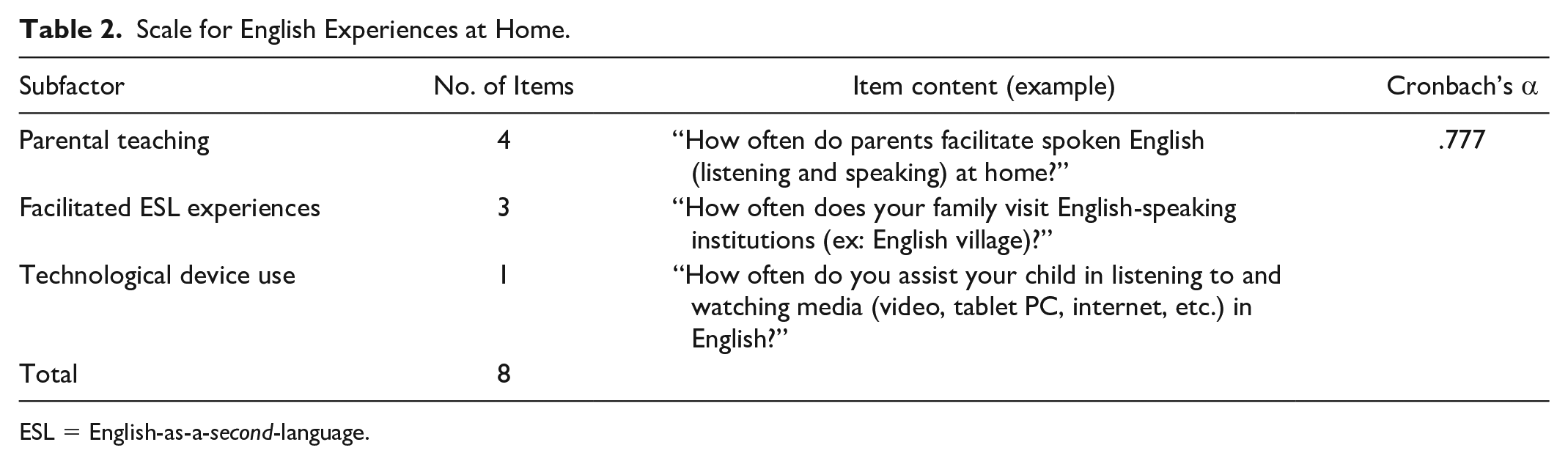
ESL = English-as-a-second-language.
Preschoolers’ attitudes toward learning English
Our measurement of preschoolers’ attitudes contains two subfactors of English activity preferences and motivation for English learning. The first subfactor measure is an abbreviated version of the “Children’s Attitudes towards School & Learning (CATS)” scale (Henry et al., 2007) and was modified to suit Korean children’s English activities. The original scale consists of 13 questions, consisting of three factors: academics, early literacy, and child-initiated activities. In this study, this format was used as it was, but a total of six items were used by selecting two items from each factor, which corresponded to English activities in early childhood education institutions: writing letters of the alphabet, English homework, reading English books, making stories in English, chat with friends in English, and watching videos in English. In this study, we added picture cards depicting each English activity to the original facial expression cards to improve the children’s comprehension and responses to questions. The interviewer read questions while showing the English activity cards to the target child. In answering the question, the child chose a facial expression card corresponding to the following: 1—“I don’t like it,” 2—“It’s okay,” 3—“I like it,” and 4—“I really like it.”
To address the second factor, we translated and revised the “Motivation and Attitudes towards Learning English Scale for Children (MALESC)” by Carreira (2006) to better reflect the situation of Korean children, and face validity was again reviewed by three child development experts. MALESC consists of 19 items of five subfactors: intrinsic motivation, instrumental motivation, caregivers’ encouragement, interest in foreign countries, and anxiety. Items were measured using a 4-point Likert-type scale from “Strongly disagree” to “Strongly agree.” In a self-reporting interview format, preschoolers expressed their responses to questions using facial expression cards. Cronbach’s α and descriptions of the item-scale constructs are provided in Table 3.
Scale for Preschoolers’ Attitudes Toward Learning English.

Research Procedure
To collect the data, the researchers visited kindergartens and daycare centers and distributed questionnaires for parents and conducted interviews with preschoolers. We conducted the interviews in places such as auditoriums that were not being used that day. The researcher placed two chairs on either side of one desk and faced the infant to conduct a one-on-one interview. Interview questions were made in accordance with the interview mantel. The child was introduced to the interview with something similar to the following instructions, given in Korean.
“You will have been doing various activities while studying English. There may be some activities that you like and some that you don’t like. You can choose which activities you like or dislike. Look at the four facial expressions on this card (Figure 1). I’m going to show you a picture (Figure 2) and talk to you about one of the activities you do while studying English. If you don’t like the activity, point to this expression (pointing to the frown). If it’s just an average activity, you can choose this expression (pointing to the neutral expression). If you like it, you can choose this expression (pointing to the smiling face). If you really like it, you can choose this expression (pointing to the smiling-ear-to-ear face). There is no right answer.”

Facial expression cards.

English activity cards.
After the explanation, the researcher read each question, showed the picture card, and let the children choose an expression. It took about 10 min per child.
Data Analysis
After the data were collected and organized, an analysis was conducted using SPSS 23.0. First, we ran descriptive statistics to examine the participants’ socioeconomic characteristics. Second, Cronbach’s αs were calculated to examine internal consistency among items of measured variables. Third, frequency analysis was conducted to observe early childhood English education trends. Fourth, Pearson’s r correlational analyses were performed to determine the relationships among family SES, mothers’ beliefs about early childhood English education, English experiences at home, and preschoolers’ attitudes toward English learning. Finally, hierarchical linear modeling analysis was conducted to look for influence and mediation between variables.
Results
Correlations Between SES and Major Variables
We first ran analyses of socioeconomic factors. As shown in Table 4, the factors of fathers’ education level and family monthly income were positively correlated to preschoolers’ English experiences at home (fathers’ education level, r = .32, p < .001; family monthly income, r = .28, p < .001). The factor of mothers’ education level was positively correlated to the factors of mothers’ beliefs in the benefits of using various teaching methods (r = .25, p < .01), preschoolers’ English experiences at home (r = .34, p < .001), and preschoolers’ attitudes toward English learning (r = .16, p < .01).
Correlations Between Socioeconomic Status and Mothers’ Beliefs About Early Childhood English Education, English Experiences at Home, and Preschoolers’ Attitudes (N = 159).

p < .05. **p < .01. ***p < .001.
That is, all socioeconomic factors were positively correlated with the amount of English experiences parents provided their children. A slight positive correlation was found between preschoolers’ attitudes and mothers’ educational level. Overall, among the family socioeconomic factors, mothers’ education seems to be the one most strongly correlated with other factors concerning preschoolers’ English.
Correlations Among Three Major Variables
We considered the relationships between the subfactors of three main variables. We examined whether mothers’ beliefs concerning early childhood English education are associated with English experiences at home (see Table 5). Parental teaching correlated positively with beliefs in both the benefits of early childhood English education (r = .45, p < .001) and the benefits of using various teaching methods (r = .23, p < .01). Technological device use also showed positive correlations with both beliefs concerning early childhood education (r = .32, p < .001) and various teaching methods (r = .23, p < .01), yet facilitated ESL experiences did not. Results suggest that mothers with stronger beliefs about early childhood English education are more likely to teach their children English directly using various education methods at home.
Correlations Between Mothers’ Beliefs About Early Childhood English Education and English Experiences at Home (N = 159).

ESL = English-as-a-second-language.
p < .01. ***p < .001.
English experiences at home also correlated with preschoolers’ attitudes toward English learning. As Table 6 indicates, parental teaching had significant relationships with preschoolers’ intrinsic motivation (r = .19, p < .05), instrumental motivation (r = .26, p < .01), caregivers’ encouragement (r = .23, p < .01), interest in foreign countries (r = .22, p < .01), and English activity preference (r = .24, p < .01). Whereas facilitated ESL experiences had a significant relationship only with interest in foreign countries (r = .16, p < .05). Finally, technological device use was correlated with preschoolers’ intrinsic motivation (r = .20, p < .05), instrumental motivation (r = .24, p < .01), caregivers’ encouragement (r = .19, p < .05), and English activity preference (r = .16, p < .05). In short, a child taught English directly by parents at home or using technological devices showed a strong level of positivity in motivation and preference in English learning. Whereas, facilitated ESL experiences showed little correlation with children’s attitudes toward English learning.
Correlations Between English Experiences at Home and Preschoolers’ Attitudes Toward English Learning (N = 159).
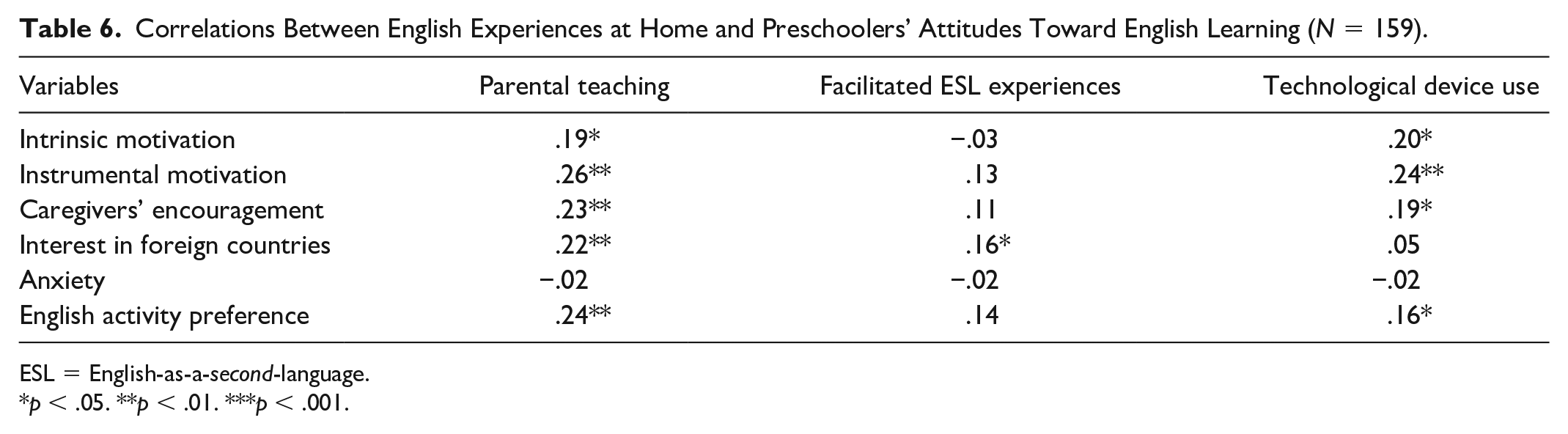
ESL = English-as-a-second-language.
p < .05. **p < .01. ***p < .001.
We examined correlations between mothers’ beliefs in early childhood English education and preschoolers’ attitudes toward English learning. The data suggest (Table 7) that mothers’ beliefs in the benefits of early childhood English education has positive correlations with preschoolers’ recognition of caregivers’ encouragement (r = .30, p < .001), interest in foreign countries (r = .17, p < .05), and English activity preferences (r = .17, p < .05). That is when a mother thinks positively about early childhood English education, a child recognizes parental support and expectations and has more interest in foreign countries and English activities. Interesting to note is that mothers’ beliefs in the benefits of using various teaching methods were negatively correlated to preschoolers’ anxiety (r = −.16, p < .05). In other words, when mothers prefer using various teaching methods, their preschoolers feel less English anxiety.
Correlations Between Mothers’ Beliefs About Early Childhood English Education and Preschoolers’ Attitudes Toward English Learning (N = 159).
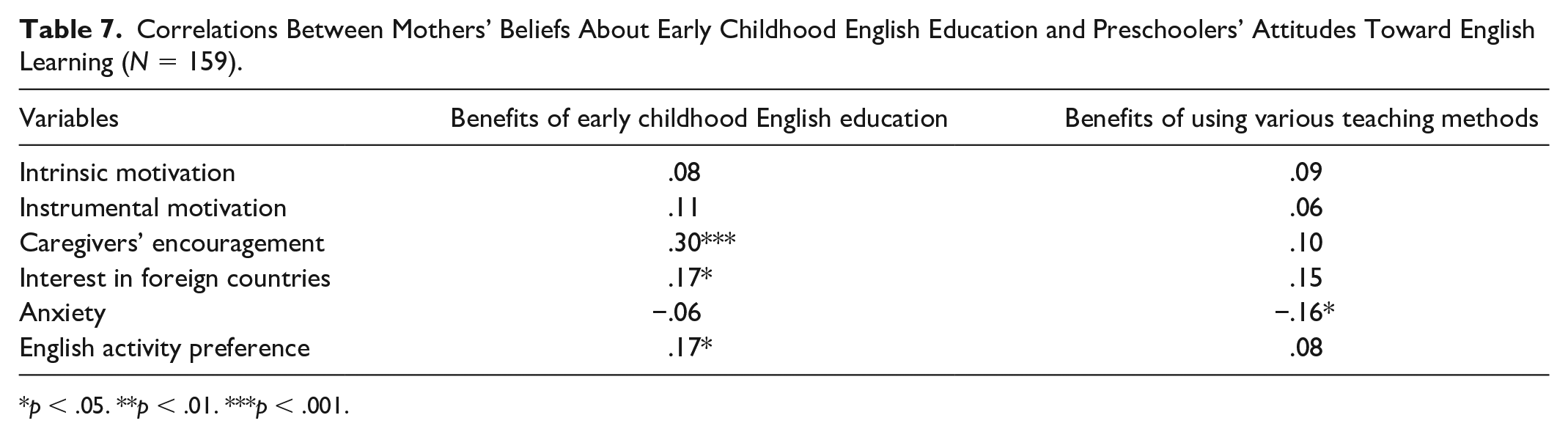
p < .05. **p < .01. ***p < .001.
Mediating Effect of Experiences on the Relationship Between Mothers’ Beliefs and Children’s Attitudes
Finally, we conducted analyses to look for the mediating effect of English experiences at home on the relationships of mothers’ educational beliefs and preschoolers’ attitudes toward English learning. Preschoolers’ English experiences at home had a full mediating effect on the relationship between mothers’ beliefs and preschoolers’ attitudes (Table 8). Thus, we can see that mothers’ beliefs concerning the benefits of early childhood English education had only an indirect influence on preschoolers’ attitudes toward English learning.
Mediating Effect of Preschoolers’ English Experiences at Home on the Relationship Between Mothers’ Beliefs on the Benefits of Early Childhood English Education and Attitudes Toward English Learning (N = 159).

p < .01. ***p < .001.
As shown in Table 9, preschoolers’ English experiences at home also showed a full mediating effect on the relationship between mothers’ beliefs on the benefits of using various teaching methods and preschoolers’ attitudes toward English learning. As said before, we can see that mothers’ beliefs concerning the benefits of using various teaching methods had only an indirect influence on preschoolers’ attitudes toward English learning. That is, mothers’ beliefs affected preschoolers’ English experiences and such experiences affected preschoolers’ attitudes.
Mediating Effect of Preschoolers’ English Experiences at Home on the Relationship Between Mothers’ Beliefs on the Benefits of Using Various Teaching Methods and Attitudes Toward English Learning (N = 159).

p < .05. ***p < .001.
Discussion and Conclusion
The purpose of this study was to find out whether beliefs held by mothers about early childhood English education, mediated by English experiences at home, affect preschoolers’ attitudes toward English learning. Through our results, we were able to see that families’ SESs were partially correlated with mothers’ beliefs about early childhood English education, preschoolers’ English experiences at home, and preschoolers’ attitudes toward English learning. A variable that showed the strongest correlation with family SES was home English experiences. This indicates that both parents’ educational background and monthly income are highly correlated with children’s home English experiences. Our results support previous studies reporting that highly educated parents provide English education earlier and more often (Ban & Seo, 2009; Song et al., 2011). Based on these findings, parents with high academic and income levels seem to provide their children with richer English experiences.
In addition, mothers’ education levels were positively correlated to the three main variables. Mothers with high educational levels attempted to use various teaching methods, and their children reflected more positive attitudes toward English learning. This result seems to be related to research showing that highly educated mothers have shown higher parenting efficacy for early childhood English education (Ban & Seo, 2009; Song et al., 2011), through the use of various teaching methods. On the contrary, mothers with lower levels of education put more pressure on their children to achieve academic achievement, leading to high anxiety, indicative of a negative learning attitude (Jun & Choi, 2017; Lee, 2015). A more explicit interpretation can be seen through causal relationships between variables, as described below.
In examining the partial correlations between the subfactors of mothers’ beliefs about early childhood English education, preschoolers’ English experiences at home, and preschoolers’ attitudes toward English learning, the data show that mothers’ beliefs in the benefits of early childhood English education and the use of various teaching methods were positively correlated with two factors of English experiences at home: parental teaching and technological device use. Therefore, we can say that mothers’ beliefs about early childhood English education are related to parents’ teaching and device use in English education. The relationship between mothers’ beliefs and children’s English experiences at home is further supported in the context of previous research results (Chee & Choi, 2012; Choi, 2012; Choi et al., 2019; Weigel et al., 2006) demonstrating that experiences with family literacy vary according to mothers’ beliefs. However, mothers’ beliefs were unrelated to children’s facilitated ESL experiences, which sometimes go beyond the boundaries of the household and can become an economic burden for parents.
We also saw that preschoolers’ English experiences at home were positively correlated to preschoolers’ attitudes toward English learning. While parental teaching and technological device use showed significant relations, facilitated ESL experiences only showed a weak correlation with the subfactor “interest in foreign countries” and showed no significant correlations with any other subfactors. The correlation between parental teaching and children’s learning attitudes implies that parents act as good English teachers during this early childhood period. In Korea, education and publications for “Mommy English” are rapidly expanding. (“Mommy English” means mothers as teachers of English.) This approach is being favored not only for economic reasons but also due to the dominant view of the value of a mother’s teaching. Mothers are often motivated by a sense of responsibility to teach English to their children (Bae et al., 2012; Jun, 2011; Lee & Choe, 2009). Thus, we see that the role of parental teaching is important in improving preschoolers’ attitudes toward English. Therefore, well-organized materials for training parents on how to teach English at home are increasingly useful.
Through this study, we confirmed that technological device use can enhance learning motivation in early childhood and lead to more active and attentive participation. Through audiovisual materials, a child can have fun and also enjoy additional benefits such as hearing native speaker pronunciation. While we can confidently say that these learning devices help the learning attitudes of young children, without actual interactions with others, a young child’s language learning will be incomplete. Language requires bidirectional interactions, and textbook-oriented education is inappropriate for preschoolers who thrive through implicit learning. Research has shown that excessive exposure to media at the expense of interaction with caregivers or peers may lead to serious problems such as attention deficit, impulsivity, aggression, or other social disorders (Courage & Setliff, 2009; Kim et al., 2016; Park, 2011; Park & Park, 2011). Therefore, appropriate guidelines for the use of media in language teaching are necessary. Parents must educate themselves concerning the proper use of media for language instruction so that they are not deceived by theoretically unfounded popular claims leading to a child’s overuse of media to replace interaction with others.
Our analysis further showed that mothers’ beliefs in the benefits of early childhood English education had a positive correlation with children’s attitudes toward English learning. Furthermore, mothers’ beliefs in the benefits of using various teaching methods were negatively correlated to children’s anxiety over learning English. These correlations indicate that when mothers perceive early childhood English education positively, children tend to be aware of parental encouragement and develop more interest in foreign countries and English activities. Moreover, mothers’ supports of using various teaching methods were negatively related to children’s anxiety about English. As anxiety is a negative factor that affects learning motivation and achievement both directly and indirectly (Cha & Kim, 2013; Ham, 2015), this result is meaningful in that it provides information on lowering children’s foreign language anxiety through the use of various learning methods and the fostering of positive learning attitudes.
Finally, we found that English experiences at home had a mediating effect on the correlation between mothers’ beliefs on early childhood English education and preschoolers’ attitudes toward English learning. This result demonstrates that educational language experience at home is a substantive variable between two psychological variables, namely mothers’ beliefs and children’s learning attitudes. Thus, these results corroborate other studies in demonstrating that parents’ behaviors and attitudes toward education affect their children’s educational outcomes (Davis-Kean, 2005; Lee & Do, 2005). In fostering children’s positive attitudes toward learning English, mothers need to move beyond simply having beliefs and act practically either by directly teaching children directly or facilitating ESL experiences in the home.
Implications, Limitations, and Future Studies
This study found that through facilitating English experiences at home, mothers’ beliefs on early childhood English education influenced their preschoolers’ attitudes toward learning English. This study is innovative in that one-on-one interviews were held with actual children and their attitudes for English learning were measured through their own voices. In addition, this study provided more data on a population that has been largely ignored thus far. Our focus on kindergartens and daycare centers, which carry out English education through adding English activity time to regular educational courses, differs from preceding studies focusing only on English immersion institutions (Hwang & Choi, 2017; Lee, 2006; Y. Kim, 2009).
Despite the interesting implications of this study, it has had limitations. The constraints of Korea’s EFL environment mean children rarely use English in their everyday lives. Thus, the overall frequency of domestic ESL experiences was very low. This low frequency of English educational experiences in the home affected the results of this study and led to a wide distribution of low correlations among other factors. Moving forward, an investigation of groups with high-frequency ESL experiences, such as English language institutes and English kindergartens, will be necessary to verify the results of this study. We also believe that although this study focused on Korean preschoolers, comparative cultural studies could be conducted in societies with similar educational environments. To take advantage of directly asking children, we modified the existing scale to measure the preference for representative English learning activities. To complement this methodology, future researchers can observe children’s behavior to measure more detailed and practical motivations, as well as use teacher and parent reports on a variety of traits, such as children’s interest and anxiety.
Based on these results, we propose that, along with having positive beliefs about early childhood English education, it is necessary for parents to be active in facilitating a rich, language environment in the home that will have a positive effect on children’s foreign language learning attitudes.
Footnotes
Declaration of Conflicting Interests
The author(s) declared no potential conflicts of interest with respect to the research, authorship, and/or publication of this article.
Funding
The author(s) received no financial support for the research, authorship, and/or publication of this article.
