




Abstract
This study is an endeavor to find how English native and nonnative EFL/ESL (English as foreign language/English as second language) writers use adversative conjunctions to connect ideas together so that texts have both coherence and cohesion. Regarding the problems nonnative writers of EFL face when composing a piece of writing, we attempted a qualitative study through compiling a stack of 200 articles written by the two groups. The research design concerned the content analysis of research articles and descriptive statistics showing the frequency of occurrences of modals in the data. The findings indicated that the number of proper and correction adversatives exceeded those of contrastive and dismissal; the statistically significant difference between two groups lay in the use of proper and correction adversative conjunction, whereas the two groups showed little or no difference in the usage of contrastive or dismissal adversatives. These findings can help material writers, EFL/ESL teachers, and learners to appreciate the significant roles adversative conjunctions play in writing.
All the elements appearing in sentences or utterances contribute to the message desired to be conveyed. What makes these sentences comprehensible for the readers is a tie which holds them together so that a unified meaning can be expressed through appropriate use of lexis, syntax, semantic, and even pragmatic of a given language. In fact, for a text to have this meaningful unity, there must be some factors which help understand the relationship between sentences. These factors are, to a great extent, dependent on both what specific lexis writers choose to keep meaning related or the signals they use overtly to maintain meaning among sentences. The latter, as a matter of fact, taps the concept of cohesion as part of discourse analysis dealing with units larger than a sentence. Cohesion acts as a crucial feature of discourse analysis that both shapes and is shaped through the medium of language.
Halliday and Hasan (1976) explicated the concept of cohesion saying that a text is a semantic unit, not a thread of syntactically correct sentences put together to convey meaning. From their point of view, what makes a text is the texture which is the trait distinguishing texts from nontexts. Cohesive ties, per se, serve to stick elements of texts with their connective properties; the concept of tie suggests the ways by which we can analyze a text which, in its own right, consists of systematic interrelation among sentences by using cohesive devices. Cohesion, as the name suggests, makes the meaning of a sentence dependent on another, that is, “the presupposition to the presupposed” (Halliday & Hasan, 1976, p. 4). Cohesion, as a semantic unit, makes the interpretation of a text easier by using several resources; these resources are of different types: references, substitutions, ellipsis, conjunctions, and lexical cohesion.
Founding the basis of intra- and inter-sentential meaning, cohesive ties help relate the meaning of the newly made structural unit to what has gone before, which, in the end, leads to easy understanding of a text by readers. Conjunctions have particular meanings the existence of which indicates the presence of other constituents of discourse. As to the type of conjunctions, there are several classifications of which adversative conjunctions are the foci of this study. As Halliday and Hasan (1976) stated, adversative conjunctions denote contrast and comparison indicating what is “contrary to expectation” (p. 250). Adversity can be expressed by a number of words such as however, but, yet, though, only, in fact, rather, in any case, and so on. This study attempts to test the hypothesis that L1-Persian learners of English as foreign language (EFL) use (or do not use perhaps) as many adversative conjunctions in their writings as those of English native speakers. The study concerns four types of adversative conjunctions based on the model proposed by Halliday and Hasan (1976): Adversative proper, Contrastive, Correction, and Dismissal. The frequency of occurrence of these conjunctions in the writings of nonnative speakers (NNSs) and native speakers of English will be delved into in addition to finding the probable differences these two groups would show in the usage of these adversative conjunctions in their research articles. Altogether, it is hoped that teachers and material developers alike may use practical and novel techniques to help learners construct a meaningful text through the accurate use of conjunctions.
Background of the Study
Writing in a foreign or second language is always a challenge especially for NNSs of EFL. Reid (1992) stated that “one of the most serious problems faced by NNSs of English in U.S. colleges and universities is the difficulty of writing adequate prose in English” (p. 79). One of the problems that learners of EFL encounter is to make a comprehensible text as unified whole through using connectives. As Halliday and Hasan (1976) emphasized, native speakers understand whether a text is a unified whole or a number of unrelated sentences; they say that what differentiates a text from a nontext is texture, that is the “property of being a text” (p. 2). For texture to be realized, there may exist specific linguistic features combine sentences into a text, which, in the long run, it will boost unity of the text. When we talk about a unit of language consisting of more than one sentence, we deal with the concept of discourse analysis. Discourse, to Johnston (2008), is the “actual instances of communicative action in the medium of language” (p. 2). The reason why we raise the concept of discourse is that the connectedness among the sentences within and among paragraphs lies in cohesion, coherence, and texture that are the essential features that maintain the unity of the text. Schiffrin, Tannen, and Hamilton (2001) reiterated that all diversity of definitions for discourse can be summed up in three main categories: “anything beyond the sentence, language use, and a broader range of social practice that includes non-linguistic and nonspecific instances of language” (p. 1). Although different conceptually, coherence and cohesion contribute to the interrelationship and meaningful connections of sentences with the former dealing with more implicit and the latter with explicit links. As Todd, Khongput, and Darasawang (2007) stated, “connectedness refers to all of the links, both explicit and implicit, in a text that make it a unified whole; usually connectedness is divided into cohesion and coherence, where cohesion refers to explicit links and coherence refers to implicit links” (p. 11). Cohesion, as a semantic unit, is explicitly realized through cohesive ties. A tie, according to Halliday and Hasan (1976), is a single instantiation of cohesion which incorporates cohesive devices such as reference, substitution, ellipsis, conjunctions, and lexical cohesion.
From among the above-mentioned cohesive resources, the nature of conjunctions is different from the other three. Not only do they differ in their linguistic function in a text, but they denote two specifications which are not as easily recognized as it is the case with reference, substitution, and ellipsis; Halliday and Hasan (1976) stated that “conjunctive elements are cohesive not in themselves but indirectly, by virtue of their specific meaning; they are not primarily devices for reaching out into the preceding (or following) text, but they express certain meanings which presuppose the presence of other components in the discourse” (p. 226). When defining conjunctions, they stress that conjunctions may give rise to cohesion by relating what is to follow with what has already gone but there is no order, the absence of which makes the text incoherent. They even name conjunctions of time as the evidence that no particular order is needed to “subsist” the relations between sentences of a text. They cite that “two sentences may be linked by a time relation, but the sentence referring to the event that is earlier in time may itself come later, following the other sentence” (p. 227). They categorize conjunctions into four types: additive, adversative, causal, and temporal. The following examples taken from Halliday and Hasan (1976) indicate the function they serve when used (pp. 238-239):
Additive: And in all his time he met no one.
Adversative: Yet he was hardly aware of being tired.
Causal: So by night time the valley was far below him.
Temporal: Then, as dusk fell, he sat down to rest.
The researchers of this study were concerned with the use of adversative conjunctions which are to be further investigated. Because the study revolved around different types of adversative conjunctions proposed by Halliday and Hasan (1976), what follows offers a table in which all categories of adversative conjunctions under the scrutiny of this study are portrayed (see Table 1).
Taxonomy of Adversative Conjunctions.

Source. Adapted from Cohesion in English, by M.A.K. Halliday and R. Hasan, 1976, p. 242. Copyright 1976 by Longman.
There has been no consensus on the name given to these types of conjunctions. In the early 1980s, Zamel (1983) and Quirk, Greenbaum, Leech, and Svartvik (1985) called them conjuncts. Cook (1984) called them contrastive conjunctions. During the next decade, Crewe (1990) named them logical connectives while Fraser (1999) labeled them as discourse markers; in 2002, they were called connective adverbs (Huddleston & Pullum, 2002) or linking adverbials (Biber, Conrad, & Leech, 2002). Oshima and Hogue (2006) viewed them as opposite transitional signals; Cowan (2008) and Swales and Feak (2004) labeled them as discourse connectors and linking words, respectively.
The findings of the studies so far show that there are discrepancies in the use of conjunctions as to the level of proficiency and different text types or registers. For example, Geva (1986) stated that “highlighting conjunctions had an adverse effect on intermediate level students and a facilitating effect on advanced level students” (p. 85). Biber, Johansson, Leech, Conrad, and Finegan (1999) emphasized the importance of registers; therefore, text types would affect the use of conjunctions used by nonnative writers of English.
Hamed (2014), investigating conjunctions in the argumentative writings of Libyan tertiary students, found that adversative conjunctions were used least appropriately compared with additive, causal, and temporal conjunctions.
Yan (2014) did a study on the use of concessive and adversative conjunctions of Chinese EFL learners suggesting that a more in-depth analysis of the four conjunctions, such as but, however, while, and on the contrary, should be done within systemic functional grammar.
Mudhhi and Hussein (2014) compared the use of conjunctions used by Kuwaiti and English native speakers. The results of their study indicated that Kuwaiti EFL learners overused additives and causals while English native speakers used adversatives frequently. They concluded that “Kuwaiti EFL learners did not use the various types of conjunctive adjuncts as native speakers did” (p. 18).
Carlsen (2010), in a corpus-based study of the use of discourse connectives in written texts of learners of Norwegian as a second language, cited that but is among the highly frequent conjunctions used by all Common European Framework of Reference for Languages (CEFR) levels of proficiency. Leung (2005), however, found that not many adversative conjunctions, especially but, cannot be found in the essays of Chinese learners of EFL compared with and as well as or.
In another attempt, Merilaine (2015) found that Estonian EFL learners tended to overuse but while native speakers of English used “different adversative conjunctions simultaneously” (p. 48). She concluded that Estonian EFL learners should be taught not to overuse but and underuse other adversative conjunctions such as though, rather, instead, and so on. The same result was obtained through another study by Alarcon and Morales (2011) who found that the adversative conjunction but was the most frequently used one in the argumentative essays of EFL undergraduate learners although they could also found traces of meager use of yet and however in the writings of the learners.
This study attempts to find answers to the following questions. Scientific research articles written by English native versus nonnative EFL writers are different and these differences may be due to the genres of their writing. This study, thus, attends to the following questions:
Method
Participants
Having a qualitative nature, the current study does not directly involve participants. In fact, the study made use of a number of scientific research articles written by English native and L1-Persian EFL writers. The number of research articles was 200, half of which were published in an English speaking country and the other half were published in Iran where L1 is Persian. The fact of the matter is that we cannot be completely sure that those published in the English speaking country were written by English native speakers but it was attempted to consider those whose length of residence in that country, the universities they graduated from, and even their English background can be strongly likened to those of native speakers of English. TESOL Quarterly (TQ) and Iranian Journal of Applied Linguistics (IJAL) were chosen as sources of these 200 research articles which had been published in the last decade. They were supposed to be content analyzed to search for adversative conjunctions on the basis of taxonomy proposed by Halliday and Hasan (1976). The adversatives that were searched for in this study included proper conjunctions: but, yet, though, and only, however, nevertheless, despite, and in contrast; contrastive conjunctions: in fact, actually, on the other hand, and at the same time; correction conjunctions: instead, rather, on the contrary, and at least; and dismissal conjunctions: in any case, anyhow, and at any rate.
To analyze the data, we took several steps. To investigate the frequency of occurrence of adversative conjunctions, we, first, determined the mean length of the two scientific research articles in both journals. The mean length of research articles was 8,122 words with the minimum of 2,913 and maximum of 16,279. Then, to make these comparable, we scaled the data, that is the occurrence of adversative conjunctions in 1,000,000 words. The reason is that the native group used 917,675 words in 100 articles and those of the nonnative reached 706,915 words, hence converting frequencies to one million sounded rational.
Results
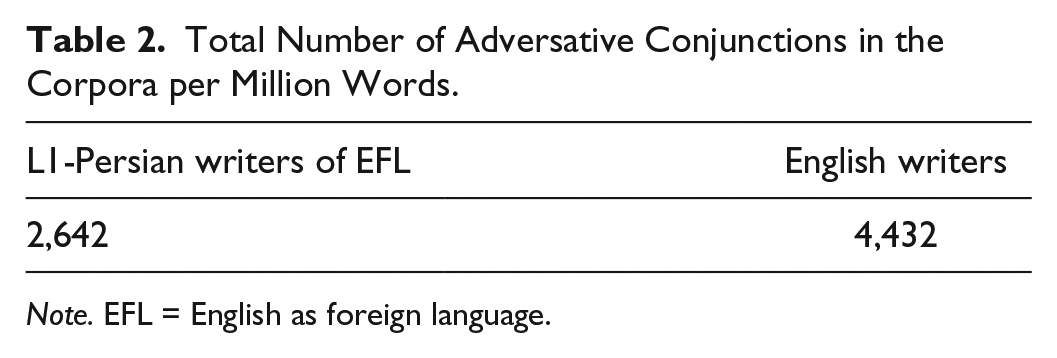
After determining the frequency of occurrences of adversative conjunctions as well as scaling these numbers, the descriptive statistics were investigated. As we had scaled these numbers, we went through parametric statistics to compare the two groups. The results of descriptive statistics indicated that native speakers used more adversative conjunctions in research articles. Table 2 illustrates the total number of adversative conjunctions used by English native and L1-Persian writers of EFL.
Total Number of Adversative Conjunctions in the Corpora per Million Words.
Note. EFL = English as foreign language.
Table 3 demonstrates that native group and nonnative used proper adversatives a lot more than the other three, and dismissal adversative was the least frequently used conjunction.
The Frequency of Adversative Conjunctions by English Native and L1-Persian Writers.
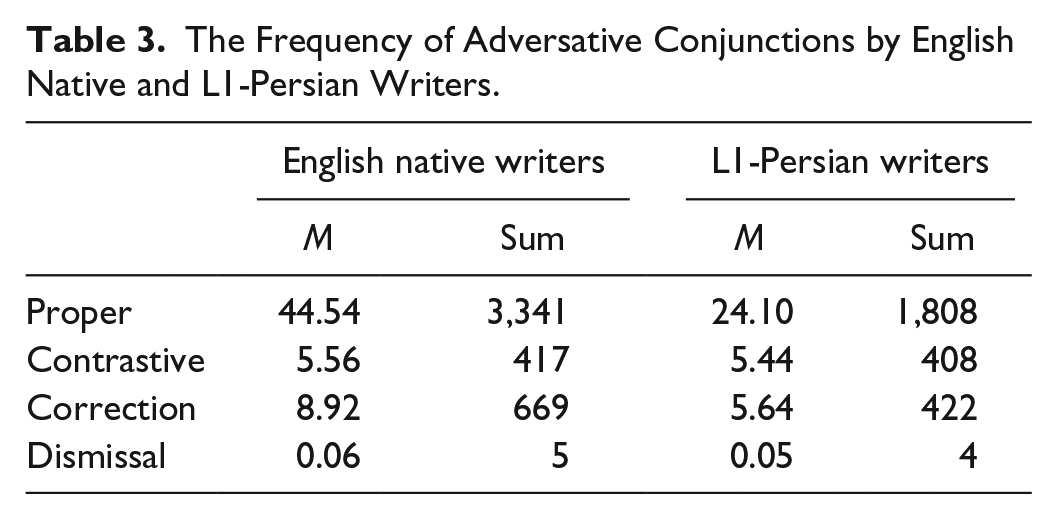
As can be seen, first proper adversatives are used most frequently by both groups, next, correction adversatives, followed by contrastive adversatives, and finally dismissals are used least frequently by both groups. It is clear that the use of adversative type was quite similar in both groups.
The second step was an attempt to go through the frequency of the occurrence of each one of different adversative conjunctions. Figure 1 depicts the mean use of proper adversatives by English native and L1-Persian writers of EFL. The adversative conjunctions but and however are the most frequently used proper adversative among others. In almost all cases, native speakers used proper adversatives more in number than nonnative EFL individuals except for in contrast that were quite similarly used by both groups.

Distribution of proper adversatives.
As is clear in Figure 2, when it comes to the use of contrastive adversatives, L1-Persian writers of EFL use in fact most frequently, then actually, on the other hand, and finally at the same time. Except for at the same time, the other three contrastive adversatives are used more by nonnative EFL individuals than English native writers. English native writers used actually and on the other hand more than in fact, and the use of at the same time was the least frequent on in their writings.
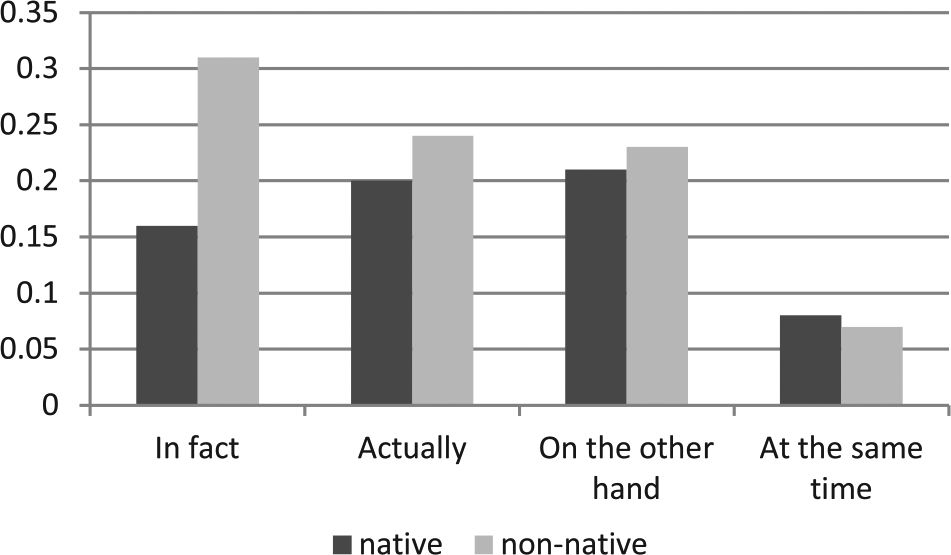
Distribution of contrastive adversatives.
As can be seen in Figure 3, after obtaining the scaled use of correction adversatives, we found that rather was the most frequently used correction adversative by English native writers which was also true with L1-Persian writers of EFL. The difference between English native and L1-Persian was also evident in the use of at least while this was not the case with the use of instead where both groups used almost the word same number of times. In spite of being the least frequently used correction adversative, on the contrary was used more by nonnative than English native writers.

Distribution of correction adversatives.
The last type of adversative investigated was dismissal. The descriptive statistics for scaled use of dismissal adversatives showed that both groups did not make use of dismissal adversatives to the extent that we can say it was not really significant. The mean use of in any case, anyhow, and at any rate was 0.006, 0.002, and 0.000, respectively, for English native writers; L1-Persian writers did not use in any case and anyhow although the mean use of at any rate came to 0.006.
The second research question was an inquiry into the probable difference two groups would show in the use of adversative conjunctions of four types. Because we had one independent categorical variable that is being English native or L1-Persian EFL writers and one dependent variable with four different types, a number of independent sample t tests were run. The independent sample t test was conducted to compare the use of proper, contrastive, correction, and dismissal adversatives between English native and L1-Persian EFL writers. At the .05 significant level, there was a statistically significant difference between the two groups just in the use of proper and correction adversatives, tProper(198) = 5.37, p < .05, tCorrection(198) = 2.60, p < .05, while there was no difference between the two groups in the use of contrastive and dismissal adversatives, tContrastive(198) = 1.83, p = .09; tDismissal(198) = 0.61 p = .56. The effect size statistics also revealed the following: for proper adversative, η2 = 0.12; correction adversative, η2 = 0.03; contrastive adversative η2 = 0.01, and dismissal adversative, η2 = 0.001. According to what Cohen (1988) suggested, the values are interpreted as small if they are 0.01, moderate 0.06, and large 0.14. As can be calculated, η2 value for proper adversative is moderate; it is small for the other three adversatives especially for dismissal adversative conjunctions.
Discussion and Conclusion
Perhaps a nonnative writer of EFL finds it quite demanding to maintain the cohesion of the text as it requires expertise in syntax, semantics, and pragmatics of the target language. Lack of expertise in the use of each of the components leads to an incomprehensibility of the essay or speech one generates. In this study, it was observed that adversative conjunctions are used much more by English native than L1-Persian writers of scientific research articles. Overall, these adversative conjunctions are most frequently used by native writers, and their usage was twice as much of the L1-Persian writers of EFL. Native writers showed that they used proper and correction adversative more than contrastive and dismissal adversative, though both groups had a tendency to use proper and correction adversatives. Contrastive adversative was used less than proper and correction adversatives although the statistical significance showed that it is not a large difference in the use of contrastive adversative when compared with proper and correction adversatives. This was not true with dismissal adversative; in this case, both groups did not use a statistically significant number of dismissal adversatives the reason for which needs thorough inspection of many linguistic or metalinguistic factors. So far, we are aware of the fact that some conjunctions have been used with much more ease than the others, such as but, however, and in fact by nonnative learners of EFL, but the problems they face when using other conjunction have not yet been solved clearly.
Writing, for nonnative EFL learners, is the most difficult skill to be learned. They always ask their tutors how they can make progress in the skill, but even for a nonnative teacher, the answer to this question seems challenging as he or she is still lacking the ability to convey messages through writing. The problem may be rooted in multiple aspects. First of all, EFL learners are not duly taught the conjunctions and the functions they have in maintaining the cohesion of the text. Both syntactic functions and semantic load they carry are not well recognized and understood; therefore, the practical usage, not the mechanical one, is difficult for the learners. They are encouraged to use them but they do not know where to use so as to contribute to the unity of the text they are generating. So the problem lies with a lack of knowledge both on the teachers’ side and the learners alike.
The second reason for inappropriate use of adversative conjunctions may be due to the discrepancy of L1 and L2 and the culture-bound factors associated with the two. If adversative conjunctions are not used that much in the first language and there exist other cohesive devices contributing to the textuality of the text, then EFL learners may not spot the difference it may make when it comes to writing in the target language. There is more to this problem. As teachers of EFL learners, we have noticed that the frequency of occurrence of some of the conjunctions exceeds the other types. For example, the Persian equivalent of however, but, and instead is so prevalent in the daily speech of Farsi speakers that you can conclude that their mere usage stems from L1 transfer and not because they have learned the accurate usage of those conjunctions in the target language. This calls for an in-depth examination of L1 and L2 so that any conclusion that is made bears a truly scientific basis which is supported by both qualitative and quantitative research.
As the title of the current study pinpoints, adversative conjunctions exist in the writings of nonnative writers of EFL, but they are not sometimes found in appropriate places that they should be, hence they are not easily discerned in the first place hidden or implied within the lines of text. It is up to the teachers of EFL learners to raise the consciousness of learners to spot the right place and time for the usage of conjunctions so that their usage approximates the one used by English native speakers.
Footnotes
Declaration of Conflicting Interests
The author(s) declared no potential conflicts of interest with respect to the research, authorship, and/or publication of this article.
Funding
The author(s) received no financial support for the research, authorship, and/or publication of this article.