




Abstract
Eve teasing was identified as a significant community problem through a community-based participatory process with nine villages in Punjab, India. Eve teasing is a common euphemism in South Asia for sexual harassment of women in public areas by men. The purpose of this study was to characterize the meaning of eve teasing in the rural context, especially among female youth, and to develop a means to measure its occurrence. Mixed methods were utilized including focus group discussions (FGDs), semistructured interviews, and direct observation of questionnaire administration. Thirty-four people participated in six FGDs; two with adolescent boys (n = 10), two with adolescent girls (n = 15), and two with women ages 20 to 26 years (n = 9). Eighty-nine females, ages 14 to 26 years, were recruited through purposive sampling for face-to-face interviews in homes and schools. Twenty-four interviews were observed directly to aid questionnaire development. Eve teasing was described as staring, stalking, passing comments, and inappropriate physical touch. Perceived consequences of eve teasing included tight restrictions on girls’ mobility, inability to attend school or work, girls being blamed, and causing family problems. FGD participants suggested that eve teasing can lead to depression and suicide. Among the 36 (40.4%) interview participants who reported eve teasing, 61.1% reported feelings of anger, 47.2% reported feelings of shame or humiliation, and more than one third reported feelings of fear, worry, or tension. The questionnaire offers a means to assess the occurrence of eve teasing that is culturally relevant and age appropriate for female youth in India.
Introduction
Sexual harassment involves nonverbal, verbal, physical, or visual sexual attention, intimidation, or coercion that is unwelcome and unwanted and often has a negative impact on the psychosocial health of the victim (Bartlett & Rhode, 2006; Paludi, Barickman, & Barickman, 1991). Eve teasing is a euphemism in South Asia for a common form of sexual harassment that typically occurs in public places (Baxi, 2001; Dhillon & Bakaya, 2014). Although prevalence studies are sparse and measurement methods vary, eve teasing is thought to be very common, with 50% to 100% of women reporting victimization (Akhtar, 2013; Baxi, 2001; Jagori & UN Women, 2011; Leach & Sitaram, 2007). Specific examples include making passes, obscene gestures, whistling, stalking, staring, pinching, fondling, and rubbing against women (Dhillon & Bakaya, 2014; Dobash & Dobash, 1998; Fairchild & Rudman, 2008).
Use of the term is discouraged by women’s advocates because it perpetuates what Baxi describes as “a culturally sanctioned practice that normalizes and escalates violence against women in public spaces” and is “a means to legitimize harassment by positioning the very presence of women in public as provocative” (Acharya, 2015; Baxi, 2001, p. 1; Mohanty, 2013). As described by the Indian government, eve teasing occurs
when a man by words either spoken or by signs and/or by visible representation or by gesture does any act in public space, or signs, recites or utters any indecent words or song or ballad in any public place to the annoyance of any woman. (Dhillon & Bakaya, 2014, p. 1)
While the term ‘eve teasing’ is not used in Indian Penal Code, it does prohibit eve teasing-like behaviors in Section 294 prohibits making a girl or woman the target of obscene gestures, remarks, songs, or recitation punishable by up to 3 months in prison (Dhillon & Bakaya, 2014). It is described by Gosh as “a set of behaviors that is construed as an insult and an act of humiliation of the female sex” (S. Ghosh, 1990, p. 100).
The day-to-day threat of eve teasing in South Asia is significant enough to curb women and girls’ participation in public, including school and work, resulting in untold opportunity costs for women and society (Crouch, 2010; Dhillon & Bakaya, 2014). Not only is it a threat to a woman’s safety, prevailing attitudes about gender roles that lay blame with the victim may exacerbate feelings of shame and humiliation. Indian women tend to be valued by society in relation to their role in the family, namely as a chaste and modest wife, daughter, daughter-in-law, and mother (Srinivasan & Lee, 2004).
Qualitative studies from India and Bangladesh report that eve teasing is a ubiquitous threat for women that often occurs in broad daylight, and can lead the victim to feel unsafe, embarrassed, disgusted, objectified, fearful, and humiliated (Dhillon & Bakaya, 2014; Nahar, Van Reeuwijk, & Reis, 2013). Women from upper-middle-class families in New Delhi reported lesser stigma with being victimized, whereas adolescent girls from Bangladesh, including urban and rural dwellers from a range of socioeconomic backgrounds, said they feared being blamed by society and even their families. More importantly, being harassed and blamed for eve teasing may reduce a girl’s chance of being matched with a suitable husband and could drive up the price of her dowry (Nahar et al., 2013). These fears do not seem unfounded, as accounts of marriage proposals being retracted and families marrying off young girls to preempt damage to a girl’s reputation are not uncommon (Hoque, 2013).
While the impact of eve teasing on the victim is a primary concern, it is important to understand the perpetrator’s intent and cultural factors that influence such behavior to inform prevention strategies. For example, the Hindi film industry has been blamed by some for promoting sexual violence because films popular among youth often portray eve teasing as an effective romantic pursuit (Ramasubramanian & Oliver, 2003). Conversely, Osella and Osella (1998) describe eve-teasing-like behaviors in a much more nuanced manner to deepen understanding of courting behavior among youth in Kerala. They explain that while male youth often begins their flirting gambit with an aggressive comment that may include a double entendre that is sexual in nature, the female recipients have the power to end the interaction by not responding or through an insulting retort of her own. If she is receptive to the attention she may offer very subtle cues or “tune” into the attention and both parties may enjoy ongoing flirting that most often does not result in a sexual relationship, but is interesting and fun nonetheless. While it is important to acknowledge that both parties may enjoy the interaction, the initial aggressive and sexually charged “gambit” is often neither given with genuine romantic intent, nor welcomed by the recipient. Given the ubiquity of eve teasing and the common sentiment by women that is a “little rape” (Dhillon & Bakaya, 2014), a more appropriate means for men to convey romantic interest is needed. This is especially pertinent in the wake of the highly publicized cases of violence against women, including the New Delhi gang-rape in 2012, which began with eve-teasing-like behaviors by a group of men.
The ubiquitous nature of eve teasing may be influenced by the strict patriarchal culture in northwest India. The World Health Organization suggests that strict patriarchal norms that favor family honor over the well-being of girls are a community-level risk factor for sexual violence (D. Ghosh, 2011). The strength of these norms is evidenced by frequent media reports of cases where eve teasing leads to suicide, interfamily violence, early or forced marriages to preempt or repair the threat to a girl’s reputation, and even honor killings (Hoque, 2013; Wang, Modvig, & Montgomery, 2009). Strict patriarchy is particularly prominent in Pakistan, Bangladesh, and northern India, particularly Punjab, Haryana, and Uttar Pradesh (Sen, 2001). Previously unpublished research from the first author among youth in rural Punjab found that eve teasing and the resulting social isolation of adolescent girls is a common problem.
A four-factor theory of sexual harassment explains various reasons why perpetrators participate in eve teasing including power and attraction at the individual level, but also external factors, such as the social environment (O’Hare & O’Donohue, 1998). First, the individual must be motivated to harass. Common reasons to harass include power, control, and sexual attraction. Women in Dhillon’s (2014) study described scenarios where men who harbored negative attitudes about women in public harassed to assert their power and control over women (Dhillon & Bakaya, 2014). In Nahar et al.’s (2013) study in Bangladesh, power and control were described as reasons why boys eve tease, but the study also provided examples of harassment based on sexual attraction, sometimes as romantic expressions of feelings or crude sexualized comments. As premarital sex and romance are taboo in much of the subcontinent, the repression of healthy interaction between boys and girls (e.g., nonsexual intimacy and respect) may help explain why boys eve tease when they are motivated by attraction (Nahar et al., 2013).
In addition to motivation, perpetrators must also overcome internal and external inhibitions to harass, such as one’s moral standards as well as sociocultural norms and expectations (O’Hare & O’Donohue, 1998). When men were asked why they eve tease, multiple studies report that they believe it is their right, that it is funny or trivial, and that it does not hurt the victim, indicating that moral restraint is easily breached (Akhtar, 2013; Dhillon & Bakaya, 2014; S. Ghosh, 1990; Leach & Humphreys, 2007; Nahar et al., 2013). More broadly, societal factors, including victim blaming, apathetic policing, and weak systems for legal redress, may minimize external inhibitions to harass. Lastly, according to O’Hare and O’Donohue (1998), the harasser must overcome the victim’s resistance. Evidence is emerging that a common defense tactic is to ignore the harasser, which only leads to more aggressive harassment (Crouch, 2010). Given the social stigma of eve teasing victimization, it is reasonable to assume that women would avoid a confrontation with the harasser(s) to minimize attention to the situation.
The impetus of this study emerged from community concern about eve teasing and its potential impact on the mental health of young women in the rural Fategarh Sahib District of Punjab, India. Prior to this study, the authors and others participated in a broad community assessment with nine villages using Green and Krueter’s Precede-Proceed framework with the aim to improve community health and well-being (Gielen, McDonald, Gary, & Bone, 2008). The process began with a social assessment, or Phase I of the Precede-Proceed model. Community meetings were held initially to garner interest in the project and to describe the process followed by separate structured meetings and focus group discussions (FGDs) with various subgroups of the community, such as leaders, elder men, elder women, mothers, and youth. Discussion groups with young men and young women, respectively, led to the prioritization of gender equity and safety for girls, including combating eve teasing. Once identified and reported, it was supported enthusiastically by elder women and albeit with some initial trepidation, approval from male leaders. This study focused on Phases II and III of the Precede-Proceed model which in short help us diagnose the problem and describe it in an ecological context. Phase II, or the epidemiological assessment, focused on behavioral and environmental factors and Phase III, of the educational and ecological assessment focused understanding cultural and ecological factors that reinforce or enable the phenomenon. Additionally, insights to effective interventions were gathered to inform the Proceed phases, which include implementation and evaluation.
While eve teasing is fairly well characterized in urban contexts, its characterization in the rural context is limited. More importantly, the literature on the prevalence of eve teasing in the community setting is sparse and methodologies lack rigor and measures lack standardization and validation. The purpose of this study was to characterize eve teasing in the rural Indian context, including its occurrence, perceived severity, perceived consequences, possible risk factors, and coping strategies, particularly as experienced by young women. Second, we aimed to develop a means to quantitatively assess its occurrence through the development of a validated teasing questionnaire. Lastly, we aimed to gather insights for the development of more rigorous epidemiological studies and to inform the design of effective strategies to combat eve teasing at the community level.
Method
Our community-based participatory research (CBPR) approach involved the broader community in problem identification and prioritization (Wallerstein & Duran, 2006). Local coresearchers also participated with the collection of data, questionnaire development, and interpretation of results. Mixed methods data gathering included FGDs, semistructured interviews using a novel questionnaire, and direct observation of a subset of interviews. Data collection was carried out in July 2013 and May 2014 in nine rural villages in the Fategarh Sahib District of Punjab, India.
FGDs
Thirty-four people were recruited for six FGDs, two with adolescent boys (n = 10), two with adolescent girls (n = 15), and two with women ages 20 to 26 years (n = 9). Discussion topics included eve teasing perceptions, characteristics, experiences, and perceived consequences. FGDs were conducted primarily in Punjabi and observed by bilingual note-takers who recorded notes in English. FGD notes were uploaded into Dedoose Version 4.5 (SocioCultural Research Consultants, LLC, 2013, Los Angeles, CA) and coded for preestablished categories and evaluated for emerging themes. Two female FGD participants spontaneously offered to share more details of their experiences through one-on-one interviews after the conclusion of the FGDs. These notes were also recorded and included in the analysis as case studies.
Semistructured Interviews
Eighty-nine women, aged 14 to 26 years, were recruited across nine villages through purposive sampling to participate in an interview using a semistructured questionnaire. Most participants were recruited through home visits, while a small number were recruited at a secondary school. The study aimed to recruit participants from a broad range of age, socioeconomic status, school-going status, and geographic distribution within each village. Face-to-face interviews were conducted in a private setting, typically in the home, beginning with a semistructured questionnaire.
The questionnaire included structured and open-ended questions about (a) eve teasing exposure, nature, timing, and intensity (Figure 1); (b) chronicity, which delineates one-time or ongoing harassment, perpetrator attributes, and emotional impact (Figure 2); and (c) attitudes toward eve teasing, which relate to O’Donohue and O’Hare’s four-factor theory of perpetration, and opinions about what should be done to curb eve teasing (Figure 3). Additional sections of the questionnaire, described in a manuscript under preparation, included mental health status, sociodemographics, and covariates pertinent to assessing the relationship between eve teasing and mental health. Three versions of the questionnaire evolved over the course of the study and the final version is referred to as the Eve Teasing Questionnaire–Mental Health, or ETQ-MH.

Eve teasing exposure questions in the ETQ-MH Questionnaire.
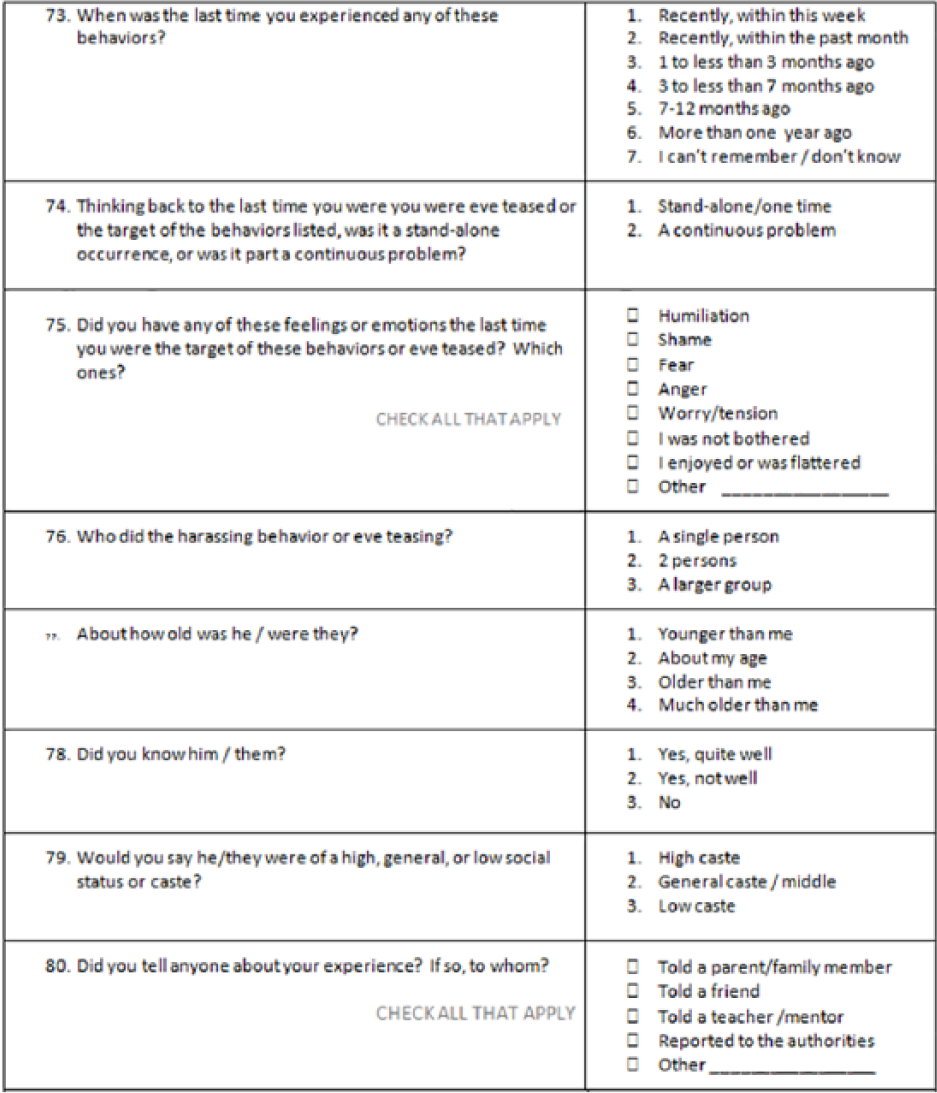
Questions about last eve teasing experience in the ETQ-MH.

Attitudes about eve teasing questions in the ETQ-MH.
Questionnaire responses were entered into Microsoft ACCESS. Quantitative responses were analyzed descriptively in STATA13 (Statacorp, 2014, College Station, TX). Open-ended responses were exported to Microsoft Excel where they were postcoded and summarized numerically.
Direct Observation of Interviews
The first 23 interviews, conducted in July, 2013, were observed by a study team member with attention paid to ease of wording, interviewer techniques, and participant understanding. Observers and interviewers debriefed and made recommendations for questionnaire revisions. An additional 66 participants were recruited and completed interviews in May 2014. We continued to revise the questionnaire through debriefing sessions with the interviewers.
Human Subjects Protection
The World Health Organization’s Violence Against Women Research Manual was instrumental in guiding the development of the study protocol, in training study team members, and in assuring safety and privacy of participants (Ellsberg, Heise, Peña, Agurto, & Winkvist, 2001). Due to the use of community-based coresearchers, additional measures were taken to provide ethics training geared toward lay researchers and assured close supervision. Confidentiality was improved by not collecting personal identifiers and using verbal rather than signed consent and assent. This study was approved by the Institutional Review Board at the University of Utah, USA.
Results
Overall, 123 participants were enrolled in the study and participated in one of six FGDs (n = 34) or an interview (n = 89), and all were rural dwellers. With the exception of two FGDs with adolescent boys, all participants were females, aged 13 to 26. A response rate of 90.8% was achieved with the interview sample (n = 89). The interview sample differed, unintentionally, from the general population in that it overrepresented women who were of lower caste, 74% compared with 46% in a recent local census (Table 1).
Demographic Characteristics of Interview Participants Compared to Selected Demographic Characteristics From a 2011 Census (n = 89).

Note. ETQ-MH = Eve Teasing Questionnaire–Mental Health.
Census Data: Demographic and Health Survey of 9 Villages in the Bassi Pathana Community Collaborative Development Project, 2011, MBCT (Unpublished).
INR = Indian Rupee. In 2013, 30,000 INR = ~US$545.00.
Measurement of Eve Teasing Experiences
The eve teasing module in the ETQ-MH questionnaire included questions about perceived exposure, occurrence, and timing as a means of measuring prevalence (Figure 1). Question 69 asks directly about eve teasing victimization: “Have you ever been eve teased?” This question is purposefully subjective, leaving the definition of eve teasing up to the perception of the respondent. A more objective measure of eve teasing was elicited using question 72, which provides several examples of eve-teasing-like behaviors but does not use the term eve teasing. Types of eve teasing are captured based on verbal, nonverbal, and physical types, or gender-based, sexualized harassment, or coercion. The timing of eve teasing was consistent across questionnaire versions for “ever” and varied somewhat for the subjective measure from the past 6 months to the past 1 year. Characteristics of last experience, including perpetrator characteristics and emotional consequences, were elicited using questions shown in Figure 2. Attitudes about eve teasing, based roughly on O’Hare and O’Donohue’s (1998) four conditions conducive to sexual harassment, are shown in Figure 3.
Characterization of Eve Teasing
Adolescent boys and young women in FGDs offered a variety of behaviors that describe eve teasing. Behavior included staring, stalking, touching, making remarks or “passing a comment,” winking, and deliberate pushing by a boy into another boy to “accidentally” push a girl. Email harassment, mobile phone harassment, and cyber-bullying were also noted. These behaviors were described as being perpetrated by single persons or groups of men or boys and perpetrated by strangers, people known to the victims, and even “within the home.” It was difficult to elicit distinctly separate descriptions of gender-based, or power-based, versus sexualized examples of eve teasing.
Based on interview responses, prevalence of eve teasing was common, ranging from 37.1% for “ever” to 48.3% in within the past 1 year (n = 89; Table 2). It is notable that “ever” was reported less frequently than “in the past 1 year.” This may be due to the subjective nature of the “ever” question and more objective nature of the “past 1 year” question that offered specific examples of eve-teasing-like experiences but did not use the term eve teasing. For instance, one must perceive a certain behavior as eve teasing to report “ever,” while one might have experienced one of the behaviors listed in the more subjective question and while they may not have perceived the instance as eve teasing, they could have responded “yes.” Second, the listing of specific behaviors allows for multiple prompts to recall a past event, and lastly, respondents may be more likely to recall minor incidents over major incidents if they are thinking about a specific and more recent time frame (e.g., past 1 year), rather than “ever.” Reports of when the last eve teasing episode occurred clustered around the past 1 to 3 months and about 1 year ago (10 months to more than a year ago). It was difficult for respondents to describe the timing of the episode, or report the last time they were eve teased. This may be due to the difference between one time and ongoing episodes. While eve teasing was most often reported as an isolated occurrence, 30.6% reported the episode as an “ongoing problem” (Table 3). Due to participants’ reluctance to share the nature of a specific episode, we found it difficult to measure the location of the episode.
Eve Teasing Occurrence Reported by Question Type and Question Version in the ETQ-MH: Women Ages 14 to 25 in Punjab, India, 2013-2014 (n = 89).

Note. ETQ-MH = Eve Teasing Questionnaire–Mental Health.
Characteristics of Last Eve Teasing Experience Among Women Aged 14 to 25 in Punjab, India, 2013-2014 (n = 36).

Among interview participants, perpetrators were described as equally likely to act as an individual or a group, be known or unknown to the victim, and be of the same age of the participant or older (Table 3). Perceived perpetrator characteristics indicate there is no specific “type” of man. However, some noteworthy findings emerged: Nearly half of the perpetrators were perceived to be older than the participant, approximately 50% were known to the participant, and close to two thirds of the perpetrators were from the general or high caste (Table 3). It is notable that half of perpetrators were known by the young woman, indicating that eve teasing may be less anonymous in rural settings compared with urban settings. It is also notable that half of perpetrators were older men, suggesting that a large proportion of eve teasing is not due to flirting or courting behaviors among peers.
Among participants who reported eve teasing (n = 36), most reported feelings of anger (61.1%) and nearly half (47.2%) reported feelings of shame or humiliation (Table 3). Over one third reported feelings of fear, worry, or tension. The high proportion of respondents reporting feelings of shame or humiliation may be a result of normative beliefs about victim blaming. Feelings of fear may be a direct result of perceived associations by participants between eve teasing and more severe forms of sexual violence, such as rape. Male and female FGD participants associated eve teasing with serious sexual crimes, such as the 2012 New Delhi gang-rape and instances of rape in their community. Female FGD participants also reported being afraid to leave their houses after a girl from the area had been raped. This further suggests that eve-teasing, especially when aggressive, may induce fear of rape and serious concerns for bodily safety.
FGD participants suggested that eve teasing may lead to depression and suicide. A female FGD participant shared a story about an adolescent girl from a nearby village who received an unwanted kiss from a boy while picking mangos. They said she was so ashamed that she fell into a depression, isolated herself from her friends, and committed suicide. In another example, a 22-year-old wife and mother described how she was eve teased at a religious event in New Delhi by being followed by a group of boys in a crowded location or “crush.” Upon learning about the episode, her mother-in-law became very angry with her and she felt ashamed and humiliated. Her husband was abroad and she could not share her emotions with her in-laws. She described feeling lonely, sometimes depressed, and said she often thought of suicide, reporting that she “thinks too much [about] where does it end?”
Reporting the incident to authorities was very rare, but a majority (72.7%) reported telling someone, such as a family member or friend (Table 3). This kind of social capital may play a positive role in mitigating the social and emotional impact of eve teasing. An example of how social capital may influence one’s resilience and willingness to report was described by a female FGD participant. She described an incident in which she was walking home with friends on her sports team and was approached by a boy on a motorcycle and harassed. She reported, with enthusiasm, that she threatened him with a stick and was successful in thwarting his harassment. She reported the incident to her coach and parents. She noted that most girls in her village would not respond in this way, implying they would be more timid. In this case, being on a sports team, and potentially even more important, being associated with girls with similar levels of self-esteem, may have increased her sense of self-efficacy. She was therefore better able to defend herself.
To understand the opportunity cost of eve teasing, we asked an open-ended question in the interview: “If eve teasing no longer existed, how might your life improve?” (n = 66). The most frequent answers were categorized as life would be much better/enjoyable (23), I would be free (21), I would feel safe (21), and I would be able to pursue school or work (8). Safety was further described as “I would not have fear,” “parents would not be afraid for their girls,” and “no rapes would occur.” It is clear that the threat of eve teasing is a significant affront to feeling safe and secure in their community.
Social Context of Eve Teasing
Eve teasing is just one of many threats to women in rural Punjab. Participants described situations where parents restrict girls to the home to protect them from sexual violence and improper relations with boys or men. As a result, participants described being relegated to the domestic sphere at the expense of school, work, and social activities. Among interview participants who were asked about common problems faced by girls in their community (n = 66), the most frequent responses were restrictions on mobility in public (n = 10), safety (n = 8), dowry (n = 7), and barriers to education (n = 7). One participant said that parents restrict girls not for safety reasons, but due to “fake family honor.” Other examples of restrictions included, “parents don’t allow girls to go outside” and “husbands keep a close eye on wife. She is not even allowed to look around while sitting on the back of a bike with her husband.” Specific safety issues included “physical abuse,” “rape,” “burning of girls,” and “eve teasing.” Educational barriers included “no rights to get education,” “parents restrict schooling,” and “not allowed to study in a co-ed school.”
We noted some variation in how female youth accept prevailing gender expectations. Some girls reported a preference to stay at home rather than be out in public. One participant blamed other girls for not conforming to marriage expectations, saying, “Girls who run off for love marriages ruin it for the rest of the girls in the village; now they face problems.” Another participant vehemently opposed the expectation that girls bear responsibility for the family’s honor and called it “fake family honor.”
When the survey participants were asked, “Do you think people in your community would support efforts to stop eve teasing? Why or why not?” (n = 66), approximately half who offered a response provided a positive outlook (n = 26) and the others provided a negative response (n = 21). Reasons for a positive outlook included “people have daughters and sisters,” “they already stop boys from standing in groups,” “for girls’ safety,” and “so that girls can go out freely and live their life.” Reasons for doubting community support included the tendency for people to blame the victim, go light on perpetrators, lack of empathy for girls outside their own family, views that girls’ problems are not important, and feeling helpless against it due to prevailing “old ways of thinking.” One person said that getting involved with an eve teasing case could lead to honor killings.
Participants discussed what could be done to prevent eve teasing. Suggestions included having parents and teachers educate boys about eve teasing; advising girls to report eve teasing to a trusted relative, teacher, or friend; and offering more support to victims. Some of the participants said that girls should retaliate against boys who eve tease or boys should be scolded harshly or beaten. They also suggested that girls, parents, the community, broader society, and government should stand up against eve teasing. Although we did not probe for more detailed solutions, these results provide a basis for future community discussions about how to address the problem.
Discussion
Our study characterizes eve teasing in the rural Indian context, indicates that eve teasing is common in rural communities (37.1%-48.3%), and may lead to restrictions on the mobility of young women in public and negative psychosocial outcomes ranging from feelings of anger and humiliation to depression and thoughts of suicide. We also learned that eve teasing is a very sensitive topic that needs to be approached by researchers with caution, using culturally and age appropriate research methods and instruments.
Due to the sensitive nature of the topic, details of eve teasing episodes were sparse, but we were able to develop a list of behaviors that describe eve teasing in general. It was difficult to elicit distinctly separate descriptions of gender-based, or power-based, versus sexualized examples of eve teasing. Common behaviors include when men or boys stare at, stalk, touch, or make a remark toward women. Email harassment, mobile phone harassment, and cyber-bullying were also noted, indicating that rural youth have increasing access to technology and thus a new channel for harassment. While eve teasing is often described as street harassment, our participants indicated that it can also occur within the home and that perpetrators are often known to the victim. This may be an important distinction between how eve teasing is perceived by broader society compared with female youth in rural areas. It may also be related to the fact that high proportion of our study participants was school-aged and unmarried. Given a prevailing cultural taboo against premarital romance, some of the instances characterized as eve teasing by rural Indian youth may be similar to adolescent courting behaviors that are acceptable in other cultures, even within India. For example, Osella and Osella (1998) describe courting behaviors among youth in rural Kerala that seem less conservative than rural Punjab such as going to a movie or getting ice cream.
Although common, we found that eve teasing may be either less frequent or underreported by female youth in rural areas compared with urban areas. The Jagori study in New Delhi reported that more than 80% of women reported ever being eve teased (Jagori & UN Women, 2011). The cause of underreporting may be due to the sensitivity of the topic or due to real differences between rural and urban populations, such as less time at risk in rural areas as many young women spend less time in public compared with urban women. Very few of the women in our study were enrolled in higher education or participated in the labor force. Second, the Jagori study included older women and specifically recruited commuters on the street, leading to a sample that has had more time at risk due to higher age and more time in public.
The nature of eve teasing and its broader impact on human rights is described by Akhtar (2013) as a means of controlling women through intimidation and an affront to women’s freedom of movement, education, and bodily integrity and a major stumbling block for achieving gender equality in India. Restriction on women’s mobility in public was a common complaint of participants in our study as has been noted elsewhere. Our findings fully support this representation of eve teasing as a human rights issue, including Akhtar’s assertion that “of all the forms that violence against women can assume, eve teasing is the most ubiquitous and insidious because it is considered normal behaviors and not an assault to females” (Akhtar, 2013, p. 169). Our study suggests for instance, while urban women may avoid going out at night, rural young women may avoid going out at all, even dropping out of secondary school.
Most importantly, we learned that eve teasing may lead to severe mental health consequences, including suicide and calls for more rigorous epidemiological study. Young age and stricter patriarchal norms and gender expectations may be contributing factors. This stigma may be exacerbated by the lack of anonymity in rural communities. While a causal link between sexual harassment and poor mental health outcomes has been well established, it is based primarily on findings from studies in North America and Europe, which do not focus on harassment in the public setting. Furthermore, the connection focuses only on research conducted on sexual harassment in the workplace or academic settings, indicating a research gap on the effect of sexual harassment, or street harassment, on women in South Asia (Bartlett & Rhode, 2006; Chiodo, Wolfe, Crooks, Hughes, & Jaffe, 2009; Fernandes, Hayes, & Patel, 2013). Our study provides a new base of knowledge and methods to assess the culturally specific phenomenon of eve teasing, or sexual harassment in the public setting.
By developing and piloting the ETQ-MH instrument, we advanced a methodology to address a form of gender and sexual harassment that is underrepresented in the literature. By including both direct (subjective) and behavior-based (objective) questions, the instrument, to some extent, disentangles perception from actual behavior. The ETQ-MH additionally characterizes eve teasing experiences to assess frequency, time at risk, chronicity, type of offense, severity, perpetrator characteristics, coping mechanisms, and the participant’s attitudes about victim blaming.
This study was part of a broader community effort to mobilize against eve teasing. While participants’ assessment of the community’s will to tackle the problem of eve teasing was mixed, it is evident that some people have a vested interest in curbing the behavior and many solutions were recommended that should be the topic of future community action. The results offer insight into awareness and prevention messages that could be developed, such as reminders that almost everyone has an interest in the well-being of their family, as evidenced by statements like “people have daughters and sisters.” Since the conclusion of this study, the authors and other community partners have moved into the Proceed phases of the process, including the implementation of a “healthy relationships” curriculum in local schools to promote gender equity and recognition of the negative effects of eve teasing and several villages have carried out a “Jago,” or awakening, to address all forms of violence against women.
Our qualitative methods were limited due to a lack of transcripts, lack of back-translation from Punjabi to English, and generally thin description. However, the participatory nature of this study enhanced our ability to broach a very sensitive topic, develop a culturally relevant questionnaire, and use findings to foster community action.
Conclusion
Eve teasing, or public sexual harassment, was described by our study participants as a significant problem that affects their day-to-day lives. Victimization, or the threat of victimization, may induce anger, shame, humiliation, fear of rape, and significant restriction on girls spending time in public. Many young women either choose or are compelled by their families to limit their time in public, including opportunities for education, livelihoods, political roles, and social participation. Eve teasing may also lead to depression and suicidal behavior. The instrument developed to measure eve teasing, both subjectively and objectively, advances our ability to conduct population-based prevalence studies and paves the way to more rigorously explore the impact of eve teasing on the physical and mental health and to better understand risk and protective factors for both victimization and related health outcomes. Eve teasing clearly has deleterious effect on women in terms of their ability to feel safe in public and is much more than an annoyance or inconvenience. It is quite plausible that eve teasing could have lasting psycho-social consequestions and thus deserves more research. Lastly, prevention efforts should focus on better enforcement, consciousness-raising about the seriousness and ubiquity of eve teasing, and educational interventions targeted to youth to to discourage perpetration and educate those at risk about support systems and coping strategies.
Footnotes
Acknowledgements
The authors would like to thank Tejinder Pal Singh, MPH, Nirupma Singh, MPH, and Amandeep Sandhu Khalon, PhD, for their advisory roles, and Deanna Samuels for editing assistance.
Declaration of Conflicting Interests
The author(s) declared no potential conflicts of interest with respect to the research, authorship, and/or publication of this article.
Funding
The author(s) received no financial support for the research and/or authorship of this article.