




Abstract
Research has indicated there are cultural differences in attitudes toward seniors. Very few studies, however, have been undertaken to evaluate attitudes toward elders in indigenous populations in Canada. The current study was unique in this regard by asking indigenous participants ranging in age from 18 to 50 years to provide their attitudes toward their native elders. The research was conducted with people who live on reserve and off reserve in communities in Northern Ontario. We sought to understand the influence of gender and personality factors on attitudes toward elders. The Kogan’s Attitude Toward Old People Scale and Cattell’s 16 Personality Factor Questionnaires were used to investigate attitude and personality differences among an indigenous sample. Results indicated that indigenous people have positive attitudes toward elders. There were no significant gender or living arrangement differences for those living on or off reserve. Significant correlations were found between personality factors and attitudes toward the elders. Potential implications are discussed.
Introduction
Previous research has indicated that people in general have positive attitudes toward seniors (Chi, 2011; Mansfield-Green, Morrisseau, Valliant, & Caswell, 2015; Runkawatt, Gustafsson, & Engstrom, 2013). It is imperative that one understand attitudes toward seniors as these beliefs can influence thought, feelings, and behavior (Lee, 2009). Understanding these features can assist in promoting positive attitudes toward seniors, which in turn will reduce any preconceived beliefs toward this growing population. Research by Mansfield-Green et al. (2015) found that undergraduate students who had personality traits including rule-consciousness, warmth, emotional stability, and tension had more positive attitudes toward seniors. Valliant (2012) has found that seniors often feel marginalized in society when they are not valued by younger people. Some researchers have also examined cross-cultural attitudes toward seniors. They found positive support and negative nonsupport attitudes do exist toward seniors (Chi, 2011; Runkawatt et al., 2013). This is consistent with the notion that seniors tend to migrate toward communities that support positive attitudes toward them whereas others insulate themselves from the population by selecting isolated communities or residential areas that espouse nonbiased views (Valliant, 2012). It has been noted that elders only move from the reserve when they need medical care or need access to hospitals (Valliant, 2012).
Evaluation of previous studies indicated there are disparities between attitudes toward seniors, and these are typically gender related. For example, a study by Allan and Johnson (2008) found that females tend to have more positive attitudes than males. Males, however, tend to take a neutral position in their attitudes and preferred to allow relevant issues to be resolved by others. This would, in large part, explain why females in general tend to have more compassion and are more attentive to care-giving roles than males (McKinlay & Cowan, 2003; Ryan, Melby, & Mitchell, 2007). Furthermore, females more often tend to report a desire to enter health professions that enable them to care for seniors (Soderhamn, Lundencrona, & Gustavsson, 2001). Cross-cultural comparisons have also identified a host of differences in this regard. As an example, Runkawatt et al. (2013) found that Swedish students tend to have more positive attitudes toward seniors than their Thai peers. Cross-cultural comparison of attitudes toward seniors is important as this provides insight pertaining to shared values and common experience of the group, which in turn leads to overall attitude formation (Chi, 2011).
A search of the literature indicates that there are very few studies that have examined the attitudes of indigenous people toward their seniors whom they classify as “elders.” Aboriginal people of Canada currently represent 4.3% of the population (Lanting, Crossley, Morgan, & Cammer, 2011). Of this particular group, approximately 1.3% of the Aboriginal population is considered elderly (Statistics Canada, 2015). There are many particular difficulties associated with the aboriginal experience, but these problems can become pronounced among elders who do not possess the physical ability to provide for their own health care and economic needs because of the limited funding available (Wilson & Macdonald, 2010). There has been much interest generated regarding cultural attitudes toward seniors but, as discussed, very few studies have focused on the indigenous people of Canada. Despite this, Jervis, Boland, and Fickenscher (2010) have assessed aboriginal caregivers. They found aboriginals in their professional roles as caregivers perceived their jobs to be highly satisfying. Interviews with the people who had participated in the study showed that traditional values and beliefs instilled from childhood promoted respect toward the elders (Jervis et al., 2010). Thorson and Perkins (1981) had earlier examined the relationship between personality and attitudes toward seniors. They used the Edwards Personal Preference Schedule to examine the correlation between attitudes toward seniors and personality traits. From this study (Thorson & Perkins, 1981), the authors found that participants who were elevated on traits including nurturance and endurance and low on aggression showed positive attitudes toward seniors.
Stemming from previous findings and the lack of literature regarding aboriginals, the current descriptive and correlational study sought to explore perceived attitudes toward elders among a sample of indigenous male and female participants living either on or off indigenous reserves in Northern Ontario, Canada. Furthermore, this study sought to investigate personality correlates regarding attitudes toward seniors to provide further insight about relevant cultural values in an indigenous population.
Method
Ethics approval for the current study was given by the Laurentian University Research Ethics Board. Flyers promoting the study were distributed in community centers on indigenous reserves in northwestern and northern Ontario. A similar procedure was used in local community centers that were not part of the indigenous reserves. Participants were given a telephone contact number to call and express their interest in the study. One of the experimenters (author N.-R.M.) contacted interested parties and provided details pertaining to the time and date the questionnaires would be available at the community centers. Participants completed a short demographic questionnaire, the Kogan’s Attitudes Toward Old People (KAOP) Scale, and the 16 Personality Factor Questionnaire (16PF).
A total of 120 individuals participated in the current study, but two participants did not complete all items on the KAOP scale (Kogan, 1961) and were excluded from subsequent analyses (N = 118). This included those living on and off reservations (n = 18 males on reserve; n = 17 males off reserve; n = 47 females on reserve; n = 36 females off reserve) with an age range of 18 to 70 years (M = 35.90, SD = 11.590). Evaluation of results using measures from Cattell’s 16PF questionnaire (Cattell, Cattell, Cattell, 1993) included n = 106 to 109 as some participants did not provide responses for various dimensions of the questionnaire or chose not to participate in this portion of the study.
Statistical analyses were performed using SPSS v17 software including Cronbach’s alpha to confirm the reliability of the scales employed within the current sample. Descriptive statistics were computed including means and standard deviations while ANOVA was used to investigate KAOP scores for differences between genders, whether participants lived on or off reserve, and the interaction between these two variables. Statistical assumptions of normality and equal variances were assessed using Shapiro-Wilks test and Levene’s test, respectively. ANCOVA was also used to investigate whether or not controlling for participant age affected any group differences of KAOP scores. Correlations were used to explore linear relationships between total KAOP scores and 16PF dimensions with nonparametric (Spearman’s ρ) analyses given that 16PF measures are ordinal rather than continuous and this particular method essentially treats values as rank scores. Results were considered statistically significant at p < .05.
The KAOP is comprised of 34 items with positive valence (even numbered items on a Likert-type scale ranging from 1 to 6 or strongly disagree to strongly agree) paired with opposite items of negative valence (odd numbered items on the same Likert-type scale) where higher total KAOP scores (i.e., the sum of all items) indicate more positive attitudes toward seniors. Doherty, Mitchell, and O’Neill (2011) have shown that total KAOP scores of 120 to 175 indicate positive overall attitudes. According to Cronbach’s alpha testing, it was also determined that this particular scale was reliable for the current sample (all α ~ .90).
The 16PF questionnaire is a widely used indicator of major personality dimensions measured on a bipolar scale with resultant Sten scores (range of 1-10). These factors included warmth (Factor A), reasoning (Factor B), emotional stability (Factor C), dominance (Factor E), liveliness (Factor F), rule-consciousness (Factor G), social boldness (Factor H), sensitivity (Factor I), vigilance (Factor L), abstractedness (Factor M), privateness (Factor N), apprehension (Factor O), openness to change (Factor Q1), self-reliance (Factor Q2), perfectionism (Factor Q3), and tension (Factor Q4). These dimensions have a history of reliability and validity as indicated by the Institute for Personality and Ability Testing (2009). Factor analyses used to originally develop the 16 personality dimensions have consistently been verified for construct validity and reliability. Also the same factor structuring has emerged from analysis of the 16PF in different languages with professional editions produced for a number of countries including Canada. The 16PF has a fifth-grade reading level for an age range of ≥16 years and α = .70-.90.
Results
In the current study, overall attitudes toward elders tended to be positive as indicated by descriptive statistics (M = 150.97, SD = 17.94). Average scores and standard deviations for KAOP results and 16PF dimensions are provided in Table 1 for males and females.
Descriptive Statistics for Kogan’s (KAOP) Scores (Total Value, Positive Items, and Negative Items) and 16 Personality Factor (16PF) Scores for All Participants and for Each Gender.
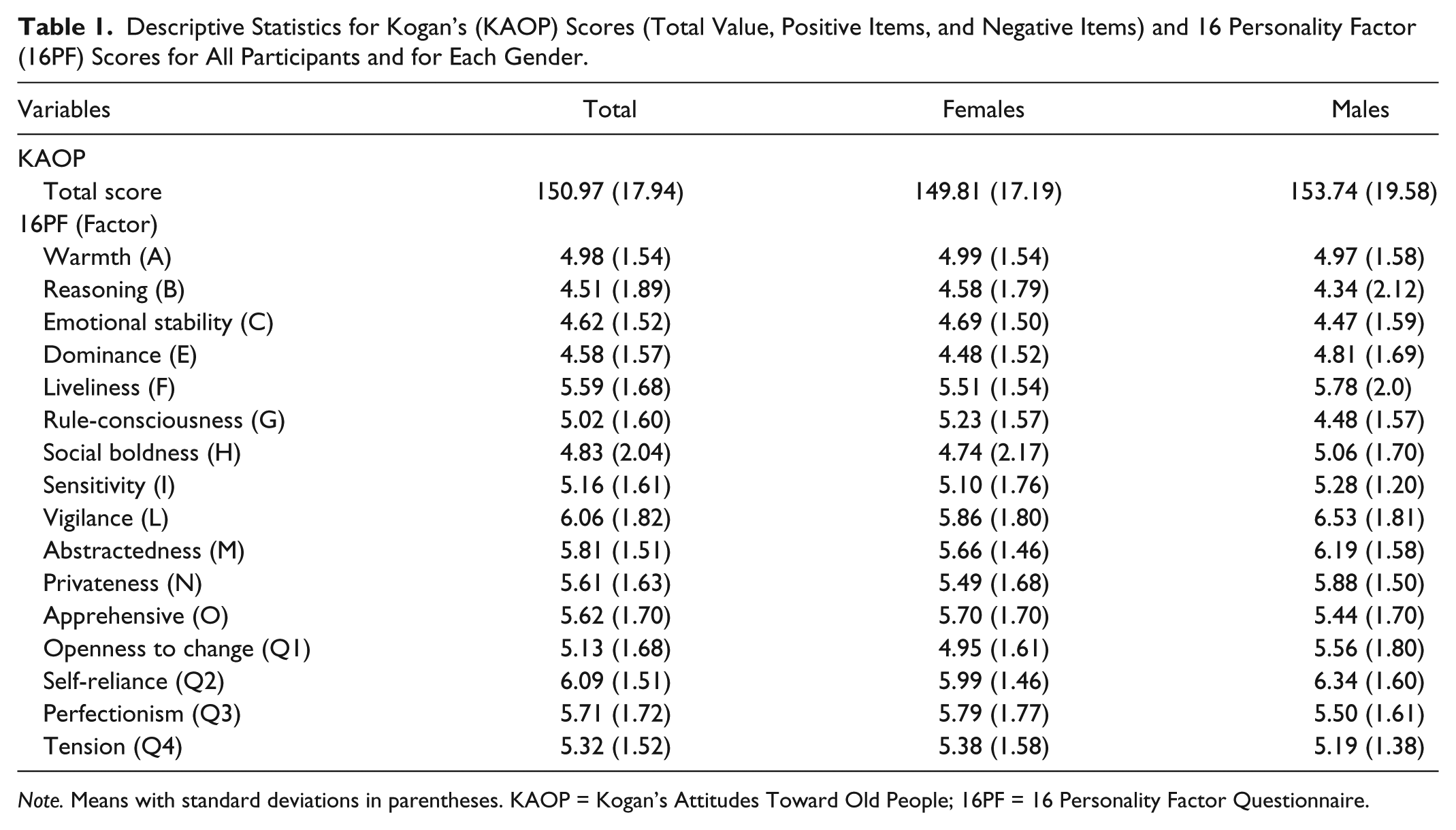
Note. Means with standard deviations in parentheses. KAOP = Kogan’s Attitudes Toward Old People; 16PF = 16 Personality Factor Questionnaire.
A two-way ANOVA was conducted using total KAOP scores as the dependent variable with gender, reserve status (i.e., living on or off an aboriginal reserve), and their interaction as independent measures for which data were normally distributed according to Shapiro-Wilks test, and assumptions of equal error variance were satisfied (all p > .05). Total KAOP scores indicating males’ (M = 153.74, SD = 19.58) and females’ (M = 149.81, SD = 17.19) attitudes toward elders were not significantly different (p > .05). Furthermore, there was no significant difference between individuals living on an aboriginal reserve (M = 148.40, SD = 17.39) or off reserve (M = 154.13, SD = 18.26) regarding their overall attitudes toward elders nor was there an interaction between those living on or off of an aboriginal reserve by gender (all p > .05). All results remained nonsignificant after ANCOVA to control for age. Although relatively weak, there were statistically significant correlations observed for KAOP with 16PF Factor B or reasoning, ρ(109) = 0.24, p < .05, and Factor G or rule-consciousness, ρ(108) = −0.24, p < .05, indicating positive and negative relationships, respectively.
Discussion
The present study that examined an indigenous Canadian sample was congruent with our previous findings regarding attitudes toward seniors. An early study of undergraduate students of mostly Caucasian descent did not demonstrate any significant differences between males and females (Mansfield-Green et al., 2015). This lack of attitude disparity between genders was also noted in the current study. Furthermore, we did not identify any difference in attitude between those living on reserve or those living off reserve nor was there any interaction between gender and reserve status observed. These findings point to a relative homogeneity of attitudes toward elders. The sampled population did not show any significant difference for gender or reserve status. This could imply cultural teaching and values regarding respect for elders do not vary for aboriginals who live on or off reserves. This could infer that regardless of one’s residence, traditional cultural values are maintained whether or not one relocates to another area separate from the reserve.
Although a number of cultures have demonstrated overall positive attitudes toward seniors (Chi, 2011; Runkawatt et al., 2013), the mean KAOP score obtained from the current study indicates a relatively more positive attitude compared with an undergraduate sample of mostly Caucasian individuals (Mansfield-Green et al., 2015). This is particularly promising for issues that directly affect native reserves that have a growing population of older people (Statistics Canada, 2015) and limited funding (Wilson & Macdonald, 2010). The finding that aboriginal people tend to possess positive attitudes toward elders could have implications pertaining to adequate care for elders who reside on or off reserves. This finding is consistent with previous research that showed positive senior care among indigenous people (Jervis et al., 2010).
Finally, the linear analyses we examined indicated that reasoning (16PF Factor B) was the personality factor most strongly positively associated with overall attitudes toward elders sampled, although the strength of this relationship was relatively weak. An additional correlation identified a negative association between KAOP values and the personality aspect of rule-consciousness (16PF Factor G). The correlation between reasoning and KAOP suggests that those who are abstract thinkers and quick to learn also possess more positive attitudes toward elders. Conversely, those who think more concretely with less flexibility in mental capacity show a reduction in this positive attitude. This is in contrast to our previous study (Mansfield-Green et al., 2015) that found warmth was most strongly correlated with attitudes toward the elderly.
Although the correlated aspects of personality appear to differ between cultures, indigenous people demonstrated positive attitudes toward elders. This could imply those individuals living on a reserve with appropriate training in gerontological care would provide a positive social environment for the elderly who may prefer to continue residence on their reservation rather than moving to an elderly care facility elsewhere.
Footnotes
Declaration of Conflicting Interests
The author(s) declared no potential conflicts of interest with respect to the research, authorship, and/or publication of this article.
Funding
The author(s) disclosed receipt of the following financial support for the research, authorship, and/or publication of this article: The authors received financial support from Shooiya Wa-Bitong Training and Employment Centre from Treaty 3 First Nations, Kenora, Ontario for the research of this article.