




Abstract
The purpose of this study was to measure student affective, behavior, and content (ABC) and global awareness outcomes after participating in a science, technology, engineering, and mathematics (STEM)–based international service-learning (ISL) course and impacts on long-term retention in STEM fields. We compared experiences from 12 participants (undergraduate and graduate students) enrolled in a STEM-based ISL course with experiences from four students enrolled in the same course without the service-learning component. The ISL course involved classroom discussions on environmental topics and four local and ISL projects with community partners to contribute to conservation efforts. Data came from student responses on a civics awareness questionnaire, reflective journal entries, and responses captured during individual semistructured interviews 2 years after the course. Findings indicate positive improvements in affective outcomes, significant gains in civic awareness, differences in behaviors based on class of student, specific content gains related to service-learning activities, global awareness gains for all students, and differential impacts on retention in STEM-related fields.
International Service-Learning (ISL)
There is a push to recruit and retain students into science, technology, engineering, and mathematics (STEM) fields (National Academy of Sciences [NAS], 2007) as well as improve civic awareness (Moely, McFarland, Miron, Mercer, & Ilustre, 2002). Service-learning allows students to learn through real-world application of content knowledge by collaborating with community partners (Brown, Hershock, Finelli, & O’Neal, 2009). This style of learning enhances academic knowledge, personal awareness, and sense of civic responsibility (Ash & Clayton, 2009). As such, service-learning is often referred to as a type of “experiential education” (Brubaker & Ostroff, 2000), where learning takes place through the actual experience rather than in a traditional classroom environment. When used in conjunction with STEM contexts, service-learning not only improves students’ social values but also facilitates involvement in the community and increases retention in STEM fields (Davis & Finelli, 2007; NAS, 2007). However, most service-learning endeavors have been associated with social science courses rather than STEM courses and are isolated to local community partners.
In recent years, service-learning courses have expanded to include international contexts. One of the major reasons behind this expansion is the evolving need for internationalization of higher education to promote students’ intercultural competence, global awareness, and understanding (De Witt, 2002; Plater, Jones, Bringle, & Clayton, 2009). ISL incorporates the components of both service-learning and international education (Bringle, Hatcher, & Jones, 2011; Nickols, Rothenberg, Moshi, & Tetloff, 2013; Plater et al., 2009). The connection between classroom instruction and community participation in an international dimension provides a unique learning experience in an intercultural setting (Crabtree, 2008; Sternberger, Ford, & Hale, 2005). Authentic learning experiences associated with ISL differentiates it from traditional pedagogical approaches such as study abroad and international education (Bringle et al., 2011). ISL experiences offered to students in higher education may help retention in STEM fields along with improved understanding of the world. Therefore, a STEM-based ISL course serves the dual purpose of generating global awareness and development of STEM interest among students. However, the limited number of such courses currently offered at the college level, requires further attention. This study was designed to exemplify a STEM-based ISL course and its outcomes on college students.
Outcomes of Service-Learning
There have been several outcomes from service-learning highlighted in the literature including affective, behavior, and content (ABC) benefits. In addition, there are global awareness outcomes that are more restricted to ISL experiences.
Affective outcomes
When students participate in service-learning, they can encounter a variety of affective responses including anger, frustration, confusion, varying comfort levels, satisfaction (Welch, 1999). As such, service-learning can encourage students to react to their emotional reactions and promote personal growth, such as the development of a personal identity and increased self-efficacy (Astin & Sax, 1998; Astin, Sax, & Avalos, 1999; Eyler & Giles, 1999; Rockquemore & Schaffer, 2000). Some other affective outcomes associated with service-learning include enhanced communication skills and leadership attitudes, and increased ability to work with others (Astin & Sax, 1998; Eyler & Giles, 1999; Vogelgesang & Astin, 2000). In addition, by situating students in real-life scenarios and developing service-learning curricula around social problems helps students to get an authentic learning experience along with the elimination of negative stereotypes (Buch & Harden, 2011; Kiely, 2005; Potthoff et al., 2000). By providing students with opportunities to interact with people of different ages, races, and social classes, such service-learning activities can help develop communication and problem-solving skills, which facilitates cultural and social understanding (Keen & Keen, 1998; Moely, McFarland, et al., 2002).
Behavior outcomes
Research indicates that participating in service-learning activity creates awareness among the students about the impact of human activities on the environment, and students learn how to behave more responsibly toward social issues (Astin & Sax, 1998; Eyler & Giles, 1999; Moely, McFarland, et al., 2002; Packer, 2009; Olszewski-Kubilius, 2009). Students are also seen to exhibit citizenship skills and to develop a commitment to service in the future as a result of participation in such service-learning experiences (Buch & Harden, 2011; Packer, 2009; Payne, 2000; Potthoff et al., 2000). Exposure of students to community services at the college level often leads to continued involvement after graduation (Astin et al., 1999). Such experiences make students more committed to their volunteering service activities (Eyler & Giles, 1999; Payne, 2000; Potthoff et al., 2000).
Content outcomes
Besides the social and personal benefits, service-learning experiences also have some academic benefits. The higher education communities focus on developing a course curriculum, which helps to connect the classroom knowledge to real-world application to improve students’ learning outcomes. Service-learning projects can promote both content and process knowledge by the application of classroom knowledge in a real-world setting (Bringle & Hatcher, 1999; Eyler & Giles, 1999; Katula & Threnhauser, 1999). Service-learning activities place students in a real-life setting and help them to gain an authentic learning experience, which is key to effective learning (Kiely, 2005). Students with diverse experiences at the college level are more likely to develop problem-solving skills, active thinking capacity, and a desire to work at diverse geographical locations in the future (Brown et al., 2009; Gurin, Dey, Hurtado, & Gurin, 2002). Among the different approaches suggested by educators to retain students in STEM education, exposure of students to real-world applications of their STEM content knowledge is thought to be very essential to generate and retain interest among them (Brown et al., 2009, Davis & Finelli, 2007; NAS, 2007; Pintrich & Zusho, 2002; Winter, 2007).
ISL-specific outcomes
All the prior mentioned benefits associated with domestic service-learning experiences also apply to ISL. However, there are some added benefits associated with ISL experiences, which include development of awareness across the globe, cross-cultural awareness, appreciation for local culture and customs, and opportunity to experience global diversity (Crabtree, 2008; Gillian & Young, 2009; Jacoby & Brown, 2009; Johnson, Johnson, & Shaney, 2008; Maher, 2003; Nickols et al., 2013; Pagano & Roselle, 2009; Plater et al., 2009; Sternberger et al., 2005; Tonkin, 2004). Most important, because ISL helps to engage students in different service activities at a foreign location, students get to immerse in different cultures, which enhances their cross-cultural awareness (Nickols et al., 2013; Sternberger et al., 2005). Considering these added benefits, ISL is gaining in popularity among educators.
Critical Reflection
Critical reflection is an essential component of both domestic service-learning and ISL to meet all the learning objectives (Ash & Clayton, 2009; Kiely, 2005; Parker-Gwin & Mabry, 1998). Critical reflections while participating in a service-learning experience help students conceptualize their experiences to meet the learning objectives of the course and help plan for future similar engagements (Ash & Clayton, 2009; Rockquemore & Schaffer, 2000; Strage, 2000). But, random reflections without any specific purpose are definitely not beneficial in attaining learning goals. Reflections in applied learning pedagogies should be planned and designed in a way so that they meet the learning objectives and should be directed toward the context of study and purpose of research (Ash & Clayton, 2009; Bringle & Hatcher, 1999; Eyler, 2002; Welch, 1999). Guided reflection designs that include prompts or specific guidelines assigned by the educator for students’ journaling activities help in more purposeful reflection (Bringle & Hatcher, 1999; Kolb, 1984; Welch, 1999). Journaling activity, which helps students to reflect critically on their experiences, should be included in the curriculum to improve the effectiveness of a service-learning course (Parker-Gwin & Mabry, 1998). Another essential skill for learners, which is problem solving in new situations, is enhanced when students engage in explicit reflection activities in multiple settings (Eyler, 2002). Thus, critical reflection is the most important part of service-learning projects as it helps to connect the components of the experience for maximizing learning gains.
Contribution to the Literature
Even though extensive literature on addressing outcomes of domestic service-learning experiences is documented, very little has been investigated with regard to ISL experiences (e.g., Tonkin, 2011); furthermore, there are even more limited studies associated with ISL in the STEM field. Our study investigates the impacts of a STEM-based ISL course on college student ABC and global awareness outcomes. We also included a longitudinal element to capture extended outcomes related to civic involvement and STEM retention.
Conceptual Framework
We used the service-learning framework proposed by Ash and Clayton (2009) that highlights the main components of service-learning and expected learning goals to guide the design of our ISL STEM course. The three main components of service-learning include academic knowledge, relevant services, and reflective practices. The academic knowledge refers to the content covered in the classroom; in our case, we focused on biodiversity and conservation ecology. The relevant services include service-learning activities as a part of the course curriculum. We partnered with four community partners, two domestic and two international, to provide service-learning activities to which students contributed. Reflective practice is critical of all service-learning components as it helps bridge students’ actions and thoughts toward expected learning gains (Ash & Clayton, 2009; Eyler, Giles, & Schmeide, 1996). Effective reflection on activities, a key component of any service-learning experience, is considered to be a continuous process and referred to as “the glue that holds service and learning together to provide educative experiences” (Eyler et al., 1996, p. 16). Reflective practices involve engaging students to reflect on their experience through journals, which we accomplished by using prompts based on the ABC model (Welch, 1999). These components are responsible for achieving learning goals, such as personal development, improved civic attitudes, and improved content knowledge (see Figure 1). Given the international context of the course we studied, we also accounted for impacts from international firsthand experiences such as global understanding and awareness, communication across cultures through direct participation, and valuing the diversity and experience of a new world (Plater et al., 2009).

Conceptual framework for service-learning according to Ash and Clayton (2009).
Purpose
The purpose of this study was to measure student ABC and global awareness outcomes after participating in a STEM-based ISL course and impacts on long-term retention in STEM fields.
Specifically, we asked the following research questions:
In what ways did the service-learning activities influence personal awareness? How have students reported altering future engagement in service activities after their experience in the ISL? What were students STEM learning gains after their experience in the ISL?
Research Design
Course Format
Due to the nature of the international program, enrollment in the ISL university course was limited to 12 students per trip offering. We included all enrolled participants (n = 16) in this study from two trips. The course included a semester-long, local orientation in the Spring Semester followed by a 10-day international trip to Ireland in the following May. During the first offering, students (n = 12, six undergraduate and six graduate students) participated in a series of service-learning activities to supplement the course. During the second offering, students (n = 4, three undergraduate and one graduate student) took part in a traditional style of the course with no service-learning component. We used the second group to make comparisons between content outcomes and STEM retention.
The course content focused on environmental topics such as global biodiversity and conservation. As a component of the course, the class worked with community partners locally and internationally to conduct biodiversity inventories, conserve and create new habitat for native wildlife, and improve public literacy in this area. Community partners included the local Audubon Chapter, Science Olympiad Organization, Wildlife Film School, and Galway Atlantaquaria, the National Aquarium of Ireland. Students participated in four projects over the course, two local and two international. For the first project, students worked with the Audubon Society to conduct a coastal bird survey to gather information on bird populations affected by a recent oil spill. They worked with the society to measure changes in birds returning to the area compared with numbers that had been collected prior to the spill. In addition, the students considered recommendations for habitat restoration and conservation policies for the area. For the second project, students worked with the Science Olympiad Organization to develop an event for middle school students to learn about endangered, exotic, and extinct species including the probable reasons for their status and biodiversity impacts. As a part of this project, students developed questions related to these issues and provided study materials to local middle school students to use when preparing for a state competition. Once students arrive in Ireland, they participated in a project with the Wildlife Film School to build bird nest boxes and bat boxes as part of an ongoing effort to provide new habitats for local wildlife. Finally, students worked with the Galway Atlantaquaria to remove debris along the beaches in Galway and restore the coastal habitats. As part of this last project, students helped gather data on types and amount of litter that accumulated on a nearby beach and help educate the public on the impacts of pollution on local wildlife while providing suggestions to improve ecological-minded behaviors.
Data Sources and Analyses
Data came from responses on the Civic Attitudes and Skills Questionnaire (CASQ) pre–postquestionnaire (Moely, Mercer, Ilustre, Miron, & McFarland, 2002), student journal entries captured during the course, and individual, semistructured interviews that we conducted 2 years after the course.
The CASQ is a 45-item Likert-type questionnaire that measures skills useful for civic endeavors, values related to civic engagement, and the likelihood of action in community issues (Moely, Mercer, et al., 2002). We had students complete this questionnaire prior to the orientation portion of the course and immediately after returning from the international trip. We ran a paired t test in search of significant gains in awareness pre–postcourse. Unfortunately, there were not enough students enrolled in the traditional course to be able to perform a comparative test between the two sections.
Students were required to keep a daily journal throughout the course, reflecting upon their course experiences. After every course meeting, we provided three prompts for students to record their reflections about the experience: Affect, Behavior, and Content (ABC; Welch, 1999). The ABC prompts acted as a guide to facilitate the process of reflection and students could also expand beyond these in their responses, as they often did, particularly with regard to global awareness. Sample prompts included the following: describe your personal emotional reactions to course experiences, how did you act during the course activities or how might you change your behaviors if you had to participate in a similar activity in the future, and what connections can you identify between your experiences and course content?
To measure the long-term impact of the course, we conducted semistructured interviews (Patton, 2002) with each of the participants 2 years after completing the course. We asked students questions related to what they remembered about their course experiences, their ideas regarding community service and current participation, global awareness, what role the course had on their choices and outlook, and content understanding.
We undertook multiple coding cycles to analyze our qualitative data. First, we used a deductive approach to sort our data according to the ABC classifications. Second, we used a line-by-line, inductive approach to assign descriptive codes to student responses in their journal entries and interviews. Next, we condensed these codes into categories based on similarities in descriptions. Then, we completed a second round of coding using the pattern coding method (Saldaña, 2013) to identify themes across data to answer our research questions.
Findings
We identified ABC, global awareness, and long-term STEM retention outcomes of students who took part in a STEM-based course abroad (see Figure 2). We also compared student outcomes across participant groups: graduate versus undergraduate students and content and STEM retention differences between participants who took part in ISL opportunities and those who did not.
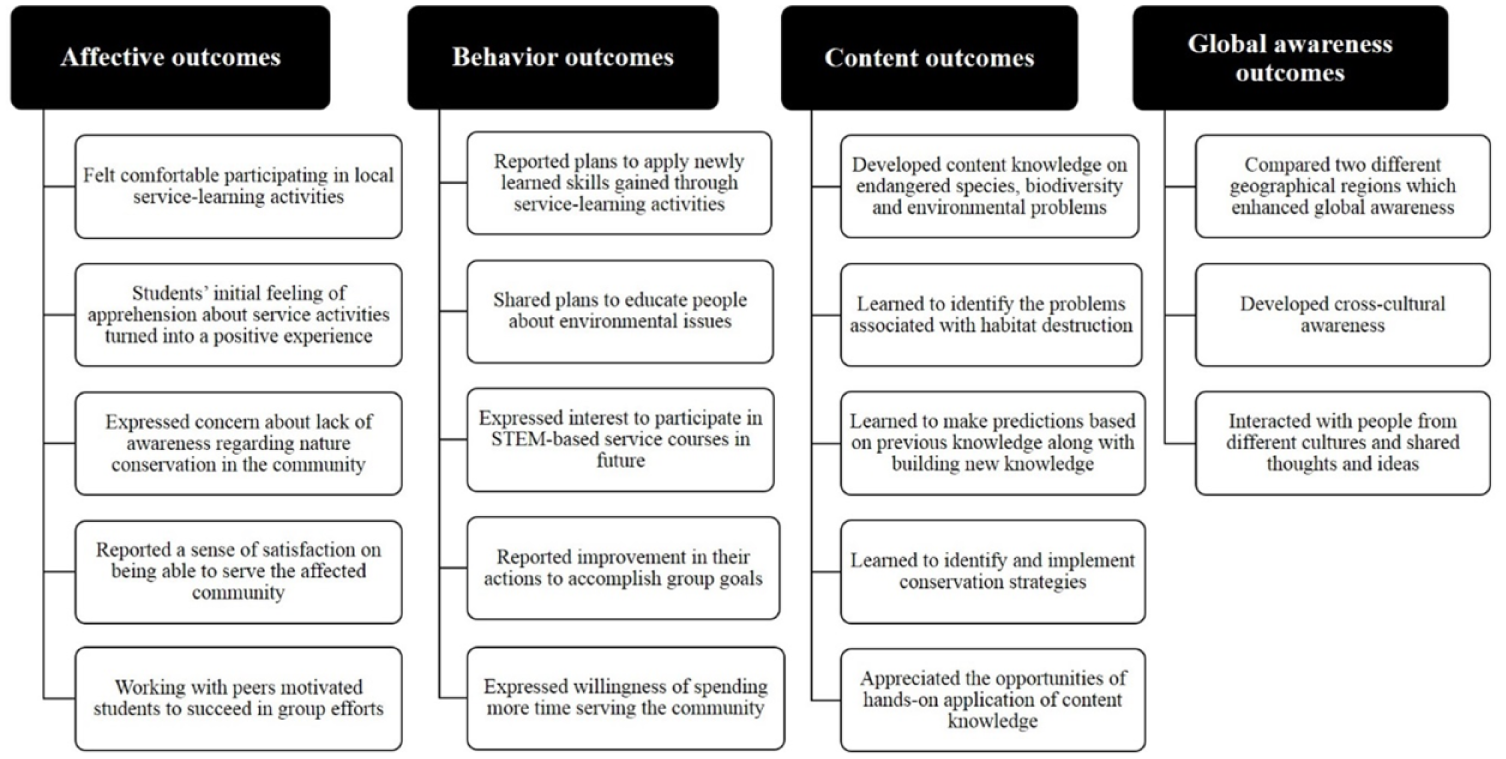
Student outcomes from participating in an ISL course.
Finding 1: ABC Outcomes
Affective outcomes
We found that students’ affective outcomes varied based on the type and location of the service-learning activities that took place. For example, students reported that they were more comfortable (58%) when taking part in local service-learning activities. Taking part in the Science Olympiad event challenged students’ prior conceptions about the types of competitors who would participate in such an event. Students remarked that they expected to encounter nerds or dorks, but instead found they were amazed by the diversity and number of competitors who attended. Instead of meeting the preconceived stereotype, students noted that the Olympiad competitors were just normal kids eager to learn more about science, and they found this to increase their excitement about the event.
Some students (33%) reported that they were intimidated and apprehensive about taking part in survey projects requiring them to draw upon technical identification skills, but later reported that they enjoyed the activity and were happy that they were able to contribute to the project and improve their confidence in their abilities. When students reflected upon their ISL activities, they tended (54%) to report initial feelings of apprehension, frustration, and indifference but were positively surprised that they enjoyed the experience afterward. For example, students reported that creating new structures providing habitat for birds and bats was much easier than they had anticipated and they felt satisfied that they had been able to contribute to the local conservation need. In some cases (41%), students also reported that the experience caused them to become frustrated, disappointed, or even depressed that so little was being done by the community to counter the issues of habitat destruction and species loss abroad. All the participants reported gratification after their experiences and were glad they were able to take part and give back to the communities impacted. Furthermore, all the participants liked being involved in the service-based course. For example, Cindy, a graduate student stated,
I like giving back to the community. I think it is a way to become a part of the community by being integrated into it. If we had another option for service course, I would do it again, particularly if it was science-based.
Students remarked how their involvement in the service-learning activities helped them feel more comfortable with their peers and became interested in contributing more to make sure all the group endeavors were successful.
Behavior outcomes
There was a significant difference in students pre–post-CASQ scores (t = 3.442, p = .009) who completed the service-learning activities indicating an overall increase in civic awareness. Although civic awareness is not in and of itself a behavior change, increased awareness can be linked to increased behavior. We found that students in the ISL group readily reported that they planned to use their newly learned skills they gained through the service-learning activities. For example, Richard, a graduate student stated, “I will be building many more bird and bat boxes when I get home, not only for my yard, but to share with friends and family.” Future plans of action, such as this example, will increase environmental conservation efforts and could also help educate others on environmental issues. Students also shared their future plans of educating others about the environmental issues and make people conscious about them. For example, Kelly, an undergraduate student said,
I don’t know if I contributed anything at that time, but I feel like the experience changed me in a way that I can contribute or make contributions going for future, like how to view the world or be conscious to not be wasteful. I was thinking on how to make people more conscious of their local environment and local resources and not to be wasteful. I don’t know why I did not think of that before though.
Both the undergraduate and graduate students reported that they were very likely to participate in STEM-based service in the future. However, undergraduate students did not provide well-defined plans for the future application of their course experiences whereas graduate students provided clear thought-out plans for the future application of service experiences.
After each service-learning activity, students commented that they wished they had been able to get more involved with the project of continue their involvement beyond the scope of the course. Many students (67%) remarked that they were surprised about the outcomes of at least one of the activities and stated that they wished they would have taken more time to be prepared for what to expect beforehand—through content or organization preparation (67%), equipment needs (33%), or proper attire (25%). Many students (58%) stated they wished they had taken more time to interact with the group during the local activities, and their commitment to the group was observed during the ISL activities. Whereas, during the ISL activities, students reported that they wished they had spent more time trying to learn more from the community partners (33%), and approached the activities with a better attitude (33%) as many were tired from traveling. All the students stated that they had gotten better with their actions over time and worked hard at accomplishing the group goals. And, all the students remarked that they would have liked to spend even more time focus on the service-learning activities and community partnerships.
Content outcomes
Both groups of students, those who took part in service-learning activities and those who did not, demonstrated content learning gains after the course. The main STEM topics that students reported developing content knowledge on include endangered species, biodiversity, and environmental problems. Both groups of students were able to identify problems associated with habitat destruction after the course. For example, both groups of students accurately discussed the environmental impacts of copper leaching from Irish mines into the Avoca river. Wes, an undergraduate, commented, “it was surprising to learn how things from 50 years ago are still affecting our environment today.” And Joanne, a graduate student stated,
I learned when we pollute we cause lack of diversity in the areas such as the streams and everything that uses the water source. It was a disturbing image to see Salmon die off in the area because of something man caused. It really put into perspective how humans harm the world and constantly destroy animal’s habitat. Change in the population of one species can have an impact on the balance of nature as a whole.
All the students, regardless of being involved in service-learning, had a unique experience of the biodiversity in Ireland with regard to both plant and animal species. They had an opportunity to explore the natural environment on their own, making predictions based on previous knowledge, and build new biology knowledge. Both groups learned about the biodiversity of Ireland, evident by Jessica, a graduate student’s statement,
I really liked the natural landscapes and being able to visit those different places. The Burren, for example, has plants there that are typically found in different regions, like Arctic, Alpine, and Mediterranean plants. You don’t see all those type of plants in one area, so it is kind of like a magical place where these plants co-exist together, whereas they shouldn’t be able to live the same place, but they do.
Each student completed lists of at least 30 species they successfully identified while in Ireland.
Likewise, all the students were able to identify potential conservation ideas. However, students who did not participate in service-learning activities provided ideas that were very superficial and not well thought out. For example, Sophia, an undergraduate student who did not partake in service-learning activities, stated we could implement local coastal cleanup, create stricter regulations for tourists, educate local communities and schoolchildren on the importance of conservation, discontinue the use of peat, and promote water conservation practices in hotels and tourist-heavy locations. Sophia did not elaborate on these policies or act upon any of her ideas other than her reflection that, “we wandered pretty much wherever we wanted, touched what we liked, disturbed what we pleased. I, personally, was not destructive, but are others?” The students who participated in service-learning activities, provided much more detailed ideas on how to implement conservation ideas with others. For example, Richard proposed he could teach schoolchildren about conservation.
I would have classes to a trash pick-up around the school, categorize what we found, graph the amounts, and then use that information to target how we would approach a recycle, reuse, reduce campaign around the school. We would have numbers to support what is being trashed improperly the most.
Also, students that took part in service-learning activities were encouraged and excited to explore content beyond the requirements for the course. For example, Beth, an undergraduate student, described how the Science Olympiad event prompted her to learn about Eastern Indigo Snakes and Gopher tortoises,
I did not know a lot about endangered species. However, I didn’t view this as a bad thing because it led me on sort of a knowledge scavenger hunt. I learned the Eastern Indigo Snake likes to live in gopher tortoise holes and that interested me enough to read up on the tortoises. And I found that their burrows provide homes for 360 other species of animals too!
This excitement and additional effort was not as evident in outcomes from students who did not partake in service-learning activities.
The purpose of engaging students in different service-learning activities was to teach them how community partners tried to solve conservation problems. Students recognized this connection as evidenced by Cindy, “Beach cleanups were directly related to the ‘conservation helps and biodiversity’ course aspect. As we keep natural areas healthy, more organisms and species can survive, thus ensuring more biodiversity.” Similarly, Joanne recognized that the activity with the Wildlife Film School tries to resolve conservations regarding suitable habitat, “We built bat and bird boxes today. By giving the animals more suitable locations to nest roost we increase the likelihood that multiple species can use the environment the boxes are in.”
Besides gaining new content knowledge, the students involved in service-learning activities also elaborated on how they thought the course provided them with a platform for hands-on application of content learned in the classroom. For instance, one of the aspects that students often emphasized during the interviews was the real-world experience they gained during the ISL course. Some students also described how they could apply STEM knowledge learned in other science classes through the service activities in this course. For example, Joanne stated,
The building of bat boxes were what I have learned the most for myself because, as I said, I have learned about bats in one of my other Biology classes and that information helped but I didn’t realize until I actually made the bat boxes that we had to scrape and scratch the inside of the boxes to make a texture such that bats can cling to it.
Students could see the connection between the content covered in the classroom and the service activities and appreciated the fact that they were able to contribute to some extent in solving environmental problems while learning more about course content. For example, Ann, an undergraduate student stated, “The service-learning projects, to me, exemplify the spirit of the course objectives: sharing knowledge of science, biology, through service activities. I liked the aspect of the course that topics discussed in class were relevant to the service activities.”
Finding 2: Global Awareness Outcomes
This course allowed students to compare environments from two different geographical regions, one local and one of Ireland. Once students had firsthand experience of this international comparison, they increased comments about global impacts. For example, David, an undergraduate student, stated, “I helped produce something that will hopefully improve biodiversity, which has fallen by double digit numbers all around the world.” Likewise, Cindy noted how the firsthand experience recognizes the widespread nature of conservation needs, “I can now say that I played a very small role in conservation efforts in Ireland. It really makes you realize that the U.S. isn’t the only country suffering from habitat degradation and a decrease in biodiversity.” This experience gave students the opportunity to see the issues brought forth in the course. Beth stated, “You always hear about birds getting stuck in those plastic can holders and turtles not being able to lay eggs because of trash.” But she had not really understood the impact this had on wildlife until she saw impacted animals while working with community partners.
Although, students involved with the service-learning activities had substantially more interactions with the locals, all students interacted with Irish citizens. The service-learning activities provided a common ground for communications related to course content. Kelly stated,
The building of these boxes [bird & bat nest boxes] was kind of an open door for talking about conservation issues. It helped like it was kind of a free flow of information between two different cultures as far as conservation was concerned.
Still, all the students demonstrated growth in their global awareness by reflecting on cultural differences and prior expectations. Cindy stated,
I knew some of the stereotypes associated with the Ireland culture but you haven’t really learned about some place until you have been there. So, when we actually went there, we got a better appreciation through the Irish culture and what they have gone through with the potato famine and their monoculture practices.
Students learned about the Irish culture and compared it with U.S. culture, enhancing cross-cultural awareness. Joanne observed,
Ireland was all about homemade food . . . In Ireland everything is local; they grow it right here, so the fish comes from the river nearby. So, I think that was the biggest difference from our culture here in the US. I wish we had a similar culture in US to help our local farmers.
All the students valued communication and interaction with people from different cultures as evidenced through journal reflections and interview comments. For example, Zane, a graduate student stated,
It [immersing in different cultures] helps you to broaden yourself as a person. It helps you understand how other people in the world think, how they look upon things, and their perception of the world. Also, I think to reach your full potential as a person, you need to understand other people because it makes a difference, definitely a huge difference as the globe is getting smaller. I am glad I got this opportunity through this course.
Similarly, Karen, an undergraduate student, stated, “The experience definitely helped me to be more open minded, understanding of other people while working with them as this was my first international experience working with people of different culture.” For nine of the 16 students who participated in the two courses, this was the first international exposure, and for all the 12 students who participated in the service-learning activities, this was their first experience as a part of ISL course.
Finding 3: Long-Term STEM Retention
All the students who participated in the course had provided initial intentions of pursuing STEM-related careers. For example, Wes stated, “I would love to come back and work after I graduate and maybe one day become the head biologist so that I can help implement new ways to protect our national wildlife and educate a bigger population about it.” He is now pursuing a STEM graduate degree. After following up with each of the students, we found that 11 of the 16 participants were pursuing a STEM career or graduate school assistantship (10 of the 12 from the ISL group and one of the four from the non-ISL group). Upon further probing, the participants from the ISL group stated that seeing firsthand how to integrate science with community involvement influenced their career paths, given that many of them pursued careers that focused on increasing public science literacy (e.g., science outreach director, science teacher, public health, graduate research). Participants from the non-ISL group stated they chose to abandon STEM career possibilities because the professional demands for such career were too high and they wanted to focus on more socially fulfilling jobs, with the exception of one participant who chose to teach science. Overall, we found that students showed differences in their learning outcomes based on the opportunity they had for participating in service-learning activities (see Table 1). These differences indicated a positive trend toward learning needed skills and content for STEM practice as well as pursuing a STEM career post experience.
Overall Differences in Student Outcomes Based on Their Participation in Service-Learning Activities.

Note. STEM = science, technology, engineering, and mathematics.
Discussion
Rubin and Matthews (2013) have extrapolated learning outcomes from study abroad experiences to make predictions about potential outcomes of students from ISL courses. Although these conclusions are helpful, they may not represent actual learning outcomes, hence the call to document student learning in ISL courses. In our study, although small in scope due to the nature of international field courses, we have been able to document actual outcomes from students in a STEM-based ISL course. Still, as ISL program can be cost prohibitive for some students, we expect that domestic service-learning courses could be modified to incorporate element of international perspectives and engage students in discussions about the global problems, or even contribute to international efforts even if they cannot physically travel to other locations, to provide them with a similar learning experience (Shmaefsky & Letargo, 2007).
Service-learning can promote community building within a course. This in turn, promotes student accountability to contribute to group projects and encourages higher rates of effort associated with such involvement. Students do not want to let down their peers or community partners. Also, as students take an active part in STEM-based service projects with community partners and see tangible outcomes, they show high levels of desire to devote more time to those efforts. Reflective practice facilitates considerations of student behavior (Bringle & Hatcher, 1999; Kolb, 1984; Parker-Gwin & Mabry, 1998; Welch, 1999). Through continued service-learning interactions, students improve confidence, behavior, and efficient contribution. Service-learning provides students with real-world application and experiences, which in turn promotes thinking about detailed ideas for future actions. It is already documented that students involved in service-learning are more motivated to share their experience with others in future (Buch & Harden, 2011; Packer, 2009). And, we know that students’ future intentions of engaging in service activities will likely encourage more individuals to engage in STEM-based service-learning, which can lead to a developed sense of intercultural awareness among a bigger population (Eyler & Giles, 1999; Payne, 2000; Potthoff et al., 2000). Thus, with significant increases in civic awareness and more thorough idea as options to pursue, we hope that this results in the follow through of future civic involvement, but this aspect warrants further exploration.
Immersing students in a different culture helps to broaden their knowledge and understanding of the world (Bringle, Hatcher, & Jones, 2011; Nickols et al., 2013; Plater et al., 2009). This is deemed essential in enhancing cross-cultural competence and breaking communication barriers between people of different geographical locations (De Wit, 2002; Keen & Keen, 1998; Moely, McFarland, et al., 2002). As our students had the opportunity to experience both local and ISL experiences as a part of this course, they were able to compare and contrast between the two different environments, which facilitated their learning experience. This is an added benefit compared with just study abroad, international education programs, or domestic service-learning considering the intercultural and global aspect (Bringle, Hatcher, & Jones, 2011; Nickols et al., 2013; Plater et al., 2009).
The high STEM retention, we found linked to service-learning experiences, could be a reflection of self-selected students. But all participants in our study had expressed an initial desire to pursue a STEM-related career, and a majority of those who stayed in STEM fields partially attributed this pursuit to what they gained from the ISL experience, particularly the explicit link on how STEM can be connected to community needs. This connection may not affect individuals who are interested in pure STEM research, but more likely those interested in careers related to policy, education, and outreach. Also, as the course enhanced students’ interest in STEM by engaging them in hands-on application, this is also a likely reason such activities facilitated their retention in STEM fields (Brown et al., 2009; Davis & Finelli, 2007; NAS, 2007).
The commitment to include service-learning as an element of a course takes time away from more traditional content delivery. However, participation in service-learning does not reduce potential content gains. In our study, the use of service-learning enriched content learning experiences and even promoted students to seek out more information beyond course content goals. However, this can hold true only if there is careful consideration given to aligning community partners and service-learning activities with course content goals. When these are aligned, students appreciated the real-world application of the content knowledge, which is an essential requirement for any experiential pedagogy (Pintrich & Zusho, 2002; Winter, 2007).
Footnotes
Declaration of Conflicting Interests
The authors declared no potential conflicts of interest with respect to the research, authorship, and/or publication of this article.
Funding
The authors disclosed receipt of the following financial support for the research and/or authorship of this article: This work was supported by Learn and Serve America: Mississippi Service Learning Program.