




Abstract
Drawing on in-depth interviews with incarcerated Aboriginal and Torres Strait Islander mothers in Western Australia, we report on the women’s use of violence in their relationships with others. Results reinforce that Aboriginal women are overwhelmingly victims of violence; however, many women report also using violence, primarily as a strategy to deal with their own high levels of victimization. The “normalization” of violence in their lives and communities places them at high risk of arrest and incarceration. This is compounded by a widespread distrust of the criminal justice system and associated agencies, and a lack of options for community support.
Introduction
In Australia, as elsewhere, most violence is perpetrated by men, and addressing and eliminating male violence—especially that relating to women and children—is a national priority (Council of Australian Governments, 2012; Department of Social Services [DSS], 2014). Historically, women’s use of violence has attracted a much lower profile than male violence, and our understanding of the contextual factors behind it is limited (Bartels, 2010). More recently, attention has turned to examining women’s use of violence, particularly in light of North American mandatory arrest laws for intimate partner violence, which have resulted in increasing numbers of women being mandated to attend batterer intervention programs (Hirschel, Buzawa, Pattavina, & Faggiani, 2007; Miller & Meloy, 2006). This growing body of literature is opening up understandings of how and why some women resort to violence in their relationships with others (Kubiak, Fedock, & Bybeeet, 2013; Miller, 2005; Swan, Gambone, Caldwell, Sullivan, & Snow, 2008).
In a review of research on women’s use of violence with male partners in the United States, (Swan and colleagues (2008) state that motivations behind, and experiences of, violence differ by gender. Women who display violent behavior are more likely than men to have been victimized: sexual or physical abuse in early life constitute risk factors for perpetrating violence in adulthood (Swan et al., 2008). In many cases, women’s violence is in response to a partner’s on-going and sustained abuse (Swan et al., 2008). Even in so-called “mutually violent” relationships (where both parties use violence), most experts concur that women experience graver detrimental effects such as physical injury, depression and anxiety (Swan et al., 2008).
Women may also use violence for other reasons: for example, those more commonly associated with men’s violence, such as to achieve control or compliance, or for reasons such as jealousy or retribution (Dasgupta, 2002). Generally, however, it is accepted that social inequalities between women and men produce different abuses and women’s and men’s violence cannot be understood as analogous (Dasgupta, 2002). Although some research documents women’s perceptions of the short- and long-term benefits of using violence against intimate partners (Larance, 2006), other findings indicate that women’s use of violence against an intimate partner rarely stops or modifies that partner’s abusive behaviors. In fact, using violence may increase a woman’s vulnerability to injury and other negative consequences, such as contact with the criminal justice system (Dasgupta, 2002; Stuart, Moore, Hellmuth, Ramsey, & Kahler, 2006; Swan & Snow, 2003).
This article examines the use of violence in a sample of 54 incarcerated Aboriginal and Torres Strait Islander 1 mothers in Western Australia (WA). In writing this article, we had concerns that the findings might be misinterpreted and generate a more negative view of these women than already exists among segments of the Australian community. We consulted with Aboriginal and non-Aboriginal academics and experts, requesting they formally review our manuscript to determine community acceptability, relevance, and quality of the research and to assess whether the publication might do more harm than good. Where possible we have contextualized the data to ensure we are providing a clear and coherent explanation for why women are being imprisoned, discussing what could be perceived as a deficit perspective of Aboriginal women’s use of violence. In addition, the article was reviewed by the West Australian Aboriginal Health Ethics Committee (WAAHEC). We also seek to bring to light the views of the women who were interviewed and freely shared their often harrowing life stories with us in the hope that they would benefit other Aboriginal women in Australia.
Women in Australian Prisons
Women comprise a small segment (8%) of the total Australian prisoner population (ABS, 2016a). However, between 2004 and 2014 the rate of female incarceration increased by 35% compared to 28% among men (ABS 2014), making women the fastest growing group in the Australian prison system. The imprisonment rate for Aboriginal women has increased at a faster rate than for non-Aboriginal women. Comprising only 2% of the adult female population nationally, Aboriginal women now make up 34% of Australia’s female prisoner population (compared to 26% for Aboriginal men) (ABS, 2016b). In WA, Aboriginal women make up 3% of the adult female population but 46% of the state’s female prisoners (ABS, 2016b).
In 2016, 33% of non-Aboriginal women were incarcerated for a violent offense 2 but among Aboriginal women this figure was 51% (ABS, 2016b). Acts Intended to Cause Injury (AICI) surpassed all other offense-type categories for which Aboriginal women were imprisoned in 2016; for incarcerated non-Aboriginal women the most serious offense/charge was illicit drug offenses (ABS, 2016b).
Aboriginal Women as Victims and Offenders of Violence
Most violence involving Aboriginal people in Australia is committed by Aboriginal men, with Aboriginal women overwhelmingly the victims (Wundersitz, 2010). Aboriginal women are 34 times more likely than non-Aboriginal women to have been hospitalized as a result of injuries caused by assault and 9 times more likely to die from their injuries (Australian Health Ministers’ Advisory Council, 2012; Kariminia, Butler, Jones, & Law, 2012). Less is known about Aboriginal women’s violent offending, and most available data relate to incarcerated women (Bartels, 2010). 3 In 2004, a report published by the Australian Institute of Criminology (AIC) found that Aboriginal women were more likely to be serving a custodial sentence for a violent offense than non-Aboriginal women (57% vs. 21%), and that Aboriginal women were more likely than non-Aboriginal women to report physically assaulting another person in their lifetime (73% vs. 40%) (Johnson, 2004). However, while higher numbers of Aboriginal women committed or reported assault, many did not progress to regular violent offending, a pattern also observed among non-Aboriginal women (Wundersitz, 2010).
Understanding Violence Experienced by Aboriginal People
Family violence is a term used in Australia to broadly describe violence which takes place within the extended family context and includes physical, emotional, sexual, social, spiritual, cultural, psychological, and economic abuses (Memmot, Stacy, Chambers, & Keys, 2001). Contested theories abound in relation to the high levels of family violence experienced by some Aboriginal people. Some argue that violence existed in traditional, precontact Aboriginal cultures, where physical punishment was used to penalize “transgressions against traditional law” (Lucashenko, 1996, p. 382). This violence was generally structured, “carried out according to social rules in response to specified offenses” (Memmot et al., 2001, p. 23) and was commonly controlled and reflexive to the severity of offense, as well as the participant’s gender and age (Memmot et al., 2001; see also Hiatt, 1965).
However, the proposition that violence within contemporary Aboriginal communities reflects a simple continuation of traditional practices has been interrogated, particularly in research conducted by Aboriginal women. Although Aboriginal academic Langton (1988) postulated that swearing and fighting “constitute[d] dispute processing and social ordering devices derived from traditional Aboriginal cultural patterns” (p. 202) as well as acts of sedition to the dominant culture, she recently condemned the extent and nature of male-perpetrated violence against Aboriginal women today, as being outside cultural parameters (Langton, 2015), as do fellow Aboriginal researchers Lucashenko (1996) and Atkinson (2002). Atkinson (2002) argues that viewing violence in contemporary Aboriginal communities as “customary practice” is further problematized when “Western” views of Aboriginal violence are perceived to be “cultural,” and especially, in some cases, when this argument is used by Aboriginal people themselves to legitimize acts of violence against others (p. 12).
Other theorists have proposed that the level and intensity of violence experienced by Aboriginal people today is strongly related to Australia’s colonial past, which saw mass dispossession of Aboriginal people from their lands, a legal framework condoning the forced removal of children from their families, structural and social exclusion, and racism. The landmark Australian Royal Commission into Aboriginal Deaths in Custody (RCIADIC; 1991) highlighted that the destruction and breakdown of Aboriginal culture and communities led to widespread disadvantage and inequality for Aboriginal people which, in turn, contribute to excessive alcohol consumption, violence, and high rates of Aboriginal incarceration.
Atkinson (2002) and others argue that Aboriginal people continue to carry deep hurt as a consequence of this traumatic history, hurt which is transmitted through subsequent generations and may, in some cases, manifest in expressions of violence, commonly, but not exclusively, when alcohol is present. Alcohol in and of itself does not cause the violence experienced by Aboriginal peoples (Memmot et al., 2001). However, accounts by Aboriginal people frequently identify it as playing a central role in the violence they experience (Atkinson, 2002; Bolger, 1991; Burbank 1994; Indig et al., 2009; Payne, 1992; RCIADC, 1991; Weatherburn, 2014).
Weatherburn (2014; see also Snowball & Weatherburn, 2008) recently “tested” theories of Aboriginal offending, particularly those related to violence. The findings provide support for the impact of “lifestyle” factors in offending, including the misuse of alcohol and other drugs, living in troubled neighborhoods and associating in households with other offenders, and do not support cultural theories of Aboriginal violence. However, Guthrie (2015) challenges these conclusions, claiming they privilege selective research at the expense of other studies and obscure evidence illustrating the systemic and institutional racism intrinsic to the Australian judicial system. Guthrie also points out that Weatherburn’s findings fail to problematize the relationship between experiences of racism and incarceration rates among Aboriginal Australians.
Criminologists suggest that the overrepresentation of Aboriginal people in Australian prisons needs to be viewed through a postcolonial lens (Baldry & Cunneen, 2014; Cunneen, 2001). Cunneen (2001), for example, contends that the justice system is an extension of “social, economic and political processes established as a result of colonialism” (p. 4). Consequently, to reduce the overrepresentation of Aboriginal people in prison, Aboriginal “criminality” must be understood within the context of a system that perpetuates colonial processes, albeit in a modified form (Cunneen, 2001). In relation to the experiences of Aboriginal women, Baldry and Cunneen (2014) argue for the “analytical importance of the concept of colonial patriarchy” in understanding and responding to the increase in Aboriginal women’s imprisonment (p. 17). The authors state that discriminatory institutional methods of control—from girls’ and boys’ homes and mental asylums to missions and state removal of children to prisons—have existed for Aboriginal people since colonial times, and that even today, many Aboriginal people are policed, detained, and segregated from the rest of the community. Furthermore, they assert that such institutional control methods impact on women in different ways to men.
Aboriginal women’s use of violence
Few published sources exist that document Aboriginal women’s use of violence except in passing (see, for example, Atkinson, 1990; Bolger, 1991). Yeo (1996) has suggested that, due to Aboriginal women’s reluctance to report the violence they experience to police, they may be more inclined to retaliate with physical force when victimized. Similarly, consecutive reports by the Australian Human Rights and Equal Opportunity Commission (Australian and Torres Strait Islander Social Justice Commissioner, 2002, 2004) have proposed that Aboriginal women may have fewer misgivings than other women about responding to violence with violence. Burbank’s (1994) study examining aggression among Aboriginal women in the remote community of “Mangrove” remains the most comprehensive to date and reveals that while most violent incidents recorded were initiated and perpetrated by men, violence by Aboriginal women was not seen as unusual or unreasonable, and was often enacted in response to male violence. However, Burbank (1994) also recorded incidents of female-to-female violence, generally directed against perceived rivals for men’s affections, but also in response to infractions of cultural rules governing behavior in this particular community. Burbank’s (1994) study further illustrated that acts of aggression by Aboriginal women, while often different in form to male aggression, were “not always minor or reactive” (p. 137).
Background and Method
Background
Women in this study came from five prisons in WA, including two female-only facilities (Bandyup Women’s Prison 4 and Boronia Prerelease Centre for Women), and three regional prisons (Eastern Goldfields, Greenough, and West Kimberley) which hold both women and men. 5 Eighty-four Aboriginal mothers were interviewed, representing approximately 36% of the total Aboriginal female prisoner population and around 44% of all eligible women prisoners. 6
Method
Data presented in this article are drawn from the larger study titled “The Social and Cultural Resilience and Emotional Wellbeing of Aboriginal Mothers in Prison,” which aimed to better understand the health, treatment, and other needs of incarcerated Aboriginal mothers in WA and New South Wales (NSW). The project represents a mixed-methods study comprised of semistructured narrative interviews and several standardized health and well-being measures. 7 In WA, following recommendations from the expert and community reference group engaged for the project, women were asked additional questions as to whether they had experienced violence and whether they had been violent themselves. 8 Specifically, we asked whether they had ever been at the receiving end of violence committed by partners, family, or others; if so, whether they had talked to anyone about this; and whether this violence had caused them to seek haven in a refuge. We also asked whether they had ever perpetrated violence against partners, family, or others, and, if so, whether they talked to anyone about this. A woman was considered a “perpetrator” if she indicated she had been violent toward another person. We did not ask the women if their current offense was violent in nature, rather whether they had ever been violent.
Three female interviewers (two Aboriginal and one non-Aboriginal) conducted face-to-face interviews with the women. Women were recruited through a contact person allocated to the researchers at each prison. All women spoke English; however, for some, it was not their first language: 40% spoke an Aboriginal language in addition to English. Interviews were conducted in private rooms at the prison or in the prison grounds without custodial staff being present. Data were collected from February to September 2013, and interviews took from between 40 min and 2.5 hr. Ethics approval was independently granted by Curtin University Human Research and Ethics Committee, the WAAHEC, and the West Australian Department of Corrective Service’s Research and Evaluation Committee. In WA, separate approval was obtained to ask a number of questions relating to women’s experiences of violence. All women were provided with written and verbal information about the project, and informed that they could stop the interview at any stage or choose not to answer any questions. All women provided written informed consent to participate in the interview. Women being monitored under the prisons’ at-risk management system due to current mental health distress were excluded from participation. In addition, a comprehensive Patient Risk Management Agreement was signed between author J.J. and the superintendent and/or health staff at each prison. The agreement mapped out a referral process for those who scored highly on the Kessler 5 or requested further referral to prison health services. Five women (6%) were referred over the course of the research.
Data Analysis
The qualitative data were managed and analyzed using NVivo 10 employing a grounded theory approach (Glaser, 1998). Grounded theory is useful for empirical inquiries involving dynamic research phenomena and entails a continuous checking and rechecking of meanings emerging from the data (Charmaz, 2008). Two authors (M.W. and J.J.) independently analyzed and interpreted the women’s stories around violence, coding interviews for dominant themes. “Violence used” was the dominant or “parent” node in NVivo, under which a number of sub- or “child” nodes (n = 11) were created.
Results
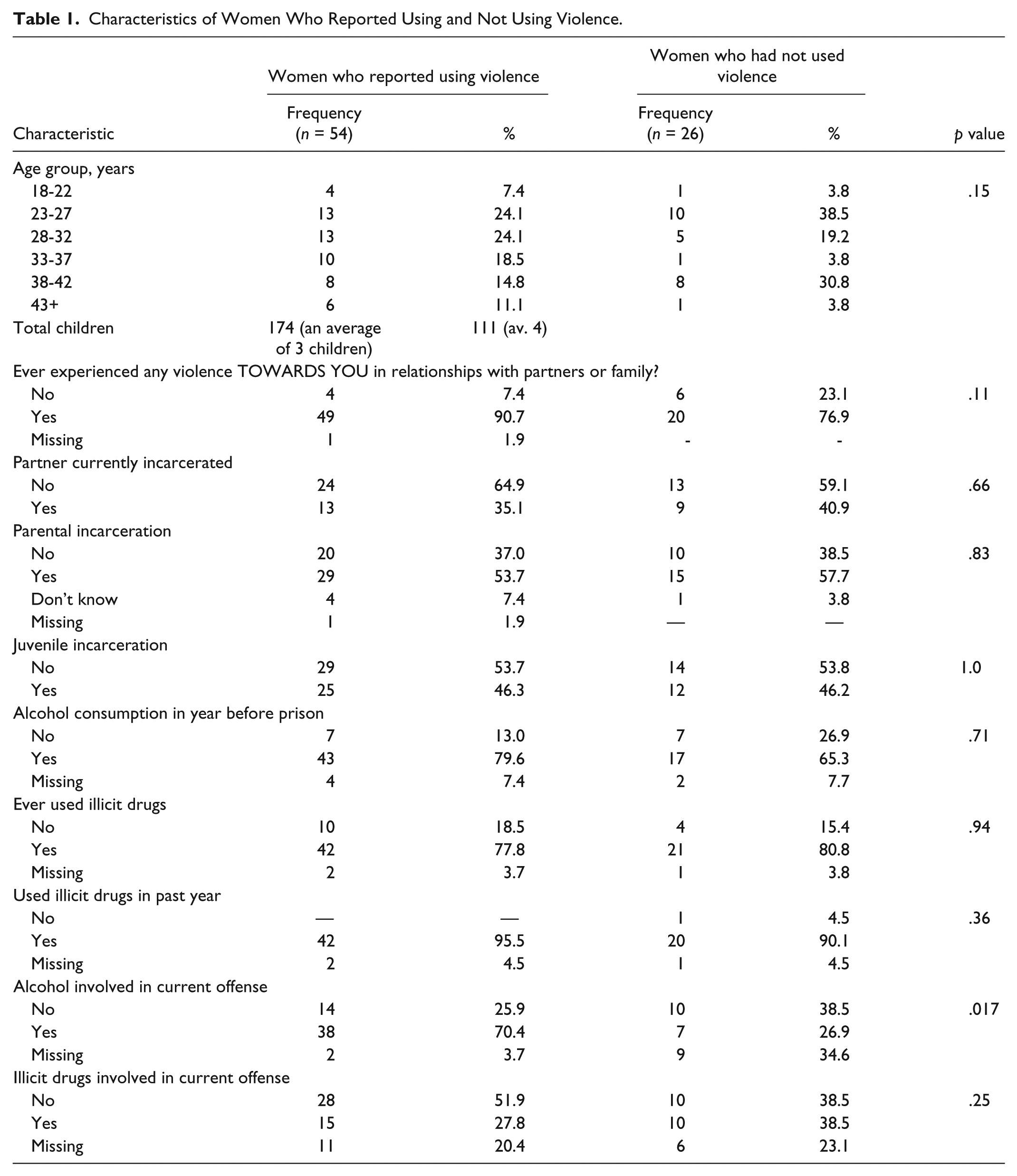
Chi-squared tests were used to examine the association between demographic and criminographic factors and self-reported use of violence. There was little difference in terms of demographic, criminographic, and patterns of substance use profiles between the two groups of women (violent/nonviolent) with the exception of the involvement of alcohol in the current offense, which was statistically significant (Table 1). In both groups, over a third of women’s partners were currently incarcerated, over half reported experiencing parental incarceration and close to half had been incarcerated as juveniles. High levels of substance use were documented, particularly in relation to alcohol, with over a quarter of women in both groups reporting the consumption of alcohol four or more times per week in the year prior to incarceration. Data presented below relate to the 54 women who indicated they had previously used violence. 9 Pseudonyms are used to protect the identities of participants.
Characteristics of Women Who Reported Using and Not Using Violence.
Women’s Backgrounds
As a group, most women came from disadvantaged backgrounds. Many depicted childhoods characterized by disruption, family substance use, and violence, where parents had “always been around, but just not always there.” Rachel, who grew up in a violent home environment, described being “passed around like a bottle of beer because when I was three I was taken away by welfare because my mum and dad were alcoholics.” Most women had experienced multiple traumas growing up, including witnessing family violence, the premature and often violent death of family members, and sexual abuse as children and rape as adults, and linked these experiences to the events leading up to their current (and historical) incarceration.
As children, most women had moved residence frequently and spent time with various family members or in foster care. This often resulted in inconsistent parenting and schooling, separation from siblings and early initiation to substance use. Leonie, who had been “flogged all my life by him [her father] and plus watching my mum get flogged and stuff,” left school at 14 years and described growing up in the following way:
I’ve been smoking dope since I was 13, pushing amphetamines since I was 17. You just really don’t think rationally. Your mind can’t sit and concentrate for long enough to know and yet at the end of the day, you just think you’re dumb anyway and you think that this is the way my life is meant to be. My life is not meant to be any better or any good because you come up in a dysfunctional family. You’ve not thought about dreams and goals and how to achieve them, so you don’t bother even doing it.
Early mothering and caring duties were common, often contributing to irregular school attendance. At an early age, Diana became responsible for the care of her siblings due to her mother’s heroin addiction: “I used to get all my siblings together, make them breakfast, take them to school, wash them, everything, and she’d [mum] be sitting half dead on the couch.” Diana left school for good when she became pregnant at 14 years. Louise explained, “I’ve got boys in their 30s that I’ve looked after, that I’ve brought up from babies. I was only in high school. I had to drop out of high school a lot of times.”
Substance use was a central feature in many women’s stories and was often related to their accounts of using violence themselves and/or their offending. Alcohol was the substance most consistently used by the women. As Claire stated, “It [alcohol] turns me into an animal so I’m not the same. When I’m drunk, I turn very nasty, very nasty.” Similarly, Cecilia, a self-confessed repeat drink-driving offender, stated, “Yes, I have been nasty and yeah been violent but against other women as well. All alcohol-related.” As for other substances, a smaller number of women reported the involvement of illicit substance use in their current offenses. In jail on assault charges, Taneka described what she is like under the influence of drugs: “When I’m on drugs, I’m not quite the person I am right now because when I’m on drugs, I’m way worser [sic]. I start going all over the place.” It is important to note that women frequently explained their substance use—especially during periods of elevated use which often corresponded with offending—as a response to other events in their lives, for example, the suicide of a family member, removal of children by the Department for Child Protection (DCP), or a partner’s sustained violence. Siobhan’s story highlights how traumatic events in her life and the ensuing grief contributed to her own drug use. In prison, awaiting sentencing for reckless driving under the influence of alcohol, Siobhan lost her mother at an early age, and in the 5 years preceding her imprisonment, lost three brothers: two to suicide and one in a car accident. Attempting to deal with her grief, she explained, “I turned to drugs, left my relationship and hit the alcohol really bad. I just couldn’t cope and I wasn’t myself. I never really came to the terms that I lost them and they were actually gone.”
Despite the struggles defining childhood, many women identified maternal and/or paternal grandparents who played a crucial protective role in providing safe and stable homes (even if only temporarily) for them as children. Grandparents performed the role of mother or father, when, as in Laura’s words, “our mothers were just confused, in relationships, drinking, smoking, carrying on, in jail, stuff like that.” Simone’s story reflects those of many others:
My grandparents raised 10 children of their own then raised about 30 or 40 of us grandchildren. I’ve been with them since I was three years old. Wasn’t well off but rich in love, you know? They’re my role models on everything. I think I would have ended up worse if it wasn’t for them.
Experiences of Violence
Violence in the family
Women spoke about violence within their immediate family. Claudine, who had experienced violence with her partner, spoke about also fighting with her “sisters and my mum.” Serving a 4½-year sentence for armed robbery, Lucy described the ubiquity of violence within her family unit: “It’s really stupid because we’re all violent—my sisters and my mum and my dad, everyone. Hitting and punching and swearing for no reason.” Leonie commented that she was taught “from a young age to be a fighter.” Julie, who had an extensive history of juvenile violence charges, was serving a 2-year sentence. At the time of interviewing, she had 13 months to serve. Despite this, her mother was “lining fights up for me already out there.” Similarly, if Diana, as a child, told her mother that
someone was picking on me she’d go to the school. The principal had to ring the police and everything. She would tell me if I didn’t punch into that girl she’d punch into me and then she’d punch into her.
The women’s narratives reveal that violence as a means for resolving grievances is not only condoned within some family units but is transmitted from one generation to the next. It is difficult to speculate as to why a mother would urge her daughter to participate in violent behaviors. However, all women cited in the accounts above reported maternal incarceration, and it is likely that the women’s mothers themselves had experienced extensive histories of trauma, violent victimization, and disenfranchisement, which, as discussed later, may inform responses to conflict resolution.
Violence within intimate relationships
Many of the women interviewed grew up witnessing violence between their parents and other close and extended family members and a large majority subsequently moved into their own violent relationships with some experiencing a succession of violent partners. Simone commented,
I grew up around violence so it was just normal I thought . . . He [partner] thought I was his property and it used to come from his mouth, “I own you,” and when I was young and impressionable I believed that was love because I’d seen it all my life growing up and watching aunties get flogged. I thought that was love and I just put up with.
Anna experienced physical and sexual abuse as a child and witnessed her father beating her mother. She described her first intimate relationship at 12 years as extremely violent, surmising, “You know when you’re trying to get away from people hurting you and you run into somebody that will hurt you more?” Sharing a domestic space with an abusive partner increases the probability of experiencing repeated violence (Dahlberg & Krug, 2002). The prominence of victimization histories among the 54 women who had used violence was stark with 49 women or 90.7% of the sample reporting they had also been victims of violence in the past.
Many women linked a victimization history to their own self-defense or retaliatory violence. Leonie, who had experienced violence against her as a child, explained how the experience colored her reactions to her current partner’s violence:
My partner [perpetrated violence] sometimes, not all the time, just now and again when he’d get too done [drunk], but then I was just as bad because I’d already been through so much with my father. I’d been getting flogged all my life by him and plus watching my mum get flogged. There was no way I was going to stand back and let a man flog me, so I gave just as much as he tried to give.
After receiving counseling in prison, Leonie realized how her experiences growing up played out in the violence she now used:
You realize why you bottled the anger up. You think about all the bad things that have happened to you as a child and that you’ve never dealt with—the sexual abuse, the drinking going on in your home, how you were kicked out of bed so uncles and aunties can have the bed, and how you watched your mother get flogged.
The perception of wrongful incarceration was common, as found in other studies of women’s violence (Dichter, 2013), particularly when the violence was a reaction to a man’s violence and the woman acted in self-defense of herself or another. Louise described being attacked by a former intimate partner as she emerged from the shower one evening: “He stalks me and rapes me and I’ve had to do the time.” In self-defense, Louise stabbed and injured her attacker for which, she reports, she was later charged. Sheryl was equally upset about her imprisonment:
I got charged for assault. They’re saying I assaulted this guy, but I threw a can at him because he grabbed my niece and started scruffing my niece in the liquor store. I shouldn’t have been in prison because I’ve been through domestic violence for 15 years, so if I see a man scruffing a woman, I’m going to try and help.
Occasionally, violence achieved what a woman hoped it would. Describing a conversation she had with her sister-in-law about her partner’s continual violence, Tracey, for example, recalled:
I hit him back. My sister-in-law said, “You’re bigger than him, hit him back.” Well the day she said that was probably the day he stopped hitting me, putting it over me. Because I was like, “well come on then. I will hit you straight back.” I’m not proud to say that I fight with my man, but you know?
However, many women who used violence in self-defense had received serious injuries. This suggests that while self-defensive violence may be a resistance strategy for some abused women (Randall, 2004), and possibly used with even greater frequency among Aboriginal women (Kerley & Cunneen, 1995), it may also increase their vulnerability to acute injury (Dasgupta, 2002). Laurel described fighting back when her partner was violent toward her. During one incident, her partner broke her arm. She hit him back with her good arm, “but he got the best of me.” Marlene also began to fight back, breaking a bottle and stabbing her partner in the back. She explained that she was “sick of getting bashed all the time and I wanted to just get the message to him to stop it.” When asked whether this move was effective in stopping his violence she answered, “no.”
Women spoke about reaching breaking point after experiencing years of violence. Claudine put up with her husband’s abuse for years. However, one night she “couldn’t hack it anymore” and “just snapped.” After he threw her down the hallway, she got a knife from the kitchen and stabbed him. It was a close call, the wound missing his heart by inches. Similarly, Margaret received a 3-year sentence for stabbing her abusive partner, explaining, “They keep pushing you to the limits. He kept pushing me right over the edge, that’s why I had to do something to him to get away from him. I couldn’t put up with him. Sick of getting abused.”
Several women explained fear for their lives had driven them to violence. Margaret had been extensively abused by her partner, including being stabbed when she was pregnant with their child. She ended up stabbing her partner “because he was killing me.” Wendy was serving a 3-year sentence for stabbing and fatally wounding her violent partner. After years of sustained abuse, she lived in fear for her life. Describing her partner as “jealous of everyone, even family,” she said, “I still got a fear inside me, I always got a fear inside me because of my husband.” On the day she was arrested, he had been “threatening me, belting me.”
Some women spoke about participating in apparently mutually combative behavior with partners due largely to frustration over their partner’s behaviors, as Taneka described,
I’m violent back with them, that’s what causes it. I’m doing wrong as well sometimes, but that’s only because I’m trying to get my way with him. Just trying to make him listen to me. I’m not trying to control it like full on, just trying to make him listen to me sometimes, not all the time. It is never my way with him, I always listen to him.
Having experienced violence from multiple partners, Sarah stated, “I’ve just had the crappest [sic] partners ever” and admitted using violence on at least one occasion: “I think one time I did hit my partner in the face because he was just so drunk, constantly. He was a constant alcoholic, drug addict, and I’d had enough.”
Some participants spoke about growing out of violence in their intimate relationships. For example, Pat and her partner reached a point where they acknowledged the damage violence was causing: “We come to a crunch where we recognize it now. We dealt with it because you’re just sick of it, chasing him up the road or him chasing me, the kids are shouting.” Similarly, when faced with conflict in her relationship Claudine now chooses to “ignore him and I just go and do some washing out the back.”
Silence around the violence experienced by Aboriginal women
The women’s experiences suggest that in some instances, there was a reluctance and/or failure by service providers, police, and community and family members to appropriately assist women in incidences involving violence, a finding reflected in other studies (r ATSISJC, 2002; Mullins & Miller, 2008). Consequently, women were hesitant to disclose violence, turned their backs on formal and informal support structures, or believed the violence was their responsibility to deal with, all of which contributed to women fighting back. As illustrated earlier, many women believed that violence in relationships was “normal” and close to a third of women in our study had not spoken about the violence they experienced in their lives and more than half had not spoken about the violence they had used against others.
Bridget, for example, described the way she responded to the violence she experienced at the hands of her former partner:
I know that they say you should talk about things, but my way of dealing with it was I just blocked it out. Like, alright that happened to me, don’t dwell on it. I don’t talk about it and I just move in a different path now.
Several women gave examples of where the violence they experienced had occurred in the presence of community members and immediate or extended family members or where women’s injuries, such as black eyes and bruises, were visible to those around them. Although on occasion someone would advise calling the police on the perpetrator or going to the hospital to have their wounds treated, in further cases the women’s stories suggested an apparent reluctance of others to get involved in the violence the woman was experiencing. Wendy, for example, shared an account of the time her husband dragged her along the concrete road by her hair, an incident witnessed by her husband’s family and other community members. No one came to Wendy’s aid in spite of the serious injuries she sustained. Similarly, Margaret contended, “when he bashed me, he did it in front of everybody and no one didn’t protect me. Of course I’m going to defend myself.” Claudine summarized her thoughts around violence, a sentiment characteristic of other women in our study. She explained that the violence taking place in her home was “my problem, I just deal with it” and violence between others was something one does not interfere in as it is “their business.”
The silence around their experiences with violence extended to women’s dealings with government agencies and police. Women spoke about actively concealing family violence from police for fear of the DCP becoming involved with their children. Participants reported experiencing considerable stress over the possibility of losing children to the DCP due to violence. As Louise commented, “the happiest feeling in the world is having a baby. The worst is having it taken away.” Women’s fear of the DCP potentially results in an underreporting of abuse. Claudine did not report the violence she experienced at the hands of her partner, explaining, “I was just taking it all in and I didn’t ring the police or nothing . . . I didn’t want to ring the police or DCP would be involved. So I just took hidings.” It was common for women facing incarceration or struggling with other issues to draw on informal family networks to organize care arrangements, thus managing to circumvent the formal welfare system. Bree, who believed the DCP were taking “everybody’s kids off them,” knew DCP had plans to take her child from her if she remained with her violent partner. This led her into hiding for 3 months, during which time she organized for her mother to assume custody: “that’s the reason why they can’t take him off me now, because I hand[ed] him over to mum.”
A number of women in this study also actively avoided reporting violence they experienced to the police. As Dichter (2013) argues, abused women who may have been arrested for offending violently, or who received little assistance when seeking police help for their partner’s or another’s violence on prior occasions, may feel reluctant to involve police in the future. Margaret was subjected to extreme abuse by her partner and felt let down by police:
I tried to report it but they [the police] think that I’m not all there. Every time I report to the police they’re saying I’m the one that’s causing trouble because I keep in and out of jail. But I told them the reason why I’m keeping in and out of jail [is] because I’m always abused and getting bashed for no reason. When it comes to me, when I do something [to him], they’re at my doorstep.
Bridget, in prison for the first time, had been stalked and assaulted by another Aboriginal woman for over 10 years. Although Bridget’s family was enmeshed in an on-going feud with the other woman’s family, Bridget tried to avoid getting involved. However, because of who her family was, she claimed this woman would not retreat. Bridget reported her to the police on numerous occasions but received no help: “I’d go to the police and she’s [the other woman] overpowering and she’d just twist things around. I got no help from the police, no mediation, no nothing.” Bridget ended up taking matters into her own hands and was remanded in prison for stabbing and injuring the woman.
The Criminal Justice System
Contact with police
For incarcerated Aboriginal mothers, the criminal justice system (including police, the courts, and corrective services) was prominent in their lives. Several women had been charged with assaulting police officers, particularly as juveniles. Bertie explained her contact with police as being, “Yeah, because I used to get picked on. I used to be fighting with certain families and then it’d be called fighting, street fighting. I used to get a fine for that.” Siobhan’s “first offense I ever had was assaulting a police officer,” while Rachel also described assaulting police officers as a juvenile: “Every time they try and grab you, I used to assault them.” Although not noticeable in the accounts they gave of their contact with police as adolescents, many women described feeling targeted by police as adults because they were Aboriginal, a finding reflected in other studies (Baldry & Cunneen, 2014; Blagg, 2008; Cunneen, 2001). Louise, who resided in an outer eastern suburb of Perth, described how she came to be arrested for outstanding warrants:
The police were driving past and taking names. They’re always taking names. Walking down the street or even in the shopping center. They’re [the police] supposed to be there for lunch, their lunch break. They’re still taking names. They’re there at the train station. We can’t even get on a train without giving our names. We can’t get off a train without giving our names.
A similar story was told by Bec, a woman from a regional town in the state’s southwest. Also arrested for outstanding warrants, Bec explained,
You might look like a criminal to them. Last time when I got out of here, they put the siren straight on me and ask for a name check and I just got out of jail! You could be doing your own thing, you get pulled up.
Bree, arrested for fighting with another Aboriginal woman in a supermarket, had a history of participating in “fights and stuff, all the time” and explained, “it’s like you grow up with it, when you’re Aboriginal that’s what you see [violence] your whole life.” When the case went to court she believed the prosecutor did not take her background or reasoning into account, which made her angry: “I got wild and I swore at him in the court house.” She concluded the courts “just think you’re another black person, lock ’em up, they’re not going to do what they’re told.”
Responses to women’s violence in the custodial setting
The majority of the women were recidivists with repeated exposure to the courts and corrections systems. However, their accounts point to a systematic failure by all levels of government to meet the specific treatment needs of Aboriginal women in contact with the justice system as a result of violence. Some women expressed concern that they would reoffend when they reentered the community. Beryl, for example, was worried she would breach her parole because of on-going tension with an ex-partner of her partner. She explained that while she was better at controlling her anger than she used to be, she had told her partner, “There’s only a certain amount I can tolerate. I already told him to tell her I’ll be out for her when I come out.”
At the time of interviewing, women serving a sentence of 6 months or more had access to four main programs running in the prisons, which broadly targeted criminal behavior, substance use, and problem solving. Women reported some positive outcomes from participating in these programs, but because the programs only dealt with their violence on a superficial level, some, as Tracey commented, identified the need for a more intensive course: “They don’t really talk about it, the violence, like they should. Oh actually they do talk about, but it’s only about—it’s more about you having your say and letting it all out.” Importantly, the lack of a violence intervention program was hindering women’s chances of qualifying for parole. Laura highlighted this when she said,
They don’t have a violent offending training program for women. So, if you were in for a violent offense, doing [standard program] you still didn’t get your parole, because you didn’t address your violent offending . . . So, a lot of women that come in, actually have done violent things, don’t get to address it and they don’t get parole.
Sheryl, who had been in prison 5 times previously and was currently serving a 9-month sentence for assault, had been refused parole on each attempt: “I kept trying to apply and they denied me again and again and again.” The denial, as she understood it, was on the basis of her violent offending history and a lack of programs to address this.
Discussion
Female prisoners as a group are a vulnerable population characterized by high rates of past exposure to childhood neglect, family dysfunction, trauma, sexual and physical abuse, as well as victimization as adults, including interpersonal and intimate partner violence in particular (Indig et al., 2009). Experiences of trauma have been strongly associated with a greater propensity for serious mental health and substance use disorders, both of which have in turn been linked to female imprisonment and to violent victimization and offending/perpetration of violence (Barrett, Teesson, & Mills, 2014; Logan & Blackburn, 2009). Most women in our study revealed histories of victimization and trauma. However, for a variety of reasons, many responded to their circumstances with violence rather than seeking help from other avenues. Among the reasons given were a lack of strategies for dealing with their situations nonviolently, the feeling that it was no one else’s business, fear, poor police responses on previous occasions, and a lack of access to (or awareness of) support and other services in their communities.
To determine whether participation in violence is consistent with culturally prescribed rules, reflects a form of lateral violence in response to colonial patriarchal forces and intergenerational trauma, or is due to other lifestyle factors such as substance use is too complex to answer. However, data presented in this article arguably resonates with each of these theoretical positions. For example, women who reported using violence against others described multiple traumas, and were more likely than women who had not used to violence to have been incarcerated previously (63% vs. 54%), to have experienced removal from family as children (25.9% vs. 15.4%), and to have been diagnosed with a mental health issue (37% vs. 26.9%). These women were also more likely to have been under the influence of alcohol at the time of their offense (70.4% vs. 26.9%). This echoes other research illustrating alcohol’s contributing role in the violence of Aboriginal female offenders (Johnson, 2004). Not only are Aboriginal women more likely than non-Aboriginal women to be arrested and charged for violent offenses, incarcerated Aboriginal women report higher levels of regular alcohol consumption (68% vs. 37%) and much higher levels of alcohol dependence (54% vs. 17%) (Johnson, 2004). However, it is clear that substance use alone is not enough to explain Aboriginal women’s violent behavior. Notably, the narratives presented raise a concerning but not unexpected issue: the influence of race and gender in structuring relations and experiences between the women and the criminal justice system and associated agencies.
First, the women’s narratives around interactions with police revealed frustration with what they perceived to be a systematic overpolicing of Aboriginal people for minor offenses, as previously documented by Atkinson (1990) and Cunneen (2001). Payne (1992) has argued that policing practices, past and present, continue to shape Aboriginal people’s relationship with police, contending that “negative opinions are also reinforced if the only time Aboriginal people meet police is in times of conflict” (Payne, 1992, p. 69). Second, women felt disillusioned by police inaction when they reported the violence they were experiencing, a finding also highlighted by Atkinson (1990) over 20 years ago. As a consequence, some women took matters into their own hands only to be arrested for the violence they used. Responses to violence by the police (and others) can disconnect the act from its context (Mullins & Miller, 2008), which may be particularly significant for women when they are arrested for violence given they were also likely victims of violence.
Norms around gender (i.e., masculinity is often equated with strength, power, and control) may act to unwittingly tolerate male violence toward females. Female-perpetrated violence, on the other hand, is frequently perceived as women acting contrary to their expected role. These gender ideologies have specific implications when violent behavior brings a woman before the judicial system—a system which continues to struggle with the concept of female violence; this may particularly be the case for those from minority backgrounds (Goodmark, 2012; Randall, 2004; Stubbs & Tolmie, 2008). In 1984, Lenore Walker developed the feminist defense strategy of the battered woman syndrome (BWS), primarily to explain women who kill in the context of abusive intimate partner relationships. Initially conceived to offer a legal recourse for women who killed rather than sought to leave their abusive partners, the theory was ultimately embraced by the North American criminal justice system and has also been used in an Australian context (Stubbs & Tolmie, 2008). However, since its formation, it has attracted considerable criticism (Goodmark, 2012).
For example, theorists have questioned the applicability of such a defense for women from non-White, non-middle class, and non-heterosexual backgrounds (Ammons, 1995; Goodmark, 2012; Stubbs, 1997). Studies have shown that women from ethnic and other minority groups may more often resort to fighting back in defense of themselves and their children rather than using other options (Goodmark, 2012), whereas the BWS framed women as passive victims who only fought back when they perceived their life was in certain danger; at all other times, they did not retaliate (Goodmark, 2012). Women who defended themselves on a more regular basis were perceived as something other than “victims” and found themselves at a significant legal disadvantage. Stubbs and Tolmie (1995) argued that
the options that [Australian] Aboriginal women have in dealing with the violence also must be read in the context of the connections they have with their communities, the economic and social disadvantages they experience and the racism of the wider community. (p. 131)
As found in Dichter’s (2013) study of women arrested for domestic violence, once a woman is charged with violence perpetration, she may turn away from formal mechanisms of protection, thus substantially increasing her vulnerability to experiencing further violence. This was the experience of many women in our study.
Several studies have found that underreporting of violence is more common among Aboriginal than non-Aboriginal victims, particularly when that violence is perpetrated by an intimate partner or family member (Taylor & Putt, 2007; Willis, 2011). This reluctance to report violence has been linked to a number of factors including fear of “payback,” ostracism from the family or community, concern that violence will escalate or be redirected to a woman’s child/ren, unfamiliarity with or lack of access to services, and distrust of police and the criminal justice system (Nancarrow, 2006; Willis, 2010, 2011). This reluctance is further problematized by a normalization of violence across generations, whereby it has come to be expected and unavoidable, making disclosure to police or other agencies even more unlikely (Atkinson, 1990). Our study also links a woman’s reluctance to report violence to a distrust and/or fear of child protection services. The distrust many Aboriginal people have for the DCP needs to be understood within a historical context characterized by forced child-removal and assimilationist policies (Bessant, 2013; Human Rights and Equal Opportunity Commission, 1997). Throughout the 19th century and until the late 1960s, policy permitted the forcible removal of children considered to be “neglected,” “destitute,” or “abused” from their parents and families (Bessant, 2013), which had a disproportionate impact on Aboriginal families and communities. In 1997, a major inquiry was conducted into the experiences of Aboriginal children separated from their families during this period. The report concluded that “the laws, policies and practices which separated Indigenous children from their families have contributed directly to the alienation of Indigenous societies today” (Human Rights and Equal Opportunity Commission, 1997).
Implications
Unsurprisingly, the extreme level of violence experienced by Aboriginal women in Australia demands a targeted and urgent response (DSS, 2014). Experiences of being a victim of violence were near universal in our study and it is well documented that a woman’s path to prison is frequently characterized by repeated victimization (DeHart, 2008). Responses to Aboriginal family violence need to be addressed at strategic and local levels (Willis, 2011). Cultural training of police is essential, and staff in services and organizations that come into contact with victimized women must be educated about the violence these women are subjected to (RCIADC, 1991; Willis, 2011). Cultural training and education alone, however, are insufficient. Trained and suitably responsive personnel and community members, who are trusted in the communities where these women live, must be accessible to women experiencing violence (Willis, 2011). The Human Rights and Equal Opportunity Commission’s (ATSISJC, 2006) report stated that the “code of silence” around violence that exists in many Aboriginal communities needs to be addressed (p. 4). Although this issue requires an across-board and structural approach, addressing it also depends on government officials “meeting their duty of care and taking moral responsibility in the performance of their duties as public officials” (p. 4).
At a local level, the delivery of education and violence prevention programs promoting greater awareness among community members of what constitutes violence and informing them of what services are available to those at the receiving end have been recommended (Taylor & Putt, 2007). The need for these programs to support a culture of disclosure and challenge the normalization of violence in some communities has also been highlighted (Willis, 2011). Nancarrow’s (2006) study into Aboriginal and non-Aboriginal women’s views of restorative justice found that Aboriginal women expressed a preference for Aboriginal community-driven solutions to family violence, rather than recourse to a system of justice that they saw removes decision making from Aboriginal people and perpetuates the separation of perpetrators from their families and communities. Restorative justice options focus on rebuilding and promoting positive social relationships between victims and offenders, and have been recommended in the context of family violence in Australia, not as a replacement for, but as an alternative to the adversarial and often alienating justice system (State of Victoria, 2016).
In terms of women’s own use of violence, this study showed that many women used violence, primarily, but not exclusively, in response to their own vicitmization. We argue that eclipsing women’s own violence from discussions of Aboriginal violence is doing these women a disservice and may be placing them at greater risk of future harm. Few in our sample had spoken to anyone about the violence they had used against others and none reported completing an intensive violent-offender program, in prison or in the community, despite a desire to do so. Indeed, the absence of such a program for women was noted in the 2011 and 2014 reports of the inspection of Bandyup Women’s Prison by the independent statutory body, the WA Office of the Inspector of Custodial Services (OICS). In spite of WA Corrective Services identifying violence as a treatment need for female prisoners, the OICS (2011) found there were “few treatment options available for female offenders” and “no treatment programs for women who were either sexual offenders or were assessed as requiring high intensity treatment for violent offenses” (pp. 173-174). 10
The provision of well-designed and appropriately funded community-based approaches to violence prevention for women as both victims and offenders of violence are critically needed. The availability of such programs will provide much required alternatives to a custodial sentence for these women as prison must be used as a “sanction of last resort” for Aboriginal peoples (RCIADC, 1991). However, for those women who do find themselves serving a custodial sentence, Corrective Services has a responsibility to ensure that programs in prison target their specific treatment needs, focus on their rehabilitation, and help minimize the time they are incarcerated. The absence of an intensive violence prevention program for women in WA prisons meant women in our study were being denied parole and the opportunity to return to their families and children because they were unable to convince the parole board that they had addressed their use of violence. As a result, they were detained in prison for longer periods. International studies of female offenders indicate that many are motivated to participate in gender-specific intensive programs for substance use, trauma, and violence (Zlotnick, Najavits, Rohsenow, & Johnson, 2003). Multileveled approaches to violence prevention need to be available in prison, especially programs developed to address the gendered and cultural specificities around women’s experiences with violence, alcohol and other substance misuse, and histories of victimization and trauma. Programs should recognize and understand a woman’s use of violence, not as an individual “problem,” but as it relates to her relationships, family, cultural, and social expectations, and to the broader sociocultural context in which she lives. 11
Finally, the increasing imprisonment of Aboriginal women has dire consequences for their children and families, and is likely to perpetuate intergenerational offending. Women are frequently the main carers in their communities, a fundamental role often commencing in childhood, and the impact of their incarceration on those they care for can be extremely traumatic. The 54 women we interviewed had 174 children between them, more than half of which were residing with their mothers prior to incarceration. Studies show that children of parents in prison are at greater risk of developing mental, psychological, and social problems, and of entering into the criminal justice system themselves (Quilty, Levy, Howard, Barratt, & Butler, 2004).
Limitations
Limitations of our study include not being able to isolate women who had used violence only against male partners from those who were indiscriminately violent, those who regularly responded with violence from those who had only done so once, or those who had been arrested and charged for a violent offense. In addition, while Table 1 illustrates the similarities along a range of characteristics between women who had and had not used violence, the study did not explicitly set out to explore the use of violence in greater depth. As such, it is beyond the scope of the current article to make systematic comparisons between these women’s experiences. Nor was it within the study’s scope to explore whether incarcerated Aboriginal women’s understandings and experiences differed from those of their non-Aboriginal peers. We hypothesize that some experiences will be contextually unique to Aboriginal women and will require consideration when developing programs in prison and/or the community.
Conclusion
Violence against women is resulting in a disproportionate level of intentional injuries, particularly among Aboriginal women. In Australia, as elsewhere, most violence is perpetrated by men, and addressing and eliminating male violence—particularly against women and children—is, understandably, a national priority. However, research into women’s violence has been relatively neglected as a result, impeding our understandings of the contexts within which it takes place. Underlying factors such as poverty, social exclusion, racism and a need for healing of the intergenerational trauma experienced by Aboriginal people must be addressed for women and subsequent generations of women to feel empowered in their lives. Our data reveal that most women in our study who reported using violence were themselves victims. However, distrust of and alienation from mainstream systems and institutions, combined with a normalization of violence within some families and communities, contributed to the nondisclosure of the violence they were experiencing. Instead, many women were fighting back and putting themselves at increased risk of harm, including injury and incarceration.
The majority of Aboriginal people abhor violence and promote a culture of nonviolence in their communities. However, they need to be empowered and supported to identify, implement, and evaluate solutions to end violence when it does occur in their communities. Victims of violence also need access to well-resourced alternative avenues of support such as refuges and Aboriginal family violence support, mediation, and legal services in order that victims do not become perpetrators. As highlighted in the women’s stories, the intergenerational transmission of violence poses the risk of another generation being profoundly impacted by the negative effects of violence—a risk that could be reduced, if not eradicated, if the appropriate measures were taken.
Footnotes
Acknowledgements
The authors would like to thank those who read and commented on an earlier draft of this article including: Victoria Burbank, Dennis Gray, Jill Guthrie, Daniel McAullay, Hannah McGlade, Sherry Saggers, Sandy Toussaint, Samantha Wilson, the members of the West Australian Aboriginal Health and Ethics Committee and the West Australian Department of Corrective Services’ Research and Evaluation Committee, and Juanita Sherwood, Chief Investigator, Social and Cultural Resilience and Emotional Wellbeing of Aboriginal Mothers in Prison. Acknowledgements also extend to other present and former members of the project team including Sacha Kendall and Lise Lafferty, members of the West Australian expert and community reference groups who guided the research process in this state, and the mothers who contributed their stories.
Authors’ Note
The researchers publicly state that material contained in this article cannot be considered as either endorsed by the Department of Corrective Services in Western Australia or an expression of the policies or views of the Department of Corrective Services.
Declaration of Conflicting Interests
The author(s) declared no potential conflicts of interest with respect to the research, authorship, and/or publication of this article.
Funding
The author(s) disclosed receipt of the following financial support for the research and/or authorship of this article: The original study on which this article is based, the Social and Cultural Resilience and Emotional Wellbeing of Aboriginal Mothers in Prison, was supported by the National Health and Medical Research Council of Australia (Project Grant ID: 630653). The analysis and drafting of this article was further supported through the NHMRC-funded Indigenous Offender Health Research Capacity Building Grant (APP: 533546).