




Abstract
As social justice is an essential social work concept, this study examined the factors that influenced the attitudes of social workers in Taiwan toward social justice through an analysis of Social Justice Scale-TW (SJS-TW) questionnaires conducted on a sample of 276 social workers. It was found that years of work experience, human rights training, and past participation in social protests were important moderating factors of supporting social justice. It was concluded that including a human rights–based approach in social work education has the potential to increase the social workers’ knowledge of and actions in support of social justice.
Introduction
The social work profession values social justice in research and practice (Maschi et al., 2011; Rountree & Pomeroy, 2010; Sewpaul & Jones, 2004; Takahashi, 2007; Wolf, 2013). One of the core values that the National Union of Licensed Social Workers, Taiwan, set as the Professional Code of Ethics is social justice (National Union of Licensed Social Workers, 2018). Notably, the concept of social justice and the manner in which social justice can be implemented are not self-evident in the field of social work. Because the social work profession mediates between the societally excluded and those in power, this study sought to gain a preliminary understanding of what facilitated the current social workers’ attitudes toward social justice in an East Asian context using Taiwan as an example. It was hypothesized that work experience, exposure to human rights education, and participation in the social protests in the past affect social workers’ attitudes and behaviors toward social justice.
Literature Review
Social justice has been seen to be an important part of a social worker’s professional knowledge base, as demonstrated in the current international definitions for social work and in codes of ethics in which a clear commitment to social justice is commonly expressed (Sewpaul & Jones, 2004; Yip, 2004). International social work organizations, such as the International Federation of Social Workers (IFSW) and the International Association of Schools of Social Work, consider social justice to be the fundamental ethical principle of social work (Williams & Simpson, 2009). Furthermore, social justice is also embodied in the Code of Ethics for the British Association of Social Workers, the National Association of Social Workers in the United States (NASW), and the Taiwanese Association of Social Workers. Consequently, in the following, the meaning of social justice is first explored, after which the social workers’ perceptions toward social justice are elucidated.
Social Justice Concepts
To date, there has been no agreed upon definition of social justice because viewpoints on social justice differ (Dolgoff & Feldstein, 2009). In a narrow legal sense, the criminal justice system considers justice to be an issue of equality, and in his book, A Theory of Justice, Rawls (1971) defined justice based on the social contract and adopted a Kantian conception that everyone is equal in power and abilities and that all individuals are rational. Rawls (1971, pp. 60–61) identified two main principles of justice: everyone must have equal access to basic liberty and socioeconomic inequalities should be reduced to benefit everyone. Mary Nussbaum capabilities approach to social justice sees the role of nationality and species membership as being positively influenced by the pursuit of potential well-being (Nussbaum, 2006). Nussbaum argued that Rawls’ conceptions of justice as equality and individual rationalism and his focus on using the social contract as a framework for a liberal theory of justice was inadequate as it assumed that everyone’s original position was strongly influenced by social structure (Nussbaum, 2006). In other words, as inequality exists because of the unequal distribution of wealth and income (Solas, 2008), disadvantaged groups face many obstacles in receiving equitable access to resources, opportunities, and choices. Considering unjust social structures (which cause unfair resource allocation) is as important as focusing on those groups who are seen as different and who often receive unfair treatment (Webb, 2009), social justice attitudes can be perceived as individuals’ values or beliefs about whether all individuals have equal access to the available resources (Torres-Harding et al., 2012).
On the contrary, the role and practice of social services need to be considered within the context of the social structure and its concept of public good in a collective society. Generally, social workers mediate for the vulnerable, discriminated, and oppressed and deal with societal issues such as poverty and economic inequality. Previous studies (e.g., Hudson, 2017; Vera & Speight, 2011) have seen equality to be the central value of social justice. For example, Hudson (2017) found that equality was the most cited social justice concept in a survey of 156 social work PhD students, which indicated that social workers’ attitudes toward fairness, discrimination, access to societal resources, imbalanced power relations, oppression, and privilege are key elements in the social work profession.
The elements of social justice inherent in social work require that social workers advocate for disadvantaged groups, such as children, women, the elderly, people with disabilities, the indigenous, and sexual minorities (lesbian, gay, bisexual, transgender, and queer people). Paradigms such as new social movements (Thompson, 2002), critical theory (Ortiz & Jani, 2010), anti-oppressive social work (Strier, 2006; S. Todd & Coholic, 2007), and emancipatory social work (Cemlyn, 2008) have been used in social work education to incite reflection on power, oppression, and privilege (Spencer, 2008). Previous studies have found that the involvement of social workers in advocacy promoted social justice; for example, Bird (2016) argued that by developing coalitions and promoting outreach campaigns, social workers played an important role in forcing the policy changes associated with women’s reproductive rights. Therefore, social justice advocacy is focused on ensuring all people have equal rights in the interdependent structure of society and is the key to social work practice.
In addition, to understand the social justice perceptions of social work students and their future intentions to participate in social justice-related activities, Torres-Harding et al. (2014) found that nearly half of the participants (44%) were engaged in activities that promoted social justice. Similarly, N. R. Todd et al. (2014) studied the relationships between undergraduate social work student interests in social justice and their perceptions of white privilege, finding that the willingness to confront white privilege was positively associated with a commitment to social justice. Briefly, social workers have an understanding of the core social justice concepts (e.g., equality, justice, non-discrimination, distribution, redistribution) and the social justice intentions to advocate for minority groups.
Human Rights Education’s Links to Social Justice
Education, and in particular human rights education, plays an important role in developing social justice values and skills training (Mihr & Schmitz, 2007). Human rights discourses, primarily by sociologists and political theorists, focus attention on the rights discourse used by social workers to promote social equality. The IFSW states that social justice and human rights are central to the definition of social work (IFSW & International Council on Social Welfare, 2012), and the International Association for Social Work with Groups “Standards for Social Work Practice with Groups” claimed that human rights was a more broadly applicable theme than social justice (Cohen & Olshever, 2013). While this may be true, Reichert (2007) stated that human rights education was a key part of social work education. Chen et al. (2015) explored 25 undergraduates’ attitudes of attending a “Human rights, Gender and Social work” module, it was noticed that there was a statistically significant change in their attitude toward human rights before and after participating in this social work module. Van Voorhis and Hostetter (2006) examined the attitude changes of 52 social work graduate students over the course of their programs and concluded that graduate education empowered the social workers and strengthened their commitment to their clients. Havig (2013) drew similar conclusions from in-depth interviews with 17 social work field instructors whose aims were to empower their students with the principles of social justice. Briefly, social work education assists social workers develop the capacity to ask reflective questions while human rights training focuses on the social workers’ attention on their roles of making a positive difference in the life of the disadvantaged (Chen et al., 2013), which Ajzen (1991) meant by the concept of social justice perceived behavioral control.
Social Workers Are Protesters
Standing by and fighting together with the disadvantaged who face social injustice, social workers can be perceived as activists who pursue social justice (Shokane & Masoga, 2019). As Aaslund and Chear (2020) highlight that when social workers commit themselves in collective actions or social movements, their professional identity and ethical perspectives are aligned for the betterment of the marginalized groups. Children, women, the elderly, people with disabilities, indigenous, and sexual minorities make up the majority of social work’s target audience. Previous research examined the reasons why social work students engaged in LGBTQ human rights activism and concluded that the likelihood of students joining political protests was significantly affected by their desires to work for social justice (Swank & Fahs, 2013). Frontline social workers in Taiwan have participated in various social transformations such as child protection movement (Lin & Lee, 2016), the women’s rights movement (Hsia, 2009), and the immigrant bride rights movement (Chang, 2009), which were good examples of the social/political engagements that have raised the awareness for social work activism.
Associate Social Justice With Social Work Practice in Taiwan
To understand how social justice is perceived in Taiwan, it is necessary to understand that Taiwan’s social welfare services have been heavily influenced by political, economic, and cultural factors. In Taiwan, non-profit organizations (NPOs), which employ a large number of social workers, address the needs of the disadvantaged, tackle social injustice, and protect and promote individual rights. The NPOs also assist in identifying social problems, intervene to enhance social functioning, and influence policy changes to deliver social welfare programs that meet basic human needs (Dolgoff & Feldstein, 2009). Before program initiation, social workers determine the program needs and goals, the eligibility criteria, whether benefits will be in cash or in services, and the program financing. Therefore, as social workers play an important role in determining eligibility, they are expected to demonstrate sufficient social justice sensitivity to identify those individuals who are facing injustice and oppression.
However, social work is influenced by local cultural beliefs and traditions (Yeung et al., 2010). While Taiwan’s model East Asian welfare system encourages economic development and the maintenance of social stability, it has been significantly influenced by Confucian ideas (Aspalter, 2006). Confucian culture, which stresses collectivity rather than individuality and responsibility rather than rights, still significantly influences Taiwanese social work practice (Hwang, 2001). For example, the gender norms in Taiwan have long been influenced by the traditional patriarchal thinking in Confucianism that portrays women as being inferior to men and responsible for household management and childcare (Hu & Kamo, 2007). Women in Taiwan face structural discrimination and various societal restrictions and are also more likely than men to face gender-based violence such as sexual harassment, rape, and intimate partner abuse (Hou et al., 2005). As social workers are educated to develop awareness toward the structural discrimination that exists in the social system, whether social workers possess values such as anti-discrimination, social justice, and human rights deserved to be explored, which is the concurrent aim of this study.
Method
Instrument
The data collection instrument used in this study was the Traditional Chinese version of the Social Justice Scale (SJS-TW) designed by Torres-Harding et al. (2012), which was originally designed to measure social justice–related values, attitudes, and behaviors in a U.S. student sample. The English language version of the SJS was developed based on Ajzen’s (1991) theory of planned behavior. With permission from Torres-Harding, the SJS was translated from English into Traditional Chinese, with the original content retained. The SJS-TW questionnaire has 24 items and nine socio-demographic questions, with each item being rated on a 7-point Likert-type scale ranging from 1 (strongly disagree) to 7 (strongly agree), for a minimum score of 24 and a maximum score of 168.
In the original English language SJS version, there are four subscales, and all of which have been found to have satisfactory internal consistency (from .82 to .95). The internal consistency pre-tests had a coefficient α of .96 for the Traditional Chinese version of the SJS-TW. The α values on the four subscales are detailed in the following. First, the social justice attitudes subscale has 11 items with a Cronbach’s α = .91; for example: “I believe that it is important to act for social justice.” The social justice perceived behavioral control subscale has five items with a Cronbach’s α = .85; for example, “I feel confident in my ability to talk to others about social injustices and the impact of social conditions on health and well-being.” The social justice subjective norms subscale has four items with a Cronbach’s α = .88; for example, “Other people around me are aware of issues of social injustice and power inequality in our society.” Finally, the social justice behavioral intentions subscale has four items with a Cronbach’s α = .90; for example, “In the future, I intend to engage in activities that will promote social justice.”
Participant Sample
Fifteen social workers from five hospitals participated in the pilot study to review the SJS-TW items for clarity of expression. None found any difficulties in completing the questionnaire; therefore, no changes were made following the pilot study. The participants were invited through convenience and snowball sampling. Because the authors are social work educators, the potential participants were approached through former social work students at the authors’ institution. After the alumni agreed to participate in the study, they then invited their own social work colleagues to participate. Finally, 300 copies of the SJS-TW were mailed to 28 social work settings, and 283 completed questionnaires were returned. After excluding those with more than 10% of the responses missing, there were 276 valid questionnaires for the analysis. Data collection occurred between December 2014 and March 2015.
Data Analysis
The data were entered into the SPSS Statistics 19 (Windows) for the descriptive statistics and the Amos 20 to evaluate models and assess reliability. The internal consistency was assessed by measuring each item’s Cronbach’s alpha value, and structural equation modeling analyses such as confirmatory factor analysis (CFA) and exploratory factor analysis (EFA) were employed to examine the reliability and validity of the SJS-TW. The relationships between the demographic data and the SJS-TW scores were examined using either t test values or one-way multivariate analysis of variance (MANOVA) as appropriate, and Cohen’s delta (d) was also calculated as a measure of the effect size. Finally, Pearson’s correlation was determined to examine the construct validity between the four subscales. Ethical approval for the study was granted by the Institutional Review Board of a university hospital in Taiwan (Approval no. CS14160).
Results
Participant Characteristics
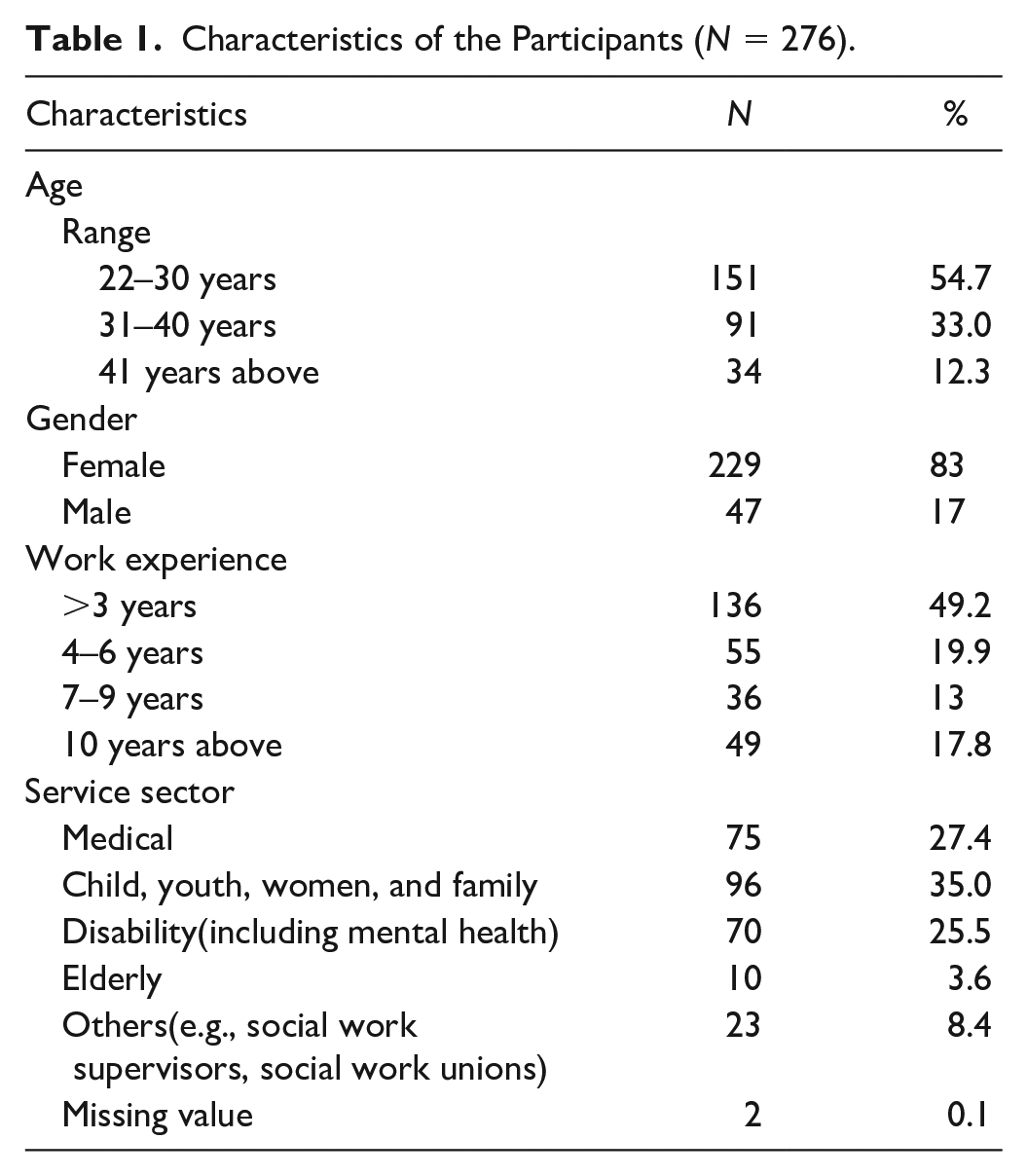
Of the 276 social worker participants, 229 participants were female and 47 were male, 151 were under 30 years old, 91 were aged between 31 and 40 years, and 34 were over 40 years old (Table 1). Around one third (n = 104, 38%) claimed that they had received training related to human rights, two thirds (n = 169, 61%) claimed they had not, and 108 claimed they had experience in engaging in social or political protests. The mean score for the SJS-TW was 135.01 (standard deviation [SD] = 15.16), which indicated that overall, the participants had positive attitudes toward social justice. The mean scores and standard deviations for each scale item are presented in Table 2.
Characteristics of the Participants (N = 276).
Means and Standard Deviations for the SJS-TW.
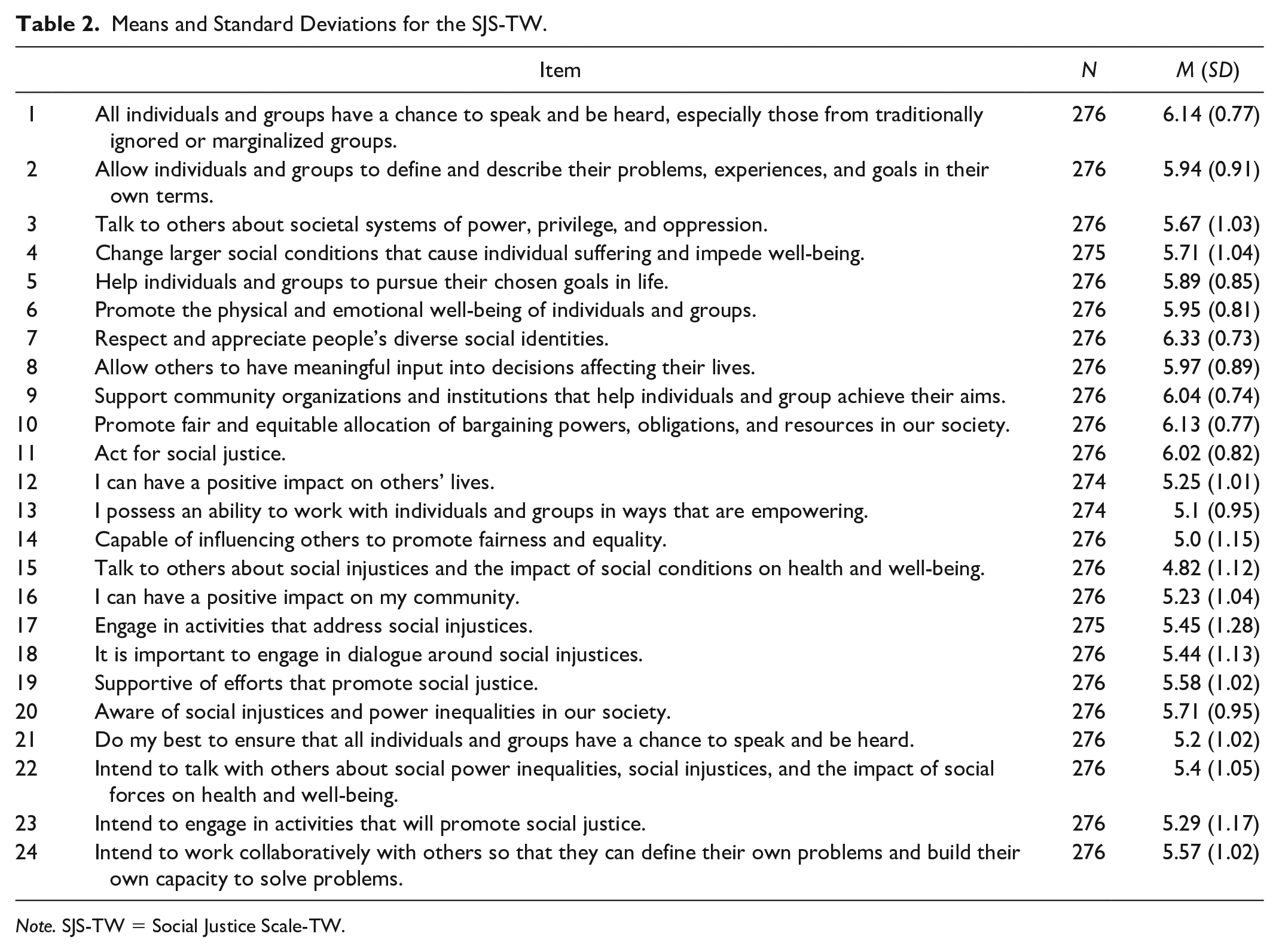
Note. SJS-TW = Social Justice Scale-TW.
To investigate the factor structure, an EFA was performed on the SJS-TW data. The Kaiser–Myer–Olkin Measure of Sampling Adequacy (KMO) was used to determine whether the SJS-TW data were likely to factor well. The KMO statistic must be 0.60 or higher to proceed with factor analysis; therefore, in this case, as the KMO was 0.93, the four dimensions (social justice attitudes, social justice perceived behavioral control, social justice subjective norms, and social justice behavioral intentions) of the SJS-TW were found to account for 64.98% of the variance. The SJS-TW’s internal consistency reliability was also found to be acceptable (Cronbach’s alpha = .94).
Structural equation modeling was used to examine the model fit for the four-factor model. The normed chi-square, which divides χ2 by df, should be in a 1 to 3 range, while the chi-square should have smaller chi-square values. Other indices such as Bentler’s comparative fit index (CFI), the root mean square error of approximation (RMSEA), the goodness-of-fit index (GFI), and the parsimony goodness-of-fit index (PGFI) were also examined. The RMSEA must be at or below 0.08 to be reasonable, while the values for the CFI, GFI, or PGFI should have higher values (Bagozzi & Yi, 1988). In the initial CFA model for the unidimensional SJS-TW, the χ2 to df ratio (χ2/df = 6.32) and the RMSEA (0.139) were too high. After the four-factor model for the SJS-TW data were adjusted, the first-order CFA model with four factors was found to have a reasonably approximate fit (Table 3). Good convergent validity was assessed based on composite reliability and average variance extracted (AVE), with the AVE scores needing to be higher than 0.5 (Table 4). Good convergent validity showed a high correlation between the subscale scores and good discriminant validity was analyzed based on an assumption of no correlations between the scale scores (Table 5).
SJS-TW: Confirmatory Factor Analysis.

Note. SJS-TW = Social Justice Scale-TW; RMSEA = root mean square error of approximation; CFI = comparative fit index; GFI = goodness-of-fit index; PGFI = parsimony goodness-of-fit index.
SJS-TW: Convergent Validity Evidence.
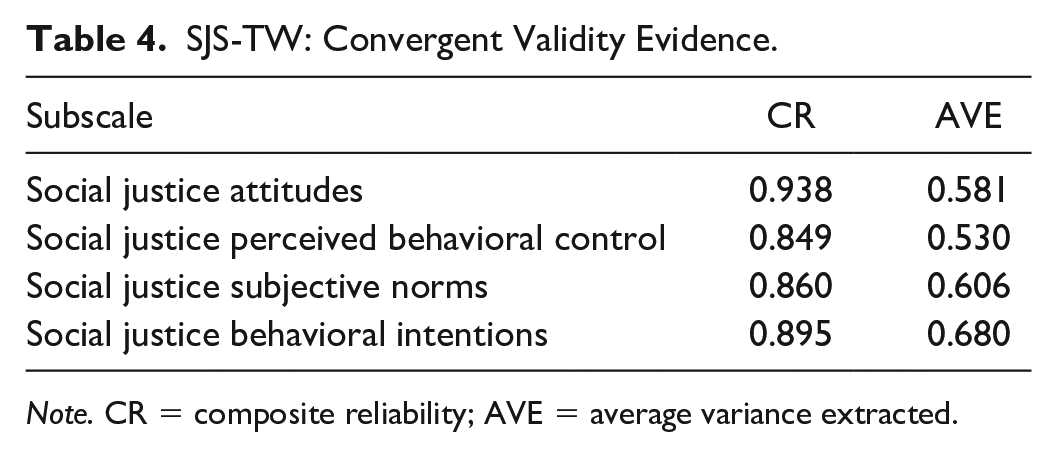
Note. CR = composite reliability; AVE = average variance extracted.
Discriminant Validity of SJS-TW.
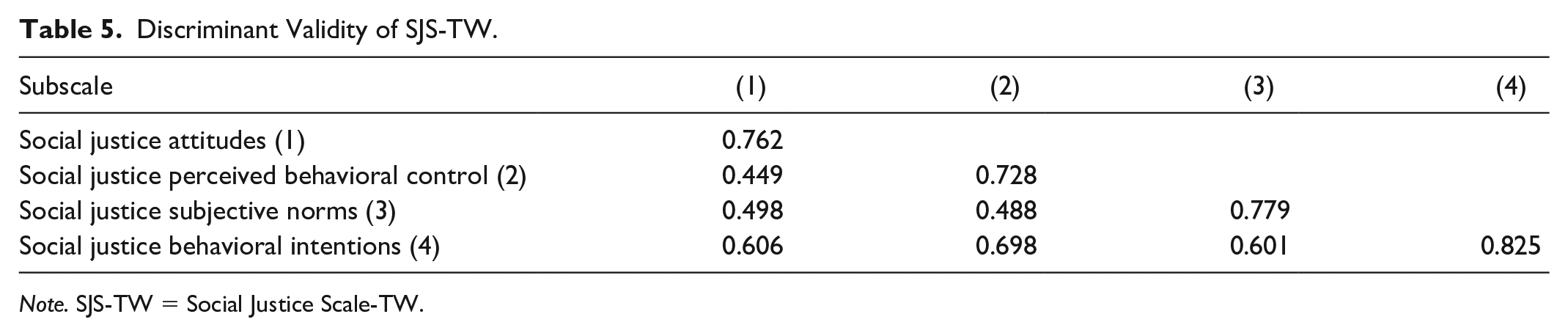
Note. SJS-TW = Social Justice Scale-TW.
There were significant differences found between the participants in terms of years of work experience (Wilks’ lambda = 0.551, p = .005, η2 = .139). Four divisions for years of work experience were made, from which it was observed that in terms of social justice attitudes and the behavioral intentions subscales, participants with more than 10 years of work experience had greater support for social justice than the other groups, F (4, 266) = 3.24, p < .05. There were also statistically significant differences between the participants with more than 10 years’ work experience on the social justice attitudes subscale (F = 3.11, p < .05) and the social justice behavioral intentions subscale (F = 4.38, p < .05).
Significant differences were also found in the attitudes toward social justice between participants who had received human rights training and those who had not, t (266) = 2.52, p < .05, Cohen’s d = 0.32. The t test, p-value test, and the Cohen’s d values indicated that there was a small to moderate practical significance; that is, participants who had received human rights training during their BSW or MSW program, or during their continuing professional development training, were more likely to promote the physical and emotional well-being of individuals and groups, t (271) = 2.11, p < .05, Cohen’s d = 0.28; to act for social justice, t (271) = 2.56, p < .05, Cohen’s d = 0.33; and to engage in activities that promoted social justice, t (271) = 3.29, p < .05, Cohen’s d = 0.43.
Statistically significant differences were also found between the participants who had participated in social protests and those who had not, Wilks’ lambda = 0.947, p = .007, η2 = .053, t(265) = 3.75, Cohen’s d = 0.47. The t test, p, and the Cohen’s d values indicated a moderate practical significance, that is, participants with social/political engagement experience reported significantly more support for social justice across all four subscales: social justice attitudes, t (268) = 2.99, p < .05, Cohen’s d = 0.37; social justice perceived behavioral control, t (267) = 2.64, p < .05, Cohen’s d = 0.33; social justice subjective norms, t (268) = 3.41, p < .05, Cohen’s d = 0.43; and social justice behavioral intentions, t (269) = 3.46, p < .05, Cohen’s d = 0.43.
Finally, the participants with social/political protest experience (n = 108) were found to be more likely to endorse the importance of acting for social justice (M = 6.24, SD = 0.70) than those without any social/political protest experience (n = 163, M = 5.88, SD = 0.87, t = 3.65, p < .001, Cohen’s d = 0.46) with a small to moderate practical significance. It was also found that those with social protest experience were more likely to engage in activities that promoted social justice (M = 5.69, SD = 0.99) than those without any social/political protest experience (M = 5.00, SD = 1.21, t = 4.90, p < .001, Cohen’s d = 0.62) with a medium to large practical significance.
Discussion
This study evaluated Taiwanese social workers’ responses to social justice through the application of the SJS-TW questionnaire. First, we found that social workers who had more work experience had significantly more positive attitudes toward social justice than those with less work experience, especially for the participants that had more than 10 years’ experience. One possible explanation for this finding was that experienced social workers were more aware of the inequalities and oppression faced by disadvantaged groups in Taiwan and were possibly more likely to identify social work as a mission and to seek job opportunities in social work settings. The results of this study demonstrated that positive attitudes toward social justice were linked to stronger social justice behavioral intentions. While social justice ideals are often espoused during social work education, practitioners need to reflect on and develop a deeper awareness of social justice ideals through their service provision.
Second, participants who had received human rights training as part of their social work studies were found to be more likely than those without human rights training to support statements suggesting they would take actions to promote social justice, including speaking with others about social injustices. This finding supported Mihr and Schmitz’s (2007) observations that human rights education was helpful not only in increasing the cognitive understanding of justice and equality but also for building an awareness of oppression and human rights abuses. This could be because a social justice orientation is inherent in social work curricula and the Code of Ethics. Social workers must both demonstrate sensitivity in empowering service users and continuously improve their social work skills to ensure better outcomes. Human rights training in social justice education gives social workers the skills to empower the oppressed. Social workers can reflect on their day-to-day practices through conversations about social systems of power and oppression with service users (Lay & McGuire, 2010; Urdang, 2010), as social service interventions in the life of service users can make oppression and the exploitation of social inequalities more visible. Self-reflection, which is a key aspect of professionalism, can deepen social worker understanding of distributive and procedural justice (Conner, 2003) and can give them the ability to weigh up relative interests and prevent harm in collective societies such as Taiwan. This study’s results therefore supported the need to include human rights training in undergraduate, graduate, and continuing education social work curricula because it is an effective tool for fostering positive attitudes toward social justice among social workers.
According to the study findings, social or political engagement was a statistically significant variable across all four subscales, and engagement in social protests was found to be important in combating social injustice and promoting social transformation. One possible explanation for this finding is that social work participants were able to advocate social justice because of their awareness of collective or structured oppression. Through their work, social workers learn to understand their own experiences, to understand the service users’ perspectives, and to empower the service users to speak candidly about their life struggles. Social workers and social work students perceive themselves to be powerful agents for social transformation and change in today’s difficult situations. This finding also reflected the paradoxes related to social justice in collective societies. For the social work profession, the social justice ideal is to prevent all people from being subjected to oppression, discrimination, and inequality from those with privilege and power within the social structures. In reality, however, social workers in collective societies such as Taiwan may not notice the multilayered mechanisms between individuals and the social structure when dealing with social problems, which means that as well as providing the needed services. Therefore, social workers need to be fully aware of the hidden societal dynamics that can affect people’s individual situations such as women often face structural injustice in Taiwan.
This study was limited by the sampling and research methods used. The sample was composed of participants who were willing to participate in this study, and as a result, generalizing these findings should be done cautiously. In addition, designing pre-tests and post-tests would have allowed for a better measurement of the changes in the social workers’ attitudes or knowledge toward the role of social justice in social work education over time. Future studies could also consider incorporating qualitative methods, as adopting different research methods could provide a more wide ranging understanding of the meaning of social justice in the various social work areas. Previous research (e.g., Parikh et al., 2013) demonstrated that believing in a just world and a certain political ideology influenced people’s desire to engage in social justice advocacy. It would therefore be useful for future studies to explore the political attitudes of social workers in Taiwan. Finally, the SJS could be used to assess attitudes toward social justice in other countries beyond Taiwan as transnational, comparative studies could help researchers better understand the broader regional and global attitudes toward social justice.
Conclusion
This study investigated social workers’ attitudes toward social justice in Taiwan and found that the majority of the participants endorsed social justice values. The differences in the participants’ attitudes toward social justice were found to be related to work experience, human rights training, and social or political engagements, which were identified as moderating factors for social justice concepts. Working in a culture that is strongly influenced by collective values, social workers in Taiwan need to consider local diversity when linking global ideas to local ideas. It suggested that the adoption of a human rights perspective in social work education had the potential to increase the social workers’ knowledge of and actions in support of social justice.
Footnotes
Declaration of Conflicting Interests
The author(s) declared the following potential conflicts of interest with respect to the research, authorship, and/or publication of this article: Part of this paper was accepted for poster presentations in the Annual Conference of Theory and Practice of Medicine and Society, Department of Medical Sociology and Social Work, Chung Shan Medical University, Taichung, Taiwan, March 28, 2015 and Social Work, Education and Social Development Conference (SWSD 2018) held by Royal Dublin Society in Dublin, Ireland, July 4–7, 2018.
Funding
The author(s) received no financial support for the research, authorship, and/or publication of this article.
