




Abstract
We present here a realist multilevel situational analysis of maternal depression. We use situational analysis to identify the interaction of mothers with social structures and the possible causal influence of those social structures on her well-being. The analysis moves from an emergent empirical approach toward the more reflexive and abductive approach of situational analysis, thus better informing our abductive reasoning and the generation of theory. Critical realism and symbolic interactionism provide the methodological underpinning for the study. The setting was South Western Sydney, Australia. Interviews of mothers and practitioners were analyzed using open coding to enable maximum emergence. Situational analysis was then undertaken using situational and social worlds/arena maps. Home and neighborhood situational analysis mapping and analysis of relations identified the following concepts: (a) expectations and dreams, (b) marginalization and being alone, (c) loss or absence of power and control, and (d) support and nurturing. The neighborhood and macro-arena situational analysis mapping and analysis of relations identified the following concepts: (a) social support networks, social cohesion and social capital; (b) services planning and delivery and social policy; and (c) global economy, business, and media. Emerging was the centrality of being alone and expectations lost as possible triggers of stress and depression within circumstances where media portrays expectations of motherhood that are shattered by reality and social marginalization. We further observe that powerful global economic and political forces are having an impact on the local situations. The challenge for policy and practice is to support families within this adverse regional and global economic context.
Keywords
Introduction
We present here the findings of a realist multilevel situational analysis of maternal depression. The purpose is to contribute to a realist theory building study that aims to explain neighborhood context, maternal depression, and the developmental origins of health and disease.
That the early years play an important role in the genesis of later adult health and disease is well recognized. Intensive efforts at theory construction seek to explain complex genetic and environmental mechanisms that interact to influence this hypothesized developmental origin of health and disease (Gluckman, Hanson, & Beedle, 2007). The environments implicated are intrauterine, the maternal–infant dyad, family and household life, and external social and physical environments (Culhane & Elo, 2005; Matthews & Meaney, 2005; Misra, Guyer, & Allston, 2003).
Postnatal depression and anxiety have consistently been demonstrated to adversely impact on maternal–infant interaction and attachment (Beck, 1995; Martins & Gaffan, 2000; Murray, Stanley, Hooper, King, & Fiori-Cowley, 1996) and subsequent child cognitive, language, behavioral, and psychological problems (Cogill, Caplan, Alexandra, Robson, & Kumar, 1986; Cummings & Davies, 1994; Downey & Coyne, 1990; Gelford & Teti, 1990; Murray, Hipwell, Hooper, Stein, & Cooper, 1996; Sohr-Preston & Scaramella, 2006). Postnatal depression may also be associated with subsequent maternal and childhood obesity (Herring et al., 2008; Surkan, Kawachi, & Peterson, 2008), not breast feed (Dennis & McQueen, 2009; Henderson, Evans, Straton, Priest, & Hagan, 2003), and maternal health harming behaviors such as tobacco and drug addiction (Cinciripini et al., 2010; Lancaster et al., 2010; Rubio, Kraemer, Farrell, & Day, 2008).
We have previously reported on individual-level psychosocial predictors of postnatal depression in South Western Sydney (Eastwood, Phung, & Barnett, 2011) and proposed that the findings were consistent with group-level socioeconomic deprivation, neighborhood environment, social networks, and ethnic diversity having causal effects on postnatal depressive symptomatology and other perinatal outcomes. That proposition is consistent with a recent qualitative study of pathways from neighborhoods to mental well-being which found that neighborhood affordability, negative community factors including crime and vandalism, and social makeup including unemployment and poverty were felt to be associated with poor mental well-being (O’Campo, Salmon, & Burke, 2009).
Theoretical bio-psychosocial (Engel, 1977), eco-social (Krieger, 2001), and bio-ecological (Bronfenbrenner & Ceci, 1994) models have made an immense contribution to our understanding of this interplay between human biology and context, but Ben-Shlomo and Kuh (2002) go further and argue that a life course approach is not limited to individuals within a single generation but “should intertwine biological and social transmission of risk across generations.” They extend the models proposed above to link across generations and to include the potential role of household, neighborhood, and national influences acting across time and individuals.
The words of a mother in our study—“each is in different circumstances anyway” challenged our view of those models by suggesting that every mother’s situation was different. The predominantly hierarchical nature of the above models may limit our attempts to understand the “deep” and “immediate” impact of personal situations on genetic, developmental, familial, cultural, social, and intergenerational mechanisms.
In contrast to the above layered conceptual frameworks, Clarke (2005, p. 72) in her work on Situational Analysis argues that
everything in the situation both constitutes and affects most everything else in the situation in some way . . . People and things, humans and nonhumans, fields of practice, discourses, disciplinary and other regimes/formations, symbols, controversies, organizations and institutions, each and all can be present and mutually consequential. Here the macro/meso/micro distinctions dissolve in the presence/absence.
We will use situational analysis here to identify the interaction of mothers with social structures and the possible causal influence of those social structures on her well-being.
Method
Critical realism and symbolic interactionism provide the meta-theory and philosophical roots for this realist multilevel situational analysis. The study reported here is part of a critical realist mixed method multilevel study that seeks to identify and explain complex perinatal contextual social and psychosocial mechanisms that may influence the developmental origins of health and disease with a focus on the role of postnatal depression (Eastwood, Jalaludin, & Kemp, 2014). The main study used various qualitative and quantitative methods, including emergent qualitative analysis (Eastwood, Kemp, & Jalaludin, 2014, 2015), non-linear principal component (Eastwood, Jalaludin, Kemp, Phung, Barnett, & Tobin, 2012) and exploratory factor analysis (Eastwood, Jalaludin, Kemp, & Phung, 2014b), visualization and cluster analysis (Eastwood, Jalaludin, Kemp, Phung, & Adusumilli, 2013), and Bayesian ecological and multilevel exploratory spatial analysis (Eastwood, Jalaludin, Kemp, & Phung, 2013, 2014a; Eastwood, Jalaludin, Kemp, Phung, & Barnett, 2013).
We have previously reported the protocol for the main study which used both Emergent and Construction Phases of a realist Explanatory Theory Building Method (Figure 1).

Phases of explanatory theory building.
The study reported here was part of the Emergent Phase where the focus is on observation, pattern recognition, abstract thinking, concept formulation, and theory generation. Three methods of theory generation proposed by Haig (2005) are Grounded Theory Method, Exploratory Factor Analysis, and Heuristics. Here, we will use the Grounded Theory method, “Situational Analysis,” as advanced by Clarke. The Construction Phase of the Main Study will use the findings of the Emergent Phase to construct a conceptual framework, theory and model. The Construction Phase methods include the following: (a) defining stratified levels, (b) analytic resolution, (c) abductive reasoning, (d) comparative analysis (triangulation), (e) retroduction, (f) postulate and proposition development, (g) comparison and assessment of theories, and (h) conceptual frameworks and model development.
Setting, Sampling, and Recruitment
The study was approved by the University of New South Wales Human Research Ethics Committee. The setting was four local government areas (LGAs) in South Western Sydney, New South Wales, Australia including communities where we had identified clusters of postnatal depression (Eastwood, Jalaludin, Kemp, Phung, & Adusumilli, 2013). The region has substantial social disadvantage, and has lower education attainment and lower income levels then other parts of New South Wales. There is a diverse multicultural population with 28.4% of the population born overseas compared with 17.8% for the rest of New South Wales. A large shopping center, from a global chain, has recently been constructed adjacent to a recently enlarged University Teaching Hospital.
Parent participants were from existing “playgroups.” The three “playgroups,” with three to seven members, were purposefully selected from (a) a community with dense housing, low socioeconomic circumstances, and high numbers of overseas born mothers; (b) a community with predominantly single dwellings, mixed ethnicity, and average socioeconomic circumstances; and (c) a community with predominantly single dwellings, low socioeconomic circumstances, and high numbers of overseas born mothers. The groups were facilitated by a research assistant. This avoided coercion and kept researcher distance. The focus group discussion asked, why there might be more or less depression in some suburbs, what the characteristics of those suburbs might be, and whether there are things at a city, state, and national level that might increase or decrease a mother’s depression. Based on emerging themes, the third focus group was asked whether communities with high numbers of ethnic groups were likely to have higher rates of depression.
Selection of participants (n = 8) for practitioner interviews was by purposeful sampling. Potential participants were identified based on gender, LGA where they worked, experience with population subgroups, professional or industry background, and emerging concepts. Interview guides for the initial interviews were as for the focus groups. The questions asked changed as analysis was undertaken and conceptual theory emerged.
Analysis
Analysis of interview transcripts involved initial open coding followed by axial and selective coding (Charmaz, 2006; Saldana, 2009). The interview transcripts were coded line-by-line and paragraph-by-paragraph. Each “incident” was coded into as many categories that it might fit during the early stages of concept and category generation to enable maximum emergence of patterns and relationships (Glaser, 1978). Constant comparative analysis was used, including across quantitative and literature analysis, to identify regularities, variations, and contrasts that would contribute to emerging insights. Situational analysis was used to provide more reflection and in-depth analysis of the discursive elements. For the purpose of this situational analysis, we used two types of maps: situational (messy and ordered), and social worlds/arenas (Clarke, 2005; Clarke & Friese, 2007). To consider the breadth of issues surrounding a situation, messy situational maps allow for the examination of all the discourses related to the situation, including those produced by individuals, groups, and institutions. The ordered situational maps frame and organize the discourses that emerge from messy maps. The social worlds/arenas maps were used to analyze individual and collective actors, key non-human elements, and the arena(s) within which they are engaged. The data for the situational maps and the social world/arenas maps were drawn from interviews, local observations, spatial studies, and from documentary sources. As observed by Clarke and Friese, the maps offered meso-level interpretations of the situation including social organizational and institutional dimensions (Clarke & Friese, 2007, p. 370).
The observations and experience of the researchers, from working in the South West Sydney community, were entered into the analysis. It is here in the situational analysis, therefore, that the researchers as clinicians and population health practitioners are able to bring to the table their knowledge of the “situation” in South West Sydney. Clarke (2005) defends this approach as follows:
The last caveat is perhaps the most radical. Researchers should use their own experiences of doing the research as data for making these maps. There is a saying in the world of qualitative inquiry that the person doing the research is the “research instrument.” I am further asserting that that instrument is to be used more fully in doing situational analyses . . . Beginning even before a research topic is decided upon, we notice and store information, impressions, and images about topic areas and issues . . . Part of the process of making situational maps is to try and get such information, assumptions, and so on out on the table and, if appropriate, into the maps. (p. 85)
Results
Home and Neighborhood Analysis
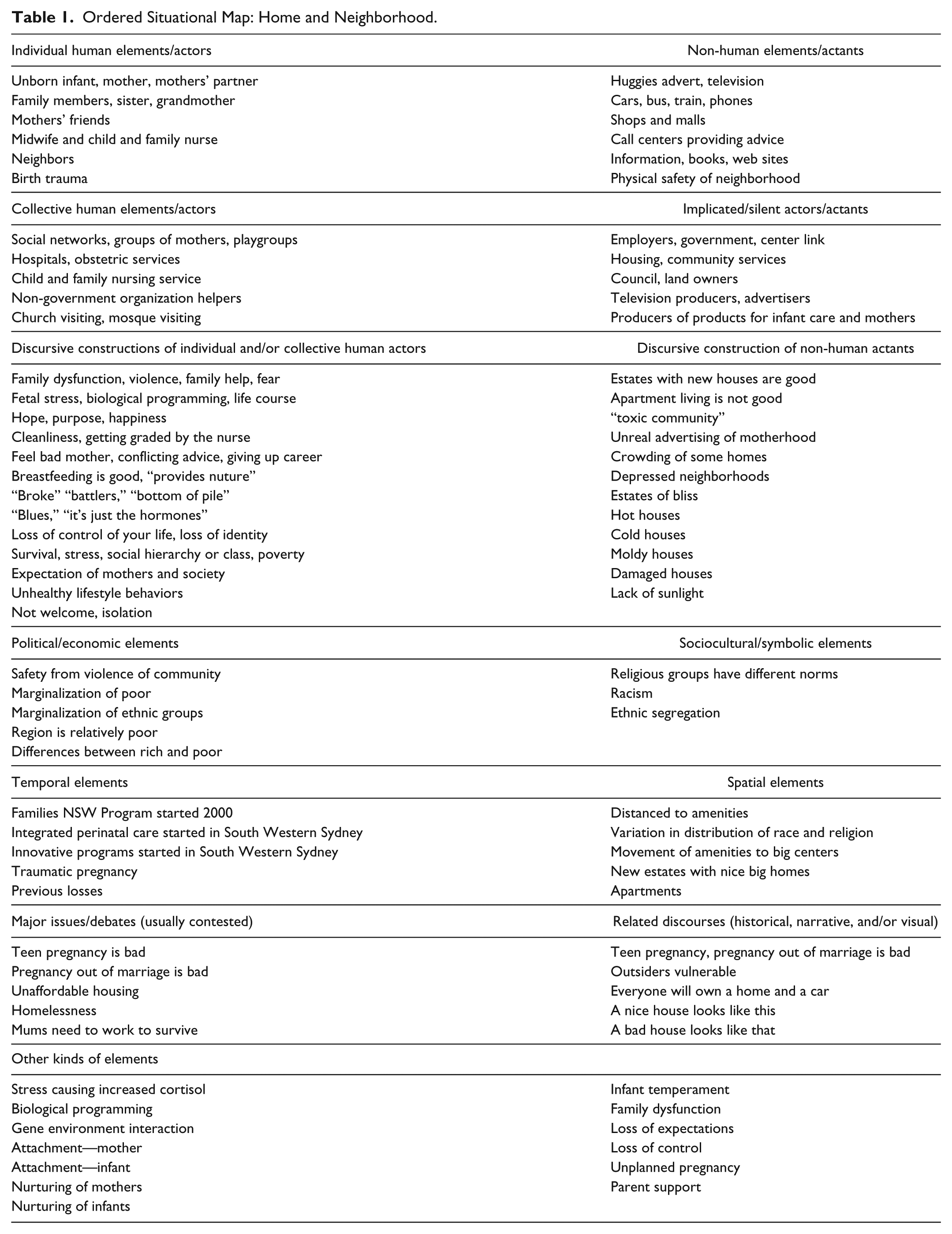
The messy working maps described by Clarke were used extensively throughout the analysis but are not presented here. The more structured maps (Tables 1 and 2) present the data in terms of the situational elements such as individual and collective human actors, silent actors, discursive constructions, political elements, spatial elements, and major issues and debates. Table 1 focuses this analysis on the mothers’ close home and neighborhood arenas, while the contribution to her situation of wider arenas, is expanded in Table 2.
Ordered Situational Map: Home and Neighborhood.
Ordered Situational Map: Neighborhood and Macro-Arena.

The home and neighborhood situational analysis mapping and analysis of relations identified the following concepts: (a) expectations and dreams, (b) marginalization and being alone, (c) loss or absence of power and control, and (d) support and nurturing.
The findings of situational analysis were then used to inform the building of the social worlds/arenas map (Figure 2) and together both analyses contributed to our findings.

Social worlds/arenas map of mothers’ home and neighborhood.
Figure 2 is the social worlds and social arenas map of mothers’ home and neighborhood. What is this map telling us? First, there is the domestic or home social arena drawn as the dotted circle with an internal light orange shade. The dotted line means that the home is permeable to multiple actions. The arena is made up of few actors: mother, baby, father, and others such as mothers’ sister, mother, midwife, visiting nurse, and friends. The home is the domain where mother and baby spend most of the day. It is here that mothers receive, or do not receive their closest emotional support. It is also here that control is lost and expectations are most manifest. Loss of control and failure of expectations may be manifest with a crying, vomit, nappies, unsettled and sick infant, unsupportive partner, and increased financial stress. The expectations are that the house, baby, and relations will be perfect. Those expectations are raised through family, friends, services, radio, magazines, and television. But it is here that expectations are sometimes lost and mothers may feel alone, unsupported, and even marginalized. The physical environment adds to stress with houses that are hot, cold, moldy, and isolated from amenities.
A second arena is the local neighborhood. In this case, it is depicted as the immediate close environment. This includes neighbors, mothers’ groups, buses, general practitioners (GPs), and nurses. Other aspects of the neighborhood arena are explored in more depth below. Important also are the attitudes of the local neighborhood to sole parents and teenage mothers. These attitudes may be influences by the cultural and religious composition of the local neighborhood or wide community.
Family is very important to most mothers. Her mother is close even when she is physically distant. The family arena can span generations and continents. With it comes culture, religion, emotional support, nurturing, and sometimes financial help. But family can also bring expectations and attitudes to sole or teenage parenthood leaving the mother unsupported and alone.
Support networks are a well-recognized determinant of maternal depression. This was supported through the focus groups and interviews with practitioners. The support network arena contains: school friends, sisters and brothers, neighbors, new friends, and mothers’ groups. Also necessary are cars and telephones. With the support networks come connections, nurturing of mothers, and not being alone. There may, however, also be expectations of parenting practices and pressures to conform. Aspects of support networks overlap with the neighborhood arena, government arena, family arena, and services arena.
The Services Arena includes a wide range of public and private services and utilities that reach into the lives of mothers and their families. There is close connection with midwives, nurses, GPs, family support workers, and mothers’ groups. The services support the provision of nurturing environments and connections. They also, however, influence and make expectations of mothers and families.
The arena for government support and policy is only lightly touched on in the map. It is clear that this domain reaches into the close lives of the family members through provision of income support, maternity and paternity leave policies. The nature of these policies reaches into the lives of the mothers who commented on the means testing of current policies pleading that all parents with babies need support. The financial stress that impacts on families appears to have its origins in higher levels of government policy. The government arena also places expectations on families which are manifest in policy requirements and expectations of parents.
Expectations and dreams
The discursive elements of the situational mapping highlighted the importance of expectations. Absent was discussion of the dreams that mothers might have. Yet implicit in comments by mothers were their dreams for the perfect baby, home, and future.
Both mothers and practitioners felt that society and mothers expected to (Beck, 1993) take home the perfect baby and that everything was “going to be fine.” The reality is often different to that portrayed in media such as the “Huggies adverts.” The shattering of dreams and expectations was described in a range of different ways.
For mothers with few resources, their hopes for the future may be dashed by the impact of the new baby on both financial and emotional resources. This may be especially true for a young woman who had plans for her life. The reality is different as expressed by one practitioner.
[Parenting] takes a great deal of emotional energy and to do it well, to be available for children and provide all their needs. Parents that are distracted by adverse environmental factors such as finance or domestic violence don’t have that energy.
For some disadvantaged parents, there may, however, be no expectations or dreams. One practitioner put it this way:
I am not sure whether it is hope or whether there is expectation . . . Expectation is the better way to put it. These people expect life to get better whereas the other disadvantaged people who have been here, may be 2nd or 3rd generation think this is it.
Mothers implied that they had been “in control” of the lives (and also their husbands) and “expected” to be in control after the baby was born. But this was not always the case and several mothers when speaking of the “loss of control” implied that this was not their expectation of how motherhood was going to be. With the birth of the baby planning ahead was no longer possible.
Society has expectations of what a “good mother” will be like as discussed in relation to the “Huggies Advert.” One practitioner felt that some mothers “don’t think they are doing a good job.” Mothers agreed with this expectation. Some spoke of expectations raised by helping services such as midwives. One mother talked of the stress associated with the nurse visit:
Now I have to get myself ready, make sure I don’t look like I have . . ., so they don’t think I am a bad mother.
Discussion about the home visit also focused on expectations related to “you are not bonding with your child and you are expected to,” and “I am going to be graded . . . please don’t put me in the high risk.”
One practitioner spoke of “career women losing it.” Several practitioners agreed with the mothers who had spoken of the shattering of expectations of what motherhood would be like. One practitioner put it like this:
Career women that have been working, who have had high expectations when they have been working high achievers in their career, suddenly with a baby thing are crashing in on top of them and it is not going the way they want.
Marginalization and “being alone”
The situational analysis and social worlds/arenas maps confirmed and strengthened the importance that marginalization and isolation may play. The earlier analysis (Eastwood et al., 2015) had identified the category of marginalization and isolation and linked it to “not belonging,” poverty, access, language, culture, single parenthood, community safety, and living in new neighborhoods.
Examination of the social worlds map drew attention to the situation that may be experienced by most mothers. Buried in the voices of the mothers were stories of “being alone” with the crying infant, with an absent partner, mother, or other support friend. Sometimes, mothers spoke of not being able to get out seeing their friends. They spoke of how important the phone call from the nurse was. The descriptions were powerful and suggested that this situation is experienced by many mothers. The link between “being alone,” “depression,” and partner support is clearly apparent in one mother’s story:
I go then, thank God Matt’s with me. So he can give me the hug, during the night when I am so depressed. That mental help as well. Just Matt going. “It is ok. I am home. I can relieve you. Go have a shower.”
Her related comment was, “I think a single parent . . . I don’t know how they do it?”
Loss of power and control
The initial analysis identified mothers’ “loss of control” as contributing to the development of depressive symptoms. That analysis identified three subcategories related to personal relationships, birth of a new baby, and conflicting advice.
Also evident in the discursive elements of the situational analysis was the lack, or absence, of power that mothers have. This lack of power may extend to families with children and those who work to support them. One practitioner commented that
there are some women who have social expectations which are well above what the society can let them have.
When discussing mothers in ethnic communities, one practitioner spoke of the lack of power that mothers may have in relation to themselves and their baby.
and lots them they don’t have the individual strengths to stand for what they want or they don’t know how to form their own judgement—what is best for their child or they even have the power. But lots of them . . . they don’t have the power to say that is what I want for my child.
The “loss of power” is also implicit in comments about career women who were high achievers with high expectations when they were working
suddenly with a baby and things are crashing in on top of them and it is not going the way they want. They don’t have the social support [and] they don’t know the people in the neighbourhood . . . I guess they lock themselves in to a mental state where they need some help.
The loss of control may therefore be also associated with a loss, or absence of power. We will explore the possible role of power below.
Support and nurturing
Support of mothers was identified in the earlier analysis as a strong emerging protective theme. That analysis drew on the findings of not only the interviews and focus groups but also systematic reviews of perinatal depression literature and the exploratory data analysis. The social world/arena maps highlight the potential breadth of this support within neighborhood and home environments. The term nurturing was previously used to describe the care of the infant. The concept of nurturing can be broadened to encompass the care and protection of the mother and family unit. The situational analysis map was silent on a discursive element related to nurturing families. We will revisit the concept of nurturing below.
Neighborhood and Macro-Arena Analysis
Table 2 focuses this analysis on the mother’s neighborhood and macro-arenas. The neighborhood and macro-arena situational analysis mapping and analysis of relations identified the following concepts: (a) Social support networks, social cohesion, and social capital; (b) services planning and delivery and social policy; and (c) global economy, business, and media. As previously mentioned, the findings of situational analysis were then used to inform the building of the social worlds/arenas map.
Figure 3 is the social worlds and social arenas map of mothers’ neighborhood and macro-arenas. What is this map telling us? First, there is the domestic or home social arena that was explored above. That arena remains central to this analysis and is made up of few actors: mother, baby, father, and others such as mothers’ sister, mother, midwife, visiting nurse, and friends. The home is the domain where mother and baby spend most of the day. It is important to again note that there may be expectations, loss of control, loneliness, and poor connection to support. The immediate neighborhood arena was also discussed in above. It is here that physical and local social aspects of the environment may impact on mothers. There may be mothers’ groups, buses, and services available but for some these are absent. The neighborhood may feel unsafe or friendly and this may affect mothers’ willingness to leave the home.

Social worlds/arenas map of mothers’ home, neighborhood, and macro-arena.
The Map illustrates two other possible neighborhood arenas. One of these has a “nice” local village, library, community hall, and nice-looking homes and physical environments. There is no comment about ethnicity because most people are “Aussie.” The other neighborhood arena has mixed ethnic peoples and is known as a “drug capital” with high levels of crime, distrust, and perceived lack of safety. Those neighborhoods are polarized images of suburbs in South West Sydney.
The expert arena has universities that historically have been physically distant from the community although their experts worked closely with the neighborhood arenas. The expert arena is closely overlapped with the policy and services and social cohesion arenas. These are two areas where universities have been active. Big expert hospitals are in the expert arena with maternity services closely associated. Antenatal classes are close to the hospitals while mothers’ groups are imbedded in local neighborhoods. The expert voice is strong, and South West Sydney has a history of providing expert leadership in innovative services and programs.
The Mall plays an important role in the lives of all who live and work in the city and community arena. The Mall is designed for cars and may not always be mother and baby friendly. The Mall is associated with “big business,” media, glamour, and expectations of what might be. The Mall has replaced the Town Centre as the place to go to meet friends and “hang out.” Absent from the Community Arena are “community gardens” and league teams. There are, however, League Clubs and fast food outlets. Football teams are emerging. The community has a poor bus and train service making it difficult for mothers to get to The Mall. Important in this arena are jobs. South West Sydney jobs are vulnerable to changes in global economic fortunes.
Dominant is the policy and services arena. Previous analysis (Eastwood, Kemp, & Jalaludin, 2016) highlighted the importance of access to services and the important role that supportive government policy plays. South West Sydney has large public housing estates and relatively poor access to services. Services are not equitably distributed or delivered as evident in a visualization of access to nursing services (Eastwood, 2011). GP services are described as a “cottage” industry in many disadvantaged neighborhoods. There are few mothers’ groups, and most antenatal classes are held at the hospitals. Federal and State policy plays an important role in the lives of the families in South West Sydney where the term “battlers” is used to describe the daily struggle of families.
Global and local economics play a powerful role in the lives of families. As illustrated in earlier media, advertisements raise expectations for families a similar phenomenon to the impact that The Mall may have on some families. There are stark differences in wealth not only between North and South West Sydney but also within local communities. Parts of South West Sydney were settled by the Gentry of New South Wales and that history still divides the region. The power of Big Business to shape lives was illustrated in the voices of local practitioners and mothers. The loss of local League teams and community gardens are two examples.
The neighborhood and macro-arena social worlds/arenas map is traversed by the Social Cohesion Arena. Social cohesion and its related concepts of social networks and social capital have a positive influence on families and maternal depression. The voices of mothers, practitioners, and our quantitative analysis (Eastwood, Jalaludin, Kemp, Phung, & Barnett, 2012; Eastwood, Jalaludin, Kemp, Phung, Barnett, & Tobin, 2012), all suggest the protective influence of support and social integration. Global forces are increasing the migration of peoples of different ethnic and cultural backgrounds to South West Sydney. The diversity of peoples is a feature of most South West Sydney suburbs. Previous quantitative studies have found that postnatal depression is associated with mothers not being found in Australia and the spatial studies indicated that rates of depression are higher in suburbs with ethnic segregation (Eastwood, Jalaludin, Kemp, Phung, & Barnett, 2013).
Social support networks, social cohesion, and social capital
Support and nurturing of mothers was identified as a strong emerging protective theme. That analysis also identified that family, services, policy, and support networks all played a role in providing a nurturing environment. The above confirmed the importance of community-level social support networks, social capital and ethnic integration. All of these concepts point toward the role of connectedness or social cohesion as being protective of mothers.
The situational analysis confirmed these findings and suggested that current matters of ethnic segregation, diversity, and integration were part of a broader idea of social cohesion. Important historical elements were identified in South West Sydney related to the phases of settlement and identity. Silent in the data is the historical settlement of Macarthur by land owning gentry and the role that the Nepean River played in dividing social Class. In contrast to the close nit Macarthur communities, other parts of the region have large migrant communities and new public and private housing estates with varying degrees of social cohesion and social capital. The situational analysis suggests that both economic and policy forces play an important role in shaping the level of social support available to mothers.
Services planning and delivery and social policy
Initial focused coding identified group-level access to services and supportive social policy as key concepts in protecting mothers from postnatal depression. The situational analysis confirmed their important role and suggests that they are linked. The division between them probably related to the hierarchical nature of policy and service delivery in the Australian context. The mothers were clear that income support, nurse phone calls, and mothers’ groups all contributed to supporting them when they felt “out of control” or depressed. Although practitioners had clearly played an important role in the region, their contribution was silent in the data. Drawing on our own knowledge and experience, we placed the expert arena between influencing policy and service delivery and strengthening social cohesion.
Global economy, business, and media
Finally, it is clear from the data that the influence of the global economy, big business, and media reaches through all levels of the Social Arenas to impact significantly on the situation for mothers and infants. Related are earlier findings that included “being broke,” economic marginalization, occupational class, absence of power and control, and the generation of expectations and dreams. Strong global economic forces are also responsible for movement of migrants and refugees to the region of South West Sydney, Sydney, Australia. Some are economic migrants while others are from past and present conflicts. Local jobs are vulnerable to global economic fortunes, and the landscape of local communities are influenced as much by the planning decisions of Big Business as they are by planners and policy makers. Thus, local communities have peoples who once fought each other living side by side.
The “Huggies” comment by one mother drew attention to the important role played by media and advertising in the ordinary lives of mothers. The role that media might play in raising the expectations of mothers was previously discussed. Related are the pressures put on families by images of large five-bedroom homes (McMansions), four-by-four wagons to drop the kids off at school, and the glitter of advertising and merchandise in “The Mall.” Our earlier analysis also included the comment on the impact to the local community of losing the local League team as a result of a media-related franchise agreement.
Discussion
Psychological stress has long been recognized as certain cause of depression (Avison, Aneshensel, Schieman, & Wheaton, 2010; Brown & Harris, 1978; Kinderman, 2005; Stone, Lin, & Quartermain, 2008). The role of explanatory research is to identify the, often unobserved, mechanisms that trigger or maintain the experienced phenomenon. Emerging from our home and neighborhood situational analysis are two central mechanisms:
Lost Expectations
Being alone
Buried in the voices of the mothers were stories of “being alone” with the crying infant, with an absent partner, mother or other support friend. Sometimes mothers spoke of not being able to get out to see their friends. The descriptions were powerful and suggested that this situation is experienced by many mothers. We agree, therefore, with Beck (1992, 1993, 2002) that depressed mothers experience an “incongruity between expectations and the reality of motherhood,” a sense of pervasive loss, and loneliness.
The centrality of these two themes is further supported by the neighborhood and macro-arena situational analysis where powerful economic and media forces had further isolated mothers and families in neighborhoods that were economically disadvantaged with crime, violence, poor transport, and either ethnically segregated or isolating for minorities. The Mall was associated with “big business,” media, glamour, and expectations of what might be.
One hallmark of critical realist analysis is the ontological assumption that reality consists of hierarchically ordered levels where a lower level creates the conditions for a higher level (Danermark & Gellerstedt, 2004). The stratified realist ontology is not, however, in conflict with Clarke’s (2005) view that “everything in the situation both constitutes and affects most everything else in the situation in some way.” Danermark and Gellerstedt (2004) argue that “in reality levels are entwined and [the] mechanisms could be supporting each other or counteracting each other, and the outcome in a specific context is the result of a very complex interplay between levels and mechanisms.” Possible structures, mechanisms, contexts, and outcomes are shown below based on the findings from the Situational Analysis and Emergent Theory Generation presented here (Table 3).
Analytical Levels of Depression and Context.

The findings of this analysis will contribute to the mixed method theory generation undertaken for the Emergent Phase of the main study. The subsequent Theory Construction Phase undertook abductive triangulation of this and other studies to construct a conceptual framework, theory, and model (Eastwood et al., 2016).
Limitations and Strengths
Mothers were interviewed at a mothers’ group. Consequently, those mothers had experience of support from a mothers’ group. They placed strong importance on the importance of the groups for establishing and maintaining support networks. One mother noted that support networks may include family, friends, and neighbors. The mothers who attended the groups were not themselves from socially disadvantaged backgrounds, and few mothers were from non-English speaking backgrounds. The number of mothers’ groups interviewed was limited in this study to three which may limit generalizability. Despite these limitations, the qualitative data were rich and contributed significantly to both theory generation and later theory construction. It was notable that the findings from this qualitative study are similar to those found by Beck in both her original phenomenological (Beck, 1992) and grounded theory (Beck, 1993) studies and her later meta-synthesis (Beck, 2002). Here, however, we have contextualized the findings within broader social structures and contexts.
The qualitative methods used in this realist situational analysis included interviews and focus groups with qualitative analysis. The strength of these approaches is their ability to provide explanatory power to the analysis (Sayer, 2000) and thus the identification of causal mechanisms. Sayer notes, however, that the “concrete patterns and contingent relations [identified] are unlikely to be ‘representative’, ‘average,’ or ‘generalizable’.” Assessment of the quality of qualitative studies is assessed using criteria that differ from those used for extensive quantitative studies (Cohen & Crabtree, 2008; Greenhalgh & Taylor, 1997; Kitto, Chesters, & Grbich, 2008; Miyata & Kai, 2009). The criteria proposed by Kitto and colleagues were used to assess the quality of the current study. The procedural rigor was made explicit through clear articulation of the ontological and epistemology position informing the study which then informed the emergent and explanatory study design, methods of data collection and analysis. The sampling techniques used were purposeful and sought to include subjects from different communities, and ethnic backgrounds. Reflexivity was maintained by acknowledging our theoretical perspectives, values, and prior knowledge. Distance from the subjects was achieved by intentionally engaging a research assistant to conduct the parent focus groups. We sought to “bracket” our prior understanding, maximize the use of open coding, and thus allow understanding of phenomena to emerge from the voices of the informants (Creswell, 1998).
The use of qualitative methods for emergent theory building was suited to the aim and objectives of this study which was to explain the mechanisms by which circumstances influence developmental and life course outcomes with a focus on perinatal depression. Emergent theory building methods such as those used here are also consistent with accepted critical realist methodologies (i.e., grounded theory). We were not able to identify where situation analysis had been previously used for critical realist theory building but, as a symbolic interactionist methodology, its use within a critical realist epistemology is appropriate (Maxwell, 2012, p. 10).
Conclusion
We presented here the findings of a realist multilevel situational analysis of maternal depression. The analysis moved from an emergent empirical approach toward the more reflexive and abductive approach of situational analysis, thus better informing our abductive reasoning and the generation of theory. Critical realism and symbolic interactionism provided the methodological underpinning for the study. We undertook a qualitative study of three mothers’ groups and eight practitioners. Interviews of mothers and practitioners were analyzed using open coding to enable maximum emergence. Situational analysis was then undertaken using situational and social worlds/arena maps.
The theoretical concepts identified included (a) expectations and dreams; (b) marginalization and being alone; (c) loss or absence of power and control; (d) support and nurturing (e) social support networks, social cohesion, and social capital; (f) services planning and delivery and social policy; and (g) global economy, business, and media.
Emerging was the centrality of being alone and expectations lost as possible triggers of stress and depression within circumstances where media portrays expectations of motherhood that are shattered by reality and social marginalization. We further observe that powerful global economic and political forces are having an impact on the local situations. The challenge for policy and practice is to support mothers and their families within this adverse regional and global economic context.
Footnotes
Declaration of Conflicting Interests
The author(s) declared no potential conflicts of interest with respect to the research, authorship, and/or publication of this article.
Funding
The author(s) received no financial support for the research and/or authorship of this article.