




Abstract
It is important that before entering primary school, the child’s phonological awareness is supported by a variety of different activities whereby phonological awareness is based on a well-developed hearing ability. Hearing is part of the musical activities that support/encourage phonological awareness with the development of rhythmic and melodic music listening. In this article, we aimed to investigate the effects of musical activities derived from the methodological system of Edward Willems on phonological awareness through a quasi-experimental study with 70 children aged 4 to 7 years. Thirty-five of them received 1 hr of music instruction per week for 6 months (experimental group) and the other 35 children received no such musical support (control group). We tested each child’s phonological awareness at the beginning of the music program and after 6 months. The results of the analysis of covariance showed that there was a statistically significant difference in phonological awareness between the experimental and control groups in favor of the experimental group. The results of the research confirmed that musical activities based on the methodological system Edgar Willems are a good and effective means of promoting phonological awareness, especially in early childhood.
Keywords
Introduction
A very important role in social and economic development has been attributed to the development of reading in recent decades (Christmann et al., 2015; Costa et al., 2016). Phonological awareness is most strongly associated with reading skills (Costa et al., 2016), especially with decoding (Hogan et al., 2005; McKenna & Dougherty Stahl, 2015; Swank & Catts, 1994; Vellutino et al., 2004). Wren believes that decoding ability includes “digit knowledge, lexical knowledge, letter knowledge, knowledge of the alphabetic principle, phoneme awareness, and concepts about print” (Wren, 2001, p. 43), while Scarborough adds “sight recognition of printed words” (Scarborough, 2001, p. 3).
Phonological awareness assessment provides information about reading in kindergarten but loses its predictive power at the second grade. At that time, phonological awareness and word reading become so highly correlated that phonological awareness does not add information to the prediction of fourth-grade reading. (Hogan et al., 2005, p. 285)
Good readers have a greater capacity for phonological awareness, whereas poor readers have many problems in the area of phonological awareness (Mitchell & Fox, 2001). Recent Slovenian studies (Jenko, 2016; Šimnic, 2016) have shown that phonological awareness is also one of the most important factors in the development of reading literacy among students with intellectual disabilities.
Music training encompasses a wide range of brain functions, going from sound encoding to higher cognitive functions. There is clear evidence that music training induces functional and structural changes in the auditory and sensorimotor systems, which in turn increases accuracy in music-related tasks. (e.g., Herholz & Zatorre, 2012; in Flaugnacco et al., 2015, p. 2) The fact that music shares several cognitive functions with other human abilities, such as language, raises the intriguing possibility that musical expertise may transfer to other domains that are not purely musical. (Tallal & Gaab, 2006, in Flaugnacco et al., 2015, p. 2)
Shapiro and Solity (2008) confirmed that training phonological awareness improves the decoding skills of all students, not just those at risk of reading problems. Many researchers have been interested in the significance of musical skills for the development of phonological awareness (Lamb & Gregory, 1993; Douglas & Willats, 1994). Lamb and Gregory (1993) and Anvari et al. (2002) also conducted a study of the correlation between reading and music skills and phonological awareness skills in 5-year-old children. They found that children with high scores in a pitch recognition test had the best scores in phonological awareness and reading tests. Parallels between the development of musical and (pre)reading and (pre)writing skills were also found by Hansen et al. (2004).
Moreover, musically trained children i) are better at recognising pitch and envelope changes in speech, ii) show higher vocabulary and reading skills, iii) are more efficient at segmenting a new language (i.e., word extraction from a continuous flow of sounds), and iv) show overall improved verbal intelligence compared to children who do not receive music training. (François et al., 2013 in Flaugnacco et al., 2015, pp. 2, 3; Magne et al., 2006; Moreno et al., 2009; Moreno et al., 2011) A psychological approach to emotion and music therefore seeks an explanation for how and why we experience emotional reactions to music, and how and why we experience music as expressive of emotion. (Sloboda & Juslin, 2001, p. 71)
Sloboda (2000) believes that a possible hypothesis is that people are likely to ascribe the emotion they detect within the music to themselves at those points where their general level of music-entrained arousal is highest, and other sources of specific emotion are not obtruding or interfering at the same moment. (p. 227)
Phonological Awareness
Phonological awareness is most often defined as an awareness of and sensitivity toward the sound structure of the individual’s native language (Jurišić, 2001). Some authors (Anthony & Francis, 2005; Pfost, 2015; Stanovich, 1986; Thomson & Jarmoulowicz, 2016; Wagner & Torgesen, 1987) use the term phonological awareness to refer to the ability to recognize and manipulate the sounds occurring in language (e.g., the search for rhyme, the combining of syllables, and counting the number of sounds in a word). The development of phonological sensitivity ranges from longer and concrete sound units (e.g., words and syllables) to smaller sound units (e.g., the initial sound in the word, rhyme) and the smallest sound units, that is, phonemes (Chard & Dickson, 1999). Therefore, the phonological awareness of the child ranges from a simple operation of audio processing to more complex operations: rhyming, separating sentences, separating and mixing syllables, separating and mixing the beginning and end, and separating and mixing individual phonemes (Chard & Dickson, 1999).
Phonological awareness is also defined as one of the key processes of phonological processing (Jerman, 2000). Phonological processing refers to “a wide range of activities that increase the sensitivity of the individual to sounds and the use of these sounds in words” (Pečjak, 2010, p. 28).
Research in the field of phonological awareness (Wagner & Torgesen, 1987) defines phonological processing as having three interrelated abilities: phonological sensitivity, phonological memory, which refers to the sound information from the child’s short-term memory and allows/enables the user to maintain the current associative relationship between the letters of the word and the sound pattern of the word, and phonological naming, which “includes the ability to retrieve sound information from long-term memory by naming individual words or word sequences” (Pečjak, 2010, p. 29). These two abilities increase the ability to decode (Goodwin & Ahn, 2013; Hulme & Snowling, 2009; Melby-Lervåg et al., 2012; Pan et al., 2011; Pečjak, 2010). The phonological process is closely related to the development of reading and writing skills; this is the case for English (e.g., Lonigan et al., 2000; Snowling, 2001; Torgesen, 2004) and for the other alphabetical languages (Branum-Martin et al., 2012). The close connection between phonological processing and the development of literacy has increasingly been reflected also for non-alphabetic languages (e.g., He et al., 2005; Kidd et al., 2015).
Encouraging the Development of Phonological Awareness
Children do not develop the abilities of sound analysis and other abilities of phonological awareness spontaneously; on the contrary, “phonological awareness can be developed through carefully planned instruction, and this development has a significant influence on children’s reading and spelling achievement” (Ball & Blachman, 1991; Bryant & Bradley, 1985; Byrne & Fielding-Barnsley, 1989; O’Connor et al., 1993 in Chard & Dickson, 1999, p. 262). Therefore, children should receive a great deal of high-quality early support in the field of reading literacy. A lack of phonological awareness skills frequently indicates specific reading difficulties (e.g., dyslexia and dysgraphia), often resulting from lower level auditory processing deficits (Pasquini et al., 2007, p. 260).
Difficulties with detecting or manipulating sounds in words are responsible for problems in learning to read, so the child’s experiences with oral language are significant in developing phonological awareness, which is strongest during the period when a child learns the alphabetic code (knowledge of letters in the alphabet). This usually takes from one to three years, depending on the orthographic transparency of the written language. (Vaessen, 2010, in Grofčíková & Máčajová, 2017, p. 46)
Furthermore, “perceptual learning mechanisms, e.g., learning linguistic sounds, require direct social interaction in order to be effective” (Goswami, 2015, in Grofčíková & Máčajová, 2017, p. 52).
Kjeldsen et al. (2003) examined the effects of phonological awareness training in preschool children and concluded that there was progress in phonological awareness skills and that consistency and continuity of training was more important than quantity of training. The well-planned content of the early literacy program in schools and kindergartens and the level of parental awareness of home literacy skills are therefore crucial for the development of phonological awareness in young children.
Music and Phonological Awareness
It has been argued that “music and language have fundamental underlying similarities both formally and psychologically, which makes it fruitful to undertake comparative studies of the two skills” (e.g., Sloboda, 1977).
The theoretical findings and results of empirical research show that music training enhances phonological awareness (e.g., Degé & Schwarzer, 2011; Gordon et al., 2015; Gromko, 2005; Moritz et al., 2013). McMullen and Saffran (2004) put forward a domain-general learning mechanism for language and music. /. . ./ They argued that “both domains rely on the same learning mechanisms, namely, the extraction of an abstract set of rules through statistical learning, in order to form “native” sound categories. (Patscheke et al., 2018 p. 6)
Several studies have shown that musical perceptual skills correlate with phonological awareness and reading skills, and may also be predictive of preschoolers’ reading development (Anvari et al., 2002; Goswami et al., 2013; Huss et al., 2011).
To be able to assign a single stimulus to the same or different categories (e.g., phonemes, pitch), children must perceive and differentiate this stimulus (Patel, 2003, 2008).
With increasing age, children are becoming aware of and are able to distinguish even subtle nuances within a category (e.g., same rhythms from different sources or similar combinations of phonemes from different speakers) as well as differences between categories (e.g., differences between two different rhythms or two different phonemes). (Kempert et al., 2016, p. 3)
Patel suggests that there is an overlap of common brain networks between speech and music, which are especially trained because music production demands high precision. Furthermore, musical activities have high emotional reinforcement potential, which stimulates these brain networks repeatedly and requires a certain attentional focus. Patel claims that these processes are responsible for the good performance of musicians in speech processing. (Patel, 2008, in Miendralzewska & Trost, 2014, p. 5)
Koelsch and Siebel (2005, p. 582, in Morley, 2014, p. 158) note that there is a common nervous basis because “it appears that the human brain, at least at an early age, does not treat language and music as strictly different areas, but treats language as a special case of music.”
The results of research examining the effects of the performance of an intensive music program on the development of phonological awareness speak in favor of using music/activities to promote the development of phonological awareness (Bolduc, 2009; Degé & Schwarzer, 2011; Gromko, 2005; Herrera et al., 2011).
Degé and Schwarzer (2011) carried out a music program and a program training phonological awareness with preschool children and compared the effects of the two programs. The measurement of the results took place at the beginning and end of the programs. Both groups made significant progress in phonological awareness skills, especially in the area of identifying larger phonological units (e.g., rhymes, separation/analysis, and mixing/combination), whereas this kind of progress did not occur in a control group.
Gromko (2005) investigated the impact of music training on phonological awareness.
He found that in 5- and 6-year-old children, musical activities promote the development of auditory perception, which has a direct effect on the ability to separate words into sounds. Moreover, Bolduc (2009) conducted a similar program with 5-year-old children and found that the intensive implementation/performance of a music program (e.g., singing, improvisation, graphic recording of music) influences phonological awareness, especially the recognition/identification of syllables, sounds, and rhymes. Herrera et al. (2011) demonstrated that training phonological awareness through musical activities with a special focus on singing songs is even more effective than the usual training of phonological awareness in early childhood. A song is a synthesis of the development of various musical elements (rhythm, melody, harmony) and the text message, which is very engaging for children.
The authors assessed musical abilities (production and perception) and precursors of reading (phonological awareness, working memory, and rapid retrieval from long-term memory) in 55 preschoolers (27 boys). Results showed that phonological awareness, working memory, and rapid retrieval from long-term memory were related to music perception as well as to music production. (Degé et al., 2015, p. 1)
Encouraging the Development of Phonological Awareness Through Musical Activities According to Edgar Willems
In Slovenia, research has been carried out on the effects of a particular music methodological system on the development of phonological awareness. In music pedagogy, the methodological system indicates a comprehensive/holistic approach to specific music education based on teaching practice in accordance with the philosophical framework, and on global and specific goals/objectives that are put into practice (Pesek, 1997). The most commonly used music methodological systems in Europe and worldwide are those of Carl Orff, Emil Jacques Dalcroze, and Zoltán Kodály. “While Kodaly focused on vocal, i.e. choral, training with the use of onomatopoeia as a form of associative medium, Orff’s approach was based primarily on movement, speech and making music on percussion instruments” (Göktürk 2012, in Bačlija Susić, 2017, p. 90).
Unlike Kodaly’s and Orff’s conceptions of music pedagogy, in which the guiding points were singing and rhythmic speech, Jaques-Dalcroze began with body movement. /. . ./ He developed eurhythmics, a system of learning music through natural body movement that enables rhythm training. (Bačlija Susić, 2017, p. 90)
Eurythmy sought to find a balance between mind and body, consciousness and spontaneity in the expression of rhythm (Anderson, 2012). Reciting rhymes and chants with a rhythmic sound pattern helps students to identify rhyming words and the division of syllables (Hansen & Bernstorf, 2002). Less known is the methodological system of Edgar Willems (Cozzutti et al., 2014; Damaceno, 1990; Frega, 1995).
According to the Willems method, children attend music lessons once or twice a week for varying lengths of time depending on their level and circumstances (available time and place). As an ideal timeframe, Willems suggested 60 min for the first level, 75 min for the second level, and 90 min for the third level, as the content is very extensive. The first part of the lesson is designed for auditory education. First of all, the child must learn to listen and to create a moment of silence within him/herself. In developing listening, Willems believes that pitch can depend on three important skills: auditory perception, emotional response to what is heard, and analytical, conscious listening. The second part of the lesson concerns rhythmic education. Rhythm represents the element that is the most physical and therefore the most primary. Like sound, rhythm represents an element prior to music; both are the precursors of actual music. This part of the lesson focuses on the awakening and development of the rhythmic instinct. The songs that are performed in the third part of the lesson are the first global element of music education, with an emphasis on the beauty of singing. Song is a synthesis of various musical elements (rhythm, melody, harmony) and the text message; it is the focus of each lesson, regardless of the level of the lesson. The fourth part of the lesson includes natural body movements, with special attention devoted to the development of tempo. The aim of this part of the lesson is for the child to feel the measure and nature of the specific musical content and to coordinate its physical expression with the music (Tomac Calligaris, 2004; Willems, 1996).
Willems’ approach encourages or develops sound analysis through the development of melodic and rhythmic listening, as well as through singing songs (Tomac Calligaris, 2004).
Musical hearing is very important for the language acquisition and fluency of children with speech disorders and delays in speech and language development.
Children with developmental dyslexia have specific problems with reading and spelling that cannot be accounted for by low intelligence, poor educational opportunities, or obvious sensory neurological damage. A core difficulty in developmental dyslexia is the accurate specification and neural representation of speech. (Goswami et al., 2002, p. 10911)
Goswami et al. (2002, p. 101911) showed “significant differences between dyslexic and normally reading children, and between young early readers and normal developers, in amplitude envelope onset detection.” “Dyslexia, in particular, has been associated with more general auditory processing deficits” (Brandt et al., 2012, p. 8). “Dyslexic children may also be less sensitive to the amplitude modulations in speech (and other sounds) than normally developing children” (Goswami et al., 2002, in Brandt et al., 2012, p. 8).
Because sensitivity to rise time and perceptual centers is essentially sensitivity to the rhythm of language, dyslexic children are predicted to have difficulties with rhythmic tasks. In fact, dyslexic children do have trouble speaking in time with a metronome, tapping in time with a metronome, rhythm perception (saying whether two rhythms are the same or different), and tempo perception. (Goswami et al., 2002; Huss et al., 2011; Overy, 2000 in Brandt et al., 2012, p. 8)
Aim of the Research and Hypotheses
In this study, we wanted to investigate whether musical activities according to Edgar Willems have an impact on the development of phonological awareness. Therefore, our hypothesis is that children who attend musical activities according to Edgar Willems once a week will achieve statistically significant higher scores on a test of phonological awareness skills than children who do not participate in music lessons.
Method
The quantitative research approach and the descriptive and quasi-experimental method were used.
Sample
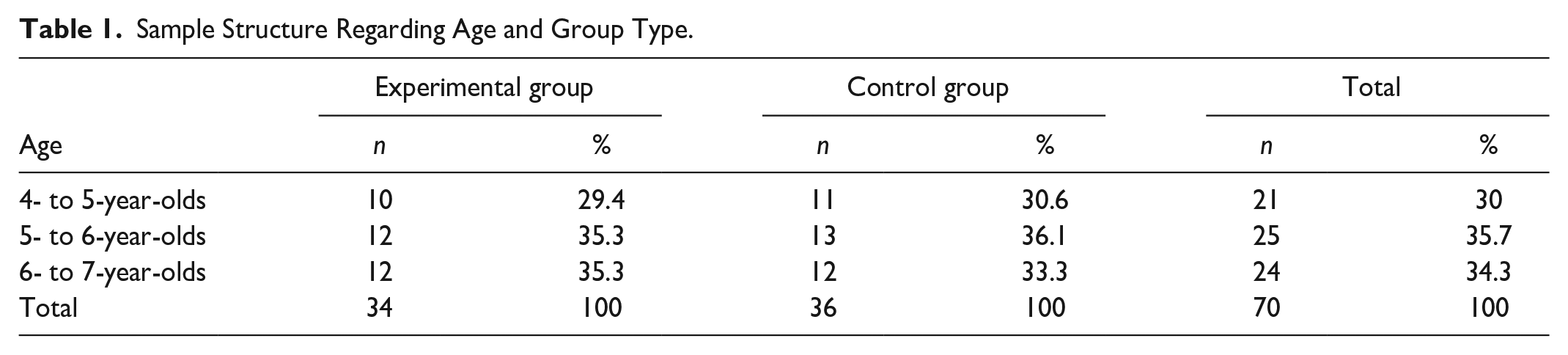
A total of 70 children aged 4 to 7 years participated in the study: 38 (54.3%) boys and 32 (45.7%) girls.
The participants were divided into two groups of approximately equal size. The first group (i.e., the experimental group) consisted of 34 children (51.4%), with an equal number of boys and girls. For a period of 6 months, the experimental group participated in a music introduction program according to Edgar Willems. The control group consisted of 36 children (48.6%)—15 girls (41.7%) and 21 boys (58.3%)—who were not included in this type of program. The entire sample was divided into three age categories to facilitate understanding of the developmental stage of phonological awareness. The children of preschool age were further divided into the categories of 4- to 5-year-olds and 5- to 6-year-olds, while the primary school children were placed in a separate category of 6- to 7-year-olds.
Sample Structure Regarding Age and Group Type.
Measuring Instrument
The test of phonological awareness by Simona Ažman (2011) was used to test the abilities of phonological awareness. The test examines the different levels of phonological awareness in the order in which the abilities of phonological awareness appear, that is, from those developed earlier to later abilities. The test has very good measuring properties. The levels of phonological awareness verified in the children and the number of points that can be achieved in each task and in the whole test are shown in Table 2.
Levels of Phonological Awareness and Number of Possible Points in Each Task.

For most of the tasks, the evaluation of the answers was carried out according to the instructions of the test author. The answers were recorded in writing on a prepared evaluation sheet, which is an integral part of the experiment. Each correct answer was awarded 1 point. A wrong answer, the absence of an answer, or the answer “don’t know” was given 0 points. If the child answered incorrectly, we were not allowed to correct it (according to the manual).
Regardless of the child’s correct or incorrect answer, we continued with the tasks until we got to the end of the test. The maximum number of points that could be achieved in the tasks varied: In most cases, it was 5 or 10 points, but in the sixth task (searching for the words with a specific phoneme), the child could score as many points as listed with the phoneme /P/. Both in the individual tasks and in the test as a whole, a higher score indicates a more highly developed ability of phonological awareness. The results show a deviation in a certain range, which can help us to further train the abilities of phonological awareness. For the test used in our research, there are not yet any standards (nonstandardized test); to achieve this, a larger sample of the child population would be required.
Data Collection and Implementation of the Music Introduction
Before conducting the test, we obtained written permission from the principals of the participating kindergarten, primary school, and music school. We also obtained the permission of parents for their children to participate in the survey. Participation was voluntary and anonymous. All the data received were processed at the group level and used exclusively for the purposes of this survey. The entire process and the completion of the survey were carried out in accordance with the ethical rules and standards of scientific research.
The test of phonological abilities was carried out with each of the children in the premises of the participating kindergarten, primary school, and music school, where there were no disturbing elements. We required 20 to 45 min to perform the test, depending on the age of the child. For younger children (4–5 years), we needed about 30 to 45 min, while the test took 20 to 30 min with older children (5–6 years, and 6–7 years). After each task, the child must be given clear instructions and the necessary tools to complete the next task (Task 4: searching for rhymes, and Task 7: describing the words with a specific phoneme). The majority of the tasks include two examples enabling us to verify the child’s understanding of the instructions.
The children were tested twice: first, at the beginning of the implementation of the music introduction (September/October 2017), and second, after a period of 6 months (February/March 2018). The same test was used in both cases. In the period between the first and the second test, the experimental group participated weekly in the music introduction program according to Edgar Willems, which includes a 60- to 90-min music lesson, depending on the age of the child. Slovenian and foreign folk and art songs suitable for preschool and school children in terms of music and content were used. Some of the songs were original (Edgar Willems) and were intended for learning musical-didactic content (songs in two to five tones, songs for learning intervals, songs for developing rhythmic listening). Each music lesson offers work on the four major topics that represent special musical skills: listening, rhythmic education, poetry, and natural body movement. The music introduction program was conducted by trained music teachers with a Willems teaching diploma who teach at the Music Edgar Willems Center. The preschool children (4- to 5-year-olds and 5- to 6-year-olds) in the experimental group received a total of approximately 23 hr of musical activity according to the music introduction program, while the primary school children received approximately 34 hr due to the extended work program (1.5 hr per week).
Procedure for Statistical Treatment of Data
The collected data were statistically analyzed using IBM SPSS Statistics. The arithmetic mean and the standard deviation of the numerical variables were calculated, and the normality of the distribution of the variables was tested using the Shapiro–Wilk test. The assumption about the effect of the (quasi-)experiment was tested by the analysis of covariance (ANCOVA), in which we examined whether differences in phonological awareness were evident under the influence of the independent variable music introduction. Phonological awareness was a dependent variable that included all 11 levels of phonological awareness. The analysis included as covariates the variables age and initial measurement (i.e., the results of the test of phonological awareness before the performance of the music introduction, observed in both groups). All assumptions for the proper application of the covariance analysis were examined and ensured.
Results
Based on the observed differences in the mean values of the initial measurement of phonological awareness in the children we had divided into the control and experimental groups, we performed an analysis of variance for independent samples. The results showed that there were statistically significant differences in the initial measurement between the experimental group (M = 44.50, SD = 14.33) and the control group (M = 34.31, SD = 18.05; F(1, 68) = 6.798, p = .011), which means that there were systematic differences in the level of phonological awareness in the groups even before the intervention was performed. Based on the observed differences in the mean values of the initial measurement of phonological awareness in the children who are in the three age groups, we performed an analysis of variance for independent samples.
The results showed that there were statistically significant differences in the initial measurement between the age groups (one group of 4-year-old children, M = 27.90, SD = 11.25; one group of 5-year-old children, M = 36.16, SD = 15.37; one group of 6-year-old children, M = 52.42, SD = 14.28), indicating that before the intervention, the age groups differ in the level of phonological attention. Due to the differences between the groups in the initial measurements, the variable initial measurement was included as a covariate in the analysis. Similarly, based on the performance differences of the children of different ages, the variable age group was included as a covariate in the analysis.
Results of the Covariance Analysis.

The results of the covariance analysis showed that there was a statistically significant difference in phonological perception between the experimental group and the control group tested at the end of the intervention. This means that with the intervention in the form of the music introduction according to Edgar Willems in the experimental group, we statistically significantly influenced the existing changes in phonological awareness, also taking into account the differences in age and the initial abilities in phonological awareness, F(1, 66) = 6.170, p = .016,
With regard to the difference in the corrected mean values of the experimental group (M = 53.01, SE = 1.43) and the control group (M = 47.91, SE = 1.38), that is, with regard to both covariates, the groups differ in the test performance of phonological awareness by 5.1 points (the absolute difference). Taking into account the size of the effect of these changes (standardized difference) achieved by the intervention, it can be concluded that the change in phonological awareness is medium strong (
Discussion
The results of the covariance analysis, which took into account differences in age and initial phonological awareness abilities, showed that there were statistically significant differences in performance in the test of phonological awareness between the experimental and control group at the final measurement in favor of the experimental group. Thus, we have confirmed our research hypothesis that children who participate in the music introduction according to Edgar Willems once a week will have statistically significantly higher scores in the test of phonological awareness skills than children who do not participate in music lessons.
These findings are in line with the results of several similar studies (Bolduc, 2009; Degé & Schwarzer, 2011) that examined the effects of introducing a music program on the abilities of phonological awareness in preschool children and showed a significant impact of musical activity on promoting the development of phonological awareness. To interpret the results of our survey, however, it is important to understand some of the differences between these studies and our study, which are evident in the implementation of the music program and the sampling method. The programs conducted by both Bolduc (2009) and Degé and Schwarzer (2011) were more intensive compared with our program (daily practice of musical activities over a short period of time) and were conducted on a random sample with a similar demographic and socioeconomic background. As a result, the larger and more pronounced differences in phonological awareness skills at the end of the measurement in favor of the experimental group were due solely to the implementation of the music program.
In our case, such an intensive implementation program was not possible because the children in the experimental group were following the public music introduction program implemented in the music school that participated in our research, which is based on a single 1-hr music lesson per week. Despite the less intensive music program, which was conducted over a period of 6 months, analysis of the results revealed a statistically significant effect of conducting musical activities on the development of phonological awareness.
The main difference between our study and the research of Bolduc (2009) and Degé and Schwarzer (2011) is that when the skills of phonological awareness were first measured in these two studies, there were no statistically significant differences in phonological awareness skills between the experimental and control groups, nor were there differences with regard to age, sex, IQ, and socioeconomic status (SES). In our case, however, the results of the variance analysis already showed (in the initial measurement of the skills of phonological awareness) that there were statistically significant differences between the experimental and control groups, indicating that the groups differed systematically in the skills of phonological awareness before the intervention was carried out. For this reason, we had to use covariance analysis in which we included the initial measurement of phonological awareness as the covariate, and this was taken into account in the final analyses. Due to the fact that the sample consisted of children of different ages (4–7 years), the differences in the skills of phonological awareness resulting from aging or normal development were finally considered as covariate. It was also found that the differences in the initial phonological awareness skills had a much greater impact on the final outcome of phonological awareness skills than the age of the participants.
If we wanted to investigate which musical abilities contributed to the better result in certain stages of phonological awareness and to what extent, it would be necessary to test the musical abilities of the children both at the beginning and the end of the implementation of the music program. Due to the lack of these data, progress in certain areas cannot be reliably attributed to individual musical abilities. Based on the results, however, we can be sure that musical activities—as holistic activities that intensively develop the child’s auditory attention and rhythmic and melodic pitch—have a positive influence on the development of phonological awareness and can therefore be an effective tool for its promotion from preschool onwards.
Limitations of the Study and Suggestions for Further Research
While administering the phonological awareness test with children of different ages and processing the data, we encountered certain methodological challenges, mainly in the following areas: the complexity of the test, the sample, and the factors influencing phonological awareness skills. Despite the deletion of two more challenging tasks, the test still proved to be slightly too demanding for some of the 4- to 5-year-olds, whereas it was slightly too easy for some of the 6- to 7-year-olds.
The main limitation of our study was the sample size, which might have partially influenced some of the results. Moreover, we did not explicitly survey and record some factors regarding the children that also have a significant impact on phonological awareness skills. These are, for example, the child’s general intelligence, bilingualism, SES, parents’ education, and the promotion of early literacy at home and in kindergarten or school (teaching and learning).
Because the incentives children receive in the preschool years are particularly important for literacy development, further research could examine more closely the influence of sociocultural factors on the development of phonological awareness. Such research could examine how often early literacy activities are used by preschool teachers and by parents at home and what kind of activities are used. It could also investigate whether preschool teachers and parents are aware of the importance of phonological awareness for literacy development, and in what ways they promote it. We would also be interested to know whether they use musical activities and to what end. We could focus especially on at-risk groups of children who come from lower SES families and bilingual environments, as well as children from immigrant families, who need a lot of stimulation in the area of language and early literacy.
The music introduction program could also help children with speech and language disorders. To confirm this, children with speech and language disorders could also be included in the study. To this end, we could assess the children’s speech and language skills and observe their progress in performing musical activities.
We could compare the effect of implementing two different programs on the development of phonological awareness skills, with one experimental group of children implementing a program of musical activities and the other group implementing a phonological awareness training program. The benefits and deficits of the respective programs could subsequently be analyzed. At the same time, a control group could be included to monitor the effects of the programs and the children’s progress.
In addition, it would be interesting to investigate the degree to which different numbers of hours of musical activity affect the quantity and quality of phonological awareness.
Conclusion
Phonological awareness occupies a special place in the development of children’s early literacy and school literacy, as it predicts performance in the preschool period at a later stage of reading acquisition. Both phonological awareness and musical activities are based on orientation in the sound environment, and this requires good listening skills (Božič et al., 2007). The development of phonological awareness takes place in a certain order, corresponding to the age of the child and his or her cognitive development. Its development should be encouraged, and the effects of a number of internal and external factors should be taken into account. The possibilities for its promotion date back to the preschool period, when parents, preschool teachers, teachers, and other professionals dealing with children (speech therapists, special needs teachers for rehabilitation) can use musical activities as an effective means of promoting the development of phonological awareness.
An insight was provided into the results of the different age categories by the finding that the development of reading and writing skills is an individual and linear cognitive process that occurs in a specific order corresponding to the age of the child and his or her cognitive development. Children come to school from a wide variety of social, cultural, and linguistic backgrounds. They are ready for reading and writing when they reach a certain level of social, cognitive, graphomotor, pre(reading), and pre(writing) skills (Marjanovič Umek, 2010).
The combination of the two types of learning is an advantage that is achieved through an individual form of learning. First, it is possible to conduct music lessons before phonological training. There is no evidence that normal phonological training would be effective before the age of 5 to 6 years, and attempts to commence progressive phonological training in the penultimate year of kindergarten (Rothe et al., 2004) show a small size of the effect in 5-year-olds compared with 6-year-olds. However, we can plan music learning in such a way that it requires a lower level of language skills than phonological training. This offers the possibility of earlier intervention. Second, the combination of different learning approaches with different content can increase the overall attractiveness of learning and capture the diversity of children’s interests, which can have a positive effect on the commitment and motivation of teachers and participants (Forgeard et al., 2008; Moritz et al., 2013).
A more systematic and conscious introduction of musical activities in the preschool period would give all children a better starting point for learning to read and write at school. Considering the importance of phonological awareness for children’s early reading and writing skills, the results of our research confirm that promoting the development of phonological awareness with musical activities according to Edgar Willems is a valuable preparation for the child’s learning to read and write (Wang et al., 2018). Musical activities can be used as an alternative approach to promoting the development of phonological awareness or as a complement to phonological awareness training. In both cases, it is important to ensure a challenging environment that offers the child a variety of written activities to promote emerging reading and writing skills, takes into account the paradigm of the child’s maturity in reading and writing, and understands learning to read and write as a process that combines a variety of factors (internal and external), each of which is causally linked (Bodé & Content, 2010).
Research Data
sj-docx-1-sgo-10.1177_21582440211021832 – Research Data for Supportive Development of Phonological Awareness Through Musical Activities According to Edgar Willems
Research Data, sj-docx-1-sgo-10.1177_21582440211021832 for Supportive Development of Phonological Awareness Through Musical Activities According to Edgar Willems by Darija Skubic, Blažka Gaberc and Janez Jerman in SAGE Open
Footnotes

References
Supplementary Material
Please find the following supplemental material available below.
For Open Access articles published under a Creative Commons License, all supplemental material carries the same license as the article it is associated with.
For non-Open Access articles published, all supplemental material carries a non-exclusive license, and permission requests for re-use of supplemental material or any part of supplemental material shall be sent directly to the copyright owner as specified in the copyright notice associated with the article.
