



Abstract
Family-focused early learning programs aim to assist parents in supporting their young children language and literacy development. This study examined program access and learning opportunities for diverse families across a wide range of community-based settings in one eastern Canadian province. As well, the study examined practitioners’ perspectives on issues related to program development and implementation. Primarily through surveys, practitioners provided data on more half of all community-based programs in the province. The findings of the study showed that most programs offered a form of parent and child focused drop-in play as the core of their programing. Few programs offered a more formalized parent-facilitator learning component as is sometimes found in other jurisdictions. The issues and challenges in programing identified by practitioners included attracting participants, maintaining funding and expanding program activities, and staff training to expand and enhance programing to meet the needs of families. These issues are discussed in light of current public policy and practice.
Keywords
Introduction and Purpose of the Study
This paper, surveying family literacy program practitioners, investigates the opportunities for families in one Canadian context to engage in programs to support children’s early learning and issues in program implementation. A number of theoretical models, further informed by empirical evidence, suggest that such program opportunities are helpful for supporting children’s learning in the early years. Vygotsky’s social development theory (1978) posits that children learn from their interactions in the social environment. In the life of the young child, the home environment is the most critical social setting in which such interactions take place. Studies have found, for example, that children acquire knowledge of language(s) through interactions with their parents, at home (Bornstein et al., 2020; DeLoache & DeMendoza, 1987; Kan et al., 2020; Kluczniok & Mudiappa, 2019; Moerk, 1985; Moerk & Moerk, 1979; Ninio & Bruner, 1978). According to Vygotsky’s (1978) theory of the zone of proximal development, parents’ fine-tuning of the level of language complexity and cognitive strategies parents use in speaking with their children can promote children’s internalization of these skills and strategies. Similarly, according to Bruner’s scaffolding theory (Wood et al., 1976), parents’ tutoring and scaffolding behaviors can help children focus on the task at hand and keep them motivated in the learning process. An empirical study by Wheeler (1983) also showed that mothers tended to adjust their language so that it was age-appropriate for their children. In sum, children can learn language and conceptual knowledge from fine-tuned interactions with their parents, at home. Families are diverse; cultural, linguistic, socio-economic, and geographic variations influence not only parent-child interactions in the home, but also the ways in which the broader educational community responds to families and their educational needs. Community-based family-focused learning programs are one educational resource that diverse families may draw upon.
Family-focused early learning programs aim to foster parent-child interactions to benefit children’s learning, especially in the domains of language and literacy development (Anderson & Morrison, 2007; Doyle & Zhang, 2011; Reese et al., 2010; Wasik & Van Horn, 2012). Exposure to oral language and print has long-lasting implications for reading development (National Institute of Child Health and Human Development, 2010; Snow, 1994) and impact not only academic success, but overall well-being across the lifespan (Barnett, 2000; Fuligni et al., 2003). Family-focused early learning programs—a type of family literacy program focusing on young children’s learning—draw from socio-cultural models of early learning (Bronfenbrenner, 1986; Cazden, 1983; Taylor, 1983) emphasizing that significant others in the lives of children are important in influencing their development. These programs also draw from the field of cognitive psychology, focusing on the influence of early experiences on children’s cognitive development (Adams et al., 1998; Bus & van Ijzendoorn, 1999; National Institute of Child Health and Human Development, 2010). Programs aiming to maximize the potential of the years before school entry have been implemented in many countries including Australia, the United States, Canada, and the United Kingdom (Carpentieri et al., 2011; Wasik & Van Horn, 2012). Research suggests that such programs can support parental learning and enhance children’s literacy development (Chow et al., 2008; Sharif et al., 2003). Where multicultural and multilingual diversity is evident, such diversity can be used as a program resource. This is important, since, for programs to engage parents and support them in scaffolding their children’s language development, cultural relevancy must be taken into account, and communication norms and practices need to be recognized and valued as tools for learning (Faircloth & Thompson, 2012; Scott et al., 2012).
In past decades, periodic scans (Kennedy, 2008; Thomas et al., 1998) offered a picture of program models and brought to the forefront issues in program implementation in Canada. This provided much needed information for informing practice and guiding future research. Since these reviews, the loss of federal funding to literacy agencies and organizations has been substantial, resulting in the closure or reduction some of these agencies and impacting how family programing is supported, in Canada (Shohet, 2012). While international research on family literacy program models and programmatic issues continues to evolve (Ihmeideh & Al-Maadadi, 2020; Rabkin et al., 2018; Swain & Cara, 2019), there is little current research addressing these topics in the Canadian context. Our study aimed to gauge the nature and availability of family-focused early learning opportunities for a diverse range of families within one Canadian context, and identify issues experienced by the community-based organizations offering these programs. Our findings illustrate current program models Canadian families can avail of, and highlight implementation issues raised by practitioner organizations. Thus, this Canadian perspective contributes to and updates the broader international picture on programs, practices and issues in the field of family-focused early literacy programing.
Context of the Study and Review of the Literature
In Canada, Family Resource Centers (FRCs) and other community-based organizations have offered family-focused early learning programs for decades; however, funding ebbed and flowed over the years (Kennedy, 2008). Establishment of the National Literacy Secretariat (NLS) within a federal ministry in 1988 marked a highlight in Canadian family literacy programs, providing national recognition and resourcing of family literacy programing. Until its demise in 2007, the NLS played a major role in funding programs and research, heightening the national profile of the family literacy movement (Shohet, 2012). Despite the loss of a federal ministerial base, family-focused early learning programs continue to be offered, but with numerous challenges. Unlike countries such as the US and the UK with federal departments of education, Canada’s education system is governed at the provincial and territorial level. Thus, the “funding pot” for education programs varies with each jurisdiction’s policies and fortunes. Since family literacy programs are seen to operate outside of the core functions of school systems funded through provincial departments of education, they typically do not benefit from a provincial education “policy home,” nor are they usually supported with the funds budgeted for schools’ “normal” operations.
With respect to targeting families and criteria for family participation, while some organizations are purposefully located in areas in which there is greater socio-economic need, an “open door” access policy is typical, in Canada. This means that access to participation is based on parental interest, not on risk assessment as is sometimes more typical in other jurisdictions. Such a disposition toward program access is influenced by the historically grassroots-inspired origins of early literacy programs in Canada, rather than being driven by federal policies aimed at poverty reduction, more typical, elsewhere (Thomas et al. (1998).
In Newfoundland and Labrador, the province where the study was conducted, program funding has varied. Until recently, matters of early childhood education (ECE) programing fell under the jurisdiction of the department of social services (now the department of Children, seniors and social development). In an effort to align ECE with the educational system, a new division created within the Department of Education is responsible for educational aspects of regulated childcare. This division also supports policy and programing initiatives that intersect with community organizations that offer early literacy programs involving parents and their children (Government of Newfoundland and Labrador, n.d.). Federal and provincial government funding has typically been provided for core operations of some organizations such as FRCs that may provide family-focused early learning programs. This core funding helps to provide for the costs of buildings, staff, and programing. Some federal departments, such as the Public Health Agency of Canada, also provide funding to FRCs for health and well-being programs for children (Public Health Agency of Canada, 2017). Over the years, the provincial government funded early learning program initiatives through an annual grants competition. This competition was open to FRCs and other groups proposing to fill a perceived gap in local program opportunities, such as regional literacy councils and Community Centers affiliated with the provincial public-housing authority. Although funding was aimed at projects to be carried out as “one-time” offerings, some applicants successfully received funding over a number of years (Government of Newfoundland, Department of Education, 2004).
Financial or in-kind support from sources including churches, service groups, local businesses, and corporate entities with connections to communities has also been used to help get programs off the ground (Kennedy, 2008; Thomas et al., 1998). This pattern of programing and funding, typical in Canada, has been referred to as a “patchwork approach” (Balla-Boudreau & O’Reilly, 2011; Thomas et al., 1998). In the province in which the study was conducted, the government suspended the grants program in 2009, pending a review. In 2014 it piloted a program in public libraries for families with young children; however no full-scale program has been forthcoming following the pilot completion. Given the current funding and political context, it has been difficult to easily gauge family learning program opportunities in the province or determine what issues practitioners currently experience. Organizations with databases documenting family learning programs across Canada, for example, COPIAN (n.d.), and in the province in which the study was conducted, for example, Literacy Newfoundland and Labrador (CBC News, 2015), have continued to suffer cutbacks and have closed due to lack of government funding. Provincial government websites provide some information about program locations (Government of Newfoundland and Labrador, Department of Education and Early Childhood Development, 2020a), but not program information. Where organizations’ websites exist, they do not always provide detailed or current information.
The province is which the study took place is relatively large—405,000 km2 (156,000 miles2)—comprised of an island and larger area on the mainland of Canada. It has a population of about 520,000 (Government of Newfoundland and Labrador, Community Accounts, 2020b). Loss of work in traditional occupations, primarily fishing and logging, has resulted in increasing urbanization or out migration; nevertheless, the remaining population is quite dispersed, providing unique challenges for program access. This study provides a contemporary perspective on the diverse responses of community organizations to meet the needs of families across a range of communities within this Canadian setting.
The families living in communities served by these organizations do not largely vary, linguistically. The most recent census indicates that about 95 % report that English is the language “most often spoken at home”, with the remaining families speaking Innu/Montagnais, French, Inuktitut, and other languages (Government of Newfoundland and Labrador, Community Accounts, 2016a). Nearly 85% are of United Kingdom/Western European descent, with the remaining groups largely represented by people of North American Aboriginal origins—First Nations, Inuit, Metis—as well as people of Asian and African origins (Government of Newfoundland and Labrador, Community Accounts, 2016b). Nonetheless, diversity is conceptualized much more broadly than ethnicity and language alone. For example, conceptualizations of diversity in an education context also encompass variations in children’s temperament, family structure, and other neurological, societal, and human factors (Katz, 2012). Diversity also include differences in ability, culture, age, gender, sexual orientation, or religious background (Adams et al., 2007). The families in this study are diverse with respect to personal- and community resource availability. These families served by the programs in the study live in communities varying in population from less than 100 to urban areas of over 100,000 people. Given the vast geographical span, access to educational resources varies greatly. Community size and proximity to larger communities greatly influences family access to educational resources. Some of the communities in which programs operate, for example, serve families who live well over 160 km from a public library in spite of numerous library locations in the province (Newfoundland and Labrador Public Libraries, 2020). While some library resources, such as e-book, are available electronically, other library learning resources, such as the children’s story time program, are not accessible to these families, due to distance. The families living in communities served by organizations in our study also vary substantially by personal family resources, such as income. As measured by median family income, across these communities, family income ranged from $23,400 for single-income families to $106,400 for dual-income families (Government of Newfoundland and Labrador, Community Accounts, 2020c).
Methods
A mixed-method research approach was employed in the study. Surveys of program practitioners were used as the primary source of data collection as well as a small number of interviews, where survey respondents were available. This study utilized both content analysis and descriptive statistics to analyze the data collected.
Participating Organizations
Through an internet search for community organizations relevant to the scope of the study, 43 community organizations potentially offering programs, such as FRCs and Community Centers, were identified and recruited to participate in the study through a mail-out invitation to each organization’s director. FRCs offer programs and services to families across a variety of domains such as health and education. They are designated as “Family Resource Centers” or “Family Resource Programs” (FRPs) by the provincial government, and are listed on the province’s Department of Education registry of resources for families. They are also typically members of the Canadian Association of Family Resource Programs. Community Centers, although having a similar function to FRPs, differ, in that, they were created primarily to serve neighborhoods with high concentrations of public housing, as part of the mandate of the provincial housing authority.
Data Sources: Survey and Optional Interview
We reviewed the nature and scope of published surveys and reports with a similar focus (Balla-Boudreau & O’Reilly, 2011; Kennedy, 2008). Our 16-question survey adapted survey items and added others to address the 3 specific foci of our inquiry (see Appendix). These were: organizational characteristics of program providers, the nature of the programs offered (e.g., aims, content, and activities), and issues in implementing programs and planning for the future. The survey queried these areas using three types of response: 1. short answer—such as the program name, as well as quantifiable information such as age of child participants, 2. forced choice—such as whether the program operated in a dedicated space or used a shared space, and 3. open-ended questions—such as why a program was adopted or suggestions for improving future programing. The survey was posted to a well-known online survey platform. It was also made available in hard copy to participants to return by mail. An invitation to participate further in an in-person or telephone interview was extended to participants. Four participants indicated willingness to be interviewed; of these, two followed through with the interview. The interview format followed the survey questions but provided participants with opportunity to elaborate. The survey data were collected between fall 2016 and spring 2017. Interviews were conducted in spring 2017. All procedures in the study were conducted in accordance with the ethical standards of the institutional ethics committee. Consent forms were signed and obtained from the participants before they provided data, and the anonymity of participants was protected.
Data Analysis
Where applicable, short answer questions were categorized; for example, organizations were categorized according to type (e.g., FRP or Community Center). Frequencies by category were noted, as were frequencies for forced choice categories. The open ended questions were analyzed using an open coding method (Patton, 2002), which is one process of content analysis. To support reliability of the analysis, two coders worked independently noting key words in each response. These were compared, and differences were discussed and resolved. Then, each coder independently categorized key words; again, categories were discussed and any differences resolved. For responses yielding a large number of initial categories, categories were collapsed; for example, books given to families, handouts for parents, and newspaper subscriptions were all categorized as “resources for families.” These data and continuous data, such as number of participants, were entered in a dataset. We examined frequencies or means for responses by category, where applicable, to aid analysis of descriptive statistics. We coded the interviews using the same method as used for the survey responses. Where these provided additional data from the participants, it was included for analysis.
Results
The results are organized as follows: 1. Community-based organizations, 2. Program Planning and Implementation, 3. Issues and Challenges in Program Development and Implementation, and 4. Recommendations of Practitioners for Future Programing and Implementation.
Community-Based Organizations
Of the 43 potentially operational organizations contacted, we received 16 survey responses—many from organizations with multiple sites; thus, the 16 respondents represented 89 sites in total—58% of the total number of sites potentially offering programs in the province. Of the 16 survey participants, 11 worked in FRCs, and 3 were employed at Community Centers affiliated with the provincial public housing authority and located in neighborhoods in which substantial numbers of people resided in public housing. The remaining two participants worked with community development organizations focusing on lifelong learning and poverty reduction and offering family-focused early learning programs through affiliations with local partners including FRCs. Regarding their role in their organization, nine participants identified themselves as executive directors or managers of the organization, six as program coordinators, and one as a family resource worker responsible programing. The 16 programs were located in urban and rural communities with populations varying from less than 100 to just over 100,000 (Government of Newfoundland and Labrador, Community Accounts, 2020b). Fifteen participants were located on the island portion of the province, which is geographically smaller but much more populous than the mainland portion; one participant was located on the mainland. Two participants agreed to be interviewed, in person.
Program Planning and Implementation
Table 1 summarizes the data about program planning, organized around the topics of program aims, location, use of space, scheduling, program selection, and program resourcing.
Program Planning.

Program aims, location, and use of space
Programs operated in a wide variety of locations, typically FRCs, Community Centers, and spare classrooms in schools. Some organizations noted having dedicated space for the operation of programing; however, church halls, municipal buildings, and other “borrowed” spaces were reported, as well as rented space, especially for satellite sites in smaller communities. Thus, many programs are set up temporarily on the days of the program’s operation, rather than permanently “fixed” in a location.
Three types of program aims were described—child development specific to the domains of language and literacy; more generally described child development with a focus on enhancing learning through play and socialization with parents and other children; and encouragement and support for parents along with the provision of resources, especially children’s books and parenting information. A practitioner in one Community Center also noted that developing trust with parents was sometimes prerequisite to family participation in programs. For example, helping parents with filling out a form and faxing it to the appropriate authority could foster a trusting relationship that might allow staff to broach the subject of programs available for children and their parents.
Program scheduling and program selection
Most participants reported developing their own programs, rather than adopting one in written form such as a program manual. One participant in a multicultural FRC with multiple satellite locations noted using the “Parent-Child Mother Goose” program—designed for parents and young children aged 0 to 4 and focusing on songs, rhymes, and stories—because it was “developed for a Canadian context. . .is evidence-based and . . .parents and children love it.” She noted, however, that they adapted the program to meet the needs and interests of the group by increasing the songs and rhymes activities and decreasing the frequency of storybook time, and adapting activities to include siblings not of focal age. This avoided absences due to lack of childcare for non-focal children. Other participants indicated that they adapted programs previously developed by their organizations based on the needs of the families and resources available. For example, activities were made more appealing to families and targeted a wider age range of children so that siblings could be actively involved. Available space also played a role in program adaptations. As one participant noted, “Our program space is not the same at each site. We must modify the program according to what is possible.” Regarding program variations, another participant stated, “It varies, because we don’t know who is attending until the actual program is offered we have many ‘back-up’ plans.” Participants were asked if their organizations’ policy documents influence program selection or development. Three participants, associated with different FRCs, cited standard documents on operating procedures and programing from The Canadian Association of Family Resource Programs. One participant from a Community Center noted that their program was influenced by the service agreement with the funder—the provincial public housing authority. He stated that the agreement, “indicate[s] a number of outcomes they want us to address. . ..this would fall under the realm of education and social development.” Other participants did not identify specific policy documents; however, it was suggested by some that the organization’s mission and vision statements guided program development. For example, one participant noted that the program “fits well with the mission of our Family Resource Center” which “is dedicated to the creation, implementation, and maintenance of programs and services to nurture families.”
Two types of program scheduling were reported with about equal frequency—drop in programs and programs with the expectation of regular attendance. “Drop-in” programs were offered one to five times per week, usually in 2- or 3-hour sessions, in the fall, winter and spring. Some continued in the summer with an outdoor focus on physical activities in natural spaces and playgrounds. No registration or commitment to attend was required. Other programs, requiring registration and regular attendance were also offered, usually 1 or 2 hours per week over 8 to 10 weeks in fall and winter.
Resourcing of programs
Funding sources for programs within any organization varies depending on the focus of each program, and on the type or category of the organization. FRCs receive some funds from two provincial government departments—the Department of Education and Early Childhood Learning, and the Department of Health—and may receive federal funding from the Public Health Agency of Canada. Community Centers rely primarily on funding from the provincial housing authority for their operations, and on donations from charitable organizations for initiatives that tend to be funded as one-time projects. Sources for the latter have included local radio stations, banks, and private family foundations. Most participants indicated that their early learning programs were offered as part of their core programing on a regular basis. When asked about the ability of organizations to meet the demand for programs, just over half indicated that they could meet the demands; however, one participant noted a hesitancy to more actively reach out to families, due to resource limitations.
Program Implementation
Table 2 summarizes the data about program implementation. These data are organized under the topics of program structure and activities, and program participants.
Program Implementation.

Program structure and activities
We queried the extent to which the programs’ activities were scheduled or freely chosen. While one participant reported that their program consisted of wholly unstructured, freely-chosen play space offerings, most programs included a combination of freely-chosen and scheduled activities, the latter engaging all families in a joint activity such as a circle game or craft-making activity. Most programs included three elements on a regular basis, among the activities offered—read aloud stories; nursery rhymes/songs; and free play with a variety of materials such as art materials, building blocks, sand, and puppets. Outdoor play was the most frequently noted occasional activity. Loosely structured, self-selected program activities were, not surprisingly, more common in programs including younger children than in those focused on older preschoolers. A smaller number of programs focusing on age 3 or 4 up to school entry at age 5, had a decidedly academic or “school readiness” focus. These programs were more structured with scheduled activities planned to target specific key aims in academic areas such as alphabet knowledge, printing, and early mathematical knowledge.
Parent discussions and providing parent materials such as information pamphlets were reported as key activities in about half of the programs, and as occasional activities in most remaining programs. Some participants described offering parent information via a guest speaker such as a public health nurse or nutritionist. Overall, participants described “hands-on” programs for parent and child together; whether other formats for parents and facilitators occurred via adult-only discussion is unclear. Parent engagement with their child and other families in the center was seen by some participants as a key conduit for parent learning. As one participant stated, “At times parents see how other parents deal with behavior or encourage their children or learn different strategies to help them to get their child to participate. . .. interacting with each other to understand that stuff [child behavior] that is going on at home is normal.” Program participants. All programs included parents and children together, except one with a hybrid health-literacy focus that involved only parents as direct participants. Organizations varied their focus on different age groups of young children. About 1 focused on babies (birth to 12 months old); 6 were specifically focused on children 3 and older, with 2 each focused on ages 3 to 4, 4 to 5, and 3 to 6; the remaining programs were broadly focused (birth to age 6). Participation varied considerably given that community populations ranged from more than 100,000 to less than 100. Within sites, participation varied from day to day. On average, there were 11 adults and 13 children at each program offering. One participant employed at a public housing-funded Community Center in the capital city noted, “Today we have four families, but some days we have 17.” Relationships in the adult-child participant dyads (or triads) varied. As noted in Table 2, mothers of focal children were the largest group, comprising about 72% of adult participants. Fathers, grandparents, caregivers and others comprised the remainder of adult participants. This pattern was not substantially different between the family resources centers and Community Centers, or between urban and rural settings.
Issues and Challenges in Programing and Implementation
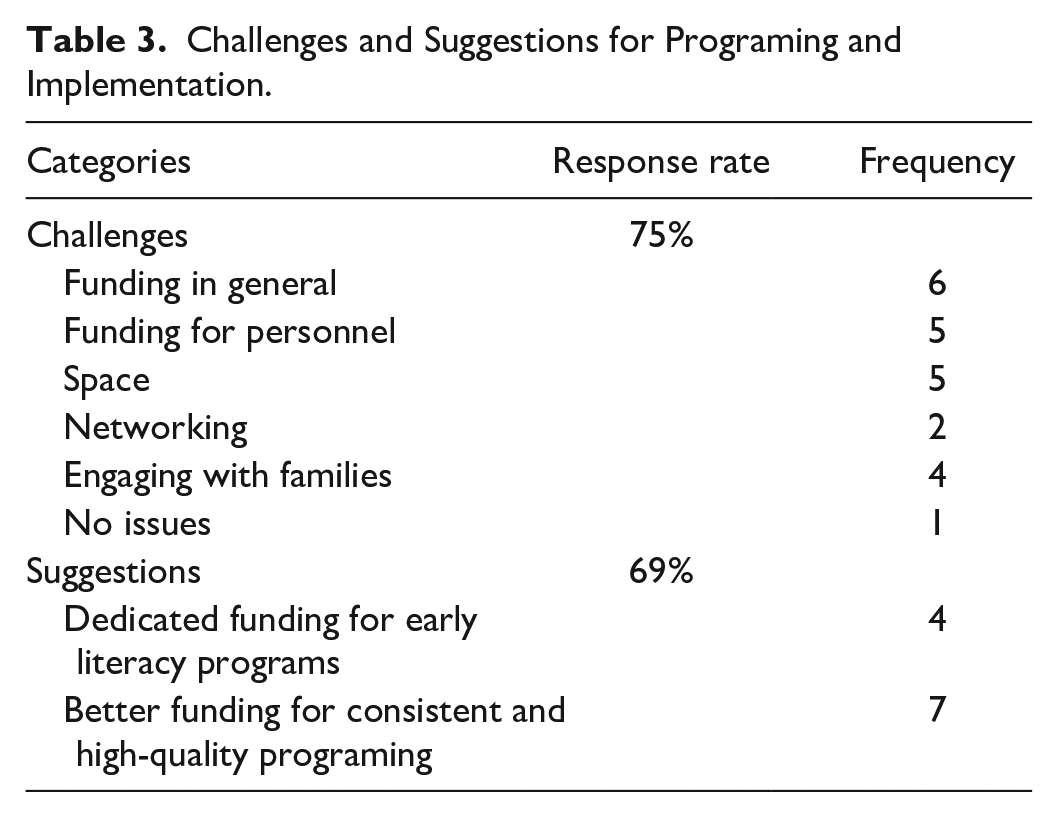
Participants identified challenges for programing and provided suggestions for programing. These are presented in Table 3.
Challenges and Suggestions for Programing and Implementation.
Resourcing of programs
Some FRCs cited that funding was stable but has not kept pace with increasing costs, including the purchase of program materials and equipment renewal. One participant said, “We have stable funding. However, it remains the same for many years and does not account for inflation.” Another participant noted, “no regular increases in budget.” Other organizations, in particular, Community Centers, reported persistent funding instability and resulting inability to plan for the long term or extend and improve on program offerings. One participant noted that the “huge issue” was that their “funding is unpredictable.” Insufficient funding resulted in challenges in attracting, training, and retaining staff. One Community Center participant stated, “It is not just the training, it is also maintaining consistent staff. The environment that we are in as well requires a level of consistency to engage with people.” Funding also affected the availability of space. Several organizations stated that they had limited suitable space to operate programs. One Community Center indicated that on days when 17 or 18 families showed up, it was challenging to operate the program. This organization perceives a much greater need in the community and would like to engage in more active outreach, but is concerned that the resulting increase would exacerbate the space problems. One participant from a FRC serving many rural satellite locations said, “Securing appropriate space for implementing the program is a challenge as we partner with community groups for use of free space including utilities.” Another family resource participant, also serving a range of rural communities indicated, “Securing appropriate space for implementing the program is challenging. Rent is costly in some areas and space is limited or inadequate in other areas.” Other FRC participants, especially in rural, multi-site settings, echoed this concern.
Engaging with families
One challenge, only partly funding-dependent, was the issue of engaging families whom the organization was intended to serve. Some participants noted several reasons, including anticipating uptake and recruiting participants, especially to new programs. One participant with a community development organization in the main city stated, “Outreach is always hard. . .. you are never certain if you have reached the right people. We underestimated how much time we needed to establish relationships with moms to get them interested in coming—if [we had] given ourselves more time, we would have had more participants.” Other organizations have expressed similar challenges that speak to the need for intensive efforts to develop trusting relationships with parents. One participant from a Community Center said, “It has a lot to do with relationships. . .. the level of comfort that people have. . .. [there is] a fear of being judged. One of the other challenges which we see is a trend in anxiety. . ..afraid of what their child will do. . ..afraid that their child will act out and they will be embarrassed, or that their child doesn’t measure up (to other children in attendance). It has become a huge barrier.” Some organizations working with vulnerable families wondered whether families were aware of program opportunities or the potential benefits for them and their children. One stated, “Sometimes people don’t see a lot of the value in early childhood [programs]. . .But there are a lot of things going on with families. . ..a lot of people who are struggling from day to day to make it—people themselves whose literacy level is not great. . ..In terms of engaging people there needs to be a lot of work around outreach. . ..it is always a challenge.” Another participant said, “Maybe they don’t see the value.” For some others, he noted, some parents do not have the confidence to participate “they have come once or twice and you can tell that their child really is benefitting from it but they have difficulty themselves. . ..integrating into the environment. . ..”
Two organizations—an urban, single-site Community Center and an FRC with sites in several smaller communities—noted that for some families lack of transportation was a barrier, especially given frequent unfavorable weather conditions. Many rural sites lack public transportation to get to programs. One Community Center participant noted that in the city, sidewalks may be covered with snow for many months—not cleared sufficiently to allow adults to push strollers to the center. One participant stated, “Weather has a tremendous impact. . .we have a lot of people who walk here [and] the snow across the street might be an impediment to them. . .especially if there is more than one child—it is just the transportation issue.” While some Community Centers serve a compact geographical region, others, he noted, like his own center, serve a larger area intersected by roads with heavy traffic.
Leadership and networking
Leadership and networking with others in the field, including government agencies and other community organizations, was seen by some participants as lacking but holding the potential to address some of these challenges. One participant suggested that resource limitations—specifically, not having anyone to liaise among other organizations and government and provide leadership and support—have inhibited their ability to improve organizational capacity and service delivery. Recalling a meeting of numerous organizations and agencies, a Community Center participant stated “they are here to engage even more. . ..but like us, are under resourced and are prepared to collaborate if somebody takes the lead, but don’t feel that they have a capacity to lead it on their own. . ..So, everybody is willing. . ..it is just having the resources to follow through.” Another participant added, “We try to do as much as we can but there is not a specific avenue to do all that kind of networking. No—effectively networking with other organizations and practitioners is not done.”
Practitioners’ Recommendations for Future Programing and Implementation
Recommendations for enhancing and sustaining programs into the future focused on more government support for consistent, high quality programing rooted in adequate, stable funding. Two main areas were identified—dedicated funding for early literacy-focused programing, and resourcing for networking for program improvement.
Dedicated funding for early literacy-focused programing
A number of participants noted the lack of specific funding for “literacy” programs for children, observing that programs incorporating literacy elements were often funded for more general child development purposes. One participant suggested that this should be addressed, noting, “Consistent funding for such initiatives is decreasing.” This aligns with another participant’s observation: “The reality is there is not a lot of money that you can draw from for literacy in this province.” A participant from a Community Center, noting this lack of early literacy-focused funding, argued for better funding to programs delivered through the Community Centers, since they are deeply entrenched in the neighborhoods, and “already have the relationships built with the families. We can start the program right away since we are already at the grassroots level.” Many participants noted areas in which inadequate or unstable funding impacted programing availability and quality. Several suggested increases in funding for adequate and appropriate program space; one participant suggested this was a priority concern, observing that, “Having space too small or (operating) on a pack up and go basis limits the activities and programing we can offer.” Suggestions for improved human resources funding included increases for access to programing and facilitator training, as “training was not available or is too expensive.” Several participants noted the challenges in offering quality programing if funds were inadequate to attract staff, train them, or retain them. As one participant noted, “Regular increases in budget would make programing more beneficial for both staff and families.” Increased funding for general operations costs such as purchase and renewal of program materials was also suggested, as enhancing literacy resources for families at home was seen as one way to meet programing goals. One participant suggested that funds be allocated to “provide low income families with more tangible resources, like free books and newspaper or magazine (i.e., children’s magazines) subscriptions, directly to their homes.”
Resourcing for networking for program improvement
Practitioners saw an opportunity for future program improvement through resourcing to improve the capacity of organizations for networking and for network leadership. Some suggested that more inter-governmental collaboration to move away from “silos” of thinking, operation and funding, and more community-level organizational collaboration would better support the goals of their programs. One FRC participant suggested a need for, “More networking and collaboration between government departments who share the same focus on early learning, and FRCs and childcare centers.” This echoes the comments by some Community Center participants who found that while there was a willingness among practitioners to collaborate with each other and government departments and agencies, and occasionally it did occur, the kind of sustained effort needed to impact programing did not happen, due to lack of an overarching leadership structure. One participant stated, “Everybody is willing. . . And you know there are a lot of common denominators there that we all see and experience. It is just having the resources to follow through.”
Discussion
The discussion examines what we learned regarding the respondents to the survey, the program opportunities for families, and the challenges identified by practitioners and their suggestions for visioning for the future. These findings are discussed in the context of the literature on family-focused early learning programing and early literacy development.
Respondents to the Survey
The 16 responses received from the organizations contacted represented more than half of the province’s multi-site FRCs in urban and rural settings and single-site Community Centers found in urban centers. Thus, the information shared, representing a very substantial proportion of survey recipients, provided robust data to address the research questions.
Program Opportunities for Families
The programs described by participants aim to support language and literacy development as well as general child development, by supporting children and their parents. This reflects the foundational mission and positions of the organizations that shape program design. FRPs, for example, take their direction from FRP Canada position statements emphasizing the importance of play in children’s lives and its value for “whole child” development including physical-health and social-emotional domains. Given this theoretical orientation, and also aiming to address the goals of their funders (the provincial education department and federal health authorities), programs are broadly based rather than domain-specific to academic development or language and literacy. Such programs provide an important opportunity for families, especially those with limited resources, to access a variety of play and learning materials with other children and adults in a warm, safe space, as well as other family supports that benefit children and parents.
Some facets of language and literacy can, indeed, be developed through the play-based activities, story reading, and the other activities reported. Other dimensions of literacy development are known to be supported through more deliberate or specifically-structured activities (Evans et al., 2000; Sénéchal, 2011; Sénéchal et al., 1998) or specifically-structured reading approaches that can enhance learning of concepts about print (Justice et al., 2009, 2011). A specific approach known as dialogic reading, that can simultaneously be modeled to parents, in-session, provides added benefit to children’s vocabulary development (Huebner, 2000; Whitehurst et al., 1994). Other research, in which parents are taught to reference print (Justice & Ezell, 2000) shows that such approaches can be helpful for improving children’s print and word awareness.
Most of the programs reported in the study have a parent-and-child-together structure for the entirety of each session; that is, they lack any formalized adult learning time such as a separate “adult only” discussion component. The descriptions of programs provided in the responses to the survey, in the interviews and on the organizations’ websites suggest that parent learning time primarily occurs in the form of parents talking with other parents and facilitators as children play. Indeed, this is an important source for both developing supportive relations and learning from other parents. Other models of family-focused early learning programing, incorporating more structured parent learning approaches, are also possible; and growing research suggests specific benefits to children’s literacy development (Zhang et al 2010; Chow et al., 2008; Sharif et al., 2003). A separate parent-time segment over the course of a program, allows for parent learning about a range of key areas of language and literacy development. Techniques to address specific facets of language and literacy can be explained, modeled, and later practiced with children in session and, more importantly, at home. Although not all parents may want to attend a program in which parents learn separately from children for a portion of the session, such focused learning opportunities can have a very substantial impact on parent learning and child outcomes (Lonigan et al., 2008; Mol et al., 2008). Our findings suggest that currently no program opportunity of this nature is available to parents in the province. Such programing requires resourcing to allow a facilitator to work with parents for a portion of the time, while a sufficient number of other staff engage with children in a separate area. Committed attendance at each week’s session, for the duration of the program, is also necessary. Given that in many communities the number of attending families may be very low, for staffing or program momentum purposes, such division may not be practical or desirable.
Alternately, some parents may prefer to attend a parent-only program focused on their learning. Such programs have been shown to increase not only parents’ learning about their children’s early literacy, but, compared to a control group, also to impact letter knowledge and phonological awareness outcomes—two key precursors for reading success in the primary school years and beyond (Doyle, 2009). Further, in a study examining parent-only programs to parent-and-child-together programs, some parents in the parent-only program indicated that they would not have attended a parent-child program, citing possible embarrassment or stress if their children did not “behave themselves” in the session (Doyle & Zhang, 2011). Some parents expressed concern that their children might not “perform as well as other children” on activities undertaken in the sessions, and it would be obvious for other parents who would see this. While these concerns may have been unfounded in that anticipated activities or expectations may not be reflective of actual programs, they speak to one of the many challenges in engaging parents to participate in programs—perceptions of program structure and experiences and fear of the unknown. One practical reason why some parents in that study preferred parent-only programs was scheduling. Many parents working outside the home do not have flexibility to attend programs in the day with their children. Flexible options of program type—program learning focus, scheduling, and participants—can allow many more families to access and benefit from programs at times convenient to them and in a manner that they are comfortable engaging in.
The Challenges Identified by Practitioners and Recommendations for Improving Programing
The challenges identified by practitioners
The challenges cited in the funding of programs, whether unpredictable and disrupted funding or more stable but insufficient funding, affected program delivery in numerous ways. These challenges included availability of program space, training, and retention of staff to establish relationship with families and offer program continuity and improvement, and the ability to provide families with tangible learning resources for their homes to supplement learning in the on-site programs. FRCs tend to have more stable funding, since they have long-established relationships with their main two funders provincially and federally; thus the program planning and delivery could proceed with budgetary certainty. Nonetheless, as reported by participants from some of the FRCs, these funds did not sufficiently cover actual program costs or opportunities for program expansion. Each Community Center participant in the study noted the precarious nature of funding as well as its inadequacy for covering the costs associated with programs. Thus, for these organizations, the challenges are further exacerbated. Their core funding from the public housing authority is intended to cover a wide range of programs and services for adults and children within four areas: employment, education (for school age children and adults), literacy (for school age children and adults), and economic development, and is aimed at poverty reduction. Other funders for specific programs are provincial government departments focusing on adult education, employment, and rural development. The Department of Education does not contribute specific funding for early literacy programs offered at Community Centers. Each center offers their programs for young children using existing infrastructure and occasional grants from charities, as resources permit. Unless stable and adequate funding for early learning programing can be secured, consequent limitations on staffing, training, programing, space, and resources are likely to continue.
Challenges in funding also affected some organizations’ ability to attract participants, especially those serving vulnerable populations, because of the need for intensive outreach by consistent staff. As reported, some participants noted that first contact with families may be to assist in completing a school or government form. The development of trusting relationship with well-entrenched staff may increase the subsequent willingness of families to participate in early learning programs and share their program experiences with family and friends. Timmons (2008) found “word of mouth” was very important in recruiting families for programs. Other studies have also reported the importance of relationship in outreach, retention of families in programs, and parent valuation of programs (Epley et al., 2011; Underwood & Trent-Kratz, 2015).
A perceived need with significant potential to address many of the other challenges cited by participants is funding for the development of a leadership role for community organizations involved in family-focused early learning programing. Such a role, with an emphasis on networking, programing improvement and expansion, would foster collaborative planning and coordinate information and resource sharing for important program underpinnings, such as facilitator training workshops, for which costs could be shared. Specialized staff with particular expertise such as music or art could also be shared among organizations to improve and expand current program offerings, potentially attracting larger numbers of participants. Developing a plan for transportation and for sharing resources to assist families with transportation to programs would address another area of need cited by participants in both types of organizations, and in both urban and rural settings. As was noted by one participant, the willingness to collaborate is evident, but the resources to take on the work of leading it, is what is needed to move programing forward.
Recommendations for improving programing: Looking toward the future
Unlike some countries, Canada has no federal department of education. Although some federal health funding flows to Community Centers, there is no federal policy home or funding source for early education or family-focused early learning. At the provincial government level in the province in which this study was conducted, although early childhood education has moved from a department focused on social services and child care regulation, into the Department of Education, and expanded its profile there, it remains to be seen how government will resource family-focused programing. In 2014, with an aim to provide province-wide program opportunities, the Department of Education launched a one-pilot of a family-focused early learning program for parents and their children between the ages of zero to 2 years of age, primarily at public library sites. The provision of a universally-available program in a province with a relatively sparse population for its large geographical area is a substantial undertaking. Although no public report is available, undoubtedly, it provided many implementation challenges, not the least of which would be the availability of trained facilitators at each site. Since the conclusion of the pilot, it is unclear whether government will build on this initiative by offering some form of programing in the future, and extend it to provide programing for families with older preschoolers. Government’s stated intent to reduce the province’s public libraries by half, despite being later withdrawn, heightens uncertainty about the future of family-focused early learning opportunities. Meanwhile, resources in the form of grants available to community organizations have not been reinstated or replaced. Thus, the current lack of funding for some groups, minimal funding for others, and overall uncertainty about how and where the province may proceed with early programing suggests that much needs to be done in the province to meet the needs of young children and their families. Clearly, stable and sufficient literacy-specific funding to existing organizations is needed with resourcing for networking and leadership to optimize available resources. A 2008 report by UNICEF noted that although substantial resources are directed toward its K-12 school system, Canada is not a leader in the development and funding of early learning. Our study suggests that, over a decade on, much remains to be done. Charity-based funding for one-time projects—while appreciated by organizations—does not address the need for well-designed policy, strategies and appropriately resourced programs (Carpentieri et al., 2011). Finally, resources for researching program participation and outcomes will aid in evaluating programs and providing direction for ongoing program opportunities that meet the needs of families in diverse settings.
Conclusion, Limitations, and Directions for Future Research
Early learning opportunities are critical for children’s academic development. To plan for the support of young children and their families, policy makers, and practitioners need to understand current opportunities available to families as well as the issues and challenges facing organizations that support families. This research identified types of programing opportunities currently available to a diverse range of families within one Canadian context, as well as issues currently faced by organizations in offering these programs. In sum, with respect to program offerings, we found that programs provided a wide variety of activities for parents and children to engage in. To a lesser extent, parents’ education was a focus of the programs. In about half of the programs, there was a direct parent education time provided regularly or occasionally. It is not surprising that programs that include parents with their young children in attendance focus on activities that engage parents and children simultaneously. Since, however, there is a growing research that shows that a direct parent education program component can benefit the quality of home interactions, it would be worthwhile for program facilitators to aim toward increasing this feature of family literacy programing. This would require that organizations offering programs have the informational resources and the human resources available to allocate to the programs. In a program involving a direct parent time, for example, there needs to be two facilitators, at minimum—one to guide child activities and one to guide parent education discussions.
Regarding the issues and challenges reported by family literacy program practitioners, two key issues rise to the forefront—sufficient funding and leadership. As discussed in this paper, the extent of access to adequate and stable funding impacts the quality of programing on many fronts. Whether it is the number of hours that staff are available to provide family literacy programing or the structure of the programs that are dictated by resources, funding adequacy, and funding stability impact every aspect of program design and program implementation.
Leadership in the area of family literacy programing is also a key concern identified by community organizations. As noted earlier in the paper, Canada has no federal department of education that could provide leadership. At provincial level, most educational resources are directed at the K-12 school system. As we have also seen, with the demise of some advocacy and funding organizations, it is increasingly difficult to identify leadership in policy, funding, and community building in Canadian family literacy. Thus, participants’ responses in our study suggest that more than a decade later, the issues noted in earlier Canadian studies (Kennedy, 2008; Timmons, 2008) continue to impede the efforts of family literacy organizations and practitioners.
By providing a current review of program opportunities, issues, and challenges in one Canadian context, this study helps to update the global picture of the state of family-focused early learning—an ongoing international effort. It also provides a basis for further inquiry into the policy perspectives and resource development needed to maximize opportunities and benefits for program participation for parents and their young children
As with all studies, limitations must be considered. The present study was conducted in Newfoundland and Labrador—a geographical area that is underrepresented in the literature—and our primary focus was program design and family access. In future research, we aim to further explore topics in early literacy program not of key focus in the current study, including the topic of program evaluation. The present study examined the family literacy programing from the perspective of community organizations only. To develop a fuller picture, studies focusing on parents” experiences and policy makers’ perspectives would be beneficial. With an aim to manage survey length by focusing only on key program questions; we did not collect data on the respondents themselves. It is possible that the number of years of experience of the respondents themselves will influence aspects of their perceptions of issues in program delivery. We also recognize that there may have been some programs operating as one-time or occasional offerings with minimal public profiles or internet presence that we were, thus, unable to locate and invite into the study. It would be worthwhile knowing how many of these may have existed and how they each function, to further contribute to an understanding of the Canadian landscape of literacy programing.
Footnotes
Appendix: Questionnaire Items
Acknowledgements
The authors would like to thank the participants from the community-based organizations who supported this study.
Author Contributions
The first author, A. Doyle, is primarily responsible for the overall research process from the research design, data collection, data analysis, and manuscript preparation. The second author, L. Li, also contributed to the data analysis and manuscript preparation.
Declaration of Conflicting Interests
The author(s) declared no potential conflicts of interest with respect to the research, authorship, and/or publication of this article.
Funding
The author(s) disclosed receipt of the following financial support for the research, authorship, and/or publication of this article: This research is funded by grant to the first author from The Faculty of Education Research and Development Fund (Grant No. 20152103), Memorial University of Newfoundland.
Ethical Statement
The Interdisciplinary Committee on Ethics and Human Research, Memorial University of Newfoundland (Approval No. 20152103-ED), approved this research.
