




Abstract
Based on an expressed need in the past few years for an appropriate research methodology for colonized peoples, this article proposes a way of conducting research that is faithful to the essential tenets of the African culture. The article delineates principles of a community-based participatory approach to research in Africa. After first outlining the essential tenets of a community-based research (CBR) that are relevant for research projects in Africa, the article argued that the existing CBR lacked a specifically African philosophical basis. It explained the uniqueness of the African philosophy. It then summed up the research principles based on that philosophy. Last, the challenges of conducting such a research study in Africa were outlined. Despite the African emphasis of the overall approach, this proposed methodology may be employed in similar settings where issues such as decolonization are important variables in the research strategy.
Keywords
A Research Yearning
There has been an expressed need in recent years for what has been referred to as a “decolonised methodology.” The term refers to a way of studying “peoples and nations whose own histories were interrupted and radically reformulated by European imperialism” (Smith, 2012, p. 19). A reason for advocating such a methodology is to avoid the perceived tendency for socio-scientific research in former Western colonies to be linked to some of the excesses of colonialism. Indeed, there is evidence that researches on colonized and indigenous peoples have often been seen as disrespectful and exploitative. For example, in the American Indian context, “Many tribes now require that research proposals be approved by either tribal councils or cultural committees” (Battiste, 2008, p. 183). At the same time, scholars such as Connell (2007) have sought to overturn the false equation that Western knowledge equals universal knowledge, both by contextualizing Western knowledge production as being located in a very specific time, place, and culture, and by presenting writing from Southern knowledge traditions.
Central to this decolonizing project is the reality of colonization and other historic encounters of imperialism between the West and the rest. Research guidelines and protocols now need to take cognizance of the fact that the very word research currently conjures up or evokes bad memories among indigenous and colonized people. Such use collectivizes the African experience alongside that of millions of others who encountered colonial imperialism. The grand scale of the colonization of Africa has already been sufficiently documented (Rodney, 1972). Thus, the need for a decolonized methodology for research among indigenous peoples is particularly pertinent to Africa. At issue here therefore is not necessarily “foreigners” researching about Africans and other colonized people. The concern includes those, like us, researching among rural African communities but trained within the Western academy. The perception of such researchers is one of “the outsider within” or “outsiders, because of their Western education” (Smith, 2012, p. 5).
Having attempted a decolonized methodology, we intend to delineate here some helpful principles of a community-based approach to research in Africa. This is done through a fourfold structure. First, this brief article outlines the essential tenets of a community-based research (CBR). It points out the relevance of the CBR principles for research in Africa, highlighting examples of adaptation of CBR within feminist and cultural perspectives. Second, it then argues that the existing CBR does not satisfy the fundamental elements of the African culture. It explains what constitutes these basic elements. Third, the article outlines the principles of a more comprehensive approach to an African Community-Based Research or ACBR approach. Last, some challenges of ACBR are expressed. As we will explore in more detail later in the article, we write in term of “Africa(n)” while acknowledging the dangers of any such shorthand term.
Defining the Existing CBR
CBR has become prominent in recent years. “Universities and funding agencies are increasingly calling for collaborative research between community partners and academics” (Ryser, Markey, & Halseth, 2013, p. 11). CBR is not new. It is traceable to the revolutionary approaches of the 1970s by oppressed communities in South America, parts of Asia, and much of Africa. These oppressed peoples were attempting to establish self-critical communities in the post-colonial period. Their approach also found much common ground with concurrent trends in feminism (Maguire, 1987). Brazilian educator, Paulo Freire, provided the “critical grounding” for the CBR approach (Minkler, 2005, p. 4). Therefore, CBR could be seen as an orientation to research with specific assumptions while employing any qualitative or quantitative methodology.
CBR draws upon constructivism and shares in some of the wider criticisms of positivism. It sees research as deeply contextual. Not only does the setting matter hugely, but the methods adopted should be determined by the purpose of the study. Such methods must respect “the input of community participants . . . in understanding of the phenomenon under study” (Israel, Schulz, Parker, & Becker, 1998, p. 176).
CBR emphasizes the socially created nature of knowledge and thus seeks the participation and influence of community members (as non-academic researchers) in the study or research process. Members of the community are understood here as possessing common symbols and shared norms. Based on respect for the community, CBR attempts to build on such shared values so as to address communal concerns (Israel et al., 1998). It should also encompass the socio-cultural factors that affect research. As such, each culture or society would adapt CBR to its own history or specific context. Based on the above summary of CBR, four tenets are deducible from this research approach:
Constructivist
Context based
Purpose driven
Community participation
A fifth element, ethical consideration, is essential to all academic researches (British Educational Research Association, 2011). However, we believe that legal definitions of ethics must be framed according to the African worldview and understanding of the individual. This worldview will be explained later. Otherwise, these tenets and other variations and additions to CBR approaches are universally relevant.
Relevance of CBR Principles for Research in Africa
First, a participative approach to research has been used to address feminist concerns. By involving the actual experiences of women, this approach to CBR combines knowledge with action so as to bring about social change toward eliminating gender disparities or oppression of women. In “An Emergent Africana Feminist Methodology,” Assatai Zerai explores an Africana feminist sociological perspective and framework. The approach considers ways in which “nation, race, class, gender, sexuality, globalisation, and other dimensions of oppression” may intersect and impact the experiences and agency of research participants. Zerai’s focus is on those with health care and social support in Zimbabwe (Zerai, 2014). By adapting the intellectual work of Africana feminists, the work proposes a new Africana feminist methodology.
A second example of the context-based approach is from a cultural perspective. Whatever the research topic, health or education, culture is at the center of the study. This is particularly pertinent to CBR in Africa. By involving the community in the study, this approach to CBR situates culture at the hub of combining knowledge with action toward achieving the aim of the study. The PEN-3 cultural model is a practical example of a research approach designed to guide researchers to always begin with the positive contexts of human culture and behavior. PEN-3 is an acronym for three separate factors within three distinct domains. In the Cultural Identity domain, PEN stands for Person, Extended Family and Neighbourhood. In the domain of Relationships and Expectations, it stands for Perceptions, Enablers and Nurturers. Thirdly, in the Cultural Empowerment domain, PEN stands for Positive, Existential and Negative. This cultural model is mentioned here only as an example of a cultural perspective of the context-based approach. “Culture in this context refers to shared values, norms, and codes that collectively shape a group’s beliefs, attitudes, and behaviour through their interaction in and with their environments” (Iwelunmor, Newsome, & Airhihenbuwa, 2014, p. 21). This model, has been applied in health-related research projects among ethnic minorities.
Whether from gender issues or a cultural perspective, CBR approaches have ensured collaboration that equitably involves and recognizes all stakeholders in the research process. However, as some have noted, “the philosophy and methods of this approach is the cornerstone of improved community-based research” (Ahmed, Beck, Maurana, & Newton, 2004, p. 141).
The Limitation of CBR in Africa
Any research methodology must attach itself to a specific philosophy (Duberly, Johnson, & Cassell, 2013). The above CBR principles may be helpful for research work in Africa, but they do not indicate the philosophy they represent. This is what we consider as the central weakness of the context-based aspect of CBR. Without specifying its philosophical foundation as African, a CBR approach in Africa may not address a crucial issue underpinning research work in the continent, namely, the issue of decolonization. The term decolonization as used here means establishing the African ontological and epistemological perspectives as the basis of the research inquiry. The aim of decolonization is to counteract the continued impact of colonization on African research. Although the full extent of the human and cultural destruction suffered by Africa remains untold, some authors (Abdi, Puplampu, & Dei, 2006) point out that the most devastating aspect of colonization is the damage done to the African mind—cut off from its philosophical roots. Thus, for a research study to be decolonized, ultimately to be African or make claims about Africa, it needs to adopt the African perspective.
Africa’s Unique Perspective
The four principles identified in CBR do not seem to include what we consider as the fundamental elements of an African culture. These underlying elements constitute a worldview, which would doubly serve here as the philosophical basis for the research methodology that will be proposed as an ACBR. Any claim for a worldview for such a vast continent requires detailed explanation or justification. The many and various African perspectives will not be examined; rather, as philosophers like Diop (1962) have argued, beneath the diversity of views lies a “cultural unity” in Africa (p. 7). For the purpose of framing the philosophical underpinning of ACBR, three aspects of this cultural unity will be presented:
A relational understanding of the individual,
A social view of knowledge/existence, and
A theocentric perspective of the environment.
A Relational Understanding of Person
A point of convergence in the perspectives of experts on the continent is in the African understanding of the human person (Holdstock, 2000; Jegede, 1999; Kenyatta, 1938/1979; Kvale, 1992; Mbiti, 1969; Menkiti, 1979; Rains, 1999; Semali & Kincheloe, 1999). According to this perspective of person, the individual exists only as a part of the community. For the Yoruba tribe of West Africa, this relational view of the individual has moral implications: The corporeal individual, essentially, cannot continue in-being without a community . . . Since the social life of a group of individual beings is sustained by a spirit of sodality, any form of self-alienation for the purpose of pursuing a purely selfish aim is, morally speaking, an error or sin . . . . (Akiwowo, 1986, p. 353)
Various other descriptions exist in other African communities showing the strictly social connection of the individual. This African view of the person as relational is often presented in contrast to the Western understanding of the person as unconnected to any community (e.g., Higgs, 2010). To emphasize the contrast between the African and Western understandings of the person, one finds statements such as, “Nobody is an isolated individual” (Kenyatta, 1979, p. 297) in contrast to “not some isolated static quality of rationality” (Menkiti, 1979, p. 158)—referring to the Western perception of the person. Descartes’ cogito ergo sum, “I think, therefore I am” (Descartes, 1637/1881) is also contrasted with the Zulu expression “Umuntu ngumuntu ngabantu,” “I belong, therefore I am,” or, as translated by Mbiti, “we are, therefore, I am” (Mbiti, 1969, p. 109).
In summary, this view of the person as necessarily in relation to the rest of the community is referred to as communalism. According to Wiredu, “a communalist outlook seems to be quite widespread in traditional life on the (African) continent” (Wiredu, 1998, p. 21). Communalism is described by John Mbiti in terms of “whatever happens to the individual happens to the whole group” and vice versa (Mbiti, 1969, p. 109). This means that there is no lone researcher-genius detached from a community of learners. However, communalism does not subjugate the freedom or autonomy of the individual. Rather, as an African research perspective, communalism means that the individual researcher finds identity and meaning in the community while retaining his or her own rational independence. Again, the idea of a lone researcher would therefore be invalid in this perspective. Ultimately, in line with the constructivist principle, the community’s reality is constructed socially (Ibhakewanlan, 2014). The validity of that reality or knowledge thereof lies in the fact that it is a product of the shared discourse of the community—this is the next point.
A Social View of Knowledge/Existence
The community’s shared discourse or the social view of knowledge is related to the above understanding of the individual. In other words, the individual and the communal are two sides of the same coin. Two aspects will be looked at in this communalist view: the epistemological (view of knowledge) and the nature of existence (ontological). Thus, communalism also guides the epistemological and ontological positions of this approach.
Epistemological view
Although epistemology refers to “the nature of knowledge,” there are as many epistemological perspectives as there are theoretical traditions (Merriam, 2014, p. 8). The African epistemological perspective detaches itself from the paradigm wars based on the viewpoint of African philosophers (Anyanwu, 1989; Appiah, 1989; Wiredu, 1980). According to this view, the validity of any African academic discourse lies in the question of relevance or usefulness to the African community at any particular time. This means knowledge is circumscribed by the community’s time and place as well as other local factors.
Such an epistemological assumption has implications for the overall methodology. For example, a positivist epistemology would mean carrying out research study with a “scientific mentality” that emphasizes a “pursuit of objectivity” (Cohen, Manion, & Morrison, 2011, p. 18). In the African epistemological view, knowledge is non-objectivist but requires “community-validity.” By community-validity is meant the shared discourse based on communalism. To explain briefly, the term community-validity is used here to refer to the common point of reference in the shared discourse. For example, when Mbiti quotes the Zulu expression Umuntu ngumuntu ngabantu, it is presumed that everyone in the Zulu community understands what the term means. It is that degree of common understanding and awareness of a particular social reality that is meant by community-validity. Central to this view is the African understanding of community and the place of the individual in society. The shared discourse does not presuppose unanimity. Because no community may enjoy perfect unanimity on all issues, the degree of unanimity is directly proportional to the extent of the community-validity. This reflects the constructivist dimension to this epistemology, for knowledge is understood as constructed by the community. The truth of what is known through research then becomes dependent on the scope and scale of the community-validity.
Is there still objective truth if knowledge is socially constructed? Yes, but any such truth claim would be directly proportional to the community-validity. On the question of the status of eternal truths independent of the community, we would require an eternal community to behold an eternal truth that is independent of any community. In other words, as the next paragraphs will hopefully make clearer, such a question is nonsensical from the perspective of communalism.
An ontological view
What the ontological question asks is whether “social reality is external” or the “product of individual consciousness” (Cohen et al., 2011, p. 7). With the above epistemological view that saw knowledge as socially constructed, does objective reality exist? Another way of asking the question is whether research findings in Africa are true outside the community members’ experience. The African reality is not eternal or unchanging but exists as it is experienced here and now by the specific community. This again raises a relativist implication.
Is the ontological status of the social reality constructed by a community true, beyond the consciousness of its individual members? The various individual “consciousnesses” experiencing a particular social reality merely constitute the communal discourse specific to that community. As every communal discourse is its own validity, so too is the proof of a given knowledge inherent in the knowledge itself. In a similar way, reality is its own proof. There may be a hierarchy of knowledge and of existence; some peoples may learn from others, a culture from another, or even one species from another; yet every reality remains capable of retaining its own communal-validity. These insights about knowledge and reality could be represented by an endless series of concentric circles as depicted in Figure 1 below.

Knowledge and reality as concentric circles.
Take for instance a Western engineer and a Masai herdsman who are mutually unaware of each other’s reality. To the engineer, the reality constructed at a fire-side chat in Africa may appear to lack objectivity, but so too would be the reality of iPad programming to a Masai community. Yet each social reality exists independent of individual perception or cognition based on their particular community-validity (the shared discourse of that community). What this means is that reality and community ought not to be separated but expanded to embrace each other. If the Masai herdsman joins the iPad manufacturing community, the programming of that gadget becomes part of the Masai’s reality. The more iPad engineers join the fire-side chat in the rural African village, the more “external” (Cohen et al., 2011, p. 7) is the social reality created through the chat.
Yet our view is that the “external” and “internal” distinction is illusory. The distinction is only a handicap of space and time—taking, for example, the when and where of the Masai herdsman and the Western engineer. The “external” nature of a reality socially constructed is objective for those who are part of the communal discourse. When others outside the community join the discourse, its “external” status becomes validated—but only for those joining the circle of discourse. In the above image, each circle is complete in its own right. As with an expanding universe that creates new space, and its ontological status is not dependent on the to-be-created “external” space, social reality exists independent of any individual consciousness that is not yet part of the communal discourse. Hence, for all practical purposes, it does not make sense to speak of a social reality existing outside a community. How can space exist without matter? Every reality requires a community to represent it or experience and describe it. These are the ontological and epistemological positions, which also affirm the African philosophy of communalism that should form the basis of a CBR in Africa.
A Theocentric Perspective of the Environment
The third aspect of the cultural unity to be presented is the place of nature and religion in Africa. People in rural African villages have a sense of relationship to nature, which is almost like a reverence. As African villagers are traditionally subsistence farmers, with some hunting alongside, there is a daily dependence on the physical world (of plants, animals, the elements and physical features). “To people of this kind land was something akin to water or air; it had no owner . . .” (Mitchell, 1954, p. 159). Rather than view the physical and non-human world as something to be owned and exploited, they are viewed as respectable “beings” that exist in a relationship with the community and a divine or transcendent reality.
For the “scientific” minded, this relationship to the physical and non-human world would be interpreted as animism, nature worship, and earth cult. Such an interpretation would reflect a lack of appreciation of the symbolism of the African culture—for such cults/nature worship are not true of the villages studied by this researcher: It might be expected that cults of the sun and the moon would play a large part in the life of African peoples, since such cults were of great importance in ancient Egyptian religion. But in fact such worship is rare even in the pantheons of West Africa. (Parrinder, 1954, p. 44)
It is true that “many things are held in great esteem for religious reasons, such as mountains, waterfalls, rocks, some forests and trees, birds, animals and insects” (Mbiti, 1991, p. 33). However, this esteem is not immediately at the level of worship or religion, but only reflects the unity of relationship that these people experience with the cosmic and divine realities. This unity of relationship, between the divine and material/human world, is often presented as the striking dichotomy between the Western and African approaches to knowledge. As Chivaura puts it, The differences between African and European worldviews . . . relate to differences in their attitudes towards the material and the spiritual. Africans regard them as compatible. (Chivaura, 2006, p. 214)
The distinction between the African and Western perspectives may appear overly dichotomous, but it at least reflects the African emphasis on these issues. We believe these African elements are also somewhat present in the Western approach to knowledge and understanding of the person. However, to dismiss the claims of African intellectuals to what is generally seen as a people’s worldview only heightens the dichotomy: With rural people, and even with many township dwellers in South Africa, the role of divine beings, ancestors, sacred places (like isivivane), sacred people and sacred objects needs to be addressed. To touch on these issues is to compel our Westernised intellectuals to experience severe conceptual violence, and yet many of them secretly subscribe to these beliefs. (Ntuli, 2002, p. 63)
A Summary of the African Perspective
The above three aspects of the African perspective of knowledge can be summed up in one word: costheantropic. The pattern is one of a holistic relationship to three realms: their physical environment, cosmos; their strong religious spirit and sense of the Divine, theos; last, anthropos, their relationship to others or communalism. Three Greek words (cosmos, theos, and anthropos) are used here to represent the African sense of these physical and non-human worlds, the transcendent world, and the world of people (Ibhakewanlan, 2003). The researcher’s relationship to these realms is represented in Figure 2.
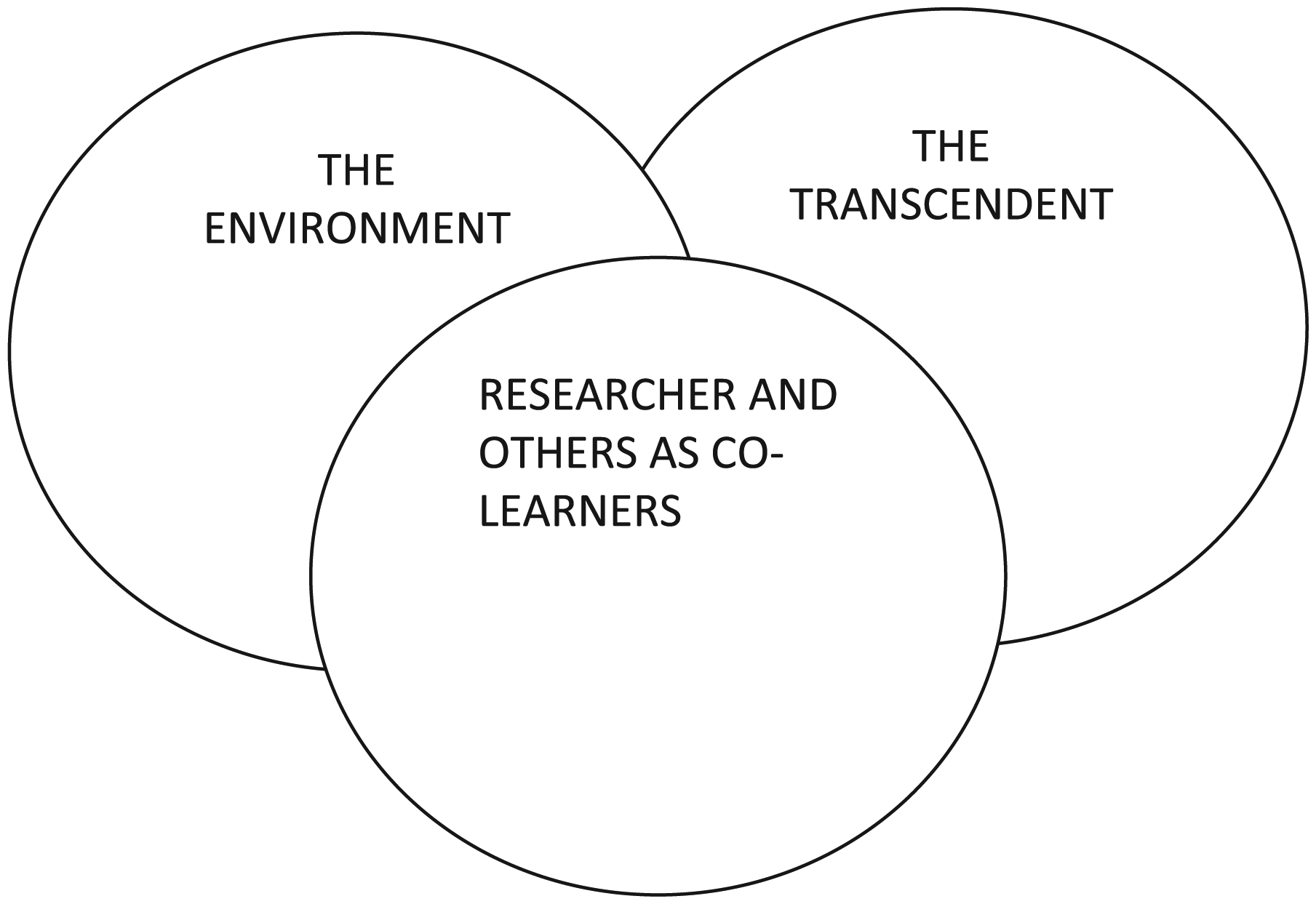
Researcher in a triune relationship.
Thus, in the African cultural perspective, people are naturally in relationship with their physical environment, a divine realm, as well as with other people—in a unity:
The ACBR investigator should feel himself or herself as part of the environment (cosmos) and engaging with it in the production of knowledge. Can the researcher share in this cosmic feeling?
The research participants (anthropos) are teachers and co-learners. They are co-researchers. Hence the selfish or individualistic “I” seeking knowledge, in “my name” as sole researcher, must give way for relationship with others. Can the researcher admit the rural participants as fellow researchers?
Then, there is the question of accepting that there is a non-physical reality (theos or transcendent) beyond the human and physical world. For example, there is currently a pervasive religiosity across the African continent in a way that is not evident in the West. To quote Mbiti’s popular statement, “Africans are notoriously religious” (Mbiti, 1969, p. 1).
Applying ACBR becomes a relational, ecological, and transcendent approach to life in general, not just as a research paradigm or methodology. The sense of the transcendent, as with the natural environment and other people, is also a relationship rather than a metaphysical discourse. The researcher should feel and acknowledge himself or herself in such a triune relationship. Only with such acknowledgment could a research study claim to adopt an ACBR approach.
Précis Principles of ACBR
We have argued that communalism, as understood by philosophers as a distinctive African attribute in understanding the individual and the community, should be integrated into the basic tenets of a research study in or about Africa. In addition, there is need to acknowledge the African relationship to nature as well as the sacred or transcendent. These salient aspects of the culture have been encapsulated in the term costheanthropic. This deepens the notion of CBR and seeks to make it authentically African by grounding it ontologically and epistemologically in African reality.
Operationally Defined Criterion
In Poor Economics: A Radical Rethinking of the Way to Fight Global Poverty, the following claim is made based on a research study: “Tanzania experiences a rash of witch killings whenever there is a drought—a convenient way to get rid of an unproductive mouth (an old woman in the community) to feed at times where [sic] resources are very tight” (Banerjee & Duflo, 2012, p. 28). Tanzanians and other Africans with whom we have shared the above finding have expressed surprise. Would the result or interpretation of such a study have been different if the local people were co-researchers in the entire process? What philosophical principle is used in the analysis and interpretation of such research studies in or about African communities?
For a research study to be true about Africa, we believe it should be as far as possible based on some aspects of the African philosophy – as it is generally conceived. Such a study would, for example, acknowledge reverence for the environment, the role of the transcendent and a communal view of the individual and of knowledge/reality. These three aforementioned aspects must also be seen as a unity of perspective. The data collection process, analysis, and reporting, in fact the entire research protocol, would require faithfulness and grounding on African philosophy and principles as already explained. Again, these African themes include a relational understanding of the individual, a communalist view of knowledge/existence and a theocentric perspective of the environment. Above all, it would enhance the research credibility if the researcher shared the above African perspectives.
Challenge of ACBR
In this section, we reflect on an attempt to use the ACBR approach during doctoral fieldwork. The details of the specific case are not given as they are not crucial to the argument and may undermine the confidentiality agreements made with participants.
Orality and History
Anyone conducting a participative research in Africa may have to be prepared for a relative scarcity of documents (written information) compared with the volume of information available by oral transmission. There is no real alternative to talking with the people. The African communities visited during the study seemed to retain a fairly oral culture, as people still preferred to ask for directions rather than use maps. Although this orality has its obvious weakness, it should be seen in the context of communalism, people rather than paper, which shows the emphasis placed here on human relationship and community.
The philosophical principles of ACBR are ultimately not based on historical accounts traceable to classical figures as those of the Western intellectual tradition, such as Josephus or Plato. The dearth of ancient historical scripts in most African societies has in the past led some to argue that Africans have no history. Hegel, the German philosopher, dismissed Africa as the land of childhood (Hegel, 1830/1975). More recently the Oxford historian Trevor-Roper stated that there is no history of Africa except that of Europeans in Africa (Trevor-Roper, 1965, 1969). Such conclusions are the product of a non-decolonized research approach. An ACBR approach would not subscribe to nor produce such a narrow understanding of history or culture, in terms of “recorded progress”—mostly understood in Western terms of technological advancement. Rather, as already explained in terms of community-validity, the view here is that the culture of any community should not be valued or devalued using the criteria of any other society. Is not much of written history a distortion of the past to suit one’s prejudice? As defined by Rousseau, history is “the art of choosing, from among many lies, that which most resembles the truth” (Durant, 1927, p. 617). Nonetheless, without enough surviving African texts, it is difficult to assert the African philosophy upon which we have based the ACBR approach.
Vastness and Variety
Traveling by road around East and West Africa, the vastness of Africa became more obvious: The African continent is larger than the combined landmass of the United States, Western Europe, and the Indian sub-continent. This is contrary to the general perception that Africa (20% of the world’s landmass and only until recently reached 14% of the world’s population) is overpopulated. The vastness of the continent is only surpassed by its variety. With relatively low population density, there are many scattered small communities with distinctive cultures. Hence it is difficult to speak of a harmonious African community. More than 350 mutually unintelligible languages are spoken in Nigeria alone (Okonjo-Iweala, 2012). Therefore ACBR may not be accepted as valid by all in Africa. In light of the diversity of the continent, it will remain debatable whether it is even justifiable to speak of an “African culture.” That is a criticism to which this and similar papers on “Africa” will remain open. Overall, this methodology is a process of becoming or a process-oriented research approach. A unified approach to ACBR may not be tenable in the near future.
Conclusion
This has been an attempt to delineate some helpful principles of a community-based participatory approach to research in Africa. This was done through a fourfold structure. First, the article outlined the essential tenets of a CBR, which are relevant for research projects in Africa. It then argued that the existing CBR lacked a specifically African philosophical basis, and then explained the uniqueness of the African philosophy. Third, it summed up as ACBR the research principles based on that philosophy. Lastly, the challenges of conducting such a research study in Africa were outlined.
The approach to ACBR we outline is not entirely of our own making. In the spirit of the argument above, and of “I belong, therefore I am,” we draw on the decades of important work done by researchers in the CBR tradition, as well as African philosophers such as Higgs and Mbiti and other Southern scholars such as Smith. However, where our contribution lies is in seeking to make more explicit the Africanness of our version of CBR. ACBR is not simply a progressive approach driven by ideology but is ontologically grounded in African realities. This leads us to highlight the costheanthropic core of African cultures and bind this closely to the methodological principles of ACBR. In doing so, we believe that we make a contribution to an African philosophy of the social sciences that sits within a wider tradition of various “Southern knowledges” (Connell, 2007) that talk back to the universalist pretentions of Western social science. In attempting such an ambitious project, we undoubtedly run the risk of essentializing and homogenizing Africa. However, we believe that this risk is justified to advance the crucial project of building an alternative approach that is grounded in the people and their cultures.
Footnotes
Declaration of Conflicting Interests
The author(s) declared no potential conflicts of interest with respect to the research, authorship, and/or publication of this article.
Funding
The author(s) received no financial support for the research and/or authorship of this article.