




Abstract
Translating the Holy Quran is a challenging task. However, it is a necessity due to the large number of Muslims who do not speak Arabic. To date, various translations are available for nonnative speakers of Arabic. These translations, however, have revealed complete and partial translation losses. One type of such losses is grammatical loss, which sometimes occurs due to differences between the source text (ST) and the target text (TT). This study aimed at investigating the grammatical losses in the translation of the Holy Quran, with special reference to Surah Al A’araf, and the extent these losses cause partial or complete semantic loss. Qualitative descriptive approach was adopted to analyze the data extracted from Abdel Haleem’s English translation of Surah Al A’araf. The study revealed losses occurring in translating grammatical aspects such as conjunctions, syntactic order, duality, tense, and verbs. It was also found that grammatical losses contributed to semantic losses, which are mostly partial semantic losses of the connotative or the expressive meanings. However, some of the identified grammatical losses were found to cause complete semantic losses. This study suggests that appropriate translation strategies be adopted to reduce loss in the translation.
Introduction
Translation is one of the most complicated tasks because it involves an attempt to achieve accurate communication of a message while attending to the form at the same time. A translator’s attempt in attaining form usually makes attaining meaning more difficult (Rendall, 1997), and thus a translator mostly needs to either sacrifice form or meaning. In other words, a translator can rarely succeed in preserving both form and meaning, in particular, in cases of two dissipate languages, such as Arabic and English. Such a problem is related to the question of what contributes to a good translation (Schulte, 2002), which is reflected in the different definitions of translation. Nida and Taber (1974), for example, defined translation as reproducing the message of the source language (SL) in a target language (TL) while keeping equivalent meaning and style. Style, in this sense, may refer to grammatical and syntactic patterns. For example, in Arabic, the style is to foreground the most important and background the least important in a certain context. This is not the case in English, as there are fixed grammatical rules which require, for instance, a subject to go before the verb or the object. Another definition of translation was proposed by Newmark (1988), who defined translation as producing an approximate equivalent of two languages at different levels, among which thought and linguistic form are the most important. Newmark’s definition is similar to that of Nida and Taber, as they also underscored the importance of linguistic form equivalence. On the contrary, Catford (1965) viewed translation as the replacement of textual material in one language (SL) by equivalent textual material in another language (TL). These definitions of translation mostly highlight two main concepts: meaning and linguistic form, which resulted in the emergence of different schools of thoughts on translation that revolve around meaning and form. For example, Larson (1984) differentiated between meaning-based translation and form-based translation. In a similar vein, Catford (1965) believed that full equivalence in meaning and form in the target text (TT) cannot always be fully achieved as it is difficult to transfer the form and meaning from a SL into a TL. Related to this is what is explained by Nida (1975), who explained that a translator may not encode a message accurately when translating texts between two different cultures. In this light, the main concern in translation is ensuring that the form and meaning between the SL and TL are equivalent.
Newmark (1988), for instance, stated that problems in translation could occur in grammar or lexicon. Much earlier, Ervin and Bower (1952) argued that distortion of meaning in translation could result from lexical, syntactical, or cultural differences between languages. Correspondingly, Darwish (2010) in Al-Hamdalla (1998) stated that difficulty in translation could result from differences between languages in terms of syntactic, semantic, lexical, phonological, and morphological features. Thus, it seems that grammatical equivalence between a source text (ST) and a TT is not less important than lexical equivalence.
The lack of equivalence problems at the grammatical level may also cause challenges for a translator, especially when he translates from Arabic to English. Arabic is a unique language in its style and is completely different from English in many of its features. The challenge becomes greater when the ST is the Holy Quran, which is a sacred book that is sought to be rendered as closely as possible to the authentic meaning in the ST. Translating the Holy Quran seems to be more challenging due to its being a sacred book, and due to its unique language, which is the words of Allah Almighty. Furthermore, the Holy Quran language has attributes which make it challenging to translate the form and sense from the ST to the TT.
To date, some studies have addressed the phenomenon of syntactic and semantic problems in the translation of some ayahs in the Holy Quran (e.g., Abdelaal & Md Rashid, 2015; Ali, Brakhw, Nordin, & Ismail, 2012; Fathi & Nasser, 2009; Khalaf & Yusoff, 2012). Studies have also been done on certain syntactic aspects. For example, Al-Ghazalli (2012) focused on the translation of the trilateral verbs in the Holy Quran. Some studies have focused on certain aspects of the text in the Holy Quran. However, these studies did not exhaustively investigate the different grammatical losses in the translation of the Holy Quran, and they did not either investigate the extent these grammatical losses contribute to the loss in the meaning conveyed, that is, the grammatical losses in the translation of the Holy Quran resulting in complete semantic losses or partial semantic losses.
Complete semantic losses may result from grammatical losses when the ST meaning is distorted or improperly conveyed in the TT as a result of such a grammatical loss. Partial semantic losses, on the contrary, may result from grammatical losses when the ST primary meaning is conveyed, while some other shades of meaning are lost in the TT due to such a grammatical loss.
This study adopts Hervey and Higgins’s (1992) perception of loss, in which they state that loss is “an important corollary of this concept of translation loss is that it embraces any failure to replicate a ST exactly, whether this involves losing features in the TT or adding them” (p. 24). Thus, what may be considered as gain by other theorists and scholars of translation is not adopted in this study.
Objectives of the Study
This study aims to identify the grammatical losses in Abdel Haleem’s translation of Surah Al A’araf, and their contribution to creating semantic losses. Following Hervey and Higgins’s (1992) definition of translation loss as failure to replicate the ST exactly through omission or addition, grammatical losses refer to any improper use of grammar components such as articles, prepositions, gender, aspect and tense, plurality, and duality. The improper use can be in terms of addition or deletion, which is likely to occur due to lack of equivalence problem as highlighted by Baker (2011), or due to the translator’s failure to select the appropriate equivalent. The study specifically aims at the following:
To identify the grammatical losses in Abdel Haleem’s translation of Surah Al A’araf
To identify the extent these grammatical losses contribute to partial or complete semantic losses.
Literature Review
In his study of the lexical gap in the translation of the Quranic verb, كاد/kada/, Al-Utbi (2011) highlighted how the translation failed to find equivalents of the verb كاد due to the lexical gap (or grammatical gap) between the SL and the TL. The investigated translations revealed mostly a change in the word class of the Quranic verb to different word classes, namely, adverbs, verbal constructions, and adjectives. Largely, the translations of the Holy Quran are abundant with examples that show grammatical gaps in translation. These grammatical problems in translation may affect the meaning intended in the ST.
In a study about the translation of the Quranic verb phrase, Al-Ghazalli (2012) found that translators failed to accurately render the verb phrase in the Quranic translation due to the gap in grammatical structure or the inaccuracy in selecting lexicons. For example, the following ayah shows such a loss or inaccuracy in translation: وَإِذْ نَجَّيْنَاكُم مِّنْ آلِ فِرْعَوْنَ يَسُومُونَكُمْ سُوَءَ الْعَذَابِ يُذَبِّحُونَ أَبْنَاءكُمْ وَيَسْتَحْيُونَ نِسَاءكُمْ(49) وَفِي ذَلِكُم بَلاءٌ مِّن رَّبِّكُمْ عَظِيمٌ And remember, We delivered you from the people of Pharaoh: They set you hard tasks and punishments, slaughtered your sons and let your women-folk live; therein was a tremendous trial from your Lord. (Ali, 1938/1983, p. 249)
The derivative verb يُذَبِّحُونَ, which was translated as “slaughtered” by Ali, signifies the sense of abundantly doing the act of slaughtering Jews’ sons by Pharaoh’s supporters. The translation of the ST verb, which is in the aorist tense and in the exaggerated form, as a past tense verb created a grammatical gap that affected the meaning (Al-Ghazalli, 2012). Al- Ghazalli, moreover, mentioned that such grammatical gaps make overtranslation unavoidable due the fact that the Quranic vocabulary is pregnant with meaning, while there is syntactic and lexical gap in the TL. He also indicated how derivative germinated-by verbs were not accurately rendered because germination in Arabic is functional but it is not so in English; for example, in translating the following ayah, the translator failed to render the meaning accurately, as illustrated below: (182) وَالَّذِينَ كَذَّبُوا بِآَيَاتِنَا سَنَسْتَدْرِجُهُمْ مِنْ حَيْثُ لا يَعْلَمُونَ Those who reject Our signs, We will lead them step by step to ruin while they know not. (Ali, 1938/1983, p. 173)
As seen in the ayah above, the derivative verb (i.e., سَنَسْتَدْرِجُهُمْ) indicates gradual change from a state to another. However, the translation failed to convey such depth of meaning.
Another problem that is highlighted in some studies is the nature of Arabic language, which permits foregrounding and backgrounding, while English does not. In Arabic language, in general, and in the Holy Quran in specific, style including word ordering affects meaning (Abdelwali, 2007). The most important information is usually foregrounded in Arabic, as the syntactic style in Arabic usually allows such kind of foregrounding or backgrounding. Style in the Quranic language is a principal component of meaning. However, translating the Holy Quran style is challenging due to the fact that the Holy Quran has various styles, for example, narrative, didactic, argumentative, and others (Sadiq, 2008). Most of the English translations failed to convey the Quranic lexemes and styles (Abdelwali, 2007). The following example, provided by Abdul-Raof (2004), indicates how style, which actually is grammatical style, affects meaning in the Holy Quran, and how translation fails to convey: (14) إنَّنِي أَنَا اللَّهُ لا إِلَهَ إِلا أَنَا فَاعْبُدْنِي وَأَقِمِ الصَّلاةَ لِذِكْرِي Verily I am God; there is no god but I; therefore serve Me. (Arberry, 1980, p. 340)
The example above shows how style was used through the use of repetition to convey vividness of the Holy Quran text though it may be regarded by nonnative speakers of Arabic as redundant, with unnecessary use of pronouns. For example, إنَّنِي /’innanii/, أَنَا’/’ana/, and أَنَا /’anaa/, all refer to Allah Almighty. This Quranic style, as Abdul-Raof explained, serves two propositions: the first proposition is related to Allah and His existence; the second proposition is about Allah Almighty Oneness. In addition, the use of ف “fa” indicates immediate action without hesitation. These entire stylistic features in the Quranic ayah are not conveyed in the translation. However, they are a basic challenge for a translator, and it can be hardly resolved because style is not universal. In other words, each language has its own style which cannot be followed in another language (Abdul-Raof, 2004). Abdul-Raof provided another example of ayah 67 in Surah Taha, which reads:
(فَأَوْجَسَ فِي نَفْسِهِ خِيفَةً مُّوسَى (67 So Moses conceived is his mind a (sort of) fear. (Ali, 1938/1983, p. 803)
As seen in the example above, the Quranic ST مُّوسَى, which is the subject, is backgrounded; however, in the translation, it was foregrounded to follow the English syntactic pattern. This surly created a kind of loss in meaning. One more example of foregrounding and backgrounding, and how they are lost in translation is provided by Abdul-Raof (2004) as follows: (و جعلوا لله شركاء الجن (الأنعام: ايه 100 Yet they make the Jinns equals with God. (Ali, 1938/1983, p. 319)
As seen above, the Quranic ST (الجن), which is the object of the clause, was backgrounded, and taken from its post verbal position, whereas, لله is foregrounded instead of its initial position. Backgrounding and foregrounding in the context of this ayah serve different communicative purposes, such as disapproving what the unbelievers say, bringing to the attention of the reader the notion of calumny that the unbelievers attribute to God, condemning the association of others with Allah Almighty, and keeping the supreme status of Allah Almighty as Creator by foregrounding لله/li-llahi, and showing the ordinary status of the Jinns who are themselves created by Allah Almighty (Al-Qurtubi as cited in Abdul-Raof, 2004). All these purposes were not communicated in the TT, as the translation could not keep the same syntactic order of the authentic text because of the linguistic limits of the English language, or maybe because of the translator’s lack of awareness of the communicative function of foregrounding and backgrounding in the Quranic text.
Another example that indicates the failure of translation to keep the same syntactic order of the ST (and backgrounding and foregrounding) is the one provided by Abdul-Raof (2004): يَوْمَ تَجِدُ كُلُّ نَفْسٍ مَا عَمِلَتْ مِنْ خَيْرٍ مُحْضَرًا وَمَا عَمِلَتْ مِنْ سُوءٍ تَوَدُّ لَوْ أَنَّ بَيْنَهَا(30 وَبَيْنَهُ أَمَدًا بَعِيدًا وَيُحَذِّرُكُمُ اللَّهُ نَفْسَهُ وَاللَّهُ رَءُوفٌ بِالْعِبَادِ (سورة اّل عمران: أية On the Day when every soul will find itself confronted with all that it has done of good and all that it has done of evil, (every soul) will long that there might be a mighty space of distance between it and that (evil). God warns you of Himself. And God is full of pity for (His) bondmen. (Pickthall, 1969, p. 70)
In the aforementioned example, the Quranic word مُحْضَرًا goes after the word خَيْرٍ; however, the translation of Pickthall failed to keep the same syntactic order, resulting in semantic loss. The buffer word مُحْضَرًا/muhdaran/ (be confronted with) serves to separate the two clausesمَا عَمِلَتْ مِنْ خَيْ/maa ’amilat min khayrin / andمَا عَمِلَتْ مِنْ سُوء/maa ’amilat min suu’in/.
Another problem in translation can result from creating stylistic ambiguities in translating some Quranic ayahs. For example, Sadiq (2008) gave an example of stylistic ambiguity in translating the following ayah from surah al-Dukhan, (41 يَوْمَ لا يُغْنِي مَوْلًى عَنْ مَوْلًى شَيْئًا وَلا هُمْ يُنْصَرُونَ” (سورة الدخان: اية ” The Day a patronizer will not avail any patronized thing. (Ghali)
Sadiq (2008) argued that translating شَيْئًا/shayan/ as “any patronized thing” is literal and syntactically vague; as the word “patronized” in the translation describes “thing,” not the person. This translation is unclear because translating شيئا strikingly literally as “thing” created a kind of ambiguity.
Method
Research Design
This study fits in the interpretive paradigm of a qualitative research. The qualitative research design is appropriate for this study because the Holy Quran translation is complex, and cannot be deeply investigated using other alternative designs. As stated by Creswell and Clark (2007), a qualitative research design is appropriate when a complex detailed understanding of an issue is sought, and when quantitative measurements and analyses do not fit the research problem.
Sampling of the Study
The data of the current study were extracted from Abdel Haleem’s English translation of Surah Al A’araf. One major reason for selecting this surah is that it has not been examined in other studies; it also addresses principal issues for every Muslim. It also provides rich data cases, as suggested by Patton (2002). Six ayahs were chosen from the selected Meccan Surah. As for the sample size, the number of ayahs that were selected (i.e., six) was based on saturation, as in any qualitative study, it is the researcher’s responsibility to identify the saturation point in his research (Creswell & Miller, 2010).
Criteria for selecting Abdel Haleem’s translation
Mohamed Abdel Haleem’s (2004) translation was selected for several reasons. First, Abdel Haleem is an Arabic-speaking Muslim, who masters both Arabic and English, as he has been living in England since 1966 (Shah, 2010). In addition, he is well versed in Islamic religion sciences, and his translation manifests originality which is lacking in many other translations (Shah, 2010). Furthermore, his translation is a modern translation that uses modern English.
Data Analysis
Inductive data analysis was followed in this study, as the researcher is the person who interpreted the data based on his prior knowledge and understanding. In the interpretive paradigm, a researcher interprets the data based on his knowledge, experience, and prior understandings (Creswell & Clark, 2007). Data analysis in the current study started concurrently with the data collection process, as it is one characteristic of qualitative inquiry is that data analysis is a simultaneous process with data collection (Merriam, 2002). For the purpose of this study, content analysis of the text was used. Content analysis allows better and in-depth understanding of the phenomenon under study (Downe-Wamboldt, 1992). Thus, the grammatical losses were identified and analyzed based on Catford’ s (1965) translation shifts.
Results and Discussion
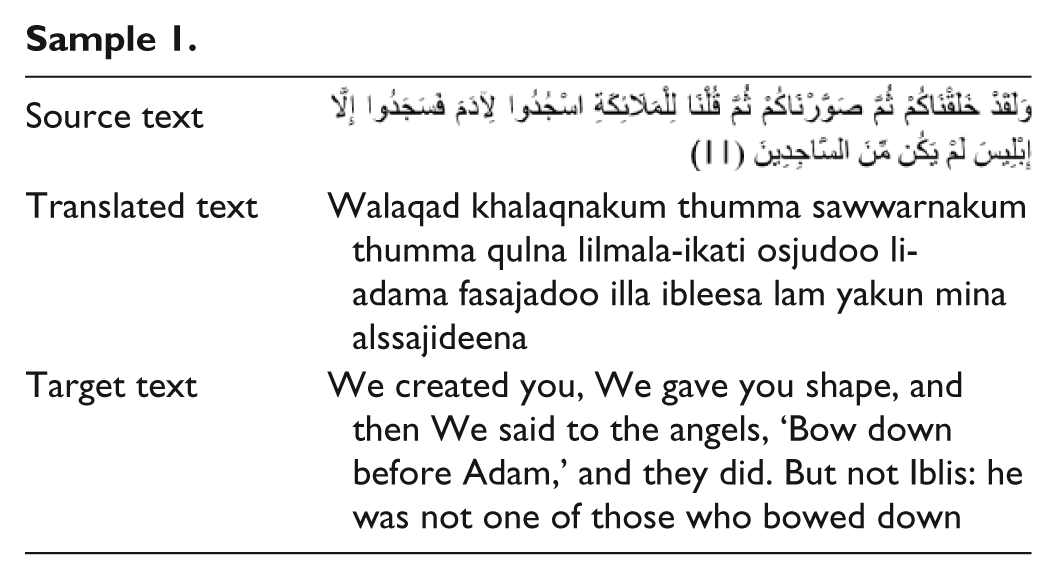
The analysis of the selected ayahs revealed frequent grammatical losses in the translation, which have mostly led to partial semantic losses, while at other times, caused complete semantic losses. For presentation of the results, the Arabic Quranic ayah is provided in the first line(s), transliteration is provided in the second line(s), and Abdel Haleem’s translation in the third line(s), followed by the discussion of the results, which are fronted by brief meaning of each ayah.
The ayah states the bounty of creation, as Allah is the Creator of His creatures including Adam, Eve, and their offspring. The ayah also tells about the situation when angels and Iblis were asked to do sujood or prostration to Adam. Angels obeyed Allah Almighty and did sujood, while Iblis refused such honor of obeying Allah Almighty.
Sample 1 illustrates grammatical losses in emphasis, conjunctions, nominal agents and plurality. These losses are discussed in details in the subsections to follow.
Loss of Emphasis
Emphasis attawkid is one of the characteristics of the Arabic language, which may differ in its forms. Sometimes, it occurs through the use of repetition, synonyms or through the use of certain words among others. One of these devices that is used for emphasis is the letter lam لام and the word  (Al-Samraai, 2006). They are used in the Holy Quran in a precise way, and they are used in the appropriate context, when there is a need for them (Al-Samraai, 2006).
As seen in Sample 1, the Quranic ayah (verse) begins with the affirmative lexeme وَلَقَدْ/Walaqad/, which is used for emphasis purpose. However, this lexeme has been omitted in Abdel Haleem’s translation. In Sample 1, the ayah talks about the creation of the human being, which is a great and important thing, and thus confirmation and emphasis are required (Al Baghawi, 1989; Al-Qurtubi, 2004). As it is expected that if a human being knows that it is Allah Almighty Who created him, he will believe in Him and worship Him. The emphasis here is to draw the attention to the basic and greatest bounty that Allah Almighty bestowed on His creature, that is, creating them. However, the translation did not even compensate for such loss, as sometimes this is followed by some translators, and suggested by many scholars (e.g., Newmark, 1988; As-Safi, 2012). The translator opted to translate it by omission in Baker’s (2011) words. Although the primary meaning of the ST is conveyed in the TT, omitting the emphasizing word surly affects the conveyance of the meaning partially, that is, the aesthetic feature of the ayah is not conveyed in the translation. Thus, this results in partial loss of meaning.
Loss in the Translation of Conjunction
As seen in Sample 1, the conjunction ثم, which refers to time lapse, or “succession at interval” (Catford, Darwin, McCarus, Moray, & Snider, 1974), was omitted from the translation of Abdel Haleem in its first occurrence in the ayah. This omission created partial semantic loss because the meaning of the ST conjunction was not conveyed in the TT. The Quranic conjunction in the ST refers to the fact that taking a certain appearance and shape took place after a lapse of the time of the creation of Prophet Adam (Al Baghawi, 1989). Some exegetes (e.g., Al Baghawi, 1989; Al-Tabari, 2004) have mentioned that the first verb خلقناكم is used to refer to Adam, while the second verb صورناكم refers to all the offspring of Adam. Following this interpretation, the use of conjunction, therefore, is a necessity in that it shows the time lapse, which is not conveyed in the translation.
Another loss in translating conjunctions occurred in translating ف as “and not then,” which caused partial semantic loss, as the Quranic conjunctive letter indicates immediate action. Put simply, the ayah (Sample 1) refers to Allah Almighty’s command to angels to prostrate to Prophet Adam, which was immediately obeyed. When angels were demanded to prostrate or bow to Prophet Adam, they did it immediately without hesitation. However, the use of “and” in rendering the ST conjunction ف does not convey such meaning. This creates loss in the expressive meaning of the ayah, that is, the immediate obedience to Allah Almighty by doing sujood (prostration to Prophet Adam).
Similarly, the resumption و at the very beginning of the ayah was omitted in the translation, which is another instance of the loss in the translation of conjunctions due to the omission of the ST conjunction in the TT. In this sample, Abdel Haleem did not retain the conjunctions in the translation, which is a kind of intra-system shift (Catford, 1965), as both the SL system and the TL system represent conjunctions. However, the translator preferred to leave the conjunctions out in his translation, which affects faithfulness to the ST.
Loss in Translating the Nominal Agent
Sample 1 also illustrates loss in translating the nominal agent. As seen in Sample 1, the Quranic nominal agent ساجدين was translated as “those who bowed down” by Abdel Haleem, which is a level shift (Catford, 1965). Such shift affects the meaning conveyed in the ST because the nominal agent in the Arabic language serves as a descriptive element that indicates constancy. In other words, the nominal clause is used in this ayah to indicate Iblis’s refusal to be among those who prostrate, and thus to obey Allah Almighty. This also creates partial semantic loss, as the expressive meaning of the nominal agent was lost in the translation.
Loss in the Translation of Plurality
Plurality is another problematic area that is challenging in the translation. In Sample 1, the aforementioned shift, in translating the Quranic nominal agent ساجدين as a verb (i.e., bow down), creates loss in plurality. Plurality in the Quranic ayah indicates that many angels were doing sujood or prostration to obey Allah Almighty, and follow His commands. However, this plurality was not conveyed in the translation, which created a partial semantic loss, as the primary meaning was conveyed, but the connotative meaning was lost in the translation. The primary meaning that the angels were doing sujood or prostration to obey Allah Almighty is conveyed. However, the translation seems to have failed to convey the connotative meaning of the ayah in the ST, that is, the vast number of prostrating angels.
The ayah describes how Allah ousted Iblis from Jannah because of his obedience to Allah Almighty (by refusing to do sujood to Adam). In the next subsection, the identified grammatical losses are discussed.
Sample 2 illustrates grammatical losses in translating pronouns, syntactic order, and verbs. These losses are discussed in details in the subsections to follow.

Loss in Pronouns
As seen in the translation of Sample 2, the translator has retained the implicit pro-drop subject pronoun into explicit subject by using the word “God,” which is not explicit in the ST. Similarly, the object pronoun in the Quranic word منها was translated as “here,” which is an adverb, which indicates a class shift from the object pronoun into the adverbial pronoun (Catford, 1965). However, the adverb “here” may be ambiguous for a reader of the translation, as he may not understand what the adverb refer to (which is Jannah). Clarification could have been made using a footnote or even by inserting the word “Jannah” between brackets.
In relation to this, one inherent characteristic of the Quranic text is that pronouns which are not mentioned earlier in the ayah or even in the Surah may be used, but they can be understood from context and from intertextuality, that is, from the understanding of the whole Holy Quran. These pronouns are called pro-drop pronouns, or implicit pronouns, which are similar to the dropped English pronoun (you) in the imperative mood. This characteristic of the Arabic language may cause confusion for a translator, as he may be unsure whether to retain the implicit pronoun explicit or just leave it implicit as it is. This is similar to what Rasekh, Dastjerdi, and Bassir (2012) called as “conscious ambiguity,” in which they mentioned that retaining the ambiguity is the TT is the right option in such kind of a translation. In general, losses in translating pronouns are avoidable, and they can be reduced so as not to create semantic losses.
Loss in Syntactic Order
Another problem in translation is related to the syntactic order. As seen in the translation of Sample 2, the subject “God” precedes the verb “said” in the translation, which is not the case in the ST. The Quranic text has the pro-drop pronoun implicitly following the verb, which could not be kept the same in the translated TT. However, this is a necessity due to the norms of English language which does not allow a verb to precede a subject. This loss in syntactic order creates partial semantic loss in the translation, which affects the expressive meaning (i.e., the aesthetic nature of the ST), as the translation sounds redundant in fronting the subject “God,” which is pro-dropped in the ST.
These findings are consistent with the findings of Abdul-Raof (2004) who showed that semantic loss sometimes occurs due the inability of the translator of observing the syntactic order of the ST. This could be either ascribed to the linguistic limits of the English language, or to the translator’s lack of realizing of the communicative function of foregrounding and backgrounding in the Quranic text. Similarly, Sadiq (2008) showed that foregrounding and backgrounding are rarely followed by translators. Keeping the same syntactic order of the ST in the TT is one of the grammatical losses resulted sometimes from the differences between the SL and TL. Syntactic order of a ST can be hardly kept in the TT, especially when the SL and the TL belong to different language families. Arabic is a language which shows flexibility in the syntactic order. The subject, compliment, or the verb can be foregrounded or backgrounded based on the purpose and the importance of the foregrounded or backgrounded lexical item. This characteristic of the Arabic language is recurrent in the Holy Quran; it serves to highlight the most important meaning. As Al-Samraai (2006) mentioned in his book The Quranic Expression, there is no single word that is foregrounded or backgrounded in the Holy Quran for no purpose. The English language does not have such flexibility of foregrounding and backgrounding, and thus the syntactic order of the ST is lost in the translation. However, many other times, syntactic losses have been created by the translator.
Loss of Verb in Translation
The Quranic sentence “فما يكون لك أن تتكبر فيها” was rendered in the translation (in Sample 2) as “This is no place for your arrogance,” which is a kind of categorical unit shift (Catford, 1965). The verb تتكبر” ” in the ST could not be rendered into an equivalent TT verb due to the lack of equivalent in the TT. In addition, the English noun “arrogance” does have a derived verb form. The translation of the ST verb also reflects overtranslation, as the word “place” is inserted in the translation, though it does not exist in the ST. Literally, the Quranic sentence may be translated as “you cannot be arrogant.” This grammatical loss in translating the ST verb affects the meaning partially, as the ST verb, which is in aorist مضارع /mudarAA/ in Arabic expresses a present and stable action (Daryabadi, 2007); however, it was translated into a noun (i.e. arrogance), which does not serve the same function as the verb. It also makes the translation less faithful to the ST This is, as Daryabadi (2007) highlighted, one of the translation problems in the Holy Quran. The مضارع/mudarAA expresses present action and stable action, which could not be rendered in the translation due to the discrepancies between Arabic and English.
The ayah describes how Satan allured Adam and Eve and urged them to eat from the forbidden tree in Jannah. He tried to convince them that if they eat from the forbidden tree, they will stay immortal in Jannah or become angels. As a result of Adam and Eve’s disobedience to Allah Almighty by eating from the forbidden tree, their privates were exposed. In the next subsections, the identified grammatical losses are explained.
Sample 3 illustrates grammatical losses in translating conjunctions, duality order, syntactic order, and prepositions. These losses are discussed in detail in the subsections to follow.

Loss of Conjunctions
The Arabic conjunction ف indicates immediate succession (Ibn Hisham, 1998). However, in Sample 3, the Quranic conjunction ف at the very beginning of the ayah has not been rendered into the TT, which has created grammatical loss in the translation of the conjunction due to the omission of the conjunction. This affects the meaning partially, as some parts of the ST meaning are not conveyed, that is, the immediate whispering of Satan to Adam and Eve.
Also, the conjunctive و in the Quranic context of و قال in the same sample has not been translated by Abdel Haleem. Instead, he has compensated it by using the colon (:), which is an intra-system shift in Catford’s (1965) words, or translation by omission in Baker’s (2011) words, which does not seem to affect the meaning. However, it affects faithfulness to the ST.
Loss of Duality
Arabic, unlike English, expresses duality in different grammatical forms. In contrast to Arabic, English does not express duality using fixed forms or pronouns. Thus, translators translate second person duality into the second person pronoun, which is used in English for singular as well as plural nouns. This type of translation is referred to by Catford as an intra-system shift. The aforementioned sample (Sample 3) shows eight examples of the loss in the translation of duality. For example, the Quranic object pronoun “هـما” is rendered as “them,” and the object pronoun كما” ”is also translated as “them.” Likewise, the word ملكين is dual which, however, is rendered into plural in the TT. This creates partial semantic loss because the duality meaning is not conveyed in the translation. Furthermore, if the ayah is read out of the context of the whole Holy Surah, the meaning of duality will be mistaken for plurality. This grammatical loss in the translation of duality could have been reduced through a compensation strategy, such as adding “Adam and Eve” in brackets after the TT word.
Loss of Syntactic Order
In Sample 3, the syntactic order of the ST فَوَسْوَسَ لَهُمَا الشَّيْطَانُ is verb + object + subject. However, the same syntactic order could not be preserved in the TT, which is “Satan whispered to them” (subject + verb + object). This different syntactic order in the TT creates partial loss in meaning, which cannot be avoided due to the linguistic differences between the SL and the TL. This is because the ST verb is foregrounded in the ST to highlight the action of Satan. However, the rendered clause in the TT highlights the agent, which is “Satan.
Similarly, in translating “ما نهاكما ربكما,” the syntactic order of the ST is not preserved, which affects its expressive meaning, that is, highlighting the verb which indicates forbidding. In the same way, the syntactic order is not preserved in translating ليبدى لهما ما ورى عنهما من سوءاتهما. The word سوءاتهما is foregrounded in the TT, which affects meaning because backgrounding the Quranic word in the ST highlights the blessing that Adam and Eve had enjoyed before committing their sin, which is hiding their private parts. However, this grammatical loss is recurrent in the translation between two different languages such as English and Arabic; it is a kind of categorical shift, in particular structural shift (Catford, 1965), which results in partial semantic loss.
Loss in Translating Prepositions
The Quranic ل in the word ليبدي functions as لام العاقبة (Al Baghawi, 1989; Al-Qurtubi, 2004), which means the consequence. In other words, as Al-Qurtubi (2004) mentioned in his tafsir, the ayah implies that as a result of Adam and Eve’s disobedience to Allah Almighty, their private parts were exposed. However, Abdel Haleem rendered the preposition ل as “so as to” in the TT, which reflects a meaning that Satan whispered to Adam and Eve to make their private parts exposed, which is inaccurate, and thus a complete semantic loss in the translated TT.
The ayah describes the fact that when Adam and Eve tasted the forbidden fruit in the forbidden tree, their private parts became exposed, and thus they started to put leaves from the trees of Jannah to cover their naked body. Then, Allah Almighty called on them and reminded them that He told them that they should not approach this tree, and that Satan is their sworn enemy. In the next subsections, the identified grammatical losses are explained
Sample 4 illustrates grammatical losses in translating conjunctions, syntactic order, duality and tense. These losses are discussed in details in the subsections to follow.

Loss of Conjunctions
The conjunctive letter ف at the very beginning of the ayah has not been translated, or translated by omission in Baker’s (2011) words. Similarly, the conjunction و in the ayah of رَبُّهُمَا وَنَادَاهُمَا, و طفقا يخصفان and in و أقل لكما has not been rendered in the translation, which is a tendency in Abdel Haleem’s translation. This is an intra-system shift (Catford, 1965) because the SL and the TL represent the conjunctions mentioned in the sample. However, the translator has opted to delete the conjunction in the TT, which has contributed to a partial semantic loss because the Arabic conjunction implies the immediate action taken by Satan to allure Adam and Eve, which has not been conveyed in the translation.
Loss of Syntactic Order
As seen in Sample 4, the Quranic conditional sentence فَلَمَّا الشَّجَرَةَ بَدَتْ لَهُمَا سَوْآتُهُمَا ذَاقَا is made up of two clauses in a specific order. The first clause is فَلَمَّا ذَاقَا الشَّجَرَةَ, while the second clause is بَدَتْ لَهُمَا سَوْآتُهُمَ. However, the translator could not preserve the syntactic order of the ST, as the translator has foregrounded the second clause, which creates a structural shift (Catford, 1965), which affected the meaning of the TT partially. The ST highlights the reason of the exposure of Adam and Eve’s private parts, which is the disobedience to Allah Almighty, that is, eating from the forbidden tree. However, the translation highlights the consequence of the disobedience of Allah Almighty, that is, being naked, which affects meaning partially.
Loss of Duality
Similar to the loss of duality in Sample 3 that has been discussed in the aforementioned sample, in this sample, duality is lost in the translation of the duality of words, such as ذَاقَا and سَوْآتُهُمَا, which could not be rendered as dual in the TT due the linguistic differences between Arabic and English. However, this grammatical loss does not seem to affect the meaning because the duality could be perceived out of the context of the ayah. However, this type of grammatical loss in translating duality affects faithfulness to the ST. In addition, it leaves some of the duality meaning out in the TT. Examining carefully the ST and the TT, it is clear that the meaning of duality in the ST is quite clear, which is not the case in the TT.
Loss of Tense
As seen in Sample 4, the Quranic ST إِنَّ الشَّيْطَانَ لَكُمَا عدوعَدُوٌّ مُّبِينٌ is rendered as “Satan was your sworn enemy,” resulting in loss in tense. The Quranic clause has an implicit pro-drop verb, that is, ‘is’ in the present form. However, it is rendered in the TT as past tense (i.e., was), which affects the meaning conveyed in the TT. The TT past tense verb does not convey the fact that Satan is still an enemy to Adam and his offspring. However, the ST present tense indicates that Satan is not an enemy for Adam and Eve only, but for all their offspring as well. This ST meaning is not conveyed in the TT due to the loss in tense.
The ayah describes how Allah Almighty will remove the ill-feelings from the hearts of believers in Jannah, and how the dwellers of Jannah will praise and thank Allah Almighty for the great guidance Allah Almighty provided to them and which made them inhabitants of Jannah. This guidance was through sending prophets and messengers. Then, the ayah ends with the great call that this great Jannah is inherited by the believers due to their good deeds.
Sample 5 illustrates grammatical losses in translating tense, conjunctions, and emphasis. These losses are discussed in details in the subsections to follow.

Loss in Tense
As seen in Sample 5, the Quranic verb تجري, which is in the present tense, is rendered by Abdel Haleem into the future simple aspect (i.e., will flow) in the TT, which indicates a loss in tense, particularly, the aorist tense. The Quranic ST verb, which is in the present form, indicates a mental picture of rivers as if they are running at the moment of reading the ayah, but the rendered verb is in the future aspect form in the TT, resulting in grammatical and semantic losses. Similarly, The Quranic verb قالوا is also in the past tense form; however, it is rendered into future simple aspect (will say). This actually affects the expressive meaning, which is the fact that the past ST verb indicates the absolute fact that the people of Jannah will thank Allah Almighty that they had been guided to Jannah.
Another double loss occurred in Sample 5 in the translation of نودوا, which is a past passive verb into as “a voice will call out to them,” which is a future active verb. The first loss occurred via the translation of the passive voice into active voice. This creates loss in translating the passive, which serves certain purposes in the language of the Holy Quran such as generalizability. In regard to the ST verb, it is in the past passive form to indicate generalizability, as it may be inferred from the ayah that the people of Jannah will be called by angels or by Allah Almighty or by both, which is rendered ambiguously in the TT. In addition, using active voice instead of passive voice ambiguated the meaning and made the TT less faithful to the ST. The second loss is by rendering the past passive into the future present active voice.
In a similar vein, the Quranic clause بما كنتم تعملون is in the imperfect aspect of the verb. However, it has been translated by Abdel Haleem as “on account of your deeds,” which is a class shift (Catford, 1965); however, it does not convey the imperfect nature of the Quranic verb that expresses the past and the present simultaneously.
Loss of Conjunction
The tendency of Abdel Haleem to drop conjunctions in the TT is also reflected in the translation of Sample 5. The conjunction و occurred in the ST sample 3 times. However, it has been dropped in the translation, which creates a partial semantic loss as some of the ST shades of meaning that are expressed using the conjunction were not conveyed in the TT, that is, the resumption function of the conjunction to separate different statements or clauses.
Loss of Emphasis
In Sample 5, the emphatic word لقد is dropped from the translation in لَقَدْ جَاءَتْ رُسُلُ رَبِّنَا بِالْحَقِّ, which is an example of undertranslation. The Quranic word لقد serves to emphasize the fact that the messengers of Allah Almighty informed people about the truths of the Hereafter which they will find true on the Day of Judgment. This fact will be spelled out by people of Jannah on the Day of Judgment, when they see Jannah and enter it. This grammatical loss of emphasis affects the meaning partially because the emphasis that exists in the ST is lost in the TT, without any sort of compensation.
The ayah describes the bounty of Allah Almighty by sending winds that are laden with clouds. Then, these clouds are driven to a dead and barren land to become revived, and the plants start to grow. Then, the ayah ends with drawing analogy by reviving the dead land and Allah’s Almighty ability to resurrect the dead people on the Day of Judgment.
Sample 6 illustrates grammatical losses in translating pronouns and adverbs. These losses are discussed in details in the subsections to follow.

Loss in Translating Pronouns
As seen in Sample 6, the implicit pronoun that refers to Allah Almighty has been rendered by Abdel Haleem into a noun (i.e., God). Abdel Haleem’s translation tends to be redundant in rendering the pronoun as an explicit noun. This grammatical loss may not affect the conveyance of the meaning of the ST, but it affects the faithfulness to the ST, and it also affects the aesthetic feature of the ST, which is accuracy, precise, and lack of redundancy.
Loss in Translating Adverbs
In Sample 6, the Quranic word بشرى, which is an adverb, is translated as a phrase “bearing good news.” This is a unit shift in Catford’s (1965) words. This shift creates a grammatical loss in the translation of the Quranic adverb, which describes the winds as a source of bounties, and Allah Almighty’s mercy for His creatures. This grammatical loss conveyed unfaithfulness to the ST, which seems to be unavoidable.
Conclusion
This article has focused on the investigation of the grammatical loss in the translation of the Holy Quran, with special reference to Surah Al A’araf, and the extent the different types of grammatical losses cause partial or complete semantic loss. The findings of the study revealed that losses occur in the translation of conjunctions, syntactic order, duality, tense, and verbs. It was also found that grammatical losses contributed to semantic losses, which are mostly partial semantic losses. In addition, some of these losses are avertable which could have been reduced. Thus, it is recommended that future studies focus on the strategies of translating the Holy Quran, and how losses can be reduced in the translation of a sacred book, such as the Holy Quran.
Footnotes
Declaration of Conflicting Interests
The author(s) declared no potential conflicts of interest with respect to the research, authorship, and/or publication of this article.
Funding
The author(s) received no financial support for the research and/or authorship of this article.