




Abstract
Ideas about romantic relationships have been studied in adolescents. This article extends this study to younger children. We asked two hundred seventy 5- to 11-year-olds to draw “two children who have a romance” and “two children who are friends,” and we subsequently interviewed each participant about the characters’ relationships. The drawings were coded with three scales of Pictorial Assessment of Interpersonal Relationships (PAIR), an instrument by Bombi, Pinto, and Cannoni. Interviews were categorized by the characters’ age and identity and by the distinguishing features of romance and friendship: location, intimacy, activity, personal characteristics, and emotions. Scale scores were compared with variance analyses, whereas the categories frequencies were submitted to chi-square. Results showed that all participants were able to distinguish the two relationships, even if the descriptions increased in detail with age. Girls provided more information than boys about romance, but were less inclined to talk about their own romantic experiences.
Introduction
The development of peer relationships during early and middle childhood has been extensively studied, both at a group level (e.g., Gifford-Smith & Brownell, 2003; Hay, Payne, & Chadwick, 2004) and at a dyadic level, with siblings (e.g., Dunn & Kendrick, 1982) and friends (e.g., Berndt, 2004; Bukowski, 2001). However, there is a type of relationship that has been rarely addressed in pre-pubertal youth: children’s “romance” (see Furman & Rose, 2015, for a discussion about this relationship in adolescence). An obvious reason for this neglect is the common idea that young children, being sexually immature, cannot have real love emotions and, a fortiori, they cannot form relationships based on an emotion they do not feel.
In contrast with this notion, Hatfield, Schmitz, Cornelius, and Rapson (1988) proposed that virtually all children can experience not only “companionate love” (with feelings of fondness, liking, and interpersonal commitment) but also “passionate love,” that is, an intense desire for union with another person. In a study conducted by these scholars with 336 children and adolescents 4 to 18 years old, none of the participants found it difficult to understand the terms “boyfriend” or “girlfriend,” to remember children in their entourage who had a partner of this sort or to name a peer of the opposite sex they would like for a romantic engagement. To assess the extent to which passionate love was present at the various ages, the authors devised the Juvenile Love Scale, an instrument subsequently included in the Handbook of Sexuality-Related Measures (3rd ed.; Fisher, Davis, Yarber, & Davis, 2011) that requires rating the subject’s agreement with sentences such as “I’d feel bad if I thought that [name of subject’s girlfriend or boyfriend, real or desired] liked somebody else better than me” and “When [name] is around I really want to touch him/her and be touched.” Using this scale, the authors found that the intensity of love in younger participants was comparable with that of the older participants; girls older than 6 years tended to receive higher scores than boys.
More recently, Brechet (2015) has demonstrated that children from 6 to 10 years of age are able to represent the emotion of love in their drawings. The author asked the participants to draw a person as a basic reference, and then compared this drawing with a second figure portraying “a person who is very much in love” (“amoureux” in the original task, a word specifically referring to romantic love). Children used various pictorial devices to distinguish the person in love from the reference figure: the symbol of heart (60% of the drawings), the presence of another person (39%), words of love (28%), metaphoric indices of a pleasant environment such as blue sky or little birds (18%), reddened cheeks (18%), heart-shaped eyes (17%), and sophisticated outfit (15%). The mean number of indicators increased significantly with age (from 1.62 at 6 years to 1.91 at 8 years to 2.37 at 10 years), but it is noteworthy that all children, even the youngest, included at least one indicator.
Taken together, the two above studies propose an image of “love-competent” young children, even if the source and extent of this competence remains speculative.
In fact, the seminal work of Hatfield et al. (1988) was repeated neither systematically, nor cross-culturally, so that we do not have a great deal of information concerning young children’s ideas about romance generally (Neeman, Hubbard, & Masten, 1995).
The literature about early romantic experiences typically focus on adolescents (see Furman, Brown, & Feiring, 2009, for a comprehensive review), and even the studies about early adolescence only take into account ages 11 (e.g., Brendgen, Vitaro, Doyle, Markiewicz, & Bukowski, 2002) and 12 years (e.g., Giordano, Longmore, & Manning, 2006).
The few researches including younger participants we were able to find were concentrated on children at the threshold of puberty and were mainly sociological or ethnographic explorative reports based on in-depth study of small numbers of children. For instance, Thorne and Luria (2004), observing fourth and fifth graders in two schools of California and Massachusetts during the less supervised moments of the day (in the playground, hallways, lunchroom), found that children engaged in “hetherosexually charged rituals” such as a chase-and-kiss game, or teasing somebody for liking a peer of the opposite sex; sometimes, a child revealed to a friend of having a crush, but according to the authors, these romances were more often imagined than real. Experiences of exchanging “Valentines” as indices of romantic socialization were also examined by Bright (1997). Mention of romantic relationships emerged, even if not explicitly requested, in a study by Walton, Weatherall, and Jackson (2002) who collected written accounts of conflict episodes from fourth, fifth, and sixth graders in some U.S. public schools; in a small number of cases (33 out of 689), the stories of conflict were focused on problems arising in the context of romantic relationships. Also, Renold (2003, 2006), who conducted a year-long ethnographic study in two primary school classes in England, found that children between 10 and 11 years old spontaneously talked about cross-gender interactions and relationships of romantic nature. Recently, a work by Holford, Renold, and Huuki (2013) took into account younger children (5-6 years old); their article provides an ethnographic report of some games involving children’s kissing, sometimes accompanied by proposals of marriage, but—as far one can gather from the described examples—this behavior did not happen in the context of dyadic relationships.
The studies summarized in the previous paragraph agree in considering the reference to romance more a way of reinforcing the distinction between the separate social worlds of boys and girls, than genuine loving experiences of some sort. However, the children’s romantic talk, teasing and play, is not irrelevant for the subsequent adolescent experiences, setting the stage for the different perspectives with which teenagers will approach their relationships to the opposite sex. As Thorne and Luria (1986) clearly stated,
Children draw on sexual meanings to maintain gender segregation—to make cross-gender interaction risky and to mark and ritualize boundaries between “the boys” and “the girls.” In their separate gender groups, girls and boys learn somewhat different patterns of bonding—boys sharing the arousal of group rule-breaking; girls emphasizing the construction of intimacy, and themes of romance. (p. 188)
A more systematic psychological study, involving 1,664 participants from 8 to 14 years old, was conducted by Carlson and Rose (2007) in six U.S. Midwestern school districts; 58.4% of third graders and 49.7% of fifth graders reported to have a boyfriend or a girlfriend, which was not simply a friend who happened to be a boy (for girls) or a girl (for boys). It may seem surprising that figures are lower for older children (seventh grade: 37%; ninth grade: 39.5%). However, this might be explained by the high proportion of younger children who made non-reciprocal nominations. In fact (excluding children with out-of-class romantic relationships for whom reciprocity could not be assessed), the percentages of unilateral naming was 65.4% in third grade, 54.6% in fifth grade, 40.6% in seventh grade, and only 10% in ninth grade. According to the authors, young children could attribute a romantic meaning to friendly behaviors, which would imply that their idea of romance is not well defined, and at least partially overlapping with cross-gender friendship.
This issue, however, had been examined in another psychological study by Connolly, Craig, Goldberg, and Pepler (1999) with different conclusions. These authors asked 1,755 children from 9 to 14 years to explain the difference between cross-sex friendship and romance, providing the boys with the following sentence stems: “A female friend is . . .” and “A girlfriend is . . .” (for girls, the stems were “A male friend is . . .” and “A boyfriend is . . .”). Only 1% of the participant denied the existence of differences between cross-sex friendship and romance. Descriptions of both friends and romantic partners were coded into four categories: passion (including references to special liking, intense caring, love, crushes, romance, physical attraction, sexual contact), affiliation (liking, friendship, companionship, dating), intimacy (trust, self-disclosure, closeness, support), and commitment (long-term alliance, exclusivity). Passion and commitment were almost uniquely associated with romance, while intimacy was equally present in romance and friendship, increasing for both relationships with age. Because affiliation was preeminent in the descriptions of friends, but was mentioned quite often also for boyfriends or girlfriends, the subcodes of this category were analyzed separately, showing that in cross-sex friendships, affiliation referred only to companionship, while in romantic relationships affiliation referred to both companionship and dating. Similarly, the few mentions of passion in the context of cross-sex friendship consisted of intense liking and caring, whereas physical and sexual contacts were mentioned only for romance. Interestingly, the ability to differentiate the two types of relationships did not depend on direct experience, which was quite low for both romance and cross-sex friendship; the amount of interaction with friends of the opposite sex and with romantic partners, however, was related to the frequency of reference to intimacy.
The Rationale for Our Study
The available literature, while pointing to the relevance of romantic love for young children, leaves almost unexplored the representation of romantic relationships before late childhood.
Our study follows the lead of Hatfield et al. (1998) and Brechet (2015) who suggested that even very young children know what “passionate love” is. Our approach, however, differs from both of these studies in that we consider it necessary to begin with an in-depth descriptive account not only of romance but also of friendship. One reason is that we have only two systematic studies about the children’s ability to distinguish the features of these two relationships (Carlson & Rose, 2007; Connolly et al., 1999), and they are about older children; moreover, they produced different results. Another reason is that we lack completely young children’s spontaneous accounts of what romance is, although the systematic study of friendship was developed on the basis of detailed descriptive reports (e.g., Selman, 1981; Youniss, 1980). Our study is aimed precisely at providing a descriptive account of children’s representation of both relationships, to verify if and how young children are able to distinguish them. To this end, we used a combination of methods: drawing and interview.
Drawing has the capacity to facilitate children’s reflection and subsequent verbal expression, as is well known by clinicians (see Davis, 2011, as a recent example of this clinical use of drawing); however, drawing as a complement of verbal expression has been used also in research contexts (e.g., Yuen, 2004). One reason for the drawing efficacy in facilitating the child’s verbalization could be its function of emotion regulation, as recently demonstrated by Drake and Winner (2013). Thanks to this function, drawing opens the way to talk about emotionally laden topics, which children tend to keep to themselves, as could be the case for romantic relationships.
Pictorial representations of relationships can be interesting per se, and have been traditionally used in clinical settings (Madigan, Ladd, & Goldberg, 2003; Pinto & Bombi, 2008). Here, however, we did not apply a symbolical interpretation, which has encountered a variety of objections (see Thomas & Silk, 1990, for a critical analysis of traditional approaches, and also Shiakou, 2012, for a more recent summary of these criticisms). Rather, we used drawings only for their explicit communicative potential, adopting PAIR (Pictorial Assessment of Interpersonal Relationships), an empirically based instrument devised by Bombi, Pinto, and Cannoni (2007) and subsequently used by many scholars (e.g., Laghi et al., 2013; Laghi et al., 2014; Lecce, Pagnin, & Pinto, 2009; Misailidi, Bonoti, & Savva, 2012; Rabaglietti, Vacirca, Zucchetti, & Ciarano, 2012; Sándor, Fülöp, & Sebestyén, 2012). PAIR requires each participant to draw one or more pictures of two persons, to illustrate the relationship between them. This way of presenting the task makes it clear the communicative, non playful nature of the drawing to be produced. The data are then analyzed with different scales, which can be used—according to the research aims—to evaluate the physical and psychological affinity of the figures (Scale of Similarity), their comparative importance (Scale of Value), their relationship (Scales of Cohesion and Distancing), and their emotional state (Scale of Emotion). To enhance the validity and depth of information gathered with drawings, Bombi et al. (2007) suggested using contrastive tasks, in which children are required to represent two instances of the same relationship (e.g., two friends when they get along well and when they have a quarrel) or two relationships (e.g., you and your mother; you and your father). A contrastive strategy is especially useful in the present study, because it allows the discovery of similarities and differences between children’s romance and friendship, the most widely experienced relationship with peers. In particular, the Value Scale can show if the parity between partners, which is characteristic of friendship (Hartup, 1989) also applies to romantic relationships; the Cohesion and Distancing Scales can show if the partners’ connectedness, which in friends’ dyads can coexist with the need for autonomy (Bombi & Pinto, 1994), is stronger in romantic couples.
The combination of drawing and interview is especially important here, because children are not entirely at ease when talking about romantic behaviors (e.g., kissing); however, children’s romance cannot be understood through pictorial representations alone, because some characteristics of partners are not easy or are impossible to draw (e.g., feelings, age). In sum, a multi-method approach was more promising than a single instrument to gather a rich description of children’s romance and friendship.
Hypotheses
Using the joint information of drawings and interviews, we enlarged the scope of the study, focusing on (a) the personal characteristics of friends and romantic partners and (b) the features of friendship and romance; for both aspects, we checked for possible differences linked to age and sex.
Personal Characteristics
We hypothesized that friends would be more similar to each other than romantic partners, because homophyly and the attempt at achieving a balance of power are well-known features of friendship (Berndt, 1986; Tesser, Campbell, & Smith, 1984); love, however, requires complementarity, for example, in terms of emotional dependence and caring for the other (for a discussion of these forms of complementarity in love relationships, see Shaver, Morgan, & Wu, 1996).
Analyzing the identity attributed to friends and romantic partners was also a way to gain some information, albeit indirect, about the prevalence of personal romantic experiences; we hypothesized that children would refer mostly to imaginary characters in the case of romance and mostly to real children (including themselves) in the case of friendship. In fact, friendship is a virtually universal experience during childhood (Krappmann, 1996) whereas the sociological and ethnographic studies summarized above (Holford et al., 2013; Renold, 2003, 2006; Thorne & Luria, 2004) suggest that children’s romantic behavior, especially for the youngest (Holford et al., 2013) is mainly a ritualized way to reinforce gender difference and does not imply necessarily a direct involvement in sustained relationships.
Features of the Two Relationships
These features should emerge from partners’ behaviors, portrayed and described. Following Connolly et al. (1999), we expected that children would be able to distinguish friendship and romance, depicting the first as an affiliative and companionate bond, less intimate and emotional than the second. Moreover, friendship allows a large variety of shared activities with the only exclusion of those carrying a sexual meaning; however, even if boyfriends and girlfriends spend their time in a variety of non-sexual and non-gendered activities (Carlson, 2006), it is probable that children would use especially sexualized and more intimate interactions to distinguish romantic couples from pairs of friends.
The ability to distinguish romance and friendship should be already present in children younger than those interviewed by Connolly et al. (1999), given the early awareness of passionate love demonstrated by Hatfield et al. (1988) and by Brechet (2015); however, we expected that the representations of young children should be less detailed than that of older, more experienced children.
Finally, in view of the different emotional socialization of boys and girls (Chaplin, Cole, & Zahn-Waxler, 2005) and especially their different experiences in the romantic arena (Renold, 2003, 2006; Thorne & Luria, 1986), we expected that the characterization of “romantic partnership” would differ somehow in boys and girls, but the lack of previous research did not allowed us to develop more detailed hypotheses.
Method
Participants
With the consent of parents and school authorities, 270 children from 5 to 11 years of age participated in the study. There were six age groups: kindergarten (20 boys, 24 girls; M age = 5.6), first grade (22 boys, 23 girls; M age = 6.2), second grade (22 boys, 21 girls; M age = 7.5), third grade (23 boys, 23 girls; M age = 8.4), fourth grade (23 boys, 23 girls; M age = 9.6), and fifth grade (23 boys, 23 girls; M age = 10.7). To represent a variety of social environments, one boy and one girl were randomly chosen from various kindergarten and primary school classes in 24 locations in southern and central Italy. Categorized by parents’ occupations, participants belong mainly to middle- and upper-middle-class (fathers: 12% blue-collar workers, students, or unemployed; 21% self-employed or shopkeepers; 33% technicians, teachers, employees; and 34% professionals or white-collar managers; mothers: 45% housewives; 8% blue-collar workers; 30% technicians, teachers, employees; and 17% professionals or white-collar managers).
Measures
To talk about romantic relationships could be embarrassing for a child, especially with an unfamiliar adult. This is why we resorted to drawing, a less direct form of information, followed by a short interview based on the drawing contents.
Drawings were collected and scored with PAIR, the above described instrument by Bombi et al. (2007). In this study, children were asked to make two separate drawings: (friendship drawing, FD) “two children who are friends” and (romantic drawing, RD) “two children who are ‘engaged.’” Note that in Italian the masculine plural “bambini” is grammatically generic and gender free, applying to all combinations of gender; hence, children could interpret the request as to draw two girls, two boys, or a girl and a boy.
The interviews were conducted to complement the information provided by the drawings (a) about the personal characteristics of the two friends and of the two romantic partners (age, identity) and (b) about circumstances and distinctive features of their relationships (places of meetings; answers to the question: “What, in your drawings, shows the difference between friendships and romance?”).
Procedure
Data were collected individually by a research assistant in a quiet schoolroom. She explained to each participant that she needed help to understand better various ideas about children’s romantic relationships and friendship. After receiving the child’s consent to discuss these topics, she gave the participant a pencil, 12 crayons, an eraser, and two white sheets (8.5″ × 11″) asking him or her to draw “two children who are friends demonstrating what it means to be friends” (FD) and then “two children who are ‘engaged’ demonstrating what it means to have a romantic relationship” (RD); the task order was reversed for half of the sample. At the end of the two drawings, the child was interviewed as described above.
Data classifying
To ensure the comparability of friendship and romance, the same scales and categories were used to score the two drawings (FD and RD) and the interview contents pertaining to friendship (Friendship Interview, FI) and romance (Romantic Interview, RI).
Drawings
In each drawing, the apparent age of each figure was coded child = 1 and adult = 2, and the apparent gender, male = 1, female = 2.
Three scales of PAIR (Bombi et al., 2007) were then applied.
The Scale of Value was used to verify if the two characters in each drawing (FD and RD) were pictorially equivalent or not. This scale provides a score from 0 to 10 for each figure, according to its dimensions, position in the page, body details, attributes (i.e., clothing and held objects) and colors; the difference between the figures’ scores indicates the degree of dyad value disparity; this difference also allows determining which figure is more valued of the two, or the dyad parity, where dyad refers to the pair of figures taken as a unit.
Other two PAIR scales were used to evaluate the closeness of the characters’ relationship. The Scale of Cohesion measures the interdependence between the partners, and provides a score from 0 to 6 to the dyad, according to the presence of six types of pictorial cues: looking, approaching, acting together, being near to each other, sharing a common location, touching each other, or being connected by an object. The Scale of Distancing measures the autonomy of the partners, and provides a score from 0 to 6 to the dyad, according to the presence of six types of pictorial cues: avoiding to look at the other, moving away, acting independently from the other, being far, staying in a specific space (not shared with the other), being separated by something.
The drawings were scored by two trained judges, blind to the research aims, following the guidelines reported by Bombi et al. (2007). The scores assigned by the two judges were highly correlated (Pearson’s r = .86, p < .001, for Value; r = .88, p < .001, for Cohesion; r = .91, p < .001 for Distancing). For the final score assignment, where the judges differed, a discussion followed until full agreement was reached.
Interviews
All the interviews were literally transcribed. An inspection of two protocols per age allowed us to detect the following interview contents about friendship (FI) and romance (RI): characters’ age, dyad identity, place of meetings, and relationship features. The information about this last content was provided in response to our request to explain the distinctive features of the drawings, but children elaborated their answers in such a way that drawings appeared merely the occasion for them to present their ideas about the difference between friendship and romance.
The characters age, both for FI and RI, received a continuous score in years.
The dyad identity, both for FI and RI, was classified in five mutually exclusive categories, ordered by increasing reality and psychological proximity to the subject: 1 = two imaginary children (“children I invented”); 2 = real generic children (“two real boys/girls”; “Maria and Walter”); 3 = acquaintances (“two classmates,” “my neighbors”); 4 = individuals closely related to the subject (“two of my friends”); 5 = a dyad including the subject (“me and my best friend”; “my girlfriend and I”).
The place of meetings, both for FI and RI, was classified in five mutually exclusive categories: 0 = do not know, 1 = school, 2 = home, 3 = outdoors (park, street, etc.), and 4 = public places (fast food, swimming pool, supermarket, etc.).
For the relationship features, both FI and RI received five scores from 0 to 2 for the presence of each of five features, non-mutually exclusive: 1 = location, 2 = degree of intimacy, 3 = type of activity, 4 = personal characteristics, and 5 = attributed emotions.
Moreover, in each of these five scores two mutually exclusive subcodes could be identified, as indicated by letters: (1) location could be either 1a = proximity (“to be in the same place”) or 1b = privacy (“to be alone together”); (2) degree of intimacy could be either 2a = contact (“to hold hands”) or 2b = intimate contact (“to kiss”); (3) type of activity could be either 3a = generic or friendly activity (“to play”) or 3b = romantic activity (“to receive a Valentine”); (4) personal characteristics could be either 4a = friendly characteristics (“to resemble each other”) or 4b = romantic characteristics (“to look attractive”); (5) attributed emotions could be either 5a = relational emotions (“to be happy”) or 5b = romantic emotions (“to be in love”). Scores of two new categories (friendly accent and romantic accent) were then obtained by summing the frequency of all the (a) subcodes and (b) subcodes, both for FI and RI.
The categories and scores were assigned by the first author; the few ambiguous answers were analyzed jointly with the second author and the category or subcode was assigned after reaching an inter-judge agreement.
Data analyses
The Statistical Package for the Social Sciences (SPSS 20.0) was used for all the statistical tests.
When a parametric test was applicable (drawing scores of Value Disparity, Cohesion and Distancing, characters age, scores of the five relationship features, scores of friendly and romantic accent), we compared the scores (in FD and RD, or in FI and RI) with variance analyses for repeated measures, with age or sex as independent variables; Duncan’s test or Student’s T for paired samples were used for the post hoc comparisons. When appropriate, Pearson’s r was used as a correlation index. The χ2 was used for the comparisons by age and sex of the remaining interviews contents (dyads identity and place of meetings) and for the frequencies of valorization of each figure in the two drawings.
Results
Personal Characteristics of Friends and Romantic Partners
Age of partners
All the participants fulfilled the task requirements, depicting two children in each drawing. When asked to attribute an age to the romantic partners, 69 children were not able to answer, and some (n = 12) were discarded because they attributed an adult age to one or both figures, even if the drawing—according to the task—represented two children; for the remaining 189 children, the ages of the two romantic partners were highly correlated, r = .91, p < .001. The 227 children who provided valid data for friends assigned also in this case similar ages to the two drawn characters, r = .89, p < .001. Romantic partners are same age in 61% of the cases, or differ by 1 year (29%); differences of 2 or more years are 10%. Friends are same age in 64% of the cases, or differ by 1 year (27%); differences of 2 or more years are 9%. Based on this similarity, we then computed the mean ages of romantic partners, on one hand, and of friends, on the other hand. The variance analysis for repeated measures on these ages (valid cases, N = 181) yielded only two main effects: type of dyad (romantic partners = 8.5 years; friends = 8.2 years), Fisher’s F(1, 169) = 7.17, p < .01, and participants age (M dyads age in years: 5 years = 5.7; 6 years: 7.5; 7 years: 7.4; 8 years: 8.8; 9 years: 9.6; 10 years: 10.5), Fisher’s F(5, 169) = 72.97, p < .001. The post hoc comparisons showed that the average age of the drawn dyads increased regularly from one age group to the next, with the exception of the 7-year-olds who did not differ from the 6-year-olds.
Gender of partners
All the RD included figures of the opposite sex; the dyads of the FD, instead, were mainly same-gender, and more often composed of two boys (two boys = 46%; two girls = 30%; a boy and a girl = 24%), χ2(2) = 21.67, p < .001. There were no age differences in these choices, χ2(10) = 10.82, p = .367. The participants’ sex, instead, had a significant influence, χ2(2) = 151.28, p < .001; in fact, 83% of the boys depicted two male friends, while only 55% of the girls depicted two female friends; friendly dyads composed of a boy and a girl appeared in 35% of the girls drawings and in 13% of the boys drawings; 10% of the girls represented two male friends and only 4% of the boys represented two female friends.
Partners’ value
The comparison of Value Disparity yielded only a tendencial difference between the RD and FD, Fisher’s F(1, 258) = 3.34, p = .069: The average disparities were very small and only slightly larger for the romantic partners (RD = 1.33; FD = 1.13).
In the RD, children tended to give more value to the girlfriend, χ2(2) = 6.69, p < .05, parity = 29%, boy valued = 30%, girl valued = 41%, this tendency was independent from children’s age, χ2(10) = 16.01, p = .10, and sex, χ2(2) = 0.85, p = .65. A higher value of the female partner appeared also in the 65 FD with mixed-sex dyads, χ2(2) = 7.97, p < .05, parity = 22%, boy valued = 29%, girl valued = 49%; χ2 by age and by sex was not applicable here, due to the small number of cases.
Identity of partners
The distribution of answers to the question “Who are these two characters?” both for RD and FD is shown in Table 1.
Type of Partners by Relationship.

The frequencies of the identities attributed to romantic partners were significantly different, χ2(4) = 59.56, p < .001. Romantic couples were mostly composed of “generic children” (34%) to whom the interviewees attributed real existence or an appropriate name; the second most frequent category was that of completely imaginary partners, which we could identify as different for gender by the drawings, but to whom the child did not provide a name or any other qualification (28%). Acquaintances (classmates, neighbors) and closely related people (typically participant’s friends, and sometimes cousins or siblings) were mentioned, respectively, by 18% and 11% of the interviewees. Only 25 children (9%) admitted to be one of the depicted characters, with a generic child of the opposite sex (n = 9), a classmate (n = 9), a friend (n = 6), and in just one case, the subject’s girlfriend.
Also, the frequencies of friends’ identities were significantly different, χ2(4) = 26.74, p < .001, but in this case, the subject was very often involved (54% in total, with a classmate 31%, with an imaginary child 23%); dyads composed by two generic children, two subject’s acquaintances or two subject’s friends were, respectively, 17%, 15%, and 14% of the total.
We found no age differences in the identities attributed to friends, χ2(20) = 23.58, p = .26. For romantic partners, to apply the χ2, it was necessary to collapse the frequency of two categories, “close relationship” and “subject involved,” due to the small frequency of this last category; the subsequent comparison by age did not show significant differences, χ2(15) = 16.84, p = .33. The participants’ sex yielded a tendency only for the romantic dyads, χ2(4) = 8.83, p = .06, because boys mentioned themselves as one member of the dyad twice as often as girls (boys, n = 17; girls, n = 8); no sex differences emerged in the identity attributed to friends, χ2(4) = 4.12, p = .39.
Features of Friendship and Romantic Relationship
Closeness of the two relationships in the drawings
First of all, we resorted to the Cohesion and Distancing scores to compare the closeness of the two relationships. The variance analysis for repeated measures (scores of Cohesion and Distancing in the RD and FD) showed that the overall number of pictorial cues (M of Cohesion scores and Distancing scores in the two drawings) increased with age (5 years: 1.59; 6 years: 2.53; 7 years: 2.98; 8 years: 3.06; 9 years: 3.3; 10 years: 4.67), Fisher’s F(5, 258) = 11.31, p < .001. The post hoc comparisons showed that the scores increased significantly from 5 to 6 years and again from 9 to 10 years. The progression, however, was not identical for Cohesion and Distancing, yielding an interaction between age and scale, Fisher’s F(5, 258) = 9.51, p < .001: progression was quite regular for the Cohesion scores, with significant increases between 5 and 6 years of age and between 9 and 10 years of age; for Distancing, instead, the only significant difference appeared between 5 and 9 years of age, with non-significant fluctuations in the remaining ages.
Considering the mean scores of the two drawings, Cohesion was significantly higher than Distancing (Cohesion = 1.99; Distancing = 0.47), Fisher’s F(1, 258) = 506.58, p < .001, but there was also a significant interaction with the type of drawing, Fisher’s F(1, 258) = 20.95, p < .001, as shown in Figure 1. Post hoc comparison showed that Cohesion was significantly higher in the RD, while Distancing was significantly higher in FD.

Cohesion and Distancing in the two drawings.
Place of meetings
Drawings were not always sufficient to understand which places children deemed appropriate for romantic or friendly meetings, but this issue was clarified during the interview. Several children were unable to locate the partners meetings (24% for the romantic couples; 19% for friends); however, several children provided more than one possible location. The summed frequencies (n = 278, for friends’ meetings; n = 249, for romantic meetings) were only qualitatively compared. We found that the most frequent place for children meetings was outdoors, for friends (37%) and especially for the romantic partners (47%); the less common were public places, such as coffee shops or fast food restaurants (friends = 9%; romantic partners = 11%). The second most common location was school, both for friends (29%) and for romantic partners (26%). Home, instead, was indicated quite often as a place for meeting friends (25%), but much more rarely for romantic meetings (16%). All considered, children seemed to prefer those places that offer a certain freedom of action (gardens, parks, streets, and sometimes public places) and are not so directly supervised by adults, such as schools and especially homes. This was true for friendship, but was more often reported for romantic meetings.
To estimate the possible differences by sex and age, we applied the χ2 to the children’s first answers, combining the relatively rare category “public places” to the category “outdoors.” These comparisons did not yield significant differences by sex, friends’ meeting places: χ2(3) = 0.16, p = .98; romantic meeting places: χ2(3) = 1.27, p = .73. Age was clearly non-significant for friends, χ2(15) = 17.04, p = .32, and only marginally significant for romantic couples, χ2(15) = 23.68, p = .07; an analysis of residuals showed that younger children were more often unable to locate the romantic meetings than were their older peers, who in turn mentioned outdoors/public places slightly more often.
Features of the two relationships in children’s verbal descriptions
Finally, we compared the five scores of relationship features obtained in FI and RI with age as an independent variable. This variance analysis with repeated measures yielded three main effects: age, FI versus RI, and type of relationship feature. The average score of the five relational features increased with age (5 years = 1.77, 6 years = 2.33, 7 years = 2.39, 8 years = 2.80, 9 years = 2.69, 10 years = 2.85); Fisher’s F(5, 264) = 5.93, p < .001; the post hoc comparison showed a significant jump from 5 to 6 years and a slower progression between 6 and 10 years, resulting in a significant difference between 6 and 10 years only. The mean score of the five relational features resulted higher for RI (1.32) than for FI (1.16), Fisher’s F(1, 264) = 9.93, p < .01. There was a significant difference between the five relationship features (M of FI and RI), Fisher’s F(4, 1,056) = 47.2, p < .001: In fact, activity (.88) was mentioned more often than any other feature, followed by emotions (.65) and proximity (.52); these latter two were significantly more often mentioned than location (.26), which in turn was more frequent than personal characteristics (.17). Finally, an interaction emerged between relationship features and the two relationships children were talking about, Fisher’s F(4, 1,056) = 37.71, p < .001, as shown in Figure 2.

Scores of relationship features for friendship and romance.
The post hoc comparisons on the data of Figure 2 showed that degree of proximity, emotions, and location was significantly higher for romantic partners, while activity was typical of friends; personal characteristics were rarely mentioned and were not significantly different in the two relationships.
A variance analysis with the same design, with sex instead of age as independent variable, did not show main effects of sex, but only a tendential interaction between sex and type of relationship, Fisher’s F(1, 268) = 3.83, p = .05, as shown in Figure 3.

Scores of boys and girls for relational features of friendship and romance.
The post hoc comparisons on the data of Figure 3 showed that the prevalence of information about romantic relationships was found in girls only.
Friendly and romantic accent in children’s verbal descriptions
Finally, we compared the scores of the friendly and romantic accent in the FI and RI with a variance analysis for repeated measures with two age groups (young = 5-7 years; old = 8-10 years) as the independent variable. The low frequencies of romantic subcategories attributed to friendship made not possible to compare six age groups. Age, type of relationship, and type of accent yielded three main effects strictly corresponding to those presented above in the paragraph about the relational features: 1) young = 2.16; old = 2.78, Fisher’s F(1, 268) = 20.43, p < .001; 2) romance = 1.32; friendship = 1.16; Fisher’s F(1, 268) = 111.85, p < .001; 3) romantic accent = .65; friendly accent = 1.84; Fisher’s F(1, 268) = 9.77, p < .01. More interestingly, two interactions emerged: type of accent by relationship, Fisher’s F(1, 268) = 207.25, p < .001, illustrated in Figure 4, and type of accent by relationship by age, Fisher’s F(1, 268) = 11.32, p = .001, illustrated in Figure 5.
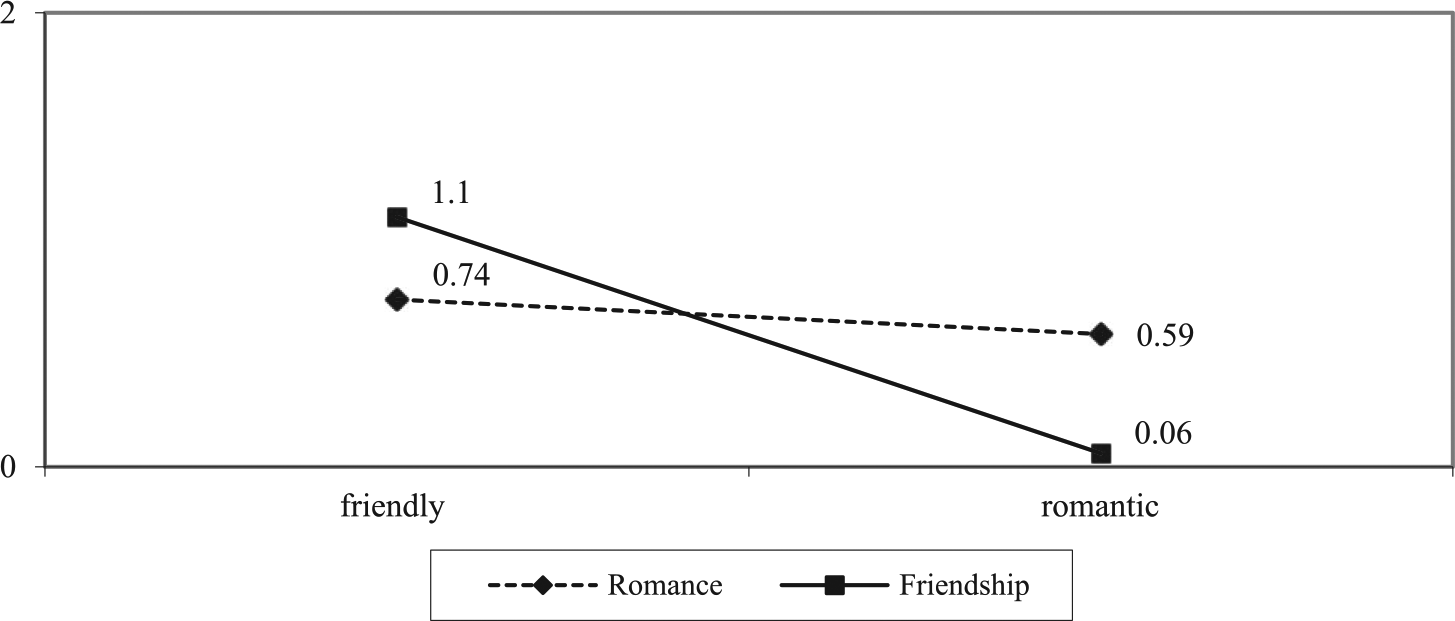
Romantic and friendly accent by type of relationship.

Younger and older children’s use of romantic and friendly accent to describe romance and friendship.
All the means of Figure 4 are significantly different from each other, but it is evident that romantic relationship admits the basic relational properties of friendship, although friendship is definitely not romantic. In fact, a closer look at the subcodes in each relational feature reveals that the kind of location was never “private” for friends, as happens for romantic partners; in addition to their closer contact, three quarters of the activities and emotions attributed to the boyfriend–girlfriend dyad were “romantic,” while this happened only rarely for friends.
Figure 5 shows that older children differ from younger only in the quantity of use of the appropriate accent, both for romance and for friendship; instead, the inappropriate use of romantic accent to describe friendship is significantly lower than any other score at both ages. A variance analysis with the same design, with sex instead of two age groups as independent variable, did not show main effects of sex, but only a tendential interaction between sex and type of relationship, Fisher’s F(1, 268) = 3.83, p = .05, which is in fact the same already shown in Figure 3.
Discussion
The data presented above demonstrate that 5- to 11-year-olds do not confuse romantic engagement with friendship, lending support to the findings by Connolly et al. (1999) possibly because their study also used a contrastive procedure, which tends to emphasize differences. However, the open-ended verbal questions and the non-leading pictorial task allowed children also to show similarities when they deemed it appropriate: in fact, differentiation was evident in the features attributed to each relationship, but much less evident in the partners’ characteristics.
Our hypothesis that friends would be more similar to each other than romantic partners did not receive a strong support, besides the fact that RDs always included a boy and a girl (but 25% of the FDs did so as well). The partners’ ages were as highly correlated for romance as for friendship, and the Value Disparity was only tendentially higher for romantic partners. Moreover, the fact that this disparity was due to a higher valorization of the female figure with respect to the male figure, and that this happened also in those FDs including a boy and a girl, make it unlikely that the tendential Value Disparity should be attributed to the romantic relationship per se. It may be that children’s romance still shares more “friendly” functions than adolescents’ and adult’s romance and has not yet come to the complementarity that is implicit in mature sexual roles.
We expected that the identity attributed to the depicted friends and romantic partners would help us to detect the degree of direct participant involvement in each of these two relationships. Our hypothesis that children’s ideas would not be the reflection of direct romantic experiences gains support from the fact that participants had more difficulty in attributing a precise age and identity to romantic partners, as compared with friends. Romance is attributed to imaginary children more often than friendship, and above all, very rarely includes the self, which is often represented in the FDs. Nevertheless, romantic relationships seem to be part of children’s culture, not only because of the ease with which the participants in this study accepted and completed the task of portraying them, but also because the romantic partners they describe are typically children of their same age. This is reflected in the characteristics of the boyfriend–girlfriend drawings even though the participants do not explicitly identify themselves with these drawings.
The hypothesis that friendship would be presented as an affiliative and companionate bond, less intimate and emotional than romance has been confirmed by several results. In the drawings, friends are portrayed with less Cohesion and more Distancing than boyfriend–girlfriend dyads, that is, with less indices of partner connection and more cues of independence. In the interviews, friendship was characterized above all by shared activities, while emotions, physical proximity, and search for privacy were much more typical of romantic dyads, which children also described as meeting away from adult supervision more often than friends. These results are coherent with the notion that “passionate love” is understood by young children (Brechet, 2015; Hatfield et al., 1988) and possibly part of their direct experience, even if the slightly older mean age attributed to romantic couples might be interpreted as an indication that romance is somehow more adult than friendship. The more detailed information obtained by comparing the impact of romantic or friendly accent in children’s descriptions of the two relationships showed that even if romantic partners share relational activities and emotions, friends are almost never portrayed as involved in romantic situations. This latter result confirms the notion that friendship allows a large variety of shared activities, with the exclusion of those carrying a sexual meaning, while a romantic relationship does not exclude more ubiquitous relational features (Carlson, 2006), and is in agreement also with older children’s description (Connolly et al., 1999).
In terms of developmental differences, we hypothesized that young children’s representations would be less detailed than that of older children. In fact, cues of Cohesion and Distancing increase with age, as well as the amount of verbal information; however, it is worth noting that even the simpler drawings and descriptions of our younger participants were sufficient to distinguish between romance and friendship.
Finally, our expectation of gender differences received some support. Girls provided more information than boys about romance, but were less likely than boys to present themselves in a romantic role. In other words, girls appeared more interested in (perhaps more competent about) romance than boys, but shyer or more defensive about their own involvement in this type of relationship. This result is coherent with the function of children’s romance in their acquisition of sex roles as portrayed by the above mentioned sociological studies (Renold, 2003, 2006; Thorne and Luria, 1986). The fact that girls depicted fairly often a boy–girl friendship is another gender difference, but which is not easy to interpret. Girls, in general, are more diligent in their drawing tasks (Lange-Küttner, 2011), and it is possible that some of them have interpreted the requirement of comparing romance and friendship as comparing romance and “boy-girl friendship,” in this way, imposing on themselves a more difficult task. Finally, the pictorial valorization of the female figure in the drawings including mixed dyads was not different in boys and girls, and may be the effect of the pictorial process itself: Characterizing a figure as feminine often implies adding facial details such as evidencing eyelashes or reddened cheeks or more elaborated clothes (Cox, 1993).
Conclusion
We can conclude, then, that this study addresses a phenomenon which has received up to now little or no attention in developmental psychology, even if the first hints of its possible relevance date back almost three decades (Hatfield et al., 1988). Studies focusing on older children (Carlson & Rose, 2007; Connolly et al., 1999) have stressed the relevance of cross-gender relationships before adolescence as a terrain for experiences that prepare children for subsequent romantic encounters. It is then noteworthy that even younger children are attentive to and develop ideas about romantic relationships, even if their direct involvement remains questionable.
We believe that drawing has been especially useful to explore young children’s ideas of romantic relationships as compared with friendship, not only for what we gathered from the pictorial representations per se but also for the verbal information that emerged through comments about their drawings.
This study has several limitations. First, it is only a descriptive report, which could have been better understood if we had had access to more information about the participants, especially about the source of their ideas. To answer this question, future research should identify children who have (or who have had in the past) some personal romantic experience, information that could be obtained either through peer nomination as in Connolly et al. (1999) or with the help of parents and teachers, before collecting drawings and interviews. Information about children’s exposure to romantic models, especially via TV programs (Valkenburg & Janssen, 1999; Ward, 1995), could be of help in interpreting the data. Second, direct observation of children’s behavior in groups, as well as indirect information through parents and teachers, is still needed to complement the children’s reports. Multi-informant studies should be included in the future agenda.
Footnotes
Declaration of Conflicting Interests
The author(s) declared no potential conflicts of interest with respect to the research, authorship, and/or publication of this article.
Funding
The author(s) received no financial support for the research, authorship, and/or publication of this article.