



Abstract
This paper aims to draw on Bakhtin’s theory of dialogic aesthetics and chronotope to address the thorny issue of data interpretation regarding using draw-and-tell as a research method in studying children’s lived and arts experiences. We argue that drawing and telling enframe children in different but successive chronotopes in which they are charged with opportunities for engagement in complex dialogues with their previous experiences and others. Two children from the groups of actors and spectators were sampled from a drama lesson to illustrate their becoming aesthetic across a succession of drama and post-performance activities due to the chronotopic factors. A microanalysis of their drawing and telling reveals the possibility of outsideness and complexity of dialogues varied with their participation as spectator or actor in the drama lesson. With all this understanding, I argue for a holistic and integral application of field observation, and drawing and telling to trace the trajectory of children’s becoming dialogic aesthetic. The study could also provide valuable insights into the research methodology of draw-and-tell, its pedagogical implications for children’s theatre participation, as well as drama teaching and learning.
Introduction
Drawing is increasingly applied as a research method to investigate children’s lived and arts experiences. Apart from its age-appropriateness, it is also believed that drawing can promote children’s participation in the research process (Einarsdottir et al., 2009; Leitch, 2008; Sewell, 2011). Considering that pictures are open to interpretation, the drawing activity is forged with telling to engage children in data interpretation prompting them to talk more about the issue under investigation (Hall, 2015; Horstman et al., 2008; Spyrou, 2011). In the areas of children audience research and drama education studies, scholars are particularly interested in children’s aesthetic experiences such as what happens to children’s mind when they are watching a performance (Reason, 2010a, 2010b; Schiller, 2007; Weddell, 2003), and what their meaning making in drama learning experiences is (Tam, 2016). However, data analysis is considered a “thorny” issue (Angell et al., 2015) since it involves epistemological understandings of the nature of drawing, children’s meaning making as well as the appropriation of their aesthetic experiences.
Many scholars refute a positivist perspective to assume an input-output or linear relationship between the children’s drawing and the actual world they see, experience and understand (Cox, 2005; Wright, 2007). They instead argue that drawing is an art making activity where children draw with their own intention and interest. Besides, numerous studies on children’s experience also argue that children’s meaning making, regardless of visual or verbal representation, is socially and culturally mediated. It is largely shaped by the context in which they are situated, the people they encounter, and the resources available at their hands. As the contextual factors of drawing and telling vary from those of the original performance watching experience, children’s responses change accordingly (Anning, 2002; Lundin & Jakobson, 2014; Wright, 2007). Reason (2010a, p. 33) of young audience research reveals that, apart from those contextual factors, experience is interpretative and ever-changing. He applies draw-and-tell as a post-performance activity, and argues that “spectator experiences, as a result, reside not just in the moment of the thing itself, but also and equally within ongoing, reflective engagement within audiences’ memories, social relations and imaginative lives.” The data generated from draw-and-tell are not simply children’s remembrances and report of the experiences of the event but also their self-reflection and interpretation of it (Thomson & Hall, 2009).
This study investigates children’s aesthetic experiences and meaning making of a drama lesson, the Chicken’s Adventure. The children were engaged in post-performance drawing and telling activities to trace the trajectory of the evolvement and transformation of their aesthetic experiences. Drawing upon Bakhtin’s (1981, 1993) dialogism and aesthetic theory, I aim to seek theoretical explanation for children’s aesthetic experiences by conceptualizing them as the emergence of a complex process of dialogic becoming. Bakhtin’s (1981, 1993) notions of outsideness, authorship, and chronotope are also applied to illustrate how these activities are successive and interwoven in a continuum, and how they each may allow or constrain children’s dialogue with others inside or outside of the drama world and the chronotopes involved. In the next five sections, I first outline the theoretical framework of dialogic aesthetics before applying it to understand draw-and-tell. Then the dialogicality of drama education as well as the research methodology of this study are explained. This is followed by a micro-analysis of two sampled cases of children’s dialogic aesthetics across the drama and drawing-telling activities. A child actor and a child spectator are chosen to illustrate how they revisited and re-created the drama in relation to their previous drama experiences and dialogue with others in the three different chronotopes. In the concluding remarks, I argue for a holistic approach to analyze and interpret children’s art and lived experiences when using draw-and-tell as a research method.
Bakhtin’s Dialogic Aesthetics
Bakhtin’s (1981, 1993) aesthetic theory is philosophically rooted in dialogism, which lies at the core of his works. Dialogue is understood as a form of human existence and epistemology in which one experiences by actively answering to others. This process, also known as ideological becoming to denote the intensive struggle between one and others, generates multiple and heterogeneous voices and meanings.
Bakhtin’s theory also embraces a dialogic lens to view both art making and spectating activities. Bakhtin (1993) refutes the argument of passivity in empathizing with the object represented in an art piece and contends that a dialogic aesthetic event constitutes a two-way process to project oneself into the object or the artwork, and to return to a place outside the empathized, where one finds his or her own voice (pp. 24–26). As he explains, it is a successive process of experiencing other and experiencing I.
I empathize actively into an individuality and, consequently, I do not lose myself completely, not my place outside it, even for a moment. It is not the object [what another person says] that unexpectedly takes possession of me as the passive one. It is I who empathize actively into the object; empathizing is my act, and only that constitutes productiveness and newness. (Bakhtin, 1993, p. 15)
What Bakhtin emphasizes here is that in a dialogic relation between the other and I, the spectator and the artwork or the artist and the artwork, the outsideness serves as a critical condition that allows one to mediate and resume one’s own perspective and authorship in answering to the other in his or her own ways. The notion of outsideness also suggests a temporal-spatial dimension in the contextual differences between the spectator and the artwork. With respect to this, I would further draw on the notion of chronotope (Bakhtin, 1981, p. 253) to explain how the differences of the two contexts are ascertained in dialogic aesthetics.
The “chronotope” denotes the unity of time and space artistically expressed in literary narrative genres (Dentith, 2002; Holquist, 2002). As human actions are necessarily performed in a specific time-space to shape one’s consciousness, the chronotope also refers to the historical and social world of an individual’s consciousness (Bakhtin, 1981, p. 342; Morson & Emerson, 1990). Accordingly, a dialogue is the encounter between two chronotopes and consciousnesses. The differences between the two can give rise to new or surplus meanings. Dwelling within a chronotope outside the empathized would provoke the resumption of one’s agency and authorship, prompting one to tap into their cultural and social resources in responding to the empathized. In this sense, the chronotope also offers us a temporal and spatial lens through which the dialogicality of children’s aesthetic experiences can be evaluated.
The Chronotopes in Draw-and-Tell
Bakhtin’s aesthetic theory offers us a new frame to re-conceptualize the use of draw-and-tell for multifarious investigations into children’s aesthetics or meaning making of their lived experiences. Firstly, what children draw and tell is greatly shaped by their experiences with others in an aesthetic event. Despite that, they are neither a passive receiver nor a faithful reporter of what they have experienced. Draw-and-tell should be treated as two activities with distinctive chronotopic features. Both take the children out of the event and relocate them in a different but interlocking time-space where they are able to reclaim the author’s position by revisiting and re-creating their aesthetic experiences in their own ways. By applying draw-and-tell after an aesthetic event, we can provide children with an array of complex and successive dialogues. Enframed by the particular chronotope brought by each of these activities, children are positioned to dialog with different people, things and issues prompting them to act, think and feel differently. This hence facilitates their becoming aesthetic. It is also suggested that the data taken from draw-and-tell cannot be regarded as a backward inference to children’s experiences in single temporal-spatiality. With all this understanding, in this paper, draw-and-tell is called drawing and telling; the notion of chronotope prompts us to investigate children’s becoming aesthetic and meaning making that evolve in a trajectory of dialogic relations in drawing and telling and the previous experiences.
In this study, the children are brought into three successive chronotopes of drama teaching, drawing, and telling activities. Each of them is featured with various dialogic conditions in and out of the drama that would shape the children’s aesthetic experiences.
Conceivably, children’s voices and consciousnesses emerging in these three chronotopes are by no means stable or identical. Instead they exist in a constant evolution by a process of ideological becoming in which meanings are “still in the process of creation, something still bending toward the future as opposed to that which is already completed” (Holquist, 2002, p. 22).
The Dialogicality of Drama Education
Drama education is a pertinent dialogic pedagogy as it always provides children with abundant opportunities of encountering others through verbal and non-verbal interaction and various types of drama and non-drama activities in and out of the drama world (Edmiston, 2010; Tam, 2010). It creates the setting for otherness, outsideness and authorship to materialize, and provides the conditions for the emergence of dialogicality. Both the spectator and the actor are required to assume an as-if stance to transgress themselves and enter other people’s lives. They are placed in what Boal (1995, p. 43) calls metaxis, a state of being between the fictive and the real worlds while holding on to both simultaneously and completely. In fact, the role and I, or the other and the self, belong to two chronotopes. The juxtaposition and in-betweenness prompt children to be aware of and to identify their similarities and discrepancies, and to generate surplus meanings. As Bolton (1985) illustrates, children in metaxis are able to make inter-reference between the drama and the reality, the signifier and the signified through which they will develop new understanding and conceptualize in abstract thinking. Metaxis suggests that dialogic aesthetic experiences can happen at any moment, in any space or activity inside and/or outside of the fictive chronotope of the drama. The dialogicality of one’s state of being is the key.
For this reason, drama educators put great emphasis on acting, which readily transposes children to a different time-space through a role. As Neelands (2010, p. 123) describes, role creating and acting involve “finding oneself in the ‘other’- what if? - finding the ‘other’ in oneself- behaving ‘as-if’. . .the boundaries between ‘self’ and ‘other’ meet and merge.” Far from being passive agents, the children in role carry their own chronotope to dialogue with that of the role, the peers, the teachers, and the researcher. The chronotopic dialogues visualize the authorship of the children as they develop new views of themselves and the world.
Research Methodology
The Background and the Sampling of the Present Study
The sample lesson illustrated in this paper was chosen from a large-scale and multi-sited ethnographic inquiry into children’s creative learning in drama education. The study covered 8 preschools and 136 sessions of drama education, each one with lengths ranging from 30 minutes to an hour. Before the study, a letter of explanation of the purpose, synopsis, duration, data collection methods, and other necessary information of the research had been sent to the school, the teachers, and the children’s parents to seek their consent. Apart from field notetaking, the entire lesson was videotaped and transcribed for analysis. After the drama lesson, drawing and telling were applied to investigate the trajectory of the children’s aesthetic experiences. I also interviewed the class teachers to understand their views on their teaching and children’s learning. The drama teaching and interviews were conducted in Cantonese, transcribed into Chinese text for analysis, and finally translated into English text for reporting.
The lesson of the Chicken’s Adventure was sampled after a preliminary analysis of the lessons from the ethnographic inquiry for choosing an emblematic case (Gobo, 2008; Yin, 2009). Considerations were given to the homogeneity, structure, and collectivity of the drama activities to assess whether the children were provided with the space to create and re-create in the three chronotopes embedded in the study. Given that the children’s aesthetic experiences and the data analysis of the researcher did not take place in a socio-cultural vacuum, a brief description of the drama chronotope enacted by the teachers and the children is given below for contextual reference.
The Site of Investigation: The Drama of the Chicken’s Adventure
The sample lesson was conducted in a private nursery located in a commercial area in Hong Kong. All the children come from middle-class families, and their parents were all working in the business companies around the school. They supported the use of drama education as a creative and playful pedagogy (Teachers’ Interview). Rebecca and her assistant teacher Dora (both anonymous) were in charge of this drama lesson for 21 children aged from 3.5 to 4 years old. Drama education was a new method introduced by Rebecca and Dora to their daily teaching. The drama of the Chicken’s Adventure was about a group of chickens undertaking a perilous journey in search of food. The lesson was divided into three interlocking sessions beginning with a warm-up exercise. The children were then divided into the actor and spectator groups. The actors played the role of chickens while the spectators were instructed to watch them quietly and attentively. The core drama activity was a steeplechase to metaphorically symbolize the perilous journey of the chickens’ search for food. They had to walk across a log bridge, climb up a hill, and jump over a rapid river before they could find rice to eat. In the midway, they encountered another chicken called Bobby, who had lost his mother. The drama ended with a brief discussion on how the chickens could help Bobby. (Classroom Observation)
The Drama Chronotope Enacted by the Teachers and the Children
Rebecca applied a drama strategy called Guide Tour (Neelands & Goode, 2015, p. 21) together with the steeplechase. Throughout the process, she gave a vivid narration of the rugged journey lying ahead to provoke the children’s imagination and to instruct them on how to avoid risks in each step they took. The actors chirruped and put their arms akimbo to imitate chickens. Their happy facial expression and jumping exhibited the enjoyment of their little act (Figure 1). Even though the spectators were told to watch the play attentively, they could not hold their excitement but project themselves into the drama by chirruping rhythmically throughout the course. Their emotions ran higher and higher when the chicken actors were approaching the destination. They mimicked the chicken actors by pretending to peck at rice on the ground (Figure 2). The lively and happy engagement of both the actors and the spectators exhibit their empathy of experiencing and becoming others in a mode of losing oneself as Bakhtin conceives.

Actors in-role as chickens.

Spectators imitating chickens.
A close look into the lesson reveals that the children’s enacted chronotope was largely identical to and conditioned by the teachers’. For this we refer to Myers and Kroeger’s (2011, p. 298) definition of the distinction between monologic and dialogic classroom chronotopes. The former is “a powerful, unidirectional discourse that disregards or denies the existence of multiple perspectives.” On the contrary, a dialogic chronotope is a shared power space that embraces multiple and even dissonant meanings and perspectives, hence supporting children to actively participate and author their experience and voice. In light of this, the enacted drama chronotopes, which appeared collective, passive, and mostly homogenous as we observed, are considerably monologic. We understood later from Rebecca and Dora that apart from the concern for classroom order, both believed that teacher-initiated-and-led drama activities were more appropriate than a child-initiated-and-centered one in a class of children from 3 to 4 years old. Moreover, Rebecca and Dora prioritized the flow of the lesson considering that drama was rather new to them and also their children. Thus, the issue of learning autonomy and authorship was not high on their agenda (Teachers’ Interview).
The Drawing and Telling
It is not within the aim or scope of this paper to evaluate the teaching of the Chicken’s Adventure. However, the monologic classroom chronotope might have restricted my access as a researcher to their individual aesthetic experiences in the drama lesson. Drawing and telling were arranged after the drama activities and lasted around 25 and 10 minutes respectively. The children were asked to draw freely any drama moment, activity, role, and situation they found so interesting and relishing that they wanted to tell and share. After that, they were invited to talk about their drawing with the researcher on a voluntary basis. Fifteen children volunteered to be interviewed in front of the class and six of them played the role of chicken while seven were spectators.
Data Analysis
As Bakhtin argues, chronotope is “the means of measuring how, in a particular genre or age, ‘real historical time and space’ and ‘actual historical persons’ are articulated, and also how fictional time, space, and character are constructed in relation to one another” (Vice, 1997, p. 200), it offers a glimpse of how one’s meaning making and perspectives are evolving. In this study, four aspects and rounds of triangulation (Patton, 1999) between the three versions of the drama chronotopes were conducted as to reveal the dialogicality and heterogeneity of the children’s becoming aesthetic in respect to their drama experiences. As mentioned, the children-enacted chronotope showed great similarity to the one framed by the teachers. To avoid generalization, we compared it with the portrayed chronotope in the children’s drawings and from there we identified some instances of surplus meanings. A qualitative content analysis (Schreier, 2012) was further applied to investigate a variety of dialogic aesthetics reflected in the portrayed chronotopes presented in the drawings, and also, later, the narrated chronotopes. It is found that the choices of drawing topics vary, indicating a diverse range of interests and perspectives the children found memorable and revealing in the drama. These drawings depict all the drama activities in the steeplechase such as bridge and river crossing, hill climbing, and rice eating. These moments were captured from various perspectives including close-ups, mid-shots, and omnipresence. I paid particular attention to the portrayal of the self and others by the children as actors and those as spectators. Another round of triangulation revealed that all the children actors humanized the chickens in their drawings but it was not the case in the children spectators’. The children actors seemed to have a stronger awareness of themselves as the subject of the drama and they held on to this feeling even after the enactment. This contrasts with the absence of the self from the drawings by the children spectators, indicating a consistently passive role they took in both the enacted and the portrayed chronotopes.
Finally, another content analysis was applied to triangulate the portrayed and the narrative chronotopes of the two children’s groups. The analysis of the children’s narratives focused on the pronouns they used in naming their peers and the teachers, as well as those in the reported speech they used in response to the researcher’s questions. This helped with the identification of the traits of authorship from the verbal data given by the children. Due to the outsideness of the telling activity, it is also found that in both the actor and the spectator groups, the narrated chronotope gave rise to more detailed elaborations, complexities, and even more dissonances of their drama experiences compared to the other two exercises. To clearly illustrate the complexity of the unfolded dialogic aesthetics of these two groups, two children, Wendy and Chris, (both anonymous) are chosen as exemplary instances. Apart from their active engagement in the drama of the Chicken’s Adventure, their general learning performance was above their class’s average (Teacher Interview).
Findings: The cases of Wendy and Chris
The Emergence of Active Spectatorship: The Case of Wendy
Although drama lesson was newly introduced to Rebeccca and Dora’s class, Wendy was able to engage in various drama activities including theatre games and a wide range of role-play (Teacher Interview). In the studied lesson, her immersion in the drama was rather evident. As most of the audience did, she was deeply hooked by the hustle and bustle in the rice-eating scene. She lost herself in mimicking the role of chicken together with their peers. In her drawing (Figure 3), she drew her peer actors as chickens. Two chickens are given a prominent position and drawn with bold, vivid lines; their beaks opened and bodies bent to indicate clucking. The subordination indicated in the movements of the other chickens is depicted with blurry, slight curves and circles to suggest the commotion of the crowd in the background. It seems that she drew not only what she saw but also what she conceived in her mind, and her self as a member in the audience is absent from the picture.

Wendy (Spectator_7), the chickens were very “乖” (a Chinese word that means well-behaved and is pronounced as “gwaai1.” The Chinese characters are written by the researcher to record Wendy’s recall of her spectator’s experiences during the interview).
Wright (2007, p. 48) describes children’s draw-and-tell as graphic-narrative-play in which they role play on paper and “meaning making shifts fluidly between intratextual components such as graphic images (e.g. objects, characters), labelling, ‘Whoosh’ lines, captions and other techniques that help anchor the text.” As shown below, Wendy’s immersion in the drama and role-playing on paper continued as she kept mimicking the chickens’ clucking at the very beginning of the interview (L2). However, in furthering the dialogue with the researcher, Wendy began to detach herself from the drama world, and the spectator’s consciousness and voice took over her in the rest of the interview.
Extract 1: L1 R: What were they doing? L2 Wendy: Cluck-cluck-cluck. . .the chickens were very funny. . .These lines are their noises. (She used a blue colour pen to add a wing and also a few more curved lines to the brown chicken) L3 R: Why did you add these lines? L4 Wendy: Because I made them move. The chickens were very ‘乖’; they were jumping up to eat the rice.
Even though Wendy named her peer actors chicken, indicating the drama was still taking effect, the interview gave rise to a complex interweaving and in-betweenness among the chronotopes of the drama, the drawing, and the spectatorship. Evidence of her assumption of metaxis and redemption of active spectatorship was beginning to come clear. Wendy gave herself a posthumous role whereby the “I” came in to empower the chickens by giving them wings so the chickens could jump high and eat more rice, and concluded subjectively that they were “乖.” Later, when asked by the researcher “where were you in the drama,” Wendy drew two human figures with a speech bubble to suggest the clucking she and another member of the audience made. This further reveals the outsideness of the interview which prompted Wendy to pursue a dialogue with herself, and also with the drama chronotopes enacted and portrayed previously. Compared with her drawing, Wendy’s narration re-creates and retells her drama experiences in a more prominent author’s voice.
Theorizing the Magic of Drama Through Complex Dialogic Aesthetics: The Case of Chris
Although Chris might not always follow through the teacher’s instruction in drama lessons, particularly in drama activities new to him, he always actively expressed himself in and out of drama (Teacher Interview). He loved the Chicken’s Adventure as he enjoyed the fun of playing one of the chickens throughout the process (Draw-and-tell Interview). His picture captures the moment of climbing up the hill in the steeplechase (Figure 4). The drama chronotope he portrayed is not based on what he saw through his actor’s lens but on his acting experiences, as well as his understanding and general feelings of the drama. Chris transgressed his actor’s position and assumed an outside, detached and holistic view in his depiction of the scene. His drawing shows no chicken but only human figures located in different positions on a slide shaped like a block of cheese, which was actually the slide in their classroom and was used as the hill in the drama. This portrayed drama chronotope reveals the dynamic dialogues he had entered with his peer actors and teacher in the act. His drawing, which contains smiley faces and some doodling that represents the noisy commotion, reflects a personalized happy and lively journey in the drama experiences. Chris also added a car into the scene, a drawing convention taken from children’s play culture and everyday chronotopes, to mingle with and re-create the drama chronotope. We count all these identifiable features as evidence of the metaxis of the drama and the real worlds, and the surplus meanings represented by Chris at the moment of drawing.
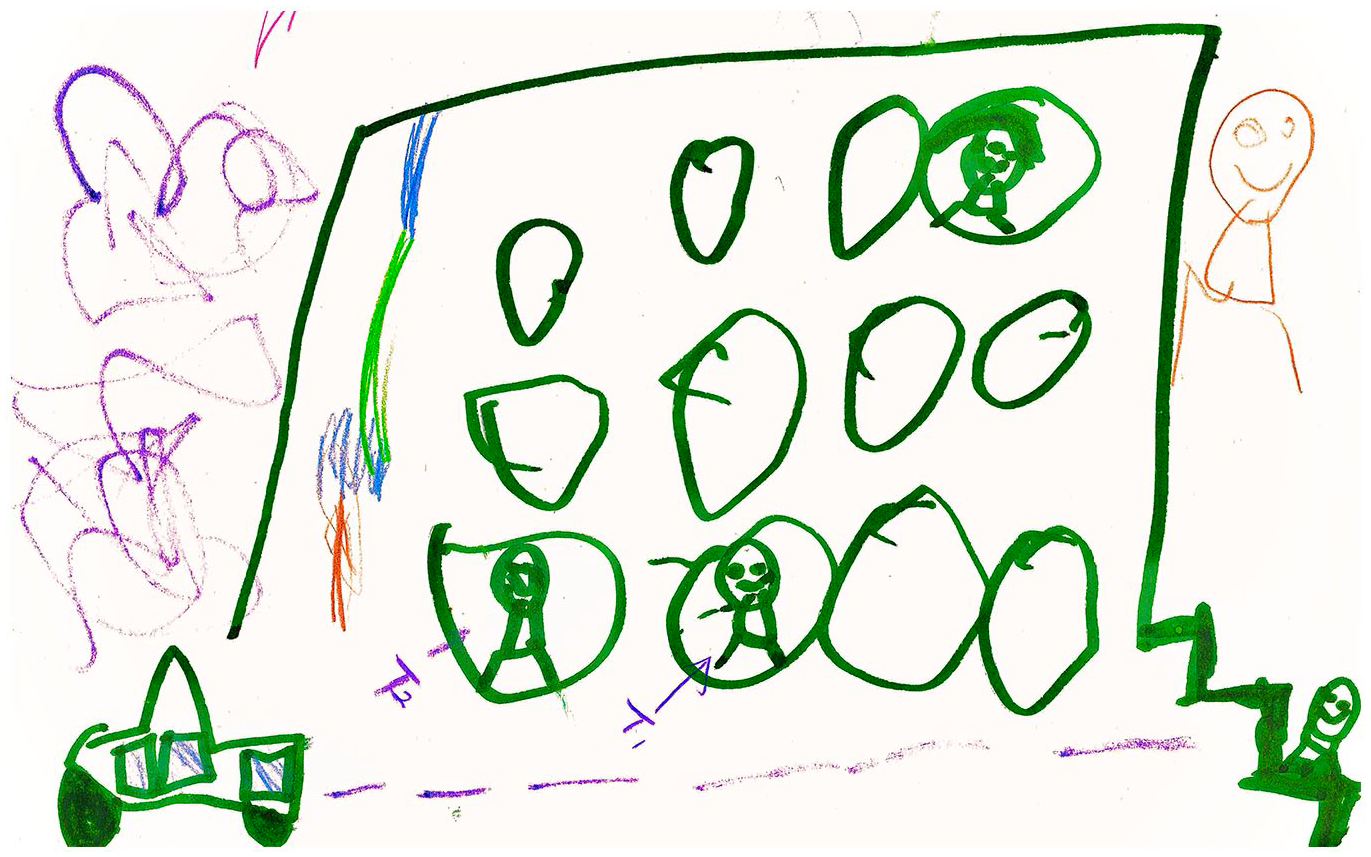
Chris (Actor_4), You need magic to pretend.
The outsideness afforded by the interview enabled Chris to adopt an omnipresent view and the first-person narration to re-savor and re-tell what he saw, thought, felt, and drew when he was playing his role in the drama. His narration is an elaboration and enhancement of the excitement suggested in the previous chronotopes. It provided a space in which he talks about the critical moments, objects such as the running car (L1), his peer actor, Peter, as well as his imagination of the peril, through the magical transformation of the road into running water (L9, L11, L13). Chris has developed complex dialogic relationships with the others at different stages of the drama activity.
Extract 2: L1 Chris: Peter followed me and I saw through the window and saw a car crossing the road. L2 R: What else did you see? L3 Chris: The audience. L4 R: What were they doing? L5 Chris: Watching us. L6 R: What did they look like? L7 Chris: Happy, when we were climbing up the bridge and I did not fall into the water. L8 R: Oh, yes, but where is the water? L9 Chris: The road could change into water (pointing to the blue lines drawn below the slide). This is magic, you need to transform yourself to pretend. L10 R: Really? How? L11 Chris: Miss Rebecca (T1, i.e. Teacher One, annotated in Chris’s drawing) used the tangerine . . .and changed to cluck-cluck-cluck and the feather. . .this is the way to play. L12 R: That’s the magic? L13 Chris: You know, the foot is slow and walks slowly. . .the wings need to be small (demonstrating it to the researcher). . . close them when you are not flying. . .and this is flying (stretching his arms). . .after that I (can) slide down by myself.
Chris actively made inter-references and blurred the connections between the chronotopes of the drama and the real world through complex dialogic relationships. Compared to the figures representing his peers, Chris’s self-portrait (The figure drawn in brown beside the slide) is much bigger, which, as he suggested in the interview, symbolizes a masked self. He was watching the others and being watched by them in a merry atmosphere. As Haynes (2013, p. 61) argues, “portraiture are actually a kind of mask making, creating a public image that may or may not be true to the person in everyday life.” More so, Chris talked like an instructor in an assertive tone when explaining to me the delicate skills needed in transforming oneself into a chicken. Indeed, he seemed to be speaking about a working theory and meta-understanding of the logic of drama, which in the end is all about transformation. His authorship came into view as the interview unfolded, and the chronotopes involved became increasingly complex.
Concluding Remarks
Although the drama lesson under investigation was largely monologic, the application of the drawing and telling activities allowed me a glimpse of the children’s dialogic aesthetic experiences that unfolded and evolved after the lesson. Bakhtin’s dialogism and its notions of outsideness, authorship, chronotope, and surplus meanings provide the theoretical ground to explain the dialogicality, fluidness, and heterogeneity of the children’s aesthetic experiences. The two cases of children’s dialogic aesthetics sampled from a drama lesson illustrate how consciousness and meaning making change across a succession of activities due to the chronotopic factors. In this regard, this paper argues for a holistic and integral application which incorporates field observation and drawing and telling to capture and examine children’s journey of becoming dialogic aesthetic. Variations of the dialogicality of the children’s aesthetic experiences in response to different chronotopes in and out of the drama have been identified. The results would provide valuable insights into the research methodology of draw-and-tell, and its theoretical application in the study of children’s theatre participation, as well as drama teaching and learning.
Data Analysis and Interpretation of Drawing and Telling
Greene and Hill (2005, p. 5) argue that researching children’s experiences is “fundamentally problematic.” Apart from the privacy issues and the challenges in making observations, children’s self-recall or recount of an experience is also interpretative. One may only infer from their representation of what has happened and what they have experienced. This study adopts a holistic approach to collect and analyze data from classroom observation and drawing and telling to address the question of authenticity of interpretation.
There are diverse opinions held by academics regarding the analytical methods of the picture and narrative data rendered from chronotopic perspectives. Some studies give more prominence to analyzing children’s narration (Horstman et al., 2008) whereas scholars such as Angell et al. (2015) argue for an integrative approach that yields a general description of children’s lived experiences under investigation based on an aggregate summary of the data generated from draw-and-tell. Wright (2007, p. 48) however argues that children’s meaning making through draw-and-tell is fluid, which “cannot be summarized adequately after the event.” She proposes a filmic analysis to capture the unfolding narration given by children.
Sharing Wright’s concerns, we referred to the Bakhtinian perspective of the dialogic aesthetics and the related notions in developing the methodologies of data analysis. For instance, attention was given to the temporal and spatial dimensions in note taking to track the becoming and changes of the children’s aesthetic experiences across various stages of the drama lesson. Because we believe that researchers should straddle all the chronotopes that the data generate and give equal weightings to their roles and analysis, we developed methods including juxtaposing and comparing the three chronotopes experienced and constructed by the children against that of the teacher to identify similarities and discrepancies. These discrepancies are particularly useful because with them, researchers can formulate ways to elicit dialogic responses from children in telling activity or interviews.
In this study, I conducted myself not as a positivist observer but as a researcher looking for similarities and discrepancies, and facilitating the interviewed child in the narrated chronotopes. My role requires awareness of the concern that any questions asked in the interview process may enable or conceal the children’s accessibility to the becoming of aesthetic experiences. In the telling activity, Wendy reacted to my questions about the absence of audience figures from her picture by articulating her implicit attempt to assume authorship over the enacted chronotope through continual drawing during the interview; I was prompted by Chris’s incoherent narration of falling into the water, which was not in the teacher’s drama chronotope, to extend our dialogue in pursuit of more of his narrative. This dialogue enabled Chris to elaborate on his fascination with magic and the meta-understanding he managed to come to about the transformative function of drama (L7 ff.). These instances show that the holistic approach allows us to trace the trajectory of children’s becoming dialogic aesthetic, and identify relevance from albeit apparent incongruities.
Pedagogical Implications of Drawing and Telling
It is not the purpose of this study to evaluate the children’s drama experiences or understanding of the drama lesson, the Chicken’s Adventure. However, the variations of the dialogicality demonstrated in the cases of Wendy and Chris suggest a point of reference for the evaluation of children’s drama learning and aesthetic understanding in terms of the emergence of voice, authorship, and dialogic aesthetics. Wendy and Chris are only two cases among many of the children spectators who drew and gave verbal account of what they had seen in the play. The fact that these children had projected themselves into the drama and were making attempts to make sense of the others is a manifestation of the aesthetics of becoming-others. Wendy’s imaginative spectatorship and authorship shown in “I made them move” (Extract 1, L4) only emerged when she responded to the researcher’s prompt to make active inter-reference between the enacted, portrayed, and narrated drama chronotopes; Chris was able to transgress himself to develop a complex network of dialogues with others inside and outside the drama chronotope. He was performing as a competent actor, analyst, and even instructor by reflexively theorizing that drama “is magic, you need to transform yourself to pretend” (Extract 2, L9). I consider this a demonstration of dialogic aesthetics in a mode of becoming-others-and-I. To promote the outsideness and dialogicality of children’s drama learning, teachers should provide them with various drama experiences by varying their roles, positions, and lens of drama engagement and disengagement. As shown in this study, this can be achieved by integrating drawing and telling as an integral part in a drama lesson as these two activities can blur the boundaries between the fictional and the real worlds as well as drama teaching, learning, and evaluation for realizing children’s dialogic aesthetics.
The Conditions for Dialogic Aesthetics
The results of this study also suggest that children’s dialogic aesthetics is not totally a result of individual thinking and endeavor but conditioned by the possibility of experiencing others and expressing one’s inner thoughts and feelings through concrete actions. McCaw’s discussion about Bakhtin’s early philosophy of the experience of being an I may sum up for the importance of actions for the present study on children’s aesthetic experience: “to experience myself as a really existing being I need to perform actions, because only through my performance of an action can I generate the feeling of engaging in the world” (McCaw, 2016, p. 81). In this view, I would call for arts pedagogies and related activities that can engage children in actions to relate a lived experience to themselves and to dialogue with the people and things involved. More importantly, these actions should be available in a series to constitute a nexus of various chronotopes, such as the successive actions arranged in-and-out of the drama of this study, so as to facilitate children’s re-encounters and re-creations of their aesthetic experiences. These understandings are consistent with Reason’s (2010a, 2010b) refutation of viewing children as passive audience. Instead, he regards children as active theatre critics and advocates using drawing workshops and theatre talks as post-show activities to deepen and extend their original theatre experiences, and to promote their interpretation and judgment of the performance. In other words, children’s becoming dialogic aesthetic should be prompted by a sequence of ongoing creative actions structured across various times and spaces.
Despite the limitations of the study, namely the sampling from a single case and the restricted scope of coverage, the research framework, methodology, and results have generated valuable insights to inform similar studies in the areas of children’s lived and art experiences, and participatory theatre audience studies. Continuous efforts and investigations could be devoted to further examine various types of children’s aesthetic and drama experiences, and the methodological issues of using drawing and telling in childhood studies.
