




Abstract
The purpose of this study was to examine the views of international Science Olympiad participants on the benefits of the competition and the factors that affected their career aspirations. We also investigated how students’ choice of competition category varied with respect to gender. The sample included 273 International Sustainable World Energy, Engineering, and Environment Project (I-SWEEEP) participants from 39 countries. Mixed-methods were used to analyze the data. Descriptive statistics and t-statistics were provided to answer the first question. As a means of addressing the second question, a chi-square test was utilized to examine how participants’ category selection differed by gender. Qualitative analysis was used to reveal the types of benefits students reaped from participation in the I-SWEEEP. Results indicated that students were most affected by their teachers, parents, and personal interests. Although the relationship between gender and competition category was not statistically significant, there nevertheless emerged a pattern showing that girls preferred environmental science projects (45.5%) to engineering projects (24.4%). Qualitative analyses revealed six themes as benefits that students gained from participation in the I-SWEEEP. The relationship among the fundamental themes was also examined and revealed important findings. The results have educational implications for helping students accomplish to be science, technology, engineering, and mathematics (STEM) professionals in the future.
Keywords
Introduction
Science, technology, engineering, and mathematics (STEM) education has been a hot topic in the field of education for a number of years. It is believed that STEM is vital for the economic future of many nations. Countries that choice to invest in STEM education will benefit economically and socially. Considering technological developments play a key role in today’s world and will be more important for the future, a highly educated workforce is essential to innovate or adopt new technologies (Schleicher, 2007). Some countries are aware of the importance of a quality STEM education and concerned that current curricula and pedagogical methods in STEM-related subjects failed to engage students adequately. One of those countries is United States of America, a country once considered an indisputable leader in science and technology. United States’ concerns are shared by a number of other industrialized nations such as the United Kingdom and Australia as well (e.g., Archer et al., 2012; Tytler, Osborne, Williams, Tytler, & Cripps Clark, 2008).
As considered the leading nation in science and technology for almost two centuries, it is worthwhile for all the other nations to look at American experience. Unsatisfactory outcomes in STEM education have given rise to serious concerns about the state of education in the United States; the majority of American students continue to fall short of national proficiency levels. National Assessment of Educational Progress (NAEP) reports dating in 2013 and 2011 show that only 36% of 8th graders in mathematics (U.S. Department of Education, 2014) and 32% of 8th graders in science are at or above proficiency level, respectively (U.S. Department of Education, 2011b). This pattern continues into the upper grades—according to the NAEP 2009 report, only 26% of 12th graders are at or above proficiency level in mathematics (U.S. Department of Education, 2011a).
In studies of academic proficiency in school-age children around the world, American students consistently rank lower than their counterparts in similarly industrialized nations. Program for international student assessment (PISA) is an international comparative study that assesses the competencies of 15-year-old students in reading, mathematics, and science. Results of 2012 PISA show that the United States is among the countries with a mean performance below the Organization for Economic Co-Operation and Development (OECD; 2013) average in both mathematics and science. The performance of American students ranks slightly higher in the Trends in international mathematics and science study (TIMSS), an equally renowned comparative study that assesses the mathematics and science knowledge and skills of fourth and eighth graders. In 2011 TIMSS, U.S. students’ performance was slightly above the international average but still trailing behind the top education systems, particularly in eighth-grade mathematics and science (U.S. Department of Education, 2013).
Another major trend that adds to existing concerns is the number of STEM bachelor’s degrees awarded in the United States. Even though the number of degrees awarded in this area has doubled since 1960, degrees relating to STEM fields only comprised 16.8% of all bachelor’s degrees awarded in 2002 (Kuenzi, 2008). This is lower than the international average (26.4%) and far behind world leaders Japan (64.0%) and China (52.1%; Kuenzi, 2008). In addition, Kuenzi (2008) stated that the percentage of foreign students in science and engineering graduate programs has increased substantially; in 2003, according to the National Science Foundation (NSF), more than half of doctoral degrees in engineering, 44% of doctoral degrees in mathematics and computer sciences, and 35% of doctoral degrees in physical sciences were awarded to foreign students.
There have been many governmental and private initiatives worldwide to address the problem. Such as, in the United States, the President Obama started a campaign to boost the efforts in STEM education. The goal is to encourage the participation of secondary school students in STEM-related activities in hopes that that this will increase their interest in STEM-related careers. This can be achieved most effectively when students develop personal connections with the ideas in STEM fields through after-school and extended day activities such as contests, laboratory experiments, summer and after-school programs, and field trips (The White House, 2010). The President’s council of advisors describes these types of activities as one of two key avenues that allow students to explore and challenge themselves with STEM in a 2010 report on science and technology (President’s Council of Advisors on Science and Technology (PCAST)). PCAST is a group of the nation’s leading scientists and engineers who directly advise the President (The White House, 2010).
As one of these initiatives, International Sustainable World Energy, Engineering, and Environment Project (I-SWEEEP) Olympiad aims to garner interest and awareness in environmental problems by engaging students to search for workable solutions to these problems at an early age (I-SWEEEP, 2013). I-SWEEEP is open to secondary school students at national and international levels. The organization hopes that early engagement will also promote the interest in science and engineering careers, which address contemporary global environmental problems most directly. This study investigated the perspectives of I-SWEEEP Olympiad participants on the benefits of participation in the Olympiad and the factors that affect their career aspirations.
Theoretical Framework
While Social Cognitive Career Theory (SCCT) was used to ground the theoretical framework for this study, relevant literature focusing on (a) the factors that affect students’ career choices, (b) factors affecting female students’ low representation in engineering professions, and (c) the benefits of participation in Science Olympiads was used to develop the “skeletal structure of justification” (Eisenhart, 1991); this served as a guide for data collection, analysis, and interpretation of results.
SCCT is grounded in Bandura’s (1977) social cognitive theory and developed by Lent, Brown, and Hackett (1994) to explain three central questions: (a) How basic academic and career interests develop, (b) how academic and career choices are made, and (c) how academic and career success is obtained (Lent, Brown, & Hackett, 2006). SCCT incorporates different concepts including interests, abilities, values, and even environmental factors important to students’ career choices and professional development. Three key components—self-efficacy beliefs, outcome expectations, and goals—serve as the building blocks of SCCT. All play key roles in SCCT’s models of educational and vocational development. This study benefits from SCCT in its explanation of how students form their career interests and make choices about their fields of study.
Factors Affecting Students’ Major Choice
Choosing a career pathway is a vital decision for students as it effects many changes in their social and professional lives. Borchert (2002) emphasized the role of career choice in a young person’s development by noting that selecting a major on which to build a career is one of the most important decisions students make in their lives. Unfortunately, for many high school students, selecting a career path is not an easy task; in addition, they are not particularly well informed about the implications of their college major selections (Hansen, 2011). Various factors play a role in selecting a college major, and students need to consider each benefit and drawback carefully (Kuechler, McLeod, & Simkin, 2009) to select a college major that renders them both productive and satisfied. Thus, investigating the factors that influence students’ major selection is vital.
Numerous factors have been identified in the decision-making process that students follow in career selection. Kuechler et al. (2009) listed six possible influences on a student’s choice of major, namely, career drive, personality traits, genuine interest, anticipated difficulty, the influence of others, and a host of ancillary factors. These remaining factors were grouped further into three main categories: economic, social, and psychological (Kimweli & Richards, 1999; Kuechler et al., 2009). Economic factors were mostly career-related and included job security, salary, signing bonuses, opportunities for advancement, hiring opportunities upon graduation, and initial compensation levels (Kuechler et al., 2009). Social factors also played into students’ major selection processes through the influences of their social circle’s beliefs, attitudes, and experiences (e.g., Kimweli & Richards, 1999). Acquaintances who influenced students’ major selection could include family members, friends, or teachers. Psychological factors tended to relate to more individual characteristics. These factors included personal skills, self-image, personal interests, and anticipated difficulty (Kuechler et al., 2009; Noel, Michaels, & Levas, 2003; Sabot & Wakeman-Linn, 1991). In addition to these three main categories of factors, “scholars suggest that a host of ancillary factors have the potential to influence the choice of a college major” (Kuechler et al., 2009, p. 466). These ancillary factors included the opportunity to take specific classes, the strength of the student in a selected branch, precollege coursework, the anticipated quality of life following a given major, and the lack of gender bias in a selected major (Kimweli & Richards, 1999).
Research indicated that factors influencing students to pursue STEM-related areas of study are similar to the factors affecting students’ non-STEM educational and vocational choices (Maltese & Tai, 2011). Researchers have established that one of the most significant influences on a student’s STEM career path selection is interest (Beier & Rittmayer, 2008; Calkins & Welki, 2006; Kuechler et al., 2009). Calkins and Welki (2006) conducted a survey among college students to determine the most promising factors influencing students’ career pathway. Their findings are the primary reason that “interest in the subject” is listed one of the salient factors influencing students’ major selection. In another study, Kuechler et al. (2009) investigated the decrease in the number of students who choose information systems (IS) majors despite an increase in the number of job opportunities in IS from 1999 to 2009. Like Calkins and Welki before them, they found that “genuine interest” was the strongest factor affecting students’ decision to become an IS major. “Interest” or “genuine interest” was defined by Beier and Rittmayer (2008) as “relatively stable preferences that are focused on objects, activities, or experiences” (p. 1). Kuechler et al. (2009) suggested that students choose certain majors only when they are exposed to real-world activities that correspond to them. Students tended to choose a major to which they had previously been exposed because their earlier experiences led them to have more positive attitudes than those of the students who had not been exposed. Thus, involving activities related to STEM disciplines in primary and secondary education can increase students’ interests toward associated college majors (Sahin, 2013).
Another important factor influencing students’ STEM career selection is school life both within and outside of the classroom. Beier and Rittmayer (2008) found that school life is positively correlated with course selection, persistence in a certain field, and overall achievement. School life has an impact not only on students’ immediate learning outcomes but also on students’ initial major selection and, later, career paths (Beier & Rittmayer, 2008). In an earlier and more specific study, Burkam and Lee (2003) found that the more advanced placement (AP) mathematics courses students took during high school years, the more likely they were to select STEM-related majors. Similarly, in a recent study regarding students’ career choices, Sahin, Erdogan, Morgan, Capraro, and Capraro (2012) investigated the relationship between high school students’ SAT scores, AP course enrollment, and choice of college major. Results from this study revealed that students with higher SAT mathematics scores were more likely to follow STEM-related majors in their college years, and students who were involved in AP courses were more likely to pursue STEM-related majors than students who did not take AP courses. Therefore, it is important to invest in students’ academic growth during secondary school years to increase their interest and success in STEM subjects.
The high school years are key in increasing students’ interest in STEM-related subjects; at that juncture in their education, most students are unsure of what career path to follow in their college years (Hansen, 2011). A recent survey sponsored by Microsoft Corporation (2011) showed that 78% of college students decided to pursue STEM-related careers in high school or earlier, but only 21% of them indicated that their STEM-related major choice was made in middle school or earlier. A more recent study, which was conducted in the United Kingdom and enlisted the participation of more than 9,000 elementary students and their parents over a 5-year period, reported that students’ aspirations and views of science started to form in early school years and solidified by age 14 (Archer et al., 2012; Archer, DeWitt, & Wong, 2014; The ASPIRES Project, 2013). More than half of the students in United Kingdom who expressed their aspirations by the age of 15 were likely to end up in similar type of professions 10 to 15 years later (Croll, 2008). Similarly, in another study conducted in the United States, students who expressed their ambitions for careers in science by the age of 14 were 3.4 times more likely to end up choosing a degree in the physical sciences or engineering than their peers who did not express an interest in a career in science at that age (Tai, Liu, Maltese, & Fan, 2006). Because students’ middle and high school years are more determinant of their STEM-related major selection, it is important to investigate the factors that influenced their decisions. Research revealed a variety of techniques to increase students’ positive feelings toward STEM-related subjects. For instance, five interventions were made to encourage students to have more positive attitudes toward STEM subjects were suggested by Beier and Rittmayer (2008). First, science and mathematics classrooms had to be well organized, as effective classroom management was positively related to students’ STEM interest. Second, students had to be made aware of achievement examples in STEM fields to increase their self-concepts in the STEM domain. Third, teachers were encouraged to integrate hands-on activities with interesting subject matter and allow students in STEM-related subjects to work in groups in activities such as project-based learning (Capraro, Capraro, & Morgan, 2013). Fourth, Beier and Rittmayer (2008) recommended placing students in STEM courses according to their academic achievement level to provide optimal learning environments, Fifth, encouraged teachers need to remember that to organize real-life activities outside of the classroom, or informal learning, was to increase students’ interest and participation (Beier & Rittmayer, 2008).
Factors Affecting Female Students’ Low Representation in Engineering Professions
Choosing a career is one of the most pivotal moments we face. Research has shown that female STEM students have a short list from which to choose careers because they are still disappointingly underrepresented in the engineering workplace (e.g., Yoder, 2012). The question of why female students do or do not aspire to engineering majors reveals a long list of deciding factors that includes personality, teachers, job environment, and stereotypes. Faulkner (2006) identified females who chose engineering majors as “extremely confident, high achievers, even rebels—the sort to seek out a challenge” (p. 2). According to this study, female engineers were usually coming from a very limited and special group of students who do not represent the mainstream population.
Kutnick, Chan, & Lee (2012) examined K-12 students’ experiences as well as their engagement of engineering education to identify key issues regarding the decisions of students who went into engineering. The study found that students’ engineering experience and engagement were primarily related to non-school, extracurricular, familial, and media influences. The study also reported that students were affected by their subject teachers’ encouragement in their career decisions; however, science teachers were unlikely to have engineering backgrounds, thus students are less likely to choose engineering as a major. The same study made the point that female students took fewer engineering courses, received less engineering-related experience, and received less encouragement from teachers and parents. For this reason, it was suggested that meeting female engineers in a single-sex context would be more helpful for female STEM students than a mixed setting in terms of encouragement. Therefore, context, teacher and parent encouragement, and early engineering experience were among the most important factors upon which to focus for educators looking to increase female representation in engineering majors.
In a recent study led by Atkins (2013), researchers examined the question of why females chose engineering majors; this stood in contrast to most studies on the topic, which look at the reasons that girls do not aspire to be engineering majors. The study found that most females who became engineers had at least one inspirational teacher (mostly in the fields of mathematics and/or science) during their secondary education years, knew one or more engineers, and/or were interested in solving or fixing things. Some of them also had an engineer parent (mostly fathers). The same study also referred to some of the reasons why females did not choose engineering, namely, that engineering was still perceived as (a) a male career, (b) involving fixing engines, (c) too difficult, and (d) requiring physical strength. To fix these problems and stereotypes, it is clear that the American educational system requires greater awareness, better advising, and more female role models (Atkins, 2013).
Benefits of Science Olympiads as an Informal Learning
The definition of informal learning is the educational process that occurs outside of classroom settings (Maarschalk, 1988; Tamir, 1990). Informal learning environments have received increased attention as alternatives to traditional learning in the promotion of science (Robelen, 2011) and mathematics (Grabinger & Dunlap, 1995) education. The National Research Council (NRC), (2011) reported the benefits of informal learning in STEM-related subjects. Informal learning environments include but are not limited to summer camps, science museum field trips, math clubs, science fairs, and Science Olympiads. One of the studies exploring the benefits of science competitions is Campbell and Walberg’s (2011) study. The study analyzed data from 345 adults who participated in Mathematics, Chemistry, and Physics Olympiads during their high school years. The study found that the Olympians fulfilled their potential and served the national interest by (a) making important contributions to the society through their valuable research, publications, and teachings as scholars and professors; (b) founding and managing important companies in software business and other areas; and (c) occupying leadership roles in different areas that magnify their influence. Another important finding of this study is that competitions are needed to challenge extraordinary students since schools do not have a differentiated curriculum which is academically suitable to these students’ levels or the resources and advanced labs they need. In addition, it is a fact that some of the science Olympiad students are more knowledgeable than their teachers in certain areas (Campbell & Walberg, 2011). Therefore, competitions are important to engage, motivate, and encourage students to work at a level where the work is much more advanced than anything being taught in their science classes (Campbell, 1985).
In addition, Sahin (2013) showed that participation in science fairs increased students’ interest in STEM fields, thus causing students to be more likely to follow a STEM-related career path. Research has found that informal learning environments such as science fairs and Science Olympiads (extracurricular activities) have become viable alternatives to traditional learning environments (Grabinger & Dunlap, 1995; Ricks, 2006; Sawyer, 2006) in terms of increasing students’ motivation and engagement in STEM-related subjects. Olympiads provide students with opportunities to realize that STEM-related disciplines are intertwined with the real world (NRC, 2009). Science Olympiads can cultivate 21st century world citizenship among students, and as participants, students gain skills in critical thinking, problem solving, creativity, innovation, communication, and collaboration as part of a lifelong learning process. Thus, they can be used to cultivate the STEM-related interests of today’s students. Once students identify specific interests within the vast field of STEM, the likelihood that they will choose STEM-related college majors will increase.
This study aimed to investigate the beliefs of students who participated in the I-SWEEEP Olympiad on the factors that influenced their career aspirations and the benefits of participation in the Olympiad as well as the relationship between students’ genders and the category in which they competed.
Research questions were as follows:
Method
Participants
Our sample for this study was high school students from 39 countries participating in the 2013 I-SWEEEP Olympiad. I-SWEEEP is an international Science Olympiad with a self-professed mission to spark interest and awareness in our planet’s sustainability challenges, help young people grasp the extent of these issues, find workable solutions to these challenges, and accelerate the progress toward a sustainable world by engaging the youth at an early age. (I-SWEEEP, 2013)
I-SWEEEP was organized so that secondary school students could position themselves to contemplate contemporary global problems as the preeminent scientists and engineers of the future.
Five hundred students representing 39 countries competed in the 2013 I-SWEEEP competition. The qualification criterion for American students was to have won an award at a regional, state, and/or national science fair competition. International students qualified to attend the Olympiad with approval of their projects by the I-SWEEEP Scientific Review Committee. Students competed in one of three categories:
Energy: I-SWEEEP promotes concepts of renewable energy, energy efficiency, energy management, and clean technology in secondary education.
Engineering: I-SWEEEP provides an opportunity for secondary school students to prepare themselves for careers as engineers who have a superior understanding of global issues and the modes of technology that can be used for the maintenance of global sustainability.
Environment: I-SWEEEP is another step in our educational efforts to develop an environmentally conscious and responsible community, to inspire personal responsibility in caring for the environment, and to focus educational resources and fresh minds on environmental problems.
For each project, the I-SWEEEP organization committee covered two participants’ expenses. I-SWEEEP is a 4-day endeavor held in Houston, TX. They have a set program every year in which students take different field trips including tours of the city, NASA, local institutions of higher education, and social events in addition to the competition. Grand award, gold medal, silver medal, and bronze medal winners receive monetary awards of US$1,500, US$600, US$300, and US$150, respectively.
Instrument
We developed 12 survey questions including both multiple choice and open-ended questions, to gather information about Olympiad participants’ demographics, prior experience with Science Olympiads, and factors influencing their future plan.
Survey Administration
The survey was sent via e-mail to the I-SWEEEP director for distribution to all 500 2013 I-SWEEEP participants after securing approval from the director. Participants completed the survey electronically within a 2-week window of time. Reminders were sent three times, resulting in a final number of 274 (55%) respondents (out of 500) representing 39 countries. Of 500 participants, 237 of them were from the United States. Although we had more international students, our American participants showed greater participation to complete the survey questions (209 of 274 were Americans). This may also be due to the generosity of the I-SWEEEP organization because about 60% of students receive one type or another award including scholarships from prestigious American colleges and/or iPads etc. Organization committee told us that they award scholarships to American students because they are more likely to use them. This may have helped the American students’ higher completion. According to the guidelines established by the Instructional Assessment Resources (2011), an average response rate of at least 30% is necessary for online surveys.
Data Analysis
Mixed-method research design was used to investigate the research questions. Descriptive statistics were calculated to see which factor had the greatest influence on the I-SWEEEP participants’ career aspirations to address the first question. Because dependent and independent variables were not continuous and each cell has more than 5, chi-square tests were used to analyze how the categories in which students competed at varied with gender. For the final research question, the phenomenological method refined by Colaizzi (1978) was used to analyze participants’ transcripts. This method helped “obtain an overall feeling for them” (Creswell, 2007, p. 270) through its necessity of reading the transcripts several times. Through this method, significant statements formulated the participants’ feelings. Across all participants’ transcripts, common themes emerged after grouping the formulated meanings. An in-depth description of the phenomenon will be available with the outcomes of the process.
Results
Demographic Characteristics of Survey Respondents
The first five questions on the survey requested demographic information about the 273 (out of 500) individual I-SWEEEP participants contacted by email with a request to respond to the survey. Most respondents (n = 201) were from the United States, while the remaining (n = 72) represented 38 other countries in Europe, Asia, South America, and North America. Percentages of responses from male and female percentages were 46.4% (n = 127) and 53.6% (n = 147) respectively.
The ages of the United States and international participants were mostly scattered between 14 and 18 years with the exception of one 12-year-old student from the United States and seven international students above age 18. In all, 37% (26) of the international students came from private school, while for the U.S. students, this statistic was only 18%. Participants from the United States were almost equally scattered between 9th through 12th grades; most of the international respondents were from 10th through 12th grades with the exception of six students from the 9th grade. Ages, grade levels, and school type distribution information is summarized in Table 1.
Demographics of I-SWEEEP Participants Responding to the DISC Survey.

Note. I-SWEEEP = International Sustainable World Energy, Engineering, and Environment Project; DISC = Determining Influences of Science Competitions.
One 12-year-old student from the United States and seven international students above age 18 were not included in this table.
Factors Influencing Student’s STEM Career Choices
Analysis of Item 9 from the survey revealed the top three factors that affected participants’ career aspirations the most in their own words. While most survey takers reported three factors, some reported only one, resulting in a total of 505 factors identified by respondents.
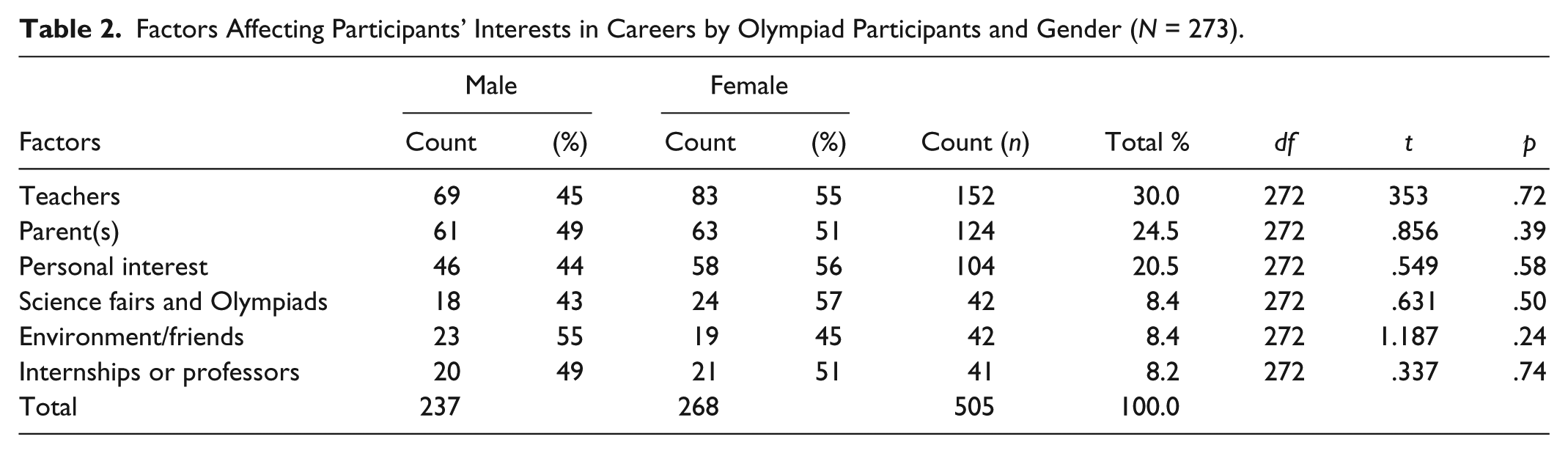
After a series of coding cycles, we clustered factors identified by students into six major themes that influenced their career interests. Table 2 lists counts and percentages for each theme by gender. Three quarters (75%) of all factors identified by respondents were represented by three themes: teachers (30.0%), parents (24.5%), and personal interests (20.5%). For these three factors, we computed a t test and found that participants’ choice of factors did not vary along with gender (see Table 2). The three additional themes (participation in science fairs and Olympiads, environment/friends, and internships or working with professors) comprised the last quarter (25%) of respondents’ other coded responses to the question.
Factors Affecting Participants’ Interests in Careers by Olympiad Participants and Gender (N = 273).
Competition Category Choice by Gender
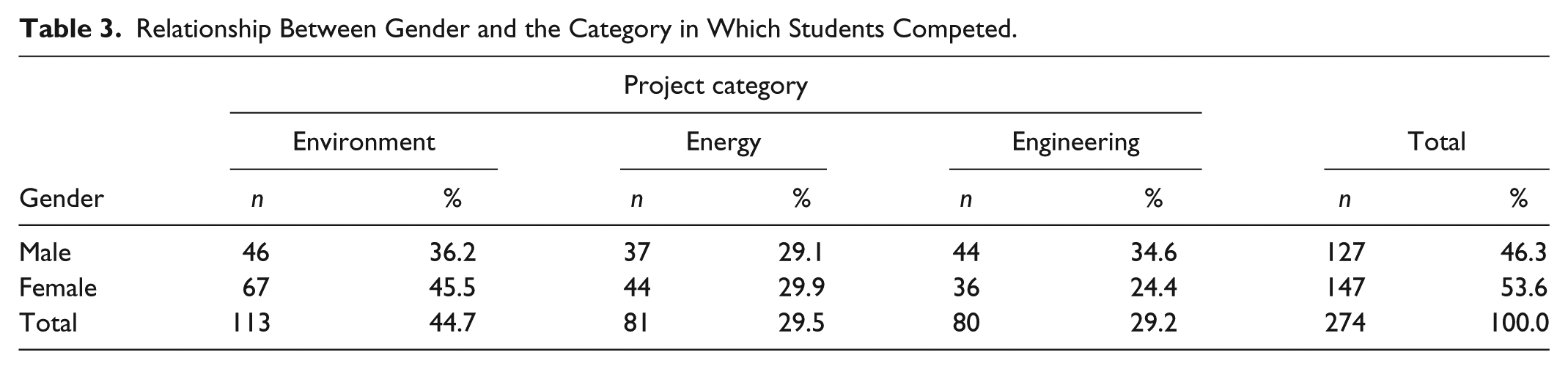
A chi-square analysis was conducted to investigate how students’ genders (Question 2) correlate to the categories (Question 6) in which they competed at the I-SWEEEP. The analysis revealed a statistically insignificant relationship between gender and the categories in which students chose to compete, χ2(2) = 3.868, p > .05, n = 274. Nevertheless, there was a pattern indicating that girls preferred environmental science projects (45.5%) to engineering projects (24.4%). Girls perceived engineering projects as their least favorite category of project among the available choices (see Table 3).
Relationship Between Gender and the Category in Which Students Competed.
Participants’ Perceptions of Participation in Science Olympiad Benefits
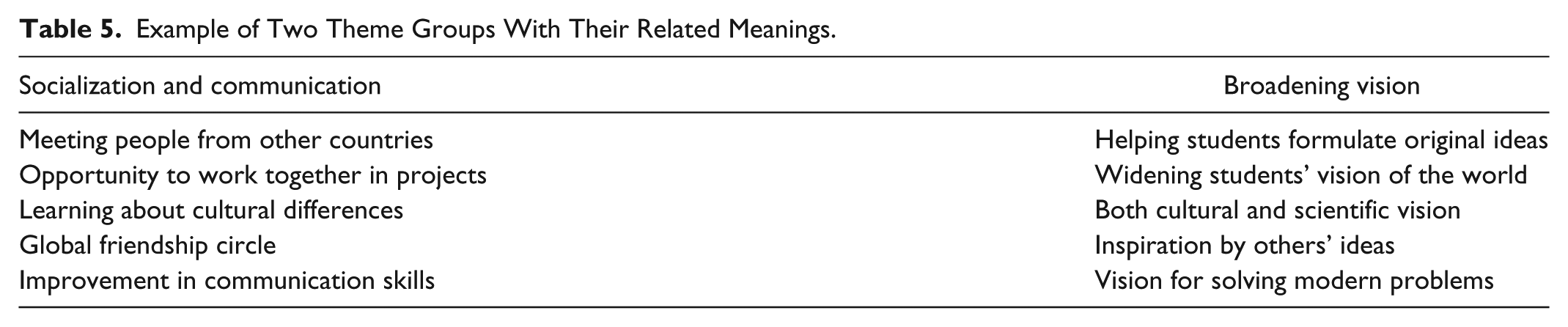
From 275 verbatim transcripts, 59 significant statements were extracted. These significant statements were then translated into formulated meanings. Some of these significant statements with formulated meanings were included in Table 4. After the formulated meanings were arranged into clusters, there emerged six themes. Two themes with associated meanings were illustrated in Table 5.
Selected Examples of Significant Statements of the Feelings of International Students on I-SWEEEP Benefits.
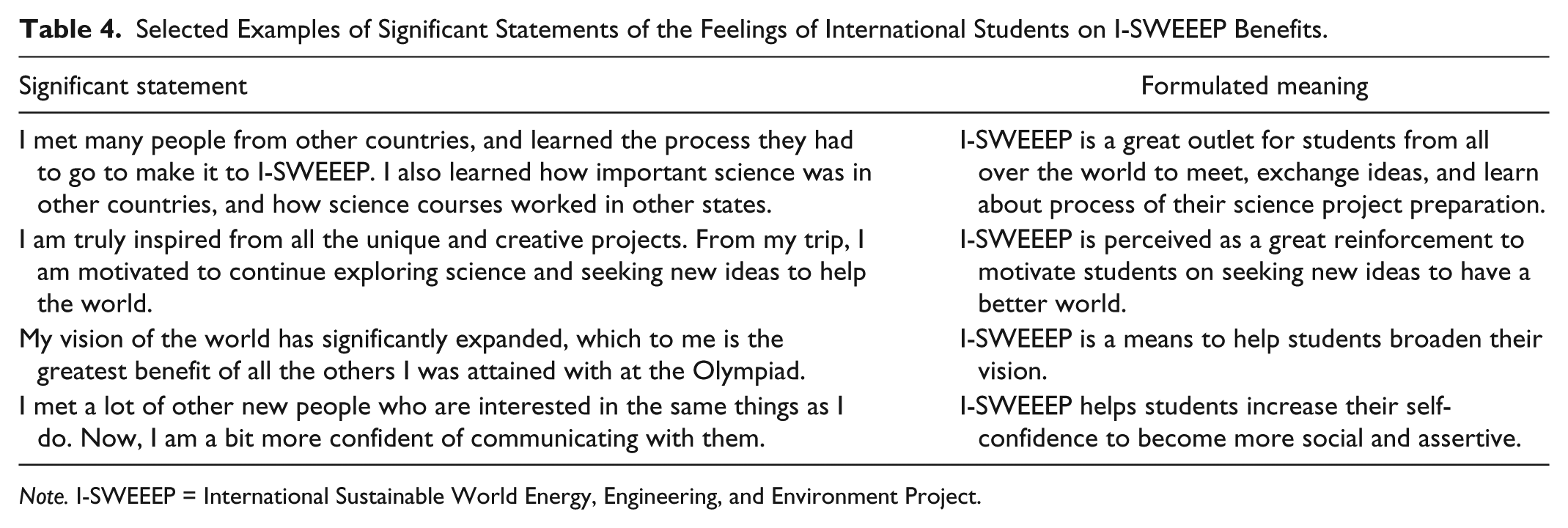
Note. I-SWEEEP = International Sustainable World Energy, Engineering, and Environment Project.
Example of Two Theme Groups With Their Related Meanings.
Theme 1: New Experiences
Many of the participants who participated in I-SWEEEP shared the sentiment that they’d had a new experience. These students described their time at I-SWEEEP in various ways, which illustrated that I-SWEEEP as an organization granted a wide variety of new experiences to many people. One of the students described it with the following statement: “Overall, I think I-SWEEEP provided a multicultural learning experience that you couldn’t even receive using a social network.” According to another student, it was a unique opportunity: “I got to experience my first international science fair, which was a great learning experience.” Moreover, some students perceived I-SWEEEP as an international experience. As one of the students wrote, “International experience gave me exposure to a wide variety of cultures.” As a final point, an American student illustrated the importance of I-SWEEEP in writing, “It has been the most rewarding experience.”
Theme 2: Socialization and Communication
I-SWEEEP is an organization in which participants hail from various countries. Students may meet their international counterparts for the first time at the I-SWEEEP Olympiad. It is not easy to get along with an unfamiliar person. However, from the perspective of the participants, I-SWEEEP created an atmosphere conducive to socialization and communication. I-SWEEEP also provided information to participants on how to communicate effectively with people from other countries and how to address cultural differences. In the following statement, a student expressed this point very well: I learned how to effectively communicate to people of other counties, and learned about cultural differences between the many peoples of the world. I made lots of new friends and got to meet lots of other brilliant people whom I am proud to be associated with.
Communication among the participants led them to form good friendships. They were able to figure out their similarities rather than focus on their differences. The following statement proves this point: I met people from around the world and created friendships to last a lifetime. I also realized how very much we all have in common. I’m prepared to work with people from around the world to create a more sustainable world.
These statements show that two of the fundamental benefits of I-SWEEEP are its encouragement of participants to socialize and its creation of opportunities for sincere and strong friendships.
Theme 3: Self-Confidence
This category serves as yet another testament to the fact that the benefits of I-SWEEEP are not only academic in nature. Participants indicated that they increased their self-confidence in various areas. One of them said, “I met a lot of other new people who are interested in the same things as I do. Now, I am a bit more confident of communicating with them.” As is evidenced by this expression, it is certain that one area in which students gained confidence was communication.
Some participants reported to have improved self-confidence in solving international problems. “I-SWEEEP provided better confidence in fighting an international problem” was a statement that strongly indicated this new confidence. In addition, I-SWEEEP helped students increase their confidence in their ability to perform in STEM fields. Some of the students had not been interested in STEM fields prior to this event; however, after the event, one of them stated, “Students are able to talk to professionals in their field. They gain confidence, knowledge and share an excitement for STEM fields.”
Increased confidence in competing with others was another benefit of I-SWEEEP in this cluster. “I gained self-confidence when I won a silver medal. It was the confidence in competing with others from all over the world,” wrote one student.
Consequently, from the perspective of the participants, I-SWEEEP is an invaluable organization in that it helps students to gain self-confidence in various fields.
Theme 4: Academic Contribution
Another main benefit of I-SWEEEP that was established as a theme is academic contribution. Since students came to the organization to compete with each other and show their skills in science and other STEM-related subjects, they hoped to strengthen their academic records. Through the formulated meanings, it became obvious that the participants felt that they received academic benefits from participation in the Olympiad: This was a great experience that I would definitely consider repeating. It was really cool to meet people from all over the world, and this will definitely give me a leg up both in next year’s project and when I apply to college next fall.
For instance, a number of students indicated that participation in the I-SWEEEP would help them get admission to the college: “I earned a medal that would be beneficial in entering to university.” To them, I-SWEEEP served as an extrinsic reinforcement to motivate students to seek new ideas and projects for the betterment of the world. That motivation can easily be felt in the following statement: “I am truly inspired from all the unique and creative projects. From my trip, I am motivated to continue exploring science and seeking new ideas to help the world.”
Furthermore, participants were hopeful that I-SWEEEP would be a great investment in their educational future. They were able to come into contact with many professors, teachers, and peers during the event. The statement “We will get a good experience with this participation. By talking with the students of many nations we got good knowledge . . . This will definitely help in our future” was promising evidence of this collective sentiment.
Theme 5: Broadening Vision
Another crucial advantage of I-SWEEEP was the broadening of students’ vision. In their statements that echoed this sentiment, many of them underscored the word “vision.” This illustrates that I-SWEEEP was more stimulating than they had expected. That is, I-SWEEEP helped students broaden their vision of the world. One stated, “My vision of the world has significantly expanded, which to me is the greatest benefit of all the others I was attained at the Olympiad.” Another expressed a similar sentiment with the added intent of environmental preservation: “I learned that there are many ways we can save the earth and put together [we] can have a huge impact.”
I-SWEEEP helps students broaden their vision both culturally and scientifically. Many students were not aware of some countries and cultures, so I-SWEEEP was extremely beneficial for broadening these students’ horizons. A participant explained the benefit of this in details: I-SWEEEP has really shown me other sides of the world, both culturally and scientifically, and has opened my eyes to a rich array of young innovators, aspiring engineers, and passionate researchers. What is impressive about I-SWEEEP is that it showed to me just how many future scientists the world is privileged to have and has further inspired my effort to follow in that very mission to improve our world, especially about exceedingly pressing issues concerning environment and energy.
I-SWEEEP was helpful for developing a broader vision in science and technology as well as in solving modern problems. Student comments such as “I developed a greater interest in science and technology and I learnt that the world has much more to offer than I initially thought” and “[I-SWEEEP] has inspired me to push myself harder and aim to solve modern problems . . . It’s nice to receive recognition for scientific achievement, especially at the international level, and with that recognition, goals only soar” were strong evidence of this particular benefit of I-SWEEEP.
Theme 6: Global Awareness and Citizenship
This category is particularly important for both international and domestic students in the sense of strengthening global awareness and becoming global citizens. Because they participated in an international competition, participants felt that their interest in global issues increased. The statement “First of all it was a great opportunity to meet people all around the world. Now I have global friend circle” illustrates how the I-SWEEEP creates opportunities for participants to connect with the world and become global citizens. Another participant, inspired by the experience of the competition, made a prediction in saying: I was allowed to view the future of our global society. As I am very interested in foreign policy, it was astounding to me to see such cooperation between people of different nations. I, myself, became good friends with other competitors from Turkmenistan, China, Malaysia, the Netherlands, and Bosnia and Herzegovina, as well as across the United States.
Participants were hopeful about the future of global society through I-SWEEEP. The statements “I-SWEEEP is a prime example of how a global society can be successful,” “gaining perspective on the global community,” and “meeting people from around the world who share the same interests and passions as you do in terms of increasing environmental awareness” clearly demonstrate how hopeful the participants were about their future after participation in the I-SWEEEP.
Participants also had a chance to learn about other citizens and their countries’ unique problems. A student stated the meaning of I-SWEEEP as follows: “I-SWEEEP means to me exploring the beauty of U.S.A. and U.S.A. citizens.” Another student wrote, “I met students from all over the world and learned about the problems their countries or regions encounter and how they try to solve them,” which clarifies participants’ enthusiasm to collaborate in solving problems particular to people of other parts of the world.
Discussion and Conclusion
The purpose of this study was to examine participants’ perceptions of the factors that affected their career aspirations and how their genders correlated with the categories in which they competed at the I-SWEEEP. Based on students’ answers, the benefits of participation in the I-SWEEEP were also investigated. Students reported that the top three factors affecting their career decisions were their teachers (primarily science and mathematics teachers), their parents, and their personal interests. No statistically significant difference was found between students’ genders and their choices of aforementioned deciding factors and competition categories. It was discovered that engineering majors did not attract many female students as it was in other research (e.g., Sahin, Gulacar, & Stuessy, 2014a). Qualitative analyses revealed that the ways in which students benefited from participation in the I-SWEEEP could be grouped into six categories: (a) new experiences, (b) socialization and communication, (c) self-confidence, (d) academic contribution, (e) broadening vision, and (f) global awareness and citizenship.
The answer to the first question revealed that I-SWEEEP participants were affected the most by their teachers. This was to be expected due to a number of factors. First, for most of the year, children spend more time at school than anywhere else other than their own home. Therefore, they interact extensively with their teachers. Second, students have more time to sit or engage in a class with their teachers. They are in a position to listen to their teachers’ lectures and talk as an adult. In addition to all of these factors, students who participate in the science fair or other competition projects spend more time and interact more with their teachers on a wider variety of occasions, from after-school hours to traveling for competitions, from preparing for the competitions to having meals together. Therefore, students have a wealth of opportunities to model their teachers and become inspired by them (Sahin, et al., 2014a). This finding is also congruent with Microsoft Corporation’s (2011) study, which found that more than half (57%) of STEM college students said that either a teacher or class affected their interest in STEM. This study’s finding showed that factors affecting students’ career selection did not vary with gender. This finding is consistent with the study of Sullivan, Hall, Kauffman, Batts, and Long (2008), in which they found that there were no significant differences between male and female students’ ratings of the influence of any of 10 factors they used in their study, including parents, teachers, and friends, on their studies. In short, influences do not vary along with gender of students where high school students are involved.
Students’ answers showed that there was no significant relationship between the category they competed at the I-SWEEEP and their gender. However, there was still a pattern showing that female students are less represented in engineering-related projects than their male counterparts. Research findings support this because engineering statistics showed that female students receiving engineering degrees make up only 18.4% of their classes (Yoder, 2012). Therefore, it may be assumed that either female students’ bias toward engineering or lack of interest in engineering still exist during high school years and therefore an intervention to fix the problem should be implemented before or at high school years to have more engineering females in colleges. The better description of the question we need to ask here is: How do we bring more women into scientific careers?
Participants indicated that they had many new experiences during I-SWEEEP competition. Because students had the chance to meet with dozens of students of different ethnicities, cultures, languages, and religions from all over the world, they were able to learn about other cultures, education systems, languages, and countries as well as other students’ stories about how they ended up coming to the Olympiad. One of the students’ statements explained the impact of being exposed to different things during the Olympiad: I met many people from other countries, and learned the process they had to go to make it to I-SWEEEP. I also learned how important science was in other countries, and how science courses worked in other states. Overall, I think I-SWEEEP provided a multi-cultural learning experiences that you couldn’t even receive using a social network.
Another benefit that students enjoyed was the extent of socialization and types of communication to which they had access during I-SWEEEP. The Olympiad committee provided a myriad of friendly and encouraging atmospheres in which students could mingle and interact with each other. For instance, field trips to local universities encouraged students to get to know each other and share their goals for higher education. Students also had lots of chances to introduce themselves and their projects and to talk with other participants who were around their project displays during judging. One student emphasized the social aspect: I’ve got the most benefit from socializing with every kind of people. I would like to run a corporation where each participant could work, because each of them is awesome not only in science but as an individual who’ve got a lot of life experiences.
This quotation implies that students had plenty of opportunities for socialization and demonstrates the extent of their communication. Several students indicated that their communications with other students helped them establish good relationships with people of different cultures and religions, thus improving their human relationships beyond borders of their countries.
Some participants emphasized the academic benefits of the organization for both their high school and college education. This clearly shows that competing at I-SWEEEP enabled students to meet with lots of intelligent students of different countries with similar interests, discuss their research interests and projects, and experience a world-class competition judged by a number of college professors. Thus, they may well have developed scientific thought processes, presentation skills, and additional motivation to be a college student. Several students already seemed aware of the college application process (especially Americans); they talked about adding this experience to their resume because they thought that it was a very important experience to mention: “[This experience is] definitely good on the resume for College application.” Likewise, some students said the award they received in the competition would motivate them to continue working on their projects, and it was beneficial for them to gain college admission. One student summarized very well how beneficial the Science Olympiad could be: “I have learned a lot from judges, peers and the public viewers. I also had the opportunity to view other excellent projects. Overall, it gave me more than I could study in class.”
Students also indicated that with regards to science and global issues, their horizons have expanded. Today, many countries’ try to update their educational systems to raise their new employees equipped with the new set of 21st century skills (e.g., collaboration, presentation, communications, global awareness) because the world has transformed from an industrial society to a knowledge-based society, which requires more sophisticated skills than typical qualifications, thus preparing them for a multicultural, multiethnic, and multilingual world (e.g., The Committee for Economic Development, 2006). Research indicates that international Science Olympiads help to accomplish this (Wirt, 2011).
In addition to all aforementioned benefits, participants had a great time during the competition. “Getting to meet and see so many students from different cultures. Seeing parts of Houston. Great hotel!” There are also lots of hidden benefits in this sentence as well: the pleasure of meeting new people, staying in hotels, handling matters without their parents, getting along with other people, traveling overseas, meeting with top researchers, and so on. In short, students were well aware of the importance and benefits of the Science Olympiad.
Limitations and Future Research
This study had several limitations. First, the data we had only included participants’ perceptions on some general matters. We could have a stronger study if we used pre- and post-test design with specific content to measure. This would help us compare how participants’ views changed after I-SWEEEP event with what they may have thought going into it. Second, we only used online surveys to collect data. We could have had better and more comprehensive data if we had included interviews with participants and mentors. Future study with a pre- and post-test design associated with some focus group interviews would elicit more information about the benefits of I-SWEEEP competition participation.
Implications and Significance
Even though there is insightful information in literature on how informal learning environments such as extracurricular activities have offered worthwhile solutions to the problems involving students’ motivation and engagement in STEM-related subjects (Grabinger & Dunlap, 1995; Ricks, 2006; Sawyer, 2006), there is limited research on the role of science fairs and science Olympiads such as I-SWEEEP in this endeavor. This study contributed to literature by providing valuable information on the factors that influenced the career aspirations of students who participated in the Olympiad, the benefits of participation, the gender effect, and the skills that the participants developed during this process.
Due to the strategic importance of STEM education and the need for qualified STEM professionals in the future, STEM policymakers, educators, researchers, and philanthropic organizations have come up with myriad solutions to attract more qualified students that are ready not only to compete and do business within a country but also to work beyond the limits of an ocean to collaborate for more and better solutions (Sahin, 2013; Sahin, Ayar, & Adiguzel, 2014b). The study showed that International Science Olympiads can be one of the means of promoting the interest in STEM careers by engaging students to search for workable solutions to environmental problems at an early age. In addition, the findings of this study indicated that participants developed lots of important and strategic skills that are labeled as necessary for the 21st century such as socialization, communication, presentation, and global citizenship (e.g., Sahin et al., 2014a). These skills are beneficial to them in their college and career lives. Therefore, in addition to all other new learning opportunities, policymakers and educators should invest effort and energy to increase participation and quality of this type of events. In addition, it was found that female students prefer engineering-related projects the least during their high school years as well. Therefore, intervening before high school can solve the problem of limited representation of female students in college engineering majors and engineering professions. Science fair events that elementary and middle school students can participate in might be a way to increase students’ STEM interest as the participants indicated science fairs are one of the factors that have influence on their career selection.
Footnotes
Authors’ Note
Declaration of Conflicting Interests
The author(s) declared no potential conflicts of interest with respect to the research, authorship, and/or publication of this article.
Funding
The author(s) received no financial support for the research and/or authorship of this article.