




Abstract
The spacing effect is a ubiquitous phenomenon, whereby memory is enhanced for the information that is learned across different points in time rather than being learned at once. A considerable amount of research has focused on the nature of the spacing effect, and there is general acceptance that spacing learning events out in time promotes learning. However, fewer studies have been conducted in educational settings. The aim of this study is to explore learners’ perceptions of different spacing schedules (massed vs. spaced). To achieve the purpose of the study, we taught 30 children 24 English–Farsi word pairs utilizing different spacing schedules. Later, we administered a questionnaire to explore leaarners’ perceptions of both massed and spaced schedules. The results revealed that the children percieved spaced practice to be more effective than massed practice.
Introduction
An extensive body of experimental research has demonstrated that spacing learning opportunities across time leads to better memory than massing these learning opportunities (for a review, see e.g., Seabrook, Brown, & Solity, 2005; Son & Simon, 2012; Rohrer, 2015; Toppino & Gerbier, 2014). For example, learners spending 5 minutes learning a list of words on 3 consecutive days perform better on retention tests than learners spending 15 minutes learning the same list of words at once. This phenomenon, called the spacing effect, has been an active research direction in experimental psychology and has been extended to educational settings within recent years.
The research on spacing effect has gone beyond the limits of laboratory research to domains such as educational research to test theories and ideas in the field of second language learning. For instance, several studies have demonstrated the existence of spacing effect when words were used as stimuli (e.g., Bloom & Shuell, 1981; Carpenter, Pashler, & Cepeda, 2009; Goossens, Camp, Verkoeijen, Tabbers, & Zwaan, 2012; Kornell, 2009; Sobel, Cepeda, & Kapler, 2011). Despite the fact that the efficacy of spaced practice has been demonstrated for vocabulary learning within recent years, there are still questions about how to use spaced practice as a standard teaching methodology while taking into account how the spacing effect works.
There are also questions about how learners perceive the use of different learning/teaching schedules. Therefore, it is important to investigate learners’ perceptions because it does not matter whether a specific teaching methodology (e.g., spaced methodology) is practical, interesting, or authentic, but whether it is perceived as such by second language (L2) learners. According to Gardner (1985), perception, attitude, and other affective variables are as important as aptitude for second/foreign language learning. Gardner (2005) also believed that the level of motivation often provides important insights into the learners’ perceptions, attitudes, and beliefs. Brown (2000) stated that positive attitudes and beliefs increase learners’ level of motivation, whereas negative attitudes and beliefs may reduce the learners’ level of motivation. Therefore, it is important to investigate how to incorporate spaced-retrieval techniques in the classrooms and how learners perceive the use of these techniques in second language learning contexts.
To date, several studies have been conducted in authentic educational settings in an attempt to demonstrate the advantageous effects of spaced practice over massed practice in word learning (e.g., Bloom & Shuell, 1981; Gerbier, Toppino, & Koenig, 2015; Goossens et al., 2012; Kornell, 2009; Schuetze, 2015; Sobel et al., 2011; Zigterman, Simone, & Bell, 2015). For instance, Kornell (2009) reported an experiment in which undergraduate students learned words using flash cards. They studied 40 flash cards under two learning conditions (massed and spaced). At first, participants went through a learning phase. In the learning phase, participants studied four stacks of five flash cards 8 times in uninterrupted succession in one single session under a spaced condition. In the massed condition, participants distributed their study sessions across 4 consecutive days and each participant studied 20 flash cards twice within each learning session. One day after the completion of the learning phase, participants went through a testing phase. The performance of the participants on the final cued-recall test was higher for the participants in the spaced condition than for the participants in the massed condition.
In another attempt, Sobel et al. (2011) examined whether or not spacing can be generalized to vocabulary learning of middle school children in an authentic educational setting. For this aim, they had middle school students learn the definitions of eight uncommon English words under two learning conditions. The study encompassed two learning sessions. The two learning sessions took place either back to back (massed) or separated by one week (spaced). Five weeks after the completion of learning trials, children took a retention test. The results showed that the participants performed vastly better under the spaced condition than the massed condition.
Similar studies have supported the existence of spacing effect in vocabulary learning in a primary school context. In one recent study, Goossens et al. (2012) taught primary school children 15 unfamiliar words in a massed fashion and 15 other unfamiliar words in a spaced fashion. The study consisted of six sessions, four learning sessions and two test sessions, over six weeks. In the massed condition, children learned three sets of five thematic words, and each set was practiced in one of the three study sessions. In the spaced condition, however, participants studied a set of 15 words once in each of the three study sessions. The children took a test after a 1-week and a 5-week break; the results showed that the children who were taught in the spaced fashion performed considerably better than the children who were taught in the massed fashion.
In a recent study, Nakata (2015) explored learners’ perceived effects of different spacing schedules (i.e., relative spacing, absolute spacing, and feedback timing) on L2 vocabulary learning. To this aim, he had 226 Japanese college students study English–Japanese word pairs using computer software. He assigned participants to one of four study groups: massed, short, medium, and long spacing. The treatment involved typing of English words as a response to given Japanese words. In the massed group, learners studied word pairs 4 times without any intertrial interval. However, in the short, medium, and long-spacing groups, participants studied each word pair 4 times separated by 1, 2, and 5 minute intertrial intervals, respectively. On completion of posttests, a 7-point scale questionnaire explored participants’ perceived effects of different learning schedules. The results showed that the participants’ perceived spacing schedules (equal vs. expanding) to be equally effective. However, they perceived spaced schedules to be more effective than massed schedule.
Numerous additional studies have clearly demonstrated the greater learning potential of spaced study over massed study. These studies have shown the effectiveness of spaced study in the acquisition of syntactical features (Ambridge, Theakston, Lieven, & Tomasello, 2006), in learning of grammar (Miles, 2014), in learning of word pairs (de Jonge, Tabbers, Pecher, & Zeelenberg, 2012), and in learning of phonics reading skills (Seabook, Brown, & Solity, 2005).
Given the beneficial effects of spaced-retrieval practice for vocabulary learning, it is surprising that teachers might not wish to incorporate spaced-retrieval techniques into classroom learning. One reason for this is the lack of standard methodology as how to successfully put the findings of experimental research into practice. Another reason might be that it is not known whether L2 learners perceive these learning techniques as being effective. The aim of this study was to illuminate the efficacy of spaced practice in L2 vocabulary teaching and to investigate learners’ perception of spaced methodology in a classroom setting. In line with prior findings, we expected that the spaced practice would result in better performance than massed practice. However, we also expected that children generally would prefer spaced practice to massed practice. Therefore, the following research questions were addressed in this study:
Method
Participants
Thirty male Iranian elementary school children were recruited from two classrooms in an English language institute located in an urban environment in Isfahan, Iran. All the participants were native Farsi speakers. By the time of the study, these children had all studied the first two levels of the six-level English Time (Rivers & Toyama, 2011) series and the two-level Magic Time (Kampa & Vilina, 2011), which is followed by the English Time course. At the time of the study, all children were studying English Time book Level 3. It is worth mentioning that children’s English knowledge was limited to the above mentioned introductory books. In addition, it should be noted that English is not a compulsory subject at primary schools in Iran, and Iranian children officially start learning English at the secondary school. Before starting the secondary school, children can learn English in private language institutes, which was the case in the present study. Therefore, their vocabulary knowledge was not profound, which indeed enhances the reliability of the results. In many previous studies (e.g., studies conducted on adult participants), it was not clear whether or not participants had any earlier experience with target language (e.g., relevant background knowledge about stimuli words). The age of participants ranged from 8 to 12 years old.
Materials and Instruments
To gather data, we used 24 English–Farsi word pairs. Twenty-four new English words were selected from the English Time book Level 4. In addition, a 15-item 5-point Likert-type scale questionnaire explored children’s perceptions of spaced methodology. The questionnaire is included in Farsi and English in Appendices A and B, respectively.
Procedure
Prior to the start of the study, a pretest was administered to make sure whether children had any background knowledge about the target words. The pretest showed that children did not have any prior knowledge about 24 stimuli words. The study encompassed two learning sessions that occurred either in an immediate succession or in a spaced fashion. The first two learning sessions were tutorial sessions on the English–Farsi word pairs. In the massed condition, children completed their learning trials all in one day with a 1-minute intertrial interval. In the spaced condition, children completed their learning trials in two sessions with a 7-day break in between. Both the order of the lists in the learning phase and the order of the tests in the test phase were counterbalanced. Table 1 shows the procedure of the study.
Procedure of the Study.

The study started with a fast-paced mode PowerPoint presentation of 12 English–Farsi vocabulary words, accompanied with examples. Each learning session encompassed study-test-study-test trials in which the children learned the words. In total, participants completed four consecutive study trials, which took about 25 minutes to be completed. Each learning trial proceeded through the learning phase as follows: At first, all 24 English–Farsi word pairs were presented to the children one by one with a portable projector. The experimenter read aloud the English words, their Farsi translations, and their sample sentences along with PowerPoint slides. Children were instructed to quietly rehearse the words along with their teacher. They were not allowed to read the words aloud or to take notes. Then, learners were asked to turn to page one of the booklet. Page one consisted of two rows of six L2 words each, and children were allotted six minutes to write down the meaning of each L2 word in Farsi. Next, children were allotted six minutes to practice page two. Page two of the booklet contained all 12 English–Farsi word pairs and a sample sentence for each one. Teacher molded the word pairs and sample sentences, and children repeated them chorally. In addition, children were given five minutes to practice the meaning of new words. Finally, children were given four minutes to practice last page of the booklet by writing down the meaning of each English word in the provided space. On completion of all learning trials, the booklets were collected. Following 1-minute break, the second learning session took place in a massed fashion. In the massed condition, children carried out exactly the same learning trials as the first learning session.
After a short break of 10 minutes, children participated in the spaced condition. In the spaced condition, the learning trials were the same as those children conducted during the massed sessions, except that participants learned 12 other word pairs. Spaced instruction encompassed two study episodes, with a break of seven days, while the massed instruction encompassing two study sessions took place on the same day with a break of one minute. The second learning session in spaced condition would be similar to its first learning session as well. Once all the instruction in the learning phase had been completed, the children were informally asked about the efficacy of both learning schedules. They generally believed that they benefit more from massed schedule than spaced schedule. However, the children’s responses were elicited verbally, and we do not have survey results to confirm exactly how many students felt this way. After completion of the last learning session, children went through the retention interval phase (one week vs. five weeks).
The test sessions occurred seven days and 35 days after the second study session. Children were instructed that they had to retrieve the meaning of words from memory and teacher would not help them. In the first test session, one week after the second learning session, the children were given a test that required them to write down the definition of each word in the provided space. In the second test session, five weeks after the second learning session, children received the same test again. In the test phase, children were instructed which one of the lists was taught in a massed fashion and which one of the lists was taught in a spaced fashion. Children were not told about the superiority of spaced learning over mass learning schedule and vice versa.
On completion of the final test session, children responded to a questionnaire in Farsi. Prior to distribution of the questionnaires, the children were instructed by the experimenter that they should provide their answers with regard to the perceptions they have of massed and spaced schedules. The questionnaire was self-developed, and it consisted of 15 statements which attempted to investigate children’s attitudes with regard to affective and cognitive states (e.g., levels of attention, interest, anxiety, rehearsal, motivation) while being taught by spaced-retrieval techniques. All 15 statements were answered on a 5-point Likert-type scale. All the statements were clear and concise and most of the sentences had fewer than 15 words (for an overview of the statements, see Table 2). In addition, to ensure the validity of the questionnaire, some colleagues were asked to read the questionnaire and to give their opinions on whether they saw any problem or not. Moreover, the Cronbach’s alpha coefficient was calculated for the questionnaire to assess the internal reliability of the questionnaire. The coefficient was found to be 0.76 indicating the satisfactory internal reliability for the questionnaire. Furthermore, because some of the younger children had difficulty with understanding some of the items of the questionnaire and to eliminate the sense of ambiguity, the idea behind all the items was explained to the respondents.
Items of the Questionnaire.

Results
Retention Tests
We computed the mean percentage of items correctly recalled during the retention test. Mean and standard deviation of percentage recall for two conditions are presented in Table 3. A 2 × 2 (Learning Condition × Retention Interval) repeated-measures ANOVA, with the number of correct items as the dependent variable, confirmed a significant main effect of learning condition, F(1, 29) = 254.018, p < .001, η2p = .90. Therefore, children in the spaced condition recalled more words than children in the massed condition. There was also a main effect of retention interval, F(1, 29) = 54.650, p < .001, η2p = .653, indicating that recall scores were lower on the 5-week test, compared with recall on the 1-week test. The interaction between type of learning and length of delay was not significant F(1, 29) = 0.813, p = .375.
Mean Percentage of Correct Recall of Massed and Spaced Words With Standard Deviation.

Survey Questionnaire
The results of what the 30 respondents believed about spaced learning schedules are presented in this section. In the section concerning children’s perceptions of vocabulary learning scheduled by spaced repetitions, children were required to select one from the five scales (1 = Strongly Disagree or SD, 2 = Disagree or D, 3 = No Idea or N, 4 = Agree or A, 5 = Strongly Agree or SA). After obtaining the respondents’ responses, we used a one-sample t test to compare the mean response of each of the survey items with the midpoint of the scale (M = 3). The results of which have been illustrated in the Table 4. The results of one-sample t test in Table 4 demonstrated that the average response score for all 15 items on a 5-point scale was above the midpoint value. As it is shown in the Table 4, there was not a significant difference between the average score for Item 10, “I get less bored when learning topics are spaced out,” with mean score of 3.37 ± 1.33, and Item 11, “I’m glad because by spaced practice, I actually enjoy vocabulary learning,” with mean score of 3.40 ± 1.33, and the midpoint of the scale (p > 0.05). This indicated that the learners’ agreement with Items 10 and 11 was about the average. That is, children found the spaced-retrieval techniques used in this study neither boring nor enjoyable. Regarding other items of the questionnaire, the mean score was above the midpoint value of the scale, and the difference between the mean score and the midpoint value was significant (p < 0.05). In general, children’s agreement on all items of the questionnaire was above the average. This indicated that in general, children perceived spaced approach to be more effective than the massed approach.
Results of Learner’s Perceptions of Spaced Methodology.
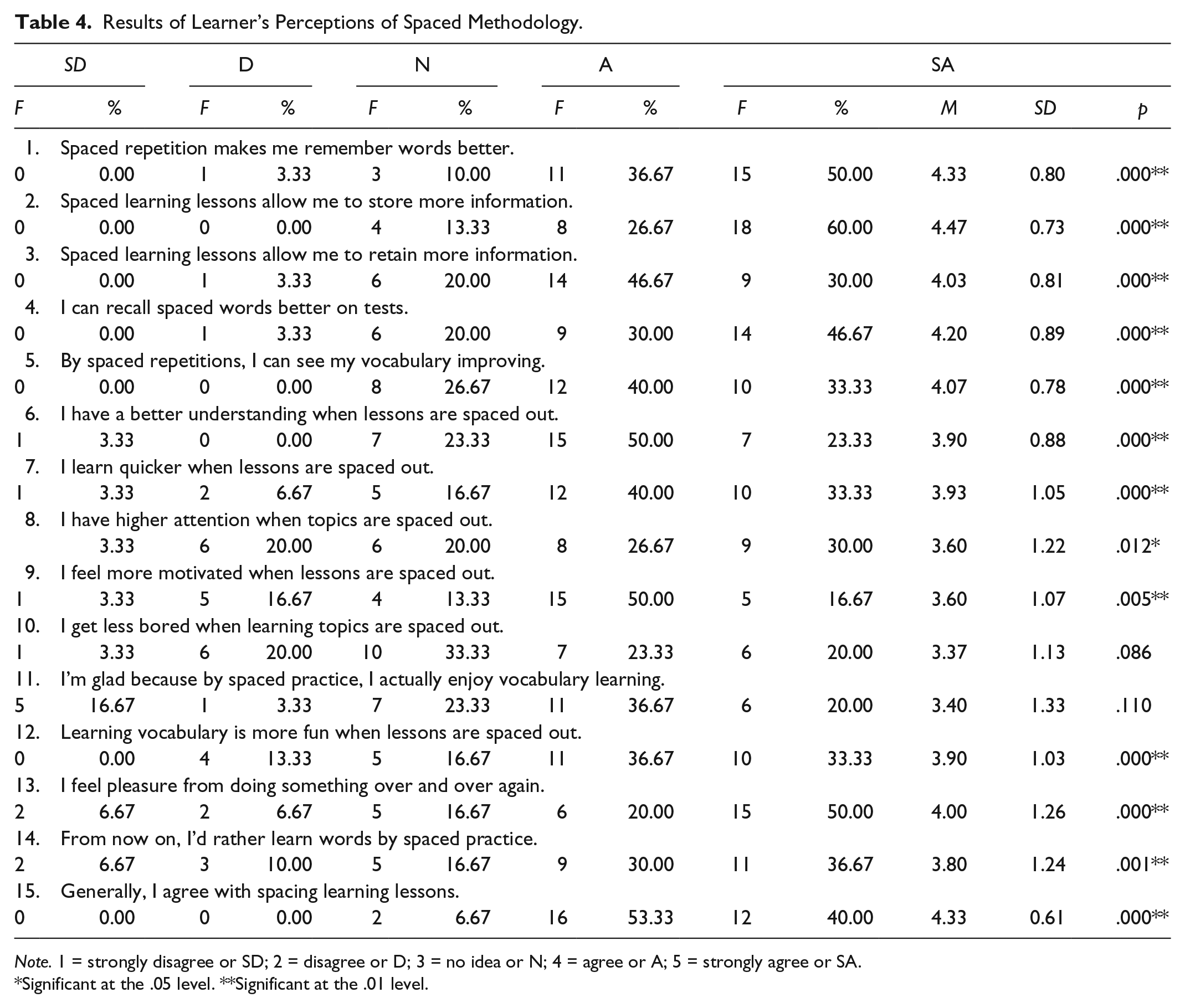
Note. 1 = strongly disagree or SD; 2 = disagree or D; 3 = no idea or N; 4 = agree or A; 5 = strongly agree or SA.
Significant at the .05 level. **Significant at the .01 level.
Items one to eight examined the respondents’ responses toward cognitive states. Item one (”Spaced repetition makes me remember words better”) showed a strong tendency of agreement. Twenty-six of the responding children (86.67%) either agreed or strongly agreed with this item. This indicates that spaced repetitions made them remember words better. Three of the respondents (10%) had no idea about Item one. Only one (3.33%) of the respondents disagreed with the item. Item two (“Spaced learning lessons allow me to store more information”) gained such high agreement among the responding children. Most respondents either strongly agreed (60%) or agreed (26.67%) with the item. However, the remaining children (13.33%) had no idea about Item two. In addition, it should be noted that the highest mean score obtained was related to Item two. About three fourth of the respondents (76.67%) agreed with Item three (“Spaced learning lessons allow me to retain more information”). Item four (“I can recall spaced words better on tests”) had about three fourth of children (76.67%) agreeing with this statement. Six of the participants (20%) had no idea about this item, and only one of the participants (3.33%) disagreed with this item. Item five (“By spaced repetitions, I can see my vocabulary improving”) had about 73% of the children agreeing with this statement. Item six (“I have a better understanding when lessons are spaced out”) had 22 of the responding children (73.33%) agreeing with this statement. Seven of the responding children (23.33%) showed neither agreement nor disagreement, and only one of the participants disagreed with this item. Concerning Item seven (“I learn quicker when lessons are spaced out”), children mostly selected either strongly agree (33.33%) or agree (40%) while strongly disagree had the lowest rate (3.33%). In addition, two of the respondents (6.67%) selected no idea. The majority of responding children agreed with Item eight (“I have higher attention when topics are spaced out”), 17 of the respondents showed a complete agreement (30%) or agreement (26.67%). Furthermore, six of the participants (20%) had no idea about Item eight.
Items one to eight elicited children’s cognitive processes involved in vocabulary learning concerning spaced-retrieval methodology. In general, children had a positive attitude toward using spaced methodology. Children strongly agreed that spacing improves learning. More specifically, they believed that spacing leads to better recall than massing does. In the present study, all learning sessions were similar. The only thing that was different between learning conditions was the amount of time between the two study sessions. At the test phase, children were surprised because they could remember words of one of the lists (spaced words) vastly better than the words of the other list (massed words). This indicates that the children could clearly differentiate between the two learning schedules, and therefore were able to judge accurately the effectiveness of the two different learning approaches on the scale.
The remaining items elicited children’s responses in relation to various affective states. With regard to Item nine (“I feel more motivated when lessons are spaced out”), children mostly selected either agree (50%) or strongly agree (16.67%). However, six of the respondents showed a completely opposite view as they either disagreed (16.67%) or strongly disagreed (3.33%). Also, four children (13.33%) selected no idea. In relation to Item 10 (I get less bored when learning topics that are spaced out), less than half of the participants (43.33%) agreed with this item, 23.33% disagreed, and 33.33% had no idea. In response to Item 11 (“I’m glad because by spaced practice, I actually enjoy vocabulary learning”), more than half of the participants either agreed or strongly agreed, less than 25% had no idea, although 20% either disagreed or strongly disagreed. Regarding Item 12, more than two third of the respondents (70%) agreed or strongly agreed with the statement, “Learning vocabulary is more fun when lessons are spaced out,” whereas only 13.33% of the respondents showed disagreement. In response to Item 13 (“I feel pleasure from doing something over and over again”), 21 respondents either agreed (20%) or strongly agreed (50%) with this item, while four respondents either disagreed or strongly disagreed with the statement (13.34%), and six said they had no idea. In relation to Item 14, less than three fourth of the respondents (66.67%) showed either agreement or strong agreement with the statement “From now on, I’d rather learn words by spaced practice”. However, the remaining respondents either disagreed or had no idea. Finally, regarding Item 15, almost all the respondents (93.33%) agreed with the statement “Generally, I agree with spacing learning lessons”. This indicates that they generally perceived spaced learning as an effective learning methodology. However, children’s responses to Items 10 and 11 were about the average. That is, children found teaching and learning techniques used in this study neither boring nor enjoyable.
Conclusion
The results confirmed both of our predictions. The primary aim of this study was to see whether or not children perceive spaced methodology as an effective approach compared with massed methodology. For this reason, we taught 30 L2 learners the meaning of 24 English words by two different spaced schedules (massed vs. spaced), and we assessed recalling one week and five weeks after the second learning session. The results of the final tests showed that spacing effect emerged when learning sessions were spread over time. This was in line with other recent previous studies (e.g., Goossens et al., 2012; Sobel et al., 2011). For instance, in the study by Sobel et al. (2011), the recall for the spaced words was 177% higher than the recall for the massed words. Furthermore, we administered a survey questionnaire to explore learners’ perceived effectiveness of these learning schedules. In general, children perceived spaced practice to be more effective than massed practice. The questionnaire was developed to elicit children’s responses in relation to cognitive and affective states. In general, children highly believed that spaced learning leads to better recall than massed learning does. However, the questionnaire showed less agreement toward the affective states of learners. For instance, the children perceived the learning activities used in this study neither enjoyable nor boring.
The present study extends the findings of Nakata (2015) who explored learners’ perceived effectiveness of different spacing schedules. In his study, college students practiced English–Japanese word pairs using computer software. Moreover, the spacing gaps between trials were limited to a few minutes. In our study, the children practiced English–Farsi word pairs in a classroom setting by using educationally related materials and with educationally meaningful spacing and testing gaps. Furthermore, the questionnaire in our study elicited children’s perceptions of their affective states.
Concerning the findings of this study, a number of limitations requires consideration. In this study, we made the learning sessions identical in both learning conditions to ensure the benefits of spacing. The only thing that was different between conditions was the amount of time between the learning sessions. However, by having both learning sessions identical, naturally, the massed words would be far less interesting. To do two identical sessions with a small break between the two would be far more boring than the spaced presentation, which separated the sessions by a week. Therefore, children may have preferred the spaced session for this reason. In the future research, it would be a good idea to use different exercises to keep the lessons from becoming boring. Furthermore, according to the study-phase retrieval account of the spacing effect (for a review, see Thios & D’Agostino, 1976), in order for spacing effect to work, the materials need to be seen at least twice. It needs to be learned during Study Session 1 and retrieved/updated (thus, memory trace strengthened) during Study Session 2. However, to make sure that the children can appreciate the difference in spaced learning versus massed learning when there were only two learning sessions, we administered the questionnaire after the final test session. In this way, the children could make accurate judgments about the effectiveness of both learning schedules. In the future research, it would be interesting to give the questionnaire before and after the test session.
Footnotes
Appendix A
Appendix B
Declaration of Conflicting Interests
The author(s) declared no potential conflicts of interest with respect to the research, authorship, and/or publication of this article.
Funding
The author(s) received no financial support for the research and/or authorship of this article.