




Abstract
University student populations are often characterised by low levels of subjective wellbeing. To understand student wellbeing from the social perspective, this study aimed to explore the prediction of wellbeing by social factors over and above the effects of stress. A particular focus was placed on the impact of social support from different sources, but also on the effects of social identification with students in one’s academic-discipline and university, and the impact of incompatible social identities at home and on campus. A sample of university students (n = 321) completed an online survey comprising measures of academic-discipline social identification (with one’s discipline and university), social identity incompatibility, stress experienced from negative life events as well as two measures of subjective wellbeing. The conducted analyses suggested that social support drawn from friends and family predicted more positive wellbeing, while support from a significant other did not. Moreover, this relationship mediated the positive impact of university identification on wellbeing, but the same was not found for discipline identification. Identity incompatibility predicted poorer wellbeing and was correlated with lower perceived social support and perceptions of higher experienced stress, which suggests a crucial role of this factor in predicting student wellbeing. The obtained results carry multiple implications for further understanding of the relationship between the three social processes, different forms of stress and student wellbeing, but also to existing preventative strategies which address the social dimension of the student experience.
Introduction
University students are often reported to experience low levels of subjective wellbeing and high levels of psychological distress (Bewick et al., 2008; Larcombe et al., 2016). They typically score lower on measures of psychological wellbeing than their non-university peers (Roberts & Zelenyanski, 2002; Stallman, 2010) and their wellbeing levels greatly decline with the commencement of studies at university and do not return to pre-university levels within the duration of their studies (Bewick et al., 2010). University students are more likely than the general population to develop depressive symptoms (prevalence at 30.6% between 1999 and 2010 compared to 20.6% in the general population; Ibrahim et al., 2013) and as such can be considered a vulnerable population. There are many new potential threats to one’s wellbeing when one becomes a student, including problems with academic performance, relationships, and finances (Grant, 2002; O’Reilly et al., 2014), but also general stress associated with considerably changing one’s life and community (Bayram & Bilgel, 2008). To understand student wellbeing, it must be considered that studying at university happens in a deeply social context. The quality of one’s social relationships does, in fact, reliably predict one’s wellbeing (Diener & Seligman, 2002). It is, therefore, crucial to consider the social processes relevant to university students. These include social support, usually given to explicitly make others’ wellbeing more positive (Cohen & Wills, 1985), academic-discipline social identification (Mavor et al., 2014; McNeill et al., 2014), but also processes that may be associated with psychological distress, such as incompatible social identities between home and university life (Smyth, Mavor & Gray, 2019).
Social Support
Siedlecki et al. (2014) suggest that satisfying social relationships allow one to receive social support and draw comfort from the fact that support is potentially available. Social support can take many different forms, such as providing tangible, instrumental help as well as companionship, information, and emotional comfort derived from friends, family, or other members of one’s community (Cohen & Wills, 1985). The positive relationship between social support and wellbeing has been established in many studies (see Cohen & Wills, 1985 for a review), and many prospective and longitudinal studies suggest a possible causal contribution of social support to physical and mental health through lowering the effects of stress or other health hazards (see House et al., 1988 for a review). In particular, perceived support, or one’s subjective view of the helpfulness and availability of social support (Lakey & Cronin, 2008), is considered to be most relevant as it is a better predictor of psychological distress and depression than enacted support (Finch et al., 1999) and is associated with higher life satisfaction in adults (Newsom & Schulz, 1996).
To fully understand the impact of social support on student wellbeing, it is crucial to explore the influence of different sources of support. Adolescents and children have been shown to rely heavily on social support from family and their general peer group (Rueger et al., 2016). University students, however, could benefit more from other sources of social support, such as one’s close friends rather than peers in general (Alsubaie et al., 2019). An early investigation into this matter suggests that there are significant differential influences of sources of social support on student wellbeing: namely, psychological distress and quality of life were predicted by support from friends and family but not by support from significant others (Alsubaie et al., 2019). If specific sources of support are shown to be relevant to the overall subjective wellbeing of students, it would be possible to address particular sources of support, as well as perceptions of their quality, in interventions designed to prevent low wellbeing.
Academic-Discipline Social Identification
Social support is unlikely to be the only process predicting students’ levels of subjective wellbeing. A sense of social identity, or knowing that one belongs to social groups and giving this belonging significance (Tajfel, 1972), is suggested to link to one’s broad social ties and wellbeing (Thoits, 1985). As Haslam et al. (2009) suggest, a sense of sharing one’s social identity with others fosters the exchange of social support and its positive interpretation. Indeed, in groups at high risk of distress, social identification with others in a similar position was associated with less stress and higher life and job satisfaction (Haslam et al., 2005). This relationship was significantly mediated by social support, which suggests that social identification could, in fact, create a psychological platform for the group members to exchange social support. Since high social identification with students in one’s academic-discipline was shown to be an important factor in the student population, predicting the adaptation of learning strategies associated with higher academic achievement (Bliuc et al., 2011a, 2011b; Smyth et al., 2015), it is possible that identification with other students in a similar position could also apply to broader outcomes such as wellbeing (Mavor et al., 2014; McNeill et al., 2014). While student populations are under-researched in this respect, there is preliminary evidence supporting this idea. Umayyah (2018), in an analysis of a sample of students representative of an Indonesian university population, showed that social support was a significant mediator of the relationship of one’s social identification as a student decreasing one’s stress levels. Further support of such relationships could prove invaluable for fostering student wellbeing. If student identity could create grounds for social support, it could be targeted to indirectly improve wellbeing and decrease perceived stress or the impact of stressful events.
Which Student Identity
While some past research has considered “student identity” as a generic form of social identification (e.g. Bizumic et al., 2009; Bliuc et al., 2011a, 2011b; Cameron, 1999), it can be argued that the content of such a generic identity may be too broad when trying to understand how social factors may impinge upon academic performance or wellbeing outcomes because different aspects of the student experience invoke different social connections and resources. Academic-discipline social identity appears to be a factor relevant to academic achievement (Smyth et al., 2015), but social identification with students in one’s broad institution could have different, more generalised benefits. Organizational identification, or feeling one belongs to one’s organization and shares its members’ experiences (Mael & Tetrick, 1992), could, in fact, predict positive outcomes in student populations as it does in professional settings, where it has been shown to be associated with outcomes such as more effective teamwork (Liu et al., 2011), higher work engagement (Mowday et al., 1982) and organization adherence (O’Reilly & Chatman, 1986).
Wilkins et al. (2016) suggest that such a broad process could also apply to university and college students as they identify with others in their academic institutions. Wilkins and colleagues propose that organizational identification of students can be a better predictor of positive outcomes such as student commitment, achievement, and satisfaction, than identification with fellow students from one’s degree programme. However, it is not entirely clear whether the difference in predicting those outcomes stems from actual differences between the two types of identification or rather from the differences in the measures used to quantify them. The items used to measure organizational identification all relate to one’s university (e.g., I feel strong ties with my university or I feel proud to be a student at my university; Abrams et al., 1998). In contrast, the items for discipline-specific social identification (adapted from Leach et al., 2008) refer to different groups (e.g., other students/the student cohort in my degree programme), but also to fellow students, which does not have to mean peers from one’s academic-discipline. As such, it is worthwhile to investigate, using measurements of discipline and organization identification that are nearly identical to each other, whether identification with the broad student community in one’s institution can in fact be a better predictor of positive outcomes, in this case wellbeing, than identifying with students in one’s academic-discipline (which would seem more relevant as one is usually closer to one’s immediate group rather than to a broad network such as an institution).
Social Identity Incompatibility
Furthermore, to fully understand the social dimension of student wellbeing, it must be considered that, in addition to academic-discipline social identification, there is another identity-related process that encapsulates the relationship between different social identities. The dissonance between one’s identity in the academic environment and one’s identity in their previous, familiar background may result in psychological distress, feelings of insecurity, and ambivalence (Reay, 2005). Especially since there can be multiple sources of identity incompatibility, such as race, ethnicity, age, and social class (e.g., de Vreeze et al., 2018; Matschke et al., 2022; Smyth, Mavor & Gray, 2019), the clash of social identities may have deleterious effects on one’s subjective wellbeing as it can result in a variety of negative feelings like inferiority, fear, alienation or shame (Cano et al., 2018; Lawler, 1999; Ostrove & Cole, 2003).
This could be particularly important in the student population due to the major changes students experience in their lives and their community when they begin their studies. Students usually possess pre-established social identities before coming to university, and, as they start to attend university, those social identities are not forgotten as students still remember and interact with their previous social groups. Instead, new, additional social identities are formed, and the new social identity may clash with the pre-existing one if the social or cultural backgrounds of the two identities are different (e.g., as in the case of students from working-class backgrounds attending elite universities; Matschke et al., 2022; Ostrove & Cole, 2003). Identity incompatibility does, in fact, appear to be a student-relevant process, as it predicts negative outcomes in students’ learning experiences such as performance-undermining behaviours like self-handicapping and procrastination (Smyth, Mavor & Gray, 2019). It is worth exploring whether the deleterious effects of identity incompatibility stretch beyond purely academic outcomes into subjective wellbeing, especially given that identity incompatibility appears to be a process independent of academic-discipline social identification (Smyth, Mavor & Gray, 2019). There is some suggestive evidence that identity integration in a study-abroad cultural exchange was importantly linked to instrumental social support and wellbeing (Matschke, 2022). This builds on the clear findings that the quality of one’s social relationships predicts one’s wellbeing (e.g., Diener & Seligman, 2002), and, with it being considered a negative social ‘relationship’, identity incompatibility might negatively impact not only wellbeing itself, but also perceived social support. Feeling that one’s social groups are not compatible with one’s identity at home might hinder the perception that social support is available from one’s support network. This could be particularly true for social support from one’s family since it is likely that the family will be the social group of the ‘former’ identity. Low perceptions of available support could at the same time exacerbate identity incompatibility, and as such the two processes are expected to be closely related.
This Study
This study, therefore, aims to explore the relationship between subjective wellbeing and three social processes: academic social identification, perceived social support and identity incompatibility. Via an online survey, the participants’ academic social identification was measured, both with students in their discipline and in their university, to allow comparison between the effects of the two types of identification on wellbeing, and to explore their potential differential relationship with perceived social support. Perceived social support was also measured multidimensionally. With measurements of social support from friends, family, and a significant other, it will therefore be possible to verify whether the effects of academic social identification are mediated by support from any particular source. It will also be possible to test whether support from friends and family is, in fact, more predictive of one’s wellbeing than support from a significant other, as suggested by preliminary evidence (Alsubaie et al., 2019). By including an additional measurement of experienced stress, it will be possible to account for the deleterious effects of stress on wellbeing, as well as explore its relationship with the social processes in the study. The Negative Life Events Scale for Students (Buri, 2018) was used to record students’ experiences of acute negative stressors relevant specifically to the student population. Finally, the study also aims to investigate, for practical purposes, whether a short-version of a subjective wellbeing questionnaire can capture the same aspects of wellbeing as a longer, more elaborate measure assessing depression, satisfaction with life, and positive and negative affect (as per the definition of psychological wellbeing; Busseri & Sadava, 2011). If the two measures apply to the same construct, the brief measure, with its few simple items, could become useful for further theoretical explorations, as well as efficiently assessing the impact of future social identification and identity incompatibility interventions.
In our study, we expect that:
Participant’s perceptions of more accessible and appropriate social support from friends and family will be associated with more positive subjective wellbeing, but the same will not apply to social support from a significant other (as per preliminary evidence from Alsubaie et al., 2019).
Academic social identification with other students in one’s discipline and university will indirectly predict subjective wellbeing; this relationship will be mediated by social support (as per preliminary evidence from Umayyah, 2018).
Subjective wellbeing will be negatively associated with stress and social identity incompatibility so that those who experience more stress and more incompatibility will report poorer wellbeing (e.g., Cano et al., 2018).
Identity incompatibility is also expected to be negatively correlated with participants’ perceptions of available social support, and this relationship is expected to be strongest for social support from one’s family (exploratory hypothesis as per preliminary evidence from Matschke, 2022).
Academic social identification with students in one’s discipline and university will not be correlated with identity incompatibility (as in Smyth, Mavor & Gray, 2019), allowing us to treat the constructs as effectively independent as predictors of wellbeing.
The following deliberate model variations were also investigated. Following good practice of testing multiple models where there is no clear causal primacy, multiple models were considered and the empirical results were used to help determine which were the more plausible.
In terms of causal order implicated by the models, wellbeing is treated as the main outcome of interest, but we remain agnostic about two main possibilities with predictors:
6. Identity incompatibility may act as a form of stress, increasing subjective stress and impacting wellbeing through stress as a mediator. Alternatively, subjective stress may be a trigger for feelings of identity incompatibility and thus incompatibility may mediate the relationship between stress and wellbeing.
7. How much students identify with their discipline/university may at least partly reflect how much social support they experience from friends or family. Alternatively, the level of social support they receive might reflect their degree of identification.
Overall Design
To address these questions, we are taking a path modelling approach based on multiple regression (Hayes, 2018). That is, we are addressing the main constructs as measured variables in several multiple regression equations (as opposed to conducting a full SEM analysis with latent variables). Since we are using established measures of our constructs, we are not interested in latent measurement models but in exploring the substantive mediational models based on reliable measured constructs. We will therefore also present substantive results in the form of multiple alternative path models comparing similar models where directional relationships are unclear.
Methods
Participants
The study was conducted as an online survey completed by 321 university undergraduate students recruited through a study advert on the online recruitment platform Prolific. The median age was 21 years (min = 18 years, max = 53 years) and there were 66% women, 31.8% men, 1.3% non-binary, and 0.9% gender-fluid participants. Nearly all participants were born (97.8%) and lived (99.1%) in the United Kingdom; English was the first language for 97.8% of the participants. The sample surveyed students across all years of study (30.5% in their first year, 27% in second, 31.1% in third, and 11.3% in fourth year or beyond). Participation was entirely voluntary and entailed financial compensation for the time investment (at an average rate of £7.78/hr).
Measures
The survey included four major predictor variables: perceived social support, experienced stress, academic social identification, and social identity incompatibility. The outcome variable in the study was one’s subjective wellbeing as measured by two scales: CORE-GP and a Composite measure (comprising scales of depression, life satisfaction and affect).
Perceived Social Support
Perceived social support was measured using the Multidimensional Scale of Perceived Support (Zimet et al., 1988). Participants expressed their degree of agreement (1–7 scale where 1 = very strongly disagree, 7 = very strongly agree) with 12 statements about the perceived availability and suitability of support from different people. There were three possible sources of support, each reflected in four statements: support from family (e.g., “I get the emotional help and support I need from my family”), friends (e.g., “I can count on my friends when things go wrong”) and a significant other (e.g., “There is a special person who is around when I am in need”). A mean score between 1 and 7 was calculated for each subscale so that a higher score designated higher perceived social support. A factor analysis (principal axis factoring, direct oblimin rotation) confirmed the items loaded onto three separate factors, or constructs (see Appendix 1 for pattern matrix); the subscales were also highly internally consistent (Cronbach’s alpha: friends α = .92, family α = .91, significant other α = .97).
Experienced Stress
Experienced stress was measured using the Negative Life Events Scale for Students (NLESS; Buri, 2018) devised from 10 recognised life events questionnaires such as the Social Readjustment Rating Scale (Holmes & Rahe, 1967), the Life Events Inventory (Cochrane & Robertson, 1973) and the Assessment of Life Change Stress (Hurst et al., 1978). The scale compiles life events from the questionnaires and removes any temporary (e.g., getting a low grade on a test), pleasant (e.g., vacation), or student-irrelevant items (e.g., retirement). The NLESS includes a list of 25 major negative life events regarding the most crucial aspects of one’s life (e.g., health, finances, education, work, and social events) which have happened in either the participant’s or their closest ones’ past year of life (e.g., “a serious personal illness or injury to yourself”; “your parent going through a separation/divorce”; “your family experiencing major and/or chronic financial strain”). This scale was used to avoid the participant’s confusion of one’s state stress with subjective wellbeing and to allow insight into the effects of acute stress rather than daily hassles. The participants indicated any experienced events and the stressfulness of each experienced event on a 1 to 5 scale (where 1 = not at all stressful, 5 = extremely stressful). An overall score of experienced stress (1–5) was calculated by averaging the stress scores given to the experienced events, with higher scores indicating higher levels of stress.
Academic Social Identification
Student discipline, and organizational social identity were measured through the participants’ agreement to statements about one’s identification with other students in their area of study and their wider university community. Such items are typically used to measure social identification (e.g., Haslam et al., 2005), and have been successfully used in the past to measure students’ specific discipline identification (e.g. Smyth et al., 2015). There were five items for discipline identification (“Being a student in <discipline> is important to me”; “I have strong ties with students in <discipline>”; “I feel proud to be a student in <discipline>”; “I feel a strong sense of belonging in <discipline>”; “I am glad to be a student in <discipline>”) and five analogous items about one’s identification with one’s university (<discipline> in each item replaced with <my university>). Each statement was rated by the participants on a 1 to 7 scale (1 = strongly disagree, 7 = strongly agree), and mean scores were calculated for each type of identification, with higher scores designating higher shared social identification with one’s university or study area. A factor analysis (principal axis factoring, oblimin rotation), performed on all items suggested that the items did load to two respective factors with separation to university and discipline items (see Appendix 2 for pattern matrix), which suggests that the two can be treated as separate constructs. As such, two sub-measures were used in further analyses –discipline identification (for identification with one’s area of study) and university identification (for identification with one’s institution). Items for both types of identification were internally consistent (discipline identification α = .86; university identification α = .92).
Social Identity Incompatibility
The measure of social identity incompatibility used four items from the scale developed by Smyth, Mavor and Gray (2019) measuring the participant’s feelings of incompatible home and university social identities. The items describe feelings of differences between one’s home and university identities, and feelings of the two identities being in conflict: “I sometimes feel as though the identity I want to project at university is very different to the one I want to project back home”;“I sometimes feel as though I have to switch between two different identities when I go from home to university, and vice versa”; “I often feel as though the people I interact with at university are not compatible with my family or friends back home”; and, “When I return home, I am often reminded of how much I have changed since coming to university”. The participants expressed their agreement to each statement on a 1 to 7 scale (1 = strongly disagree, 7 = strongly agree) and an average score from all four items was used in further analyses (with higher scores indicating higher perception of conflicting home and university identities). While only half the items of the original scale were used to ensure survey brevity, the items were still highly reliable (with Cronbach’s α = .78).
Subjective Wellbeing
Subjective wellbeing (SWB) is a long-standing construct in Psychology with a long and complex history. Deiner (1984, 2013; Deiner et al., 1999) has been a significant figure, particularly in seeing SWB as an expression of general wellbeing and life satisfaction in “normal” populations (Seligman & Csikszentmihalyi, 2000). Deiner’s basic formulation of SWB as consisting of a cognitive component (life satisfaction) and an emotion component consisting of subjective positive and negative affect has been quite robust (Busseri & Sadava, 2011; such a combination has been successfully used to measure subjective wellbeing in other studies of social support; e.g., Siedlecki et al., 2014). Although there has been some contention over the best way to deal with this combination (e.g., simple composite, or higher order latent construct; e.g., Busseri & Sadava, 2011; Kaufman et al., 2022), it is still common practice to use a simple composite score in many applications. While a very common approach is to use a life-satisfaction scale (e.g. Diener et al., 1985), along with the PANAS (Thompson, 2007) as a measure of positive and negative affect, it is also common (e.g., Rice & Shorey-Fennell, 2020) to include other measures of positive and negative emotional experiences such as the Scale of Positive and Negative Experiences (SPANE), the Subjective Happiness Scale (SHS), or the Center for Epidemiological Studies Depression Scale (CES-D).
For our purposes, we incorporated the classic trio of satisfaction with life (SWL), positive and negative affect (PANAS), but we also included a depression scale that was designed to assess negative experiences in a general population, and therefore has a reasonable range of response in a “normal” sample. We felt that this inclusion addresses not only immediate emotional experience but some subjective processing of that emotion in terms of general sadness (anhedonia) and physical manifestations (somatization). There is support for seeing this as an integral part of the SWB construct (e.g., Disabato et al. 2016). Each of the elements we use in our composite are elaborated below, along with our mechanism for combining these elements.
The Satisfaction with Life Scale (SWL; Diener et al., 1985) aims to measure global cognitive judgements of one’s life satisfaction. There are 5 items (e.g., “If I could live my life over, I would change almost nothing”; “In most ways, my life is close to my ideal”) and participants indicated whether they agreed with each item on a 7-point scale (1 = completely disagree, 7 = completely agree). An average SWL score was calculated, with high scores indicating high life satisfaction. The internal consistency of the measure was high (Cronbach’s alpha = .87).
An 8-item version of the International Short Form Positive and Negative Affect Schedule (I-PANAS-SF; Thompson, 2007) was used as a very brief measure of state affect. The participants indicated how often they felt in certain ways over the past week, with four adjectives for positive affect (PA; excited, happy, enthusiastic, proud) and four adjectives for negative affect (NA; irritable, hostile, ashamed, upset). Answers were given on a 1 to 5 scale (1 = not at all, 5 = very much), and a mean score for PA and NA was calculated for each participant, with high scores indicating higher PA or NA. Since it is part of the larger Composite measure, the use of these 8 items (rather than the typical 12) allowed us to keep the measure brief, while preserving the essence of the longer measure (items with high factor loadings for positive and negative affect were used; Watson & Clark, 1989).
The measure of depression was the Center for Epidemiologic Studies Depression Scale (CESD; Radloff, 1977). It comprises 20 short statements about one’s affective and behavioural symptoms (e.g., “I had crying spells”; “I thought my life had been a failure”; “I was bothered by things that usually don’t bother me”). The participants indicated how often they felt those ways in the past week by rating each item on a 1 to 4 scale (where 1 = rarely or none of the time (less than 1 day); 4 = most or all of the time (5–7 days)). A mean score for each participant indicated how depressed they had been in the past week, with high scores indicating high levels of depression. The internal consistency of the measure was strong (α = .81).
The Composite measure of subjective wellbeing was calculated by first converting the individual scores of each component scale to z-scores. This was necessary because the component elements were measured on very different measures and scales. They could not therefore be combined directly in any meaningful sense. By combining them as z-scores we are creating a higher-order composite scale that measures the individual’s location in the current sample. It is important to note, therefore, that the Composite score is not meaningful against any specific population anchor point (such as a clinical cutoff). The z-scores were combined directionally such that higher scores indicated better wellbeing:

CORE-GP (Screening measure of SWB)
As well as measuring general subjective wellbeing, higher education researchers are often interested in measures of wellbeing that might presage or indicate higher levels of distress. The advantages for us in including such a measure are two-fold: screening measures are often broad and short, allowing us to test a short-form scale that might efficiently replace the longer SWB composite for some purposes; secondly screening measures often have clinical population data allowing individual and group scores to be interpreted in absolute terms when needed. Although these features are not crucial to our study, inclusion of such a screening measure allow us to examine exploratory questions about substituting a short screening measure for a longer SWB composite. For this purpose, we included the 14-item Clinical Outcomes in Routine Evaluation-General Population questionnaire (CORE-GP; Sinclair et al., 2005). This measure was adapted from the 34-item Clinical Outcomes in Routine Evaluation-Outcome Measure (CORE-OM; Evans et al., 2002) and is appropriate to use with non-clinical, student populations (GP). The CORE-GP is highly correlated with the CORE-OM (r = 0.9–0.95) and has the same psychometric properties (Evans et al., 2005). The questionnaire assesses one’s subjective wellbeing through eight positive (reverse-coded) items (e.g., “I have felt O.K. about myself”; “I have been able to do most things I needed to”) and six negative items focusing on psychological distress, physical problems, depression, and anxiety (e.g., “I have felt tense, anxious or nervous”; “I have felt unhappy”). The participants indicated how often they related to the items in the past week on a 0-4 scale (where 0 = not at all, 4 = most or all of the time). A mean score was calculated for each participant whereby a higher mean indicated lower wellbeing and higher psychological distress over the past week representing a more typical use of the measure for screening distress. For analytical purposes, a reverse of the mean score (rCORE-GP) was used in all regression analyses such that higher scores indicated more positive wellbeing. The measure was robustly reliable in this study (Cronbach’s α = .85).
Stress related to COVID-19
A short additional measurement was added to account for potential stress experienced from the outbreak of the coronavirus pandemic which started in 2020. Stress relating to COVID-19 was not meaningfully correlated with either measure of wellbeing, so was excluded from further analyses (see Supplementary Materials for further details).
Procedure
Ethical approval was received, before the study commenced, from the Ethics Committee at the researchers’ institution. The study was carried out as an online survey implemented using the Qualtrics platform. The participants accessed the study link on the Prolific online recruitment service on their personal devices (computer or tablet, but not mobile phone) and at their desired time. Following information about the study and consenting to participate, the participants first completed questions about their demographic information (age, gender, country of birth, and residence) and questions about their experiences related to the COVID-19 pandemic. Then participants completed the measures of academic social identification, identity incompatibility, experienced stress, perceived social support, and wellbeing (CORE-GP and the Composite measure). The order of the identification scales (academic-discipline identity and university identity), and the order of the two sets of wellbeing scales (CORE-GP and the Composite measure) were counter-balanced across participants. In addition, the order of the items within each measure was randomised for each participant. In order for a response to be considered valid, participants had to answer all questions in all measures, although they were able to skip demographic questions. There were eight validity (attention) checks randomly incorporated into the measures to ensure the participants’ attention to the questions which they were answering (e.g., ‘To show I am paying attention, I will answer ‘somewhat agree’ to this question). There was a clear criterion for exclusion – participants who did not get at least 5/8 validity checks correct would be removed from analysis.
Results
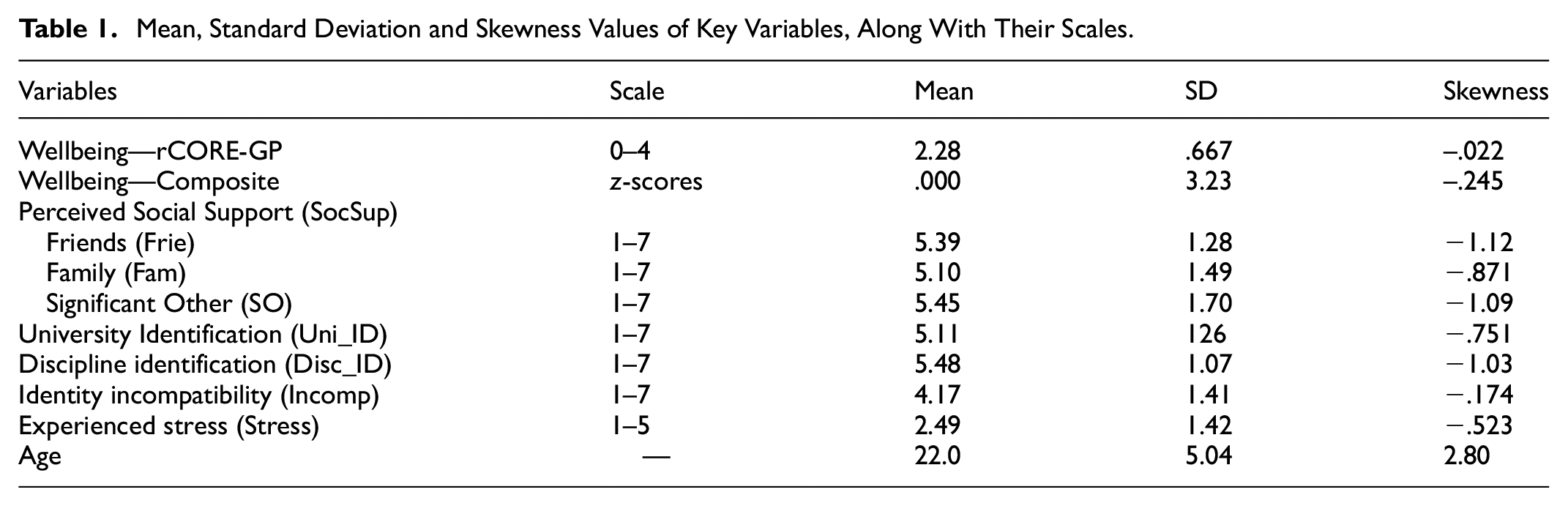
Only a small number of participants (n = 3) were excluded from all statistical analyses due to these participants not passing the validity check; which left the final sample with n = 318. The majority (93.4%) of the participants in the sample answered 7 or 8 validity checks correctly. The descriptive statistics and correlations of the key variables are shown in Tables 1 and 2, respectively.
Mean, Standard Deviation and Skewness Values of Key Variables, Along With Their Scales.
Zero-order Correlations of Key Variables.

Significance at *p < .05, **p < .01.
The two wellbeing measures, the CORE-GP and the Composite measure, were highly correlated (r = .880, p < .1), suggesting that the measures captured wellbeing to a similar extent. Further analyses including Wellbeing will provide parameter values for both measures, presented in rCORE-GP / Composite measure order. Social support from all sources was positively correlated with wellbeing so that participants who perceived their social support to be of better quality reported higher subjective wellbeing. This was most true for support from one’s family, followed by friends and significant other (respectively r (rCORE-GP /Composite) = .466/.465, .380/.382, .251/.223, p < .01). While support from friends and family are similarly correlated to wellbeing and academic social identification, support from family does uniquely correlate with identity incompatibility (r = .204, p < .01) and stress (r = −.114, p < .5) while support from friends does not. Given this, further regression analyses will be conducted separately for support from friends and family. Since support from significant other was the type of support least correlated with wellbeing and academic social identification and did not significantly predict wellbeing in a regression model with the three social support sources predicting wellbeing (standardized β = .051, t = .909, p = .364), it was excluded from further analyses.
University identification was positively correlated with wellbeing (r = .208/.218, p < .01), so that those identifying more strongly with other students in one’s institution experienced less psychological distress and more positive wellbeing. Discipline identification, however, was not significantly correlated to wellbeing (r = .084/.097, p = .135/.087), and as such was also removed from further analyses predicting wellbeing.
As expected, stress had a negative correlation with wellbeing (r=-.351/-.361, p < .01); those who experienced more acute stressful events experienced more psychological distress than those who experienced less stress. A similar relationship was found for identity incompatibility, which was also negatively correlated with wellbeing (r = −267/−.319, p < .01), so that those experiencing more dissonance between their home and university social identity reported lower wellbeing. As expected, identity incompatibility was not significantly correlated to university identification (r = −.049, p = .384), suggesting that these factors can be treated as effectively independent when interpreting subsequent path analyses.
Regressional Analyses
The overall regression model was found to be significant, with support from friends (r = .543/568, R2 = .295/322, F = 32.8/37.3, p < .001); and, with support from family (r = .572/.592, R2 = .327/.350, F = 38.0/42.1, p < .001). Next, several sets of path models were explored considering different possible mediation relationships between the predictors according to the research questions. Remaining agnostic about the causal order of two pairs of variables, four models were tested in total with all four variations in order. In the case of research expectation 7, it was found that the direct paths in the models supported university identity as a predictor of social support rather than the reverse. Therefore, only those models are reported below (but the alternative models are provided in Appendices 3 and 4). In contrast, models considering alternative causal orders of stress or identity incompatibility were both plausible and added to an understanding of possible processes. As such, both families of these models are presented.
For both Models (see Figures 1 and 2), Social Support was tested for its mediation of the relationship between university identification and wellbeing (University Identification → Social Support → Wellbeing). Since the direct path from university identification to wellbeing was non-significant, but an indirect path through social support was significant, this suggests that university identification might increase one’s perceptions of social support both from friends and family, which in turn might positively impact one’s wellbeing.
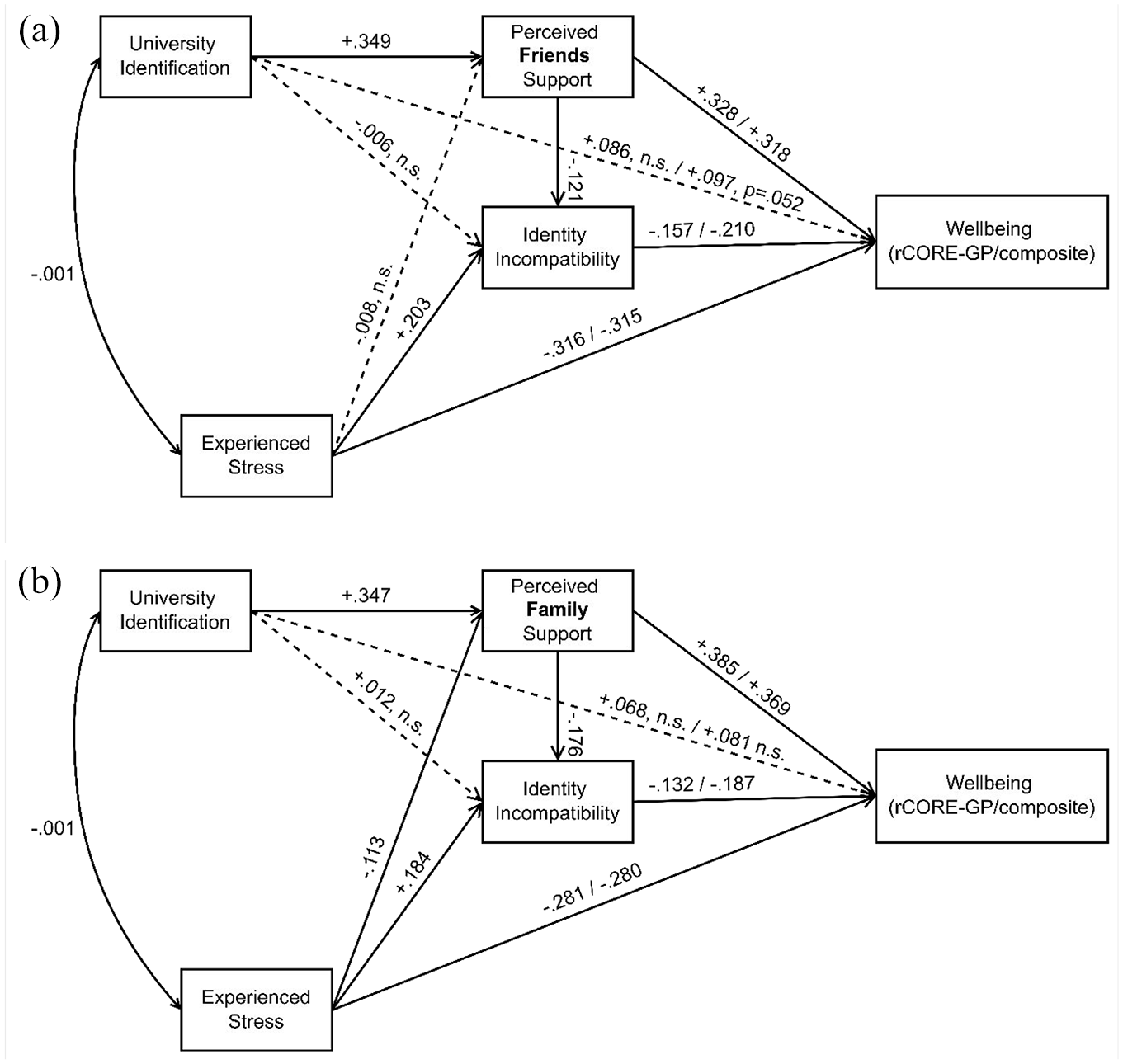
(a) Friends. (b) Family.

(a) Friends. (b) Family.
Using PROCESS (Version 4.2; Hayes, 2018), the indirect effect of university identification on wellbeing through friend support (controlling for all other variables in the model) was significant, (Composite: B (SE) = 281 (.068), CI [.158,.422], β = .109; rCORE-GP: B (SE) = .060 (.015), CI [.033,.092], β = .113). Similarly, the equivalent indirect effect of university identification on wellbeing through family support was also significant, (Composite: B (SE) = .322 (.065), CI [.202, .458], β = .125; rCORE-GP: B (SE) = .069 (.014), CI [.043,.097], β = .131). In all these analyses the direct effect was not significant, highlighting that the effect of university identification on wellbeing is completely mediated through social support, whether that be support of friends or family.
For Model 1, giving causal precedence to stress, in both versions (Figures 1(a) and 1(b)) a moderate direct effect from stress to wellbeing (around .3) can be seen, with a weaker indirect effect mediated through identity incompatibility. That is, feeling stress in the academic context could exacerbate feelings of identity incompatibility and contribute to lower wellbeing. The indirect effect of stress on wellbeing through identity incompatibility (controlling for all other variables as covariates) was significant, (Composite: B (SE) = -.075 (.031), CI [−.141, −.023], β = −.33; rCORE-GP: B (SE) = .011 (.006), CI [−.024, −.002], β = −.023).
Both family and friends’ support negatively predicted the experience of identity incompatibility and positively predicted wellbeing. So, in this model, support has a mediating effect through identity incompatibility by reducing that sense of disconnection, even if only small compared to the direct effect. The indirect effect of friend support through identity incompatibility was significant, (Composite: B (SE) = .065 (.035), CI [.006, .141], β = .026; rCORE-GP: B (SE) = .010 (.006), CI [.001, .023], β = .019). Similarly, the indirect effect of family support was significant, (Composite: B (SE) = .072 (.030), CI [.024, .141], β = .033; rCORE-GP: B (SE) = .010 (.005), CI [.002, .023], β = .023). In this way, support is counteracting a small but reliable component of the impact of stress through identity incompatibility.
Model 2 (Figure 2) also proved viable, where the relationship between stress and identity incompatibility was reversed compared to Model 1. This suggests that stress might also partially mediate the relationship between identity incompatibility and wellbeing. The indirect effect of identity incompatibility on wellbeing through stress (controlling for all other variables in the model) was significant, (Composite: B (SE) = −.128 (.042), CI [−.215, −.050], β = .056; rCORE-GP: B (SE) = −.026 (.007), CI [−.044, −.011], β = −.056). Taken this way, the experience of identity incompatibility can exacerbate other forms of stress in the academic context and thus also contribute to reduced wellbeing. In this case though, support does not directly impact on stress and therefore does not have an indirect effect through stress, on wellbeing.
The broader point therefore is that the experiences captured by the stress scale and the identity incompatibility scale are most likely to exacerbate each other dynamically, as well as having independent impacts on wellbeing. However, the social support factors are more likely to impact via the identity incompatibility pathway (reducing the experience of incompatibility), rather than impacting stress. Stress has a somewhat stronger direct effect on wellbeing, whichever way you model it. An interesting small variation between the models was that higher levels of stress were found to significantly predict one’s lower perceptions of support from family (Figure 1(b)), but not friends (Figure 1(a)). This was only found when stress was treated as a predictor to social support and identity incompatibility.
Discussion
This study aimed to explore how subjective wellbeing of university students is predicted over and above the effects of acute negative, student-relevant stressors. Firstly, the effects of social support were explored to investigate whether social support from different sources is differentially relevant to students. Moreover, the students’ academic social identification with other students in one’s discipline and university was also measured to provide insight into the potential indirect effect of identification on wellbeing through facilitating social support. Finally, a measure of incompatibility of social identities at home and university was also included in the study to investigate whether the disparity of social identities can be a source of psychological distress to university students. Importantly, the findings from each of the investigations discussed in this section were applied to wellbeing measured by a brief general measure of wellbeing (CORE-GP), as well as a more elaborate measure based on items capturing depression, positive and negative affect, and satisfaction with life (Composite measure). As the two measures were found to be closely correlated, the relationships of the discussed social processes can be viewed to interact with wellbeing, not only understood as one’s subjective comfort or ‘feeling well’, but also crucial clinically relevant factors, such as depressive symptoms. As a practical matter, this supports the use of the shorter screening measure, CORE-GP, for the purpose of capturing a broadly understood construct of student distress versus wellbeing.
Social Support
It was initially predicted that students who consider their social support to be of higher quality—that is, more available, and relevant to one’s needs—would experience more positive wellbeing. This prediction was supported in this study, which is in line with other studies exploring this relationship in adult (Lakey & Cronin, 2008), adolescent (Rueger et al., 2016), and student populations (Alsubaie et al., 2019). In terms of causal order, it is certainly plausible that students of higher wellbeing may perceive support from others to be more available due to their generally positive outlook as well as their lower need for support (and thus considering what is available to be abundant as it is surplus to need). Nevertheless, considering the extensive body of research suggesting an instrumental role of social support in improving our wellbeing (e.g., Cohen & Wills, 1985; House et al., 1988), it is only reasonable to understand the results of this study to indicate that the help, comfort, and emotional support provided to students by their close ones does indeed contribute to more positive wellbeing. This supports our choice of Wellbeing as our primary outcome measure.
As far as different sources of social support are considered, the results suggest that, in student populations, social support from friends and family are significant predictors of wellbeing. However, support from a significant other does not appear to predict wellbeing over and above the other sources of support. Such a pattern is consistent with the results of Alsubaie et al. (2019), who show significant prediction of students’ depressive symptoms and life quality by support from friends and family, but not from a significant other. It is not clear why such a pattern is observed. It could be that for many students at an early stage of adult life, a significant other (usually a partner) may be considered less reliable or stable than their friends and family with whom relationships might be more established and considered more permanent or long-lasting. Further research exploring the perceptions of support available to students experiencing poor wellbeing, could shed light on this differential impact.
Academic Social Identification
Strong social identification with others in one’s communities has been suggested to be a crucial element for psychological and even physical wellbeing, especially for vulnerable groups (Haslam et al., 2009). Thus, this study investigated whether more positive wellbeing is observed for students who closely identify with others in their immediate community, namely students. It was particularly expected that the effects of student identification on wellbeing would be mediated by social support as individuals who identify with others in a similar situation are shown to perceive more available social support (Haslam et al., 2005). While it was primarily expected that identification with students in one’s discipline would be more crucial (due to its positive outcomes academically; Smyth et al., 2015), Wilkins et al.’s (2016) suggestion, that the broader identification with the academic organization is a better predictor for students, was also tested. Measuring discipline and university identification using parallel-worded items allowed us to disentangle these two constructs, and to test Wilkins et al.’s (2016) suggestion. Wellbeing was, in fact, significantly positively correlated with university identification, and not discipline identification. This suggests that identification with students in one’s broad institution may be a better predictor of positive outcomes, such as wellbeing, perhaps due to the broader network of people one could identify with. Discipline identification may then be a more academically relevant construct, especially if it is associated with matters closely related to the actual discipline, such as adaptation of particular learning strategies or perception of peer studying norms (Smyth, Mavor & Platow, 2019)
The more predictive role of university identification as a broader process appears to also be supported in the next finding of the study—the fact that the effect of university identification on wellbeing was nearly completely mediated through its effects on social support from friends and family. While identification with one’s university peers might seem intuitive to predict higher perceived support from friends (it is likely one’s friends are at the same university), finding it predict perceived support from one’s family is an intriguing result. It is possible that parents support students while at university in many direct and indirect ways, so the more a student feels connected with the university, the more they experience that family support. It is also likely that identifying with one’s institution, feeling that we are in a community we belong to, and we have strong ties with, may cause a more positive, comforting outlook allowing us to better perceive the support available from both friends and family. As such, stronger identification with students in one’s institution does appear to create a psychological platform facilitating better perceptions of social support, as suggested by Haslam et al. (2009). Not only does this highlight the importance of encouraging students to form strong social identification with their universities through appropriate interventions or actions taken by universities and their staff (Lambert & Felten, 2020), but also allows us to understand how crucial social identification and positive social relationships are to our wellbeing in general.
Social Identity Incompatibility
In our study, it was expected that having incompatible social identities at home and university would predict poorer student wellbeing. This is particularly because identity incompatibility can take the form of feelings of insecurity or inferiority (Reay, 2005), but also due to evidence showing it can be associated with negative academic outcomes, such as procrastination or self-handicapping (Smyth, Mavor & Gray, 2019).
As expected, identity incompatibility predicted poorer wellbeing. It was also positively correlated with the measure of experienced stress - those with more incompatible identities reported that their acute stressors were more stressful to them than those with low incompatibility. As incompatibility was also negatively correlated with perceived social support from friends and family, there appear to be two alternatives in terms of the directionality of the effects of those variables. Both stress and identity incompatibility have direct effects in predicting wellbeing, but the additional mediation of their effects is viable in both directions – either higher identity incompatibility increases perceptions of the stressfulness of one’s acute stressors, which in turn has detrimental effects on wellbeing (Figure 2) or seeing one’s stressors as more stressful worsens one’s incompatibility of identities, which then leads to lower wellbeing (Figure 1).
In terms of predicting wellbeing, the difference between the two causal options shown in the bottom sections of Figures 1 and 2, does not seem to have huge importance – both path directions are plausible, and stress and identity incompatibility are likely to impact each other over time. The reciprocal character of the relationship (“things are more stressful for me when I feel my identities are clashing” and “I cannot align my identities when I am acutely stressed”) appears even more likely when identity incompatibility is considered a form of stress—finding oneself unable to reconcile one’s pre-existing social identity with a new one at university could in itself be an acute psychological stressor. While the effects on wellbeing are similar regardless of directionality, a better understanding of the identity incompatibility-stress-wellbeing relationship will certainly benefit from further investigations using different measures of stress. Additional measures of state stress, daily hassles, and more strictly academic-/university-related issues could allow us to disentangle the potential contributors and distressing outcomes associated with identity incompatibility. This could also help us to understand the only major difference between the two versions of the suggested model—the path where one’s ratings of stress significantly predicted a reduction in social support from one’s family, but not from friends (Figure 1).
Despite the question of the directionality of the relationships that identity incompatibility has with factors such as stress and social support, it can be confidently considered a crucial negative factor in predicting student wellbeing, and possibly other social processes like social support. This puts identity incompatibility forward as a potential screening measure to identify vulnerable groups who are most likely to experience poorer wellbeing as well as other negative academic effects (Smyth, Mavor & Gray, 2019). This might be more likely to apply to groups for whom the change in environment is the most drastic as they begin university, such as those coming from “non-traditional” racial, ethnic, age, or socioeconomic backgrounds (Smyth, Mavor & Gray, 2019).
Implications of the Study
The effects of social support, university identification, and identity incompatibility on student wellbeing found in this study underline a common theme – the importance of students’ social lives to their wellbeing. On one side, there are the positive effects of social support providing us with psychological reinforcement and comfort, and the identification with students in one’s university helping us better perceive, and draw upon, the available support. On the other hand, there is the detrimental impact of acute stress and perceptions of disparity or mismatch between one’s home and academic identity. While the suggested models are not exhaustive, they certainly highlight factors that can contribute to achieving happier and mentally healthier student populations.
Our objective in improving the wellbeing of students should be, in addition to supporting them individually, to address the social aspect of being a student. Targeting social identification with other students in the institution could lead to improvement in student wellbeing. Supporting one’s feeling of being part of the community could, according to the suggested model, allow them to better see the support available to them. Similarly, helping students to overcome the seemingly inescapable incompatibility of their social identities could lead to more positive wellbeing through lowering distress, but also through potential beneficial effects to perceptions of social support or stress.
An interesting avenue in addressing those social processes could be in already existing interventions aimed to improve the perceived belonging of students. For example, the Social-Belonging Intervention (Walton & Cohen, 2011) is aimed to target what Walton and Cohen (2007) call “belonging uncertainty”—doubt concerning whether or not we belong to our community (“can people like me belong here?”). This brief interactive exercise includes stories of more senior students who describe having experienced belonging uncertainty and explain that such concerns are normal, common, and that they weaken over time. In a series of randomised controlled trials, this intervention was shown to lead to increased confidence about one’s belonging, more positive wellbeing and physical health, better academic outcomes, and even fewer worries about being negatively stereotyped (see Walton & Brady, 2020 for a review). While the Walton and Cohen (2011) intervention specifically targets students experiencing belonging uncertainty, those same students are likely to be experiencing incompatibility of social identities at the same time. Using this intervention might, therefore, also help with distress related to identity incompatibility, and, as it aims to increase feelings of belonging to one’s academic community, it can also strengthen students’ identification with other members of their university. It is perhaps why such reliable positive outcomes are seen for this intervention—it might be that not only belonging is bolstered, but also that identity incompatibility is lowered, and academic identification strengthened, leading to perceptions of more available and relevant social support from one’s social networks. Moreover, when describing the intervention, Walton and Cohen (2007) say: “That lens can forestall global, threatening interpretations of negative experiences.” Which, from the perspective of this study, could mean that even stressful interpretations of events could be less drastic post-intervention. It could be extremely worthwhile examining the levels of stress, university identification, social support, and identity incompatibility before and after the intervention. University identification and perceived support will likely increase from pre- to post-intervention while stress levels and identity incompatibility will decrease. Such a pattern could be contributing to the positive outcomes usually seen for the intervention, and if found to be present, it could allow for further modifications to be made to the intervention, which would address these additional factors more effectively, alongside addressing belonging.
In conclusion, we framed our study around the core relationship between the intensity of stressors experienced by university students and their wellbeing, and examined the role of several social factors that might help explain, compensate for, or mediate this relationship. We explored the role of social support, particularly from friends and family; the level at which students identify with their peers (emphasising in this case shared identification at the institution level); and the experience of identity clash (or incompatibility) between home and campus identities. We considered multiple models of these relationships, exploring several plausible causal orders suggesting that: (1) identifying with other students at the institutional level increases feelings of social support (from both friends and family) and increases wellbeing (in support of a social cure interpretation; Haslam et al., 2005, 2009); (2a) that identity incompatibility can undermine the expectation of social support, and increase the intensity of experienced stressors (in both cases subsequently reducing wellbeing), along with a further negative direct effect on wellbeing; or (2b) that higher levels of experienced stress in the academic context can also undermine the expectation of social support, and increase the experience of incompatibility between home and campus identities, directly and indirectly (in both cases subsequently reducing wellbeing), along with a further negative direct effect on wellbeing.
The alternate pathways captured by Figure 2 (supporting the importance of identity incompatibility as a possible screening measure; Smyth, Mavor & Gray, 2019) are compatible with a dynamic model in which experiences of stress and identity incompatibility are mutually reinforcing over time and could lead to a crisis of wellbeing. The utility of our models is that they suggest multiple intervention points that could help to break this negative cycle, and that something akin to the Walton and Cohen (2007, 2011) belonging intervention might be successful because it both boosts student identification at the institution level (increasing perceptions of social support) and re-attributes experiences of identity incompatibility such that they may no longer lead to increased stress. Models such as those explored here may have some utility in more theoretical explorations for why such interventions are successful and thus provide avenues for further improvements in practice. We hope that the models presented here can be an inspiration for further research that explores the student stress-wellbeing relationship alongside multiple social factors.
Supplemental Material
sj-docx-1-sgo-10.1177_21582440251359418 – Supplemental material for Student Wellbeing in Higher Education: The Role of Stressors, Student Identity, and Social Support
Supplemental material, sj-docx-1-sgo-10.1177_21582440251359418 for Student Wellbeing in Higher Education: The Role of Stressors, Student Identity, and Social Support by Milena W Pszczolinska, Kenneth I Mavor and Paula J Miles in SAGE Open
Footnotes
Appendix 1. Pattern Matrix for the Factor Analysis of the Perceived Social Support Measure

| Item | Factor 1 | Factor 2 | Factor 3 |
|---|---|---|---|
| There is a special person in my life who cares about my feelings. | 0.954 | ||
| I have a special person who is a real source of comfort to me. | 0.950 | ||
| There is a special person with whom I can share my joys and sorrows. | 0.938 | ||
| There is a special person who is around when I am in need. | 0.888 | ||
| I get the emotional help and support I need from my family. | 0.895 | ||
| My family really tries to help me. | 0.894 | ||
| I can talk about my problems with my family. | 0.835 | ||
| My family is willing to help me make decisions. | 0.779 | ||
| I have friends with whom I can share my joys and sorrows. | 0.889 | ||
| I can talk about my problems with my friends. | 0.876 | ||
| My friends really try to help me. | 0.846 | ||
| I can count on my friends when things go wrong. | 0.829 |
Note: Suppressed factor loadings < 0.4.
Appendix 2. Pattern Matrix for Factor Analysis of the Academic Identification Measure

| Item | Factor 1 | Factor 2 |
|---|---|---|
| Being a student in <my discipline> is important to me | 0.891 | |
| I have strong ties with students in <my discipline> | 0.440 | |
| I feel proud to be a student in <my discipline> | 0.815 | |
| I feel a strong sense of belonging in <my discipline> | 0.783 | |
| I am glad to be a student in <my discipline>) | 0.896 | |
| Being a student at <my university> is important to me | 0.861 | |
| I have strong ties with students at <my university> | 0.861 | |
| I feel proud to be a student at <my university> | 0.863 | |
| I feel a strong sense of belonging with <my university> | 0.873 | |
| I am glad to be a student at <my university> | 0.826 |
Note: Suppressed factor loadings <0.4.
Appendix 3: Model 3—Rejected Path Model
Rejected Model 3—3a. Social support from Friends, 3b. Social support from Family—reversed path (Social Support → University Identification → Wellbeing) predicting Wellbeing as measured by rCORE-GP/Composite measure, with standardized β coefficients as path weights. Reversed path was found to be non-significant with University Identification no longer predicting Wellbeing.
Appendix 4: Model 4—Rejected Path Model
Rejected Model 4—4a. Social support from Friends, 4b. Social support from Family—reversed path (Social Support → University Identification → Wellbeing) with reversed relationship between Identity Incompatibility and Stress predicting Wellbeing as measured by rCORE-GP/Composite measure, with standardized β coefficients as path weights. Reversed path was found to be non-significant with University Identification no longer predicting Wellbeing.

Ethical Considerations
Ethical approval was granted from the University’s Ethics Committee (Ethical approval code: PS15370) and informed consent was obtained from all participants.
Author Contributions
All authors contributed to the study conception and design, material preparation, data collection and analysis. The first draft of the manuscript was written by M. W. Pszczolinska and all authors commented on previous versions of the manuscript. All authors read and approved the final manuscript.
Funding
The author(s) received no financial support for the research, authorship, and/or publication of this article.
Declaration of Conflicting Interests
The author(s) declared no potential conflicts of interest with respect to the research, authorship, and/or publication of this article.
Data Availability Statement
The datasets generated during and/or analysed during the current study are available in a data repository (upon acceptance).
Supplemental Material
Supplemental material for this article is available online.
References
Supplementary Material
Please find the following supplemental material available below.
For Open Access articles published under a Creative Commons License, all supplemental material carries the same license as the article it is associated with.
For non-Open Access articles published, all supplemental material carries a non-exclusive license, and permission requests for re-use of supplemental material or any part of supplemental material shall be sent directly to the copyright owner as specified in the copyright notice associated with the article.
