




Abstract
Land ownership and security of title have continued to dominate land management discourses in many developing economies, leading to a proliferation of studies that explore, among other things, the nexus between land title registration and land security, women’s access to land, innovation in agriculture, access to finance, and economic development. For many years, Ghana experienced minimal success in formalizing land ownership and title registration. However, public confidence and expectations were raised once more in 2008 with the merger of four disparate land agencies into the New Lands Commission (NLC) under the overarching ambit of the Land Administration Project (LAP). This article contributes to existing studies by evaluating the impact of the 2008 merger. This is accomplished by matching the project’s stated objectives with actual outcomes and situating the findings in the broader theoretical debate about land title registration and economic development. Using data gathered through interviews with officials of the Greater Accra Lands Commission and with prospective land title holders, the study concludes that there have not been any great gains in achieving the complete digitization of the title registration process and follow-up procedures. However, there has been a reduction in the turn-around time for processing land documents, from more than 36 months to about 3 months, as well as increased public awareness about the process of title registration. The study recommends further training of staff members of the NLC in handling the digitization process, institutionalization of anti-corruption and anti-bribery practices, and the introduction of a well-functioning customer feedback system.
Introduction
Ghana is a rapidly urbanizing country, and governments, civil servants, politicians, and other organized groups have all had to grapple with issues of land ownership, tenure, and security due to their significant role in underpinning all physical development. Land ownership in Ghana is non-homogeneous and is split between customary authorities and the state, with the former owning about 80%, and the latter, 20% of all lands (Antwi & Adams, 2003; Arko-Adjei, 2011; Bentsi-Enchill, 1964; Ollennu, 1962). The 1999 National Land Policy (NLP), however, categorizes all land in Ghana broadly into private and state land. Private land includes land owned by stools/skins, clans, and some families (Agbosu, 1990; Spichiger & Stacey, 2014), whereas state land constitutes public land, solely owned by the state, and vested lands, which are owned by traditional authorities but currently managed by the state (Larbi, 2008).
Prior to the formalization of land ownership in Ghana, land transfers made by oral grants were deemed valid when grantees expressed appreciation with items such as kola nuts and alcoholic drinks (Bentsi-Enchill, 1964). Although this practice gave certainty to land transfer between parties, it was fraught with challenges such as the fading memory of witnesses, misplacement of proof of evidence, and the death of witnesses, all of which resulted in frequent inter-clan clashes and endless litigation (Bentsi-Enchill, 1964; Ollennu, 1962). The inability of customary land ownership to provide reliable records of land transactions necessitated the formalization of land transactions to guarantee certainty and security of title (Kasanga & Kotey, 2001). In this respect, attempts were made, through legislation and the establishment of land institutions, to ensure that dealings in land became safer, simpler, and more secure. New legislation introduced included the Land Ordinance (1883), the Land Registry Ordinance (1895), and the Land Registry Act (1962). Each of these pieces of legislation had shortcomings, thus necessitating the enactment of the Land Title Registration Law, 1986 (subsequently renamed the Land Title Registration Act, 1986; Provisional National Defence Council Law [PNDCL] 152). PNDCL 152 sought to provide for the registration of title, rather than the mere recording of land transactions (Agbosu, 1990). The Lands Commission (LC) was thus established and given constitutional backing to oversee land administration and management in Ghana.
Subsequently, land administration in Ghana was divided among six land sector agencies, namely, the Office of the Administrator of Stool Lands (OASL), the Land Valuation Board (LVB), the Town and Country Planning Department (TCPD), the LC, the Land Title Registry (LTR) and the Survey Department (SD; Gambrah, 2002). Several challenges emerged due to the many agencies involved in the land administration and management process. The division of tasks among these six agencies resulted in fragmentation of responsibility and a lack of coordination (Karikari, 2006; Kasanga & Kotey, 2001; Obeng-Odoom, 2015). In addition, the system of dealing separately with these agencies made it difficult for applicants to get their title and deeds processed expeditiously. The complexities of dealing with six land sector agencies, each having different requirements to be fulfilled, prolonged the process of title registration from 1 to 5 years (Gambrah, 2002). It is not surprising, therefore, that only 30,000 of the 6,000,000 land parcels in Ghana were registered under PNDCL 152, although an unconfirmed number was also registered under the deed registration system (World Bank, 2011). The NLP made it clear that the new legislation and institutional arrangements, which had been introduced since 1986 to speed up title registration, had been less than effective. It was, therefore, recommended that the disparate land agencies be merged institutionally, and their work process re-engineered to improve land title registration.
In 2008, this recommendation was implemented under the Land Administration Project (LAP) through the establishment of the New Lands Commission (NLC) by the Lands Commission Act, 2008 (Act 767). The NLC constitutes the Land Valuation Division (LVD), the Survey and Mapping Division (SMD), the Public and Vested Land Management Division (PVLMD), and the Land Registration Division (LRD), each with its regional branches. Under component 3 of LAP 1, land titling, registration, valuation, and information systems formed part of the core objectives (World Bank, 2013b). Under the LAP, the NLC is expected to expedite the process of land title registration, make title registration affordable to Ghanaians, avoid duplication of roles, eliminate complexities and administrative bottlenecks in title registration, and educate and inform the public on the title registration process. The ultimate aim is to reduce the number of boundary disputes and conflicting land claims, and ensure security of tenure (Larbi, 2008; World Bank, 2008). This study was carried out to examine the extent to which these objectives have been achieved.
Many studies on title registration have been conducted pre- and post-2008 restructuring. They include research on land tenure and agriculture (Bugri, 2008), land title registration in Ghana (Agbosu, 1990; Mahama, 2001; Sittie, 2006), land registration and access to credit (Domeher & Abdulai, 2012a, 2012b), and a political economic analysis that situates title registration in the broader process of social change and the commodification of land in Ghana (Obeng-Odoom, 2012, 2014, 2015). However, an empirical study, which marries these studies under the overarching perspective of legislation and institutional framework, and analyzes current interview results, is yet to be undertaken. Such a study would be important to aid understanding of the changing nature of the broader land question in international development (Obeng-Odoom & Stilwell, 2013) and related ongoing debates specifically on land title registration in Ghana.
The present study therefore seeks to bridge that gap. It also explores the current nature and process of title registration following the 2008 merger. Using data gathered through interviews with officials of the Greater Accra Lands Commission and prospective land title holders, the study concludes that there have not been any great gains in achieving the complete digitization of the title registration process and follow-up procedures. However, there has been a reduction in the turn-around time for processing land documents, from more than 36 months to about 3 months. There has also been increased public awareness of the process of title registration. The study recommends, for the consideration of policy makers, further training of staff members of the NLC in handling the digitization process, institutionalization of anti-corruption and bribery practices, and the implementation of a well-functioning customer feedback system.
The rest of the article is organized as follows. Section “Theoretical Basis of Land Title Registration” reviews literature on title registration, land legislation, and the process of title registration in Ghana. Section “Research Methodology and Data Collection” discusses the research methodology. The “Findings and Discussions” section presents, analyses, and discusses the research findings. The “Conclusion” section concludes the study and offers some proposals for the improvement of title registration in Ghana.
Theoretical Basis of Land Title Registration
There was a time, mere decades ago, when land in Africa seemed an almost inexhaustible asset. However, rapid population growth and the advent of neoliberal policies have created mounting competition for land resources (Toulmin, 2009). In response to the increased pressure on land, Kanji, Cotula, Hilhorst, Toulmin, and Witten (2005) observed that many African nations adopted legislation and policies to secure the land rights of their respective populations. Such security was meant to be backed by some form of documentation of interests in land and a guaranteed legal protection by the state (Kanji et al., 2005). Notwithstanding the laws and policies enacted to facilitate title acquisition, very little land in Africa has actually been registered (Cotula, Toulmin, & Hesse, 2004), and hence the continent is being deprived of the benefits of title registration. It is against this backdrop that Hernando De Soto’s The Mystery of Capital argues for African countries to prioritize the documentation of interests in land to release the latent value in the land occupied by the poor (De Soto, 2000). Obeng-Odoom (2013) described The Mystery of Capital as a major influencer of the policies churned out by some global development agencies, including the World Bank.
It does not come as a surprise, therefore, that many land studies (Arko-Adjei, 2011; Awuah & Hammond, 2013; Benjaminsen, Holden, Lund, & Sjaastad, 2008) trace the theoretical foundation of title registration to the “gospel” according to De Soto, which postulates that the continued lack of access to formal property rights is responsible for the abject poverty prevalent in most parts of the developing world. In other words, De Soto is believed to have argued that informal settlements are better characterized as a planet of wealth inhabited by dormant entrepreneurs waiting to become rich (Obeng-Odoom, 2013). Having diagnosed the problem, De Soto provides a “medication” to treat it. He suggests that formal “registered” title will not only widen the tax net but will also lead to an improved economic growth and development in developing countries (De Soto, 2000). As expected in every academic discourse, De Soto’s argument has been criticized for its failure to consider factors such as the risks inherent in the formalization process, including the high transaction cost, the proclivity of land markets to accentuate wealth differentiation (Benjaminsen et al., 2008), and the over-exaggeration of the entrepreneurial base of the informal sector (Amanor, 2009) and its likelihood of deepening urban poverty (Obeng-Odoom, 2013). Briefly, it has been indicated that most of the scholars who criticize De Soto’s thesis believe that there is an error in his definition of the problem, as well as the procedure that he proposes for addressing it. This undermines the feasibility of implementing his ideas (Obeng-Odoom, 2013). Indeed, De Soto and most advocates of title registration conflate land title registration with “security of tenure,” which “like poverty . . . needs to be seen as a multidimensional concept and addressed through a correspondingly broad set of strategic policy initiatives” (Obeng-Odoom & Stilwell, 2013, p. 328).
Many of De Soto’s critics are skeptical of his perception that land title registration plays a central role in unearthing the potential wealth in developing countries. According to Adams and Turner (2005) and Cousins et al. (2006), title registration programs in developing countries neither have spontaneously unlocked economic growth, nor have they consistently produced the predicted results; rather, they have “disempowered vulnerable people (women, tenants, divorcées and widows), embroiled rural people and bureaucrats in innumerable disputes and tied down substantial state resources” (p. 6). More so, Domeher and Abdulai (2012a) found that possessing registered title does not necessarily guarantee ownership security, neither does it make any substantial difference to accessibility and availability of formal credit. In Ghana, Sittie (2006) argued that the reason for the introduction of title registration is yet to be achieved due to the poor implementation of PNDCL 152 and other institutional-related factors. Asiama (2003) is also pessimistic about the approach to title registration in Ghana. According to him, title registration in Ghana has been more sporadic than systematic, implying that until a lessee commences the process of registration, a title will not be registered. It appears that registering a title in Ghana is being treated as an optional process, hence the reason for the low rate of title registration. Asiama cannot comprehend why the LRD cannot enforce the penalties provided in PNDCL 152, even though title registration in Ghana is compulsory.
However, it must be acknowledged there is also evidence that title registration programs have produced good results in some jurisdictions. Studies by Thurman (2010), Abusah (2004), Rahmato (2009), Kanji et al. (2005), and Cotula et al. (2004) revealed that title registration increases tenure security and removes disincentives to invest in longer term management and productivity. It also creates a land market that allows land to be transferred from less to more dynamic land users and to be consolidated into larger holdings. It provides landholders with a title that can be offered as collateral to financial institutions. It also provides the state with information regarding landholders and the size of lands they own, which is a good basis for a property tax system. It enables greater ease of marketability, and provides an organized approach to the efficient utilization of national land resources. More to the point, Feder and Nisho (1999) believed that an efficient title registration system has a twofold effect—as it eliminates or reduces uncertainty of ownership, it facilitates more transactions and eventually induces a better land allocation and a higher level of economic well-being. They concluded that a registered title could ultimately lead to increased farm productivity and higher income (see Figure 1). Recent research by Philip Antwi-Agyei, Dougill, and Stringer (2015) strongly recommends title registration as a panacea in Ghana. In the light of existing challenges to this view (e.g., Hammond, 2008), it is important to revisit the debate and the evidence in Ghana, starting with the legislation underpinning the drive for titling in the country.

The effect of registered title on farm productivity.
Land Title Legislation in Ghana
In spite of recent historical and historiographical approaches to the study of Ghana’s land economy (Obeng-Odoom, 2014, 2015), the journey through the history of land title registration in Ghana has been difficult because of missing links and gaps in the historical account. This part of the article takes a pragmatic approach by tracing the history of title registration from the initial failure of the colonial land ordinance to ensure effective survey and mapping of lands in Ghana, which resulted in a problem of large-scale transfer of communal lands to bourgeoning foreign concessionaires and indigenous elite population (Agbosu, 2000; Armeyaw-Ampadu, 2011; Aryeetey, Aryee, Ninsin, & Tsikata, 2007; Owusu, 2009). The article also examines the post-independence legislative framework and institutional arrangement for land title registration in Ghana.
The Land Registry Act, 1962 (Act 122)
Broadly, the failure of the 1883 and 1895 Ordinances to insist on usage of cadastral maps and accurate plans for land registration fueled the passage of the Land Registry Act, 1962 (Act 122). Act 122 essentially provided for the registration of deeds rather than the registration of title to land (Kasanga & Kotey, 2001). It was favorably received because it introduced some compulsion in the registration process. Section 24 provides that every instrument, except a will or judge’s certificate first executed after the commencement of the Act, shall be of no effect until it is registered. Act 122 helped ensure that a description, whether in the form of a map or plan, was attached to instruments submitted for registration. This description is expected to contain information on the location of the land and its boundaries. However, in practice, these descriptions were mostly given in writing without any accurate maps being attached, leading to unverifiable instruments being entered into the land register (Sittie, 2006).
Furthermore, Act 122 did not provide for careful and professional examination by licensed surveyors of maps and plans attached to instruments. It only provided for the appointment of a registrar to oversee the registration (Agbosu, 1990). The professional background of these registrars has been called into question, because some found it extremely difficult to verify the accuracy of plans and maps attached to instruments submitted for registration (Agbosu, 1990). This, in the words of Agbosu (1990), contributed to multiple registration of the same property, fraudulent documentation, and indeterminate boundaries of land records found in the deed registry (DR). However, unlike the 1883 and 1895 Ordinances, Act 122 has not been repealed or amended. It works in tandem with PNDCL 152. The distinction, however, is that Act 122 ceases to be of effect in areas declared registration districts under PNDCL 152. It must be stressed that only two locations in Ghana (Accra and Kumasi) have attained the status of a registration district, and hence Act 122 still has national coverage (operating in eight regions of Ghana) and has helped in shaping land registration in Ghana by providing records of land transactions.
The Land Title Registration Law, 1986 (PNDCL152)
Registration of title to land simply means an entering into the record books, established for the purpose, of the various interests in land to which a person may be entitled (Simpson, 1978). Title registration is a system that remedies the defects of deed registration and enables title to be ascertained as a fact instead of leaving it to be wrought out as an inference (Simpson, 1978). It is widely accepted that the land title register is always the final authority in ascertaining the validity of land documentation, and hence the state only accepts responsibility for the validity of transactions that have been entered into the land title register. Title registration offers a system of conveyance that is complete, and dispenses with the need for investigation of title by persons dealing with registered land. Before such protection and privileges are awarded to any person, careful attention is paid to requirements such as clear definition of land affected, name and address of the owner, whether individual or corporate, and particulars of any interest affecting the parcel. These legal principles have formed the backbone of any system of title registration and PNDCL 152 is no exception. Its memorandum reads
Systematic land tenure research in Ghana has revealed radical weaknesses in the present system of registration of instruments affecting land under the Land Registry Act, 1962 (Act 122). The chief among them is litigation, the common sources of which are the absence of documentary proof that a man in occupation of land has certain rights in respect of it, the absence of plans and maps of scientific accuracy to enable identification of parcels and ascertainment of boundaries.
PNDCL 152 addresses some of the loopholes in Act 122, especially the non-provision of plans and maps of scientific accuracy. It prescribes in Section 15 that instruments tendered for registration shall only be admitted and subsequently registered if a map approved by the Director of Survey or an officer of the SMD is attached thereto. This provision is vital as it aims to eliminate the practice of registering instruments that lack accurate maps and plans. Section 18 of the Act also provides that the land register shall serve as conclusive evidence of title. This eliminates the need for persons intending to deal with such registered lands to go outside the register for further information. The Act further provides for registration of customary interests, which has hitherto been absent from most of Ghana’s land legislation.
The establishment of the title adjudication committee to handle and make determination on disputes relating to land title as provided in Section 22 was a remarkable achievement of the Act (Sittie, 2006). This provided some respite to the already overburdened high courts and regional tribunals. However, it has been argued that it is a false impression to believe that title registration would help eliminate uncertainty, reduce litigation, and significantly help farmers to acquire credit facilities from commercial banks (Agbosu, 1990). This critique is relevant in Ghana because even under PNDCL 152, farmers in some parts of northern Ghana continue to wallow in poverty due to the lack of adequate credit facilities to enable them to expand their farm holdings and adopt mechanized farming.
In addition, under the current system of title registration, holders of usufructuary or customary freehold interests who desire to have their rights registered in the formal land administration system must settle for a leasehold interest that may or may not contain an option for renewal (Anim-Odame, 2011). PNDCL 152, unlike Act 122, does not have wide national coverage, and therefore, its impact is felt mostly in Accra, Kumasi, and areas such as Weija and Ejisu, which were piloted under the Systematic Land Titling Registration Project. It is disappointing to observe that, after about 28 years of operation, land title registration under PNDCL 152 has still not been decentralized nationwide. In fact, title registration was only meant to parallel the deed registration until it fully substituted it, but deed registration is yet to phase out and integration of the two systems has been poorly executed (Jones-Casey & Knox, 2011). This explains why Ghana is still running the dual registration system simultaneously.
Having discussed the legal framework of title registration, it is useful to turn attention to the institutional framework within which the current system of land title registration operates in Ghana.
Institutional Framework
The DR and the Deed Registration Process
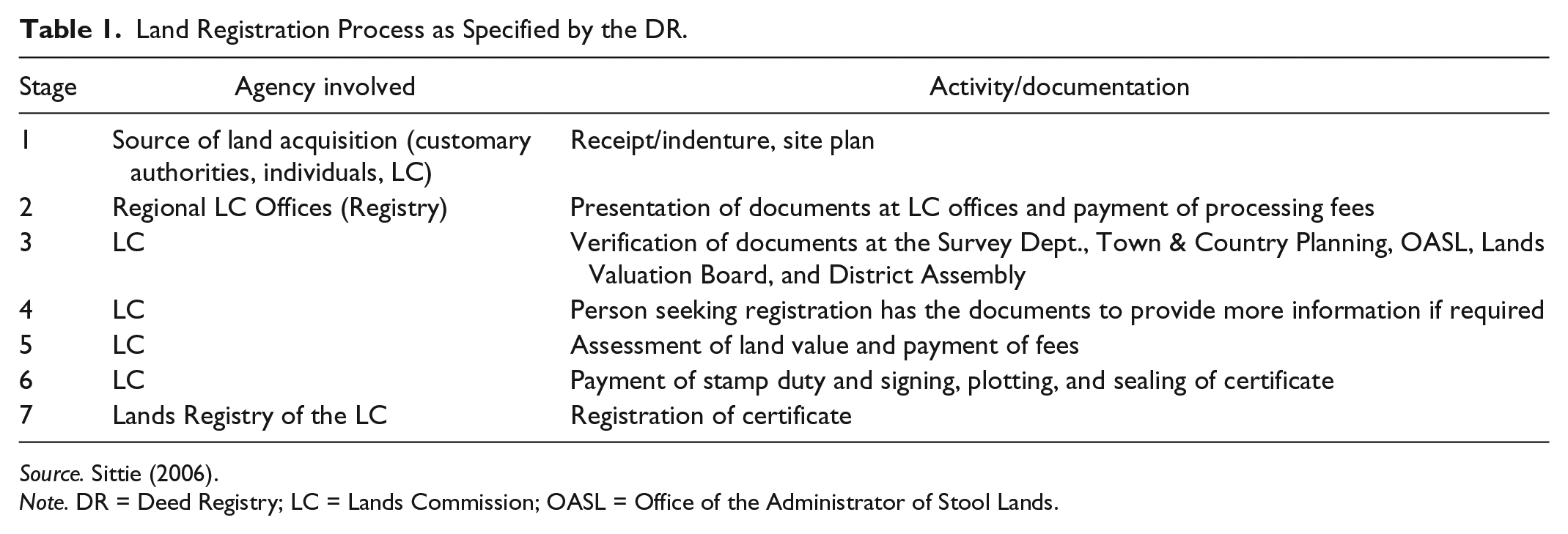
Section 1 of Act 122 established the DR, the storehouse of deed records. The Act makes provision for a Chief Registrar of Lands, appointed by the president of Ghana and tasked to head all DR offices and registrars in the country. The operations of the DR began in Accra due to Accra’s resilient land market, its national significance, and the large pool of middle and high-skilled labor available. The DR has spread quickly to other areas of Ghana, namely, Kumasi, Takoradi, Cape Coast, and Koforidua. As of 2013, operation of the DR had been extended to eight regions in Ghana (World Bank, 2013b). As reported by Osman and Manuh (2005), most of these registries are centralized in regional capitals with little or no access by rural dwellers. Table 1 shows the registration process at the DR.
Land Registration Process as Specified by the DR.
Source. Sittie (2006).
Note. DR = Deed Registry; LC = Lands Commission; OASL = Office of the Administrator of Stool Lands.
A study by Osman and Manuh (2005) on land registration found that it takes more than 6 months for land certificates to be issued under the deed registration system. The complexities and uncertainties in the process of deed registration, as concluded by Sittie (2006), have resulted in an apparent lack of confidence by members of the public in the ability of institutions to protect their rights or secure their tenure. This must have been the case in the Wassa-Akropong Districts where Osman and Manuh found that most farmers were reluctant to register their farm holdings under the deed system. They also found that the system favored large foreign firms and companies over small-scale local firms. The inherent bureaucracy in the system frustrates indigenous businessmen and favors foreign companies because the latter are able to offer bribes. The location of the DR in Accra further discourages the public. Boakye (2001) noted that the distance between the DR and the LC creates great inconvenience for people who do not own vehicles. Despite its inherent administrative and institutional weaknesses, however, the system has proved useful in providing land records, which form the building blocks of title registration.
LTR and Title Registration Process
The LTR was set up by PNDCL 152 to oversee land title registration in Ghana. A Chief Registrar, who is responsible for administration of the registries established under the Act, heads the LTR. There are registrars at all locations that the minister, in consultation with the Title Advisory Committee, shall declare registration districts. There were 27 registration districts as of 2009 (Safo-Katanka, 2012). The title registries are to serve as a storehouse for all title records in Ghana. A study on records management in Accra’s LRD by Safo-Katanka (2012) revealed a massive reliance on paperwork, resulting in a complete takeover of working space in the registry’s records room, frequent misplacement of documents, and a tedious file retrieval process. Below is the process of title registration prior to the formation of the NLC.
Figure 2 is admittedly simplistic as it pays more attention to the LTR than the other related departments involved in the titling process. However, this is understandable, as the LTR is the first and last port of call within the registration process. Despite this seemingly well-defined itinerary, the process is fraught with challenges and the public is not well informed of the stages. Consequently, Jones-Casey and Knox (2011) have indicated that a large number of titles remain unregistered. To support this assertion, they added that between 1986 and 2006, only 42,000 applications for land registration were submitted to the LTR and yet less than a third of these applications were registered, creating a huge backlog. Nevertheless, as of February 2015, it was reported that more than 43,314 applications, pending from 1988 to 2003, had been cleared (Smith-Asante, 2015). However, despite these strides, a considerable number of title applications from 2004 to date are yet to be processed and registered. The LTR has been criticized for the duplicative nature of its requirement that parcel plans should be prepared and annexed to instruments before registration proceeds, as seen in S2a of Figure 2, as land use plans prepared could serve similar purpose (Gambrah, 2002).

Title registration process under PNDCL 152.
The LAP and the Merger
Following recommendations in the 1999 NLP, the Government of Ghana (GoG), supported by its development partners, initiated the LAP to reduce poverty and enhance socio-economic growth in Ghana (World Bank, 2013b). LAP’s long-term goals include improving security of tenure, simplifying the process of land titling, and fostering prudent land management practices (Larbi, 2011; World Bank, 2013a). The project was launched in 2003 with an initial timeline of 15 years. Implementation difficulties, however, led to its extension to 25 years. LAP is compartmentalized into four phases, each having different components. This study is targeted at some components under Phase 1 of the project. Phase 1 sought to lay the foundation for the establishing of a self-sustaining land administration system that is fair, efficient, transparent, and cost-effective, and which guarantees security of title (World Bank, 2013a). The four components under Phase 1 include the following:
harmonizing land policy and regulatory framework;
institutional reform and development;
improving land titling, registration, valuation, land use planning, and land information system; and
project management, human resource development, monitoring, and evaluation.
The focus of this study is on components 2 and 3 of Phase 1. To improve the process of title registration, four land sector agencies were merged to form the NLC. They include the then LVB, SD, LTR, and the LC. This merger was made possible by passing Act 767. Upon the merger, these agencies became divisions under the mother agency, the LC. The divisions constitute LVD, SMD, LRD, and the PVLMD. Despite the radical institutional merger, little or no change has occurred in the core functions of the divisions. It has been argued that the rationale behind the merger was to reduce the transaction cost of land registration, eliminate overlaps in the operations of land sector agencies, make the registration process transparent, expedite the process of title registration, increase public awareness on title registration, ensure title security, and reduce land litigation and conflicts (Sittie, 2006).
Figure 3 is an overview of the registration process under the merged NLC. Most of the corpus of literature on title registration ex-post merger has shared little insight on the outlook and operations of the merged institution. There is not much information on the usage of accurate cadastral maps and plans in registration, how much applicants pay at each stage of the registration process, complexities in the current institutional structure, or public perception about accessibility, transparency, and title security (UN-Habitat, 2011). The figure only provides the core activities undertaken by each division of the NLC in the title registration process.

External work of title registration under the NLC.
Figure 4 illustrates the title registration process after the merger, demonstrating the duration of the title registration process, as well as the related agencies involved in land administration. It takes approximately 3 months 20 days (an aggregate of 14 weeks) for applicants to receive their title certificate, provided that no objection is raised. It also provides information on the stages of the registration process over which the NLC has some degree of influence.

Title registration process after 2008 restructuring.
Research Methodology and Data Collection
The research subscribes to the ontological position that observations can be made from social construction, defined according to set parameters and consequently measured (Bryman, 2008; Creswell, 2009; Rao, 2008). Against this backdrop, a mixed research paradigm was deemed suitable for the study as it allowed the researcher to elicit further information that a purely quantitative or qualitative approach would not offer. Data were sourced from published peer-reviewed journal articles and published reports. For the literature search, key words from the title of this article were entered into search engines, namely, Google Scholar, Jstor, and Elsevier, among others. The resulting articles were categorized based on their key themes, date of publication, and the rating of the journal in which they were published. For the empirical data, semi-structured interview guides and closed-ended questionnaires were first piloted for a week and revised before finally being administered.
This article used the Accra Lands Commission as a case study because the office is located in Accra, Ghana’s capital city, its political and administrative center, and headquarters of most public institutions and foreign corporations in the country (Grant, 2001; Konadu-Agymenang, 2001; Yeboah, 2003). Although second to Kumasi in terms of population size, Accra is notable for its vibrant land market, with a higher number of recorded land transactions and pending land cases, and for its escalating appeal as a preferred investment destination for both local and international real estate developers (Grant, 2005). The LVD, SMD, PVLMD, and LRD were purposefully selected for the interviews due to the fact that they are the core institutions involved in the restructuring. Interviews were also granted by the Executive Secretary (ES) of the Commission and the Coordinator of the LAP. The interviews were targeted at discovering the rationale behind the restructuring, the project cost, and source of funding, specific areas targeted, and actions undertaken by relevant stakeholders and their overall impression about the restructuring. Interview transcripts were sent to the officers interviewed for corrections and approval.
Furthermore, a survey was conducted to uncover the knowledge and opinion of the general public about the restructuring, how they obtained information on the title registration process and how the restructuring had either improved or worsened their experience of the process. It also aimed at ascertaining the amount that members of the public paid at each stage of the registration process. The respondents included individuals encountered on the premises of the respective divisions, who were there to follow up on their submitted land documents. Particular attention was given to persons found on the LRD premises who were scheduled to collect their land certificates, because that was the last stage of the title registration process. Seventy respondents participated in the survey and a 100% response rate was recorded. For the purpose of the analysis, the interviewed official at the LVD is identified as Participant 1, the LRD Official as Participant 2, the PVLMD official as Participant 3, the SMD official as Participant 4, the ES of the LC as Participant 5, and the LAP official as Participant 6. The study adopted an input–output analytical approach to project evaluation by drawing on inductive and deductive reasoning to extract relevant themes raised in the literature as well as emerging evidence from the field data. This approach thrives on the premise that projects are best evaluated if there is a baseline to serve as a reference point for the inputs or interventions made or introduced in connection with the project and the observed output and outcomes (Morrison & Smith, 2006; Young & Gray, 2008). It should however be noted that the approach adopted in this study is the simplified and direct version of the holistic approach often recommended by larger corporations and international bodies (European Union) and government departments (Her Majesty’s [HM] Treasury of United Kingdom).
Findings and Discussions
The rationale behind the 2008 merger was the need to create a “one-stop-shop” that would simplify the processes of land administration in Ghana, especially land titling and registration. Consequently, several inputs and interventions were made. These include project financing, legal and legislative reforms, institutional restructuring, human resource capacity building, and logistical support. These inputs are discussed in turn.
Project Financing
The 2008 overhaul and merger of land sector agencies into the NLC was a massive project demanding enormous financial commitment that the GoG could not single handedly provide. Development partners and foreign agencies who have demonstrated an interest in land management and governance issues in Africa provided a greater proportion of the finance needed to translate policy decisions into reality. Refer to Table 2 for financial contributions made toward the LAP.
LAP Funding Partners and Their Contributions.

Source. World Bank (2013a).
Note. LAP = Land Administration Project; GoG = Government of Ghana.
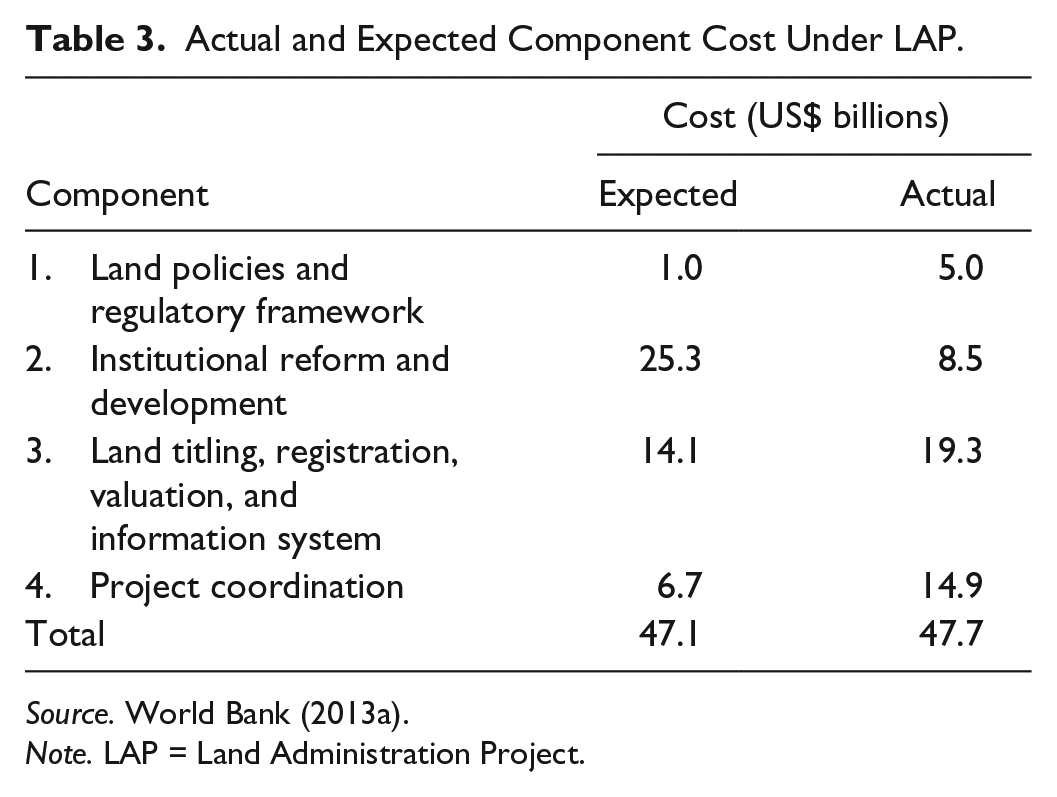
The amount sunk into the project included expenditure on all four components under the LAP as earlier mentioned. From Table 3, expenditure on components 2 and 3 together constituted about 58.28% of the entire actual cost of the project. This amount is quite significant, and hence raises greater expectation for an effective land administration system in Ghana.
Actual and Expected Component Cost Under LAP.
Source. World Bank (2013a).
Note. LAP = Land Administration Project.
Legislative Reform
As discussed in Agbosu (2000), for title registration to have its course and earn public acceptance, there was the need to enact new legislation. Act 767 was passed to provide the legal backbone and define the institutional structure of the NLC. In addition, a Land Bill aimed at streamlining and integrating some of the 156-odd land laws in Ghana is currently in the third round of cabinet discussion before final submission for parliamentary approval and passage into law.
Institutional Re-Engineering and Duration for Processing Documents
The need to merge the often conflicting and overlapping functions of Ghana’s land sector agencies has consistently been highlighted in the literature (Gambrah, 2002; Kasanga & Kotey, 2001; Sittie, 2006). This dominant view underscored a thorough research of the structure, business process, and endowed resources of the land sector agencies. Four land sector agencies whose activities have direct bearing on title registration were consequently selected: the LVD, the PVLMD, the LRD, and the SMD. It is useful to mention that activities of the OASL, TCPD, and Lands Court have no less impact on general land management and governance in Ghana than the four divisions earlier mentioned. Their involvement in title registration, however, is secondary and hence not discussed in this article. The recent work of Obeng-Mireku, Kuusaana, & Kidido (2016) deals with aspects of such issues.
For the purposes of registration, no radical changes were made to the original functions of the four divisions during the merger. However, their institutional setup was greatly re-engineered. Presently, there is an ES responsible for the overall strategic vision and performance of the NLC and vested with managerial and administrative powers in matters of land administration and management. Four directors are further appointed by the President of Ghana to head each of the four divisions. From the organizational structure presented in Figure 5, these directors report directly to the ES and often meet with him to discuss performance of their respective divisions.
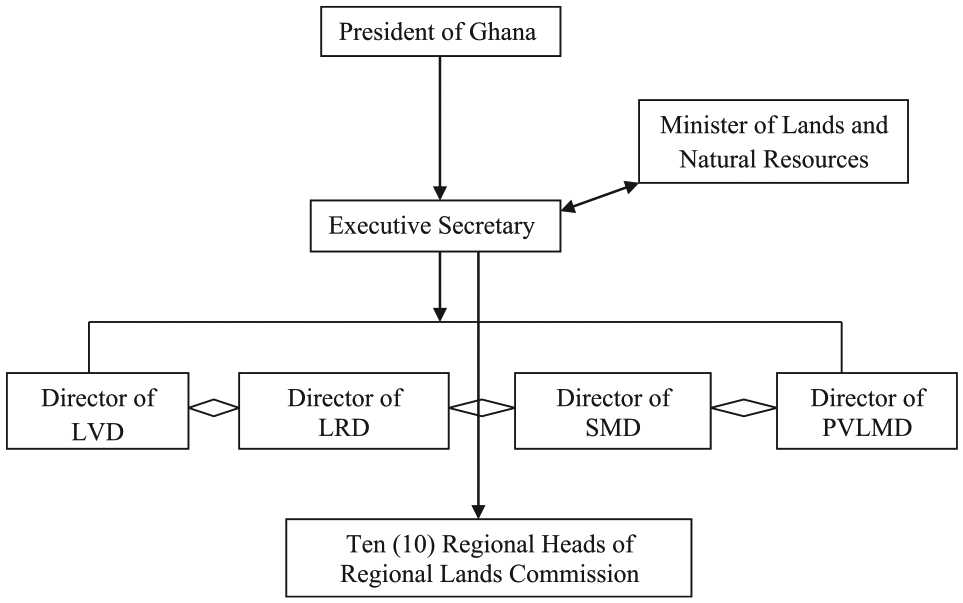
Organizational structure of the NLC post 2008 merger.
From the re-engineered structure, the first point of call in the title registration process is the LVD for stamping of documents. According to respondents, the length of time it takes to stamp documents varies from case to case as it depends on the availability and workload of technical officers and the preparedness of clients to pay assessed fees. On the whole, however, the time frame for stamping has lessened. Following stamping is the deposition of documents and issuance of “yellow cards” by the LRD. Consequently, a request is made to the SMD for parcel plans to be produced in support of documents in the custody of the LRD. Documents that have site plans already approved post 2008 by the Director of Surveys are exempted. At the LRD, respondents were inconclusive in explaining how long it takes the division to work on the documents, although some gave an unconvincing estimate of 2 weeks. The SMD subsequently visits the site to inspect its boundaries and then prepares site plans as requested by the LRD. Thereafter, an official search for the root of title is carried out by the PVLMD, and finally, publication and issuance of title certificate is done by the LRD, once all obligations have been fulfilled without any countervailing factors.
Capacity Building and Logistical Support
Mahama (2001) examined land title registration in Ghana and concluded that the erstwhile LC lacked the requisite logistical support to adequately equip staff members to improve the process of title registration. Kasanga and Kotey (2001) raised similar concerns and both have emphasized the need to train the NLC’s staff in the usage of modern survey equipment. Following this observation, the LAP committed a substantial amount of funding toward capacity building and logistical support. Exemplifying this point, an institutional reform specialist was engaged to help prepare the staff members of the respective divisions to work together. The initiative was perhaps considered necessary because of the perceived tensions and misunderstandings among the staff members of the different divisions, which would likely mar the project, if there were not properly identified and addressed.
Furthermore, modern survey equipment was procured under the LAP to increase the efficiency of the operations of the LC. This involved the installation of geodetic referencing and survey equipment, namely, ortho photos, intelligent scanning machines, personal computers, and Internet facilities. According to the World Bank (2013a), three Continuously Operating Satellite Reference Stations (CORS) equipment were installed in Accra, Kumasi, and Takoradi to provide correctional data that would reduce errors from hand-held Geographical Positioning System (GPS) equipment. This enabled surveyors to use hand-held GPS sets, which were more affordable (costing US$100-US$500 each) than Total Station and Differential GPS sets, which cost about US$10,000 each. Notwithstanding the provision of this modern survey equipment, the needed manpower to effectively utilize the equipment is virtually non-existent.
The World Bank report on the LAP’s project performance assessment (2013a) noted that 100 four-wheel drive vehicles were purchased under Phase 1 of the LAP. Accra was allocated 72 vehicles whereas the remainder was distributed disproportionally among the other nine regions. These vehicles were originally to help the ministry and its allied departments and agencies in the performance of their official duties. However, a staff member of the NLC, who pleaded anonymity, stated that although the directors of the four divisions were often seen driving the vehicles during official hours, none was available to field officers, who consider themselves to be the lifeblood of the NLC. There is an unverifiable rumor that some of these vehicles are even used by relatives of top officials at the NLC. In response to concerns raised about clustering the land sector agencies in close proximity or at best, housing them in a single complex (Boakye, 2001; Gambrah, 2002), there is currently an ongoing development complex at Cantonment, Accra, expected to be completed soon. Funding for this project has stalled as one of the funding partners pulled out recently for reasons that remain unclear.
Output of the Merger on Title Registration
Based on objectives of components 2 and 3 of the LAP, several outputs were observed. However, those having direct impact on title registration are discussed below.
Customer-Centered Approach to Service Delivery
The public has decried the NLC for its apparent lack of attention to public concerns especially during the title registration process. A related study by Osman and Manuh (2005) highlighted that the DR ignored concerns raised by indigenous farmers about delays in processing their land documents whereas documents of wealthy foreign investors were expedited. Participant 3 noted that as part of the restructuring exercise, a Client Service & Access Unit (CSAU) has been established to provide public information about the title registration process. Following an interview, Participant 3 intimated that the CSAU has tremendously improved public awareness about the process of title registration and even ranked the CSAU’s performance as moderate, with an assurance that plans are far advanced for stepping up the awareness campaign. This admission is affirmed by sections of the survey respondents whose opinions about sources of information on remedies available to them during the registration process are shown in Figure 6.
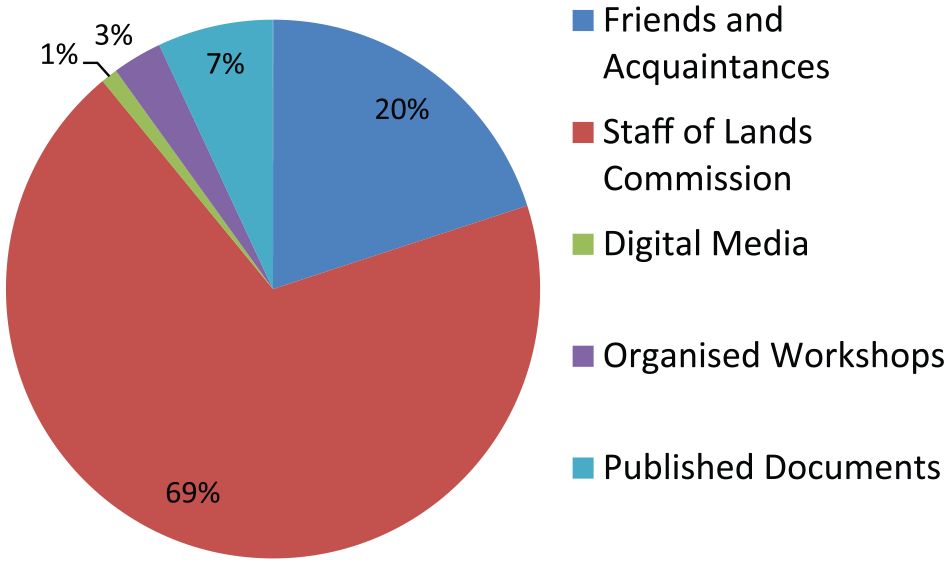
Source of customer information on land title remedies.
A majority of respondents (69%) admitted to receiving some information about remedies available under the title registration process through officers working in the Commission, though it was unclear whether they received such information directly from the CSAU as claimed by Participant 3. The field officer, during the field investigation, could not find any unit designated “CSAU” in the premises of the four divisions. It can be inferred that the medium of customer information about the title registration process is rather haphazard. It is therefore not surprising that 14 respondents (20%) stated that they got information about the process from friends and acquaintances, rather than from the CSAU.
Transition to Digitized Land Administration and Management
There is an ongoing nationwide scanning of all land records kept at the LRD. Participant 2 explained that about 16,000 documents were scanned in 2013 and further added that, unlike the conventional scanners that produced copies in non-editable formats, the intelligent scanning machines have configurations that make it possible to add further details to documents that have already been scanned. Commenting on the NLC’s commitment toward digitization of the land title registration process, Participant 2 noted that plans were currently in place to install a high-speed Internet broadband system to coordinate work among the divisions, and added that a consultant had been engaged in this respect. He, however, admitted to delays in the process, and attributed this setback to the high financial input required to set up this Internet portal. It is fascinating to observe that all 70 of the survey respondents (100%) were in favor of digitizing the title registration process, and an overall aggregate of more than 80% were prepared to make extra payments to guarantee a well-functioning digitized title registration system (see Figure 7).

Number of respondents and the extra % fees respondents are prepared to pay for digitizing title registration.
Duration and Number of Title Certificates Issued
From Figure 8, it is ironic to observe that both the number of land title applications received and land title certificates issued declined slightly in the years immediately following the merger, when an increase in both would have been expected due to the new and improved system. It was not until 2010 that there was a swell in the number of applications received by the LC. This could partly be ascribed to the fact that information about the rehabilitation of the land title registration was not well disseminated by the LC initially, and, therefore, took some time to be understood by the public. The subsequent steep rise in the number of land title applications received between 2010 and 2011 shows the level of excitement and expectation once the implications of the merger began to sink into the public consciousness. However, there was no corresponding rise in the number of certificates issued between 2010 and 2011 in spite of all the new survey equipment and technologies, which had been procured to make the system more efficient. It could be argued that this was because the personnel of the various divisions of the LC had not been sufficiently trained to make optimal use of the new facilities and, therefore, could work no more efficiently than before. This could explain why the number of title certificates issued 4 years after the merger (2008-2012) remained relatively unchanged before finally recording a marginal increase in 2013, as depicted in Figure 8.

Number of title applications received and issued in Accra, 2008-2013.
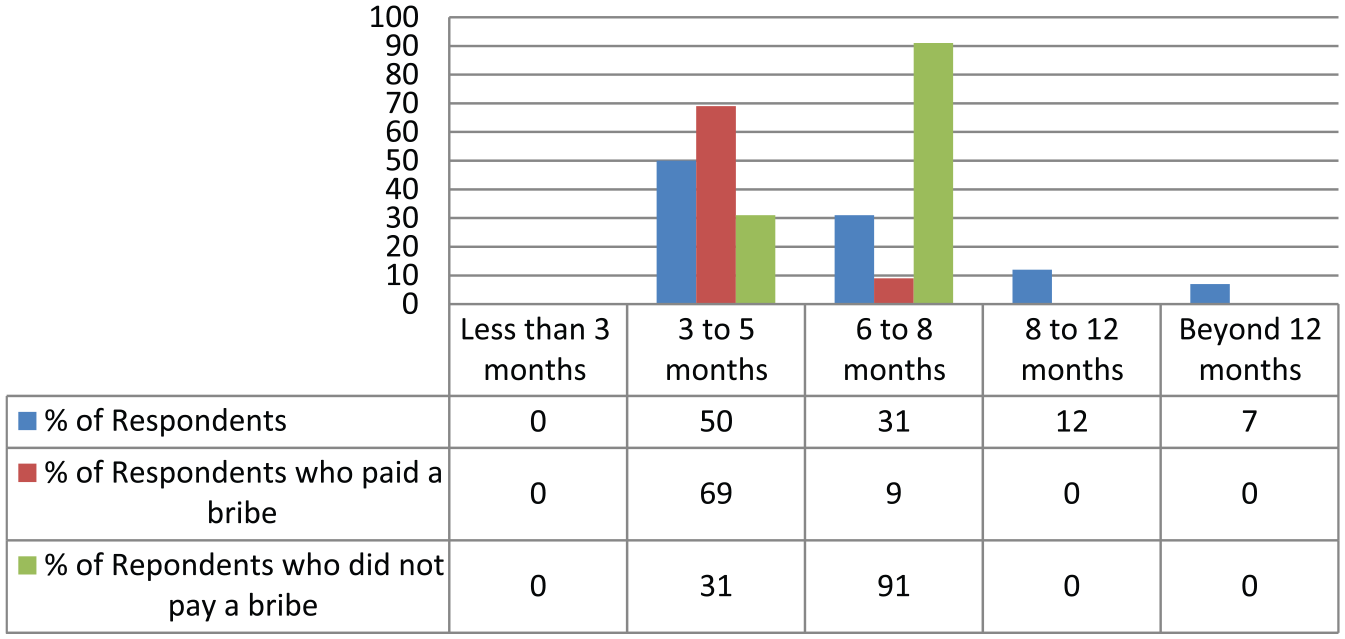
Participant 2 explained that the 2008 merger had indeed streamlined the business process of the NLC, reducing the average turn-around time to 3 months for title registration and 1 month for deed registration. This constitutes a major achievement of the merger, because the initial turn-around time stood at 36 months for title registration and 7 months for deed registration. The NLC’s target, however, is to further reduce this duration to 1 month for both title and deed registration. Figure 8 charts a steady rise in the number of title certificates issued after 2008. This notwithstanding, the survey respondents had a differing opinion on the turn-around time, as all the respondents indicated that they had been following up on their title applications for more than 3 months. Figure 9 succinctly illustrates this point.
Respondents’ opinion about turn-around time and its determinant.
It can be deduced from Figure 9 that a significant number of respondents (50%) waited for a period of 3 to 5 months to receive their title certificate as against 50% who received their certificate within 6 months or more. The fact that the majority of respondents registered their title within an average of 4 months is considered an improvement because LAP envisaged duration of 3 months for title registration. It is worth mentioning that 69% and 9% of respondents who received their certificate between 3 to 5 months and 6 to 8 months, respectively, paid bribes to middlemen or staff of the NLC to facilitate the titling process. This buttresses the point that payment of bribes continues to be a major motivation for land administration officials in processing title registration (World Bank, 2013a), regardless of whether they have been professionalized by higher education and/or by association with professional land and surveying bodies (Obeng-Odoom, 2011). In addition, as depicted in Figure 9, there were a number of respondents who did not have to pay bribes to have their title registered. Nevertheless, applicants are likely to receive their title certificate more quickly if they pay a bribe. For instance, the majority (69%) of those who received their title certificate within 3 to 5 months paid bribes as against 31% who did not pay any. It is not surprising that most of the respondents who refused to pay a bribe had their documents neglected by officials of the NLC, prolonging their waiting period for 6 to 12 months. Notwithstanding the mixed narratives about the turn-around time and what influences it, it is certain that there has been a massive improvement in the turn-around time from 36 months to the worst case scenario of 12 months reported by some respondents. Participant 2 explained that the turn-around time exceeded 3 months only when applications submitted were incomplete or were challenged after their publication in the newspapers due to claims of multiple ownership. Publication is currently done monthly in two newspapers that have good nationwide coverage (The Spectator and The Ghanaian Times). The officer interviewed considered this a great improvement, and explained further that in the absence of any procedural setbacks, title certificates could even be issued within 2 months.
Fees Charged for Title Registration
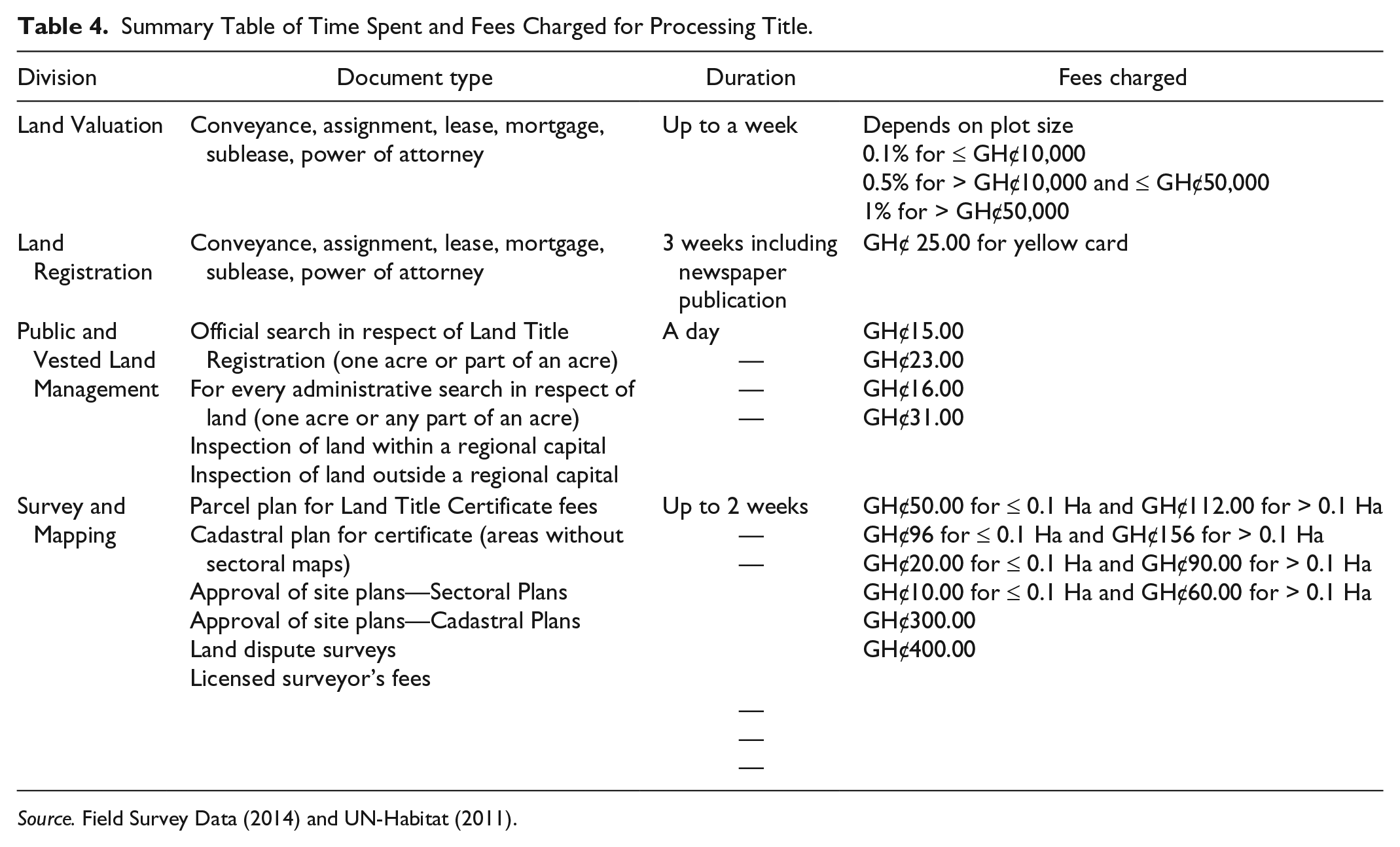
Equally important, among the reasons often attributed to the low patronage of title registration in Ghana, is the high cost of title registration. Although a study that provides an approximate figure for the entire cost of title registration is yet to be undertaken, some have generally asserted that the process is very expensive and often discourages people from going through the formal title registration process (Armeyaw-Ampadu, 2011; Gambrah, 2002). Findings from the field data suggest that it is difficult to estimate the total amount of fees that applicants are expected to pay at the onset for the entire process. However, in Table 4, an attempt is made to provide a range of expected amounts payable by applicants depending on the particular size of their land. The size of the land in question and its market value determine the fees charged at each stage.
Summary Table of Time Spent and Fees Charged for Processing Title.
Source. Field Survey Data (2014) and UN-Habitat (2011).
According to Participant 1, to have documents stamped at the LVD, applicants pay 0.25% of the value of their property as stamp duty if the property is worth up to GH¢10,000 (US$ 3,333), 1 0.5% if its value is between GH¢10,000 and GH¢50,000 (US$3,333-US$16,666), and 1% if it exceeds GH¢50,000 (US$16,666). At the PVLMD, Participant 3 explained that the Parliament-approved fee for an official search is GH¢50.00 (US$16.66). However, if an additional certified copy is requested by applicants, an extra GH¢20.00 (US$ 6.66) is charged. The situation is however different at the SMD, according to Participant 4. The SMD does not charge applicants for the preparation of site plans requested by the LRD per se, because applicants initially make payments at the LRD. Applicants are, however, forced to pay the cost of transporting surveyor(s) to and from the field because there are no official vehicles for this exercise. An informant intimated that clients are occasionally cajoled by surveyors to pay unauthorized fees, amounting to about GH¢700.00 (US$233.33), to expedite the processing of their documents.
At the LRD, Participant 2 explained that fees charged depend solely on the plot size. GH¢130.00 (US$43.33) is charged for land parcels between 0.16 and 0.64 acres and GH¢150 (US$50.00) for plots exceeding 0.64 acres. It is instructive to mention that there is evidence to suggest that applicants are sometimes made to pay fees far in excess of the statutory approved fees, the bulk of which end up in the pockets of officials at the NLC.
Confidence of the Public in Issued Title Certificates
In Figure 10, respondents demonstrated great confidence that the title certificates issued them would meet their objectives for registering their title. These objectives, as noted by Barry and Danso (2014), ranged from obtaining a building permit to securing land tenure. The majority of the survey respondents indicated that security of tenure and the avoidance of land litigation were the main objectives they expected to achieve by possessing title certificates. This finding is consistent with works on title registration by Yiri (2006), Karikari (2006), and Sittie (2006) who have argued that the absence of secure land title breeds land litigation due to incidents of encroachment and multiple land ownership. This finding also supports views expressed in Adolwine (2010) that women are more likely to increase agricultural productivity once they have secured their title to land. Whether this perception is consistent with actual experiences after registration, however, requires more careful study, taking into account trends in land litigation (Obeng-Odoom, 2012, 2014, 2015).

Confidence ranking of respondents in the ability of the land title certificate to help them to meet their objectives.
It is remarkable to observe that about 55% of respondents believed that having secure land title did not improve their prospects of securing a loan using the issued land certificate as collateral—This is broadly consistent with earlier studies (Domeher & Abdulai, 2012a, 2012b). It further validates recent findings from Barry and Danso (2014) that it is wholly untrue to assume that title registration guarantees title security, due to the recent activities of local chiefs and land guards. In addition, 62 respondents (89%) were confident that their tenure security would be guaranteed by their ownership of a title certificate. About half the respondents (representing 43%), believed that the title certificate could help with receiving planning and development permission. It is interesting that 87% of respondents were optimistic that possessing a title certificate would guarantee an absence of litigation, as this figure synchronizes with most of the existing literature on reasons for pursuing title registration. It should be noted that recent reviews (e.g., Obeng-Odoom, 2015) of the trends in litigation take a more critical view.
Conclusion
This study has examined land title registration in Ghana during the colonial period, post-independence, and after the merger of four land agencies into the National Lands Commission (NLC) in 2008. However, 6 years post merger, the NLC is yet to fully exploit the benefits of the initiative. Although it is now evident that a clearly defined organizational hierarchy and work itinerary among the four divisions is in place, traces of unhealthy competition for funding, separate accounting systems, corruption, and low public awareness are easily noticeable among the divisions.
The drive toward digitizing the title registration process has been slower than expected. The NLC is struggling with radical digital transition after 6 years, although the fundamental logistics needed to operationalize this campaign are in place. The NLC must consider a move from the orthodox voluminous paper-based application and title registration process to a complete digitized system, where electronic versions of documents and relevant files are used. In 2012, the Electoral Commission of Ghana introduced the biometric system of voter registration and verification during the presidential and parliamentary elections, although it was not hugely successful. However, valuable transferrable lessons on how the system was set up and operated can be learned. This, coupled with the ongoing scanning of land records, would help create a complete digitized system of land title registration where applicants would be able to monitor the progress of their application online. In realizing this, it is also imperative for proper boundary demarcation to be undertaken to facilitate the production of cadastral maps and accurate site plans.
As much as the NLC should be commended for reducing the turn-around time from more than 36 months to 3 to 5 months, it should be challenged to step up its efforts to lessen the time frame even further. There is abundant evidence that the NLC has the capacity to change the situation, judging from the up-to-date survey equipment it possesses. As is often highlighted in the plethora of Ghanaian land title registration literature, competent and well-resourced staff are relevant to improving title registration. This point cannot be overemphasized and we strongly recommend that the NLC recruit more personnel with requisite knowledge and skills in land management, notwithstanding the current economic challenges that Ghana is facing.
Incentivizing current staff members with attractive packages and award schemes has proved to be a real booster of staff performance in the institutional management literature. Although human wants are intrinsically insatiable and hence salaries and remuneration must be capped, it would be instrumental for the NLC to inform staff members about the packages and benefits available to them should they achieve a prescribed target. The NLC should further show commitment to the disciplining of staff members implicated in any reported corruption situation. In marketing, managing customer confidence is essential to the continuous operation and survival of any organization and, in the same spirit of customer priority, the NLC ought perhaps to build on the appreciable level of confidence expressed by the public in the title registration process. The NLC should strengthen the CSAU by increasing publicity about the Unit’s activities and employing personnel with excellent customer relations to manage it. From the responses given by respondents to questions about their knowledge of remediation mechanisms, it is clear that a proper feedback system should be implemented, and customers be made aware that their feedback would ultimately go to ameliorate the system of title registration. This is a proven medium of improving service delivery in most organizations.
Although the study focused on land title registration in Accra, its findings and existing literature support the view that title registration has not been further decentralized beyond Accra, Kumasi, and some traditional areas under the systematic land titling registration (Agbosu, 1990; Osman & Manuh, 2005). Although decentralizing the process to every district remains infeasible, after 5 years of merger, the project should not only consider but should make a firm commitment toward further decentralizing title registration to major metropolitan, municipal, and district assemblies in Ghana. This will call for investment in finance, human resource, logistics, and infrastructure, which can be realized if revenues generated from the NLC’s activities are prudently managed and effectively used.
Despite the insights shared in this article, the study’s sample size admittedly limits the ability to generalize the findings. Although the land market in Accra is buoyant and the most vibrant in Ghana, a replication of this study in other regional capitals such as Kumasi or Takoradi could possibly produce different findings from this present study. However, it is more probable that, notwithstanding the limited scope of the current study, its findings are representative of the other regions.
Footnotes
Declaration of Conflicting Interests
The author(s) declared no potential conflicts of interest with respect to the research, authorship, and/or publication of this article.
Funding
The author(s) received no financial support for the research and/or authorship of this article.