




Abstract
This research tests the hypothesis that group practice of the Transcendental Meditation® (TM) and TM-Sidhi® program by a group of sufficient size is associated with reduced rates of homicide and violent crime. Data from a prospective quasi-experiment were analyzed using intervention analysis or interrupted time series analysis. Dependent variables are time series of the U.S. monthly homicide rate as well as violent crime rate from a sample of 206 cities. The binary intervention variable is based on the size of the largest U.S. TM-Sidhi group. Intervention effects were analyzed by time series regression using a broken-trend intervention model. As hypothesized, there was a statistically and practically significant shift in trend in the direction of reduced rates for each of the variables beginning with the onset of the intervention period. Diagnostic tests indicate that key statistical assumptions of the analysis are satisfied. Alternative hypotheses are considered for the apparent effect of macro-level social behavioral change without micro-level behavioral interaction.
Keywords
The present studies have implications for broader understanding of the collective nature of consciousness and also for the prevention of homicide and violent crime. They focus on the macro-level of society and propose that a positive impact on the collective consciousness of society can be predicted, generated, and its influence measured in terms of decreased homicide and violent crime.
Although the rates of violent crime and murder in the United States have declined significantly since the early 1990s and again since 2006 (Federal Bureau of Inves-tigation, 2011), the cause of that decline remains, in large part, unclear to behavioral and social scientists, with factors discussed for the 1990s decline including police numbers and policing strategies, changing demographics, reduction of childhood exposure to lead, increased prison populations, waning crack market, immigration, and improved security measures (Farrell, 2013; Levitt, 2004). As a result, policy makers lack clear direction for effecting further reduction. The rate of murder in the United States remains higher than other developed countries such as Canada, Australia, New Zealand, and the countries of Western Europe (United Nations Office on Drugs and Crime, 2011), and thus, further insight into any factors contributing to violent crime that can be influenced by intervention is very valuable.
A number of theories have historically been proposed to account for the incidence of homicide and violent crime, reflecting what may well be a multicausal phenomenon. One distinction among theories of violent crime is between theories that emphasize its social and ecological conditions (places) and theories that emphasize the individuals (people) most susceptible to crimes. For example, social disorganization theory has historically focused on the community factors such as poverty, residential instability, and social networks that influence a community’s ability to control behavior (Kubrin & Weitzer, 2003) and was substantially developed by the work of Shaw and McKay (1942/1969) who found that the Chicago neighborhood factors predicted delinquency rates over time despite the neighborhoods’ changing ethnic or racial makeup. The present study concerns short-term changes in the national level of homicide and violent crime rather than prediction of community variations, so the social disorganization perspective is of limited relevance, although prior research related to the hypothesis of this study, reviewed below, controls for, and thus appears independent of, many community-related variables.
One process that can be seen in a number of theories is the connection between frustration and aggression. This frustration might arise from strain due to lack of economic opportunity for advancement (Cloward & Ohlin, 1960; Merton, 1938), or due to poverty (Hsieh & Pugh, 1993), or due to inability to avoid aversive situations and achieve goals (Agnew, 2007), or due to social disruption or disorganization, affecting family and community structures (Shaw & McKay, 1942/1969) that might otherwise avert frustration or at least control aggression.
The study of social stress (Linsky, Bachman, & Straus, 1995; Linsky & Straus, 1986) provides an interesting theoretical perspective on the frustration-aggression process that has the advantage of connecting with a large body of research on stress at the individual level (e.g., Mueller, 1983; Selye, 1956). Linsky and Straus (1986) found that the degree of social stress was a strong predictor of violent crime rate (VCR) among the states of the United States, using a state stress index (SSI) of 1976 data to quantify economic, family, and community stressors. The relation-ship of the SSI to rates of homicide, rape, robbery, and aggravated assault was significant taking into account a number of control and potentially moderating variables. The creation of the SSI was based on the “life events” approach to conceptualization of stress, assuming that the accumulation of many challenging events places increasing stress on the individual, with potentially negative health consequences (Holmes & Masuda, 1974). Because this life-events approach to defining stress is applied to societal rather than individual data, there is considerable overlap of variables considered by the social stress approach and social disorganization theory, and Linsky and Straus (1986) analyzed the area of commonality and uniqueness in these two conceptualizations. Subsequently, Linsky et al. (1995) replicated the finding of an association between higher social stress (measured by the SSI with 1982 data) and higher homicide rate (HOM). Controlling for urbanization and racial composition of the states, the relationship of social stress to homicide was also independent of indices meant to measure weak social control, economic deprivation, and cultural support for violence.
At the individual level, some of the behavioral and physiological effects of stress have been found associated with aggression. For example, offenders guilty of homicide were found to have more stressful and more chronically stressful life experiences than nonviolent offenders (Humphrey & Palmer, 1986). Disruption of parenting and of family functioning, a significant stress for the growing child, has been found to be a major mediating factor for the historically studied societal influences of poverty and social disorganization that contribute to high rates of crime and delinquency (Moore, 2001; Weatherburn & Lind, 2006). Many of the physiological imbalances consequent to repeated stress have been found to be associated with aggression and violence (Walton & Levitsky, 2003).
The intervention investigated in this study is a practice found by previous research to reduce stress and crime at the individual and social levels, the Transcendental Medita-tion® technique and its advanced practice, the TM-Sidhi® program. 1 The Transcendental Meditation technique is a mental procedure founded by Maharishi Mahesh Yogi and introduced to the West from India in the late 1950s; it is practiced 15 to 20 min twice daily and is described as systematic but involving no effort, beliefs, or specific lifestyle and requiring no specific mental abilities on the part of the practitioner (Roth, 1994). The procedure is said to allow the individual to experience more silent levels of awareness, leading to the experience of “pure consciousness”—consciousness without the mental activity of perception or thought (Maharishi Mahesh Yogi, 1967). The advanced TM-Sidhi program, practiced following Transcendental Meditation, is said to develop the ability to function from this silent mental state of pure consciousness and thereby activate this field of pure consciousness more effectively for greater impact on the individual and society (Maharishi Mahesh Yogi, 1986). The implications of a “field” character of pure consciousness for societal effects are noted below. Group practice of the TM-Sidhi program is identical to individual practice except for large number of individuals being together.
During Transcendental Meditation, the process of increased mental silence has been found to correspond to a distinct physiological state of restful alertness that is associated, in comparison with eyes-closed rest, with reduced respiratory rate, reduced plasma lactate levels, reduced skin conductance, greater excretion of the serotonin metabolite 5-hydroxyindoleacetic acid, and increased coherence of electroencephalographic activity, particularly in the frontal cortex (Bujatti & Riederer, 1976; Dillbeck & Bronson, 1981; Dillbeck & Orme-Johnson, 1987; Travis & Arenander, 2006). Outside of the practice, randomized controlled research found greater integration of brain functioning during task performance and more effective galvanic skin resistance responses to stress among those learning and practicing the Transcendental Meditation technique over a 10-week period in contrast to controls (Travis et al., 2009).
In research on the individual level related to violent crime, longitudinal studies among prison inmates, either using randomized controlled trial (Ramirez, 1989), matched group (Abrams & Siegel, 1978), or active control group (Alexander & Orme-Johnson, 2003) designs, have indicated a corresponding reduction in hostility, aggression, and neuroticism among those learning the Transcendental Meditation technique compared with controls. In addition, they indicate reduced recidivism for periods of study ranging from 3 to 15 years after release (Alexander, Rainforth, Frank, Grant, & von Stade, 2003; Bleick & Abrams, 1987; Rainforth, Alexander, & Cavanaugh, 2003).
There is also a body of research on the application of the Transcendental Meditation technique for crime prevention on the broader societal level, especially through group practice of the advanced TM-Sidhi program. This research began in the late 1970s and 1980s to test a prediction derived from the Vedic tradition of knowledge by the founder of these practices that as few as 1% of the population of a society practicing Transcendental Meditation, or as few as the square root of that number practicing the advanced TM-Sidhi program together as a group twice daily, would have a stress-reducing effect of greater harmony on the collective consciousness of the whole society (Maharishi Mahesh Yogi, 1977, 1986). In both cases, this prediction rests on the theoretical premise that there is an underlying level of connection between individuals (as noted above, termed a field of pure consciousness) through which coherence may be propagated, or stress reduced, in society. The square root term in the predicted effect of group practice of the TM-Sidhi program derives from the study of coherent systems in physics, in which the combined intensity of coherent elements is proportional to the square of the number of elements (Hagelin, 1987, p. 65). Due to the nonlinear nature of the square root formula for this predicted effect of group practice of the TM-Sidhi program, it would be possible to influence very large social units; for example √1% of a city of one million people would require a TM-Sidhi group of 100, or for the current U.S. population, a group of almost 1,800.
A number of published studies have examined this predicted effect for crime and violence reduction at the city, state, national, and regional or international levels. (In the research studies, this effect has been termed the Maharishi effect after Maharishi Mahesh Yogi, who predicted it as early as 1960 based on the Vedic knowledge.) The early studies examined the percentage of Transcendental Meditation participants in cities in relation to crime rate changes using annual data. The first published study found that when small cities reached 1% of their population instructed in the Transcendental Meditation technique, they showed reduced rate of FBI Part 1 crimes the next year and a decreasing trend the following years, compared with matched control cities. This study statistically controlled for eight candidate crime-related demographic variables on which the groups of cities differed: population, population density, median education, population stability, per capita income, percentage below poverty level, unemployment, and percentage aged 15 to 29 (Dillbeck, Landrith, & Orme-Johnson, 1981). Two studies, using cross-lagged panel analysis among random samples of 160 cities and of 80 metropolitan areas, were consistent with the hypothesis of a causal influence of the proportion of Transcendental Meditation participants on decreased crime rate. The cross-lagged panel analysis examined patterns of correlation over time using either raw correlations or partial correlations, controlling for demographic variables that were predictive of crime in those samples (Dillbeck, Banus, Polanzi, & Landrith, 1988). That is, increased Transcendental Meditation participation predicted decreased crime rate, but not vice versa. In the cross-lagged panel analysis of cities, the 10 variables serving as potential statistical controls were equivalent to the list above (for Dillbeck et al., 1981) with the addition of police per population and the use of two age distribution indicators—median age and percentage above age 65. In the cross-lagged panel analysis of metropolitan areas, the 13 demographic control variables examined also included change in population since last census, area, African-American population, change in African-American population since last census, and college students (police coverage and population above age 65 were not available at the metropolitan level). Based on these city and metropolitan area studies, the effect under study seems to be independent of the demographic variables used to predict crime at the urban level.
The advantage of subsequent studies on group practice of the advanced TM-Sidhi program and social indicators is that the greater hypothesized societal effect (√1%) allows quasi-experimental interventions to be performed using a finer time scale of analysis when groups of TM-Sidhi program participants are brought together temporarily or when more permanent groups are created. To be explicit, the decision rule used to predict a hypothesized influence in a specific location and time has been to predict an effect during, or immediately after, the time when the size of the TM-Sidhi group reaches √1% of the population of the largest social unit for which consistent objective behavioral data are available. “Social unit” has been operationalized in terms of governmental/administrative units—city, metropolitan area, state, and nation. Extending this prediction principle to the regional or international level, an effect was predicted when the size of the group reached √1% of the combined population of adjacent countries (Assimakis & Dillbeck, 1995) or the combined population of all countries within a given distance from the group (Davies & Alexander, 2005) or the combined population globally (Orme-Johnson, Dillbeck, & Alexander, 2003).
Most of the TM-Sidhi group studies have used autoregressive integrated moving averages time series analysis (Box & Jenkins, 1976) to rigorously estimate the effect on societal parameters of specific periods in which large groups of TM-Sidhi program participants practicing together twice daily have been established for various lengths of time; these statistical methods model and control for the time dependence of the outcome measures, including seasonality and trends. For example, Dillbeck, Cavanaugh, Glenn, Orme-Johnson, and Mittlefehldt (1987) reported three intervention studies in which reduced crime totals were found at the metropolitan or territorial level during temporary intervention periods when groups of TM-Sidhi participants exceeding the predicted threshold were brought together in the union territory of Delhi, India (daily Indian Penal Code crime totals); in Metro Manila, the Philippines (weekly crime index totals, parallel to FBI uniform crime index prior to 1979); and in Puerto Rico (monthly Type 1 crimes, also equivalent to pre-1979 FBI uniform crime index). An examination of possible alternative explanations for these time-specific effects, including an analysis by a third party in the case of the Delhi results, did not locate a viable alternative. The time series methodology of these studies and the findings were replicated in metropolitan Merseyside, United Kingdom, using monthly crime rates from police-reported crime totals (Hatchard, Deans, Cavanaugh, & Orme-Johnson, 1996).
Two time series transfer function studies that analyzed weekly data from metropolitan Washington, D.C. (1981-1983 and 1993), found reduced violent crime associated with the creation of large groups of TM-Sidhi program participants, the effect varying with the size of the group (each group was above the predicted threshold during the periods of the study; Dillbeck et al., 1988; Hagelin et al., 1999). The first study measured FBI violent crime totals, estimating a 9% decrease, and did not find evidence supporting the alternative hypotheses of demographic changes (youth population), neighborhood crime watch programs, or changes in police coverage (Dillbeck et al., 1988). The 1993 transfer function study in Washington D.C., (Hagelin et al., 1999) was a prospective study in which predictions were given in advance to a 27-member project review board of academic and civic leaders. Due to different seasonal patterns, it separately analyzed homicide, rape, and aggravated assault data (termed HRA crimes in the study) from robbery data, the fourth violent crime subcategory, and subsequently jointly estimated the two models for these two categories, yielding a reduction for total violent crime of 15.6%. The HRA analysis controlled for weekly variations in temperature, which were strongly positively associated with those crimes; in the case of modeling robberies, the prior seasonal pattern (1988-1992) was included as a significant predictor. These were the only control variables found to be significant by multiple regression, from a set of potential control variables that included seasonal crime cycles, temperature, precipitation, humidity, daylight hours, changes in police and community anti-crime activities, prior crime trends in Washington D.C., and concurrent crime trends in New York and Philadelphia (Hagelin et al., 1999).
A similar transfer function analysis found reduced daily crime totals in Jerusalem and also in Israel as a whole, as well as changes in other dependent variables, following increases in the size of a group of TM-Sidhi program participants (Orme-Johnson, Alexander, Davies, Chandler, & Larimore, 1988). The authors subsequently responded to a methodological critique by showing their time series conclusions to be independent of the stochastic “noise” model specified (Orme-Johnson, Alexander, & Davies, 1990). Studies using both transfer function and intervention time series methods found reduction in violent deaths as measured weekly by the total of homicides, suicide, and motor vehicle fatalities at the national level in the United States and Canada in the 1980s when the size of a large group of TM-Sidhi participants was above the predicted threshold for the United States and for the United States plus Canada, respectively, (Assimakis & Dillbeck, 1995; Dillbeck, 1990).
The purpose of the two studies reported here was to evaluate the effect, on homicide and violent crime at the national level in the United States, of a recently established large group of TM-Sidhi program participants that has, for a period, reached sufficient size to predict a national effect. The rapid establishment of this group offered a clear opportunity for intervention research. This research is designed as a quasi-experimental intervention, for which the intervention variable broadly approximates a step function, and this is simply modeled by a binary variable. The central hypothesis, consistent with prior research, is that of a significant impact of the independent variable in terms of decreased rates of homicide and violent crime.
General Method
Intervention
The studies reported in this article use time series regression to assess whether there is a change of trend in measures of U.S. homicide and violent crime associated with an intervention based on group practice of the TM-Sidhi program. To assess the predicted effect on HOM and VCR of the largest group of TM-Sidhi participants in North America, the independent (intervention) variable used in the analysis was a binary intervention indicator based on the size of this group. This group is located in Fairfield, Iowa, at Maharishi University of Management, where students, faculty, staff, and community members gather to practice the Transcendental Meditation and TM-Sidhi program together before and after the school or workday. Daily totals are recorded morning and evening from the meditation halls on campus.
Starting in July 2006, a concerted effort was made by university leaders to expand the size of the TM-Sidhi program group from less than 1,000 to a number sufficient to predict a positive influence generated for the whole population of the United States (approximately 1,725 needed for the 297 million population at that time, according to the √1% formula). At the time of inaugurating the endeavor, based on the theoretical principles and previous research, reduced violent crime was publicly predicted to be a measurable effect when the size of the group was sufficiently large. A course was held (termed Invincible America Assembly) for visitors from other parts of the country and world. 2 To further supplement the size of the group, a special program was created starting in November 2006 for a large group of several hundred visiting Indian experts in the TM-Sidhi program on a nearby campus. As a result, the size of the groups began to exceed the predicted threshold in January 2007.
The binary intervention variable (It) was specified as 0 from July 2001 to December 2006, and 1 from January 2007 to December 2010. (At the time of beginning the study, this was the full time series possible, since 2010 was the latest year for which homicide and crime data files containing monthly data were available, and archival data for the group size had been lost for several years prior to July 2001.)
Data Analysis
The statistical analysis empirically tests the hypothesis that a significant reduction in the trend rate of growth of homicide and violent crime occurred beginning with the onset of the intervention period in January 2007. The outcome measures include the U.S. national HOM as well as the VCR and rate of murder with non-negligent manslaughter (MUR) in 206 larger cities that report uninterrupted monthly data for these measures. To analyze the results of this prospective quasi-experiment, we use intervention analysis or interrupted time series analysis (Chelimsky, Shadish, & Orwin, 1997; Cook & Campbell, 1979; Marcantonio & Cook, 1994; Mark, Reichardt, & Sanna, 2000; Shadish, Cook, & Campbell, 2002). The statistical analysis of monthly data for 2002-2010 uses time series regression to estimate a broken-trend, or segmented-trend, intervention model for each outcome variable (Perron, 1989; Rappoport & Reichlin, 1989). The intervention model in each case includes a pre-intervention linear trend with an exogenous structural break at the theoretically predicted date of December 2006. As noted above, a shift to a decreased rate of growth in homicide and violent crime beginning in January 2007 was predicted because in that month the average daily size of the TM-Sidhi group in Fairfield, Iowa, exceeded the theoretically predicted critical threshold of √1% of the U.S. population and remained above or relatively near that level for the final 4 years of the sample.
Study 1—National HOM
Dependent Variable
The dependent monthly variable for Study 1 was national U.S. rate of homicide (Centers for Disease Control and Prevention [CDC], 2012). The homicide data were converted into rates per 100 million population using U.S. total population estimates calculated by monthly linear interpolation between the two U.S. census counts of April 2000 and April 2010 (and extended to later months of 2010 by assuming the same rate of change). This rate was further divided by the number of days in the month. This last operation was to equate all the months in length, so that any annual seasonality would be the result of annual factors that were not simply the sequential pattern of number of days in the month. Thus, the monthly figure represents the daily rate of homicide for that month per 100 million population.
Results
Plot of monthly U
S. HOM. Panel (a) of Figure 1 displays the plot of HOM, and panel (b) shows the plot of the average daily size of the TM-Sidhi group (GROUP) for each month. The sample is November 2002 through December 2010, with effective sample size T = 98, which is used for all statistical analyses reported below. The initial date of the sample was selected to avoid large outliers associated with the huge spike in homicide totals due to the September 11 tragedy in 2001 and give the largest possible sample after allowing for lags and differencing of outcome variables required in diagnostic testing of the statistical assumption of stationarity.

Plots of monthly homicide rate (HOM) and size of the TM-Sidhi participants group (GROUP).
Strong monthly seasonal variation in HOM is apparent in the plot as well as a relatively flat overall trend in the pre-intervention period. With the onset of the intervention period in January 2007 (shown by the vertical line), HOM displays a shift to a declining trend that continues through the end of the sample.
In January 2007, the monthly average daily size of the TM-Sidhi group reached 1,748, rising for the first time in the sample above the predicted critical threshold of 1,725, the √1% of the U.S. population at that time. From July 2006, when the larger Iowa assembly began, through January 2007, the average size of the group rose rapidly from the level of 391 participants in June 2006. The average size of the group is 587 participants for the 50 months of the pre-intervention period and 1,792 for the 48 months of the intervention period. The GROUP series thus approximates a step function, with the group size well below threshold in the pre-intervention period and above or relatively near it in the intervention period. Thus, in the broken-trend model described below, the intervention component is modeled as a binary (0-1) step function (It) that triggers a shift in the trend function at the end of the pre-intervention period.
Regression results for HOM
To test the hypothesis of a decrease in the growth rate for HOM, we estimate the following broken-trend, piecewise-linear intervention model that incorporates a shift of linear trend beginning with the onset of the intervention period (January 2007):

In Equation 1, µ is the regression intercept, t is a linear time trend
The summation term in Equation 1 is a deterministic seasonal component to control for the monthly seasonal variation in HOM. The seasonal component consists of 11 binary (0-1) seasonal dummy variables Dj (with monthly index
Table 1 summarizes the ordinary least squares (OLS) regression results for Equation 1. The estimated model includes a significant, positive pre-intervention trend for HOM. Consistent with the predicted reduction in growth rate during the intervention period, the estimated regression coefficient for the trend shift variable DT (see Table 1) is negative and highly significant. Although we have a directional hypothesis, to be conservative, two-tailed tests are used for all estimated intervention coefficients reported in Tables 1 and 2. Relative to the pre-intervention trend, the estimated trend shift after December 2006 implies a cumulative reduction of 3.5035 in the expected value of HOM over the 2007-2010 intervention period. 3 This is a reduction of 21.24% compared with the mean pre-intervention rate of 16.6714 (an annual decline of 5.31% during the intervention period). The cumulative reduction in homicode per 100 million population translates to a total expected reduction of 8,157 homicides for the intervention period. Thus, the estimated change in trend for U.S. homicides has the predicted negative sign and is both statistically and practically significant.
OLS Regression Analysis of Monthly U.S. HOM.

Note. Sample is Nov. 2002 to Dec. 2010, T = 98. OLS = ordinary least squares; HOM = homicide rate; BIC = Bayesian information criterion; AIC = Akaike information criterion; ARCH = autoregressive conditional heteroscedasticity; RESET = regression specification test.
SEs and t ratios were calculated using autocorrelation and heteroscedasticity consistent SEs (Newey & West, 1987) with bandwidth of five lags (Bartlett kernel).
Asymptotic t ratio with df = 84.
p < .05. **p < .01. ***p < .001.
OLS Regression Analysis of Monthly VCR in 206 U.S. Cities.
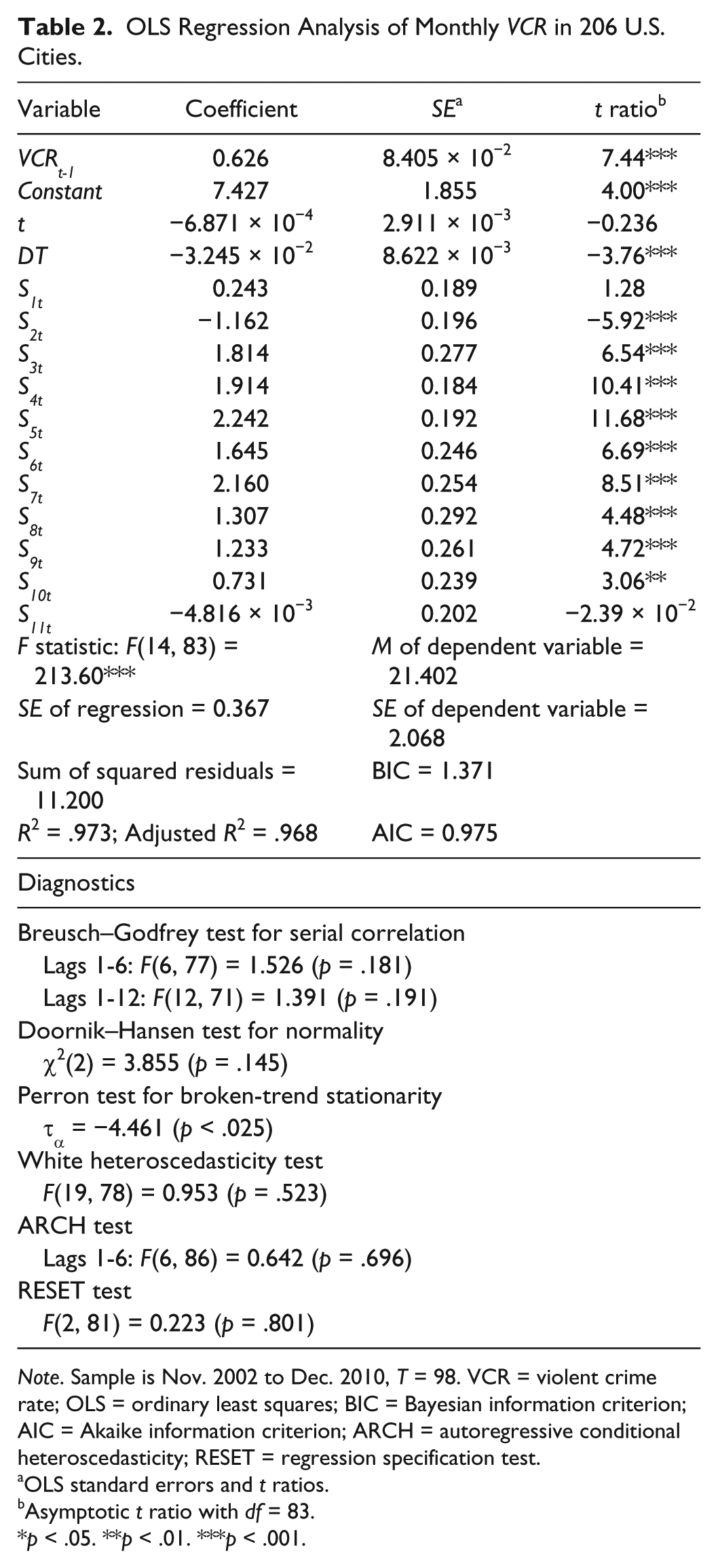
Note. Sample is Nov. 2002 to Dec. 2010, T = 98. VCR = violent crime rate; OLS = ordinary least squares; BIC = Bayesian information criterion; AIC = Akaike information criterion; ARCH = autoregressive conditional heteroscedasticity; RESET = regression specification test.
OLS standard errors and t ratios.
Asymptotic t ratio with df = 83.
p < .05. **p < .01. ***p < .001.
Regression diagnostics for HOM analysis
Diagnostic tests for adequacy of the estimated model are summarized in Table 1. The Breusch–Godfrey Lagrange multiplier (LM) test for serial correlation of the regression residuals (Godfrey, 1978) indicates that the null hypothesis of no serial correlation at lags 1-12 is just significant at the 10% level. 4 Individual autocorrelations at lags 6 (.298) and 10 (.208) are small but significantly different from 0 at the 5% level. To correct for this modest serial correlation of residuals, Table 1 reports t ratios calculated using standard errors that are valid (consistent) in the presence of residual autocorrelation and heteroscedasticity of possibly unknown form (Newey & West, 1987). 5
Although some mild autocorrelation is present, the residuals from the estimated model approximate a white noise series and are clearly stationary. This suggests that HOM is broken-trend stationary (broken TS), exhibiting covariance stationary (or weakly stationary) fluctuations around a broken trend. A time series is said to be covariance stationary if its mean, variance, and auto correlations (or, equivalently, its auto covariances) are invariant with respect to a change in time origin (Enders, 2010).
Stationarity of the regression residuals is required for valid statistical inferences regarding the estimated regression parameters in the intervention model (Banerjee, Dolado, Galbraith, & Hendry, 1993; Enders, 2010; Granger & Newbold, 1974). Broken TS for HOM implies that the OLS regression estimates in Table 1 have standard distributions and thus the observed significant change in trend is unlikely to be the result of the “spurious regression” phenomenon (Banerjee et al., 1993; Granger & Newbold, 1974). Such spurious regressions can result when time trends are fitted to nonstationary variables that contain a random walk component (“stochastic trend”). A key signature of spurious regressions is highly autocorrelated, nonstationary regression residuals. The latter violate the distributional assumptions underlying statistical inference for time series regression.
Table 1 also reports a formal test for broken TS (Perron, 1989, 2006). 6 The Perron test rejects the null hypothesis (p < .01) that the HOM time series is a nonstationary random walk with drift (Perron, 1989; Zivot & Andrews, 1992). 7 The alternative hypothesis is that HOM displays stationary fluctuations around a linear trend with a known, one-time break in the trend function in December 2006. 8 The test allows for a possible gradual adjustment of the trend to its new value in the intervention period (“innovations outlier” type model; Perron 1989, 2006; Zivot & Andrews, 1992). 9
The Perron test assumes that the time of the structural break is known (exogenous; Perron, 1989). The results of the test may be misleading if the date of the break is unknown and must be determined from the data (Christiano, 1992; Zivot & Andrews, 1992). The assumption of an exogenous structural break is appropriate for the current intervention study because the date of the hypothesized trend break for the violent crime measures examined in this article was selected on a priori theoretical grounds, not determined by visual inspection or statistical pre-testing.
Other diagnostic tests for model adequacy are also satisfactory. The null hypothesis that the regression errors have stable variance (homoscedastic), or if heteroscedasticity is present, it is unrelated to the explanatory variables, is not rejected by White’s general test (White, 1980). The RESET test (regression specification test) does not reject the null hypothesis that the functional form of the regression equation is correctly specified (Ramsey, 1969). The null hypothesis that the regression residuals are drawn from a normal distribution is not rejected using the omnibus Doornik–Hansen test (Doornik & Hansen, 2008; Doornik & Hendry, 2013). No regression residuals exceed 3.5 standard errors, indicating the absence of extreme outliers. Finally, the null hypothesis of no autoregressive conditional heteroscedasticity (ARCH) of the model residuals (Engle, 1982) also is not rejected by the LM test for ARCH. In sum, the diagnostic tests for model adequacy support statistical conclusion validity for the statistical inferences reported in Table 1.
Study 2—Urban VCR
Dependent Variable
The dependent variable for Study 2 is monthly rate of violent crime, reported by the FBI Uniform Crime Report system as comprising murder and non-negligent manslaughter, forcible rape, aggravated assault, and robbery. In addition, murder together with non-negligent manslaughter was analyzed separately as the most serious and precisely measured of the violent crime categories and for comparison with the CDC homicide data (details available from authors). Monthly data suitable for time series analysis are not published for the United States as a whole by the FBI, but the FBI Multimedia Productions Group provided computer files of Return A Master Files, containing all Uniform Crime Report data for each month of a given year for each city or other geographical unit and the population estimate for that city. These files were used for each year from 2001 to 2010, and the monthly violent crime totals were extracted for each city with more than 100,000 population for which uninterrupted data were available. The annual population figure for each city was used to derive monthly population estimates for that city by linear interpolation (the listed annual estimate was taken as the April figure, because this listed figure coincided with the official U.S. Census Bureau count published as an April figure for census years). The 206 cities, with a combined population of 60.17 million in 2010, were located in 37 states and the District of Columbia.
The data of all 206 cities with more than 100,000 population in 2009 for which an uninterrupted monthly time series was available in the FBI data from 2001 to 2010 were combined into one time series separately for VCR in the following manner. (The calculation for MUR was done in a parallel way using only the data for murder and non-negligent manslaughter per 100 million population). For each month, the total incidence of violent crime (murder, forcible rape, aggravated assault, and robbery) for the 206 cities was divided by the summed monthly population estimate of the 206 cities, multiplied by one million (i.e., rate per one million population), and divided by the number of days in the month. Thus, the monthly figure represents the daily rate of violent crime for that month per one million population in the 206 cities. The different population ratios used in this study for violent crime (per one million) and in Study 1 for homicide (per 100 million) were used such that the resulting rates would be of the same order of magnitude.
Results
Plot of monthly VCR
The plot of VCR in Figure 2 displays strong monthly seasonality as well as a flat pre-intervention trend. In the intervention period, VCR shifts to a declining trend.

Plot of monthly VCR.
Regression results for VCR
To test the hypothesis of a decrease in the trend growth rate for VCR during the intervention period, we estimate the following broken-trend intervention model:

In this case, lag 1 of VCRt is required to model its autoregressive dynamics, and all other terms are defined as in Equation 1.
Table 2 summarizes the OLS regression results for Equation 2. The pre-intervention growth rate for VCR does not differ significantly from 0. Consistent with theoretical prediction, the change in trend following the onset of the intervention is negative and highly significant.
The estimated coefficient for the change in trend DTt in Table 2 gives the immediate impact of the intervention. The first-order autoregressive dynamics of VCRt implies a gradual adjustment of the trend to its new value in the intervention period. If (1 − β3) ≠ 0, it can be shown that the total change in trend is given by κ = (β2 − β1) / (1 − β3) = −0.08665 (t = −6.14, p < .001), where κ is the coefficient on DTt in the steady state, or static long-run, equation for VCR (Hendry, 1995). 10 Here, “long run” denotes the steady state expected value and does not necessarily imply a long period of time (Hendry, 1995). The estimated cumulative lag weights for Equation 2 indicate that 90.4% of the intervention adjustment in trend is completed in 4 months.
PcGive 14 software (Doornik & Hendry, 2013) reports the standard error for the estimate of κ that is calculated from the standard errors of (β2 − β1) and β3 in Equation 2 by numerical differentiation using a nonlinear algorithm (Bårdsen, 1989; Doornik & Hendry, 2013). Inder (1993) showed that t tests for κ based on critical values from the standard normal distribution have good statistical properties (size and power).
Relative to the pre-intervention trend, the estimated shift in trend during the intervention period implies a cumulative reduction of 4.1594 in the expected value of VCR over the 2007-2010 intervention period. 11 This is a reduction of 18.54% compared with the mean pre-intervention rate of 22.4280 (an annual decrease of 4.64%). In the 206 urban areas, the cumulative reduction in the daily rate of violent crime per million population translates to a total expected reduction of 186,774 crimes for 2007-2010. Thus, the estimated shift in trend for urban violent crime has the predicted negative sign and is both statistically and practically significant.
Regression diagnostics for VCR
Each of the diagnostic tests for adequacy of the estimated model is satisfactory. No regression residuals exceed 3.5 standard errors, indicating the absence of extreme outliers. Both LM tests for autocorrelation of residuals are not significant, and no individual autocorrelations at lags 1 to 24 are significant at the 5% level. That the residuals appear to be serially uncorrelated, stationary white noise, lends empirical support to the conclusion that VCR is likely broken TS. This conclusion is further supported by the Perron test reported in Table 2, which rejects the null hypothesis of nonstationarity at the 2.5% level. 12
Murder rate—Secondary analysis
As noted above, we also analyzed data on the rate of FBI-reported murder and non-negligent manslaughter (MUR) in the subsample of 206 cities. Due to space limitations, only summary results are listed here; more detailed results are available from the authors.
Using an intervention model for MUR having the same form as given by Equation 1 for HOM, the regression results include a nonsignificant pre-intervention trend and a significant shift to a declining trend in the intervention period (p < .001). The Perron test rejects nonstationarity at the 1% level, and all other diagnostic tests for the MUR model are also satisfactory.
The estimated trend shift implies a 28.40% total reduction (3,865 murders) for the 2007-2010 intervention period, or 7.10% annually, relative to the pre-intervention trend. For these 206 urban areas, whose pre-intervention murder rates were substantially higher than the national average, the estimated annual decline in the murder rate during 2007-2010 is 2.4 times greater than that for HOM in the United States as a whole and 1.34 times as great when the percentage changes are compared.
Discussion
For each of the three measures of violent crime examined in this study, the intervention analysis based on time series regression rejects the null hypothesis of no effect of the quasi-experimental intervention on the trend rates of change during the intervention period 2007-2010. Statistically and practically significant reductions in the trend rate of growth are found in each case, with the shift in trend occurring, as predicted, with the onset of the quasi-experimental intervention in January 2007. A battery of diagnostic tests indicates satisfaction of the key statistical assumptions of the analysis, thus supporting statistical conclusion validity. The statistical results from the broken-trend intervention modeling of outcomes for this prospective quasi-experiment, thus, are consistent with the hypothesis that the group practice of the TM-Sidhi program may have contributed to decreased rates of homicide in the United States as a whole as well as violent crime and murder in a subsample of 206 larger U.S. cities during 2007-2010.
Of course, rejection of the null hypothesis of no intervention effect on violent crime trends does not necessarily imply that the alternative hypothesis is true, namely, that the observed reduction in violent crime trends is attributable to the TM-Sidhi group practice. Common to all intervention analyses of quasi-experiments, a limitation of the study is the threat internal validity posed by potential omitted variables (Cook & Campbell, 1979; Shadish et al., 2002). Thus, a first major consideration is alternative hypotheses.
For example, one might consider the very significant economic changes of the late 2000s, for which increased unemployment is a primary indicator, as an alternative hypothesis for the observed national decline in homicide and violent crime. However, although the relationship of unemployment and crime is complex (Rosenfeld & Messner, 2013), increased unemployment is generally associated with increased crime, especially in the longer term (Aaltonen, MacDonald, Martikainen, & Kivivuori, 2013; Cantor & Land, 1985; Chiricos, 1987); therefore, the sharp increase in unemployment during the intervention period does not explain the measured decreases in HOM and VCR over the years 2007-2010. Moreover, the significant increase in U.S. unemployment began in 2008, a year later than the observed effects of the study began to be measured. Also, as pointed out by Richard Rosenfeld, past president of the American Society of Criminology, the recession of December 2007 to June 2009 was the first time rates of violent crime failed to rise during a substantial U.S. economic downturn since World War II (Eng, 2012).
Incarceration rates are understood to be negatively correlated with rates of crime (Marvell & Moody, 1994), but prison admissions and prison releases converged from 2006 to 2009, slowing the growth of the U.S. prison population, and in 2010, prison releases exceeded prison admissions for the first time for which records are available (Guerino, Harrison, & Sabol, 2011; Sabol & West, 2011). This would predict increased rather than decreased violent crime. Also, the proportion of youth aged 18 to 25 positively correlated with higher homicide or violent crime (Nivette, 2011) was increasing through the 2000s (Howden & Meyer, 2011) and, thus, would not predict reduced rates of homicide or violent crime. Recent attention has been given to the role of temperature on interpersonal violence (Hsiang, Burke, & Miguel, 2013), with an estimated 4% increase in violence for one standard deviation of warmer temperature; but again, any recent trend to warmer temperature would not predict a resulting decrease in violence, and the seasonal variations in violence associated with annual cycles of temperature are modeled by the seasonal parameters of the analyses performed here.
More effective policing strategies may also contribute to reduced rates of homicide and violent crime in some cities; however, cities around the United States would have had to implement more effective policing strategies almost simultaneously in 2007 to explain the observed effects. Increased use of surveillance technology may have a deterrent effect, particularly on property crime, but violent crime and homicide, to which impulsiveness and alcohol use contribute significantly (Roizen, 1997), may be more resistant to these type of deterrence effects; again, a nearly simultaneous implementation in cities around the United States is also required to serve as an alternative explanation of the measured effects.
In addition to the apparent lack of compelling alternative explanations for the empirically observed effects, additional support for the conclusion that the independent variable may possibly have contributed to the observed decline in rates of both homicide and violent crime is that the findings of this article further replicate those of 12 previous studies of this effect published in eight peer-reviewed articles. These articles report statistically significant reductions in crime or violence and were reviewed above with a citation of alternative demographic or environmental factors influencing crime for which each study controlled or examined. The studies reported in the current article are part of a more comprehensive empirical evaluation by the current authors (in preparation) of the impact of this prospective quasi-experiment on U.S. quality-of-life measures, using the same methodology as this article.
Methodological issues aside, what is the most effective way to conceptualize this extended effect apparently associated with a small group? That is, if the effect is non-spurious, how to explain the far-reaching influence?
Turning first to the founder of the program, both macro-level connections and a deeper connection between individuals are proposed to contribute to this effect. Each level of society (family, community, city, state, nation, world) is posited to have a corresponding collective consciousness that results from the combined quality of consciousness of all the individuals in the society (Maharishi Mahesh Yogi, 1977). The quality of that collective consciousness—for example, stressed, violent, peaceful—in turn is an input to the experience of all the component individuals through the general quality of the atmosphere and the myriad social interactions through which that quality is expressed. The group practice of the TM-Sidhi program is predicted to alleviate stress in the collective consciousness, thereby reducing stress and violence in individual behavior.
In addition to this macro-social reciprocal influence between individual and society, the Vedic tradition describes the character of pure consciousness (experienced during the Transcendental Meditation and TM-Sidhi program) ultimately as a universal substrate fundamental to the consciousness of each individual (e.g., Radhakrishnan, 1968) and that the beneficial effects of that experience are thus shared to some degree by others (Maharishi Mahesh Yogi, 1986). This non-behavioral influence on others is proposed to interact with the levels of collective consciousness of society such that an influence would measurably affect the largest social unit of which the group is a part, if the size of the group exceeds a threshold (√1%, as noted earlier) for the population of that social unit. If the size of the group substantially exceeds the predicted required amount for a societal unit (e.g., nation), then previous research has presumed a proximity effect for nearby nations, assuming the size of the group is sufficient for the total population of the countries. One might ask whether proximity should enter into consideration at all if pure consciousness is described as a universal substrate of consciousness. The most salient evidence related to that consideration is that the predicted group size required to create a measurable global influence is the √1% of the world’s population (Maharishi Mahesh Yogi, 1986) that was approached or exceeded on occasions of some weeks in the 1980s (when the required size was about 7,000), with measurable time series results on international conflict and international terrorism (Orme-Johnson et al., 2003). For the world’s present population, the group size predicted to be required is about 8,500. One way to view the predicted nonlocal influence is that the hypothesized substrate property of pure consciousness is a field property, perhaps at more unified levels of natural law (Hagelin, 1987), although an inverse square law for diffusion of a force over distance is not posited, as indicated above in the context of levels of society.
Are there more familiar concepts of consciousness and social interaction that can account for the empirical findings of the present and related studies? One immediate hypothesis could be the high level of interconnectedness within and between societies that has emerged in the past two decades, expressed in social media and seen in the more instant communication of events nationally and internationally. Thus, perhaps the influence of a group of individuals experiencing greater peace in their personal lives could be amplified and spread through their interactions online. Similarly, the “extended mind” hypothesis, that cognition should be conceptualized as including the environmental elements of the person–environment interaction, gains broader extension through current social interaction technology; new properties emerge from the person–environment interaction as indicated by a dynamical systems analysis even in the minimal case using robotic artificial nervous systems (Froese, Gershenson, & Rosenblueth, 2013).
There are two points of evidence suggesting that a communication technology explanation for the current results is not likely to be the case, one based on previous studies and one specific to this study. Previous research on this phenomenon, particularly in studies from the early 1980s to early 1990s, has found similar effects from an equivalent group of TM-Sidhi participants (√1% of the social unit), even though many of these studies predated wide access to the Internet, and in some cases, predating the widespread use of personal computers (Dillbeck, 1990; Dillbeck et al., 1987; Hatchard et al., 1996; Orme-Johnson et al., 1988). The relevant evidence from the current study is that the group was increased to the size predicted to influence the whole U.S. population by a private grant supporting a subgroup of participants —young trained experts from India who had little interaction with the U.S. social environment. This subgroup averaged 27% of the total group in 2007 and grew from 41% to 50% in 2008-2010. The organizers for this group reported that the majority of these guests did not speak English (Hindi was their mother tongue) and to physically and culturally care for their welfare, separate campus facilities were provided which happened to have very little Internet access, although they had mobile phones to speak with their families in India. Thus, they had little interaction with the U.S. population through communication technology.
However, more broadly, research in dynamical systems is an alternative approach that could be relevant to the phenomenon of this study. The presumed nonlinear effect of the groups of TM-Sidhi participants and associated presence of threshold effects in social systems of different sizes might suggest the property of a self-organized critical system (Bak & Paczuski, 1995; Kron & Grund, 2009) or a scale-free network (Barabási & Bonabeau, 2003). In the present study, we did not see evidence that the dependent variables were other than stochastic processes (as expected in a time series of this length), but it might be possible to design research within a dynamical systems framework.
Independent of these theoretical considerations, this research and the studies that preceded it could potentially have important practical considerations for crime prevention. So far, this research has relied solely on private well wishers to implement such preventive groups and study their effects. But, because such groups are centralized rather than diffused and do not require behavioral interference with the larger population, governments are in an effective position to establish and evaluate interventions using this procedure.
Footnotes
Acknowledgements
The authors appreciate the cooperation of the Multimedia Productions Group of the FBI and the Invincible America Assembly Office of Maharishi University of Management for providing data used in this study.
Authors’ Note
Additional supplementary materials may be obtained from the first author at
Declaration of Conflicting Interests
The author(s) declared the following potential conflicts of interest with respect to the research, authorship, and/or publication of this article: The authors have no financial relationship with the foundation that teaches Transcendental Meditation® in the United States (Maharishi Foundation U.S.A.). The authors are evaluating a project of their own university, but currently receive no compensation for their research or other activities with the university, which are donated as contributed services.
Funding
The author(s) disclosed receipt of the following financial support for the research and/or authorship of this article: The authors received no funding for this research. However, the university’s intervention studied here was supported by grants from the Howard and Alice Settle Foundation.