




Abstract
The issue of teaching and learning accountability has been discussed for years. This study focuses specifically on advising accountability of management education to explore how faculty advisors communicate with their student advisees using instant messaging (IM) to enhance advising presence primarily based on Tetlock’s social contingency model. The dependent relationships between advisor and advisee are considered a cohort, and their collaboration as a community of practice. Of the 254 graduate students in the college of management, the result reveals that their perception of advising accountability has been casually explained by the antecedents, that is, self-efficacy, advising presence, epistemic engagement, advisor credibility, and their flow experience toward using IM to communicate with their thesis advisors. The research finding validates intervening factors between students’ perception of IM self-efficacy and advising accountability of thesis advisors. The findings, regardless of the limited generalization, provide prescriptive implications that educational practitioners can use to evaluate related issues of advising accountability.
Keywords
Introduction
The issue of accountability has been discussed and reported for various domains (Ammeter, Douglas, Ferris, & Goka, 2004; Dill, 1999; Hall & Ryan, 2011; Hendry & Dean, 2002; Hochwarter et al., 2007; Huisman & Currie, 2004; Lindkvist & Llewellyn, 2003). Faculty members in higher education have faced challenges of academic accountability regarding the three-facet quality assurance: teaching, research, and student advising. The abovementioned academic accountability is closely interdependent with each other. Academic accountability, relating to teaching and learning specifically, has been addressed and examined through multiple perspectives. Because teaching and learning are reciprocal processes, the faculty tends to be the party that is held most accountable for the results of that process. As early as 1980, Hansen (1980) discussed the amount of time that the faculty members, who might be overworked, spent on advising, who they advised, and the types of activities involved in advising. Maxwell and Smyth (2010) re-conceptualized thesis supervision and advising as a research project by accounting for three interrelated areas: (a) the learning and teaching process, (b) preparing students, and (c) producing research outcomes as a social practice. When thesis advising, academic advisors supervise not only graduate students who are writing theses and dissertations to complete their master’s or doctoral degrees but also mentor them in career planning during their interactions.
Due to professionalism and obligations, efficiency and effectiveness of the issues are highly dependent on the sophisticated use of information and community technologies (ICTs). Exploiting ICT-supported communication tools has become undoubtedly vital for managing these delicate and crucial tasks. The use of ICTs has prompted a gradual transformation of instructional processes and strategies that improve instructors’ capability to meet the needs of learners. Feghali, Zbib, and Hallal (2011) posited that the use of ICTs in academic advising may provide better services to students, which in turns introduces greater accountability. Because of complex and time-consuming matters that relate to teaching and learning accountability, advising tasks often burden faculty advisors. Yet, not all the faculty members are ready for the ICTs’ integration; needless to say, they remain resistant to such a shift (Mitchell, Parlamis, & Claiborne, 2015).
The use of instant messaging (IM) has become an academic advising factor because of its ability to provide real-time interaction and information exchanges (Bardi & Brady, 2010; Birnholtz, 2010; Sheehan, 2008). In a report on how Americans use IM, Shiu and Lenhart (2004) found that (a) nearly 25% of IM users use IM more than they use email. Nonetheless, most Internet users favor email over IM as media of communication. In addition, (b) 32% of college graduates use IM while working, and (c) at-work IM users tend to be positive about how IM improves work flow and the quality of their workday. Furthermore, (d) IM users habitually use specific features to enhance their capability to communicate and to stay connected with others. This study includes a brief summary of findings that can be accessed at a glance, and the additional findings can be accessed in Shiu and Lenhart (2004). The results indicate that compared with other communication technologies, IM technologies provide a superior solution regarding cost-effectiveness and immediacy. Shea and Bidjerano (2010) pointed out that further research is needed to comprehend self-efficacy (SE) and its broader concept of online self-regulation of learners.
As the premise of thesis advising to be ensured, the study addresses two purposes: (a) to present a conceptual framework of thesis advising and the antecedents to accountability and (b) to explore whether the practical use of ICT-mediated synchronous communication media promotes advisor availability to graduate students who are completing their theses. In the context of thesis writing and advising, the synopsis of this study lends support to the twofold research question. The first is to explore how graduate students perceive their self-accountability while synchronous ICTs, that is, IM, occupy the main media of mutual discourse. Under the circumstances, the next is to identify and validate what the antecedents of advising accountability (AA) are when taking into account of multiple theoretical models.
Literature Review
A conceptual framework for acknowledging the antecedents of AA is proposed by integrating flow experience (FE) of using IM and a community of inquiry (CoI). The proposed model comprises the notions of epistemic engagement (EE), advising presence (AP), advisor credibility (AC), FE, and SE. The hypotheses that are generated using the theoretical framework are presented. The study provides a substantial literature review to support the proposed model (Figure 1).

Research model.
Self-Efficacy for Using IM
SE, which originated from social cognitive theory (SCT), is used to determine the amount of effort people contribute to an activity, how long they persevere when confronting obstacles, and how resilient they are when facing adversity (Pajares, 2002). Because it is part of a belief in personal competence, SE acts on individual behavior in different manners (van Dinther, Dochy, & Segers, 2011). Pajares (2002) concluded that the sense of efficacy is commensurate with the effort, persistence, and resilience that a person demonstrates. The empirical research on SE, which was conducted by adopted various perspectives, has explored the determinants of SE and its effects (Hatice, 2011; C.-P. Lin & Bhattacherjee, 2009; Madhavan & Phillips, 2010; McCoy, 2010; Papastergiou, Gerodimos, & Antoniou, 2011; Shea & Bidjerano, 2010; van Dinther et al., 2011). For example, Papastergiou et al. (2011) used a pretest/posttest experimental design to examine the effects of multimedia blogging in physical education on student knowledge and ICT SE. They found that among students who were interested in ICT, interest might have influenced the development of their SE in using ICT. In planning technology resources, McCoy (2010) concluded that educators’ awareness of ICT SE could benefit student learning proficiency, particularly for those above the age of 25. In their longitudinal study on IM use among undergraduates in Taiwan, C.-P. Lin and Bhattacherjee (2009) found that information technology (IT) SE indirectly influences online social support, which is moderated by ICT use. Grounded on SCT, one promising area of research has focused on SE as a predictor of individual perceptions when it relates to technology proficiency in technology use (S. Lin & Overbaugh, 2009). Whether SE in using IM has an effect on the student perception of AA in academic thesis writing is particularly relevant to the topic of this study.
Flow Experience
When people completely get involved in an activity, an innately positive experience known as flow emerge to produce intense feelings of enjoyment (Csikszentmihalyi, 1990). Chen, Wigand, and Nilan (2000) considered flow as an optimal, extremely enjoyable experience; that is, the FE occurred when people were fully engaged and involved in activities. In the state of flow, people typically experience deep enjoyment, creativity, and a total involvement with life, as well as improved performance and a sense of satisfaction (Csikszentmihalyi, 2008). Csikszentmihalyi, Abuhamdeh, and Nakamura (2005) posited that three conditions are necessary for achieving a flow state. First, being involved in an activity with a clear set of goals adds direction and structure. Second, an appropriate balance between the perceived challenges of a task and one’s perceived skills is critical; a person should have a considerable amount of confidence in his or her ability to carry out a task. Third, clear and immediate feedback to task performance helps people negotiate changing demands and allows them to refine their performance and maintain the state of flow. In their large-scale empirical study, Esteban-Millat, Martínez-López, Huertas-García, Meseguer, and Rodríguez-Ardura (2014) took a deep route on understanding antecedents and consequences of FE in virtual learning environments. They concluded that when leading students into ICTs-mediated environments, instructors are accountable for getting them into a flow state.
Pilke (2004) studied the FE of 20 academic students or postgraduates from a variety of fields, including engineering, art, educational sciences, and psychology, by using ICTs. The participants reported that inducing flow in ICT use could be classified in one of four categories: (a) immediate feedback; (b) clear rules and goals; (c) sufficient complexity, but not to the extent that exhaustion is induced; and (d) dynamic challenges instead of static challenges. The study of Pilke (2004) signified the core value to faculty and students of utilizing IM in academic advising, specifically thesis and dissertation advising. In their empirical survey study, Wang, Hsieh, and Song (2012) validated the relationship between the use of IM and user satisfaction in the context of building and maintaining social relationships with others. They found that the antecedents of user satisfaction include perceived enjoyment, perceived social presence, and perceived usefulness. Therefore, for the purposes of this study, FE comprises two factors: perceived enjoyment and concentration. Conceptually defined, enjoyment is the extent to which a person perceives that using IM is enjoyable, aside from the performance outcomes associated with using IM, whereas concentration is the extent to which a person can focus only on IM when using it (Lu, Zhou, & Wang, 2009).
Advising Presence
The concept of AP originates from the notion of CoI identified by Shea and Bidjerano (2009). They posited that the CoI framework addresses the processes of instructional conversations within an online learning community likely leads to EE. Required to cultivate a sustainable learning community, the CoI framework is the core element of the collaborative constructivist learning environment (Garrison, Cleveland-Innes, & Fung, 2010). They also stress that higher order learning would be best supported in a community in which learners are engaged in critical reflection and discourse. The multivariate measure of learning represented by the cognitive presence factor could be predicted according to the quality of teaching presence and social presence reported by learners in online courses (Garrison et al., 2010; Shea & Bidjerano, 2008). Responding to this research context, the term advising presence is more appropriate than teaching presence. Examination of AP should not only be focused on the task-oriented thesis study, but socio-emotional support should also be considered to build authentic communication. Therefore, the FE that is invoked using IM could influence the students’ perception of faculty AP.
Again applying CoI in field research, Shea and Bidjerano (2010) conducted a study of 3,165 students of online and blended courses from forty-two 2- and 4-year institutions. They extended the CoI framework by using a learning presence that was conceptually defined as learner self-regulation, in addition to the original teaching, social, and cognitive presence. They found a strong correlation between the CoI constructs and SE. Students believed that they achieved significant learning and that the effort they expended depended partly on their sense of efficacy. Furthermore, the results confirmed that a strong correlation existed between constructs within the CoI framework and SE. In addition, Hester (2008) posited that (a) students who interacted frequently with advisors show increased satisfaction with advising, (b) a greater number of advising sessions was related to higher grade point averages (GPAs), and (c) students’ knowledge of university resources and policies increased through advising sessions.
Advisor Credibility
Credibility has been considered in three layers: competence, trustworthiness, and goodwill (McCroskey & Teven, 1999). According to the definition given by McCroskey (1998), competence is the extent to which a person truly understands the topic being discussed. The second factor, trustworthiness, is the degree to which a person perceives another person as honest. The third factor, goodwill, is the perceived caring that a person sees in a source. Among the three factors, goodwill might be the most crucial (Punyanunt-Carter & Wrench, 2008). McCroskey and Teven (1999) developed the measurement of source credibility to measure competence, trustworthiness, and goodwill. Therefore, AC is a construct defined by the three variables of competence, trustworthiness, and goodwill. Regarding the use of ICT-mediated communication to build a sense of community, Brown (2001) posited three criteria: (a) students who perceive common interests tend to make contact and form relationships, creating online acquaintances; (b) students who interact in a thoughtful way over time tend to agree with each other to form community acceptance; and (c) students who feel rapport, trust, goodwill, and friendship for each other tend to build camaraderie.
Epistemic Engagement
Psychological research on epistemological development began in the mid-1950s (Hofer & Pintrich, 1997). Within a multidimensional framework of epistemic beliefs, researchers have examined the relationships between students’ beliefs and their use of cognitive processing strategies (Franco et al., 2012). Similar to the vision of knowledge as an epistemic and discursive practice, Larreamendy-Joerns and Leinhardt (2006) have posited that consistency exists between asynchronous learning networks and social constructivist and sociocultural theories of learning. Larreamendy-Joerns and Leinhardt (2006) specified that online education integrates a “vision of knowledge as practice and of learning as emerging participation in a disciplinary community” (p. 591). In online education, Shea and Bidjerano (2009) empirically validated that partially mediated by social presence, a CoI can foster EE. In another work regarding epistemic communities, Paavola, Lipponen, and Hakkarainen (2004) analyzed three models of innovative knowledge communities: Nonaka and Takeuchi’s (1996) model of knowledge creation, Engeström’s (2001) model of expansive learning, and Bereiter’s (2002) model of knowledge building. They found that despite fundamental differences, the three models have pertinent common features; specifically, the dynamic process for transforming prevailing knowledge and practices is greatly emphasized. Because online thesis advising is considered a form of epistemic community in this study, the support of ICT-mediated communication can maximize student perception of advisors’ availability to enhance their level of engagement.
Advising Accountability
Numerous accountability-related studies that are based on Tetlock’s (1992) social contingency model are rooted in social psychology. To conceptualize accountability in organizations, Hochwarter et al. (2007) asserted that levels of accountability are likely to be inconsistent and even contradictory, even when demands and expectations are equivalent; such is the nature of felt accountability. Understood as answerability for performance, accountability raises immediate inquiries for he who holds to account (Romzek, 2000). Lindkvist and Llewellyn (2003) elaborated that the terms responsibility and accountability (R/A) are often used interchangeably because there is little agreement on their definitions. Regarding academic teaching, Hendry and Dean (2002) considered accountability to be an explanation of one’s teaching practices. Romzek (2000) proposed two dichotomous dimensions, namely, sources of authority (internal/external) and degrees of autonomy (low/high), and classified four types of accountability: hierarchical, legal, political, and professional. Berman and Smyth (2013) brought up that tertiary relationship of advising practices aims for cognitive enhancement relying on social and cultural activities. Because of this research context, AA indicates factors to which faculty advisors are held liable and accountable for the professional and social development of their student advisees. The ICT-mediated communication between student advisees and faculty advisors is inevitable for meeting the expectations of degree projects and social practices. The conceptualization of the research model is illustrated in Figure 1.
Method
Research Participants and Procedure
The participants in this study were 310 graduate students who were completing their master’s thesis in management at universities in central Taiwan. The participants completed an online survey powered by Google Docs™ and took less than 10 min to complete the 24-item questionnaire in addition to the demographic items. The participants were invited to respond voluntarily during the spring semester. The data provided by 56 participants were removed due to their response of not using IM to communicate with their thesis advisors. Therefore, the responses from 254 participants were entered for statistical analysis.
Measures
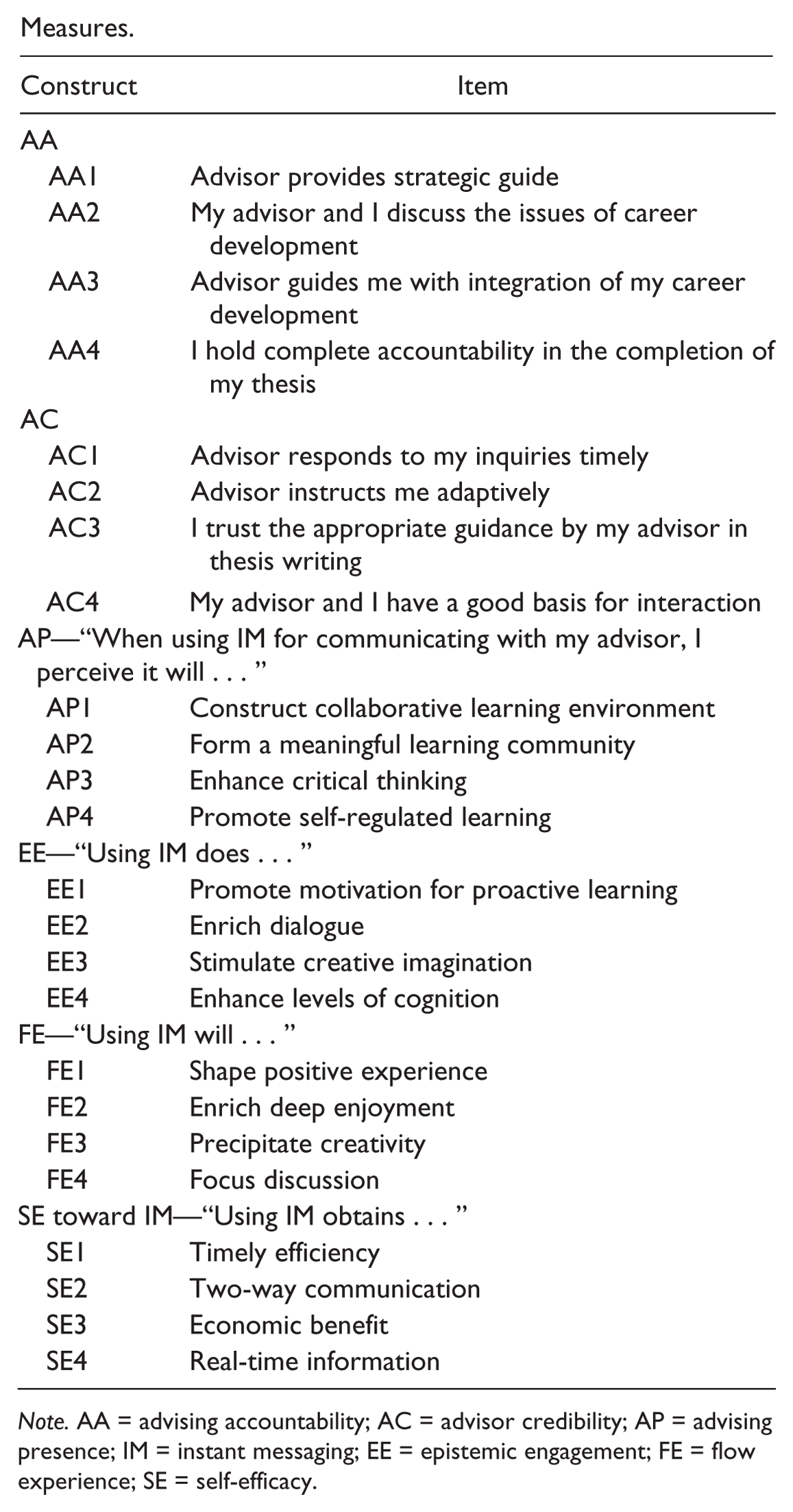
The 24-item scale composed of six constructs was developed based on the mentioned literature and was adapted to the operational definition accordingly to ensure its contextual consistency. The participants rated their perception level on a 7-point Likert-type scale, which ranged from strongly disagree (1) to strongly agree (7). The items exhibiting low loadings on the corresponding construct were eliminated to enhance the reliability of measures. The appendix presents the scale items of the measures in this study.
All 24 items were examined for their mean and SD. All the mean scores ranged from 4.49 to 5.84, which exceeded the midpoint of the 7-point Likert-type scale. The mean scores indicated an overall positive response to the variables in the study. The SD ranged from 1.09 to 1.43, which indicated the limited spread of the participants’ responses. Because of the use of a non-random sample, generalizing the results of this study was limited to similar groups.
Post Hoc Testing for Common Method Variance (CMV) Effects
Because of the potential problem of using self-reported measures in behavioral research, the CMV was attributable to the measurement method rather than to the constructs that the measures represent (Meade, Watson, & Kroustalis, 2007; Podsakoff, MacKenzie, Lee, & Podsakoff, 2003). The first statistical procedure used to examine the CMV was Harman’s one-factor test (Podsakoff et al., 2003; Podsakoff & Organ, 1986). In this procedure, all relevant variables are entered into a factor analysis. During the procedure, a single factor emerges from the unrotated solution of the factor analysis. In this study, the first factor accounted for 45.87% of the variance, and all factors accounted for a total of 72.89% of the variance. That is, one single factor did not account for the majority of the covariance among the measures. Therefore, the CMV was not a problem in testing the hypotheses.
Results
The partial least-squares (PLS) technique was used to estimate the measurement and the structural models. The technique of PLS-structural equation modeling (SEM) has become accepted in recent years because of its accuracy and utility (Hair, Black, Babin, & Anderson, 2010; Hair, Ringle, & Sarstedt, 2011; Vinzi, 2010). As a causal modeling approach, the PLS-SEM is designed to maximize the explained variance of the dependent latent constructs (Hair et al., 2011). Because of its predictive orientation, the PLS-SEM is the preferred method for theory development and prediction (Hair et al., 2011). Developed by Ringle, Wende, and Will (2005), SmartPLS 3.0 is a professional application of PLS-SEM that is used to compute a path model and the parameter estimation based on a path-weighting scheme.
Descriptive Statistics
Of the 254 participants, 34% (n = 86) were male and 66% (n = 168) were female. Their ages ranged from 22 to 58 years, and the average age was 30.89 years (SD = 8.47 years). Regarding the students’ status, 61% (n = 154) were full-time students, and 39% (n = 100) were part-time students. Regarding the thesis writing stage, 9% of the participants (n = 24) had not yet determined their thesis topics, 34% (n = 89) had confirmed their thesis topics, 29% (n = 74) were writing their proposals, and 28% (n = 70) had passed the oral defense of their theses.
Measurement Model
Convergent validity refers to the extent to which multiple items or indicators share a proportion of variance. Reliability is an alternative indicator of convergent validity (Hair et al., 2010) that has been verified using internal consistency reliability (ICR) and average variance extracted (AVE). Ideally, acceptable values of ICR exceed .70 (Bollen, 1989; Hair et al., 2010). An AVE value of .50 or higher suggests adequate convergence, whereas an AVE value of less than .50 implies a higher level of error variance than was explained by the variance remaining in the measurement model. The ICR and AVE values of this study met the recommended thresholds as in Table 1.
Measurement Model Estimation.

Note. Off-diagonal elements are correlations between the constructs. The diagonal elements (bold) are the square root of the shared variance between the constructs and their measures. Square root of the shared variance across items measuring a construct was higher than correlations across constructs shows that discriminant validity across constructs is supported. ICR = internal consistency reliability; CA = Cronbach’s alpha; AVE = average variance extracted.
Discriminant validity, which refers to whether a given construct is truly distinct from other constructs, could be assessed using two criteria: (a) the square root of the AVE for each construct should exceed the correlations between this construct and other constructs and (b) the factor loading should be larger than cross loadings (Bollen, 1989; Hair et al., 2010). As shown, the square root of the AVE for each construct exceeded the correlations between the constructs and all other constructs (i.e., the off-diagonal elements in the corresponding rows and columns). The factor loading of each construct (.71-.95) exceeded .70 and the cross loadings. The above assessment demonstrated that the discriminant validity of the measures was adequate. In summary, the measurement model assessment substantiated that all of the construct measures were reliable and valid. Based on these findings, the following step was to examine the structural model focusing on the hypothesized relationship between the constructs.
Structural Model
The examination of the structural model involved estimating the path coefficients and the R2 values. The path coefficients represented the magnitude of the expected change in the observed variables, and the R2 values indicated the amount of variance in dependent variables explained by their antecedents (Vinzi, 2010). The R2 values and the path coefficients demonstrated the extent to which the data validated the research model. With the bootstrapping procedure, Figure 2 shows the results of the structural model that were assessed using the overall explanatory power, the estimated path coefficients, and the associated t values of the paths. The primary advantage of bootstrapping is to allow researchers to assess the stability of parameter estimates and to accurately report the values (Byrne, 2013).
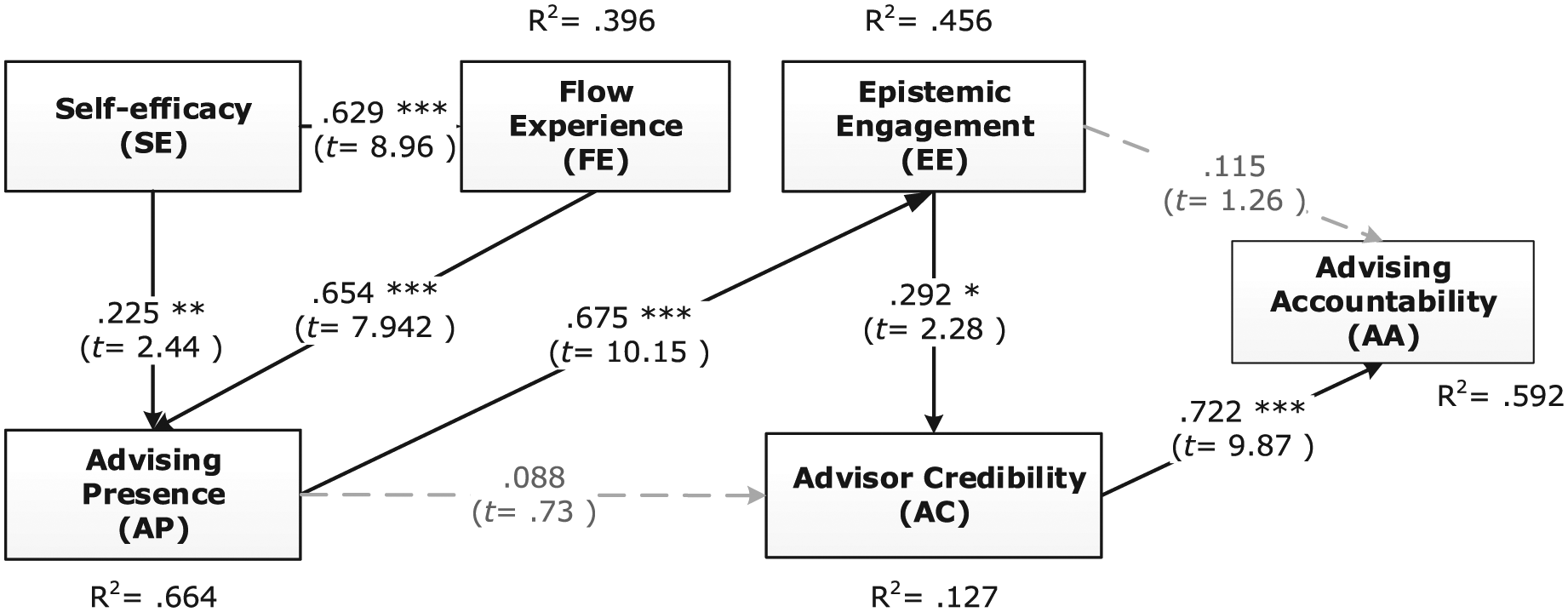
PLS structural model assessment of the study.
As shown in Figure 2, the analysis demonstrates that FE (R2 = .40) was explained by SE (β = .63, p < .001), thus, supporting H1. AP (R2 = .66) was determined by FE (β = .65, p < .001) and SE (β = .23, p < .01), thus supporting H2 and H3. AC (R2 = .13) was explained by EE (β = .29, p < .05) in H6. However, it was not influenced by AP, indicating that H4 was not supported. EE (R2 = .46) was explained by AP (β = .68, p < .001), which supported H5. As a whole, AA (R2 = .60) was directly explained by AC (β = .72, p < .001) in support of H8; however, it did not statistically support H7. SE and FE explained 66% of the variance in AP. Three antecedents, namely, SE, FE, and AP, directly and indirectly explained 47% of the variance in EE. Four antecedents, namely, SE, FE, AP, and EE, directly and indirectly explained 13% of the variance in EE. Overall, the five antecedents explained 59% of the variance in AA.
Discussion
As aforementioned, the purpose of this study was to analyze and validate the determinants of AA by integrating IM in the context of the development of graduate theses in higher education. Regardless of the generalization caveat resulted from the non-representative sample pool, the results showed that student perception of AP is influenced by both their FE when using IM and positive interactions in communicating with their thesis advisors. Therefore, AP influences EE, but not AC. The students’ perception of AA was highly dependent on their awareness of their advisors’ credibility but not on the EE of the students. Based on the tested hypotheses, the results showed that the student perception of AP was influenced by SE and FE when using IM. In other words, the FE partly mediates SE and AP. To increase AP through IM, users must have sufficient literacy and experience in using the system interface and application, even if they are efficiently used in computer-mediated communication applications such as IM.
Advisors are most likely to utilize ICT-mediated communication such as IM to maximize their availability or virtual presence; however, this tactic does not directly increase students’ perception of their advisors’ credibility. The enhancement of credibility occurs only when the virtual presence enables cognitive engagement. High levels of AC do not directly result from AP but depend indirectly on the levels of EE during thesis writing. EE fully mediates AP and AC. AP, which originates from a CoI, indicates a high level of socio-emotional support, whereas AC indicates the students’ perceptions of the advisors’ competency, trustworthiness, and goodwill.
High levels of AA are not directly caused by EE; however, AA indirectly depends on AC. AC fully mediates EE and AA. Student perception of AA depends on whether they believe their advisor to be competent and trustworthy and on their rapport with them; nonetheless, they consider themselves to be accountable for their own cognitive involvement in their theses. To conclude, this study has produced the following three findings: (a) SE and FE when using IM are antecedents of AA, (b) the advisor’s role (i.e., AP, AC) mediates the preceding findings, and (c) student advisees consider their own EE during the thesis advising process.
Sufficient discussion between graduate students and faculty advisors should involve higher order thinking skills and encourage critical reflection. Development of critical thinking can be best supported in an interactive community in which learners are engaged in critical reflection and discourse (Mendenhall & Johnson, 2010; Qiyun, Huay Lit, & Jianhua, 2009; Richardson & Ice, 2010). The faculty should cultivate a responsibility for auditing the quality of teaching and learning in their classes on an ongoing basis (Dill, 1999). In graduate programs, the evaluation of thesis advising has not gained as much attention as student evaluation of teaching (SET) has. For instance, SET has been extensively applied to all credit courses to evaluate students’ perception of teaching quality. However, independent studies for theses and/or dissertations are typically excluded. Nonetheless, additional determinants, which might be mediated by, or confounded by, the students’ perception of AA, should be identified. Regarding the potential contributions of this research, IM vendors could reference the results of this study to identify the critical factors involved when developing or customizing IM interfaces or functionality for the exclusive use of academic advising.
Footnotes
Appendix
Measures.
| Construct | Item |
|---|---|
| AA | |
| AA1 | Advisor provides strategic guide |
| AA2 | My advisor and I discuss the issues of career development |
| AA3 | Advisor guides me with integration of my career development |
| AA4 | I hold complete accountability in the completion of my thesis |
| AC | |
| AC1 | Advisor responds to my inquiries timely |
| AC2 | Advisor instructs me adaptively |
| AC3 | I trust the appropriate guidance by my advisor in thesis writing |
| AC4 | My advisor and I have a good basis for interaction |
| AP—“When using IM for communicating with my advisor, I perceive it will . . . ” | |
| AP1 | Construct collaborative learning environment |
| AP2 | Form a meaningful learning community |
| AP3 | Enhance critical thinking |
| AP4 | Promote self-regulated learning |
| EE—“Using IM does . . . ” | |
| EE1 | Promote motivation for proactive learning |
| EE2 | Enrich dialogue |
| EE3 | Stimulate creative imagination |
| EE4 | Enhance levels of cognition |
| FE—“Using IM will . . . ” | |
| FE1 | Shape positive experience |
| FE2 | Enrich deep enjoyment |
| FE3 | Precipitate creativity |
| FE4 | Focus discussion |
| SE toward IM—“Using IM obtains . . . ” | |
| SE1 | Timely efficiency |
| SE2 | Two-way communication |
| SE3 | Economic benefit |
| SE4 | Real-time information |
Note. AA = advising accountability; AC = advisor credibility; AP = advising presence; IM = instant messaging; EE = epistemic engagement; FE = flow experience; SE = self-efficacy.
Declaration of Conflicting Interests
The author(s) declared no potential conflicts of interest with respect to the research, authorship, and/or publication of this article.
Funding
The author(s) disclosed receipt of the following financial support for the research and/or authorship of this article: The author thanks the National Science Council of Taiwan for the research grant that made this article possible (NSC 101-2511-S-142-013) during the period of 2012-2013.