




Abstract
In this article, the psychometric properties of a new test battery aimed at quantifying motor competence across the life span are explored. The battery was designed to be quantitative, simple to administer, applicable for large-group testing, and reliably to monitor life span motor development. A total of 638 participants between 5 and 83 years of age completed assessment of four different motor tasks (two fine and two gross motor tasks), enabling us to investigate its feasibility, internal consistency, construct validity, and test–retest reliability. Feasibility: Overall pattern of results suggest that the test battery for motor competence presented here is applicable for the age-span studied (5-83). Important consideration in this regard is that the same tasks are applied for all ages. A u-shaped curve between age and total test score indicate the adequate sensitivity of the test battery for the age range examined. Internal consistency: All individual test item scores correlated positively with the total test score with correlations ranging from .48 to .64. Correlations between scores on individual test items were moderate to high (.31-.69). The Cronbach’s alpha value for the standardized items was .79. Construct validity: Pearson correlation coefficient between total score Test of Motor Competence (TMC) and Movement Assessment Battery for Children (MABC) were .47 for 7- to 8-years-old children (n = 70) and .45 for 15- to 16-years-old (n = 101). Test-retest reliability: Intraclass correlation coefficients (ICCs) between test and retest scores ranged from .75 to .94, and test–retest coefficient for the total score was .87.
Introduction
The life span approach to development provides a theoretical framework to examine the general principles of development across all ages (Baltes, Lindenberger, & Staudinger, 2006; Craik & Bialystok, 2006). Previously, developmental research has typically either focused on changes in early development (e.g., infancy or childhood) or on aspects of the aging process (Craik & Bialystok, 2006). The knowledge base concerning the general principles of lifelong development is still insufficient and limited (Baltes et al., 2006; Thelen, 2005). One aspect of increasing the understanding of life span developmental processes is further methodological development of adequate assessment tools that are designed to measure individuals throughout the whole life-course (Leversen, Haga, & Sigmundsson, 2012). Research on motor development has been of great significance for our knowledge of general principles of human development (Thelen, 2000). To assess our motor repertoire and ability to perform movements can serve as a window into the nervous system and the processes of development (Gallahue, Ozmun, &, Goodway, 2012). Assessment of motor development as a part of overall neuropsychological and developmental examinations has been used to predict developmental problems such as delays and disorders (Barnett & Peters, 2004; Lockman & Thelen, 1993). Thelen and Smith (1994) emphasized the importance of measuring movement over time: “Development is not the specification of the outcome—the product—but is the route by which the organism moves from an earlier state to a more mature state” (p. xvi). Bearing this in mind, designing assessment tools that enable longitudinal monitoring of motor competence may be a useful step to explore the principles of life span development.
In this study, we examined aspects of reliability and validity of a new test battery for assessment of life span motor competence. Such an assessment tool will give us the opportunity to investigate the developmental process by measuring motor competence in different age groups with the use of the same test items in cross-sectional populations. In addition, it gives us the possibility for longitudinal assessment of motor development, following the developmental process in individuals, as the same test items can be used over the whole life span. To date, many of the motor tests are designed to identify special groups with functional problems and limitations, that is, to identify children with motor difficulties (e.g., Movement Assessment Battery for Children [MABC]), or to identify older adults with reduced balance, gait-speed or increased risk of falling (e.g., Timed up and go [TUG] and Berg’s balance scale). Such instruments have limitations regarding that they are not sensitive in both ends of the scoring scale, and that ceiling effects often are observed.
To avoid these effects and increase the discrimination ability, the raw score (on interval level) is preferred. In addition to be meaningful and functional in a wide population range, both very young children and very old people must be able to perform the test items.
Motor behavior is a fundamental component in the human life span, as the execution of precise and coordinated movements adapted to environmental demands is a prerequisite for participation and function in everyday life (Burton & Rodgerson, 2001; Henderson & Sugden, 1992). In this respect, the term motor competence has been postulated to conceptualize a person’s level of performance when executing different motor acts (Burton & Rodgerson, 2001; Henderson & Sugden, 1992). The term encompasses both fine motor skills/activities, the coordination of small muscle movements such as the fingers, and gross motor skills/activities, which involve the coordination of large muscle groups, and whole body movements. Test batteries for motor performance might focus on various aspects of speed, accuracy, sureness, coordination of the two hands, hand-eye coordination, and/or static/dynamic balance (Henderson, Sugden, & Barnett, 2007), and the choice of assessments are highly influenced by the general approaches toward understanding the complexity of motor coordination and the varying subsystems that contribute to the emergence (or disturbance) of coordinated movements (Latash & Anson, 2006). However, compared with, for instance, well-defined and standard measures of cognitive performance (e.g., intelligence), there is no universal agreement about what might constitute a “gold standard” assessment of motor performance (Crawford, Wilson, & Dewey, 2001; Henderson & Barnett, 1998).
To define motor development in a theoretical framework is an initial step when developing appropriate measurement tools. Taking a dynamical system perspective can help us to understand the life span process of motor development (Thelen & Smith, 1994). Motor development may be defined as “the continuous process of change in movement, as well as the interacting constraints (or factors) in the individual, environment, and task that drive these changes” (Haywood & Getchell, 2009, p. 5). The individual is regarded as a dynamic system in which the motor behavior changes over time as a result of the interaction of multiple intrinsic (i.e., muscle strength, body weight, and brain development) and extrinsic constraints (i.e., environmental conditions or the specific requirements of the movement task or action; L. B. Smith & Thelen, 2003). The concept of development has also become closely linked to the concept of learning (practice or experience leading to changes in the ability to perform tasks) and with it the role of nurture and environmental conditioning (Connolly, 1970, 1986; Edelman, 1987, 1992; Gottlieb, 1998). Edelman’s theory (Edelman, 1987, 1992) on “neural Darwinism” argues that the process of learning can be explained as a process of selection that takes place inside the neural system. The theory emphasizes how experience increase connections within specific areas of the brain. Practice of a task strengthens the neural networks involved to execute that particular task (Sporns & Edelman, 1993). Motor development comes to expression through both quantitative and qualitative changes; quantitative changes means to learn new skills, for example, a child could learn to catch a ball for the first time. Qualitative changes will occur after further experience on this task as the quality of the performance is improved and refined. In older people, individual constraints such as increased reaction time, reduced vision, decline in muscle strength, or the lack of practice and stimuli (leading to a weakening of the neural network involved in the movement) could result in less precise and slower movements, explaining the functional decline in tasks that require fine and gross motor skills compared with the younger populations (Kleim & Jones, 2008; Leversen et al., 2012). In children and novices, practice and experience on executing the movement task could lead to qualitative improvements of the performance. For example, not only to increased speed and sureness of movements but also to a more stable performance, that is, be able to execute the movement with less variability when this particular task is repeated (because the neural networks that are involved in executing that particular task are strengthened; Kleim & Jones, 2008). In this way, the dynamical view has provided a perspective on how to explain both the global similarities and individual differences (variations) in motor development (Vereijken, 2005).
In this article, we report on the development of a new test battery aimed at objective quantification of motor performance across the life span. The overall approach resembles that of previous motor ability/competence assessments, in which one of the characteristics is the use of an overall score calculated from several subtests. Applying such a score to classify individual’s motor competence beyond the specific tasks is considered to be advantageous in terms of a life span approach, as the reduction of amount of information from several subtests to one composite score can facilitate the interpretation of test results across different levels of motor competence at different ages. Furthermore, four other considerations were considered important in the development of the battery: First, the test items should be sensitive in both ends of the distribution, that is, providing both above and under average scores. Second, the same test items should be applicable for all ages as this design enables longitudinal monitoring of motor competence. Third, the items should contain elements of both fine and gross motor tasks. Our final consideration was that to be applicable in studies with large sample sizes, the test battery should be easy to administer and not require specialized training of experimenters or specialized high-cost equipment. The principal aim of this study was to examine the applicability of the test battery, its internal consistency and construct validity, as well as test–retest reliability in a sample of 638 participants between 5 and 83 years of age.
Method
Participants
Children between 5 to 9 years (n = 230) were randomly recruited from three mainstream primary schools, and children/adolescents in the age group 10 to 18 (n = 167) were recruited from three primary schools, two secondary schools, and two high schools. The sample thus reflected the population of children and adolescents attending schools in these areas and included children and adolescents from a wide range of socio-economic backgrounds. None of the participating children or adolescents had any behavioral, neurological, or orthopedic problem, or experienced any learning difficulties. Before participating in the study, the parents provided written consent. The adult (n = 241) participants were randomly selected from a group of visitors to a public building. Before subjected to testing, they provided written consent. All adult participants had no primary uncorrected visual deficit and no medical condition that might interfere with their ability to carry out motor tasks. They were instructed to use either glasses or contact lenses if they usually wore them. The study was conducted in accordance with the declaration of Helsinki, and was issued by, and carried out according to the rules of, the Norwegian social science data services (NSD).
General Procedures
Assessment of children and adolescents were conducted in a quiet room during normal school hours. The adult participants were tested in a quiet room at the university campus. All sessions were performed individually in a 1:1 setting, and the experimenter explained and demonstrated each test. Verbal encouragement and support were provided throughout the testing procedure. For the test–retest part of the study, 45 adults (M age = 24.66, SD = 2.83) were tested twice, 1 week apart. Forty-five adults carried out three test items: placing bricks (PB), heel to toe walking (HTW), and walking/running in slopes (W/R). From this sample of 45 adults, 20 subjects (M age = 24.25, SD = 2.81) were in addition tested on building bricks (BB); thus, the total test score were based on their scores. For the construct validity part of the study, a group of children (n = 70, 7-8 years old) were also tested on MABC. In addition, one group of adolescents (n = 101, 15-16 years old) were tested on MABC-2.
Test Items and Materials
The battery, Test of Motor Competence (TMC), consisted of four different tests: two fine motor tasks based on manual dexterity and two gross motor tasks based on dynamic balance. In all tasks, the performance measure was time to completion in seconds. The participants were given a practice run of all tasks.
Fine motor tasks
To quantify aspects of fine motor performance, the test battery consisted of two brick handling tasks: PB and BB.
Description
PB. Eighteen square-shaped Duplo™ bricks are to be placed on a Duplo™ board (which has room for 3 × 6 bricks) as fast as possible. The participant is seated at a table and is given a practice run before the actual testing. The bricks were positioned in horizontal rows of three on the side of the active hand and the board was held firmly with the other hand. Both hands are tested.
BB. Twelve square-shaped Duplo™ bricks are used to build a “tower” as fast as possible. The participant holds one brick in one hand, and one brick in the other. At a signal, the participant assembled the bricks together one after one until all 12 have been put together to form a tower. Neither of the arms is allowed to rest on the table. The bricks should be held in the air all the time. The tasks were conducted with participants sitting comfortably at a table, and time was stopped when the participants released contact with the last brick. Brick handling has been used extensively in previous test batteries for motor performance (Yoon, Scott, Hill, Levitt, & Lambert, 2006).
Justification/content relevance
An adequate level of fine motor skills is necessary to perform and participate in many everyday activities, and to develop and maintain independence. Fine motor skills include activities such as dressing, eating, preparing a meal, control of a writing implement, and different types of play. Three aspects of function are consistently distinguished: speed and sureness of movement by each hand, coordination of the two hands for the operation of a single action, and hand-eye coordination as it is required in the control of a brick. Clinical experience indicates that motor performance becomes better from childhood to young adulthood and decreases into old age, the sparse existing empirical data supporting this (Adler, Hentz, Joyce, Beach, & Caviness, 2002; C. D. Smith et al., 1999; Thomas & French, 1987).
Gross motor tasks
To quantify aspects of lower extremity motor performance, the test battery consisted of HTW and W/R.
Description
HTW. This task is adapted from the tandem walking test (Rinne, Pasanen, Miilunpalo, & Oja, 2001; Rooks, Kiel, Parsons, & Hayes, 1997) and is considered to be a measure of dynamic balance capabilities. Participants are required to walk down a straight line (4.5 m long) marked on the floor as fast as they can place their heel against the toes of the foot in each step.
W/R. This task was an adaptation of the figure of eight test (Johansson & Jarnlo, 1991). The participant starts at the starting point. At a signal, the participant walks/runs as fast as possible in a figure of eight around two marked lines (1 m in width). Line 1 is 1 m from the starting point and Line 2 is 5.5 m from the starting point. If the participant starts to go on the right side of the Line 1, the subject will go to the left side of Line 2, turn around, and go back on the right side of Line 2 and left side Line 1, and over the starting point. The time is stopped when the participant arrives the starting point. Participants freely choose which direction they walk/run. The participants were wearing suitable shoes.
Justification/content relevance
An adequate level of gross motor skills is necessary to perform functional activities that reflect independent living. To move quickly to a target location reflects common dynamic balance skills, mobility, and gait maneuvers required in daily life across all ages such as go to the bathroom, climbing stairs, get off the bus in a timely and safe manner, or pass by obstacles in your way (Rikli & Jones, 1999). In the category of gross motor tasks, test items are oriented toward fast, controlled, and explosive movements measuring aspects of speed and sureness of movement, agility, and dynamic balance, capturing running or walking agility (Pasanen, Parkkari, Pasanen, & Kannus, 2009) and/or dynamic balance ability (Hansson, Månsson, & Håkansson, 2005; Karinkanta, Heinonen, Sievanen, Uusi-Rasi, & Kannus, 2005). In an attempt to define the W/R task, Pasanen et al. (2009) wrote, “The figure of eight test measure a person’s ability to move, accelerate, decelerate and change direction effectively and quickly in a controlled manner” (p. 5).
MABC/MABC-2
To measure motor performance in children and adolescents, MABC (Henderson & Sugden, 1992) and MABC-2 (Henderson et al., 2007) were used, respectively. The MABC-2 is a revisited version of MABC, and the new version made it possible to test adolescents as the age range was extended from 4-12 years to 3-16 years. The new version does not change substantially, but the scaling of the test score has been reversed (Ellinoudis et al., 2011; Holm, Tveter, Aulie, & Stuge, 2013). In MABC, low score represents good performance, but in MABC-2, high score represents good performance. The test battery uses different tasks for children of different ages; MABC consist of four age bands (4-6 years, 7-8 years, 9-10 years, and 11-12 years), while MABC-2 consist of three age bands (3-6 years, 7-10 years, and 11-16 years). An individual’s performance is referenced to a standardized sample value of individuals of same age. Raw score on items are summed and converted to a standard score and equivalent percentile rank (Henderson & Sugden, 1992).
The MABC/MABC-2 provides objective, quantitative data on motor competence. The overall motor functioning of an individual is given through this broad test of tasks representative to those found in daily life, including fine and gross motor items. Three broad and selected areas of motor performance are assessed: (a) manual dexterity (three subtests). In this category, three aspects of function are consistently distinguished over the age bands: speed and sureness of movement with each hand, coordination of the two hands for the operation of a single action, and hand-eye coordination as it is required in the control of writing implement. (b) Aiming and catching (two subtests). In this category, two aspects are consistently distinguished over the age bands: accuracy of receiving a moving object projected either by the assessor or by the child, and accuracy of aiming at a target. (c) Balance (three subtests). This category is organized into static balance, where the individual is required to hold a specific position for as long as possible, and dynamic balance, where the test items are oriented toward slow and controlled movements and fast and explosive movements. Different tasks are used to measure motor competence across the age bands, and each category consists of tasks that increase in difficulty across the age bands in both MABC and MABC-2 (Brown & Lalor, 2009). In addition, both MABC/MABC-2 can be categorized as motor ability tests due to their use of one general score, which is generalized beyond the specific skills assessed, to classify the individuals’ motor competence (Burton & Miller, 1998; Burton & Rodgerson, 2001).
The MABC-2 reported good reliability, with a minimum test–retest at any age of 0.77 and inter-rater reliability of 0.79 (Henderson et al., 2007). The validity and reliability of the overall score of the MABC has been reported as good (Chow, Henderson, & Barnett, 2001; Henderson & Sugden, 1992) with minimum test–retest reliability, at any age, of 0.75 and an inter-rater reliability of 0.70 (Tan, Parker, & Larkin, 2001).
Data Reduction and Analysis
The data were analyzed in SPSS (version 15), after first screening the data for entry errors. The occurrence of missing data was low (less than 5%) and was treated by listwise deletion. Task scores were transformed into standardized scores (z-scores) for the whole sample (N = 638). A total test score of motor performance (TS) was calculated for each individual by taking the sum of the z-scores for the four tasks. The participants were divided into age groups based on chronological age. The children and adolescents were put in two groups, while the adult sample was divided so that mean age of the groups were a decade apart. This procedure resulted in eight age-groups: 5 to 9, 10 to 18, 19 to 25, 26 to 35, 36 to 45, 46 to 55, 56 to 65, and 66 to 85.
To estimate internal consistency of the test battery items, the Cronbach’s alpha value for the test battery was calculated. In addition, an analysis of correlation (Pearson’s r) between the individual test items score and the total test score, and between the scores on individual test items were conducted. When an individual test item score was correlated with the total test score, the individual test item score was excluded from the total test score to avoid statistical dependence. Construct validity was examined by correlating the total test score with the MABC total score. The relative test–retest reliability of the test battery was estimated by using intraclass correlation coefficients (ICC) (2, 1) and 95% confidence intervals (Shrout & Fleiss, 1979) between test and retest scores for both total test scores and individual test item scores.
Results
Feasibility
The means and the standard deviations for age and the raw scores for the four different motor tasks for each age group are shown in Table 1. Figure 1 shows a plot of the total test score against age for females and males separately. A one-way ANOVA showed a significant main effect for age on motor competence, F(142, 375) = 9, 52, p < .001.
Mean age for the age groups and raw scores for the four motor tasks.
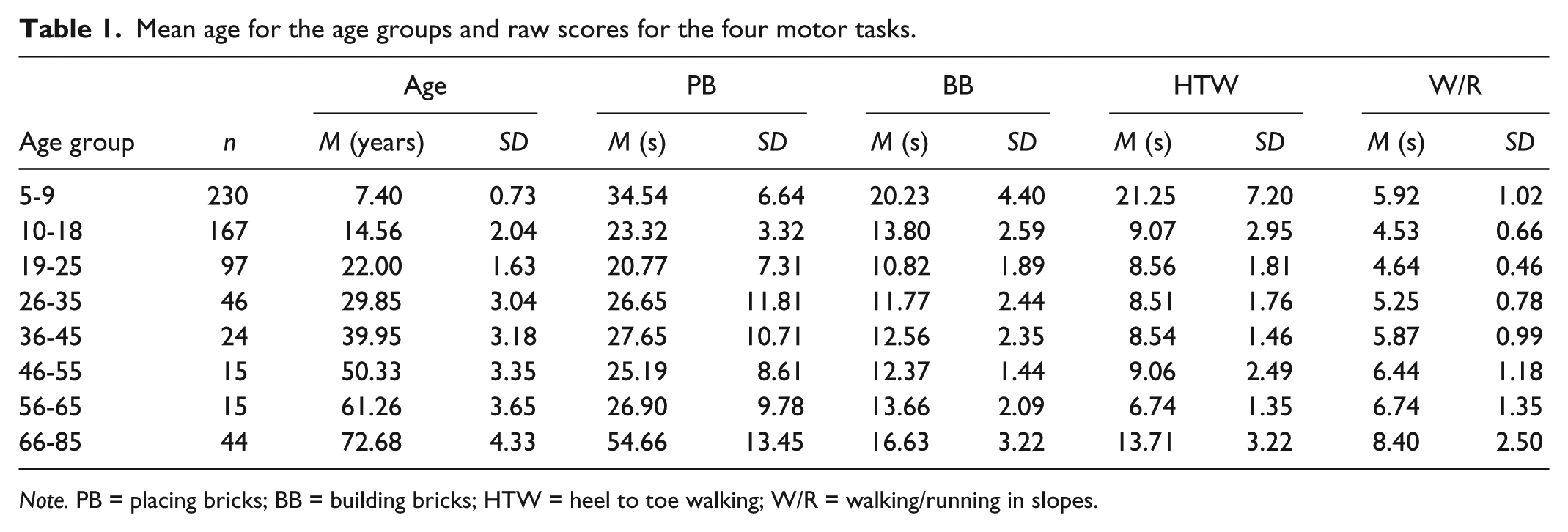
Note. PB = placing bricks; BB = building bricks; HTW = heel to toe walking; W/R = walking/running in slopes.

Changes in total test score (averages of z-scores for the four test items) with age (N = 638).
Internal Consistency
All individual test item scores (see Table 2) correlated positively with the total test score with correlations ranging from .48 to .64. Correlations between scores on individual test items were moderate to high (.31-.69). The Cronbach’s alpha value for the standardized items was .79.
Pearson Correlation Coefficients and 95% Confidence Intervals for Individual Test Item Scores* and Total Test Score and Person Coefficients for Individual Test Items.
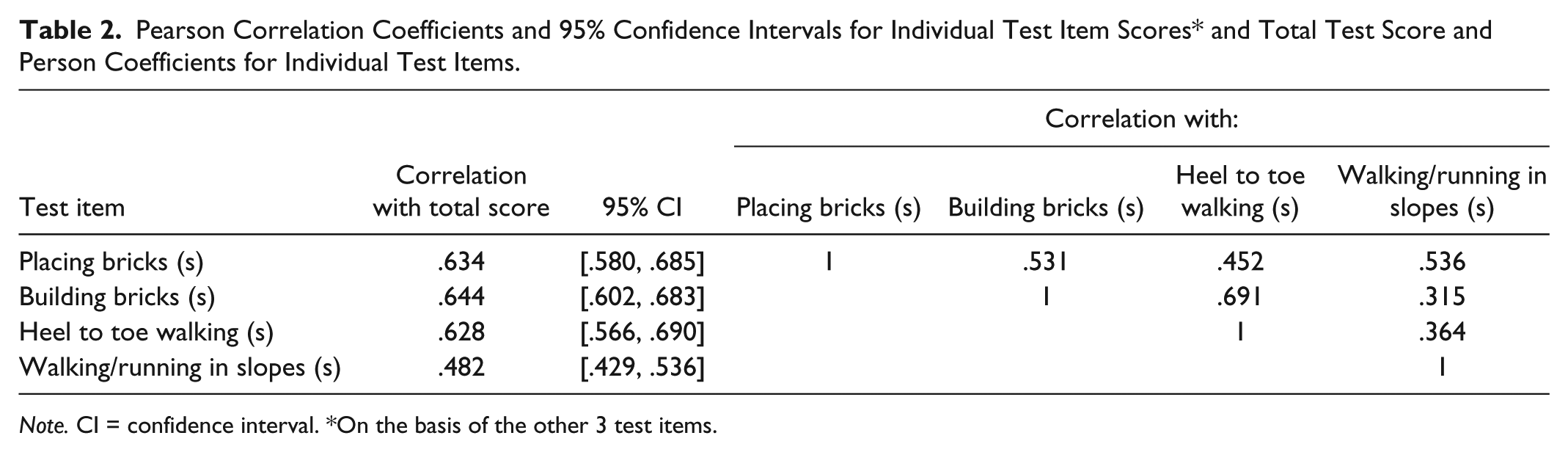
Note. CI = confidence interval. *On the basis of the other 3 test items.
Construct Validity
Pearson correlation coefficient between total score TMC and MABC were .47 for 7- to 8-years-old children (n = 70) and .45 for 15- to 16-years-old (n = 101).
Test–Retest Reliability
Table 3 shows the means and standard deviations of test and retest scores and the 95% confidence intervals for the ICCs. ICCs between test and retest scores ranged from .75 to .94 and test–retest coefficient for the total score was .87.
Means and Standard Deviations of Test and Retest Scores and 95% Confidence Intervals for ICCs.

Note. ICCs = intraclass correlation coefficients; CI = confidence interval.
Average measures.
Discussion
In this article, we have described and explored the psychometric properties of a new test battery aimed at quantifying motor competence across the life span. In the first round of testing reported in this study, the battery was administered to 638 children and adults, enabling us to investigate its feasibility, internal consistency, construct validity, and test–retest reliability.
Applicability of the Test Battery Across the Life Span
Total test scores (sum of Z-scores) increased from childhood (5-9) to young adulthood (19-25) and decreased from young adulthood (19-25) to old age (66-85). As indicated in Figure 1, this resembles a u-shaped curve between age and total test score. This finding is strikingly similar to life span curves obtained in other performance domains, for example, executive functions (Salthouse, 1996; Verhaeghen & Cerella, 2002), as well as u-shaped curves found for structural brain measures such as white matter volume (Groves et al., 2012). A life span approach within the motor domain research is sparse, albeit existing data indicate that motor performance becomes better from childhood to young adulthood (Thomas & French, 1987) and decreases into old age (Adler et al., 2002; C. D. Smith et al., 1999). These overall patterns of results suggest that the test battery for motor competence presented here is applicable for the age-span (5-83 years) studied. An important consideration in this regard is that the same tests are applied for all ages, favorable for longitudinal monitoring of motor competence.
Internal Consistency of the Test Battery
The test battery was designed with four different motor tasks that could be combined into a total score to provide an overall estimate of motor competence across the life span. It is clear that the subtasks (two fine and two gross motor tasks) only represent a limited sample of the substantial amount of possible motor tasks. However, if one considers three important aspects of the presented data, it might still be argued that the battery items provide an overall picture of fine and gross motor skills, as they both are seen as basic components of the motor competence construct (Vedul-Kjelsås, Sigmundsson, Stensdotter, & Haga, 2012). First, the sub-task correlation coefficients shown in Table 2 ranged from .31 to .69. This suggests a relatively fair homogeneity of test scores, providing a balance between shared and subtest-specific variance. In other words, the subtests were sufficiently (statistically) related, as well as un-related. Second, the individual subtest-to-total score coefficients ranged from .48 to .64. Based on these correlations, it might be argued that this property of test homogeneity suggests that all tasks appear to be measuring aspects of the same construct—that is, motor competence. A third aspect of test homogeneity was also investigated by calculating the Cronbach’s alpha. Our finding of α = .79 suggest that the test battery has at least acceptable internal consistency (Bland & Altman, 1997). However, the interpretation of this statistical index is highly debated (Sijtsma, 2009), and given that α takes into account variance associated with subjects and subject-subtest interactions, it still remains to account for some subtest-specific variance in the test battery (Cortina, 1993). This could motivate further work with the test battery, that is, by systematically examining aspects of standardization such as number of trials on specific subtests, timing, and instructions. These contentions, however, should not compromise the overall goal of the test battery in being simple to administer and applicable for large-group testing.
Construct Validity of the Test Battery
In research and clinical assessment of motor competence in children, the MABC is one of the most commonly applied test batteries (Brown & Lalor, 2009). The extensive use of MABC by clinicians and researchers worldwide has given the test battery merit (perhaps undeserved) as a “gold standard” in motor assessment of children (Venetsanou et al., 2011). Although MABC is not targeted at motor competence per se, it was applied in this study to assess an important aspect of criterion-related validity. We found that the correlation coefficient between total score from TMC and the total score from MABC to be .47 for 7- to 8-years-old children, and .45 for 15- to 16-years-old. This overall pattern of results suggests that the two test batteries total score share about one fifth of variance, which can be interpreted as moderate construct validity (Cronbach & Meehl, 1955; Lane & Brown, 2015). This is perhaps not surprising; the MABC is an example of a norm-referenced test designed to identify children who are below a specific cutoff point. The TMC, however, is an example of a criterion-referenced test which incorporates a continuum of a skill. Motor assessments such as the MABC are generally considered to be applicable for diagnosis and identification of children with motor problems, provided with the information of individual performance in relation to a representative group (e.g., children at the same age). The TMC might be complementary to such diagnostic tools, given that criterion-referenced tests can be more sensitive to interventions (Montgomery & Connolly, 1987). The moderate correlation coefficients found between total scores from the two test batteries still suggest that they capture similar aspects of motor competence. Given that the MABC is accepted as an appropriate reference standard, this lends support to the construct validity of the test battery presented in this article.
Reliability of the Test Battery
In repeated administration of the test battery to the same participants, we obtained ICC coefficients for individual subtests ranging from .75 to .94. Furthermore, the ICC for the total score was .87 (95% CI = [.68, .95]). There are some limitations worth noting: test–retest was conducted in a relatively few subjects, also this group consisted only of adult participants and not children and older people.
Like other forms of statistical indexes, there are no standard values for acceptable ICCs that can be applied in every context (Bland & Altman, 1986). For example, within-trial individual variability can be more substantial in motor tasks compared with cognitive tasks (Lövdén, Schaefer, Pohlmeyer, & Lindenberger, 2008), which suggest that reliability statistics both within and between performance domains are not necessarily comparable. Assessment of motor performances is particularly prone to substantial inter and intra-individual variability that, among other things, can display as low correlations between different motor tasks (Haga, Pedersen, & Sigmundsson, 2008; Lorås & Sigmundsson, 2012). Held against this background, we are inclined to conclude that our obtained ICCs (≥.75) suggest relatively low degree of variation in test–retest of the subtests/total score. Although this finding can be interpreted as acceptable reliability of the test battery, the relative degree of random or systematic components in the obtained variability awaits further study.
Conclusion
The presented test battery was applicable for a wide age-span (5-83) and favorable for longitudinal monitoring of motor competence throughout the whole life-course.
Moreover, based on the acceptable internal consistency of the test battery items, the TMC can be useful to give an overall picture of fine and gross motor skills, and hence, the motor competence construct. Due to the moderate correlation coefficients found between total scores from the MABC and TMC, it is possible to suggest that they capture similar aspects of motor competence, supporting the construct validity of the test battery. Findings further suggest that the subtests and the total score have acceptable reliability.
Footnotes
Acknowledgements
The authors would like to thank Arve Vorland Pedersen for always interesting discussions about testing motor skills.
Declaration of Conflicting Interests
The author(s) declared no potential conflicts of interest with respect to the research, authorship, and/or publication of this article.
Funding
The author(s) received no financial support for the research and/or authorship of this article.