




Abstract
The study was designed as a linked two-phase investigation, aiming to psychometrically develop and validate a Chinese version of the “Organizational Climate Diagnostic Instrument for Junior High Schools” (OCDI-JH) for use in Taiwan. Through extensive literature reviews, the complex phenomena of school climate were decomposed into a priori school climate construct in the first phase of the study. The data were collected from two separate samples of 287 junior high school principals/teachers/administrators for exploratory factor analysis (EFA) and 295 for confirmatory factor analysis (CFA), which were performed to scrutinize the psychometric properties of the OCDI-JH comprising 22 items clustered under five dimensions of (a) Safety (three items), (b) Academic (three items), (c) Relationships (seven items), (d) Institutional Environment (five items), and (e) Leadership (four items). Importance-Performance and Gap Analysis (IPGA) was applied in the second-phase elicitation study on 15 school faculty members to detect climate factors to be strengthened in a selected junior high school for school improvement. Focusing explicitly on contextually specific evaluation that facilitate school improvement, the OCDI-JH offers promise as a robust school climate diagnostic appraisal with practical implications for improving school effectiveness and implications for future research directions.
Keywords
Introduction
The unbridled forces of globalization, digitalization, and international competitiveness have converged to spur unprecedented challenges for school operations with the consequences of reshaping the landscape of K-12 education around the globe, including Taiwan (e.g., Hwang & Lee, 2017; B. Wei & Ou, 2019; Yang & Lin, 2015). Since 2014, the inception of 12-year basic education, alongside the policy proposal of competence-based curriculum standards implemented in 2018, has turned a new page in Taiwan’s educational history (S. F. Chen & Huang, 2017; Huang, 2016; Hwang & Lee, 2017). In the midst of a large-scale educational reform in Taiwan, there have been multifaceted challenges to sustainable educational development, including changes in educational policy/philosophy, school management, renewed curriculum guidelines, and measurements. As schools are fundamentally organizations, it necessitates the need to spark a renewed dialogue on how the changing landscape of school climate, as a collective dynamics within the current reform entity, can be re-conceptualized to reflect enduring capability of schools to cope with changes and foster a myriad of positive educational outcomes (Brand et al., 2003; L. S. Chen et al., 2012; Cohen, 2014; Lindahl, 2006).
Targeting at Taiwan students, recent studies using existing data retrieved from international large-scale assessments, such as Programme for International Student Assessment (PISA), Trends in International Mathematics and Science Study (TIMSS) and Teaching and Learning International Survey (TALIS), for cross-countries comparative analyses found that school climate, as a indirect latent variable, was positively linked to students’ achievements (Berkowitz et al., 2017; Ho, 2009; Scherer & Nilsen, 2016; Yang & Lin, 2015). Given the fact that positive school climate is a potentially important vehicle for strengthening varying aspects of organizational health and effectiveness, school climate is seldom conceptualized in studies from a indigenous as well as an evolving perspective for dealing with the accompanying issues of accountability in response to culturally contingent concerns as contrast with a generalizability approach to thinking about the construct of school climate. Hence, the study was designed as a linked two-phase investigation. The first phase of study aimed to untangling the knots of a myriad of attributes, components, and dimensions documented in the literature to develop a new and psychometrically sound “Organizational Climate Diagnostic Instrument for Junior High Schools” (OCDI-JH) in Taiwan. Armed with such a psychometric validated diagnostic appraisal, Importance-Performance and Gap Analysis (IPGA) was then applied in the second-phase investigation to assess contextually specific performance of a junior high school by the school principal, teachers, and administrators who are in a position to develop strategic plans for improving school functioning toward educational success. Research questions that guide the proposed study were as follows: (a) What are the psychometric properties of the OCDI-JH for use in Taiwan’s junior high schools? (b) How does IPGA be applied to the OCDI-JH evaluation scheme to empirically diagnose school climate performance of a junior high school in Taiwan?
Literature Review and Conceptual Framework Development
Conceptualizing Organizational Climate of Schools
Throughout the past few decades, the field of school climate research worldwide as well as in Taiwan has explicitly explored varied linkages between positive school climate and teachers’/students’ mental, physical, and emotional health and safety (Bradshaw et al., 2014; Collie et al., 2012; Kutsyuruba et al., 2015). Organization health of schools also contributes significantly to students’ self-esteem and self-concept (Shindler et al., 2016; Way et al., 2007). Likewise, a proliferation of research has elucidated the impact of positive school climate on mitigating behavioral problems of pupils, such as aggression, violence, drug use, bullying, and sexual harassment (Bear et al., 2014; Johnson, 2009; Ormerod et al., 2008).
Following the lead of industrial and organizational psychology, organizational climate of schools has been a subject of intense research for more than five decades, with many early efforts of this research stream summarized in a growing body of recent studies on the identification of specific components that make up school climate constructs (e.g., Bradshaw et al., 2014; Grazia & Molinari, 2020; Hoy et al., 1998; Tagiuri, 1988; M. T. Wang & Degol, 2016). A conclusion drawn from this large body of research is that school climate is a complex and multifold manifestation of school atmosphere for different school levels, different cultures, and one not easy to be conceptualized by means of a simple model (Demir, 2007; Shukla et al., 2019; Thapa et al., 2013).
Ever since 1963 when Halpin and Croft ushered in their study two metaphors of school personality and health categorized along a continuum from open to closed, the nature of school climate has been gradually enriched by a plethora of scholars (Hoy et al., 1998). Miles, in 1965, postulated a conceptual framework with 10 properties of school climate framed into three common domains configuring the task needs of schools in a social system, the internal state of schools’ maintenance needs, and the needs for organizational growth and development (Miles, 1969). Examples of other notable attempts to define the nature and enduring quality of organizational climate of school include theoretical underpinning of a balance between two primary dimensions of social action and social order (Stockard & Mayberry, 1992), and the authoritative discipline theory put forth by Baumrind (1996) on responsiveness (social action) and demandingness (social order), with its primary goals of enhancing social interactions, and curtailing behavior problems and promoting safety.
Another forefront stream of academic works on synthesizing critical components for school climate research were contributed by three widely noticed meta-analytic reviews (Thapa et al., 2013; M. T. Wang & Degol, 2016; Zullig et al., 2010). Entailed from reviews of a wide variety of over 200 research studies, school climate was integrated into five common domains of: (a) Safety, (b) Relationships, (c) Teaching and Learning, (d) Institutional Environment, and (e) School Improvement Process (Thapa et al., 2013). More recently, a review on school climate research by Wang and Degol (2016) identified 13 dimensions clustered under four domains of school climate: (a) academic (i.e., teaching and learning, leadership, professional development); (b) community (i.e., quality of relationships, connectedness, respect for diversity, partnerships); (c) safety (i.e., social and emotional safety, physical safety, discipline and order); and (d) institutional environment (i.e., environmental adequacy, structural organization, availability of resources). What the ever-expanding research on school climate has in common lies in their central purpose of detecting various aspects of school climate for improving organizational health and school accountability.
Instruments for Assessing School Climate
A striking feature of this line of research is the development of a wide array of robust and psychometrically sound constructs used to capture not only the perceived goodness of the psychosocial subsystems of schools but also their integrated effects on assessing the well-being and the health of their members and work effectiveness. The metaphorical framework of personality and health emanated by Halpin and Croft in 1962 gave impetus to the development of two instruments: The Organizational Climate Description Questionnaire (OCDQ) measures aspects of the openness of school climate and the Organizational Health Inventory (OHI) taps dimensions descriptive of the health functioning of school climate (Roach & Kratochwill, 2004). The popularity of OCDQ led to the development of four variations of OCDQ, namely the OCDQ-RE modified for elementary schools, the OCDQ-RM constructed for middle schools, the OCDQ-RS for secondary schools, and the OCDQ-HE for higher educational institutions (Hoy & Clover, 1986; Hoy & Hannum, 1997; Roach & Kratochwill, 2004). Similarly, the OHI was revised to measure teachers’ and administrators’ perceptions of organizational climate as it contributes to different school operations at the elementary, middle, and secondary school levels (Hoy & Clover, 1986; Hoy et al., 2002; Hoy & Hannum, 1997). Grounded on the main axis of personality/health metaphors and openness of school climate, the four versions of OCDQ and the three versions of the OHI have triggered a wide array of studies, including but not limited to interpersonal relationship, student achievement, student well-being/safety, school leadership, teacher self-efficacy, and job satisfaction (e.g., Kutsyuruba et al., 2015; Oyedeji, 2017; Pan & Wu, 2015; Pas et al., 2012; Witcher, 1993). In view that overlaps exist in conceptualizing measurement properties between OCDQ and OHI, the Organizational Climate Index (OCI) was then constructed to permit a more parsimonious framework by reducing the six aspects of the OCDQ and the six subset properties of the OHI into four general dimensions imbued with both openness and health of school climate: (a) environmental press, which was later renamed as institutional vulnerability, refers to as the extent to which the school is susceptible to the community; (b) collegial leadership looks at the openness of the leader behavior of the principal; (c) teacher professionalism means the openness of teacher–teacher interactions; and (d) academic press examines the relationship between the school and students. Iterations of openness and health climate were thus scrutinized into a unidimensional framework of the OCI (Hoy et al., 2002).
Schools, like other organizations, are not static; they evolve through changes over time. People’s experiences of school climate, such as school norms and values, managerial atmospheres, well-being needs, curriculum and instruction, student achievement, and teacher behavior, differ from culture to culture and across historical periods. As such, universal principles and axioms for determining domains of school climate might be to some extent arbitrary and idiosyncratic. Yet, there is a dearth of research on developing school climate diagnostic mechanism to gauge culturally contingent understanding of school climate with a primary aim of generating relatively important climate factors for school climate improvement plans (Thapa et al., 2013; Witcher, 1993). In preparation for challenges posed by the current nationwide educational reform, the focus of the study, thereby, is to benchmark central climate dimensions and their corresponding factors with an emphasis placed on preliminary validation of the a priori factor structure of the OCDI-JH in Chinese for use with junior high school in Taiwan. For diagnostic purpose, IPGA will be used in a contextually specific manner as a diagnostic instrument for strategic planning of school improvement.
Benchmarking a Diagnostic Framework for Assessing School Climate
To encompass insights from an evolving body of generic reviews and prevalent studies into a composite and malleable understanding of school climate properties associated with positive school improvement, the present study set out first to exploit an initial climate diagnostic framework comprising five dimensions of Safety (D1), Academic (D2), Relationships (D3), Institutional environment (D4), and Collegial leadership (D5) and 30 corresponding factors based mainly on a confluence of climate components derived from three current reviews of school climate constructs and prevalent research on school climate, as displayed in the left side of Table 2 (Bradshaw et al., 2014; Hoy et al., 2002; Thapa et al., 2013; Wang & Degol, 2016; Zullig et al., 2010). The benchmarked framework initially translated by the researchers into Chinese, together with factors’ definitions (see Online Appendix), was prepared for expert panel discussions and reviews for ensuring the translated version’s language clarity, common language use, conceptual equivalence, and content-related evidence prior to collecting data for subsequent dimensionality and factor analytic validity testing (Eremenco et al., 2005).
Impacts of School Climate on Junior High School Education
As a promising new perspective on essential factors for projecting educational performance, school climate has received much attention as a mediating variable of academic outcomes, including students’ mental, physical, and emotional health, well-being, and safety (e.g., Bradshaw et al., 2014; Collie et al., 2012; Kutsyuruba et al., 2015). With respect to junior high schools in Taiwan, a growing body of research has been carried out over the past decade on diverging effects of school climate on educational outcomes, including learning attitude, motivation, academic performance, school belongs, origination health, prevention of violent behavior, and so forth (e.g., Ho, 2009; M. S. Wang et al., 2019; M. T. Wang & Degol, 2016; H. S. Wei & Chen, 2010; Yang & Lin, 2015). As have been already investigated by studies on educational reform worldwide including Taiwan, positive school climate could be a promising mediator which affect quality assurance and improvement of junior high schools in the midst of changes (Brand et al., 2003; Cohen, 2014; Ross & Lowther, 2003; L. T. Tsai & Yang, 2015). Whereas a growing body of research has been done to measure school climate, there is a dearth of research on developing diagnostic instrument to assist school improvement in Taiwan. The current study, therefore, attempted to validate a school climate diagnostic measure from an indigenous perspective, followed by a contextually specific elicitation study to demonstrate how the diagnostic instrument be used to generate school improvement priorities for dealing with potential adverse climate impacts at the stage of Taiwan’s large-scale education reforms.
Method
Participants
The study entailed three stages of investigation involving four separate sample groups: (a) a purposeful sample of 12 expert panelists to judge and refine the benchmarked framework for practical utility in the Chinese language; (b) two independent samples used to validate the diagnostic measurement; and (c) a purposeful sample of 15 participants from a selected school for generating contextually specific school climate improvement plans by IPGA technique. Worth noting is that all samples drawn from the entire population were initially recruited from a pool of 1,002 participants who had completed separate cohorts of workshops and been certified as seed trainees by the 12-year Basic Education Seed Program organized by Taiwan’s K-12 Education Administration. For research study involving human subjects, Taiwan’s Research Ethic Committee (REC) approval was required and informed consent forms were signed by all participants.
To address language clarity and acceptability, content validity of the translated version, and attain initial consensus on the a priori framework of school climate diagnostic measurement, a homogeneous group of 12 experts consisting of five scholars in the field of educational leadership/management (of the five scholars, three were also highly proficient in both Chinese and English), four junior school principals, and three junior high school teachers/administrators from five pilot schools involved in the first cohort of the workshop were purposefully recruited to participate in expert panel discussions and reviews for language clarity and content validity. As for the baseline inclusion criteria, experts selected should be certified as seed trainees and have a minimum of 5-year experience in school leadership, administration, or teaching.
Aside from the above panelists recruited to attain initial consensus on generating a benchmarked framework, the preliminary Chinese version of the school climate diagnostic framework developed by expert panelists was evaluated further on two separate samples of participants via purposeful and snowball sampling strategies, aiming at detecting dimensionality and measurement reliability, and confirming whether the exploratively validated factor model fits the observed data.
To collect data for conducting exploratory factor analysis (EFA), 450 questionnaires were distributed to potential participants; 163 were either not returned or incomplete, yielding a valid response rate of 63.7% (N = 287). To verify the factor structure emerging from EFA, confirmatory factor analysis (CFA) was used to perform further analysis on the second sample, referred to as the CFA sample. Another 430 questionnaires were thus distributed, and 135 were not returned or incomplete, yielding an effective response rate of 68.6% (N = 295). Of the total of 880 questionnaires distributed, 582 were collected, giving a total valid response rate of 66.1%, as displayed in Table 1. The sample sizes in total and at the separate levels were considered sufficient for carrying out factor analysis (Costello & Osborne, 2005; Hoe, 2008). Only data with no missing values were included in the samples for further analysis.
Demographic Profile of Respondents.

Note. EFA = exploratory factor analysis; CFA = confirmatory factor analysis.
To perform Importance-Performance Analysis (IPA) incorporating Gap Analysis (IPGA) for a contextually specific analysis of a target junior high school, a total of 16 school faculty members were invited as participants, consisting of the school principal, four administrators, and 11 in-service teachers. Fifteen questionnaires were completed and one was not returned, yielding a total valid response rate of 94%.
Instrumentation
The Chinese version of climate diagnostic framework for junior high schools was proposed based on a confluence of a five-dimensional framework inclusive of 30 factors. With respect to the design of instrumentation, a bilingual version of the measurement was delivered to a sample of 12 expert panelists to address content validity and ensure items of the translated version were conceptually and meaningfully comprehensible by Chinese population in Taiwan. Responses were categorized into a 5-point Likert-type scale (very unimportant = 1 to very important = 5) to assess perceived importance of each items for schools’ developmental and reform needs.
After deriving the underlying climate structure and estimating how well the proposed climate model fits the observed data by factor analysis, IPGA technique was executed to understand discrepancies between perceived importance and performance of organizational climate of junior high school in Taiwan. Therefore, each respondent was also asked to rate the degree of importance (very unimportant = 1 to very important = 5) they attach to each item and perceived performance of the institution on each item (strongly disagree = 1 to strongly agree = 5).
Data Analysis
The “Data Analysis” section was broken down into four major phases. The first phase focused on thoroughly discussing, appropriately modifying, deleting, or adding dimensions and their corresponding items through expert panel discussions and reviews supervised by the researchers. The second phase involved item-level analysis followed by EFA to assess the dimensionality and measurement reliability. In the third phase, CFA was performed to test the a priori model of the school climate factor structure scrutinized by EFA. The final phase of the analysis integrated Importance-Performance Analysis (IPA) and Gap Analysis (IPGA) in an elicitation study to determine priority factors that are of more fundamental importance to the improvement of school climate in a given school context in Taiwan.
Initiated in 2009 by Lin et al., IPGA technique has been successfully applied to in many areas of social science studies, aiming at determining quality improvement plans. IPA and Gap Analysis enjoy distinct advantages which compensate each other in the process of generating strategic improvement plans. While the IPA developed by Martilla and James in 1997 assumed that performance and importance were independent attributes with linear and symmetric relations between overall performance and performance factors, the IPGA was proposed by taking into consideration attributes’ relative importance (RI) and relative performance (RP) for prioritizing areas contributing to the overall quality of improvement. Calculation procedure for attaining the IPGA grid is explained in the “Method” section. The IPGA grid is graphically presented in four separated quadrants of (I) keep up the good work, (II) concentrate here, (III) low priority, and (IV) possible overkill (M. C. Tsai & Lin, 2014; Schellinck & Brooks, 2014). The promise of IPGA has been supported by a number of educational studies in quest of generating contextually specific plans for various aspects of school improvements, such as factors considered relevant to educational-service-quality and sustainable development goals for university reforms (Chalim, 2016; Cheng et al., 2016; Weng et al., 2019). Therefore, as an elicitation study, the final phase of the analysis applied IPGA in a given school context, attempting to inform applicability of the developed measurement tool by constructing a two-dimensional matrix displayed on a grid with the diving point of (0, 1) classified into four quadrants corresponding to the average of importance and satisfaction (performance) rated by the 15 respondents (Lin et al., 2009). Procedure of IPGA leading to a graphical presentation, together with its interpretations, will be detailed below along with results of the data analysis.
Results
Quantitative data collected were analyzed using IBM SPSS 20.0 and LISREL 8.70 for Windows.
Modifications of School Climate Framework by Expert Panelists
As a result of the expert panel reviews and discussions for attaining content-related validity, the first and second dimensions termed “Safety” (D1) and “Academic” (D2) remained the same with three factors/items (hereinafter referred to as items for scale development purpose) and five items, respectively. The majority of the panelists agreed that the third dimension of “Relationships” (D3) was reduced from eight to six items to precisely conceptualize relationships between students, teachers and students, teachers and teachers, administrators and teachers, and schools and community. “Institutional integrity” (C22) clustered under the fourth dimension of “Institutional environment” (D3) was deleted for it would be too abstract to be comprehended by teachers. The fifth dimension, “Collegial Leadership” (D5), was replaced by “Leadership” (D5) for easy comprehension by people in Taiwan, categorized as a high power distance culture where people show a tendency to favor power-based and downward influence tactics of leaders (Ho, 2009). The corresponding eight items clustered under the fifth dimension of “Leadership” (D5) were either combined or revised to comprise six items. The discussions continued until no claim was made to any optimality of the a priori model school climate diagnostic framework. A modified Chinese school climate framework was formulated, comprising five dimensions and 25 climate items, as shown in the right side of Table 2.
The Initial and Modified School Climate Frameworks.

All ps < .01.
Descriptive Statistics, Item-Level Analysis, and Reliability
Item-to-total correlations were executed to determine whether the items would support an internally reliable instrument. Generally, a correlation coefficient of less than .3 suggests that the item be excluded from the scale (Nunnally, 1994; Tabachnick et al., 2007). The results of all item-to-total correlations were above the threshold value of .3, ranging from .593 to .755. Item-scale correlation coefficients should fall between .3 and .7, with a cut-off value of .4 recommended for homogeneity of the scale (de Vaus, 1996). A closer examination of the item-scale coefficients revealed that all items were significantly correlated with their intended dimensional scales (p < .01) and with greater coefficients than other scales.
The mean, standard deviation, and reliabilities of item scales were presented in Table 3. It is generally agreed that a minimum acceptable value of a Cronbach’s alpha coefficient is .7 (Nunnally & Bernstein, 1994). Across the two samples and the total sample, Cronbach’s alpha coefficients for all dimensional scales ranged from .729 to .898 (Table 2), and total reliability coefficients were above the threshold value of .7 (.838–.902), as shown in Table 3. Internal reliability coefficients for the five-dimensional construct with 25 items were therefore considered acceptable for further exploratory analysis.
Means, Standard Deviations, and Cronbach Alpha Reliability Coefficients.

Note. EFA = exploratory factor analysis; CFA = confirmatory factor analysis.
EFA
An EFA was performed to examine the latent factor structure of the school climate construct. Principal axis factoring was used to analyze the dimensionality of the variables comprising each measure. Several well-recognized criteria for the factorability of a correlation were used. First, all the 25 items correlated at least .3 with at least one other item, suggesting reasonable factorability (Hair et al., 1998; Tabachnick et al., 2007). Second, the Kaiser–Meyer–Olkin measure of sampling adequacy was 0.93, above the recommended value of 0.6, and Bartlett’s test of sphericity was significant χ2 = 4,572.258, p < .001. Finally, the communalities, ranging from 0.568 to 0.759, were all above 0.3, further confirming that each item shared some common variance with other items (Hayton et al., 2004; Kaiser & Cerny, 1979).
Principal axis factor (PAF) analyses were performed for factor extractions, and the varimax rotation with an oblique rotation was applied to derive the best factor structure and detect the cut-off point of 0.40 or greater, no cross-loading or non-loading on intended scales for item selections, and the selection criterion of no fewer than three items per dimension (Gerbing & Hamilton, 1996; Raubenheimer, 2004). Both the scree plot and eigenvalues greater than 1 suggested a five-dimensional solution for the a priori construct of organizational climate of school. Based on the aforementioned selection criteria, item 19 was estimated to be cross-loaded, item 21 was wrong-loaded across two dimensions, and item 7 was marginally loaded on a composite scale other than the intended one. The three items were therefore discarded from the benchmarked Chinese OCDI-JH. Aside from the item deletion procedure, results of the factor analysis suggested that item 8 be moved from Academic (D2) to Relationships (D3) in the proposed model. Consequently, the remaining 22 items were selected for inclusion across five composite scales of (a) Safety (three items), (b) Academic (three items), (c) Relationships (seven items), (d) Institutional Environment (five items), and (e) Leadership (four items). The five-dimension Chinese OCDI-JH with 22 items explained as high as 66.96% of the common variance in the model. Summaries of factor/item reliabilities and loadings are presented in Table 4.
Factor Reliabilities and Loadings.

CFA
To verify the factorial structures of the refined version recommended by the EFA, CFA using maximum likelihood estimation method was performed to account for possible correlation among the dimensional-level and factor/item-level components (Gerbing & Hamilton, 1996; Raubenheimer, 2004). Several goodness-of-fit indices considered acceptable for CFA studies were adopted jointly in this study to determine if the model proposed by EFA fits the data, including the ratio of chi-square to degrees of freedom (χ2/df) of less than 3 (Hair et al., 1998; Kline, 1986; Santokhie & Lipps, 2020), Joreskog and Sorbom’s goodness-of-fit index (GFI) of greater than 0.85, the adjusted goodness-of-fit index (AGFI) of greater than 0.80, root mean square error of approximation (RMSEA) of less than 0.08, and p value for test of close fit (CFit; RMSEA < 0.05) (Hooper et al., 2008; MacCallum & Hong, 1997; Marsh et al., 1988). Other indices used to verify the model fit included the standardized root mean square residual (SRMR) of less than 0.07 suggested by McDonald and Ho (2002), Bentler’s comparative fit index (CFI) of greater than 0.95 as indicative of good fit, and normed fit index (NFI) or incremental fit index (IFI) exceeds 0.95 (Hooper et al., 2008; McDonald & Ho, 2002). All data collected from the CFA sample were analyzed using LISREL 8.70 for Windows.
The exploratively scrutinized factor structure of the Chinese OCDI-JH with five dimensions and 22 items was further tested and cross-validated by means of CFA in the second sample of 295 participants. Using the maximum likelihood estimation method, the CFA led to an acceptable fit for the factor structure drawn from the previous EFA analysis. Fit indices for the model were χ2(295) = 485.54, p < .001, χ2/df = 2.38, GFI = 0.869, AGFI = 0.838, RMSEA = 0.069, p-value for test of close fit (RMSEA < 0.05) = .000, SRMR = 0.046, CFI = 0.958, NFI = 0.953, and IFI = 0.958. Therefore, by taking all the fit indices into account, it is concluded that the proposed OCDI-JH model could be regarded as satisfactory to the data in the present study. Standardized estimates of factor loading are presented in Table 5. Figure 1 depicts the factor model of the Chinese OCDI-JH with the regression coefficients of items, scales, and composite scales loading on to each dimensional factor. In conclusion, all of the model-fit indices exceeded the common acceptance levels, thus demonstrating that the model reasonably fits the empirical data.
Standardized Estimates of Factor Loading.

p < .001.
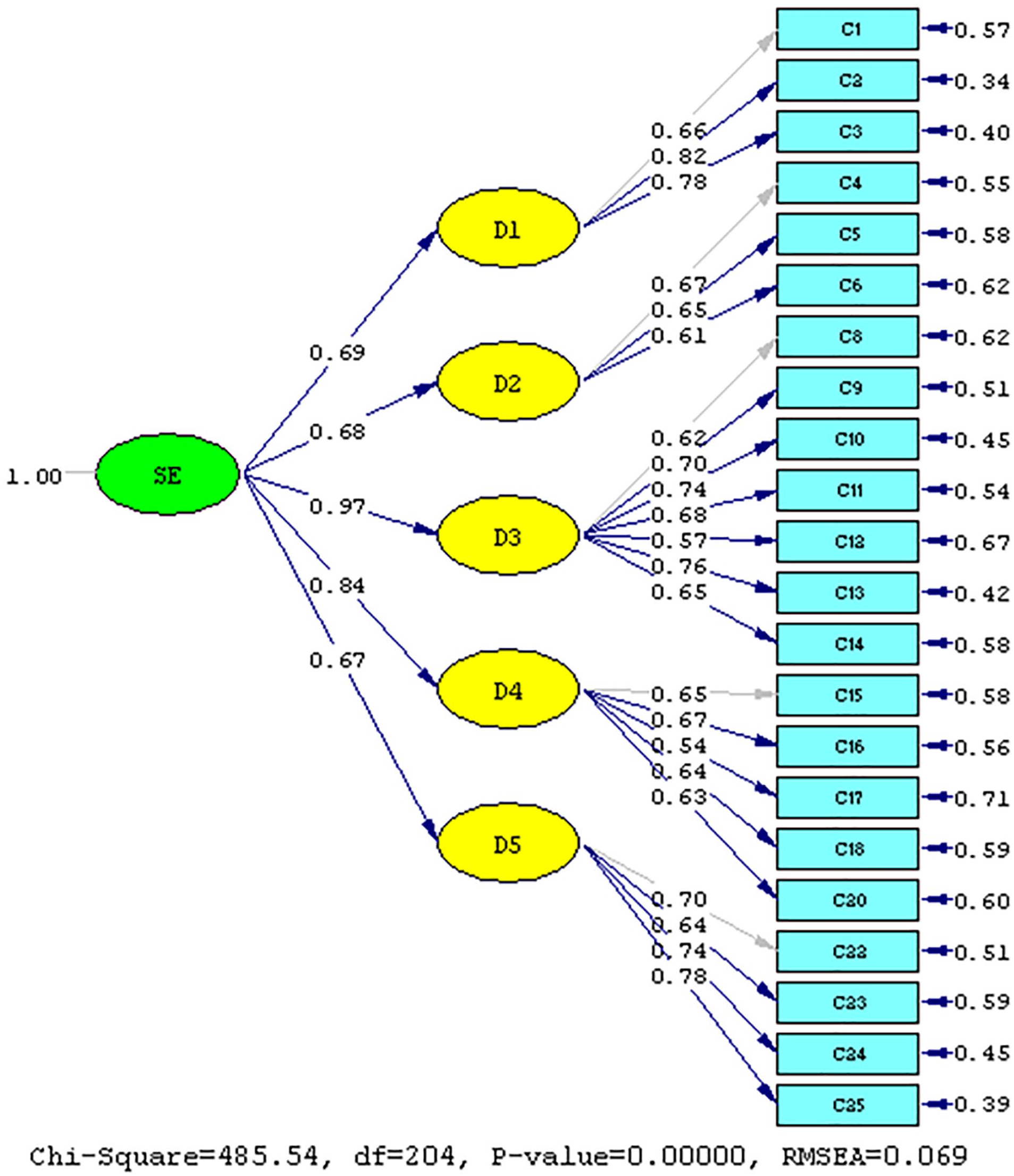
Results of structural equation model of the Chinese OCDI-JH.
An Empirical Diagnostic Study by IPGA
The procedure of IPGA in this study entails six steps, targeting at empirically demonstrating how a contextually specific climate improvement plan can be generated based on the OCDI-JH (Chalim, 2016; Weng et al., 2019):
Administering the OCDI-JH to 15 junior high school teachers who had been certified as seed lecturers affiliated with the target school to collect perceived importance and performance of the school’s climate.
Calculating the mean value of each climate item in terms of its importance
Conducting paired-sample t-tests to determine whether significant positive, negative, or nonsignificant gaps exist between the 15 participants’ perceived importance and performance of each climate items. Results of paired-sample t-tests in Table 6 revealed that there are significant differences between performance and importance in negative directions for all school climate items, suggesting that further detections of prioritized areas to concentrate may lead to effective improvement of the target school’s organizational climate (Lin & Wang, 2012).
Computing the RI and RP of individual climate items. RI is obtained by
Graphing the IPGA grid on a two-dimensional matrix, as shown in Figure 2, where each climate item is located in one of the four quadrants with (0, 1) as the intersecting point of the horizontal and vertical axes (Schellinck & Brooks, 2014; M. C. Tsai & Lin, 2014). After analysis of climate items through IPGA in the present undertaking, the results showed that 13 items were situated in quadrant II, which were perceived as priority items as factors to be concentrated for climate improvement. Among the total of 22 items, nine were situated in Quadrant III, while none in Quadrants I and IV. Items located in Quadrant II included three in the Safety dimension, three in the Academic dimension, five in the Relationships dimension, one in the Institutional Environment dimension, and one in the Leadership dimension. A graphical presentation of the IPGA grid is illustrated in Figure 2.
Identifying climate items requiring improvement and determining their priority. Thirteen climate items perceived to have high RI but low RP were located in the quadrant of “concentrate here” (Quadrant II). Estimating their priorities for improvement is critical to strengthen the holistic school climate. Based on the rational of “the larger the distance of a given item from the intersecting point (0, 1), the higher the priority for urgent improvement,” degrees of priority measured by distance

IPGA of OCDI-JH Items.

Note. OCDI-JH = Organizational Climate Diagnostic Instrument for Junior High Schools; RI = relative importance; RP = relative performance; IGPA = Importance-Performance and Gap Analysis.
**p < .05. ***p < .001.
Computation Rules of RP Values.

RP = relative performance.

IPGA grid of a contextually specific analysis.
The results of
Discussion
The inception of 12-year basic education since 2014 has turned a new page in Taiwan’s educational history. As what had been navigated in the literature, the impact of school climate on a wide array of academic, behavioral, and socio-emotional outcomes, and so forth (Cohen et al., 2009; Collie et al., 2012). Measuring, enhancing, and sustaining positive school climate is thus one of the key determinants for school changes, improvement, success, and accountability in the midst of the current large-scale educational reform (H. L. S. Chen et al., 2012; Cohen, 2014; Lindahl, 2006). At the beginning on the road to understand more about climate dynamics of junior high schools in Taiwan, the study aimed to develop a school climate diagnostic instrument with an emphasis placed on school-level analysis by school principals, teachers, and faculty for soliciting school improvement plans in responses to the current educational reform. Specific purposes of the study are summarized as follows: (a) Through extensive literature reviews, expert panel discussions, and EFA/CFA procedures, the complex dynamic phenomenon of school climate was decomposed into a Chinese version of the OCDI-JH for use with Taiwan’s junior high schools. Reliability, dimensionality, and factor analytic validity testing of psychometric properties of the instrument evidenced that the a priori factor structure comprising 22 items clustered under five dimensions measuring school climate could be regarded as a “reasonable fit” to the data in the present study. (b) To empirically test how the preliminarily validated climate diagnostic scheme be applied to diagnose organizational climate of schools, a junior high school in Taiwan was selected for contextually driven analysis, so as to showcase how OCDI-JH be used to generated improvement priorities among climate items via IPGA. The present version of OCDI-JH differs from the original construct integrating four notable measures, OHI and OCDQ for existing measure constructed in English would be to some extent arbitrary and idiosyncratic to mandarin speakers in Taiwan, a relatively high power distance and collective culture in contrast to low power distance and individualistic cultures based on Hofstede’s model of cultural differences (Leong et al., 2006). This could explain, at least from a cultural perspective, why some items (factors) were altered and discarded at the EFA and CFA phase of the analysis. One significant instance is that Participative decision-making (item 21) was deleted for it might be too aggressive to harm group harmony in a high power distance and collective culture. The current version of OCDI-JH, nonetheless, offers promise as a diagnostic instrument useful for schools in a position to engage in developing systematical strategies for improving climate toward educational success.
Practical Implications
The school climate diagnostic model structured by EFA and CFA in the first-phase investigation can be seen as a preliminarily validated instrument for diagnosing performance of organizational climate of junior high schools in Taiwan. In the elicitation study, IPGA technique was used to assess discrepancies between importance and satisfaction of a specific junior high school for contextually driven analysis. To account for peripheral reasoning featured by IPGA, the classification of climate items (factors) into four quadrants on a grid illustrated by the case of a junior high school can be used as a reference for school improvement efforts by installing limited resources and time while focusing on priority items (factors) identified by the second group of participants in the present study. Targeting at systematically examining the work and managerial atmospheres of schools for generating scenario-based climate development and improvement plans, the present undertaking intended to incorporate school administrators’ and teachers’ responses into a comprehensive climate diagnostic mechanism for generating a coherent situated understanding of school climate with a primary aim of evaluating the relative priority of climate factors considered critical to school improvement. With respect to the methodological implications, the adoption of IPGA by the present study was intended to add to the body of knowledge pointing to the prioritization of critical climate factors relevant to improving school effectiveness. The climate diagnostic mechanism silicated by IPGA, therefore, can be utilized to facilitate individual schools for effectively fostering climate improvement plans and interventions based on contextually specific diagnostic results.
Limitations and Future Directions
With regard to limitations and recommendations for future research, this study, regarded as leaning more toward an indigenous view of school climate, lent support to the notion that there is no universal definition or consensus with regard to what constitutes the best school climate measurement. It is therefore certainly not enough to confirm exploratively scrutinized construct validity for the present Chinese OCDI-JH. Future research could expand the research scope by formulating a high-leverage construct through test–retest reliability, criterion, concurrent, and convergent validities (Bannigan & Watson, 2009; Zimmerman & Mattia, 2001).
A total of 287 participants as the EFA sample and 295 as the CFA sample are considered adequate for the present undertaking on investigating psychometric performance of OCDI-JH for use in Taiwan’s junior high schools. A possible concern is that directly applying the OCDI-JH to other school levels is not appropriate. Following the steps of the accumulative developments of OCDQ, continuing efforts are needed to extend the present undertaking to kindergarten, elementary school, and senior high schools for constructing psychometrically sound diagnostic measurements for diagnosing and improving school climate at different levels of schools (Hoy & Clover, 1986; Hoy & Hannum, 1997; Roach & Kratochwill, 2004). At the present time, changing the dimensionality and factor structure in any respect for use in schools other than junior high schools is not recommended until further validation work is available from follow-on studies. Valuable from a practical perspective, the present IPGA undertaking may shed light on further investigations on how and to what extent overall quality of school climate can be enhanced through developing leadership and faculty intervention programs and training toolkits as a means to go further than the diagnostic scheme and practically extend to strategic needs for ensuring climatic improvement (Cuadra-Peralta et al., 2017; Haritha & Subrahmanyam, 2013).
Worth noting is that results yielded by the proposed IPGA approach would only be feasible to the specific case where the study sets to investigate. Generalizing the findings to other schools in Taiwan or elsewhere might not be appropriate. Further studies from a relatively more collective perspective may expand the elicitation study by comparatively evaluating schools’ organizational climate across different regions in Taiwan and highlighting priority features of climate components in need of change.
Conclusion
For the purpose of establishing a robust diagnostic instrument extracted from a plethora of literature on a school climate constructs in relation to school effectiveness and improvement, a mixed research design combining focus interviews with experts, EFA and CFA were carried out in the first-phase study to ensure the inclusion of adequate and representative sets of climate dimensions and their corresponding latent variables (factors), as well as to confirm a priori factor structure of school climate in Chinese for use with junior high schools in Taiwan. In the interest of simple modeling for practitioners, an IPGA analysis was performed to illustrate how the diagnostic instrument can be used to generate fundamental climate improvement plans for a junior high school in Taiwan. Given the fact that any synthesis of school climate construct cannot put a jigsaw puzzle together to create a holistic picture of school performance, the full extent of characteristics of learning contexts and life within schools certainly requires a fruitful further research across multiple assessment domains and scales for sustainable school development and improving student outcomes.
Supplemental Material
sj-docx-1-sgo-10.1177_2158244021989267 – Supplemental material for Developing an Organizational Climate Diagnostic Instrument for Junior High Schools in Taiwan
Supplemental material, sj-docx-1-sgo-10.1177_2158244021989267 for Developing an Organizational Climate Diagnostic Instrument for Junior High Schools in Taiwan by Hui-Wen Vivian Tang and Lynne Lee in SAGE Open
Footnotes
Declaration of Conflicting Interests
The author(s) declared no potential conflicts of interest with respect to the research, authorship, and/or publication of this article.
Funding
The author(s) disclosed receipt of the following financial support for the research, authorship, and/or publication of this article: This research was funded by a research grant from the Ministry of Science and Technology in Taiwan (MOST 106-2410-H-130-015-MY2).

Supplemental Material
Supplemental material for this article is available online.
References
Supplementary Material
Please find the following supplemental material available below.
For Open Access articles published under a Creative Commons License, all supplemental material carries the same license as the article it is associated with.
For non-Open Access articles published, all supplemental material carries a non-exclusive license, and permission requests for re-use of supplemental material or any part of supplemental material shall be sent directly to the copyright owner as specified in the copyright notice associated with the article.
