




Abstract
In this research, the importance and sustainability of one of the components of Gaining Early Awareness and Readiness for Undergraduate Programs (GEAR UP), parent involvement, was studied identifying the importance placed on parent involvement determined the programs’ capacity for sustainability. Results show parent involvement activities, which may provide the most beneficial outcome for parents and their children, are activities that include parents in the planning, decision making, and recruitment of other parents, and that parents need to be considered an important part of GEAR UP services from the beginning of program development. The importance placed on parent involvement was found to have a strong positive effect on the capacity for sustainability of partnership type programs, which draws attention to the way partnership programs are created, and programs that best meet the needs of the community are created by those in the community in which services are provided.
Comprehensive Intervention Programs (CIPs) for College Access
Calls, claims, and findings from political leaders (e.g., Obama, 2012), policy organizations (e.g., Carnevale, Smith, & Strohl, 2010), and research (e.g., Giegerich, 2006) address the need to increase enrollment in higher education institutions. Of particular focus is the attention to student populations traditionally underserved by higher education (e.g., students who are first in their family to attend college, academically underprepared, ethnic minority, or from low socioeconomic backgrounds). Efforts to increase the college going rate of these students include financial aid (e.g., grants, loans, and work study), college awareness and preparation programs, and attention to factors such as expectations and aspirations; academic ability and preparation; accurate information about college options; and support from teachers, counselors, family members, and peers. Early intervention or outreach efforts focus on eliminating higher education barriers to ensure that academically qualified individuals are not denied access. CIP is a term that was first used by Cabrera et al. (2006) to describe a comprehensive approach in providing resources for underserved students to help them prepare for higher education. Cabrera studied the specific CIP, Gaining Early Awareness and Readiness for Undergraduate Programs (GEAR UP), although the term CIP may be applied to programs such as Achievement Via Individual Determination (AVID); I Have a Dream (IHAD); Mathematics, Engineering, Science Achievement (MESA); and the initial three TRiO programs, now nine, suite of programs through the Federal Government. CIP initiatives are established by not-for-profit and governmental organizations to increase the likelihood that underserved students will successfully make the transition from high school to college.
Several researchers have investigated specific components within CIPs (Adelman, 1999, 2006; Cabrera & La Nasa, 2001; Paulsen & St. John, 2002), and others have studied additional components for possible inclusion (Fenske, Ceranios, Keller, & Moore, 1997; King, 2012; Perna, 2002; Tierney, Corwin, & Colyar, 2005; Tierney & Hagedorn, 2002). Gardner (2009) synthesized the CIP literature and empirically identified 19 CIP components that help underserved students prepare for college, one of which was parent involvement. CIP components such as parent involvement “provide access to forms of cultural and social capital that are usually unavailable to low-income students” (Cabrera et al., 2006, p. 94). The provision of access to cultural and social capital for students and their families is vital for underserved students to access higher education. Parents play a prominent role in helping their children gain access to and succeed in higher education, so that they may accomplish their educational goals.
Parent involvement is possibly the most beneficial resource for children in the classroom (Perna & Titus, 2005). However, parent involvement as a CIP component lacks empirical support. Personnel who manage parent involvement components frequently become frustrated because of the lack of participation by parents, but within the GEAR UP intervention program, the issue is compounded: Parent involvement and all other components are expected to continue beyond the time period of the grant, and the sustainability of parent involvement is unknown (Department of Education [ED], 2003). The theoretical framework for the sustainability component of our study came from the public health and health promotion literatures regarding empirical and theoretical evidence for the sustainability capacity of innovations (e.g., Goodman & Steckler, 1989; Johnson, Hays, Center, & Daley, 2004; Mancini & Marek, 2004; Scheirer, Hartling, & Hagerman, 2008; Shediac-Rizkallah & Bone, 1998).
Parent Involvement: The Problem and Potential
Parent involvement activities constitute college readiness activities involving parents, and may include the participation of parents in their children’s education at any level, as well as a variety of partnerships between the school, family, and community (Auerbach, 2012a; Hill & Taylor, 2004; Perna, 2006). In the context of our study, parent involvement is the inclusion of parents and family members in their children’s education, ultimately leading to college attendance (Perna & Titus, 2005). Recent studies have shown parent involvement is positively related to aspirations for attending college, as well as actual enrollment and academic performance leading to college success (Rowan-Kenyon, Bell, & Perna, 2008). Research also demonstrates parents from low-income backgrounds face economic, social, and psychological barriers (Hoover-Dempsey & Sandler, 1997; Rowan-Kenyon et al., 2008).
Within CIP programs focused specifically on preparing students from low socioeconomic backgrounds for college—despite recognition of parent involvement as important—program personnel have doubts about involving parents, citing parent involvement as the most difficult component to implement (Auerbach 2001, 2004; King, 2012; Perna & Titus, 2005; Swail & Perna, 2000; Tierney, 2002; Tierney & Auerbach, 2005). In their review of the literature, Tierney and Auerbach (2005) concluded parent involvement is underutilized because CIPs are underfunded, noting when prioritization of services takes place, components such as parent involvement “almost never rise to the top” (p. 45). Perna (2002) found parent involvement was the most challenging component for CIPs to develop and implement. Both Gandara and Bial’s (2001) evaluation of several CIPs, and the ED (2003) evaluation of GEAR UP, showed personnel frequently became frustrated with the lack of parent participation, which limited the implementation of parent involvement. Programs involving parents were especially limited for students from underserved populations (Gandara & Bial, 2001), the very focus of those same programs.
Rowan-Kenyon et al. (2008) observed past research has focused on the quantity of parent involvement rather than the quality, and concluded program personnel had a clear idea about how to involve parents in preparing their children for college (e.g., attendance at school or program sponsored events), but parents did not meet these expectations because of “work commitments, lack of comfort with school staff, language barriers, and conditional mistrust” (p. 583). Rowan-Kenyon et al. (2008) recommended school and program personnel give up on their preconceptions about parents, and instead find innovative ways to involve parents. Perna (2002) reported the most problematic concern for CIPs was coordinating with parents. In Perna’s study, about 25% of all programs required a parent involvement component, and approximately 75% had some form of one. The GEAR UP evaluation conducted by the ED (2003) found that “with some notable exceptions, the projects [were] experiencing difficulty engaging parents in activities” (p. 13). The evaluators found that project staff members and teachers at project schools became frustrated with the lack of parent responsiveness, and attributed poor attendance by parents to a lack of concern by the parents for their children’s educations. However, they also found parents viewed themselves as involved with and concerned about their children’s education.
Parents can have the most significant influence on student preparation for and success in college, regardless of the family’s income level, ethnicity, or the amount of education the parents may have received (Hossler, Braxton, & Coopersmith, 1989; Hossler & Gallagher, 1987; Hossler, Schmit, & Vesper, 1999; Hossler & Stage, 1992; King, 2012; Perna & Titus, 2005; Rowan-Kenyon et al., 2008). Perna and Titus (2005) concluded that “parent involvement as a form of social capital . . . [was] positively related to college enrollment regardless of the level of individual and school resources” (p. 511). Parent influence was identified as particularly influential for underserved populations, such as Hispanics and African Americans. Perna and Titus pointed out “college preparation programs, particularly those that are able to effectively involve parents, offer a promising approach” (p. 511) in addressing the needs of underserved groups.
A crucial characteristic of parent involvement is its interface with all other CIP components as parents occupy a special position in the student’s life to help the child take advantage of other services provided by a CIP. Parents are recognized as an important factor in college enrollment from the time students enter preschool to the completion of secondary education and the transition to college (Cabrera & La Nasa, 2001), as well as throughout their college pursuits (Wartman & Savage, 2008). Jun and Colyar (2002) reviewed the K-12 literature regarding parent involvement and concluded as follows: “A majority of the research indicated that students performed better and had higher levels of motivation when they were raised in homes characterized by supportive parents who were involved in schools and who encouraged and expected academic success” (p. 195). Parental influence across the socioeconomic spectrum is significant. As Rowan-Kenyon et al. (2008) concluded, policies and programs can in fact shape the educational futures of children from an early age for both low and high socioeconomic families.
Parent Involvement in Preparing for College
A role for parents in the college selection process is articulated in the college choice literature (Hossler et al., 1989; Hossler & Gallagher, 1987; Hossler et al., 1999; Hossler & Stage, 1992; Paulsen, 1990; Perna, 2006). Hossler et al. (1989), in an article considered central to understanding college choice (Cabrera & La Nasa, 2000; Griffin, del Pilar, McIntosh, & Griffin, 2012; Perna, 2002, 2006), suggested a three-stage model consisting of (a) predispositions, (b) search, and (c) choice. Hossler et al. (1999) identified five key factors in the predisposition stage that involve the family: (a) socioeconomic, (b) parent education level, (c) family residence characteristics, (d) parent support, and (e) parent encouragement. According to Hossler et al. (1999), parent support and encouragement—in the form of “frequency of discussions between parents and students about the parents’ expectations, hopes, and dreams for their children” to attend college (p. 24)—have the most influence on students attending college. In their longitudinal study, Hossler et al. (1999) interviewed 4,923 students and their parents—with a smaller subsample of students interviewed at least eight times as they made their way to higher education or the workforce—and found “parents, other family members, and to a lesser extent, peers had the largest effect on students’ college aspirations” (p. 23). They also found students who talked with their parents about their postsecondary plans were more likely planning to attend college, and were more likely certain of their plans, than students who did not talk to their parents. Parent encouragement and support were identified as important predictors of educational aspirations for students from underserved populations.
Perna (2006) developed a well-received model that describes the basis for considering the role of the school, community, and parents each influencing students in their transition to college. Perna’s model was built on the work of Hossler and Gallagher (1987) and Paulsen (1990), and framed the college decision-making process in a multi-layered context: (a) students and their families, (b) K-12 schools and community, (c) higher education institutions, (d) and the broader societal, economic, and policy context. The most important student level predictors for college enrollment identified by Perna were (a) academic preparation and achievement, (b) financial resources, (c) knowledge about college, and (d) family support. This model took into account the economic or human capital factors, as well as the cultural and sociological factors (Bourdieu & Passerson, 1977; Coleman, 1988), in explaining the way social structures and resources provide or limit access to higher education (McDonough, 1997). Rowan-Kenyon et al. (2008) indicated most relevant research regarding college access focuses on the “innermost layer of the model: the relationship between a student’s parental encouragement and involvement and the student’s college-related outcomes” (p. 566). However, the other layers, especially the second layer (Schools and Community Context), focused attention on the need for the school and community to “provide access to resources and opportunities including information about college and help with college admission requirements” (Perna, 2006, p. 118).
Parents, Schools, and Community
As stated in the findings and conclusion sections of the present article, the importance placed on parent involvement had a positive interaction with partnership type grants. Partnership grants, consisting of a partnership with school and community organizations, may facilitate the development of parent involvement activities and break down the barriers created between the parents and school. For many educators, the involvement of parents is an affront to their credibility, and though they may know the involvement of parents is important, they resist it. The conflict between the school and family is not new: Lightfoot (1978) described the conflict as two silos: parents and teachers, both curious about each other, yet they create roadblocks for the other, even excluding one another from having a positive influence.
In an attempt to assuage the sometimes contentious relationship between the home and the school, Epstein (1995; see also Epstein & Jansorm, 2004; Epstein & Lee, 1995) developed one of the more commonly used frameworks for describing and measuring parent involvement in the K-12 setting. This metric identified six types of parent involvement in which schools should encourage parents to engage as they seek to influence their children’s education. First, schools should promote parenting as the most basic form of parent involvement by providing resources for parents to learn good parenting skills, provide family support, understand child and adolescent development, and create a good learning environment in the home. Second, schools should communicate with families about school programs in a reciprocal relationship. Third, schools should participate in recruitment, training, and other activities that include parents as volunteers in the school. Fourth, schools should promote learning at home where teachers create homework assignments requiring students to ask for help from parents, and encouraging students to share what they learned in school with their families. Fifth, schools should include parents as partners in decision making, such as participation on school councils, improvement teams, committees, parent and teacher groups, or other organizations where parent input is valued. Sixth, schools should coordinate resources and services for families to engage with community organizations, such as businesses, agencies, civic organizations, or colleges and universities helping families contribute their resources to the community.
In a qualitative case study of parent involvement within CIP programs seeking to expand access to higher education for underserved populations, Auerbach (2001; see also Auerbach, 2004; Tierney & Auerbach, 2005) criticized Epstein’s (1995) framework for its singular focus on school-based activities that include parents, and for the exclusion of parent involvement activities considering the unique needs of low-income and minority families. Low-income and minority families are unlikely participants in activities directed by the school (Tierney & Auerbach, 2005). Auerbach suggested a role for parents advocating for their children’s rights, such as protecting children from discrimination, obtaining special services, resisting tracking, choosing schools, promoting family values, or establishing social networks with other families. Auerbach’s conceptualization aids in helping to conceive of a type of parent involvement that is not just a top-down approach originating at the school, where school personnel are viewed as sages with the solutions and parents are expected to listen and respond. Auerbach challenged educators to see parent involvement as involving parents in making decisions and solving problems that confront their children and the school system, and not just showing up to school-planned activities. A less criticized concept introduced by Epstein (1995; see also Epstein & Jansorm, 2004; Epstein & Lee, 1995) is making schools more home-like and homes more school-like. In family-like schools, all students, regardless of the challenges they bring, feel valued and included as members of the education community. In school-like families, students are recognized as students, and the importance of doing homework and other activities that build student skills is emphasized. Communities can create school-like opportunities for students that reinforce student learning and create family-like settings that support families and children. Epstein explained that in a true partnership, the school, family, and community work together to identify and fill gaps where learning resources for students are lacking. In a partnership, gaps in community resources are filled by family and school resources, and when the family or the school falls short, community partners make up the difference.
The successful relationship between the school, family, and community depicted by Auerbach (2012b) is from the perspective of the school leader. According to Auerbach, the motivation fueling an authentic partnership is not for the ultimate academic results of the students in the community, family, and school, but instead for reasons fueled by social justice—“it is the right thing to do” (p. 5). Auerbach (2012a) presented a continuum contrasting the perspective of leadership preventing partnerships and that of leadership for authentic partnerships between the school, family, and community characterized by (a) respectful alliances, (b) dialogue across differences, and (c) sharing of power. Auerbach (2012a) draws attention to the need for examples of successful collaborations among schools, parents, and the community from which school leaders can learn from and emulate. Hands (2012) provided a case study example of what authentic school, family, and community partnerships look like. In short, authentic partnerships “stemmed from a pragmatic understanding that community partnerships were necessary to provide students with the learning experiences and support they needed to succeed in school and beyond” (p. 187). Furthermore, the most successful partnerships “were those voluntarily established by partners rather than those established by legislation or mandates for collaboration” (p. 188).
Activities That Constitute Parent Involvement
This study presents the following hypothesis: If the parent involvement component is viewed as important and sustainable, the CIP becomes more sustainable. Gardner (2009) reviewed the literature on parent involvement intervention programs (Auerbach, 2001, 2004; ED, 2003, 2006; Perna, 2002; Plank & Jordan, 2001) and identified more than 30 specific activities intervention program administrators may choose involving parents in helping the traditionally underserved students in their programs become ready for college (McClafferty, McDonough, & Fann, 2001; Perna & Titus, 2005).
Sustainability and the Capacity for Sustainability
The connection between importance placed on a program component (e.g., parent involvement) and capacity for sustainability of the program (e.g., GEAR UP) is what our research study addresses. Sustainability means different things to different people, and it is important to define “types of sustainability” (Scheirer & Dearing, 2011; Scheirer et al., 2008). Two terms, sustainability (Shediac-Rizkallah & Bone, 1998; Pluye, Potvin, & Denis, 2004) and institutionalization (Goodman & Steckler, 1987, 1989; Goodman, McLeroy, Steckler, & Hoyle, 1993), have received the most attention relevant to making innovations last beyond the grant period or becoming a permanent part of an organization. Shediac-Rizkallah and Bone (1998) chose the term sustainability to capture the “general phenomenon of program continuation” (p. 92) on the basis of sustainability as too broad and does not “imply a static program” (p. 92), as does institutionalization and routinization, but rather a dynamic and evolving concept. Sustainability was the preferred term used by Johnson et al. (2004) and Pluye, Potvin, and Denis (2004), who built on the work of Shediac-Rizkallah and Bone to further conceptualize sustainability. Johnston et al. utilized sustainability as their “overarching construct” because they believed it was the only term “broad enough to incorporate the essential elements of the other constructs, especially institutionalization” (p. 137). Scheirer et al. (2008) and Scheirer and Denning (2011) specify four different sustainability outcomes: (a) continuing the project activities within the funded organization, (b) sustaining benefits for clients, (c) maintaining a collaborative structure, and (d) maintaining attention to the issues. Adopting the rationale of Shediac-Rizkallah and Bone (1998) in our study, sustainability is the preferred term, and is defined as “the process of ensuring . . . a sustainable innovation . . . can be integrated into ongoing operations to benefit diverse stakeholders” beyond the time period of the initial grant funding (Johnson et al., 2004, p. 137). In addition, in accordance with the Scheirer et al. (2008) framework, sustainability is also defined as “continuing the project activities within the funded organization” (p. 336). Finally, our study assesses the perceived capacity of an organization to become sustainable, similar to the work conducted by the Doughterty (2011), which utilized various facets of sustainability and measures to determine the potential for becoming sustained within the organization: The degree to which the indicators in each domain exist increases the likelihood that a project or program has the resources, skills, capacity, and knowledge necessary to sustain components over time. The stronger the existence of indicators for each of the domains, the more likely a project or program can be sustained. (p. 1)
Researchers in the fields of education (Buchanan et al., 2005) and organizational development (Foorman & Moats, 2004) have addressed sustainability, but the literature referenced in our study to frame sustainability and the Parent Involvement Component Sustainability Scale (PICSS) has come out of the public health or health promotion field (Goodman & Steckler, 1989; Johnson et al., 2004; Mancini & Marek, 2004; Shediac-Rizkallah & Bone, 1998; Scheirer et al., 2008). Our study does not rely on the conceptualizations found in organizational development, which primarily are about helping organizations innovate in their thinking rather than sustaining innovations within organizations or beyond initial grant funding. In addition, the educational innovation literature focuses on reforms within school systems, and these frameworks are less developed than those found in the public health literature. The public health conceptualizations are applicable to other areas of social science programming where sustainability is also a concern, such as in education, and are well developed through empirical and theoretical research (Goodman & Steckler, 1987; Johnson et al., 2004; Mancini & Marek, 2004; Pluye, Potvin, & Denis, 2004; Pluye, Potvin, Denis, & Pelletier, 2004; Pluye, Potvin, Denis, Pelletier, & Mannoni, 2005; Shediac-Rizkallah & Bone, 1998).
Sustainability and the capacity for sustainability is a concern in public health and education because of the considerable funds devoted to interventions and innovations across the United States and internationally to address health education issues (Johnson et al., 2004). Public- and private-funding agencies are concerned with how scarce resources are allocated, and desire their efficient use. The federal government or private organizations provide seed money or demonstration grant funds to initiate health promotion programs (e.g., Johnson et al., 2004) and expect the programs to continue beyond the time period of the grant. The grant-funded programs are not just expected to continue, they are expected to incorporate effective practices. Grant recipients are subject to the same pressures by the federal government or private-funding agencies to become sustainable and demonstrate effective outcomes, particularly in education.
Purpose
The purpose of the current study was to examine the effect of the program emphasis placed on parent involvement on the capacity for sustainability of the parent involvement component of a CIP. We hypothesized that the more importance a CIP placed on its parent involvement component, and the more parent involvement activities the CIP implemented, the greater capacity for sustainability the parent involvement component of the CIP would have.
Methods
Research Design
The design of this study was a web-based survey, specifically an online questionnaire (Dillman, 2007; Fowler, 2002) that involved a nonprobability, purposive, nonproportional, quota sampling technique. The survey captured quantitative data and open-ended responses from a cross-section of current and former GEAR UP program administrators located throughout the United States.
Population and Sample
The target population included all GEAR UP partnership grant administrators from each of the GEAR UP partnership grants (n = 418) and known local or regional entities (n = 388) within the state-awarded GEAR UP grant programs funded by the ED between 1999 and 2007. The accessible population in this study consisted of partnership grant recipients (n = 387) and local or regional entities within state grants (n = 388) for which email addresses were obtained. The final sample included 223 respondents, of which 143 (64%) were partnership grants (a response rate of 37%) and 80 (36%) were local or regional entities within state grants (a response rate of 21%). Of the respondents, 80 (35.9%) GEAR UP programs received initial funding prior to or during 2001 and 143 (64.1%) after 2001 (programs received funding for a duration of 6 years, so those funded prior to 2001 had to obtain additional funding by the time of data collection or cease operation). At the time of data collection, 184 (82.5%) of the respondents’ GEAR UP programs were still in operation.
Variables
Covariates
The covariates—status, type, and year—were entered as dichotomous variables in the multiple regression analysis to answer the research question. The program status variable was coded as a 1 if it was in operation and 0 if it was no longer in operation at the time of data collection. For the grant type covariate, programs identified as a partnership grant were coded as 1, and programs identified as a state grant with local entities were coded with a 0. The covariate, funding year, also was entered in the regression model as a dichotomous variable. To clarify funding year, if the program received initial funding from 1999 through 2001, indicating that the initial grant funding time period would have ended at the time of data collection, it was coded as 0, and if the program received initial funding from 2002 through 2007, meaning that the program was at the end of the initial grant period, it was coded as 1.
Importance of Parent Involvement variable
Nineteen total CIP components were identified by Gardner (2009) through a systematic review of the intervention literature (Cunningham, Redmond, & Meriosotis, 2003; ED, 2003, 2006; Gandara & Bial, 2001; Perna, 2002; Swail & Perna, 2002; Tierney et al., 2005). Gardner (2009) originally created a comprehensive list of 60 components, which was then reduced to 19 after eliminating overlapping items. Respondents were asked to rate the level of importance of each of the 19 CIP components (e.g., Career counseling) on a 5-point Likert scale: Please identify the IMPORTANCE of each of the following components to the GEAR UP program you specified. IMPORTANCE is the amount of time, personnel, financial, or other resources devoted to the component to help students prepare for and be successful in college. (Gardner, 2009, p. 267)
Principal components analysis (PCA) was used to further reduce the CIP components, and the Importance of Parent Involvement variable emerged as a combination of two CIP components, CIP 8-Parent Involvement and CIP 19-Volunteers are included in carrying out programs.
Parent involvement cluster variables
The parent involvement cluster variables represented the activities implemented by each GEAR UP program. Respondents’ identified whether or not 27 different parent involvement activities, identified in the literature (Auerbach, 2001, 2004; ED, 2003, 2006; McClafferty et al., 2001; Perna, 2002), were included in their parent involvement component. One example item was, “Boards, or committees include parents.” Instructions provided to respondents were as follows: The following activities may be part of the Parent Involvement component within your GEAR UP program. Please identify those activities that are currently part of your program by checking the “Yes” button next to the activity. If the activity is not part of your program, check the “No” button. If the GEAR UP program you are familiar with is no longer functioning, please identify the activities that were implemented when the program was functioning. (Gardner, 2009, p. 267)
Hierarchical cluster analysis (HCA) was then used to identify clusters that grouped the parent involvement activities together based on similarity of responses. Visual inspection of the dendrogram output resulted in five clusters that were labeled according to the content of their constituent items: (a) Concern for Parents, (b) Personalization, (c) Communication, (d) Inclusion, and (e) Services Provided. Cluster scores were calculated by summing the items, and were used as independent variables in subsequent multiple regression analysis. Cluster scores represented the number of times a type of activity was implemented within an individual program.
Capacity for the sustainability of parent involvement
The PICSS was created to measure the participant perceptions of the future capacity for sustainability for the GEAR UP parent involvement components. The development of the PICSS and its eight facets was based on a review of public health literature addressing the capacity for sustainability of public health innovations after grant funds end (Goodman & Steckler, 1987, 1989; Johnson et al., 2004; Mancini & Marek, 2004; Pluye, Potvin, & Denis, 2004; Pluye, Potvin, Denis, & Pelletier, 2004; Pluye et al., 2005; Scheirer & Denning, 2011; Scheirer et al., 2008; Shediac-Rizkallah & Bone, 1998).
The PICSS covers eight content domains with roughly equal numbers of items: planning early for sustainability, having a program champion, funding, evaluation, collaboration, community involvement, organizational structure, and professional development. Respondents completed the PICSS by identifying their level of agreement with each of its 41 items (see Table 1 for a list of item stems). Respondents selected their response from a 5-point Likert-type scale ranging from strongly disagree to strongly agree. The PICSS was scored by averaging the items. Cronbach’s alpha for the total scale was .96. A PCA was conducted on the item responses, and is reported in the Results section.
Principal Components Analysis Results of Parent Involvement Component Sustainability Scale (N = 223).
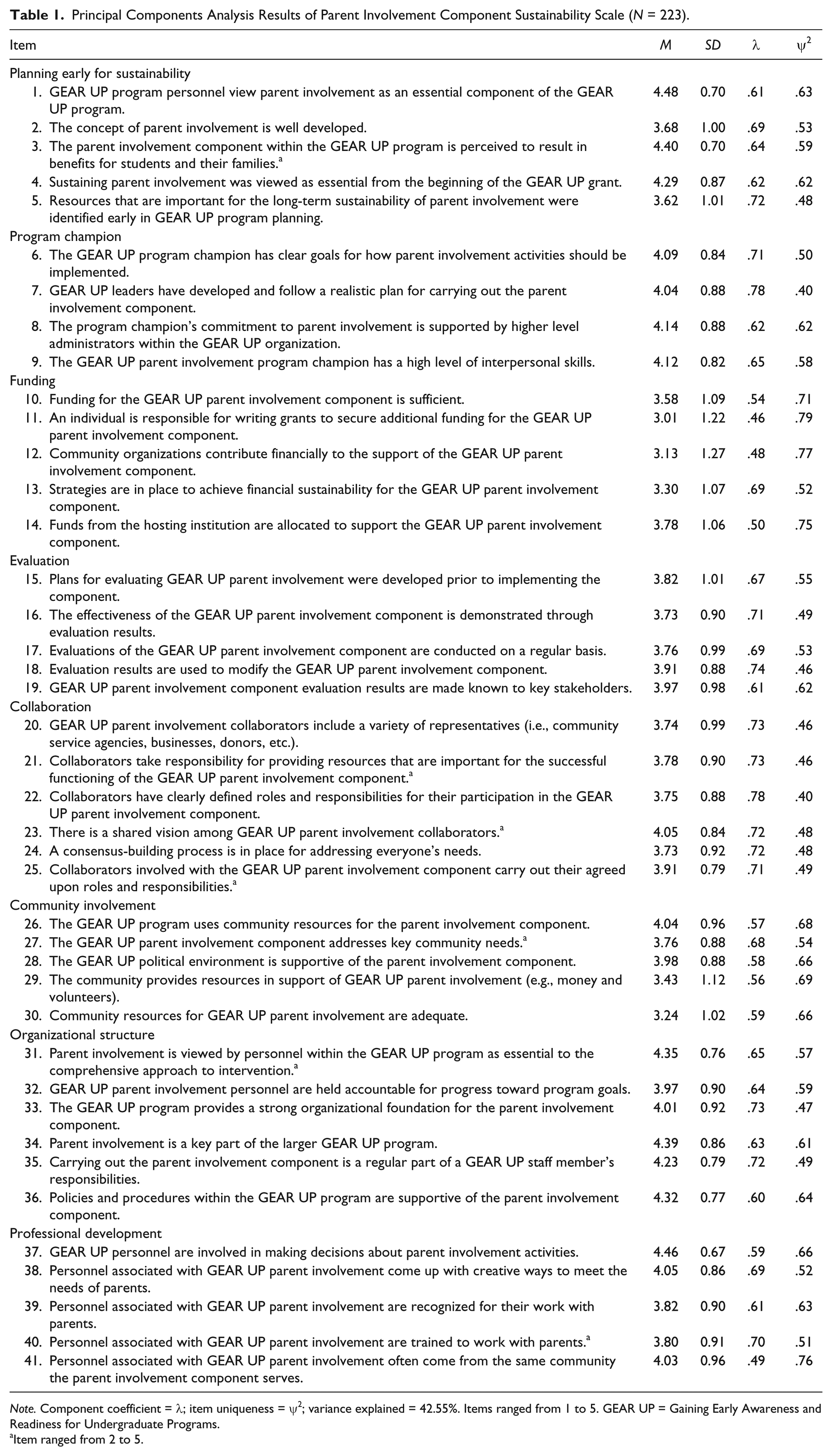
Note. Component coefficient = λ; item uniqueness = ψ2; variance explained = 42.55%. Items ranged from 1 to 5. GEAR UP = Gaining Early Awareness and Readiness for Undergraduate Programs.
Item ranged from 2 to 5.
Open-Ended Questionnaire Items
Two open-ended questions provided qualitative data analyzed for this study. The first open-ended question asked respondents to identify activities their programs implemented, but were not listed in the questionnaire. Specific parent involvement activities mentioned by respondents were grouped together based on similarity. The second open-ended question was asked to better understand what constitutes the parent involvement component within GEAR UP: “What advice do you have for other GEAR UP programs as they implement the parent involvement component?”
Results
Analytical Plan
The five parent involvement cluster variables, and the Importance of Parent Involvement variable (discussed above), represented the independent variables in a multiple regression model. The PICSS was used as the dependent variable. Covariates in the model were type, year, and status of the GEAR UP grant.
PCA
Importance of Parent Involvement variable
A PCA was conducted using the 19 CIP components (hereafter referred to as items for the sake of clarity). Preliminary diagnostics indicated that all assumptions were met for PCA, including sample-to-item ratio (about 12 to 1), appropriate magnitudes of Pearson correlations (none greater than .75), the correlation matrix determinant (.004), and the Kaiser-Meyer-Olkin (KMO) statistic (.827). The analysis was conducted in SPSS v16 using Varimax rotation and the Kaiser criterion for component extraction. Each of the 19 CIP items loaded onto 1 or more of 6 extracted components (considering only those pattern coefficients that were greater than .30), which explained 62.50% of the variance in the data. Only one item had no pattern coefficients greater than or equal to .40: Academic Skills Assessment, which has its highest pattern coefficient of .37 on Component 2 (See Table 2).
Principal Components Analysis Results of CIP Components and Correlations With the PICSS (N = 223).

Note. Boldfaced coefficients are of those items retained for that component. Varimax rotation; Kaiser criterion. CIP = comprehensive intervention program; PICSS = Parent Involvement Component Sustainability Scale; FAFSA = Free Application for Federal Student Aid.
p < .05. **p < .01.
Component 1 was interpreted to represent CIP items that help students to become aware of supplementary education and career activities implemented in conjunction with GEAR UP programs. Component 1 items included the following: After-School and Summer Jobs (CIP 2), Peer Group Counseling (CIP 9), Job Shadowing (CIP 5), and One-on-One Mentoring (CIP 7). Component 2 represented academic and financial preparation that needs to take place while in high school, so students can become eligible to take requisite college courses and have access to financial aid resources. The items loading onto Component 2 were SAT/ACT Preparation Training (CIP 12), Rigorous Course Taking/College Preparation Curriculum (CIP 11), Financial Aid (Free Application for Federal Student Aid [FAFSA]) Counseling (CIP 4), Scholarships for Participation (CIP 13), Career Counseling (CIP 1), and Academic Skills Assessment (CIP 14). Component 3 was interpreted as the out-of-school activities in which students participate to prepare for college, and included Tutoring/Homework Assistance (CIP 16) and Summer Programs (CIP 18). Component 4 includes Visits by College Representatives (CIP 17), Motivational Speakers (CIP 6), and Visits to Colleges for Tours (CIP 18), and were interpreted as visitors and visits providing inspiration/motivation to students to continue their efforts in pursuit of higher education. Component 6 included the items Professional Development for K-12 Educators (CIP 10) and Awareness of College Opportunities (CIP 3), and seemed to take into account the overall effect of educators in the school setting on students’ continuation their educations.
Component 5 accounted for an additional 8.68% of variance and contained two items, Parent Involvement (CIP 8) with a loading of .771 and Volunteers Are Included in Carrying Out Programs (CIP 19) with loading of .683. Component 5 was interpreted as parent involvement. The Importance of Parent Involvement variable was computed by summing the item scores of Component 5.
PICSS
A PCA was conducted on the 41 items of the PICSS using the Kaiser criterion for extraction. Although the KMO statistic for the data was .95, indicating superior suitability for PCA, only seven components were extracted rather than the predicted eight corresponding to the content domain coverage of the items. In addition, component coefficients with Promax rotation did not correspond to the pattern anticipated by the a priori subscales (i.e., one subscale for each content domain). Therefore, a second PCA was conducted with the specification of extracting one component. Results supported a unidimensional structure for the scale in the form of a first extracted eigenvalue (λ = 17.45) that was over seven times the size of the second (λ = 2.42), which has greater significance when one considers that over-extraction typically occurs when the cases: items ratio is 5:1 or less (223/41 ≈ 5/1). The single-component solution explained 42.55% of the variance in the items, and component coefficients ranged from .46 to .78, with communalities from .21 to .61. Component coefficients, uniquenesses, and descriptive statistics for each of the item in the PICSS are included in Table 1. These results justified treatment of the PICSS as a single score representing capacity for sustainability rather than as eight separate scores.
Preliminary Analyses
A screening of the data revealed severe skewness in several variables, including the Importance of Parent Involvement variable and four of the five parent involvement cluster variables. Because multivariate normality is an assumption of the multiple regression models intended for use in the analysis, the variables were transformed using various expressions to approximate normality (e.g., square root, natural logarithm, and inverse). Analyses were conducted with the transformed variables, and repeated with the original variables. Because the hypothesis test and effect size results were the same for both sets of analyses, we retained the results obtained with the original variables. Data screening also revealed one multivariate outlier, and similar to the treatment of nonnormal variables, we repeated analyses after dropping the case. Again, because substantive results were the same, we retained the results with the original data set and report them here.
Several preliminary comparisons were performed; the PICSS, the parent involvement cluster variables, and the Importance of Parent Involvement were compared on grant type, funding year, and funding status using independent samples t tests. PICSS score differed significantly, t(35.81) = 3.01, p < .01, .95% confidence interval (CI) = [0.1, 0.68], between programs that were (M = 3.95, SD = 0.55) and were not (M = 3.54, SD = 0.72) in operation at the time of data collection. Importance of Parent Involvement did not differ on any of the three covariates. Programs initially funded in 2001 or previous years implemented more Communication parent involvement activities (M = 3.54, SD = 0.76) than programs initially funded in 2002 or later (M = 3.20, SD = 1.08), t(209.53) = 2.75, p < .01, .95% CI = [0.10, 0.59]. The number of Communications activities implemented also differed significantly between state grants and partnerships grants, t(118.16) = 3.43, p < .01, as did the number of parent involvement activities classified as Concern for Parents, t(127.73) = 2.00, p < .05; Inclusion, t(136.39) = 2.61, p = .01; and Services Provided, t(192.47) = 3.27, p < .01; in each case, partnership grants implemented more.
Pearson correlations were also examined among the following variables: amount of parent involvement in the GEAR UP program (i.e., the five cluster variables), the importance placed on parent involvement by the program (i.e., Component 5: Importance of Parent Involvement), and the capacity for sustainability of the parent involvement aspects of the program (i.e., the PICSS). Correlations among the cluster variables were all significant and ranged in magnitude from .22 to .46, indicating varying degrees of association. Correlations among the PICSS and the cluster variables had a similar range in magnitude from weak-to-moderate (.20) to moderately strong (.43). The Importance of Parent Involvement variable had weak (e.g., .13, ns) to moderate (e.g., .30) correlations with all variables. These relationships provided evidence that the variables merited further examination in multiple regression, which would re-examine them after controlling for the covariates of program type, status, and funding year. See Table 3 for a summary of correlations, means, and standard deviations. Pearson correlations were also examined between the PICSS and each of the 19 CIP components (see Table 2). The strongest correlation was between the PICSS and CIP 8-Parental Involvement (r = .32, p < .01), which made up one half of the Parent Involvement Variable (i.e., Component 5). The other half consisted of CIP 19-Carrying Out Programs, which correlated with the PICSS moderately (r = .18, p < .01). Correlations between the PICSS and all other CIP components ranged from .02 (p = .73) to .19 (p < .01).
Means, Standard Deviations, and Bivariate Pearson Correlations of Continuous Variables (N = 223).

Note. PICSS = Parent Involvement Component Sustainability Scale.
p < .05. **p < .01. ***p < .001.
Multiple Regression Analysis
Multiple regression was used to examine the relationships among the Importance of Parent Involvement variable, the five parent involvement cluster variables, and the PICSS (see Table 4). The covariates of grant type, funding year, and funding status were used as controls in the analysis. A hierarchical-block approach was used, with the covariates entered simultaneously as Block 1, the parental involvement cluster variables as Block 2, the Importance of Parent Involvement variable as Block 3, and interactions in Block 4. A full factorial model was tested with the following interactions: Grant type × Funding year, Grant type × Program status, Funding year × Program status, and Grant type × Funding year × Program status. All assumptions, including homoscedasticity and multivariate normality, were met for the full factorial model and all subsequently reported models. In addition, all models were tested for homogeneity of slopes by testing each two-way interaction between a categorical covariate and a continuous independent variable, and all such tests but one were statistically nonsignificant. In the full factorial model, the three-way interaction of the categorical covariates was statistically nonsignificant, F(1, 208) = 0.08, p = .77, so the model was adjusted by dropping that term and testing each two-way interaction of the covariates in separate models, but none were significant. Evidence for one two-way interaction between a categorical covariate, program type, and a continuous independent variable, Importance of Parent Involvement, was obtained in the form of a significant regression coefficient (β = 1.27, p < .01), and the model containing just this one interaction was retained (see Table 4).
Hierarchical Linear Regression of PICSS Score on Categorical Covariates, Parent Involvement Cluster Variables, and Importance of Parent Involvement (N = 223).

Note. Block 2: ΔR2 = .23, F(5, 214) = 14.7***. Block 3: ΔR2 = .01, F(1, 213) = 2.84. Block 4: ΔR2 = .03, F (1, 212) = 8.36**. PICSS = Parent Involvement Component Sustainability Scale.
0 = state grant; 1 = partnership grant.
0 = initially funded before 2002; 1 = funded after 2002.
0 = no longer in operation; 1 = in operation.
p < .05. **p < .01. ***p < .001.
The retained model explained a large amount (31%) of the variance in total PICSS score, F(10, 212) = 11.15, p < .01, adj. R2 = .31. The covariates (Block 1) explained 6% of the total variance, a small-to-moderate amount, and the inclusion of the cluster variables explained an additional 23%, a large amount, which meant that the overall number of parent involvement activities implemented by a program had a strong association with the capacity for sustainability of parent involvement. Although Importance of Parent Involvement did not add a significant amount of explanatory power on its own, F(1, 213) = 2.84, p = .09, ΔR2 = .01, its interaction with program type did, F(1, 212) = 8.36, p < .01, ΔR2 = .03. Program status had a statistically significant association (β = 0.16, p = .01), as did the level of certain categories of parent involvement activities, such as Personalization (β = 0.18, p < .01), Communication (β = 0.16, p = .02), and Inclusion (β = 0.26, p < .01). Program status had a moderate relationship, in which an increase of 1.00 SD was associated with an increase of 0.16 SD in PICSS when all other variables were controlled. In other words, the difference in the capacity for sustainability of parent involvement found between extant programs and extinct programs in our preliminary t test was confirmed even after all other variables had been controlled. Programs in operation had an average PICSS score of 0.16 SD greater than programs out of operation. The regression coefficients of Personalization, Communication, and Inclusion were all small; an increase of 1.00 SD in any one of these was associated with an increase of between 0.16 and 0.26 SD in PICSS score with other variables controlled. That is, increases in any single type of the parent involvement activities of Personalization, Communication, or Inclusion were related to small increases in the capacity for sustainability of parent involvement in the program. Although an increase in a single type of parent involvement activity was related to improved capacity for sustainability somewhat, an increase in three to five types of activities together was related to substantial improvement.
Interaction
The interaction effect of Importance of Parent Involvement and program type was significant, F(1, 212) = 8.36, p < .01, R2 = .03, and explained an additional 3% of variance in PICSS score, a small amount. Figure 1 illustrates the difference in regression slopes between state grant and partnership grant programs when predicting PICSS score from Importance of Parent Involvement with all other variables controlled. The slope of the line for the state grant group is negative, but not statistically significant (B = −0.06, SE = 0.05, p = .23), and the slope of the partnership group is positive and statistically significant (B = 0.11, SE = 0.04, p < .01). These results suggest that the importance that a program places on getting parents involved is associated with an increase in the capacity for sustainability of the parent involvement component of that program, but only if the program is part of a partnership grant. No association was identified in programs funded by a state grant. This interaction effect is in addition to the unique main effects described above.

Scatterplot of the association between Importance of Parent Involvement and PICSS score moderated by program type.
Open-Ended Results
The open-ended data were analyzed by looking for emergent themes, and through using the labels of the five parent involvement clusters as preassigned codes. The analysis found 50 comments (22%) addressed Personalization (Cluster 2); 45 (20%) mentioned Communication (Cluster 3); and 61 (27%) mentioned Inclusion (Cluster 4), all variables that were found to have a small to medium effect on the PICSS.
Personalization was the second parent involvement cluster, and included three questionnaire items: (a) speaking the same language as parents, (b) providing FAFSA counseling, and (c) giving personal attention to parents’ needs. One respondent captured the personalization theme in terms of relationships with the students: “Take time trust me there is time to visit with all of these students, even after school. The main point I learned is when the students are comfortable with [the administrator] the parents are more likely to accept all invitations.”
Communication and recognizing parent’s demands as a theme represented one or more comments from 57 (26%) different respondents. This theme is characterized by GEAR UP personnel communicating information to parents through a variety of methods, such as mailings, flyers, phone calls, and home visits. This theme also represents the need for GEAR UP personnel to acknowledge parents have many demands on their schedules and desire involvement in their children’s education. One respondent captured this theme in the following words: “Ask the parents what they already know; what they want; what they need; and what they consider to be important. Then, build your programs from there.” Another comment from a respondent captures the sensitivity GEAR UP personnel should have toward parents in communication: “Be sensitive to culture, flexible scheduling, involve parents in the planning, provide training in native language.” The following comment from another respondent also captures the essence of this theme: Don’t expect parents to come to meetings or events, not because they are not interested or don’t care about their children but because of time, other conflicts, fear. Reach out to parents in other ways such as newsletters, e-mail, and college access campaigns to start building relationships. Then offer workshops and events. Some will come.
One respondent encouraged other GEAR UP administrators to “Keep the lines of communication open at all times NO MATTER WHAT YOU HAVE TO DO!”
Inclusion was the next theme identified in the open-ended responses. Parent advisory committees were mentioned by four respondents. This same structure was identified by other respondents as a “Parent Action Committee.” One respondent captured the rationale for including parents and a possible approach toward parents: “Far too often we think we know what they need. Until we bring them into the decision-making process, we will continue to provide services that are irrelevant to their immediate needs.” Parents’ views on what their children need and on parents’ help in making decisions may enrich the parent involvement component, and serve as a mechanism for increasing parent involvement itself.
Additional insight regarding the involvement of parents on boards included advisory committees led by parents, making sure the parent boards are ongoing, and giving parents responsibility for planning events and reaching out to other parents. Another respondent described the significant role for parents within the GEAR UP program: “Parents design the program and work on committees to keep the interest going. They work with staff to participate in specific opportunities that relate to their children’s education. These are ongoing committees.” The parent advisory or action committee theme was identified by other respondents who listed parent leadership, parent board of trustees, parents attending national conferences, and the training of parents.
The involvement of parents on boards and other decision-making committees and activities was included among the 27 parent involvement activities in the questionnaire, and may have adequately represented many of the respondents’ experiences. However, the detail provided by respondents about the different types of boards or committees, and the different involvement activities, further informs and enriches the practice of involving parents in productive ways.
The inclusion cluster represents the many ways GEAR UP personnel include parents’ weekend programs, instructional programs for students, advising for parents, and having parents work on committees or serve on decision-making and planning boards. Respondents’ comments encouraged getting parents talking to parents, and having parents participate in a variety of activities. One suggestion that stood out was to “pick a particular parent who is involved and use that parent to help reach other parents.” Another key point was that parents need to work with GEAR UP personnel so that everyone can recognize that they are working for the same goal.
Discussion
Our results indicate program status (i.e., whether or not the program was still extant) and the number of parent involvement activities in which programs engaged from three separate clusters or categories (Personalization, Communication, and Inclusion) had small-to-medium associations with the capacity for sustainability of the parent involvement components of CIPS, and together explained a large proportion of its variance. Although the importance programs placed on incorporating parent involvement did not have a direct relationship, it did have a significant interaction with program type (i.e., whether a program was funded with a state grant or a partnership grant). These findings are discussed below.
The regression coefficient of program status seems to indicate an association between the sustainability of parent involvement program components and the sustainability of the overall CIP itself. When all other variables are held constant, the more sustainable the parent involvement component is (i.e., the higher the PICSS score), the higher capacity for sustainability. This relationship provides evidence of consequential validity for PICSS scores.
The number of parent involvement activities a GEAR UP program implemented that were identified as Personalization had a small-to-medium relationship with PICSS score, and the category consisted of three basic activities, the fewest number of any cluster used in the analysis: (a) program personnel speak the same language as parents; (b) FAFSA counseling is provided for parents; and (c) personal attention is given to parents’ needs. Personalization seems to indicate activities in which program personnel constructively interacted with parents on an individual basis. In contrast, the seven activities identified as part of the Concern for Parents cluster seem to share the characteristic of program policies that take parent concerns into account. Two representative activities were (a) differences in parents’ ethnicity, education, and socioeconomic status are respected and (b) flexible scheduling of activities takes into account parents’ work schedules. The fact that Personalization had a significant effect and that Concern for Parents did not seems to indicate that CIPs should focus on improving individual interactions between staff and parents to increase sustainability.
Communication activities were identified as having a small-to-medium association on the PICSS, and represented GEAR UP administrators’ efforts to get information out to parents about what was taking place and how parents could become involved. In the open-ended portion of the survey, when GEAR UP administrators provided advice in the form of encouragement to keep on trying to involve parents, they often mentioned efforts to communicate to parents about what is occurring in the GEAR UP program. For example, one respondent wrote that to involve parents, “communication is the KEY. Empower parents to have a vital role in GEAR UP.” Another respondent provided advice about how to design communication in a way that grabs parents’ attention: “keep mail outs simple and on point. Parents are too busy to read lengthy literature. Something has to grab their attention right off or it is tossed or set aside.” We observed more Communication activities on average in programs funded in 2001 and prior than those funded in 2002 and after, which suggests that current CIPS should rededicate themselves to implementing this type of activity.
Inclusion activities had the largest association with the capacity for sustainability. The inclusion of parents in activities that get them highly involved in the programming, decision-making, and recruitment activities of GEAR UP enables them to increase their networks with GEAR UP personnel, educators, and others who can provide access to important resources. Perhaps the most import networking is among parents as they work together toward common goals, such as the implementation of other program components. An increase of one standard deviation in inclusion activities corresponds to an increase of over one-quarter of a standard deviation in capacity for sustainability. The open-ended data suggest administrators believe this type of involvement results in benefits for both the parents and their children. The purpose is not to increase the number of parents who are attending meetings, classes, or workshops as passive participants, but instead to help parents become involved as advocates in the education of their children, and of other children for whom access to higher education is blocked. One respondent made the connection between parent involvement and student benefits: “Parent support is one of the most important ways to help the students. Do all you can to get them involved and interested in the program, and then do even more!”
Workshops and seminars are often identified as an effective way to involve parents, but merely holding a workshop is not the best parent involvement activity (ED, 2003). Merely holding a workshop, seminar, or class for parents may not bring about positive results. Open-ended responses indicated parents’ needs were important considerations when planning and selecting topics and incentives for parent participation in workshops. One way parent workshops and classes were more effective addressing parents’ needs was the involvement of a third party specializing in classes and seminars for parents. This idea was introduced in the evaluation of the first two years of GEAR UP (ED, 2003). The present study found some GEAR UP programs had involved contractors operating under the state grants to work with parents in 9- or 10-week courses, where parents were recognized for “graduating” if they attended a certain percentage of the classes. Three respondents mentioned the organization, Parent Institute for Quality Education (PIQE), and praised the efforts of that program to help parents learn from each other how to help their children. Created in 1987, PIQE initially brought together parents in a San Diego community to talk about their poor living conditions and the poor performance of their children in school. The PIQE program grew into weekly meetings for parents and several programs throughout the State of California.
Another theme emerging from the analysis of the recommended parent involvement activities was including parents in GEAR UP planning and programming. The inclusion of parents allows parents to take part in providing services to their children and tailoring those services to meet individual needs. Including parents is a high involvement activity, giving them real responsibilities, such as participating on planning committees, being part of decision-making bodies, and reaching out to other parents to involve them in GEAR UP services.
Interaction Between Importance of Parent Involvement and Program Type
Although the importance programs placed on parent involvement had no direct association with the capacity for sustainability of their parent involvement components, one of the key findings of this research study was the interaction between program type (i.e., partnership grants vs. state grants) and the importance placed on parent involvement in the sustainability of the parent involvement program component. Specifically, the importance of parent involvement had a positive association with the PICSS score for partnership type programs, but no association with state grant programs.
When a partnership type program is applied for, the partnership must consist of one or more local education agencies, one or more degree-granting institutions of higher education, and “no less than two additional community organizations or entities such as businesses, professional organizations, state agencies” (ED, 2011, pp. 52-53). State agencies do not have the same expectations to create partnerships prior to the submission of the grant. After receiving a state type grant, it is typical that local entities resembling partnership grants are then created to provide the GEAR UP services. The creating of partnerships at a very early stage, by partnership grant recipients, may provide for stronger partnerships and services more clearly focused on meeting the needs of the local area, and these partnerships may have a stronger focus on parent involvement or better carry out parent involvement-focused services than recipients of state grants. Partnership type grants, because of their early focus on developing partnerships, are able to carry out GEAR UP services in more personalized ways and focus on the needs of the local area. We observed that partnership grants implemented more parent involvement activities on average than state grants in the areas of Concern for Parents, Communication, Inclusion, and Services Provided.
Partnership type grants funded through the GEAR UP organization, as opposed to GEAR UP state funded grants, may accurately portray the concept of overlapping spheres of influence introduced by Epstein (1995), Epstein and Jansorm (2004), and Epstein and Lee (1995) and lead to the creation of authentic partnerships discussed by Auerbach (2012a) and described by Hands (2012). This conceptualization of a partnership is where the school, family, and community work together to meet the needs of students, each filling in gaps where the others are lacking. Partnership grants funded through GEAR UP can facilitate the partnership between the school, family, and community. The early planning that takes place as GEAR UP partnership grants are prepared for submission is essential to program capacity for sustainability, and is a good example of one faucet of the PICSS, which was Planning Early for Sustainability (Goodman & Steckler, 1987; Shediac-Rizkallah & Bone, 1998; Pluye, Potvin, & Denis, 2004; Pluye et al., 2005).
Limitations
Although we believe our sample is representative of GEAR UP programs in the United States, our nonrandom sampling methodology may not guarantee it, which somewhat limits the generalizability of our results. In addition, the use of a cross-sectional design precludes the use of temporal effects as a source of support for causality. The analytical methods we use are based on correlations, which are a necessary but insufficient component of causality. Another limitation is the self-report nature of the data used, which makes the results vulnerable to social desirability bias. For example, some GEAR UP administrators may have answered survey questions in ways they perceived as more acceptable to the larger educational community. In an effort to reduce potential social desirability bias, all participants were informed through an informed consent document that “neither you nor the program you represent will be identified in the written report with the findings reported in the aggregate . . . To protect you from identification, your responses will not be analyzed, reported, or otherwise connected with your name.” An area of focus for future research is the measuring of actual or future sustainability, as this current study focused on the participant perceptions of future capacity for sustainability. Future studies can expand on our results by addressing these limitations, but with the present findings, several lessons apply to the broader CIP community.
Lessons Learned
Parent involvement within CIP’s is recognized as an important component of comprehensive intervention that helps students from underserved backgrounds, particularly for students who are the first in their family to attend college, academically underprepared, are members of an ethnic minority, or are from lower socioeconomic backgrounds. Parent involvement is not an easy component to implement (ED, 2003); however, respondents participating in this study and representing the perspectives of their GEAR UP funded programs believe parent involvement is beneficial for parents and students in ways that make the struggle to implement it worthwhile. The parent involvement activities that are recommended as a result of this study include getting parents in highly involved and engaging activities, such as planning activities for other CIP components for their children or for other parents. Parents also can participate on decision-making boards where they can give their input on the long-term direction of the program, but especially the parent involvement component. Programs should focus more on increasing positive one-on-one interactions between parents and staff and among parents. Finally, parents can recruit other parents; parents who are natural leaders can reach out to their peers and involve them in CIP-sponsored activities. By participating, parents can develop valuable networks with other parents who have not, themselves, attended college.
From a program development standpoint, the process of applying for a GEAR UP partnership grant where K-12 and higher education institutions, as well as community organizations, are working together at the early stages of implementation are a great opportunity for key stakeholders in building strong relationships, and identifying and solidifying CIP components, such as parent involvement, in helping underserved students make the transition from high school to college. Furthermore, the successful implementation of parent involvement is more likely when the schools, community, and parents are working together to identify how important components, such as parent involvement, can become sustainable beyond the time period of the grant.
We conclude that parent involvement is in fact an important component of any early intervention program seeking to help students prepare for college, and parent involvement activities providing the most beneficial outcome for parents and their children are activities including parents in the planning, decision-making, and recruitment functions of the GEAR UP program. GEAR UP services for parents should begin as soon as services are offered to students, and parents need recognition as an important part of GEAR UP services from the beginning. Planning for sustainability is an issue needing focus at the beginning of program planning, even as groups representing schools and the community work together submitting GEAR UP partnership grants, as indicated by the moderation effect of the type of program implemented on the relationship between the importance of parent involvement and the capacity for sustainability of the GEAR UP parent involvement program. The sustainability of the CIP itself seems impacted.
Footnotes
Declaration of Conflicting Interests
The author(s) declared no potential conflicts of interest with respect to the research, authorship, and/or publication of this article.
Funding
The author(s) received no financial support for the research and/or authorship of this article.