




Abstract
In two studies, participants completed measures of trait empathy and social dominance orientation, read a summary of a hit and run trial, and provided reactions to the case. In Study 1, the three randomly assigned conditions included a prompt to empathize with the victims, the empathy prompt with a mortality salience manipulation, and a control condition. Participants high in trait empathy were harsher in their judgments of the defendant than were low empathy participants, particularly after having read the mortality salience prompt. The results indicated that mortality salience had triggered personality differences. Participants high in social dominance assigned harsher sentences across conditions. Study 2 involved the same paradigm, but the prompts were presented on behalf of the defendant. Despite the pro-defendant slant, the pattern of results was similar to Study 1. Differences by trait empathy were more apparent among participants experiencing mortality salience, and social dominance was related to sentence choices. There were no indications in either study of mortality salience increasing bias against defendants in general or increasing racial bias.
Terror Management Theory
According to Terror Management Theory, people tend to react to reminders of their own mortality and existential threats by striving for self-preservation. Anxiety ensues at the thought of death, and people feel a need to buffer against that existential anxiety. One response is to cling to beliefs that give meaning to life and provide a sense of security. Reaffirming personal belief systems, including political and religious beliefs, provides some anxiety relief (Solomon, Greenberg, & Pyszczynski, 2004).
People with death anxiety, therefore, value their own cultural worldview; they value the set of beliefs that give them a sense of belonging and worth as a way of transcending existential angst. In turn, people tend to value others with similar beliefs when dealing with death anxiety. Ingroup membership provides a feeling of belonging and validates the shared worldview; as such, ingroup evaluation rises with death anxiety. “Across different countries more than 350 studies have found that reminders of mortality increase such responses as positive evaluations of those who validate the participants’ belief system and negative evaluation of those who threaten it” (Niesta, Fritsche, & Jonas, 2008, p. 49).
Terror Management Theory therefore posits that people tend to be more discriminatory toward those they perceive as different from themselves, or as violating the values of their worldview, when death is salient. When faced with the idea of their own mortality, people seek to solidify their own cultural worldview as a form of protection against feelings of anxiety and terror. Individuals reward those who validate their own belief system and reject those whom they deem to hold an opposing worldview (Greenberg, Pyszczynski, Solomon, Simon, & Breus, 1994; McGregor et al., 1998; Niesta et al., 2008; Solomon et al., 2004). Targets for rejection may include people of different races or religions as well as people who have violated the law. For example, mortality salience has been linked to legal judgments about prostitutes (Jonas et al., 2008; Rosenblatt, Greenberg, Solomon, Pyszczynski, & Lyon, 1989), jail sentencing (Greenberg, Schimel, Martens, Solomon, & Pyszczynski, 2001), hate crimes (Lieberman, Arndt, Personius, & Cook, 2001), armed robbery (Pickel & Brown, 2003), property crimes, fraud, and negligence cases (Dechesne et al., 2003; Florian & Mikulincer, 1997), among others.
However, the exact effects of mortality salience regarding legal decisions differ from study to study, as a function of the nature of the case and experimental paradigm, the values and personality traits of the perceivers, and the type of dependent measure examined. For example, Arndt, Lieberman, Cook, and Solomon (2005) reviewed a series of terror management studies involving legal judgments; an analysis of those 25 studies indicated that in approximately 70%, participants experiencing mortality salience were harsher in their judgments of criminal or civil defendants. However, those effects were sometimes mitigated by personality factors. Furthermore, in approximately 20% of the studies reviewed, mortality salience had no effect or increased leniency. Finally, 10% of the studies examined racial effects, and judgments were harsher against defendants of a different racial group as compared with ingroup members. Thus, although most of the research found greater bias against those who had violated the law in mortality salience conditions, especially if they were of another racial group, that finding was not true in all situations.
Jonas et al. (2008) argued that mortality salience increases people’s desires and proclivities to cling to their cultural worldviews and values, but that the specific values salient in a given situation differ based on what is primed in that situation. For example, Jonas, Schimel, Greenberg, and Pyszczynski (2002) found greater generosity toward personally valued charities over neutral charities among participants in a mortality salience condition. In later research, Jonas et al. (2008) demonstrated that mortality salience sometimes leads to greater altruism toward others, even outgroup members, when prosocial values are primed and the target is relevant to the prime. For example, when a prosocial norm was experimentally primed in participants, mortality salience resulted in a greater tendency to help others, especially when the altruistic targets were children (Jonas et al., 2008). Prosocial norms are particularly strong when children are involved (cf. Penner, Dovidio, Piliavin, & Schroeder, 2005). Thus, there appears to be an interaction among factors that can result in greater helping rather than greater discrimination under mortality salience conditions.
Consistent with the findings of Jonas et al. (2008), there may be cultural differences in reactions to mortality salience. For people from Western cultures, mortality salience increases adherence to an individualistic worldview, and a personal defensive stance. Thus, unless primed with prosocial norms, those from Western cultures tend to value similar others, and to show greater prejudice against different others while in a death aware state. However, people from eastern cultures hold a different type of worldview featuring a more collectivist perspective. Ma-Kellams and Blascovich (2011) demonstrated that mortality salience increased the tendency of participants from eastern cultures to defend others and to reaffirm a collective mentality.
Thus, although there are hundreds of studies supporting the role of mortality salience in increasing adherence to personal and cultural values, the outcomes of specific mortality salience conditions depends on many factors: The cultural worldview held, the specific values within that worldview that are primed at the time of response, and the relevance of the attitudinal target to the primed values.
Terror Management and Justice Disparities by Race
Racial disparities in treatment by the justice system are well-documented. “African-Americans make up 13% of the general US population, yet they constitute 28% of all arrests, 40% of all inmates held in prisons and jails, and 42% of the population on death row” (Hartney & Vuong, 2009, p. 2). Racial disparities have been documented with respect to police contacts (Crutchfield, Skinner, Haggerty, McGlynn, & Catalano, 2012), charge severity (Martin, 2014), and severity of sanctions across decision points within the criminal justice system (Stolzenberg, D’Alessio, & Eitle, 2013). See Kansal and Mauer (2005) and the report by the American Civil Liberties Union (ACLU, 2014) on Racial Disparities in Sentencing, submitted to the Inter-American Commission on Human Rights for reviews of the literature on race and sentencing.
Factors affecting racial disparities in treatment are numerous, complex, and involve both overt and subtle forms of discrimination. Under certain circumstances, mortality salience may be one of the subtle contributing factors to racial disparities in treatment within the criminal justice system. As discussed above, when manipulated in research studies, mortality salience has been shown to increase bias against criminal defendants, particularly outgroup defendants. In actual criminal proceedings, the types of cases likely to “naturally” invoke mortality salience within jurors, attorneys, and the public are cases involving death, some of which would be capital cases. Thus, cases in which death has occurred could trigger mortality salience, adding to potential racial biases in treatment.
If it were true that mortality salience increases the tendency for individuals to judge criminal defendants harshly, especially defendants from a racial group different than the perceiver, then there are some specific patterns of racial disparity that should appear. First, there should be greater racial disparity within the criminal justice system in regions where the racial composition of a jury is likely to be different than a minority defendant. There is statistical evidence that this is true. Within the United States, the states with the highest levels of racial disparity in incarceration are among those with the lowest levels of diversity within the state population. For example, we compared the 10 states with the highest levels of racial diversity and the 10 least diverse states, based on the percentage of non-White, foreign-born, and mixed race populations (Emerson, 2011). Racial disparity in incarceration in 2011 for the most diverse states was significantly less than the disparity for the homogeneous states, based on data from The Sentencing Project (2014). The mean 2011 Black:White incarceration ratio for the 10 most diverse states was 5.87:1 (SD = 2.17) and the mean ratio for the homogeneous states was 9.05:1 (SD = 2.87), t(17) = 2.70, p = .02. In comparison, the mean Black:White population ratio in the diverse states was .16:1 for 2010, and the population ratio for the homogeneous states was .05:1, based on U.S. census data. Thus, the homogeneous states have proportionally more Black individuals incarcerated even though the proportion of Blacks in the state population is lower. Furthermore, the relatively high racial disparity in prison in these homogeneous states does not appear to be due to overt racism in general within those regions. For instance, we note that most diverse states in this sample have more hate groups (M = 22.78) listed by the Southern Poverty Law Center (2014) than the least diverse states (M = 8.80).
Second, there should be significant racial disparity in treatment in cases involving death. An examination of murder cases and racial disparities in the death penalty would be informative. Sorensen and Wallace (1999) found that Black individuals accused of killing Whites were more likely to be charged with first-degree murder by prosecutors, with the possibility of the death penalty, than any other racial combination in murder cases. Furthermore, 97.5% of the chief District Attorneys making decisions about whether or not to pursue the death penalty in this time period were White in the United States; only 1.2% were African American (Pokorak, 1998). This pattern of racial disparity in charging was substantiated more recently by Baldus, Grosso, Woodworth, and Newell (2011) in their examination of military death penalty cases.
With respect to sentencing, in 2002, the Supreme Court ruled that within jurisdictions that have capital punishment, defendants have the right to have a jury decide on eligibility for a death sentence, rather than a judge alone (Ring v. Arizona). Therefore, in death penalty cases, unlike other types of cases, the jury plays a significant role in the sentencing. And in death penalty cases, the jury is likely to be in a state of mortality salience. Research indicates that racial disparity in sentencing does increase as the severity of sentences increases. Black defendants are more likely to receive the death penalty in murder cases than are White defendants, controlling for other relevant legal factors (ACLU, 2014; Baldus & Woodworth, 2004; Baldus, Woodworth, Zuckerman, Weiner, & Broffitt, 1998).
What of cases involving death that are not death penalty cases? In these cases, judges decide the sentences rather than the jury, often with state guidelines informing their decisions. In her study of over 1,000 homicide cases in Philadelphia, 98.8% of which did not involve the death penalty, Auerhahn (2007) found that while race alone did not predict sentences, it did interact with age and other characteristics to increase sentence severity.
In contrast, the literature on racial disparities in sentencing across nonhomicide cases is mixed (Mitchell, Haw, Pfeifer, & Meissner, 2005). Kramer and Steffensmeir (1993) found race to be a small factor in sentencing across cases in their review of the Pennsylvania courts. Auerhahn’s (2007) review of the literature indicates that most, but not all, studies of race and sentencing find harsher sentences for minority defendants across crime categories. Yet, data on weapons offenses do not show racial disparities in sentencing (Hartney & Vuong, 2009). Data presented by the ACLU (2014) and Hartney and Vuong (2009) indicate that racial disparities in sentencing appear to be the greatest for drug offenses.
Based on the pattern of findings cited above, mortality salience may be one of the factors affecting judgments by prosecutors, judges, and juries in death related cases, and thus merits study. Racial bias in death penalty cases is clear, for example, and racial disparity in incarceration is more common in regions which are overwhelmingly White. However, racial disparities within the criminal justice system appear to be prevalent in a wide variety of cases, not just those involving death. Thus, mortality salience is but one of many factors leading to potential biases in criminal justice cases.
Furthermore, past research has documented that the effects of mortality salience depend on situational primes and individual differences in personal values (cf. Arndt et al., 2005). If indeed mortality salience leads to a reaffirmation of personal belief systems as a way of relieving anxiety (Solomon et al., 2004), then individual value systems moderate the effect of mortality salience on judgments of others, including criminal defendants. For example, two personality traits that have been linked to judgments of criminal defendants, and which may interact with mortality salience, are empathy and social dominance orientation.
Individual Differences Affecting Perceptions of Criminal Defendants
Empathy
Empathy has been defined in various ways by different researchers. Mehrabian and Epstein (1972) discussed two types of empathy: cognitive empathy and emotional empathy. Cognitive empathy involves understanding another’s reactions and feelings, while emotional empathy is a shared emotional response to what another is experiencing. Mehrabian and Epstein designed a measure of emotional empathy, and during validation found that this measure correlated negatively with aggression toward another, and positively with altruistic behavior. People scoring high in empathy tended to be less aggressive and more helpful to others.
Similar to the definition of emotional empathy above, Hoffman (1987) has defined empathy as “an affective response more appropriate to someone else’s situation than to one’s own” (p. 48). He also discussed the role of empathy in the perception of justice. Empathy toward the victim of a perceived offense is particularly strong if a person can readily identify with the victim and the victim’s actions at the time of the crime (cf. Sundby, 2003). In addition to expressed support for such a victim, Hoffman described the development of empathic anger, a process by which environmental cues divert a perceiver’s empathic attention from a victim, and turn that attention into empathic anger at the culprit responsible for harm to the victim. Rather than focus emotion on the victim, the emotional reaction becomes focused on the offender in the situation. Within a legal case involving victim harm, therefore, empathy with the victim may be exhibited in terms of harsh judgments against a defendant.
In contrast, it is also possible to induce empathy for a defendant, depending on the type of offense and characteristics of the defendant. Such empathy should result in more lenient judgments against the defendant. These effects have been demonstrated in research by Plumm and Terrance (2009) with a simulated domestic violence trial, and with a patricide mock trial in research by Haegerich and Bottoms (2000). In both cases, manipulations of mock juror empathy affected perceptions of the defendant.
In addition, empathy has been found to interact with mortality salience in affecting perceptions of offenders. Schimel, Wohl, and Williams (2006) demonstrated that overall people are more likely to forgive an ingroup member for an aggressive act than an outgroup member when in a mortality salience condition. However, people high in trait empathy were equally likely to forgive an outgroup offender as an ingroup offender. Those low in empathy were only forgiving of the ingroup offender. Thus, there was an interaction between empathy and mortality salience in perceptions of an outgroup offender. Schimel et al. argued that to people high in empathy, exhibiting a sympathetic reaction is a value within their worldview and thus the tendency to be forgiving was heightened by mortality salience with respect to both ingroup and outgroup offenders. It is important to note that in their study, the empathic focus was on a male adult offender, the same gender and age as the person injured.
Social Dominance Orientation
Pratto, Sidanius, Stallworth, and Malle (1994) have defined social dominance orientation as “one’s degree of preference for inequality among social groups” (p. 741). Past researchers have found respondents scoring high in social dominance orientation to endorse conservative and nationalistic political ideologies (Passini & Villano, 2013; Pratto et al., 1994), existing status hierarchies and stereotypes (Tausch & Hewstone, 2010), military actions (Cohrs, Moschner, Maes, & Kielmann, 2005; Dunwoody, Plane, Trescher, & Rice, 2014; Pratto et al., 1994), and various forms of prejudice (Bäckström & Björklund, 2007; Cohrs, Kämpfe-Hargrave, & Riemann, 2012; Gatto & Dambrun, 2012; Kteily, Sidanius, & Levin, 2011; Whitley, 1999). In Pratto et al.’s work, social dominance was negatively related to support for women’s rights, social programs, and gay and lesbian rights. In addition, social dominance was found to be negatively related to empathy and tolerance (Bäckström & Björklund, 2007; Pratto et al., 1994; Sidanius et al., 2013).
In examining the interplay between social dominance orientation and mortality salience, Bassett (2010) found that participants who were high in social dominance were more negative toward illegal immigrants in a mortality salience condition, but not in a control condition. There was no main effect for mortality salience on attitudes toward illegal immigrants in Bassett’s findings, only an interaction between social dominance orientation and mortality salience on attitudes. Similarly, Crawley, Bacs, Nascimento, and Pavon (2014) found that social dominance orientation was related to racial bias in the perceived guilt of a suspect in a fictional stabbing case in a mortality salience condition, but not in a control condition.
Based on all of the research described above, it appears that mortality salience elicits anxiety and people attempt to alleviate that distress via adherence to their personal values and by embracing beliefs and others that are familiar. Individual personality traits, such as empathy and social dominance orientation, reflect those personal values and thus shape the specific effects of mortality salience. Finally, situational prompts also play a role in the form and strength with which those personal values are manifested. We designed the present research to further investigate these relationships. The focus of the present studies was on the impact of mortality salience, empathy, social dominance orientation, and race on reactions toward a criminal defendant, specifically in a hit and run case.
The target of the dependent measures in these studies was the defendant; the victims of the crime were children. Therefore, attitudes toward the defendant may be shaped in part by values evoked by reading about injured children. The case presented to participants in a trial summary was based on a real incident and part of the trial description was taken from an online news account of the actual trial to increase the realism of the experimental materials. Although some details were changed, including the names, ages, ethnicities, and location of the incident, the summary was very similar to what a person reading the news might encounter.
We designed this research to examine mortality salience in the context of an ambiguous criminal case, rather than a case in which the evidence was overwhelming. Past research has indicated that the strength of presented evidence is a significant predictor of case judgments (cf. Devine, Clayton, Dunford, Seying, & Pryce, 2001) such that biases tend to show up more in ambiguous cases. The hit and run case selected was not clear cut; the evidence was open to interpretation.
Study 1 Method
Participants
Four hundred and thirty-three adults completed an online study, 234 female, 196 males, three not indicating gender. The racial diversity in the sample by self-identification was 65.36% White, 15.70% Asian, 6.24% as Black, 7.16% as Latino/Hispanic, and 5.54% as either another racial group or multiracial. The mean age was age was 31.33 (SD = 11.86), with a range from 18 to 75. Participants were solicited via mturk and a participant pool at a public college in the northeastern United States.
Materials and Procedure
An online survey included the following components: a consent statement with a warning not to participate if the participant was at all depressed or would be discomforted by reading about a violent crime, a 33-item Empathy Scale (Mehrabian & Epstein, 1972), a 14-item Social Dominance Orientation Scale (Pratto et al., 1994), 11 items about experiences with the criminal justice system, and the presentation of a trial summary for an alleged felony hit and run case. Four dependent measures followed the trial summary, including a 6-point rating scale for defendant’s probable guilt, a 6-point scale for confidence in that verdict, six sentence choices if the defendant were found guilty ranging from 200 hours of community service, no jail time to 10 years in prison per victim (max sentence allowed), and a 6-point scale of the likelihood that the participant would forgive such a defendant. See Appendix A for a copy of the dependent measures. Finally, demographic items, a mortality salience manipulation check, and a debriefing completed the survey. The debriefing included an item asking if the participant had been familiar with the case before the study began. The study used was based on an actual case that had been adjudicated earlier in the year in the northwest, although identifying details of the case were changed. An additional change to the case was the outcome for the victims. The victims in the actual case died; however, we did not want all of our participants to be in a state of mortality salience; thus, we described the victims as injured rather than killed. In total, 35 (11.33%) of the participants answering the question had heard of the case before.
The case presented involved a 22-year-old male named Michael who had driven through a pile of leaves, not knowing that there were two children playing in the leaves. The children, one male and one female, were described as “seriously injured.” The driver heard a bump going through the leaves, but did not stop. He discovered later in the day that the children had been hit by a car, but he did not contact the police, nor did he return to the site of the crime (as required by law). The male was randomly described as an African American, Asian, Hispanic, or White, and was given one of the statistically most common surnames associated with each racial group in the United States (Washington, Wong, Rodriguez, or Anderson). The neighborhood in which this incident took place was described as having a population of the same racial identity as the defendant so that each case involved an intraracial incident.
Participants were randomly assigned to one of three versions of the prosecutor’s closing statement within the trial summary. The prosecutor ended with a request that the jury think about the fact that they themselves could be victims of a hit and run driver like the defendant (empathy condition), that they themselves could be victims of a hit and run driver like the defendant and could be killed (mortality salience condition), or no such request was included (control condition).
Design
The study was a 3 (mortality salience, empathy, or control) × 4 (race of defendant) factorial design, with the additional personality variables of empathy and social dominance orientation. Participant race and gender were also included in analyses. The dependent variables included rating of guilt, confidence in verdict rating, sentence choice, and rating of likely forgiveness.
Study 1 Results
Correlations Among Measures
There were significant correlations among the personality scores and dependent measures. For example, social dominance orientation was negatively correlated with empathy, r(431) = −.43, p < .001. Guilt rating was negatively related to the likelihood of forgiveness, r(430) = −.20, p < .001, and positively related to confidence, r(430) = .33, p < .001. In addition, participant age correlated with guilt rating, forgiveness, and confidence as presented in Table 1.
Correlations Among Personality Scores and Dependent Variables in Study 1.
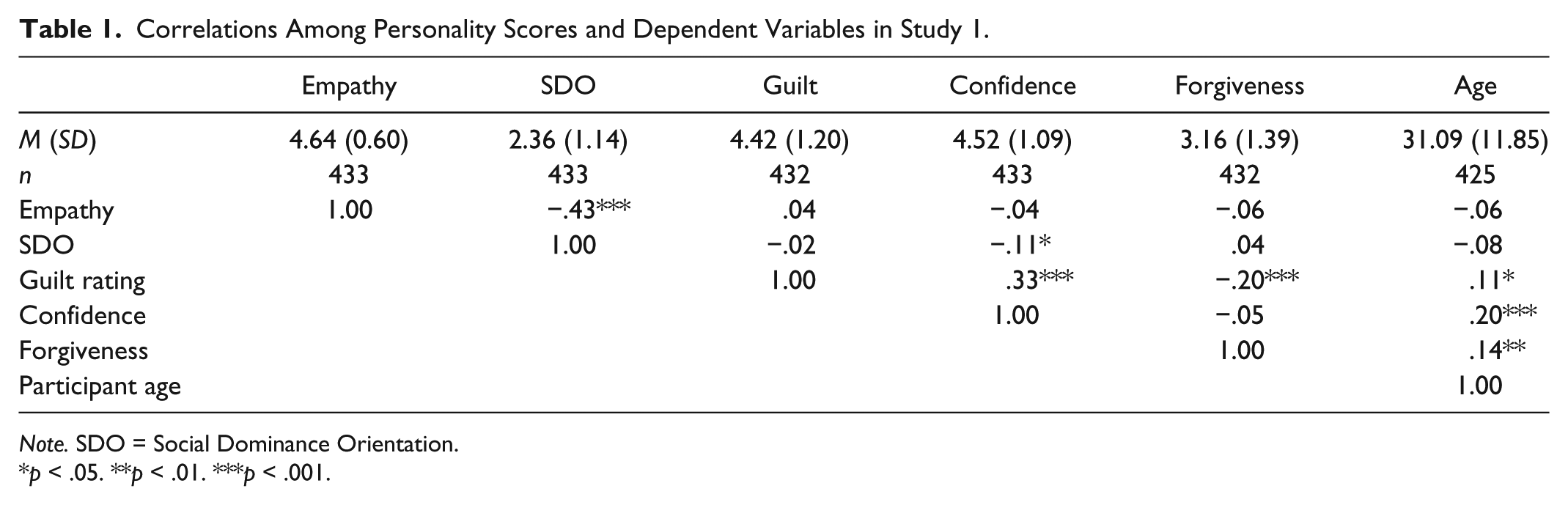
Note. SDO = Social Dominance Orientation.
p < .05. **p < .01. ***p < .001.
Manipulation Check
At the end of the survey, participants were asked whether or not they thought about their own possible deaths while completing the dependent measures. The response options were “yes,” “slightly but not much,” or “not at all.” These three responses were not significantly correlated with the manipulation of mortality salience within the trial summary, χ2(4, N = 399) = 6.12, p = .19. Although more participants reported thinking of death in the mortality salience condition than in the other two conditions, the difference did not reach significance, even when combining the “slightly but not much” and the “not at all” respondents together, χ2(2, N = 399) = 5.32, p = .07. Therefore, the analyses involving mortality salience were done using self-reported thoughts of death as an indication of the presence of mortality salience.
Familiarity With the Case
The dependent variables were analyzed to determine whether familiarity with the actual case before the study affected outcomes for those participants who answered this question. Although the sample sizes are very different, there were no significant differences between those who had heard of the case (n = 35) and those who reported they had not (n = 274) in the ratings of guilt (p = .41), confidence (p = .83), or sentence (p = .45). However, those familiar with the case were more likely to forgive the defendant (M = 3.11, SD = 1.17) than those unfamiliar with the case (M = 3.76, SD = 1.43), t(306) = 2.61, p < .01. We note that the parents of the victims in the real case did forgive the defendant.
Gender Differences
Gender differences appeared for empathy scores, t(428) = 6.29, p < .0001, and for social dominance orientation, t(428) = 4.29, p < .0001. Females scored higher in empathy (M = 4.82, SD = .59) than males (M = 4.43, SD = .56); males scored higher in social dominance orientation (M = 2.62, SD = 1.24) than did females (M = 2.15, SD = 1.01). We found no significant gender differences for the dependent variables.
Race of the defendant
There were no main effects by the race of the defendant on any of the dependent variables (p = .61 for guilt, p = .99 for confidence, p = .30 for type of sentence, and p = .33 for forgiveness).
Hypotheses
Given the correlations among the dependent measures, we performed a principal components analysis for the evaluative dependent variables of guilt, forgiveness, and sentence severity. This analysis resulted in a single component with an eigenvalue of 1.50, accounting for 49.84% of the variance. Therefore, we created a composite dependent variable as a measure of overall harshness toward the defendant consisting of the sum of the guilt rating, the forgiveness rating, and a rating (1-6) for the severity of the specific sentence chosen. For each variable, the higher score indicated the harshest judgment of the defendant. The lowest possible score on the composite was a 3, indicating leniency toward the defendant, and the highest was an 18, indicating a very harsh reaction to the defendant. This composite score was the primary dependent variable used in the analyses.
For most of the following analyses, we used a MANOVA to examine the effects of self-reported mortality salience, defendant race, empathy, and social dominance orientation on the composite measure and the rating of confidence. The self-reported responses of mortality salience of “slightly, but not much” and “no” were combined for the analyses.
H1 and H2: Mortality salience
There were no significant main effects of mortality salience on the composite measure of harshness (p = .84) or on ratings of confidence in judgment (p = .30). These results indicated no bias against the defendant due to mortality salience.
In addition, there were no interactions between defendant race and mortality salience for the composite score (p = .84) or confidence (p = .46). We also did these analyses using only the White participants to examine same race/other race judgments with a sufficient sample size and found no significant effects by mortality salience and defendant race. The first two hypotheses were not supported by these data.
H3: Empathy and mortality salience
The mean empathy score was 4.64 (SD = .60); participants with scores below the mean were categorized as low in empathy (n = 227) and those above the mean as high in empathy (n = 205). Respondents high in empathy had higher composite scores (M = 11.30, SD = 2.73), indicating harsher overall judgment of the defendant, than did participants low in empathy (M = 10.59, SD = 2.62), F(1, 361) = 3.70, p = .05, η2 = .01. High empathy participants appeared to empathize with the victims more than did low empathy participants, supporting H3. There was no significant two-way interaction between trait empathy and self-reported mortality salience on the composite measure (p = .28). However, there was an interaction between trait empathy and mortality salience experience for confidence in judgment, F(1, 361) = 5.12, p = .02, η2 = .01. An examination of the simple effects in post hoc comparisons indicated that high empathy participants experiencing mortality salience were significantly more confident (M = 4.88, SD = 1.03) than low empathy participants experiencing mortality salience (M = 4.43, SD = .91), albeit only at the .05 level. There was no difference between high empathy (M = 4.40, SD = 1.21) and low empathy (M = 4.61, SD = 1.03) participants without mortality salience. Differences in confidence by empathy category only appeared when mortality salience was also present.
In a separate analysis, we also examined the effect of trait empathy on each of the individual dependent measures as a function of the empathy prompts embedded in the experimental texts. The three experimental conditions involved trial descriptions with no-prompt, an empathy-only prompt, or an empathy with mortality salience prompt. In this analysis, similar to the results above, respondents high in trait empathy were slightly more likely to find guilt (M = 4.56, SD = 1.18) than participants low in empathy (M = 4.28, SD = 1.24), F(1, 414) = 3.41, p = .07, η2 = .01 as a main effect. However, the difference in guilt ratings by trait empathy level occurred primarily in interaction with the mortality salience prompt condition, F(2, 414) = 2.98, p = .05, η2 = .01. An examination of the simple effects in post hoc comparisons indicated that high empathy participants in the mortality salience prompt condition were significantly more likely to rate the defendant guilty (M = 4.64, SD = 1.05) than low empathy participants in that condition (M = 4.04, SD = 1.27), t(153) = 3.09, p = .002. There were no difference between high empathy and low empathy participants in the other conditions (see Figure 1). Thus, neither the control condition nor the empathy-only prompt condition seemed to cause a difference in judgment by trait empathy. Only the mortality salience prompt yielded such a result.
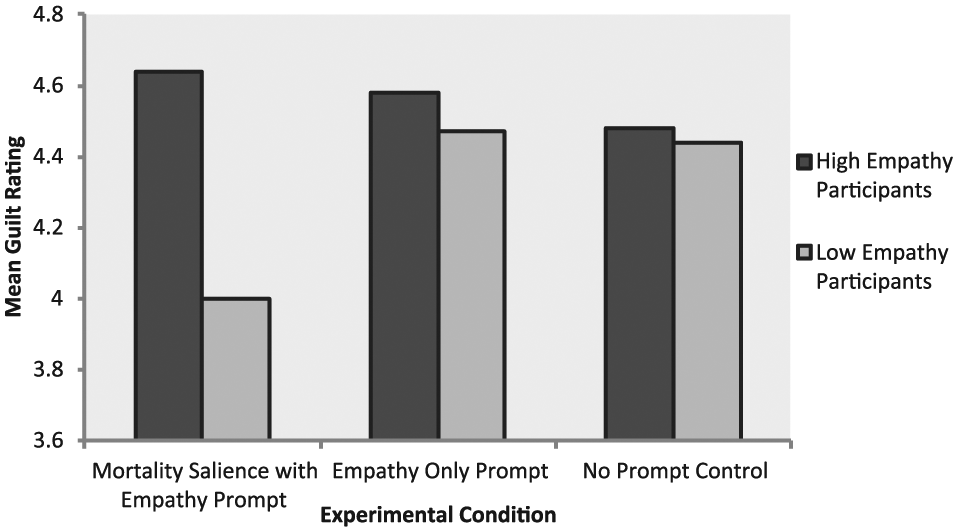
Mean ratings of defendant guilt by personal empathy level and mortality salience condition in Study 1. Higher scores indicate greater perception of guilt. Differences in ratings by personal empathy level were found only in the mortality salience condition, p = .05.
H4: Social dominance orientation
Participants were categorized as high in social dominance orientation (n = 193) if their score was above the sample mean of 2.36 (SD = 1.14) and low in social dominance orientation (n = 240) if below the mean. Although there were no significant main effects of social dominance orientation on the composite measure (p = .87) or confidence (p = .07), high social dominance participants were more likely to select a jail sentence for the defendant, χ2(1, N = 423) = 4.10, p = .04 than participants low in social dominance (see Figure 2).

Frequency of sentences with and without a jail term selected as a function of participants’ social dominance level in Study 1, p = .04.
Finally, a significant three-way interaction was found between self-reported mortality salience, social dominance, and empathy for the composite measure, F(1, 361) = 9.85, p = .002, η2 = .03. There was a significant interaction between empathy and social dominance for the composite score only for participants self-reporting mortality salience, F(1, 95) = 8.16, p = .005, η2 = .08). As shown in Figure 3, when experiencing mortality salience, participants low in social dominance were harsh in their judgments of the defendant when high in empathy (M = 12.49, SD = 2.40) and lenient (M = 9.06, SD = 2.98) when low in empathy. In contrast, participants high in social dominance demonstrated the opposite pattern: harsher when low in empathy (M = 11.65, SD = 2.70) and more lenient when high in empathy (composite M = 10.42, SD = 2.41). For those participants not experiencing mortality salience, there were no differences by personality (see Figure 4). These results support H3 and H4.
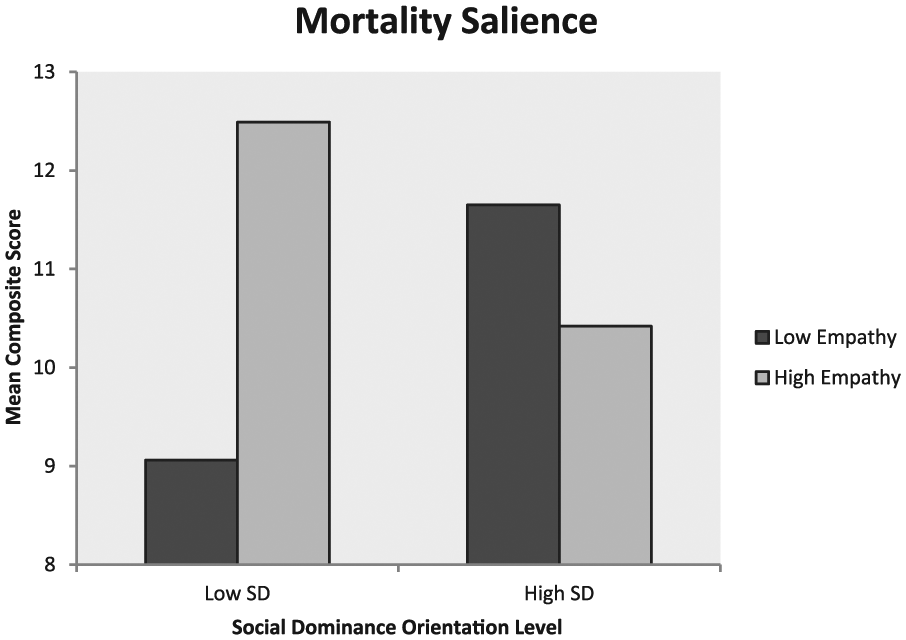
Mean composite scores by personal empathy level and social dominance among participants experiencing mortality salience in Study 1. Higher scores indicate harsher judgments of the defendant. A significant interaction between the personality variables was present for participants who reported mortality salience, p = .003.
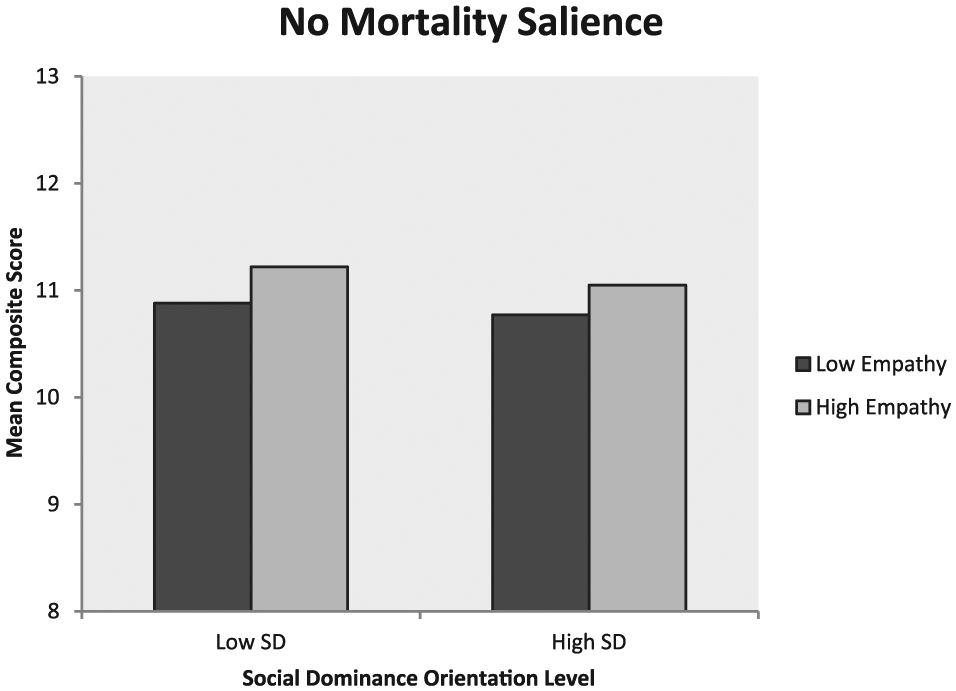
Mean composite scores by personal empathy level and social dominance among participants who did not report experiencing mortality salience in Study 1. There were no differences in judgments of the defendant by personality for participants not experiencing mortality salience.
Discussion
There was no indication of mortality salience increasing bias against defendants in general or increasing bias against defendants of a different racial group as some past research on terror management theory might suggest. However, results did indicate that mortality salience, empathy and social dominance orientation were all related in some way to the participants’ reactions to the events described in this hit and run trial summary.
Schimel et al. (2006) also found an interaction between empathy and mortality salience in their research, with differences by trait empathy appearing in the mortality salience condition. In their research, the ingroup and outgroup offenders and victims were all adults, and high empathy participants did not exhibit bias against outgroup offenders under mortality salience conditions. Low empathy participants showed such bias in all conditions. In the present study, empathy was directed toward the child victims by high empathy participants, not for the offender. If anything, high empathy participants exhibited empathic anger against the defendant in this case. Overall, children as victims appeared to prime prosocial values for high empathy participants, consistent with the findings of Jonas et al. (2008). However, the effects were moderated by social dominance and mortality salience experience. In effect, mortality salience triggered personality differences in reactions to the victims and defendant.
In Study 1, the wording and presentation of the empathy prompt and mortality salience prompt pushed for empathy toward the child victims. In addition, the prompts appeared toward the end of the trial descriptions and thus were among the last things the participants in those conditions read before completing the dependent measures. It was not entirely clear, therefore, whether the child victims would have primed prosocial values in high empathy participants absent those specific prompts. We also were concerned that the results involving trait empathy, social dominance, and mortality salience might be due in part to the specific wording and placement of the prompts because most of the participants self-reporting mortality salience (73.74%) were in one of the prompt conditions. Therefore, we designed Study 2 to investigate whether mortality salience, empathy, and social dominance would affect perceptions of a hit and run case in similar patterns if the prompts appeared earlier and were in favor of the defendant, rather than on behalf of the victims.
Study 2 Method
Participants
At total of 159 adults completed an online study, 75 female and 84 male. The sample was 67.30% White, 13.21% Asian, 6.92% Black, and 6.29% Latino/Hispanic, with 5.66% self-identifying as another racial group or multiracial. The mean age was 33.41 (SD = 9.83), with a range from 19 to 68. Participants were solicited via mturk.
Materials and Procedure
The same design and materials from Study 1 were used. However, there were only two levels of defendant racial identity, Hispanic or White. Moreover, the three experimental conditions involved versions of the defense attorney’s summation, rather than the prosecution. The defense ended the closing statement with a request that the jury think about the fact that they themselves make mistakes as drivers (empathy condition), that they themselves make mistakes as drivers and possibly could even be killed in an accident while driving (mortality salience condition), or no such request was included (control condition). The additional statements in the defense summation were approximately equal in length to the comparable statements in the prosecutor’s summation in Study 1. In this sample, 18 (11.30%) of the participants had heard of the case before (see Appendix B).
Design
The study was a 3 (mortality salience, empathy, or control) × 2 (race of defendant) factorial design, with the additional personality variables of empathy and social dominance orientation. The dependent variables included ratings of guilt, confidence in verdict, sentence choice, and ratings of forgiveness. Sentence choice was measured in two ways. In addition to selecting one of the six specific sentence choices as in Study 1, respondents also selected a general category of sentence from a 3-choice item: “no jail,” “a brief jail term,” or “a long jail term.”
Study 2 Results
Correlations Among Measures
Similar to the results of Study 1, social dominance orientation was negatively correlated with empathy scores, r(157) = −.57, p < .001 and confidence, r(157) = −.22, p < .01. In addition, guilt ratings were related to confidence, r(157) = .35, p < .001, and forgiveness, r(156) = −.35, p < .001. Finally, participant age was related to empathy, social dominance orientation, guilt rating, and confidence as presented in Table 2.
Correlations Among Personality Scores and Dependent Variables in Study 2.
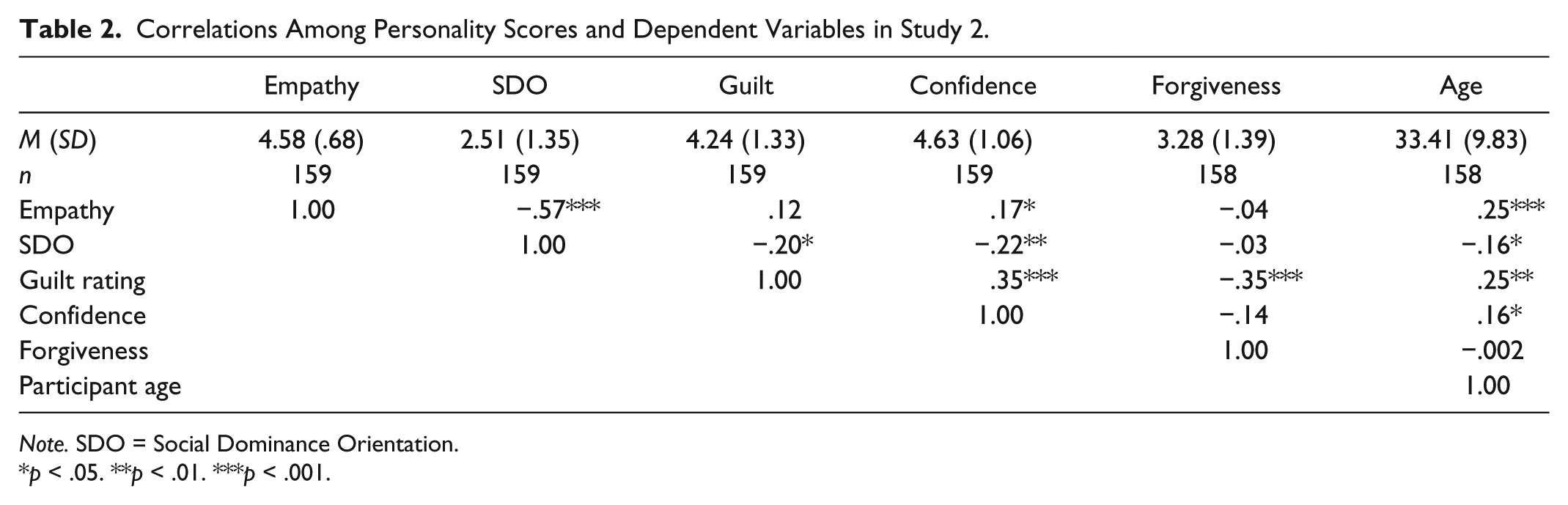
Note. SDO = Social Dominance Orientation.
p < .05. **p < .01. ***p < .001.
Manipulation Check
At the end of the survey, participants were asked whether or not they thought of their own possible death while completing the dependent measures. The four response options were “yes, thought of death a lot”; “yes, slightly”; “no, not much”; “no, not at all.” These responses were correlated with the experimental mortality salience manipulation. There was no relationship at all between the manipulation check responses and the manipulated conditions, χ2(2, N = 159) = .55, p = .76. The mortality salience prompt in the defense attorney’s closing statement in this study did not increase participants’ likelihood of reporting a focus on their own death. Given the apparent failure of the manipulation, we used the self-reported mortality salience in the analyses rather than the manipulated conditions.
Gender Differences
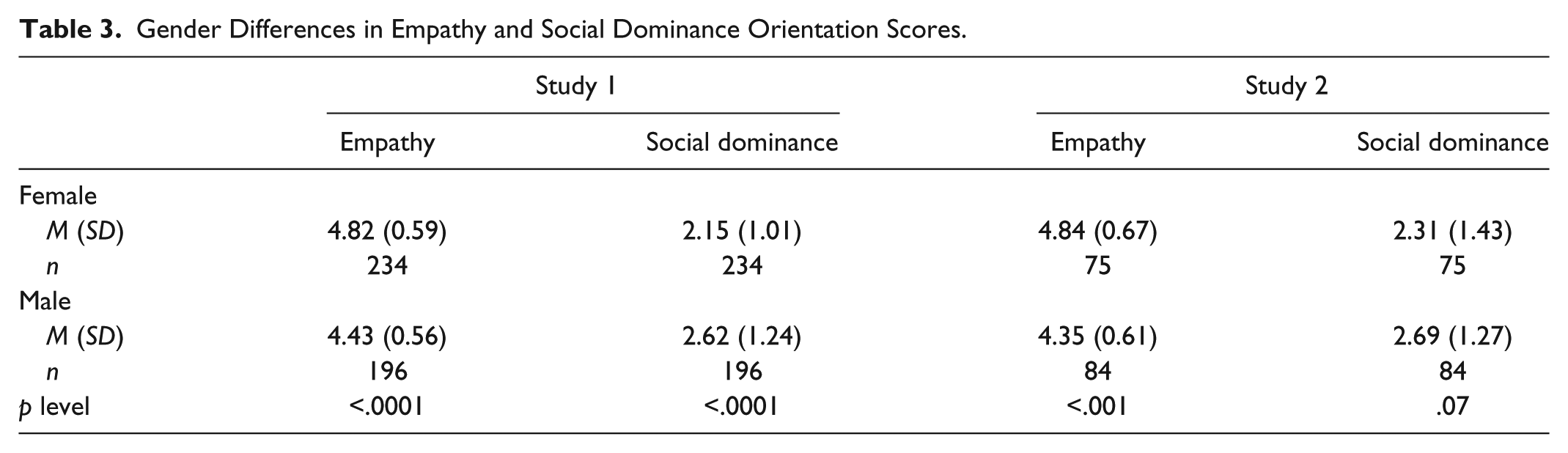
Gender differences appeared for empathy scores, t(157) = 4.81, p < .001 and to a lesser degree for social dominance orientation, t(156) = 1.80, p = .07. Females scored higher in empathy (M = 4.84, SD = .67) than males (M = 4.35, SD = .61); males scored higher in social dominance orientation (M = 2.69, SD = 1.27) than did females (M = 2.31, SD = 1.43). We found no significant gender differences for the dependent variables (see Table 3).
Gender Differences in Empathy and Social Dominance Orientation Scores.
Race of the defendant
There were no main effects by the race of the defendant on any of the individual dependent variables (p = .84 for guilt, p = .65 for sentence category, p = .81 for confidence, p = .57 for forgiveness).
Hypotheses
We again created a composite variable, consisting of the sum of the guilt rating, the forgiveness rating, and a rating (1-6) for the severity of the specific sentence chosen, to measure the harshness of judgment against the defendant. For most of the following analyses, we used a MANOVA to examine the effects of self-reported mortality salience, defendant race, empathy, and social dominance orientation on the composite measure and the rating of confidence. The “yes” choices on the self-reported responses of mortality salience were combined, as were the “no” choices, to produce two levels of this variable. We note that the overall sample size for this study was too small to reliably interpret three- or four-way interactions. Thus, the main effects and two-way interactions were analyzed for the composite measure and confidence.
H1 and H2: Mortality salience
Mortality salience was not related to the composite measure of harshness toward the defendant (p = .40) or confidence (p = .28). Similarly, a separate analysis on the general sentence category indicated no effect of mortality salience (p = .56). Thus, there was no overall bias shown by participants based on their experience of mortality salience. An analysis of the interaction between mortality salience and defendant race also indicated no significant effects for the composite (p = .25) or for confidence (p = .56).
In addition, using White participants only to examine same race/other race effects, there were no racial biases by reported mortality salience (p = .86 for the composite measure).
H3: Empathy and mortality salience
Participants were categorized as high in empathy (n = 73) if their scores were above the mean of 4.55 (SD = .68) and low in empathy (n = 86) if below the mean. Although there was no main effect of empathy on the composite score (p = .44), there was an interaction between empathy and mortality salience, although not significant, F(1, 150) = 3.08, p = .08, η2 = .02. Empathy differences in the composite score were exhibited when in a state of self-reported mortality salience; such differences were absent without mortality salience. For the composite, participants high in empathy were harsher on the defendant when experiencing mortality salience; those low in empathy were more lenient toward the defendant in a mortality salience state. See Figure 5 for the composite measure data.

Mean composite scores for participants high and low in personal empathy as a function of reported mortality salience in Study 2. Higher composite scores indicate greater harshness of judgment toward the defendant, p = .08.
These results are similar to those in Study 1; mortality salience appeared to trigger differences in reactions to the defendant by empathy. Once again, there was greater apparent empathy with the child victims for high empathy participants experiencing mortality salience, leading to harsher perceptions of the defendant. No such personality differences appeared among participants not experiencing mortality salience.
H4: Social dominance
Participants were categorized as high in social dominance orientation (n = 67) if their score was above the mean of 2.51 (SD = 1.35) and low in social dominance orientation (n = 92) if below the mean. There was no main effects of social dominance on the composite measure (p = .90), but there was an effect on confidence, F(1, 150) = 3.89, p = .05, η2 = .03. Participants low in social dominance were more confident in their judgments (M = 4.78, SD = 1.11) than those high in social dominance (M = 4.44, SD = .96).
In addition, there was a main effect of social dominance orientation on choice of sentence category. Participants low in social dominance were equally likely to give no jail, a brief jail term, or a long term, whereas those high in social dominance were more likely to selected at least some form of jail sentence, χ2(1, N = 157) = 7.32, p < .01 (see Figure 6).

Frequency of sentences with and without a jail term selected as a function of participants’ social dominance level in Study 2, p < .01.
General Discussion
The most strikingly findings in these studies is the relationship between mortality salience and personality differences in reactions to the defendant. When mortality salience was absent, personality differences were minimal. When mortality salience was experienced, differences by personality, notably by empathy, were present. This pattern of results makes sense in light of the theory that people deal with existential anxiety by clinging to their values (cf. Solomon et al., 2004) and that those values are reflected by personality traits. In some sense, people become more true to themselves when experiencing mortality salience. In support of this theory, participants’ values regarding care for others or empathy in the present studies was evidenced most when they were experiencing mortality salience.
There were two common results across these two studies. First, differences by empathy were more likely to be exhibited when people were experiencing mortality salience, regardless of whether there was also a prompt to empathize with the victims or the defendant (see Figure 7). Furthermore, the pattern of differences by empathy level was the same regardless of the type of mortality salience prompt: High empathy participants were harsher on the defendant and the low empathy participants were more lenient regardless of the type of mortality salience statements included in the trial summary.

Differences in mean composite scores based on participant empathy level and mortality salience experience. Positive scores indicate that participants high in empathy were harsher on the defendant than those low in empathy. Significant differences by personality were found under mortality salience conditions, but not for those absent mortality salience.
In the case presented to participants in these two studies, the injured victims were children. Results indicate that high empathy participants empathized with the children and their families, especially when experiencing mortality salience. Low empathy participants did not show particular empathy with the victims and were more lenient on the defendant under mortality salience conditions. This consistency in results by empathy level and mortality salience suggests support for the position presented by Jonas et al. (2008) and the literature on altruism presented by Penner et al. (2005) that children in need evoke or prime a prosocial norm in people for whom benevolence is a personal value.
Evidence for the unique position of children as victims of crime is presented by Sundby (2003) in his research on capital juries and empathy. Sundby studied jurors’ perceptions of “worthy” and “unworthy” victims and found that jurors were significantly affected by the age of the victim. No other victim characteristic affected jurors as much as whether or not the victim was a child. Although not all jurors indicated that they would judge a defendant more harshly with a child victim, 53% of Sundby’s respondents did indicate they would be “much more likely” to select the harshest sentence, the death penalty, for defendants who had killed children. This pattern of response indicated greater empathy with child victims and their families than with any other type of victim (Sundby, 2003).
The second common finding was that participants high in social dominance orientation selected harsher sentences across conditions. This finding is consistent with past research on social dominance orientation (cf. Pratto et al., 1994). Social dominance orientation is related to conservative values, and the finding that people with a high social dominance orientation were more likely to select a jail sentence for the hit and run driver is consistent with a “law and order” conservative political stance.
The results of these studies do not support the idea that mortality salience may significantly contribute to differences in perceptions of cases based on defendant race within the criminal justice system, however. There were no significant findings regarding the interaction between the race of the defendant and race of the participants for this case and this research design. As discussed above, it is possible that having children as the injured parties evoked norms strong enough to erase other types of bias. Past research with adult defendants and adult victims has found effects of mortality salience on both overall and racialized views of criminal defendants (cf. Arndt et al., 2005; Greenberg et al., 2001).
In addition, the findings of the two present studies do not necessarily reveal factors that would appear among jurors in an actual courtroom. The lack of racial disparity in the treatment of the defendant in these studies does not negate the possibility of racial effects by personality and mortality salience within the criminal justice system. Given the design, we have studied perceptions and judgments when reading about a case, as if in a news report. We did not ask participants to engage in a mock trial, nor did we study decision-making processes by police, attorneys, judges, and juries in cases carrying real consequences.
The findings of this research do inform an understanding of public perceptions of criminal cases, however. When cases appear in electronic or print media, people react as to the perceived fairness of trial outcomes. In turn, perceptions of the criminal justice system are affected by such perceptions. Based on our research, more conservative members of the public who are high in social dominance orientation are likely to expect harsher sentences and may therefore be critical of leniency by judges. Similarly, people high in empathy may expect harsher treatment of defendants in cases that prompt victim empathy for them.
Limitations
Based on the discussion above, the general limitations of these two studies include the following. First, participants read about cases via a written summary presented online; they did not participate in any deliberations or view a live-action trial. The victims in the case were children, which may evoke a different pattern of normative reactions from participants than evoked by adult victims. In addition, the case involved an ambiguous unintentional criminal incident. Judgments about cases with offenders who engaged in intentional crimes, violent or nonviolent, may be quite different.
There are also limitations due to the nature of the samples. Using both a college participant pool and mturk increased the diversity of the sample in term of age and racial identity. However, the sample is still not representative of adults in the United States who might serve on juries or who might read about criminal cases in a news source. For example, the present samples were younger in age (median = 29) than the general population in the United States (median = 37.70; U.S. Census Bureau, 2015a). Furthermore, the samples underrepresent the percentage of Hispanic (17.40%) and Black or African American (13.20%) individuals, and overrepresent Asians (5.40%) in the United States (U.S. Census Bureau, 2015b). Finally, the samples are not random; the students and adults on mturk are self-selected; their views may differ from the general adult population. Therefore, further research is needed to determine whether the current findings generalize.
Footnotes
Appendix A
Appendix B
Acknowledgements
The authors thank Samantha Gibson and Alexandra Gibson for their assistance.
Declaration of Conflicting Interests
The author(s) declared no potential conflicts of interest with respect to the research, authorship, and/or publication of this article.
Funding
The author(s) received no financial support for the research, and/or authorship of this article.