




Abstract
This study provides an empirical analysis of parole decision-making in China, examining 1,098 offenders housed in the prisons of Z Province. Drawing on questionnaire data and archival records, it models parole decisions using a binary logistic regression framework and tests 30 potential influencing factors across 3 theoretical dimensions: retributive justice, preventivism and community controllability, in order to identify the key determinants of parole approval in China. The findings reveal a critical imbalance: while community controllability and retributive justice factors heavily influence parole decisions, preventivism factors that focus on mitigating future risk play a disproportionately minor role. This misalignment exposes a deeper systemic flaw in the integration of the parole system’s retribution, prevention, and rehabilitation functions. To address these challenges, this research proposes reducing the influence of retributive justice factors, enhancing preventivism assessments with data-driven tools, and recalibrating community controllability factors to prioritize diversionary control and corrective treatment. These reforms reflect an effort to align punitive measures with rehabilitative and re-integrative strategies under a framework that emphasizes risk prevention and social stability. By adopting these reforms, China’s parole system can transform into a more effective tool for justice and reintegration.
Plain Language Summary
This study analyzes parole decision-making in China’s Z Province by examining data from 1,098 incarcerated individuals. The findings indicate a significant imbalance: decisions are predominantly influenced by community control and retributive justice factors, while considerations aimed at preventing future offenses receive comparatively less attention. This disparity suggests a systemic issue in harmonizing the objectives of punishment, prevention, and rehabilitation within the legal framework. To address this, the study recommends reducing the emphasis on retributive justice factors in parole decisions, enhancing preventive assessments by incorporating data-driven tools to better evaluate the risk of reoffending, and revising community control considerations to focus more on diversionary measures and corrective treatments that facilitate reintegration. Implementing these reforms aims to balance accountability with rehabilitation, reduce future risks, and strengthen public safety. By doing so, China’s parole system can evolve into a more effective mechanism for justice and reintegration, aligning policy with practice and supporting societal harmony and second chances.
Introduction
Parole represents a cornerstone of modern correctional policy, embodying the principle that punishment should balance retribution with rehabilitation and risk-appropriate reintegration (Feeley & Simon, 1992). Every year, millions of incarcerated individuals worldwide look to parole as their path to reintegration. The extent to which a jurisdiction utilizes parole reflects, to a significant degree, its commitment to rehabilitative principles and evidence-based release policies. From this perspective, in jurisdictions where parole is robustly utilized, such as the United States, nearly 80% of those released from prison are placed under parole or other community supervision (Kaeble, 2020), reflecting a rehabilitative framework that seeks to balance public safety with offender reintegration (Reitz & Rhine, 2020).
In stark contrast, China’s parole system tells a far less optimistic story. Despite substantial legislative and policy efforts to regulate parole decisions and boost parole rates, the numbers remain discouragingly low. Based on our interviews with prosecutors at the Supreme People’s Procuratorate responsible for parole policy, China’s parole rate is approximately .67% in 2025, and in some provinces fewer than ten parole cases are granted in an entire year. These statistics highlight that while significant strides have been made to expand parole usage, China’s parole rate stagnates at persistently low levels.
This stark disparity between policy ambitions and practical outcomes raises a critical question: what factors are driving this disconnect in China? Regrettably, China’s understudied parole practices remained unexamined in Anglophone scholarship until Li Enshen’s pioneering analytical examination in 2022 (E. Li, 2022). From a sociological perspective, E. Li (2022) posits that China’s parole system functions primarily as a punitive preventive mechanism controlling prisoner reintegration, rather than serving rehabilitative objectives. While Li’s analysis elucidates systemic functionality, its reliance on publicly disclosed data and sociological argumentation potentially compromises empirical inference validity. Lin and Shen’s (2017) antecedent prison research provides superior internal quantitative analysis, yet their focus on sentence reduction mechanisms rather than parole limits applicability. They demonstrate that the Party policy imperatives, rather than juridical frameworks, predominantly determine commutation decisions (Lin & Shen, 2017). Subsequent prison scholars similarly prioritize commutation over parole (Ding et al., 2023), perpetuating this empirical lacuna. Current Chinese early release scholarship thus bifurcates into non-quantitative sociological inquiry and commutation-focused empirical studies, with quantitative parole research remaining conspicuously absent.
To explore this question and address this scholarly void, this study examines 1,098 Chinese inmates meeting the basic juridical prerequisites yet experiencing different judicial outcomes. The sample was divided into two groups. Group A (n = 544) included individuals who met the criteria but were denied parole, either because prison authorities did not submit a request or because the court rejected it. Group B (n = 554) consisted of those who successfully secured parole after court approval of their requests.
At the heart of this study is an attempt to identify the primary determinants of parole decisions in China. Using “whether parole was granted” as the dependent variable, the study evaluates 30 potential influences. These range from retributive justice factors tied to the severity of the offense, to preventive considerations focused on the risk of recidivism, and community controllability factors assessing the offender’s reintegration potential. To ensure analytical robustness, sentence length was included as a control variable, and further robustness checks were conducted using propensity score matching. Through logistic regression modeling, the study not only identifies the most influential factors but also ranks them, shedding light on the decision-making process.
This research provides a fresh perspective by delving deeply into the critical factors shaping parole decisions in China. The article is organized as follows. Section “China’s Parole System: Legislative Evolution and Implementation Dynamics” examines China’s parole system and compares it with Germany and Japan. Section “Explaining Parole Determinants: Retributive, Preventive, and Community-Based Factors” presents three key factors influencing parole decisions: retributive justice, preventivism, and community controllability. Section “Methodology” describes the methodology and data from 1,098 inmates. Section “Findings” reports the empirical findings. Section “Discussions” discusses the implications of these findings. Section “Foundational Principles for Parole Reform: Risk Management, Rehabilitation, and Social Repair” proposes specific reforms to improve the parole system. Final section concludes.
China’s Parole System: Legislative Evolution and Implementation Dynamics
Parole in China encompasses two key components: the decision to grant release and the subsequent period of post-release supervision. Introduced in the 1979 Criminal Law as part of the country’s broader efforts to modernize its legal system, parole was initially conceived as a mechanism for early release based on an offender’s genuine repentance and assurance of no further societal harm. Article 73 of that code established basic eligibility criteria, requiring fixed-term prisoners to serve at least half of their sentence and life-sentenced individuals to serve a minimum of ten years before seeking parole. Once released, parolees were subject to direct supervision by local police authorities, reflecting the system’s emphasis on maintaining public order.
Legislative revisions have progressively tightened and refined this framework. The 1997 Criminal Law re-codified parole in Article 81, lengthening the eligibility period for life sentences to thirteen years and excluding both recidivists and offenders convicted of serious violent crimes. The 2011 Eighth Amendment replaced the earlier standard of “no social harm” with the more rigorous criterion that the prisoner poses “no risk of re-offending,” and it directed courts to assess the likely impact of release on the parolee’s residential community. This marks a clear shift toward actuarial risk and community-oriented decision-making.
Parole supervision also evolved significantly over time. In 2003, supervisory responsibilities shifted from the police to administrative agencies, such as justice bureaus and local community committees, integrating parole into the framework of community corrections. These agencies now manage offenders deemed to pose low social danger through structured rehabilitation programs. Subsequent amendments, most notably the National People's Congress Standing Committee (2015), further expanded the list of non-parole offenses to include crimes with grave societal harm, such as corruption, arson, and the dissemination of hazardous materials.
With respect to China’s contemporary parole requirements, this section contends that cross-national comparison, particularly with civil law counterparts like Germany and Japan, may better illuminate the conditions under which parole is granted.
In China, Article 81 of the Criminal Law permits release after one-half of a determinate sentence or 13 years of a life term, provided the prisoner has observed prison rules, accepted reform programs, demonstrated genuine repentance, and is deemed to present no risk of recidivism, while categorically excluding recidivists and offenders sentenced to ten or more years for specified serious violent crimes and obliging courts to assess the prospective community impact.
Germany’s Strafgesetzbuch (Criminal Code) §§ 57–57a empowers an execution court to suspend the remainder of a sentence once two-thirds (15 years for life imprisonment) has been served, subject to the prisoner’s consent and a holistic judicial finding that release is compatible with public security, though first-time offenders with short sentences or “special circumstances” may qualify after one-half.
Japan’s Penal Code Article 28 renders prisoners eligible after one-third of their term (10 years for life imprisonment), but the Regional Parole Board may grant release only when four cumulative criteria are met: genuine remorse and willingness to reform, no “reasonable” risk of re-offending, suitability of community supervision, and absence of adverse public sentiment, operationalized through prison-initiated referral mechanisms (Toda, 2024).
Overall, China’s statutory scheme is comparatively restrictive. Its categorical exclusions go beyond the discretionary risk-based barriers found in Germany and Japan, and its eligibility threshold, although not the highest proportionally, combines temporal, behavioral, and community-impact tests that collectively privilege public security over expansive reintegration goals. Table 1 delineates these comparative criteria systematically.
Statutory Conditions for Parole Eligibility (China, Germany, and Japan).

Explaining Parole Determinants: Retributive, Preventive, and Community-Based Factors
With these developments in mind, this article examines how three primary factors, namely retributive justice, preventivism, and community controllability, influence parole decisions in China.
Retributive Factors
The idea of retributive justice refers to responsibility retribution, where punishment is justified because the offender chose to commit a crime of their own free will (Wood, 2002). For this reason, people typically equate the seriousness of the crime with the severity of the punishment, viewing punishment as the rightful consequence of committing a crime (Adriaenssen et al., 2020).
The principle of retributive justice plays a central role in the Chinese parole system, where the severity of the crime heavily influences parole eligibility (E. Li, 2022). This principle is codified in Article 81 of the 1997 Criminal Law, which excludes individuals convicted of grievous offenses such as murder, robbery, and violent crimes from parole consideration. Notably, the expansion of non-parole offenses in the National People's Congress Standing Committee (2011) and the Ninth Amendment in 2015 further underscores this focus on retribution. This approach ensures that offenders responsible for significant harm are held accountable and not prematurely released.
From the perspective of retributive justice, punishment should be proportionate to the offender’s degree of culpability. Courts therefore need to collect as many concrete factors as possible that reflect the deserved level of punishment. Existing research suggests that, under a retributive conception, the main factors expressing retributive punishment include the following: (1) Sentence length, which serves as the basic metric of retribution. (2) Crime type, which captures the nature of retribution, directly determines the form of retribution and the type of sanction imposed (Bond & Jeffries, 2014). (3) Crime form, which functions as an adjuster of retributive punishment. Completed and inchoate offences differ significantly in the amount of retribution they call for. (4) Intentional crime, which is the outcome of a rational choice and therefore warrants a more severe response. (5) Modus operandi, which is a key yardstick for assessing both the offender’s subjective blameworthiness and the objective harmfulness of the conduct, and thus directly shapes the degree of deserved retribution (Lightowlers, 2019). (6) Principal offender status, where the distinction between principal and accomplice is a paradigmatic application of retributive theory in co-offending (S. D. Li & Liu, 2017). The principal offender is generally the primary bearer of retributive punishment and should assume heavier responsibility, while accomplices bear relatively lighter responsibility. (7) Crime circumstances, where the seriousness of the circumstances influences judicial assessments of subjective blameworthiness and objective harm and enables fine-tuning of the amount of retribution (Pina-Sánchez & Linacre, 2013). Aggravating circumstances, such as extreme cruelty, increase the quantum of deserved retribution, whereas mitigating circumstances, such as provocation, reduce it.
In light of the above, we select the following seven indicators as retributive factors in our analysis: sentence length, crime type, crime form, intentional crime, modus operandi, principal offender, and crime circumstances.
Preventive Factors
The second factor influencing parole decisions is the evaluation of an offender’s potential risk to society, a principle grounded in preventivism, which prioritizes the reduction of future criminal behavior (Collins, 2018). Preventivism conceptualizes punishment not as a reactionary measure to past actions but as a forward-looking strategy aimed at mitigating the risk of recidivism (Mayson, 2022). Within this framework, human actions are not entirely autonomous, rather, criminal behavior emerges from a confluence of personal attributes, familial influences, and broader social conditions. Crime, therefore, is indicative of the offender’s antisocial tendencies and constitutes a reflection of their overarching personality.
The Chinese justice system has long embodied a preventive character (Biddulph, 2015). Rooted in Maoist-era revolutionary justice, preventive measures such as re-education through labor aimed to reduce crime and ideological conflict (Leng et al., 1985). The idea of preventivism also reflects in the amendment of the current Chinese Criminal Law. The 2011 shift from the criterion of “no longer causing harm to society” to “no risk of re-offending” marks a significant move toward this preventive approach.
Existing research grounded in a preventivist perspective suggests that the main factors reflecting preventive punishment include the following. (1) Age is a basic indicator of personal dangerousness and rehabilitative potential, and one of the most important criteria for assessing preventive punishment. Modern penal systems adopt differentiated preventive strategies for offenders of different ages in order to maximize crime-prevention effects at minimal penal cost. (2) Educational level affects cognitive ability and stock of knowledge and thus serves as a predictor of reoffending risk that is closely related to preventive punishment (McNeeley, 2023). For example, low educational attainment may restrict employment opportunities and increase the likelihood of recidivism. (3) Number of prior offenses is a key indicator of the extent to which an offender has developed a habitual disregard for legal norms and is one of the most powerful empirical indicators for assessing preventive punishment (Yukhnenko et al., 2020). For first-time offenders, placing them under community-based correction through parole may be more effective than continued imprisonment. (4) Voluntary surrender refers to an offender’s act of turning themselves in and truthfully confessing their crime after the offence, thereby voluntarily submitting to state judicial authority and demonstrating a willingness to comply with the legal order. (5) Confession refers to an offender’s truthful admission of the charged offence after being apprehended. Although it is less proactive than voluntary surrender, it likewise signals cooperation and repentance, lowers personal dangerousness to some extent and saves judicial resources, and therefore constitutes an important mitigating factor in the exercise of preventive punishment. (6) Meritorious service refers to conduct such as exposing the crimes of others, providing important leads that help solve other cases, or engaging in other actions that facilitate the prevention, detection and punishment of crime. Such conduct often produces tangible social benefits, strongly indicating that the offender’s personal dangerousness has significantly decreased and that they are actively attempting to atone and reintegrate into society, which greatly weakens the need for severe preventive punishment. (7) Attitude toward admitting guilt is the external manifestation of an offender’s inner sense of remorse. A positive attitude signals willingness to accept correction and return to society, indicating a reduction in personal dangerousness and, accordingly, a reduced need for a high level of special prevention through punishment. (8) Expression of remorse refers to the offender’s genuine regret for their crime. This internal acceptance of the legal order provides a safeguard against future offending and indicates that personal dangerousness has markedly diminished or even disappeared, thereby reducing both the necessity and intensity of preventive punishment.
In light of the above, we select the following eight indicators as preventivist factors in our analysis: age, educational level, number of prior offenses, voluntary surrender, confession, meritorious service, attitude toward admitting guilt and expression of remorse.
Community Controllability Factors
The concept of community controllability is explicitly codified in China’s Criminal Law. Article 81(3) provides that “when deciding on parole, consideration shall be given to the impact on the community where the criminal resides upon release.” This provision reflects an underlying expectation that judicial authorities, in evaluating parole applications, must assess the community’s capacity to manage, supervise, and reintegrate the offender upon release. If the risks associated with conditional release can be effectively addressed through mechanisms of community-based supervision, rehabilitation, and social repair, then continued incarceration is no longer deemed necessary. This distinguishes community controllability from preventivism factors. While preventivism examines individual characteristics to predict personal recidivism risk, community controllability assesses the external support systems and infrastructure available to manage the offender’s reintegration. It highlights the imperative that parole decisions be guided not only by considerations of restorative justice but also by the capacity of local communities to support normative correction and to mitigate the offender’s potential risk. Substantively, the concept of community controllability encompasses three interrelated dimensions that include social restoration, corrective treatment and social control mechanisms.
The first dimension, social restoration, emphasizes that parole should respond to the justice expectations of the state, the community and the victim. It recognizes that crime generates emotional, moral and material harm, and highlights the role of restorative justice practices in rebuilding social order and the community’s moral fabric (Nascimento et al., 2023). Existing research suggests that social restoration is primarily reflected in the following factors: (1) Fulfilment of property-related legal obligations, that is, whether the offender, after the criminal judgment has taken legal effect, has actively or passively complied with the property-related obligations specified in the judgment or ruling. Voluntary fulfilment of pecuniary sanctions expresses a conception of restorative justice that the offender “offsets” their wrongdoing through their property, thereby partially satisfying the victim’s sense of fairness and helping to restore a broader sense of social justice (Ruback et al., 2018). (2) Whether restitution has been made, which covers both compensation for the victim’s losses and the return of illegal gains to the victim or the authorities. Restitution provides material and symbolic redress, constitutes the practical basis for apology and reconciliation, and can help rebuild damaged social relationships (Martin & Fowle, 2020). (3) Attitude toward restitution, which reveals the offender’s sincerity of remorse and willingness to repair social relationships, and thus shapes the depth and quality of restoration. (4) Whether forgiveness has been granted by the victim, which indicates that the most immediate conflict between offender and victim has been resolved, reduces the risk of ongoing retaliation, and directly contributes to the restoration of community peace and social trust (Nascimento et al., 2023).
On the basis of this framework, we select four indicators to capture social restoration: fulfilment of property-related legal obligations, whether restitution has been made, attitude toward restitution and whether forgiveness has been granted by the victim.
The second dimension, corrective treatment, focuses on the offender’s capacity base for successful resocialization. It is concerned with the offender’s treatment and adjustment in prison and uses evidence-based correction, grounded in internal psychological change and external behavior, to reduce personal dangerousness (Hausam et al., 2018). Reflecting this, the main factors capturing corrective treatment are: (1) Average monthly prison assessment scores, generated by a continuous, quantitative evaluation system that assesses compliance with rules, work performance and participation in education and reform. (2) Receipt of administrative rewards, such as commendations or merits, which provide objective evidence that the offender’s personal dangerousness has declined and that they have a strong willingness to reform. They also constitute hard indicators for the prison to initiate sentence reduction or parole. (3) Imposition of disciplinary sanctions, such as warnings or other penalties for violations of prison rules. Disciplinary sanctions typically downgrade an offender’s treatment status and may directly restrict their eligibility for sentence reduction or parole in the near term. (4) Average monthly spending in prison, which is used as an indicator for assessing both genuine remorse and the capacity to fulfil property-related obligations. Persistently high levels of spending combined with non-fulfilment of pecuniary obligations lead authorities to infer that the offender has the ability but not the willingness to pay. (5) Documented attitude toward reform, a key subjective indicator of whether the offender has genuinely changed and an important basis for improving their treatment status and assessing eligibility for sentence reduction or parole.
In line with this framework, we include five corrective-treatment indicators: average monthly prison assessment scores, receipt of administrative rewards, imposition of disciplinary sanctions, average monthly spending and documented attitude toward reform.
The third dimension, social control mechanisms, reflects the practical operation of China’s community-corrections system, which tends to emphasize supervisory control rather than offender autonomy (Berg & Huebner, 2011). Structured supervision plans seek to balance risk control and minimal social integration, enabling parolees to live in the community under continuous oversight and administrative guidance. Existing research indicates that the main factors reflecting social control include: (1) Household registration status, which is a basic condition for confirming identity and assessing both social dangerousness and community control capacity (Jacobs & Gottlieb, 2020). In practice, local “hukou (household)” status is therefore a key basis for both granting parole and implementing control measures. (2) Marital status, an important indicator of social ties and stability that is closely linked to social control and parole decisions. Stable marriage is often seen as a form of “informal social control” that provides support for supervision and reintegration, thereby advancing the goals of parole and community control (Brunton-Smith & McCarthy, 2017). (3) Employment status prior to incarceration, which indicates the strength of the offender’s prior connection to mainstream society. Having stable employment before imprisonment suggests a higher likelihood of returning to a stable lifestyle after parole, reducing supervision costs and increasing the chances of successful control (Berg & Huebner, 2011). (4) Family relationship quality, where positive family relationships typically indicate stronger social support, facilitating formal supervision and providing informal social control through emotional support, financial assistance and day-to-day monitoring, thereby significantly enhancing the effectiveness of social control (Brunton-Smith & McCarthy, 2017). (5) Family financial situation, where good economic conditions function as a “protective factor” by reducing the risk of reoffending due to economic pressure and enhancing the effectiveness of community supervision. By contrast, poverty may be a source of concern in parole decisions and may require stronger social support to offset the associated risks. (6) Social interaction, referring to the offender’s social network, which constitutes the most immediate environment after release (Schaefer et al., 2021). A healthy, mainstream social circle functions as a protective layer against reoffending and supports control.
On this basis, we include six social-control indicators: household registration status, marital status, employment status prior to incarceration, family relationship quality, family financial situation and social interaction.
Methodology
Data
The data for this article are derived from a survey conducted in prisons located in Z Province, China. To uphold the principle of confidentiality for judicial data and to fulfill ethical obligations toward protecting research participants, the specific names of the prisons have been anonymized and are collectively referred to as the Z Province Prisons.
To ensure the study’s representativeness and objectivity, a sample of 1,200 individuals was selected from the “Comprehensive Evaluation System for the Quality of Inmate Education and Rehabilitation” within the Z Province Prisons. A stratified random sampling approach was employed, dividing the sample into two groups. The first group consisted of 600 inmates who were eligible for parole but had not been granted it. This group, referred to as the Group A (non-parole group), included both inmates for whom the prison authorities did not submit a parole request and those whose parole requests were denied by the court. The second group comprised 600 inmates who had been granted parole, forming the Group B (parole group). In this group, parole requests had been submitted by prison authorities and approved by the court.
Questionnaires were administered to both groups, and their files were reviewed to collect relevant data. To ensure consistency and facilitate analysis, the collected questionnaires and archival data were coded and entered into SPSS for quantitative processing. After the data collection stage, cases with incomplete variables were excluded, resulting in a final effective sample size of 1,098 individuals. Of this total, Group A contained 544 participants (49.5%), and Group B included 554 participants (50.5%).
Variables
This study employs a binary dependent variable to indicate whether an individual was granted parole. The variable parole granted is coded as “1” for individuals approved for parole and “0” for those who were denied.
The independent variables are organized into three conceptual dimensions: retributive justice, preventivism, and community controllability. These dimensions reflect distinct theoretical rationales for parole decision-making in China, as elaborated in the preceding section. The specific variables included under each dimension have already been introduced above, while detailed measurement indicators are provided in Supplemental Appendices I and II.
Regression Analysis
This investigation employs binary logistic regression to model parole-granting decisions. The logistic regression model specification follows:

where P(y = 1|x) represents the probability of the dependent variable y being equal to 1 given the independent variables x1, x2, …, xn. β0, β1, β2, …, β n are the regression coefficients, where β0 is the intercept, and β1, β2, …, β n indicates the extent of influence of the independent variables x1, x2, …, xn on the dependent variable y.
Model parameters were estimated using maximum likelihood, and statistical significance was assessed with Wald tests at conventional significance levels. Standardized coefficients were used to compare the relative strength of predictors, while odds ratios and their 95% confidence intervals were used to quantify the effect size of significant predictors.
To guard against multicollinearity, we used the variance inflation factor (VIF) as a diagnostic. Each predictor in turn was regressed on all remaining predictors, and the resulting VIF values were all below 2.30, indicating no serious multicollinearity.
Procedure
To minimize the risk of harm to participants, the study design incorporated several safeguards. First, the identities of all participating institutions were anonymized. Prisons are referred to generically as “Z Province Prisons,” and no specific facility names are reported. Second, the questionnaire did not collect names, identification numbers, precise addresses or any other directly identifying information, and all data are analyzed and reported only in aggregate form. Third, data collection was carried out by trained researchers with academic backgrounds in law and psychology, rather than by correctional staff, and no individual questionnaire responses were shared with prison, court or community-corrections authorities. Finally, all electronic datasets were stored on password-protected computers accessible only to the research team.
Given these safeguards, the risks to participants were assessed as minimal and primarily involved a small time burden and the possibility of mild psychological discomfort when reflecting on past offending or correctional experiences. We considered these minimal risks to be clearly outweighed by the potential benefits of the research. At the societal level, the study aims to promote a more evidence-based and transparent understanding of parole decision-making in China, which may contribute to fairer and more rational use of parole and, indirectly, to better correctional and reintegration outcomes. For participants, the study provided an opportunity to express their views and experiences in a confidential setting, without any positive or negative impact on their sentence or correctional status.
Informed consent was obtained prior to participation in the questionnaire survey. Trained interviewers first provided a standardized oral explanation of the study’s aims, the voluntary nature of participation, the procedures involved, the expected time commitment, the measures taken to protect confidentiality and the right to refuse or withdraw at any time without adverse consequences. After this explanation, inmates who agreed to take part provided oral informed consent, no written signatures were collected in order to preserve anonymity. Eight variables (age, educational level, household registration, marital status, pre-incarceration employment status, family financial situation, family relationships, and social connections) were collected through this self-administered questionnaire component. All remaining variables were extracted directly from the Integrated Evaluation System for the Quality of Prisoner Education and Reform.
It should be noted that most of the data recorded in this system are derived from official court documents, such as sentencing judgments and offence descriptions (e.g., sentence length, crime type), while other entries, such as in-prison administrative sanctions and average monthly prison assessment scores, are based on structured assessments conducted by correctional officers. These officers receive formal training in evaluating rehabilitation progress and recidivism risk, which helps ensure the reliability and validity of the administrative data used in this study.
Findings
Common Method Bias Test
Given single-source data collection, common method bias potential necessitated examination (Chang et al., 2010; Podsakoff et al., 2003). Harman’s single-factor test employed unrotated principal component analysis on all 30 variables (see Table 2). Results indicate the first factor accounts for 17.135% of total variance, substantially below the 40% threshold indicative of bias presence. No single factor emerged, nor did one factor account for majority variance. Thus, common method bias does not threaten validity.
Factor Eigenvalues and Variance Contribution Rates.

Descriptive Statistics
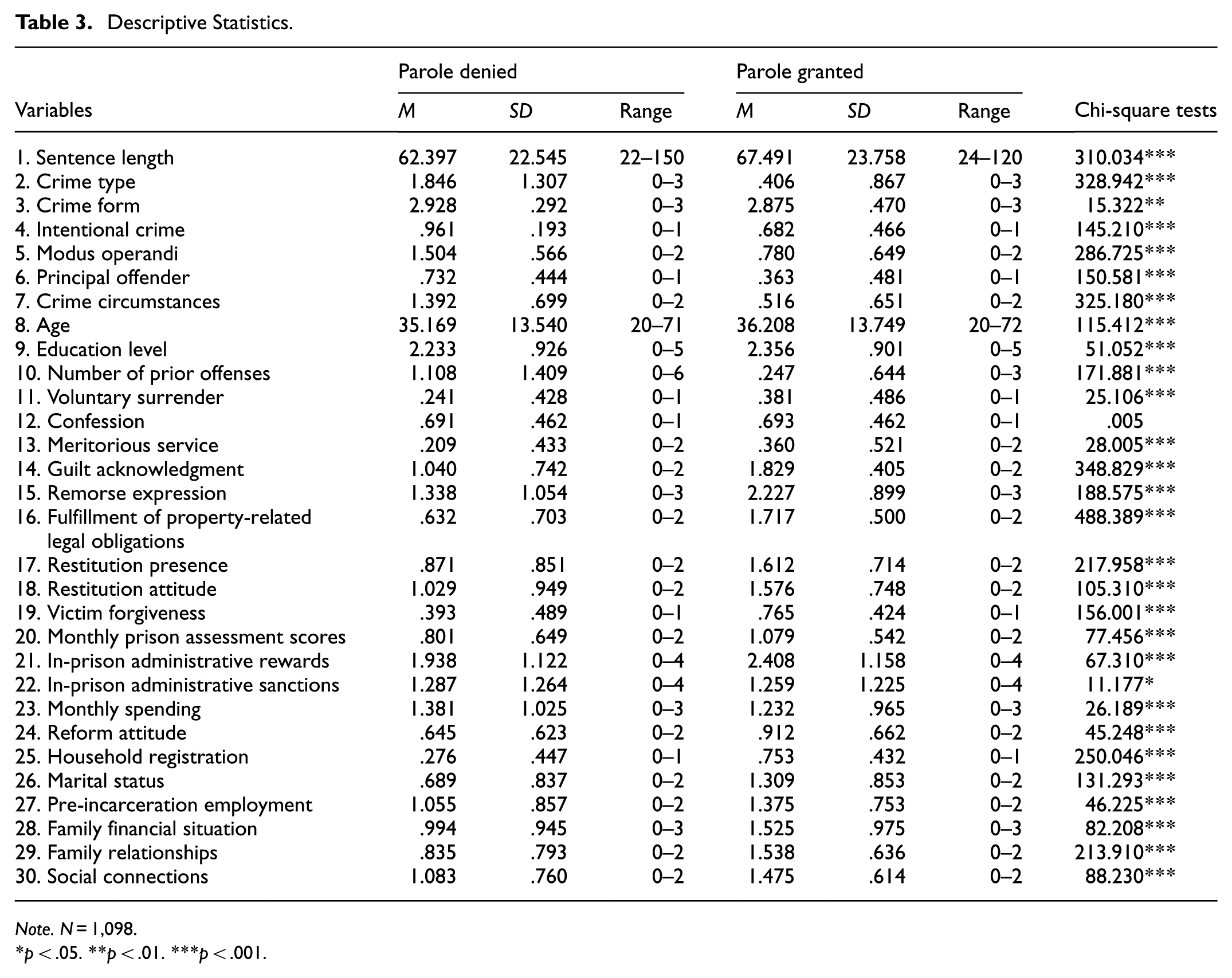
Table 3 presents descriptive statistics for all variables, disaggregated by parole decision. The sample comprises 49.5% parole denials and 50.5% parole approvals.
Descriptive Statistics.
Note. N = 1,098.
p < .05. **p < .01. ***p < .001.
Regarding retributive factors, mean sentence length equals 64.967 months overall, with parolees averaging 67.491 months versus 62.397 months for non-parolees (p < .001). Crime type (M = .406 vs. 1.846), crime form (M = 2.875 vs. 2.928), and intentional crime proportion (68.23% vs. 96.14%) demonstrate significantly lower values among parolees. Modus operandi (M = .780 vs. 1.504), crime circumstances (M = .516 vs. 1.392), and principal offender status (36.28% vs. 73.16%) similarly exhibit lower prevalence in the parole-granted cohort.
Concerning preventive factors, parolees average 36.208 versus 35.169 years for non-parolees (p < .001). Educational level (M = 2.356 vs. 2.233) and voluntary surrender rates (38.09% vs. 24.08%) exceed those of denied applicants. Prior offenses average .247 (range: 0–3) among parolees versus 1.108 (range: 0–6) among non-parolees. Confession rates show no significant difference (69.31% vs. 69.12%, p > .05). Meritorious service (M = .360 vs. .209), guilt acknowledgment (M = 1.829 vs. 1.040), and remorse expression (M = 2.227 vs. 1.338) demonstrate superior levels among approved cases.
Community controllability factors encompass three dimensions. First, regarding community restoration: fulfillment of property-related legal obligations reaches 74.01% among parolees versus 13.05% among non-parolees (p < .001). Restitution presence (M = 1.612 vs. .871), restitution attitude (M = 1.576 vs. 1.029), and victim forgiveness (M = .765 vs. .393) significantly favor parolees. Second, concerning institutional correction: monthly assessment scores (M = 1.079 vs. .801), in-prison administrative rewards (M = 2.408 vs. 1.938), and reform attitude (M = .912 vs. .645) exceed non-parolee values, while in-prison administrative sanctions (M = 1.259 vs. 1.287) and monthly spending (M = 1.232 vs. 1.381) remain lower. Third, regarding diversionary control: local household registration (75.27% vs. 27.57%), marital status (56.50% married vs. 24.26%), employment status prior to incarceration (54.15% vs. 39.52%), family financial situation (M = 1.525 vs. .994), family relationships (M = 1.538 vs. .835), and social connections (M = 1.475 vs. 1.083) demonstrate substantial advantages among parolees.
Regression Results Analysis
Table 4 displays regression outcomes. Model diagnostics yield Nagelkerke R2 = .904, indicating superior fit (Nagelkerke, 1991). Hosmer–Lemeshow test produces p = .993, confirming specification adequacy (Hosmer et al., 2013).
Logistic Regression Analysis.

Note. Overall Nagelkerke R2 = .904; N = 1,098.
All coefficients achieve statistical significance (p < .05). Fulfillment of property-related legal obligations emerges as the paramount predictor (β = 1.495, OR = 4.457), whereby unit increases elevate parole probability 345.7%.
Six additional “community readiness” variables enter the model: household registration (hukou), monthly prison assessment scores, marital status, pre-incarceration employment status, in-prison administrative rewards, and reform attitude. Each exerts a positive effect on parole. A one-unit increase in these predictors raises the odds of release by 191.6%, 131.5%, 131.2%, 106.7%, 80.6%, and 72.7%, respectively, underscoring the salience of community-integration indicators.
Five proxies for offence gravity, that is, modus operandi, intentional crime, aggravating crime circumstances, principal offender status, and crime type, also enter the equation (sentence length and crime form do not). All carry negative coefficients: a one-unit increase lowers the odds of parole by 66.9%, 60.1%, 53.4%, 37.4%, and 27.9%, respectively, indicating that more serious or blameworthy conduct substantially constrains release decisions.
Of eight potential preventive variables, only guilt acknowledgment and number of prior offenses remain in the final model. Guilt acknowledgment is positively signed (OR = 3.222): relative to an unrepentant offender, each incremental rise in plea sincerity increases the odds of parole by 222.2%. By contrast, the coefficient for prior offenses is negative (OR = .638): each additional conviction reduces the odds of release by 36.2% compared with first-time offenders. Together, these findings confirm that both current rehabilitative behavior and criminal history shape preventive assessments of future risk.
Table 5 presents the classification results for the 1,098-case sample using the 14-predictor logistic-regression model. Among the 544 prisoners ultimately denied parole, the model correctly identified 518, yielding a specificity of 95.2%. Conversely, it accurately predicted 529 of the 554 prisoners who were granted parole, corresponding to a sensitivity of 95.5%. Overall accuracy therefore reaches 95.4%, with only 51 misclassifications (26 false negatives and 25 false positives). The predicted probability for each prisoner i is obtained from Equation 1, using the coefficient estimates reported in Table 4.
Prediction Accuracy of the Logistic Regression Model.
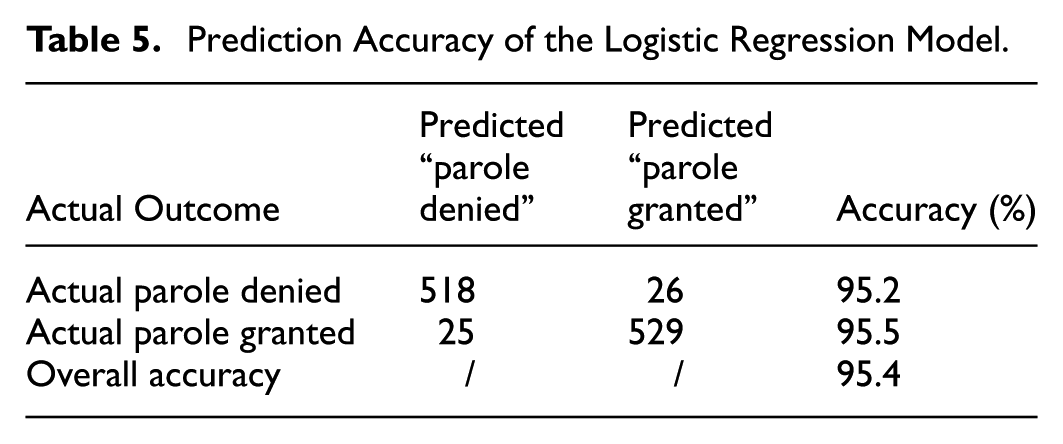
Substantively, the retained model comprises 14 theoretically grounded predictors: 7 (50%) capture community-controllability considerations, 5 (35.7%) reflect retributive-justice concerns, and the remaining 2 (14.3%) pertain to preventivist logic. The prominence of community-based variables, such as chiefly fulfillment of property-related legal obligations, underscores their decisive role in China’s contemporary parole decisions.
Robustness Analysis
To guard against potential sample-selection bias, we re-estimate the benchmark model using propensity-score matching (PSM). Because PSM requires a binary treatment indicator, we recode fulfillment of property-related legal obligations as a dummy variable: offenders who fully complied are coded 1 (treatment group), whereas those who failed to comply or only partially complied are coded 0 (control group). Within the full sample, 43.8% of prisoners fully complied and 56.2% did not, so the 2 groups are well represented.
We implement four matching algorithms: One-to-one nearest-neighbor, radius, kernel, and local-linear regression matching. After matching, the absolute standardized mean difference for every covariate falls below the conventional 10% threshold, and the null hypothesis of no systematic group differences cannot be rejected, indicating satisfactory covariate balance.
Using the matched sample, we re-estimate the binary logistic model specified in Equation 1. Table 6 reports the results. The magnitudes and signs of the coefficients closely mirror those obtained from the original (unmatched) data, confirming that our substantive conclusions are robust to alternative specifications.
Robustness Check Based on PSM-Matched Sample.

Note. Nagelkerke R2 = .892, N = 681.
Discussions
Drawing on an empirical study of 1,098 offenders in Z Province Prisons in China, this research provides a quantitative analysis of the key factors influencing parole decisions in China. The findings demonstrate that community controllability factors and retributive justice factors both exert a significant impact on whether judicial authorities grant parole, while preventivism factors play a relatively minor role. This outcome reveals a stratified “misalignment” among the penal system’s three major functions: retribution, prevention, and community control.
The most striking finding concerns the role of property-related obligations in parole decisions. Before proceeding, it is crucial to clarify the legal status of this factor in Chinese law. Contrary to what might appear as a mandatory eligibility requirement, the fulfillment of property-related obligations operates as a discretionary factor with conditional application. Chinese parole system explicitly provides that offenders who lack the financial capacity to fulfill pecuniary obligations shall not be denied parole on that basis alone. The stricter standard applies only to those who possess payment capacity but willfully refuse to comply. Therefore, this variable captures judicial discretion in assessing offenders’ willingness to accept legal responsibility rather than imposing an absolute financial barrier to release.
Our research shows that, in cases involving pecuniary sanctions, the fulfillment of property-related legal obligations is the decisive factor in parole approval. Specifically, whether an individual has complied with property-related orders is often the primary consideration for the judiciary when granting parole. This emphasis responds to the long-standing challenge in Chinese judicial practice of “judgments without enforcement” in respect of pecuniary penalties (Lin et al., 2022). To address that problem, the judiciary introduced a linkage mechanism that conditions parole eligibility on the fulfilment of pecuniary penalties. Piloted locally with promising results, the mechanism was later endorsed by the SPC and rolled out nationwide.
For example, the SPC’s 2012 Provisions on Several Issues Concerning the Application of Law in Handling Cases of Sentence Commutation and Parole first endorsed leniency for offenders who “actively perform pecuniary penalties,” while mandating stricter treatment for those able but unwilling to pay. A 2016 revision coined the term pecuniary adjudicative item and barred parole outright when the offender possessed payment capacity yet failed to settle the amount in full. In 2024 the SPC issued further Provisions on the Examination of the Execution of Pecuniary Adjudicative Items in Cases of Sentence Commutation and Parole that catalogued evasive behaviors, such as concealing assets or filing false declarations, and confirmed that offenders must satisfy pecuniary obligations before any parole petition will be entertained, unless an enforcement court has verified their absolute inability to pay.
Empirical indicators suggest that the “linkage mechanism” has had the desired enforcement effect. For instance, relevant research reported an 85% payment rate among offenders seeking sentence reduction or parole after the policy’s introduction in Hengyang, Hunan Province (Lao, 2018). The present study echoes that pattern. 74.01% of prisoners who ultimately obtained parole had fully discharged their pecuniary obligations, making this single variable the most powerful predictor in the model.
Therefore, the linkage mechanism undoubtedly enhances judicial credibility, resolves civil-criminal disputes arising from the same conduct, and supports the law’s restorative ambitions by facilitating victim compensation (Zhao, 2020). However, our findings reveal that placing excessive emphasis on linking property fulfillment with parole risks undermining the broader objectives of punishment by neglecting other critical factors, such as an offender’s reform progress, risk management, and social ties.
For instance, the linkage mechanism may exclude offenders who have made demonstrable progress toward reform and present low residual dangerousness but lack the financial capacity to satisfy pecuniary orders. Denying parole in such cases can sap the motivation of inmates genuinely committed to self-improvement, undermining both behavioral change and day-to-day prison management.
Moreover, because criminal liability should rest squarely on the offender, shifting the financial burden to relatives raises normative concerns. Yet, in practice, families often face formidable obstacles in raising the required sums. When inmates learn of these hardships, they may view the process as fundamentally unfair, deepening distrust in the justice system.
Finally, the mechanism can worsen the already precarious finances of many prisoners’ households, fueling intra-family conflict and eroding the social-support networks essential for successful re-entry. These strained dynamics, in turn, elevate management risks within the prison and impede broader rehabilitative and societal goals.
Beyond property obligations, retributive justice factors also significantly shape parole decisions in China. With the exception of sentence length and crime form, all five remaining retributive justice factors significantly impact judicial decisions on parole. This finding reveals that, in Chinese practice, considerations of retributive justice remain a central driver of parole determinations: the more serious the wrongdoing, the stricter the screening standard.
In practice, courts evaluating parole applications do not exclusively emphasize the offender’s reformative progress during incarceration. Instead, they also give substantial weight to retributive factors, including the nature and gravity of the crime, the severity of its circumstances, whether the offender exhibits habitual criminal behavior, and whether multiple offenses were committed. A landmark case issued by the SPC, that is, the Wang Xiaomeng Case, illustrates this judicial approach.
In its ruling, the court observed: “although the defendant Wang Xiaomeng demonstrated remorse while serving the sentence, the offence itself was extremely grave, produced severe consequences, and inflicted substantial social harm. Consequently, a stringent standard must be applied in the parole review.” Based on this rationale, his parole request was denied. Such decisions reflect a deliberate effort to embed retributive principles within the parole process and to reaffirm proportionality as a normative cornerstone.
However, the justification for punishment must extend beyond the mere imposition of suffering, it is legitimate only when it serves broader societal objectives. Overreliance on retributive justice has been subject to growing criticism for its limited effectiveness and misalignment with modern theories of justice (Garland, 2018). A singular focus on retribution may inadvertently cause greater harm. Contemporary penal theory therefore advocates a balanced model that pairs retributive desert with preventive aims such as deterrence and incapacitation (Lucken, 1998). In this framework, punishment is understood to address multiple objectives, including accountability, deterrence, and the protection of society (Alschuler, 2003).
In stark contrast to the prominence of property obligations and retributive factors, preventivism considerations play a surprisingly modest role in Chinese parole decisions. Among the eight indicators of preventivism influencing parole decisions, only the offender’s guilt acknowledgment attitude and the number of prior offenses committed show a statistically significant correlation with the likelihood of parole being granted. The limited explanatory power of the remaining variables suggests that preventive considerations play only a modest role in Chinese parole practice. Consequently, parole policy in China has yet to fully operationalize the Criminal Law’s stated orientation toward special prevention.
Why does this legislative priority translate so poorly into practice? Scholars point to the intrinsic difficulty of quantifying recidivism risk in the parole context (Yuan, 2019). Preventive factors lack standardized metrics, and predictions of future dangerousness are inevitably probabilistic and contestable (E. Li, 2022). Existing statutes and judicial interpretations offer only broad guidance, leaving the exact scope and weight of preventive criteria undefined (Jiang et al., 2014). This ambiguity exposes judges and prison administrators to reputational or even disciplinary consequences if a paroled offender reoffends. Faced with possible hindsight blame, decision-makers adopt a “safety-first” posture, defaulting to more tangible, readily defensible factors and sidelining those preventive indicators that are harder to substantiate.
Until objective, evidence-based risk-assessment tools are institutionalized, as well as the professional liability for adverse post-release outcomes is clarified, preventivism is likely to remain an under-utilized component of China’s parole calculus.
Balancing Parole Factors: A Proposal for Reform
Drawing on current Chinese parole practice and the interplay among retributive justice factors, preventivism factors, and community controllability factors, one pressing question confronts judicial authorities: How can the parole decisions be standardized while responsibly increasing the parole rate? This question is central to structuring judicial decision-making processes for granting parole. This research shows that parole decisions should elevate community controllability and preventivism factors while moderating the weight assigned to retributive justice factors. Considering the performance-evaluation metrics exert a powerful influence over judicial behavior in China (Chan & Wu, 2024), this study suggests initiating preliminary reforms through the straightforward approach of adjusting corresponding assessment criteria.
Moderating the Role of Retributive Justice Factors
Retributive variables address the social harm already inflicted and satisfy the backward-looking “desert” dimension of punishment (Dagan & Segev, 2015). Yet, because they pertain to completed conduct, they measure only indirect future risk, and their relevance to an offender’s likelihood of reoffending is limited (Adukia et al., 2023). Over-emphasizing retribution therefore risks eclipsing forward-looking aims, such as risk mitigation and social reintegration, that modern correctional theory regards as equally, if not more, important (Dagan, 2022; Dagan & Dancig-Rosenberg, 2020; Dagan & Cnaan, 2024).
Addressing historical offences remains necessary, but parole determinations should hinge primarily on evidence of present reform and future social safety. By moderating the salience of retributive factors, decision-makers can strike a more appropriate balance between accountability and rehabilitation, promoting public security while affording reformed offenders a meaningful path back into society.
Enhancing the Role of Preventivism Factors
Because parole is ultimately forward-looking, its legitimacy depends on a clear appraisal of future risk. Yet our regression results show that only two preventive variables currently exert meaningful influence on release decisions. To restore the preventive orientation envisioned in Article 81 of the Criminal Law, Chinese courts must ground their judgments in a more systematic, data-driven assessment of recidivism risk.
A first step is to construct a transparent and relatively objective indicator framework that combines demographic information (such as age and educational level), case characteristics (for example, voluntary surrender, confession, or meritorious service), and criminogenic-needs measures (including prior offending, attitudes toward guilt, and degree of remorse). Embedding these dimensions in a unified scale would reduce the discretion that now surrounds “no danger of reoffending” and give judges a clearer evidentiary basis for release decisions.
The credibility of any such framework, however, rests on the quality and breadth of its underlying data. Judicial authorities should therefore draw on artificial-intelligence and big-data platforms to assemble large, representative case sets and to model recidivism with modern statistical techniques (Laqueur & Copus, 2024). Doing so will align preventive scoring with real-world outcomes and, by extension, with the system’s rehabilitative and public-safety goals.
Finally, preventive assessment cannot remain static. The predictive value of individual variables shifts over time, so the model must be recalibrated at regular intervals, say every 3 to 5 years, to retire factors that have lost explanatory power and to incorporate newly salient ones. A dynamic, periodically validated tool will keep preventive justice at the center of parole review, ensure that release decisions respond to evolving criminological patterns, and enhance both the fairness and the effectiveness of the system.
Re-calibrating the Weight of Community-Controllability Factors
Community controllability factors represent the most immediate and critical considerations in parole decisions (Schaefer et al., 2021; Schaefer & Brewer, 2022). They mediate both rehabilitation and social control by asking whether stable housing, family support, employment, and local supervision can contain any residual risk (Bernhardt et al., 2012; Guiney, 2023). In our model they account for one-half of all statistically significant predictors, underscoring their practical salience, underscoring their centrality to the decision-making process.
Despite their demonstrated significance, the current emphasis on community controllability factors appears misaligned with the theoretical objectives of parole. Judicial authorities often prioritize social repair elements, such as the fulfillment of financial judgments, over diversionary control and corrective treatment. While restitution offers value, it addresses indirect and less immediate risks, rendering it secondary to factors that directly impact public safety and the offender’s reintegration (Pei, 2014).
To realign the prioritization of community controllability factors with parole’s core objectives, greater emphasis should be placed on diversionary control. Key variables such as residency status, marital status, employment, and social connections are pivotal for facilitating gradual reintegration and ensuring effective supervision. Corrective treatment, which addresses residual risks following rehabilitation, should be the next priority (S. D. Li, 2014). Social repair, though still valuable, should receive comparatively less weight because its link to future risk is more attenuated (Wong & Fung, 2023). Reordering the assessment in this way would anchor parole decisions in factors that best balance public safety with the offender’s prospects for durable reintegration.
Foundational Principles for Parole Reform: Risk Management, Rehabilitation, and Social Repair
The rationale for reforming China’s parole system lies in the nuanced interplay of its three foundational functions: diversionary control, corrective treatment, and social repair. Operating within a management-oriented penal philosophy, parole primarily seeks to protect public safety by neutralizing the risk an offender may pose after release (Yuan, 2019). This risk-focused approach prioritizes the prevention of recidivism through tailored supervision or isolation strategies, calibrated to an offender’s specific risk profile. While rehabilitation is a secondary goal, the central function of parole in this framework is to uphold social stability by minimizing the potential for harm.
Corrective treatment complements this risk-based paradigm by addressing the underlying causes of criminal behavior, which often arise from a confluence of social, psychological, and environmental factors (Daffern et al., 2022). Parole decisions guided by this function aim to reduce recidivism among offenders who demonstrate a capacity for reform, while concurrently protecting the public from individuals who lack such potential. By fostering rehabilitation through targeted interventions, corrective treatment serves as a critical bridge between punitive measures and societal reintegration.
In contrast, social repair centers on restoring relationships between offenders and victims, predominantly through restitution and symbolic justice. While this function contributes significantly to mending the social fabric disrupted by crime, its effects are inherently indirect and long-term (Dagan & Cnaan, 2024). Compared to the immediate concerns of diversionary control and corrective treatment, the benefits of social repair are less urgent and thus should be considered a supplementary component in parole decision-making. Its subordinate role reflects the prioritization of public safety and offender rehabilitation as the primary objectives of the parole process.
This multifaceted rationale underscores the necessity of a balanced and principled parole framework, one that carefully weights these functions to achieve the dual goals of justice and societal well-being. By aligning the parole system with these priorities, judicial authorities can ensure that their decisions are equitable, evidence-based, and effective in mitigating risks while promoting reintegration.
Conclusions
Parole stands as a vital bridge between incarceration and societal reintegration, embodying the delicate balance between justice, public safety, and second chances. Yet, as this study reveals, China’s parole system struggles to fulfill its potential. Despite well-intentioned legislative and policy reforms, persistently low parole rates highlight systemic misalignments that hinder the practical application of this critical mechanism. By examining the cases of 1,098 inmates and analyzing 30 influential factors, this research offers a comprehensive lens through which to understand the complexities of parole decision-making in China.
To address these challenges, our study proposes a recalibrated approach to parole, one that prioritizes future risk management and reintegration potential while moderating the weight of retributive considerations. Moderating the role of retributive justice factors ensures that parole decisions do not disproportionately hinge on historical offenses but instead foster a balance between accountability and rehabilitation. Enhancing preventivism factors through expanded assessment metrics and the use of advanced data-driven tools strengthens the focus on future risk mitigation. Meanwhile, recalibrating community controllability factors to emphasize diversionary control and corrective treatment over social repair ensures parole decisions prioritize tangible reintegration outcomes while addressing public safety concerns.
This study, however, is not without limitations. The reliance on data from the self-reported offender information presents a narrow scope that may overlook critical perspectives. Future research should expand to include insights from diverse stakeholders, such as prison officers, judges, and community correctional officials, to develop a more nuanced understanding of parole dynamics. Additionally, the exclusive focus on offenders in Z Province’s prison system limits the generalizability of findings to other regions in China. Regional variations in parole practices and outcomes should be considered when interpreting these results.
Despite these limitations, this research is more than a critique, it is a blueprint for change. A reformed parole system, grounded in fairness, consistency, and empirical evidence, can better align with modern penal philosophies and foster a justice system that values both accountability and redemption. By bridging the gap between policy and practice, China has the opportunity to unlock the transformative potential of parole, benefitting not just for individual offenders, but for society as a whole.
Supplemental Material
sj-docx-1-sgo-10.1177_21582440251414931 – Supplemental material for Between Punishment and Reintegration: Empirical Reflections on Parole Practices in China
Supplemental material, sj-docx-1-sgo-10.1177_21582440251414931 for Between Punishment and Reintegration: Empirical Reflections on Parole Practices in China by Tun Xu, Ruihao Lin, Ting Luo and Wanqiang Wu in SAGE Open
Footnotes
Acknowledgements
A draft of this article was presented at the Young Scholar Workshop: Empirical Legal Studies in the Sinophone Region at Cornell Law School, supported by the Clarke Program in East Asian Law and Culture, the Cornell Center for Social Sciences (CCSS), and the Mario Einaudi Center for International Studies. It was also presented at the Zhuomo Workshop and the Asian Law and Economics Conference. We are grateful to Yun-Chein Chang, Huabing Li, Ensheng Li, Yali Peng, Yu Xiaohong, and Yuhao Wu, as well as other scholars, for their constructive comments. All errors remain our own.

Ethical Considerations
This study was conducted in accordance with the ethical standards laid down in the 1964 Declaration of Helsinki and its later amendments, as well as all relevant institutional and national regulations. The research protocol was reviewed and approved by the Ethics Committee of the School of Law, Sun Yat-sen University, Guangzhou, China (Approval No.: SYSU-Law-IRB-2025-002; date of approval: November 17, 2025). The approval covers both the administration of a questionnaire survey to incarcerated and community-based offenders and the analysis of de-identified judicial records and administrative database materials. Only anonymized data were used in the database component of the study, and no directly identifiable personal information was accessed by the researchers. The Ethics Committee of the School of Law, Sun Yat-sen University was only recently established in its current formal structure, which explains why the official approval letter bears a relatively recent date. However, before any data collection for this study commenced, the research protocol had already been reviewed and approved by a temporary ethics review panel appointed by the law school, and the newly constituted Committee subsequently confirmed and recorded this prior approval.
Consent to Participate
For the questionnaire component of the study, all potential participants were informed orally by trained interviewers about the aims of the research, the voluntary nature of participation, the procedures involved, the expected time commitment, the measures taken to protect confidentiality, and their right to refuse or withdraw at any time without any adverse consequences. After this explanation, participants who agreed to take part provided oral informed consent, which was recorded by the interviewer on the corresponding questionnaire form. The consent script used for this procedure is available from the authors on request. No names, identification numbers, precise addresses, or other directly identifying information were collected in the questionnaires. For the judicial and administrative database component of the study, informed consent to participate was not applicable, as the analysis relied exclusively on secondary data that had been fully anonymized by the data providers prior to being made available to the research team and contained no information that could directly or indirectly identify individual persons. The use of such anonymized secondary data for research purposes is in line with the institutional research ethics guidelines of Sun Yat-sen University and the applicable national regulations on data protection and research ethics.
Consent for Publication
Not applicable.
Author Contributions
Tun Xu and Wanqiang Wu jointly conceptualized the study. Tun Xu was responsible for the research methodology, conducted fieldwork, drafted the initial manuscript, and secured research funding. Ruihao Lin assisted in data collection and contributed to revising the manuscript. Ting Luo contributed to data processing and also participated in manuscript revisions. Wanqiang Wu performed the formal data analysis and contributed to manuscript editing.
Funding
The authors disclosed receipt of the following financial support for the research, authorship, and/or publication of this article: This research was supported by the National Social Science Foundation of China (Grant No. 23BFX172), a grant obtained by Tun Xu.
Declaration of Conflicting Interests
The authors declared no potential conflicts of interest with respect to the research, authorship, and/or publication of this article.
Use of AI-Assisted Tools
ChatGPT (OpenAI, San Francisco, CA, USA) was used for language editing and polishing. All core ideas, analyses, and arguments are our own, and AI was used solely to improve the clarity and readability of the manuscript text rather than to generate substantive content, research data, or statistical results. We have verified that all factual statements are accurate, that all citations are genuine and appropriately support the claims made, and we have carefully reviewed and, where necessary, revised all AI-assisted text to ensure its accuracy, appropriateness, and alignment with the standards of academic integrity.
Data Availability Statement
The datasets used and/or analyzed during the current study are available from the corresponding author on reasonable request.* Due to legal and confidentiality restrictions on judicial and correctional data in China, the datasets cannot be made publicly available but can be shared in anonymized form subject to appropriate data-use agreements.
Supplemental Material
Supplemental material for this article is available online.
References
Supplementary Material
Please find the following supplemental material available below.
For Open Access articles published under a Creative Commons License, all supplemental material carries the same license as the article it is associated with.
For non-Open Access articles published, all supplemental material carries a non-exclusive license, and permission requests for re-use of supplemental material or any part of supplemental material shall be sent directly to the copyright owner as specified in the copyright notice associated with the article.
