




Abstract
This article adopts a mobilization framework to examine the crucial actions of workplace activists in overcoming fear of employer reprisal during union organizing campaigns in hostile environments. The article explores fear as part of the organizing process in two ways; first, we examine how fear can act as a stimulus for workplace activists to take action in an attempt to overcome the source of that fear. Second, we examine fear as an inhibiting factor in organizing, whereby the presence of fear hinders individuals from taking action. Using qualitative data from interviews conducted with workplace activists across a variety of campaigns in Ireland, this article examines the process through which workplace activists conquer their own sense of fear and undertake the task of mobilizing colleagues toward collective action in pursuit of union representation amid fear of employer reprisal.
Introduction
Fear makes the wolf bigger than he is.
Employees seek representation to defend their interests, overcome workplace problems, and in some instances collectivize in response to a perceived threat to their conditions or livelihood. Representation at work, while espoused as a basic constitutional right in Ireland, is not readily attainable for all employees, making the right alone inadequate. With no automatic right to union recognition, many workers are faced with stark opposition from employers upon attempting to unionize or have their union recognized by the employer. In Ireland, employees may request their employer to recognize a union for the purposes of negotiating terms and conditions of employment; however, recognition is a voluntary concession on the part of employers (Geary & Roche, 2005).
Union joining was once considered a natural process for workers facing difficulties at work. The “representation gap,” refers to the extent of unsatisfied demand for union membership among the labor force (Freeman & Rogers, 1999) and has been examined extensively internationally. Findings reveal that a significant unmet demand for union membership exists in Europe (D’Art & Turner, 2008). What then accounts for the gap between actual union membership and potential union membership? The availability of a union in one’s workplace is fundamental in giving workers an opportunity to fulfill this desire for union joining. This is evidenced by the far higher levels of union density among public sector workers where union availability is generally not an issue as employer hostility toward union presence is largely absent. Internationally, many unions have adopted a more active organizing approach in an attempt to stem the tide of union decline and address the worker representation gap.
This article is predicated on two basic assumptions; first that workers have a right to join a union if they so wish and second that management through a process of fear at work is morally and ethically wrong. The purpose of the article is therefore to explore both the motivating and inhibiting aspects of fear in union organizing campaigns. This article contributes to a greater understanding of the presence of fear in union organizing by exploring the concept of fear in two ways. First, we make a contribution to understanding fear as a source of injustice at work that could compel workers to seek unionization, for example bullying, unfair work practices, or the suppression of employee voice. Second, we examine how fear inhibits the process of collective representation where workers are anxious of employer reprisal for such action. Pivotal to the process we argue is the role of the workplace activist in helping others to overcome this fear of reprisal. We employ Kelly’s (1998) mobilization theory as a framework in which to examine the role that fear and workplace activists play in bridging the representation gap.
Defining Fear
Fear is a powerful emotion that affects all aspects of human behavior (Kish-Gephart, Detert, Treviño, & Edmonds, 2009). It is defined as a normal reaction to a threat, be that real or imagined (Gullone, 2000). Rogers (1975) identified perceived threat and perceived efficacy as important cognitive aspects of fear. Both threat and efficacy are composed of two dimensions. The perceived threat that an individual experiences is based upon the degree to which he or she feels he or she is susceptible to actually experiencing the threat and second the severity of harm associated with that threat. Perceived efficacy on the other hand is comprised of perceived self-efficacy (an individual’s belief in his or her own ability to respond to a threat) and perceived response efficacy (an individual’s belief regarding how effective his or her response will be in averting that threat; Witte & Allen, 2000). Fear at work can manifest itself in a variety of forms; many of these such as workplace bullying or rights to health and safety have been widely researched. However, fear at work has remained underexplored from an industrial relations perspective. The pressures associated with globalization and changes in work practices in industrialized societies increasingly puts pressure on workers as technological advancements or cost saving measures are frequently manifested through downsizing (Jalajas & Bommer, 1996) or decreased job security (Hartley, Jacobson, Klandermans, & Van Vuuren, 1991). Despite the proliferation of progressive management practices and legislative efforts to protect workers’ rights, a likelihood of fearfulness among employees is associated with the stresses caused by such practices (Kanter, 1989). This can consequently trigger an emotional response to seek redress for such changes through collective action; in such cases, fear can be viewed as having induced an active response from workers. Fear, however, can also create an inactive response where fear of employer reprisal in effect is so acutely felt that it actually immobilizes workers from responding and inhibits group action.
Context: Union Representation in Ireland
Earlier, we referred to the representation gap in Europe. Research conducted using the European Social Survey (ESS) data reveals that the majority of those surveyed believe that unions have a strong role to play in protecting workers (D’Art & Turner, 2008). However, density rates in much of Europe do not reflect this belief although decline is principally attributed to macroeconomic factors. Union density decline in Ireland has been dramatic not only in absolute terms from a peak of 61% in 1980 to less than 30% in 2013 (CSO, 2013) but also in terms of the relative balance between private and public sector unionism. Public sector unionization levels of close to 80% stand in stark contrast to the private sector level of just 20% in some industries (Gunnigle, Heraty, & Morley, 2011). Within the same institutional context, what accounts for this disparity in representation? Research demonstrates that where an individual is employed in a workplace with a recognized union the probability of being a union member is increased (Bryson & Gomez, 2005). This in part explains the considerable gap between private and public sector membership levels in Ireland where public sector employers have been largely innocuous if not even facilitative of unions. In contrast, recognition rates have declined sharply in the private sector amid growing employer hostility toward unions (D’Art & Turner, 2005). Recognition, it has been argued, is the key determinant of union growth. Bain and Price (1983) suggest that union recognition and growth enjoy a “virtuous circle” of cause and effect whereby the more unions obtain recognition, the more they are likely to grow. It is therefore rational to assume that institutional arrangements impede individuals’ right to representation. Ireland is indeed unusual in this regard, as a country where a system of social partnership between government, unions, and employers operated for more than 20 years (until 2009); one might expect unions to enjoy an institutional climate facilitative of union recognition and employer cooperation with unions (D’Art & Turner, 2011). However, this was not the case. The lack of state support for union recognition in Ireland has certainly impeded union activity (Teague, 2009). While Article 40.6.1 of the Irish Constitution confers the right of citizens to join unions, this does not extend to the right of representation as employers cannot be compelled to recognize or negotiate with a trade union. Therefore, an anomaly exists where around a third of union members are members of unions who cannot engage in collective bargaining with an employer on their behalf (Turner & O’Sullivan, 2013). It has been argued that the much admired model of social partnership was “driven by extreme pragmatism rather than ideological conviction, on the part of the main actors” (Doherty, 2011, p. 371). D’Art and Turner (2005) highlight that the tactics used by Irish employers to suppress union organization have become more sophisticated and intense, including the victimization and sacking of union activists and threats of closure or relocation. Only 27% allowed union organizers access to the workplace. Amid such hostility, we must consider the factors that motivate union joining.
Wheeler and McClendon (1991) identify three models that explain individual support for unions. First, the instrumental model, whereby workers join if they experience job dissatisfaction and view unions as efficacious in alleviating their dissatisfaction. Viewing the model in the context of fear at work, it has explanatory power to suggest that workers would join a union so as to overcome that fear. However, the second model, a utility model, proposes that workers will join unions only if the benefits of doing so outweigh the costs. For some individuals working in a hostile environment, the costs associated with union joining may be deemed too high. Employer barriers to union joining are commonplace (D’Art & Turner, 2006). Union density varies across the Irish economy but hotel, catering, and agriculture sectors have the lowest union density rates (Walsh & Strobl, 2009). These sectors typically report a higher than average presence of youth and immigrant workers, individuals whom it could be argued are more susceptible to abuses of power by management and therefore susceptible to experiencing fear at work due to their vulnerable status in the labor market. Finally, the ideological model asserts that workers join unions because of their political beliefs; indeed, our research indicates that this could be true of quite a number of activists.
Workplace Activists
Kish-Gephart et al. (2009) argue that fear can influence a wide array of organizational phenomena. We argue that the decision to pursue collective representation is one such phenomenon. Fiorito, Gall, and Martinez (2010) point out that “there are usually no immediate or explicit monetary rewards associated with union activism, but there are personal and political rewards, and possibly self-actualization” (p. 264). Hickey, Kuruvilla, and Lakhani (2010) argue that unions are voluntary organizations that have a core group of activists and a large number of free riders. While some academics question the extent to which grassroots activism is a prerequisite to union organizing success (Hickey et al., 2010), others point to the importance of leaders or activists in the organizing process (Darlington, 2006, 2009; Metochi, 2002). These activists help to construct a collective sense of injustice and develop group cohesion. The social movement literature sees leadership as the key to the development and activation of social identities and the process of social attribution. Another important role of the leader is to instill a belief in the group that collective action can work toward remedying injustice. Ultimately, it is the adoption of a sense of collective grievance that creates the potential for collective action. In this article, we contend that activists with whom workers identify and feel a sense of commonality with are crucial in the organizing process. Indeed, we argue that once an activist empowers a group of colleagues to act collectively, the balance of power in the employment relationship can sway disproportionally in labor’s favor for a period of time, in some cases, to such an extent that the employer themselves will make concessions in a response to the threat of unionization among the workforce. These forms of concessions typically represent what Roy (1980) terms “sweet stuff” and it is at this point we contend that the workplace activist is critical in inoculating workers to these strategies and encouraging them to pursue their rights to full representation.
Theoretical Framework
Using a Marxist premise, Tilly (1978) developed the theory by viewing society as comprising of a ruling class and a subordinate (working) class. The appeal of mobilization theory lies in its capability to explain not only the presence of collective action but also its absence. According to Tilly (1978) mobilization refers to the process by which a group acquires collective control over the resources needed for action. In his pioneering work on collective action in the workplace, Kelly (1998) applied mobilization theory to industrial relations beginning with the assumption that interests, power, conflict, and cooperation are at the center of industrial action. More specifically, Kelly (1998) outlines the process by which individual concerns translate into collective action and the conditions that have to be met for collective action to escalate (Tilly, 1978). The theory suggests that collective organization ultimately stem from employer actions that trigger a sense of injustice among employees. It is this focus on injustice that is likely to provide a better understanding of the reasons why individuals are more or less likely to undertake collective action (Johnson & Jarley, 2004). We extend this argument by examining whether a sense of injustice can be accompanied by feelings of fear also. This is not intended to suggest that in all circumstances fear coincides with injustice. For instance, in the case of a wage cut, a sense of injustice is likely to be felt if workers deem the decision to be unnecessary; this, however, is unlikely to be accompanied by fear. However, in the case of redundancy, employees may deem the need for layoffs unjust and for some individuals feelings of fear may co-exist regarding their own personal job security if they were to express a grievance.
Attribution is the second vital component of mobilization theory. If management’s actions are accepted as legitimate, a mere sense of dissatisfaction may result. Alternatively, if management is blamed for either causing the problem or not addressing it, a sense of injustice is more likely to develop. Consequently, a subjective perception of injustice is then crucial to providing the trigger for collective action. For “injustice” and “attribution” to be turned into collective action, employees must acquire a sense of common identity. They must attribute a perceived injustice to the employer and be willing to engage in some form of collective organization and action. Such action has potential costs and benefits associated with them.
Collective action refers to the pursuit of goals as part of a group. In the collective action literature, there is a well-established link between membership of a social category and commitment to action on behalf of that category (Kelly, 1998). Gilbert (2006) defines collective action as “a matter of people doing something together and it is assumed that this involves their having a collective intention to that thing together” (p. 3). Of central importance to Gilbert (2006) is the notion of collective intention or joint commitment to act as a group. If joint commitment fails to occur within a group of workers, the likelihood of collective action is seriously diminished. Gilbert (2006) also argues that collective commitment involves members being directly socially committed to each other. The distribution of power among the parties involved determines the costs and benefits of collective action for workers. In industrial relations terms, collective action can be viewed as acts of defiance and resistance that unions and their members use to further their interests. Strike action has always been the form of collective action that attracts the most attention despite the existence of many alternative forms of action. The ability to take any of these forms of action is determined by the capacity of the group to overcome any sense of fear they have about action.
We argue here that Gilbert’s (2006) concept of joint commitment is central to the mobilization process where fear exists in the workplace. Of significance is the fear of being punished for supporting the union. As Kelly (1998) asserts, workplace activists are crucial in driving the mobilization process. To build collective identity and commitment, activists must first highlight injustices that exist in the workplace and emphasize the employer’s role in creating or residing over those injustices. In doing so the activist is often placed directly at risk of reprisal from the employer. Since the 1960s, industrial psychologists have developed methods that have allowed employers to identify possible union supporters, recognize employments susceptible to unionization, and shape the workplace to “support the maintenance of a non-union environment” (Logan, 2006). Employers often use suppression tactics to dissuade workers from engaging in collective action (in pursuit of union recognition) by imposing costs such as isolation from work colleagues, verbal and physical abuse, and dismissal (D’Art & Turner, 2006; Kochan, McKersie, & Chalykoff, 1986). These techniques are in essence what Roy (1980) termed “fear stuff.”
Method
The data in this article were collected between 2008 and 2012. The research examined the strategy, tactics, and outcomes of 11 campaigns conducted in the private and not for profit sectors among five Irish trade unions. To garner knowledge of the organizing process at the workplace level, a case study approach was deemed appropriate. In terms of union organizing research, a disproportionate number of case studies are based on either (a) highly successful campaigns or (b) campaigns outside the private sector. There are obvious reasons for this such as access and availability of data; however, it could be argued that similar to Collinson and Rugman’s (2010) assertions on management practices there is a danger that much organizing research is based on unrepresentative campaigns where the outcomes bear little semblance to run-of-the-mill organizing campaigns. The aim of the broader study here was to capture an array of cases hence avoiding that drawback.
Purposive sampling was adopted as it is generally associated with small in-depth qualitative studies focused on the exploration and interpretation of experiences and perceptions (Matthews & Ross, 2010). The criteria on which the cases were selected included, first, the aims of the campaign, that is, to achieve substantive changes in working conditions and/or union recognition. Campaigns of this nature were more likely to stem from a deeper sense of workers dissatisfaction and/or encounter some form of resistance. The researchers were keen to include cases based on principles of worker organization rather than simply member recruitment. A second criterion included the period of time and effort involved in the campaign. There were cases available in the private sector that would have been interesting to report but for the difficulties in gaining detailed information. In the case of unsuccessful campaigns, in particular, the employee activists and organizers involved were often hesitant in discussing the campaign; this may have been due to feelings of regret or resentment toward the outcomes of the campaign. Suitable cases emerged from three sources. First, an analysis of Labor Court recommendations in union recognition cases allowed the researchers to identify cases where an organizing campaign had resulted in a Labor Court hearing. Second, searches of media reports on incidents of industrial action revealed organizing campaigns worthy of investigation. These reports were followed up with the union official involved to determine if the action was part of an organizing campaign. Finally, union newsletters and websites were analyzed for reference to previous and ongoing organizing. Much of the background information from the organizing campaigns was sourced from union officials and organizers. Ethical approval for the study was granted by the researcher’s institution. Each of the participants was informed of the aims of the study and that his or her involvement was entirely voluntarily, and was assured of anonymity before partaking in the study.
During initial interviews with the union organizers, it became apparent that fear in the workplace was a significant factor that had to be overcome in the organizing process. What was also apparent was the extent to which organizers actively sought out strong leaders in the workplace who were capable of conquering this feeling of fear so as to take and lead others, in seeking changes to their employment situation. It was deemed important in this research to capture the voice and experiences of the relatively small number of lay workplace activists or leaders who were engaged in these campaigns rather than a larger sample of the workers involved. This group is the central focus of this research as activists are central to organizing as Kelly (1998) and Metochi (2002) conclude. For this reason, it is important to examine factors that either encourage or hinder the emergence of workplace activists in organizing. It is their experience and interpretation of fear in the organizing process that is examined here. Through a mix of contacts with union organizers and existing union officials in various workplaces, interviews were secured with 17 workplace activists. The paid officials through access to the union database and records system were able to supply telephone numbers of the main activist or another activist who had been influential in building support for the union at workplace level. In the case of successful campaigns, that lead activist had often taken on a shop steward or union official role in the time since the organizing campaign. Interviews were conducted either in person or by telephone at mutually convenient times for the researcher and participant. The interviews were conducted outside of the participants’ working hours and workplace settings. The interviews were semi-structured in nature, allowing the participant plenty of scope to add details that they felt were important in the case. They ranged from 30 min to an hour in duration. The interviews focused on sources of injustice that existed in the workplace, how widely felt this sense of injustice was, the extent to which the activists and other workers attributed blame to the employer for this injustice, and the extent to which the activist felt that there was a real possibility of changing the injustice through action (efficacy). In addition, a strong focus of the interviews was on the tactics of employers with regard to the creation of a sense of fear in the workplace either in advance of the organizing campaign or in reaction to it. A limitation of this overall sample is that we rely on a retrospective account of the experiences of those who were active and involved in the campaign and have the benefit of hindsight in determining what may have constituted an empty threat as opposed to a very real possibility of retribution on the employers’ part.
The interviews were analyzed with a view to identifying aspects of mobilization theory central to the campaign; a sense of injustice, attribution, and sense of efficacy; and attempts to gauge the levels of fear that existed among the workers. In the case of some campaigns, a number of high profile Labor Court hearings occurred as the union challenged industrial relations practices of the employers. Supplementary to the primary data, documents from these hearings were examined, in particular any citing the victimization of workers.
Findings
The focus of this article is to examine the role of fear in organizing campaigns. First, examining the experience of fear at work as a driving factor for union organization as workers seek to redress the balance of power and secure fair and ethical treatment at work. Second, in our findings, we examine whether and how workplace activists overcome fear at various stages of the organizing process. Our first research question pertains to the extent to which working amid a climate of fear stimulates workers to pursue representation. The subsequent research question examines the extent to whether and if so how workplace activists overcome fear of reprisal and sustain the mobilization process.
To What Extent Does the Experience of Fear at Work Encourage Organizing?
During the in-depth interviews, it emerged that fear in the workplace was a central issue that stimulated workers to seek unionization in a variety of contexts from private transport and manufacturing to call centers and financial services. Both the phrases atmosphere of fear and culture of fear emerged consistently in interviews with activists, many stating that such working environments resulted in “motivating them [the workers] into doing something about it.” The decision to unionize (or attempt to) in light of experiences of fear at work can be viewed as an attempt to address the power imbalance between workers and their employer. Based on interviews conducted with the activists, fear at work could be generally assigned to one of two categories. First, fear linked to ill treatment in the workplace (see Table 1). For instance, bullying or lack of respect from management or supervisors, as one activist recalled “we would be constantly screamed at, humiliated in front of our co-workers, customers whoever was on site.” Another activist told of how some immigrant workers lived in constant fear of being reported to the authorities because they were non-European Union (EU) citizens and were working without appropriate permits, “supervisors would use that against them, saying you’ll find yourself back wherever you came from if you don’t like it here.” One of the activists explained how workers were fearful of making mistakes at work and even of circumstances beyond their control because management had a policy of “taking the money out of the wages, and no one would question it, you knew it wouldn’t lead to anything good for you if you did.” Poor health and safety practices that created fear among workers for their physical safety was another issue, as the activist in BusCo recalled “they had people coming in at 11 at night (driving) and not finished until 10.40 the following morning which was absolutely crazy.” For workers, fear went beyond the workplace where their employer was also their landlord or employed other members of their family in other locations. One activist recalled how fear of retribution from the employer if they voiced their concerns about workplace issues was also evident. In the case of CarryCo, 14 active members of the union who were selected for redundancy highlighted the employer’s attempt to quell representation attempts: “the redundancy situation had a massive effect. It acted as propaganda because what we did was say “who is next? You could be next, if it can happen to old Johnny it can happen to me and you.”
Campaign and Activists Characteristics.
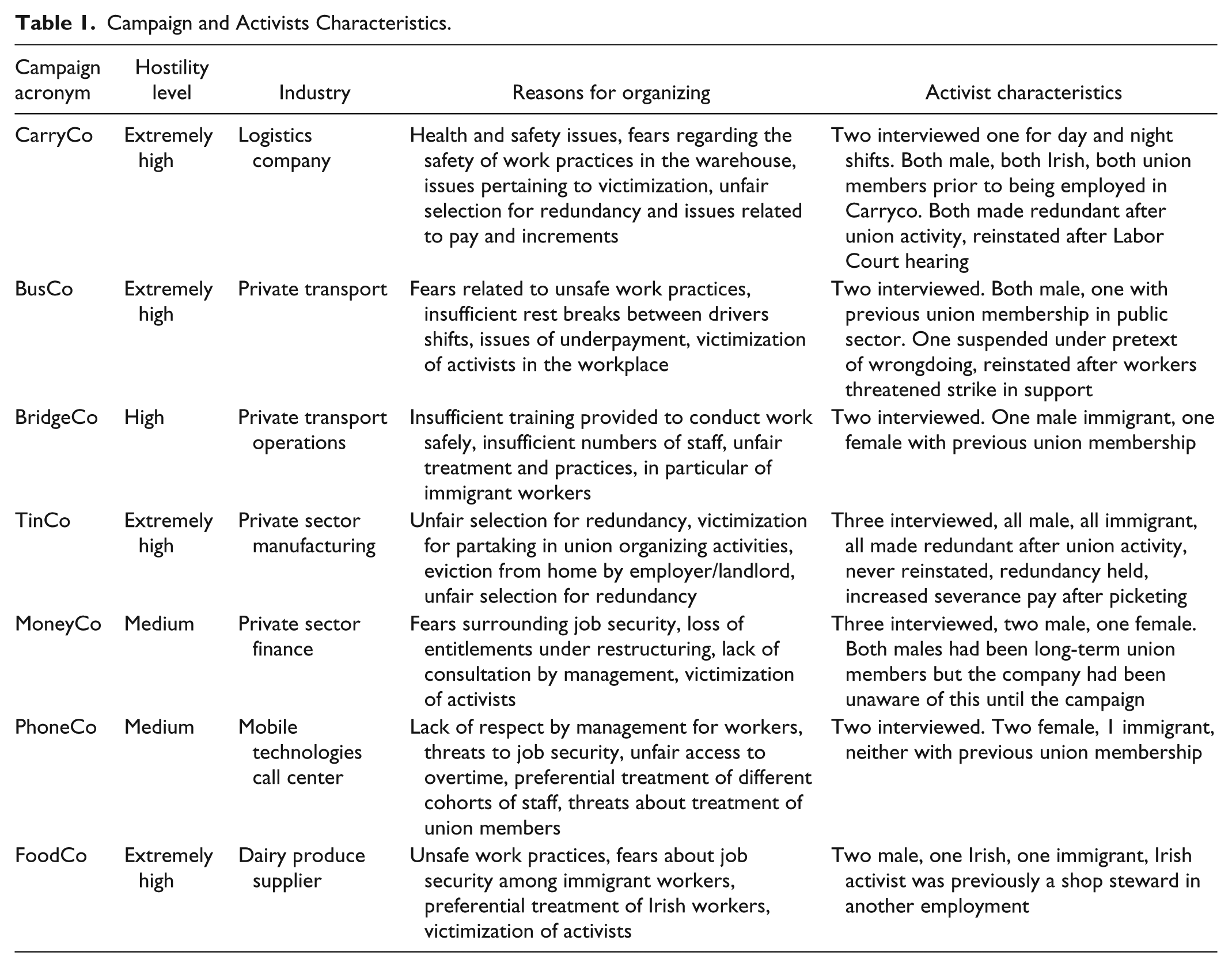
The second category of fear at work related to issues pertaining to job security. In some cases, the threats to job security were subtle and related to the quality of working conditions such as in the meat processing sector where preferential roles were not allocated to workers who were openly critical of management practices: “there’s some parts of the factory that are really hard to work in, but guys would end up working [in those areas] for days without change.” It is notable that this research was conducted in a period of severe economic recession when threats to job security are likely to have been felt more deeply than during periods of high employment. A significant number of organizing campaigns were in establishments that had announced cutbacks and possible redundancies; in those instances, workers were most likely inclined to join the union for instrumental reasons such as the procurement of an enhanced settlement. With regard to job security, high unemployment rates increased fears among employees pertaining to job security. “There are rumors that if anyone were to be made redundant those union members would only get a statutory payment and everyone else would get the traditional six weeks . . .” (Activist, PhoneCo). In another instance, management’s decision to make a group of workplace activists redundant based on their union activities increased fears around job security among the remaining employees and facilitated a renewed emphasis in seeking representation in a logistics-based company. Furthermore, employees’ fears regarding job security were augmented by employers’ failure to produce a physical copy of a job contract when requested. This was particularly found to be the case for immigrant employees. “We joined because the situation in the company was getting worse and worse. It is my opinion and my colleague’s opinion, only because we joined the union that we were harassed by the employer” (Activist, TinCo). The findings also reveal that in many workplaces activists’ personal job security was severely threatened by their actions “The owner was anti-union. The attitude was if you don’t like it get out . . .” For some, the fear of job loss was strong enough to convince them to cease their struggle for changes “it was a long hard battle . . . when we started there was seven or eight of us [activists] and then it dwindled down to four.” It was interesting that for many of the activists interviewed, they referred to the union “as a last resort,” suggesting that organizing had not occurred due to any political belief in worker representation but rather as a reaction to the “sense of fear” that prevailed in the workplace.
Activists’ Experiences of Fear During Organizing
The focus of the previous section has been on the extent to which the experience of fear in the workplace can act as a trigger in mobilizing workers toward union representation. In addition, this article is concerned with the extent to which activists experience fear as a result of seeking such representation. An individual’s cognitive appraisal (how an individual views a situation) of an event or decision will determine their reaction to it. In a fear-inducing situation, this stimulates the fight or flight response (Mullins, 2011). In other words, it is the perception of a situation that determines how an individual will react rather than the situation itself. Experiences of fear and injustice are likely to induce negative emotions but whether these emotions are related to action (attempts to change the situation) or inaction is dependent on the individuals’ cognitive evaluation. Fear and anxiety are obviously overlapping, aversive, activated states centered on threat. They both involve intense negative feelings and strong bodily manifestations (Öhman, 2010). The interviews with the activists attempted to determine the extent to which they experienced fear (real or perceived), during the organizing campaign in two ways. First, the respondents were asked to what extent they had ever experienced anxiety because of employer actions during the campaign. Four of the activists expressed that they had not felt anxious at any point despite it being a hostile situation; these were, however, from an employment rated as medium hostility. Only one activist admitted to feeling extremely anxious and pointed out that this had a lot to do with the macroeconomic situation whereby high unemployment meant that finding alternative employment would be very difficult. Second, of interest was whether these activists had ever felt threatened by the behavior of the employer during the campaign. There was an equal split among the group between those who had felt threatened and those who did not. One activist in BridgeCo recalled that the employer tried to force employees to say that he and others had forced them to unionize.
They brought us down to hotels and they said to us we’re not anti-union but why would you want to join a union? Tell us if you are you being forced to join a union! They did everything to just not let it happen.
Another activist in PhoneCo recalled how management learned of a union meeting that was held and attended in an attempt to scare workers: “management turned up to the meeting in the hotel that we’d arranged and stood outside in the corridor, the employees inside were terrified.”
Lower levels of anxiety were evident among activists who had strong support and other activists to draw upon. However, employer countermobilization tactics had the effect of reducing the number of activists over time, “it was a long hard battle . . . when we started there was eight of us and then it dwindled to four. I suppose the four that were left took the battle and ran with it.” Interestingly, this research also revealed more than one instance of “reluctant activism” whereby an individual was identified to act as a leader given the individual’s background or characteristics and reluctantly, “out of obligation” took on an activist role “I didn’t really want to get involved but they [other workers] heard that I’d been in a union in my last job. I was trying to keep my head down” (Activist, BusCo). Those were the instances in which levels of hostility were such that workers generally felt powerless, not necessarily wanting to take collective action but needed some mechanism through which to engage with management “[workers were] afraid to do anything, you can see that tension in them, if I was to say we’re going on strike next week they’d have a heart attack.” These findings indicate that even with strong support from the union and colleagues, some activists still experience fear, which can have the effect of suppressing their efforts. This indicates the need for greater protection for workplace activists under the law, which is discussed in the next section.
Discussion
D’Art and Turner (2008) argue that an increased emphasis on worker organizing in Ireland was required to address the representation gap, that research also emphasized the importance of active union representatives on the ground. In the case of greenfield organizing, the strength of shop floor organization and activism are critical in closing the representation gap. It is during this form of challenging organizing that workplace activists play a significant role.
Identifying with the union and its aims is a vital antecedent to union joining (Byford, 2011). One of the critical factors in the success of organizing, identified as part of this research, was the work of the workplace activist. Using workplace activists as a resource to promote and encourage worker organization among their own workplace is a central aspect of the organizing model. Workplace activists are a potentially powerful resource for unions in bridging the representation gap as workers are arguably more likely to identify with other workers than a member of an external body. Individuals with previous union membership were found to be an essential element of the mobilization process in many cases. Organizers typically either sought out these individuals or they emerged naturally as leaders during the campaign. Where no previous exposure to unions existed among the group, the process of engaging with staff and building trust generally took considerably longer. In the hotel and retail sectors, for example, the composition of labor in terms of age, gender, and skill level meant that previous union membership was unlikely. A reliance on those with past membership to act as leaders during organizing is a feature that should be of concern to Irish unions. This resource will become increasingly difficult to replicate as diminishing employment density over the past 30 years results in further decline of the individuals with membership experience.
One of the most obvious expressions of conflict between capital and organized labor is employer victimization of union representatives and workplace activists (Hyman, 1975). Gall (2009) defines victimization as dismissals (sacking and redundancies) or suspensions as a result of alleged serious disciplinary offences, of union representatives such as shop stewards, branch secretaries, or activists who hold no formal union position. Victimization works as it sends out a message that others who may consider playing such representational roles will suffer similarly punitive action (Gall, 2009). Gall adds that victimization is a high-risk tactic for employers—given the possibility of it provoking a collective and confrontational backlash from the affected workers. It is this backlash that emerged, from the cases of organizing studied, as one of the key ways in which activists can overcome fear in the workplace; through creating a strong sense of workplace solidarity, both activists and workers became more secure in carrying out collective displays of action. During one campaign examined, BusCo, the lead activist was suspended for a week without pay on the pretext of a customer complaint. The organizer identified that as a turning point: “the only moment in the campaign when I felt that members would have been prepared to strike.”
As mobilization theory suggests, framing issues such that they resonate with the wider group is essential to creating a shared sense of identity in the workplace. Where this was successfully achieved, generally positive organizing outcomes followed, for example, CarryCo, BridgeCo, and BusCo. In contrast, where identity was absent, employers in turn harnessed this lack of identity as a mechanism with which to foster a divide and conquer style of management. In the case of TinCo, the sense of collective commitment to action was an important feature of the campaign. After the initial phase of industrial action was resolved, only the immigrant workers returned to strike action on the second occasion. Management succeeded in breaking collective commitment by separating the issues of contention such that only one group remained affected by the initial grievance. This illustrates the importance of maintaining a sense of collective commitment across the group. This can be an onerous task, one which workplace activists will often find difficult to overcome but which is valuable to both activists and workers through the protection it provides.
The use of fear tactics by employers in the workplace often manifests, as this article has shown, in the attempt to exercise absolute managerial power and suppress worker voice. Power may be defined as the importance that consequences of actions have in a social relationship; “if the consequences of an act are highly important for everyone involved, then the actor is powerful” (Durbin, 1957, p. 61). In the majority of cases, treatment by the employer was cited by the participants as a significant factor affecting their decision to organize. Union representation can be highly effective in restoring the balance of power in the workplace, even in the absence of full union recognition for collective bargaining rights. The establishment of a formal procedural agreement between an employer and union can go some way to rectifying fear at work for many groups. Unlike recognition, a procedural agreement’s powers are limited in scope and exclude pay and substantive issues. Nevertheless, procedural agreements can lead to improvements in staff treatment and to improved perceptions of fairness in the workplace. The creation of such procedural agreements or amendments to existing procedures featured. The cases in this research have highlighted the potential to create changes in the absence of collective bargaining agreements and recognition through employers’ concession to allow for procedural agreements on foot of worker mobilization. This was particularly evident in the MeatCo case where changes were made to the manner in which bonuses were calculated and paid and the recording of overtime. An important implication, however, for unions in the absence of full recognition is the ability to sustain lasting union structures in the workplace in the workplace over time. Yet again, the activist provides a key function in this regard but requires adequate training and protection to do so.
Implications
The findings in this article indicate that the presence and efforts of workplace activists are significantly related to successful results in overcoming fear among participants in union organizing campaigns. This finding adds to the results of studies in worker mobilization that have found activists to be vital in a leadership capacity (Kelly, 1998). To aid the chances of successful organizing, union leaders thus not only need to identify strong workplace activists but also endeavor to protect them during the organizing process. One way in which an organizer can achieve this is through building support among the group such that the worker activist is protected by colleagues support.
Fear has been described as a negatively valenced emotion, accompanied by a high level of arousal (Witte & Allen, 2000). Furthermore, fear has been linked with two other variables as proposed by Rogers (1975, 1983), perceived threat and perceived efficacy. As discussed earlier, the interplay of these cognizant factors will determine the reaction of individuals. The impact of fear on workers during organizing is often downplayed or underacknowledged. For unions, the encouragement of discussion of fears related to the process could be helpful during organizing as it could act to improve the perceived levels of efficacy among some workers through reiterating that success can be achieved through group action. Turner, O’Sullivan, and D’Art (2011) highlight that paid full-time union officials are generally appointed after many years of shop-floor activism and tend to be highly committed trade unionists. However, amid inadequate resources for organizing, many union officers may prefer to avoid involvement with recalcitrant employers, favoring to organize in sectors where hostility is absent. Yet again, fear has a bearing on this decision, the implications of which are twofold. Without adequate support within their workplace and from their union, activists are left vulnerable and unlikely to succeed in achieving positive workplace change. A broader consequence of this beyond union membership is on the creation of paid union officials. With fewer unionized workplaces to draw upon, recruitment of committed union officials is also affected.
Conclusion
To achieve balance in the employment relationship, workers need to either harness their collective power or enjoy strong institutional support. Undoubtedly, the financial crisis in Europe at least has had the effect of weakening such institutional support. Erne (2012) emphasizes the raft of measures that have been imposed in liberalized European economies, which have affected workers, for example, reduced protection against unjustified dismissals, adjustments to multi-employer collective wage bargaining, and adverse changes in the fundamental right to strike. Amid declining protection for workers at national level, one would expect workers to turn toward unionization. However, this article has illustrated that fear stands in the way of such a response. Fear in the workplace has the effect of reducing worker power. Consequently, the balance of power will determine the opportunities that workers perceive to exist to rectify the situation. The manifestation of power in the workplace can take many forms and these have been categorized by McClendon, Wheeler, and Weikle (1998) as factors that can facilitate or inhibit the individual decision to support union action. This article has outlined how fear can be viewed as both a facilitator and inhibitor of the individual decision to unionize. The experience of fear, regarding treatment and job security, and desire to change that experience can be a powerful mobilizing factor for workers in seeking union representation. We have also shown how fear of employer retribution during the organizing process can act as an inhibitor to the individual decision to organize as it raises the costs associated with such action. Workplace activists are crucial to capturing this sense of fear and using it to empower workers toward organization, thus giving them a central role in bridging the representation gap. When questioned on feelings of anxiety during the campaign, some activists reported not feeling anxious. It is likely that many ordinary, less active members in campaigns may perceive a far greater threat than activists have. Returning to the German proverb cited in the introduction of this article, “fear makes the wolf bigger than he is,” workplace activists we argue are almost unique in many workplaces in that they either underestimate or have a realistic view of the level of power an employer holds. Vulnerable groups at work such as immigrant workers, young workers, or agency/contract staff are arguably more likely to overestimate the power of the employer, either as a result of their own vulnerable employment characteristics or through lack of awareness of their employment rights. Consequently they allow this fear to stifle their desire for representation, it is workplace activists who are crucial in convincing groups such as these, that change is possible through acting as a collective. These findings revealed that even the most defiant activist will only take action where a reasonable chance exists that he or she will be supported by his or her colleagues. It is this fact that makes fear such a powerful force in attempting to gain representation. We argue that through an effective mobilization process, to which strong leaders are crucial, that a robust sense of collective commitment can be formed, which subsequently reduces the influence that fear has on both the activist and the group.
However, where fear tactics are used to suppress worker voice in Ireland, there has been limited evidence of efforts beyond that of the union movement to act against such behavior. The National Employment Rights Authority (NERA) is the institutional body charged with inspecting workplaces to ensure that legal provisions related to the payment of wages, working time, and safety are being met. Ensuring voice and rights to representation at work have not been viewed as falling within the agency’s remit. A key recommendation of this research is that action ensuring fairness at work and eliminating employer victimizations should be within the realm of the state and not viewed only as a duty of care exercised by trade unions toward their membership.
The Irish Employment Equality Acts prohibits workplace discrimination on the grounds of union membership, and the Industrial Relations Acts contain a union member victimization clause. However, unions have been slow to progress or publicize such cases, though this research suggests that instances have undoubtedly occurred. This is perhaps because such action represents a double-edged sword for unions. While taking and winning cases on these grounds against employers would send a message that such employer action is reprehensible, unions may also fear that publicizing such cases may discourage other activists from organizing when they see that it can result in job losses and legal actions. It may also be the fact that some cases are settled out of court and the employer embargoes publicity. One recent advancement for unions in this area is the Industrial Relations Amendment Bill 2015, which aims to improve industrial relations procedures where employers refuse to engage in collective bargaining with employees and increase victimization measures to prevent workers being victimized for trade union activity. The revised Industrial Relations Act provides for procedures whereby unions in companies where they are not recognized can apply to the Labor Court for a review of terms and conditions where the employer has refused to engage voluntarily. However, the union must prove that a “not insignificant” number of workers in that workplace wish to be represented by the union. The act will explicitly prohibit inducements by employers for employees to relinquish their trade union membership. Although this is a step forward for Irish unions, it is by no means a panacea for the problems faced by workplace activists. For employers, keeping their workplace outside the scrutiny of the Labor Court relies on sustaining union membership at a minimum, thus repressing the efforts of union activists.
Lipset and Katchanovski (2001) argue that libertarian and individualist values hamper U.S. private sector unionism more strongly than employer hostility does. In contrast, Comstock and Fox (1994) assert that claims suggesting employer resistance does not play a significant role in union decline defy common sense. Indeed research from Fiorito and Bozeman (1996) and Ferguson (2008) suggests many organizing drives end prematurely when a prominent activist is targeted by the employer. If Irish unions are to learn anything from the U.S. experience, it is that protection of activists is essential. Even with strong institutional and legislative support for union recognition, it is activists who drive the organizing process. They therefore require special protection under the law to facilitate this process. The Irish Industrial Relations Amendment Bill 2015 (currently in development) is expected to enhance victimization protection for activists by allowing for an interim relief against dismissal to be applied for in circumstances where an unfair dismissal is suspected to have resulted from union activity. The Bill is also expected to prohibit employer inducement of workers to relinquish trade union representation as per the European Court of Human Rights Wilson v. Palmer case. Although welcome, this legislation has come later, and lacks some of the impact of the legislation designed to protect whistle-blowers introduced in 2014, the Protected Disclosures Act 2014, which act prohibits (a) coercion, intimidation, or harassment; (b) discrimination, disadvantage, or adverse treatment in relation to employment (or prospective employment); (c) injury, damage, or loss; or (d) the threat of reprisal. Under the act, an employee who is dismissed as a result of having made a protected disclosure may claim up to 5 years’ remuneration from his employer. That act also provides for 5 years compensation where the employer was found to have unfairly penalized the individual. Penalties similar to these may act as a stronger deterrent to employers in dealing with activists. Finally, in addition to improving protection of activists from individual employer reprisal at work, legislation and penalties should also be developed to pursue employers who attempt to individually or collectively adversely affect activist’s personal lives beyond the workplace. As Smith and Chamberlain (2015) illustrate in their exposure of blacklisting practices among British construction firms, the victimization of union activists goes beyond the actions of supervisor and managers, it is action that is condoned and facilitated by those at the highest levels of corporations, politics, and law enforcement and affects not only activists but also democratic society as a whole.
Footnotes
Declaration of Conflicting Interests
The author(s) declared no potential conflicts of interest with respect to the research, authorship, and/or publication of this article.
Funding
The author(s) disclosed receipt of the following financial support for the research, authorship, and/or publication of this article: The author would like to acknowledge research funding from the Industrial Relations Research Trust which faciliated part of this research.