




Abstract
There exists a strong relationship between having a criminal history and experiencing barriers to employment. Negative credentials facilitate the social and economic exclusion of individuals with criminal records. However, previous research has not concretely identified whether the stratification of economic opportunities by individual-level criminal records may be further affecting those who demonstrate substance use histories. In this study, we examine the substance use and criminal history profiles of probationers participating in an experimental drug treatment study and how probationer characteristics affect employment outcomes and gross earnings at both the 6- and 12-month follow-up periods. We hypothesize that substance use and criminal history have a main effect and interactional relationship that reduces the odds of self-reporting employment and decreases gross earnings outcomes of probationer. Our results demonstrate that substance use history and criminal history has a main effect on employment and earnings outcomes.
Introduction
In this study, we examine post-treatment employment and gross earnings outcomes of probationers participating in the Maricopa County (Arizona), First Time Drug Offender (FTDO), experimental drug court program that was tested between 1992 and 1994 (Deschenes, Turner, & Greenwood, 1996). Using secondary data, we will be statistically analyzing the main effects and interaction effects of criminal record and substance use history indicators among probationers on their post-treatment employment and gross earnings outcomes at the 6- and 12-month follow-up periods. The model that we will be developing for predicting employment and earnings outcomes among probationers controls for social-demographic and psychosocial indicators.
The extant literature on the theoretical labeling of individuals with criminal records has demonstrated that entrenchment in the criminal justice system has a bifurcated impact on employment opportunities, particularly, for those individuals who have experienced incarceration (Pager, 2005). The primary impact felt by those sentenced to jail or prison is their relocation from their routine social and employment context in the community to a highly regimented, supervised, and structured environment with limited or no economic opportunities for inmates (Rose & Clear, 1998). The secondary impact can be observed during the reentry phase, post-incarceration, when the formerly incarcerated are attempting to resituate themselves into the employment landscape from which they have been suspended for varying periods of time. Frequently discussed observations in the extant literature describe the reentry phase as a form of extrajudicial punishment, where the formerly incarcerated continue to be punished for their criminal records by employers, in the competitive labor market, who are searching for prospective hires with near flawless credentials (Wacquant, 2009). Pager (2005) discusses how criminal records serve as negative credentials that prematurely signal to prospective employers that job applicants may be unstable or unreliable, without further consideration for the job applicants’ skills, education, or employment history. The rate of unemployment among ex-offenders searching for jobs that pay a living wage ranges from 25% to 40% (Pager, 2005).
Even more alarming, more than 700,000 inmates exit prison annually, two thirds of whom reentering society having histories of drug use (Friedmann et al., 2012). If drug problems are left untreated or unmonitored, then this can result in, with a high-likelihood, relapse or re-arrest of ex-offenders. It is reported that drug use results in reincarceration of more than half of inmates within 3 years of their release (Friedmann et al., 2012). Research conducted on employment outcomes of college educated drug users demonstrates that persistent drug users compared with non-drug users have a higher likelihood of being unemployed (Arria et al., 2013). Persistent drug users compared with non-drug users were also found to have an increased likelihood of being employed part-time versus full-time. These findings on the relationship between drug use and employment are even further exacerbated by criminal records as demonstrated by Sung and Chu (2011) who found that offenders who participated in substance use treatment interventions experienced treatment schedules that conflicted with work schedules, making employment difficult during the treatment process. The researchers found that treatment length, treatment compliance, and self-efficacy were strong predictors of post-treatment employment (Sung & Chu, 2011). Those offenders who completed treatment had increased employment prospects compared with offenders who failed to complete substance use treatment. Sung and Chu (2011) discuss how both pro-social personality and law-abiding behavioral characteristics are required to complete substance use treatment and to obtain employment. More specifically, offenders who demonstrate a strong sense of self-efficacy, goal orientation, and motivation have increased odds of both completing substance use treatment and gaining employed when compared with offenders without those profile traits. Although, Sung and Chu found that completing substance use treatment improved employment prospects, however, it did not improve personal incomes.
For this study, we are interested in examining post-treatment employment and gross income outcomes for probationers. We hypothesize that probationers, who self-reported having a criminal or substance use history, will have a decrease in odds of reporting employment at the 6- and 12-month follow-up periods compared with offenders without criminal or substance use histories. In addition, we hypothesize that probationers who reported having a criminal or substance use history, will have a statistically significantly lower mean salary rate at the 6- and 12-month follow-up periods compared with probationers without a history of substance use. Finally, we hypothesize that substance use history moderates the relationship between having a criminal history and post-treatment employment and earnings outcomes. More specifically, the moderator hypothesis states that offenders with a substance use history will have a strengthened relationship between their criminal history and decreased odds of employment and earnings outcomes.
Literature Review
For the past four decades, there has been an exponential growth in the population of inmates under the authority and surveillance of the criminal justice system at both the state and federal levels from 96 per 100,000 in 1970 to 501 per 100,000 in 2006 (Nagin, Cullen, & Jonson, 2009). In particular, African American communities that have historically experienced high-rates of poverty and unemployment are now routinely being targeted and blanketed by formal modes of social control through the active presence of law-enforcement and community-correctional supervision (Garland, 2001; Wacquant, 2009). Western and Wildeman (2009) state that the one in seven Black men are entrenched in the criminal justice system by 2004. It is reported that a third of young African American men, who were non-college educated, were being incarcerated at the beginning of the 21st century (Western & Wildeman, 2009). The enhanced surveillance and authority of the criminal justice system in low-income and minority communities has had socio-legal implications that are pronounced, and difficult to mitigate and reverse (Rose & Clear, 1998). Criminal justice offenders that have passed through the corrections system are labeled criminal and disenfranchised from the formal economy due to discriminatory hiring practices by employers.
Employers with entry-level openings that pay a living wage are typically risk-averse and have a surplus labor pool to draw from to fill their employment needs. The disenfranchisement of the formerly incarcerated not only increases their risk for recidivism, as the formerly incarcerated lack the means to provide shelter and finances for supporting themselves, but unemployment and low-incomes has had a large impact on the public safety and health of communities with high concentrations of offenders. African American men living in post-industrial communities with high unemployment rates have limited education and job skills, thus making them highly susceptible to engaging in the drug-trade and using violence to resolve drug-related disputes (Western & Wildeman, 2009). By engaging in the drug-trade, Black men are not only engaging in criminal behavior, associated with mandatory minimum sentences, for economic gain, but also simultaneously proliferating addiction and the mental and physical health problems associated with addiction into their communities. Similarly, violence is now understood to not only be a public safety issue for communities but is now also being viewed as a significant public health disaster as emergency rooms are flooded with an influx of victims of violence suffering from both physical wounds and trauma. The homicide epidemic among economically disadvantaged Black men between the ages of 18 and 25 are nearly 25 times higher compared with White men between the ages of 25 and above (Western & Wildeman, 2009).
The negative social and health effects of incarceration are not only found among African American men, but results from research demonstrate that experiencing incarceration increases the odds of premature adult mortality, particularly among women, even when statistical controls for socio-demographic characteristics, education, drug use, and cigarette use are applied. Men who have experienced incarceration have an increased odds of premature adult mortality compared with men who have not been incarcerated. Having a lower level of education and being Black were found to increase the odds of premature mortality (Massoglia, Pare, Schnittker, & Gagnon, 2014).
The reentry phase for the formerly incarcerated, released from prison or jail, presents numerous obstacles, which include but are not limited to, explaining to employers about gaps in employment, criminal records, and temporary residential addresses. The overwhelming presence of law enforcement as the primary instrument for maintaining social control of the formerly incarcerated, through the appendages of community corrections, has been linked to exacerbating the social disorganization, within communities with high concentrations of offenders, through the active removal and relocation of ex-offenders who violate their parole or probation mandates. Research illustrates that recidivism rates are high among the formerly incarcerated. An estimated two thirds of offenders released from prisoners are rearrested and one-third are reincarcerated (Freeman, 2008). The revolving doors of the criminal justice system diminishes or outright eliminates offenders’ capacity to assume multiple roles, such as, being guardians and financial providers for their families (Rose & Clear, 1998).
The displacement of offenders through the process of removing and criminally labeling existing and potential social capital and financial providers through differentially enforced law-enforcement policies that have disproportionately targeted communities with high concentrations of African American and Hispanic young men has had a profound impact on their employability and income outcomes (Freeman, 2008; Golub, Johnson, & Dunlap, 2007; Wacquant, 2009). Contemporary criminal justice policy serves as an instrument of actuarial management of offenders to not only mitigate offender risk for recidivism but also enhance public safety through intensive supervision and surveillance practices, rather than emphasizing rehabilitation or treat offenders for their underlying criminogenic risk factors, thus leaving offenders unprepared for the labor market and vulnerable to law-enforcement practices (Andrews & Bonta, 2010; Feeley & Simon, 1992; Packer, 1968; Tonry, 2004).
Unsuccessful reentry and reintegration of offenders within their respective communities has been linked to the inability to access employment training programs and to find meaningful employment that provides living wages (Sung & Chu, 2011). Finlay (2009) found that in states with open-records policies where employers have access to criminal history records over the Internet corresponded with lower wages and earnings when compared with states that provide closed-record policies and restorative rights for former offenders. In addition to the structural barriers to entering the labor market faced by those with criminal records, offenders returning back to their communities, after a period of incarceration, often lack employment and skills that correspond with the volatile demands of the labor market.
However, the results remain mixed when examining the effectiveness of community employment treatment programs on reducing the risk of offender recidivism. Results from a meta-analysis conducted by Visher, Winterfield, and Coggeshall (2005) suggest that non-custodial community employment programs do not reduce the odds of re-arrest among ex-offenders. Furthermore, the researchers divided the studies that they meta-analyzed into two groups, examining re-arrest rates among community employment program participants based on whether they either had a prior conviction or only a prior arrest. Similarly, they found that community employment programs did not reduce the odds of recidivism for both groups (Visher et al., 2005).
Bushway and Apel (2012) report that at the national level, 35% of incarcerated inmates have a high school diploma compared with 82% of the general population. Furthermore, Bushway and Apel state that the formerly incarcerated demonstrate characteristics that parallel other hard-to-employ populations, such as welfare recipients and high school dropouts. The limited emphasis placed on the rehabilitation of offenders through education and employment training within the context of the criminal justice system has shaped the narrative surrounding reentry of offenders and their recidivism rates. Although routinely unsuccessful in reducing recidivism, evidence-based employment programs provide valuable information on program participant demographics and outcomes tied to substance use treatment, emerging public health issues, and medical services utilization. In addition, reentry employment programs have been viewed as an alternative and less invasive state-sanctioned social control for supervising inmates post-incarceration.
In particular, Bushway and Apel (2012) discuss how a longitudinal research study conducted in New Jersey over an 18-year period demonstrated that upwards of 25% of convicted felons desisted from offending during that time period. However, most evaluations of employment training programs for the formerly incarcerated remain shortsighted and examine recidivism rates within a 2-year pre and post-treatment period, which is problematic because they are unable to identify potential offenders who will desist for the long term (Bushway & Apel, 2012). Therefore, according to Bushway and Apel that desistance from future recidivism either aided or unaided through employment programs should be perceived as a signal that offenders have the capacity to become law-abiding when given the opportunity and in the absence of official state-sanctioned social controls, such as probation or parole.
Researchers, stakeholders, and criminal justice policy makers continue to examine and promote interventions that facilitate reductions in recidivism and yield high-quality data that allow for the indirect surveillance of economic and public health outcomes, associated with offenders, for the purposes of informing public policy (Bushway & Apel, 2012). Other scholars suggest that reductions in recidivism can be achieved by leveraging the authority of the criminal justice system to pressure offenders post-incarceration into aftercare rehabilitation oriented programs, such as substance use treatment, mental health treatment, employment readiness, and job placement programs (Chintakrindi, Porter, Mellow, & Sung, 2015; Chintakrindi, Upton, Louison, Case, & Steadman, 2013; Friedmann et al., 2012; Sung & Belenko, 2005).
Pager (2005) provides an applied theoretical framework for understanding how the labeling process is facilitated for the disenfranchisement of offenders from the formal economy, through the institutionalized administration and bureaucratic management of negative credentials, thus stratifying offenders and non-offenders in the competitive labor market. Sung and Belenko (2005) found that offenders participating in the Drug Treatment Alternative to Prison (DTAP) program who were unemployed had a higher likelihood of arrest compared with those who were employed. More specifically, 45% of those who indicated that they were unemployed were rearrested at the 5-year follow-up period compared with 28% of those who indicated employment while participating in DTAP. The researchers hypothesize that the lower odds of arrest among the employed ex-offenders may perhaps be attributed to the imposition of discipline, generation of income, and increased self-esteem associated with a pro-social identity that is facilitated by having stable employment.
Employers advertising entry-level positions with livable wages demand higher education, optimal physical and mental health, above-satisfactory credit histories, and no criminal records. The research conducted by Pager (2005) illustrates how the interaction of race and criminal history in the contexts of searching for employment, for the formerly incarcerated, is a form of “double jeopardy.” The formerly incarcerated and those with criminal histories continue to be punished long after having served their sentences, where they face discrimination for not only their criminal records, but research demonstrates that their race may also factor into employability (Pager, 2005). From an experiment conducted by Pager on the callback rates from employers for employees seeking jobs, descriptive statistics illustrate that White individuals with criminal records (17%) had slightly higher callback rates compared with Blacks without criminal records (14%).
Along with race and criminal history, substance use history appears to be a significant detriment to employability. However, previous research has not concretely identified which factor has the strongest main effect on ex-offenders seeking employment. Pager (2003) reviews how incarceration history alone does not fully explain poor post-incarceration employment outcomes among offenders. In fact, the relationship between incarceration history and employment outcomes may be spurious. Instead, Pager illustrates that pre-existing characteristics of offenders, such as substance use dependence, behavioral problems, and poor interpersonal skills have been found to be robust predictors of both recidivism and poor-employment outcomes when compared with the effects of incarceration history alone.
An examination of treatment outcomes from a study on drug court participants revealed that participants who reported having employment at intake increased their odds of completing of drug court (Roll, Prendergast, Richardson, & Ramirez, 2005), whereas, participants who reported having a history of injection drug use were less likely to complete drug court. Roll et al. (2005) speculates that indicators of employment and injection drug use history are proxies for measuring the severity of participants’ substance use disorders while being under the supervision of drug court. Furthermore, the researchers speculate that individuals who are able to maintain employment are not as impaired as those participants without employment and also have less severe histories of substance use disorders and better prognosis for recovery.
Similarly, research on employment and work outcomes among drug court participants conducted by Leukefeld, Webster, Staton-Tindall, and Duvall (2007) demonstrates that participants who received an employment/skills training intervention, while mandated to drug court, reported decreased drug use and recidivism compared with the treatment as usual control group in the study. More specifically, increased dosage and exposure to the employment intervention was associated with decreased self-reported substance use and criminality among the drug court clients. Although findings from both the Roll et al. (2005) and Leukefeld et al. demonstrate a promising relationship between being employed, receiving employment training, and decreased substance use and criminality, there still remains a gap in knowledge regarding the extent to which having a substance use history affects the relationship between criminal history and post-treatment employment and gross income outcomes.
Summary of the MaricopaCounty FTDO Program
Data for this study were taken from the Arizona, MaricopaCounty, FTDO Program. This study is a secondary data analysis of the FTDO program participants’ earnings and employment outcomes. The researchers who collected the data for the FTDO study were concerned with measuring the drug usage and recidivism outcomes of probationers (Deschenes et al., 1996). Participants in the program were randomly assigned to either standard probation with varying drug testing and probation supervision schedules in the control group or they were assigned to drug court and intensive drug treatment, which was the experimental group, for a 12-month period. The method for randomly assigning research participants into the control and experimental groups was managed by a computer program (Deschenes et al., 1996).
Within the control group, probationers were randomly assigned to three different tracks which differed in their frequency of urine-analysis testing and probation supervision dosage. All three tracks were assigned probation supervision with varying schedules of supervision dosage. Probationers in Track 1 did not receive any urine-analysis testing and the frequency of visits with the probation officers were determined by both scores from a risk and needs assessment. Probationers in Track 2 received low-frequency urine-analysis testing once a month and visited once bimonthly with a probation officer. Probationers in Track 3 received high-frequency urine-analysis testing biweekly and visited with the probation officer once bimonthly (Deschenes & Greenwood, 1994).
The intensive treatment program, for the experimental group, in Track 4, emphasized a biopsychosocial treatment model that sought to treat the whole individual, rather than focus solely on drug use. An assumption of the biopsychosocial treatment model is that drug use is a symptom of other problems that may include but is not limited to poor coping skills related to family dysfunction, anxiety, self-esteem, anger, or codependency (Deschenes & Greenwood, 1994). Offenders in the experimental group received the treatment intervention in three phases, each of which lasted 2 months. The first phase, the orientation, provided weekly drug education, social skills training, and a 12-step meeting focused on providing drug education and relapse prevention. The second phase, known as stabilization, focused primarily on relapse prevention. The third and final phase, known as transition, required probationers to attend one process group meeting and one 12-step meeting once a week. The treatment protocol and underlying theory guiding the experimental intervention has been exhaustively detailed by Deschenes and Greenwood (1994).
Research participants in the experimental group, Track 4, received probation supervision through a drug court program that included random urine-analysis testing, probation supervision, and intensive outpatient drug treatment that included counseling, drug treatment, relapse prevention, social skills training, and group therapy. The drug court, provided offenders with a contract, outlining expectations and the structure of the program. The judge in the program explained to the offenders how rewards and punishments are associated with urine-analysis outcomes. Probationers, who consistently had negative urine-analysis outcomes, indicating no drug use, received reduced jail time and probation sentences. For probationers with positive urine-analysis outcomes, indicating drug use, the judge had the option of ordering probationers to repeat phases of treatment, more drug testing, or jail time (Deschenes & Greenwood, 1994).
Research Questions
Our study seeks to understand the main effects of substance use and criminal history on post-treatment employment and income outcomes among probationers participating in the Maricopa County, Arizona, Experimental Drug Treatment Study at the 6- and 12-month follow-up periods (Deschenes & Greenwood, 1994). This study is interested in examining the moderating effect that having a substance use history has on the relationship between criminal history and employment outcomes at the 6- and 12-month follow-up periods. Moreover, this study is interested in examining the moderating effect that having a substance use history has on the relationship between criminal history and income outcomes at the 6- and 12-month follow-up periods.
Hypotheses
In this study, we hypothesize that probationers with substance use histories have an increased odds of reporting unemployment at both the 6- and 12-month follow-up periods. Moreover, we hypothesize that probationers with criminal histories have an increased likelihood of reporting unemployment at both the 6- and 12-month follow-up periods. We hypothesize that having a substance use history has a moderating effect on the relationship between having a criminal history and decreased odds of unemployment at both the 6- and 12-month follow-up period. More specifically, we hypothesize that probationers reporting a substance use history will strengthen the relationship between having a criminal history and decreased odds of unemployment at both the 6- and 12-month follow-up periods.
Similarly, we hypothesize that probationers with substance use histories compared with those without substance use histories have decreased gross incomes at both the 6- and 12-month follow-up periods. Moreover, we hypothesize that probationers with criminal histories compared with those without criminal histories have decreased gross incomes at the follow-up periods. We hypothesize that having a substance use history has a moderating effect on the relationship between having a criminal history and decreased gross income outcomes at both the 6- and 12-month follow-up periods. More specifically, we hypothesize that reporting a substance use history will strengthen the relationship between having a criminal history and decreased gross income outcomes at both the 6- and 12-month follow-up periods.
Method
Data
For this study, we conducted a secondary data analysis of the Maricopa County, Arizona, adult probation experimental drug testing program data, which was collected between the years 1992 and 1994 (Deschenes et al., 1996). These data were accessed using the Interuniversity Consortium for Political and Social Research (ICPSR) website.
Sample
Probationers in this study were sentenced between 1992 and 1993. The probationers agreed to participate in the Maricopa County Adult Probation Department (Arizona) drug court experiment. The Maricopa County FTDO program is a post-adjudication drug treatment program for offenders sentenced to probation for a felony drug offense (Deschenes et al., 1996). Offenders who were eligible for the FTDO program had first time convictions for possession of marijuana, dangerous drugs, narcotics, or drug paraphernalia (Deschenes & Greenwood, 1994). Offenders convicted of drug sales or trafficking were not eligible to participate in the research study.
Measures
In this study, we use a retrospective case–control design, in which employment and earnings among probationers were compared in terms of their expression by social-demographic, psychosocial, and criminal and substance use history characteristics. The measures we will use for our final multivariate models were specified based on the extant literature discussed in the literature review and through identifying statistically significant indicators during our bivariate analyses.
Outcome variables
In this study, we will examine both employment and gross earnings outcomes among probationers, which include the employment status and gross earnings of probationers at both the 6- and 12-month follow-up periods. We dichotomously coded the employment status (0 = unemployed or had part-time/full-time employment = 1) at both the 6- and 12-month follow-up periods. The gross earnings variable is a continuously coded, ratio level, measure that is used to measure monetary earnings at both the 6- and 12-month follow-up period.
Predictor variables
For this study, we will be controlling for seven items that are indicators of the social-demographic background characteristics among the probationers. The study track variable was originally coded as the control group (Tracks 1-3) and treatment group (Track 4). The study track variable in this study will be recoded into a discrete dichotomously coded variable that will be operationalized as 1 = treatment group and 0 = control group. The demographic data that will be used in this study include the age of the offender entering the research study, gender of the offender (1 = male or 0 = female), race (1 = non-White or 0 = White), education level of offender (1 = high graduate or 0 = not high school graduate), relationship status (1 = has relationship or 0 = single), and living status (1 = living alone or 0 = living with at least one person).
We will be controlling for six items that are indicators of psychosocial characteristics. The psychosocial variables that we will use in this study include data on the attitudes toward complying with the law (1 = not motivated to change, rationalizes behavior or 0 = motivated or somewhat motivated to change), marital and family relationships (1 = some or major family dysfunction or 0 = exceptionally or relatively stable family functioning), peer associations (1 = has occasional or completely negative relationships or 0 = good or no negative relationships), physical health (1 = some or severe health dysfunction or 0 = sound health), emotional stability (1 = some or severe limits to emotional functioning or 0 = exceptionally or appropriately adjusted), and probation officer assessment of probationer needs (1 = probation officer assessment indicates moderate or high needs or 0 = probation officer assessment indicates well-adjusted or no needs). The psychosocial variables were originally coded using multiple indicators. We collapsed the indicators into dichotomously coded binary categories.
We will be examining seven items that are indicators of criminal history. The variables we will include in this study will be dichotomously coded variables including the number of prior arrests (1 = one or more prior arrests or 0 = no prior arrests), number of prior misdemeanor convictions (one or more prior misdemeanor convictions or 0 = no prior misdemeanor convictions), number of prior felony convictions (one or more prior felony convictions or 0 = no prior felony convictions), prior jail history (1 = yes has been to jail or 0 = no has never been to jail), prior prison history (1 = yes has been to prison or 0 = no has never been to prison), employed prior to arrest (1 = yes employed prior to arrest or 0 = not employed prior to arrest), and history of drug dealing (1 = yes has dealt drugs or 0 = no has not dealt drugs).
We will be examining nine items that are indicators of substance use history. We will be dichotomously coding each of the specific drug use indicators (1 = used substance and 0 = did not use substance). We will create an aggregate measure using the data from the individual substance use history variables to measure history of any drug use (1 = yes has history of any drug use or 0 = no does not have history of any drug use). In addition, we will measure substance use treatment prior to arrest using a dichotomously coded indicator (1 = yes has previously been enrolled in substance use treatment or 0 = no has not been previously enrolled in substance use treatment). Finally, we will use a dichotomously coded indicator of whether probations were enrolled in substance use treatment at the time of their arrest (1 = yes enrolled in substance use treatment or 0 = no not enrolled in substance use treatment).
Plan of Analysis
For this study, we begin by providing descriptive statistics using percentages and means for the outcome variables at the 6- and 12-month follow-up periods. Moreover, we will present descriptive statistics for the predictor variables: demographic characteristics, treatment condition, criminal history, and substance use history. Next, we will be conducting bivariate statistical analysis of the employment and gross earnings outcomes with predictor variables for the purpose of identifying marginally or statistically significant relationships with an alpha value of less than .10. The employment outcome variable measured at the follow-up periods is discrete and dichotomously coded. Therefore, we will use a chi-square test to examine the relationship between employment outcomes and predictor variables. Using an independent sample t test, we will examine the relationship between gross earnings and predictor variables. For continuously coded predictor variables, we will use a Pearson’s r correlational test for examining their relationship to gross earnings. This will allow us to identify the magnitude and direction of marginally or statistically significant relationships between predictor and outcome variables with an alpha value of less than .10.
Finally, we will identify predictor variables that were found to be theoretically important in the extant literature and statistically or marginally significantly during our exploratory bivariate analyses. These predictor variables will then be used to specify our hierarchical logistic regression and hierarchical multiple regression models for predicting earnings and employment outcomes. Hierarchical regression is used when there is a lack of independence across levels of clustered data. Sung and Richter (2006) report that the hierarchical regression technique can control for temporal and spatial clustering of data when testing predictive models using data with similar background characteristics. A lack of independence across levels of clustered data can result in incorrect point estimates, confidence intervals, standard errors, and p values, which are threats to both internal and external validity (Sung & Richter, 2006). We are attempting to determine which criminal history and substance use history variables are robust for predicting employment outcomes for probationers when controlling for background and psychosocial characteristics.
The output that will be reported and interpreted for the logistic regression analysis includes the −2 log likelihood for the fully reduced model and the related χ2 for the full model and related significance levels to determine whether inputting independent variables improves the model fitness. The results that are reported and interpreted include the odds ratios and significance levels for each predictor variable. The output that will be reported and interpreted for the multiple regression analysis include the R2, F-value, model significance, unstandardized regression coefficients, and significance of coefficients.
We hypothesize that indication of a prior criminal history separately predicts a decrease in employment and earnings outcomes at both the 6- and 12-month follow-up periods. The moderator hypothesis is that substance use will strengthen the relationship between criminal history and employment and earnings outcomes. The model diagrammed in Figure 1 has three causal paths that affect the post-treatment employment and earnings outcomes. Path A examines the main effect of the predictor, substance use history, on post-treatment employment and earnings outcomes. Path B examines the “impact of controllability as a moderator” (Baron & Kenny, 1986). The moderator in Path B for this study is substance use history. Path C examines whether there is a significant interaction between criminal history and substance use history when separately predicting both employment and earnings outcomes.

Moderator hypothesis testing of criminal history and substance use history.
If a significant interaction effect is observed, then we can interpret our observation as a moderation effect. However, to determine whether our moderator hypothesis is supported, it is necessary to interpret the magnitude and direction of the interaction effect. Baron and Kenny (1986) report that there may be significant main effects for both the predictor and moderator; however, the main effects are not conceptually relevant to testing the moderator hypothesis. Baron and Kenny also report that the moderator variable should be uncorrelated to both the predictor and outcome variable to clearly interpret the interaction term between the predictor and moderator (Path C). Moderators and predictors are both considered exogenous variables and are always considered independent variables that are causally antecedent to the outcome variable (Baron & Kenny, 1986).
The moderator hypothesis for our research question is tested by computing an interaction term between the predictor variable (criminal history) and the moderating variable (substance use history). To avoid issues with multi-collinearity, the criminal history for each case was centered by subtracting the overall mean from each individual case for the criminal history variable. Next, an interaction was computed between the centered criminal history and the substance use history by multiplying the two variables. Finally, both of the main effects, the interaction term and control variables, will be entered into the model to predict the employment and earnings outcome variables.
Missing Data
For this study, we highlight the percentage of missing data in our descriptive statistics. Among predictor variables the percentage of missing data ranged from 0% to 10.4% missing. For predictor variables, we observed a relatively low percentage of missing data, especially when compared with missing data among our earnings and employment outcome variables for this study. Among the outcome variables, we observed that the percentage of missing data ranging from 53% to 70% of outcome data recorded at the 6- and 12-month follow-up periods. For this study, we listwise deleted cases with missing predictor or outcome variable data. We did not attempt to impute missing outcome variable data because Wood, White, and Thompson (2004) discuss that when a large percentage of outcome data is imputed this can lead to bias in statistical interpretation, particularly if it is missing data for outcome variables.
Given the large percentage of missing outcome data and an analysis of missing data using the Missing Value Analysis module in IBM SPSS v.22, we find that our data is missing completely at random and is unrelated to baseline covariates. Porter and Ecklund (2012) provide an extensive discussion on “active nonresponders” which are described as research participants that complete a portion of the study but refuse to or are unable to complete the rest of the survey for individual-level reasons. Porter and Ecklund found that when asking research participants controversial research questions regarding personal or stigmatizing information, they were less likely to respond to those questions. Porter and Ecklund specifically state, We link their data patterns to family formation, religious socialization, and present religiousity . . . traditional statistics do not always help us understand the reasons behind missing data and low survey-response rates. (pp. 450-451)
Results
The results that we will be presenting in this section are separated into three parts. We will begin with the descriptive statistics by summarizing the social-demographics characteristics of the probationers in the sample and their employment and earnings outcomes. In the second part of the results section, we will provide the results from the bivariate analysis using the chi-square test and independent samples t test for examining the relationship between control, predictor, and outcome variables. In the third and final part of the results section, we will be presenting a series of output for logistic and multiple regression analyses where we are predicting employment and earnings outcomes measured at both the 6- and 12-month follow-up periods. Our moderator hypothesis will be tested using indicators of criminal history and substance use history by examining their main effects and interactional effects on the outcome variables. Marginally or statistically significant relationships will be reported and interpreted.
Descriptive Statistics
Using study data, in Table 1, we observe that there are 630 probationers with 27.9% (n = 176) randomized to the treatment group and 72.1% (n = 454) in the control group. The mean age of the probationers was 28.9 ± 7.6 years. The gender distribution is 22.1% (n = 139) women and 77.9% (n = 491) men. The race distribution is 53.7% (n = 338) White and 46.3% (n = 292) non-White. The distribution of relationship status is 17.5 % (n = 110) married or in a relationship and 82.4% (n = 519) are single or divorced. The distribution of living status is 8.6% (n = 54) living alone and 87.1% (n = 549) living with at least one other person. The education distribution is 50.0% (n = 315) with a high school education or higher and 49.4% (n = 311) with less than a high school education.
Descriptive Statistics of Variables.

Note. HS = high school; GED = General Education Development.
Using study data in Table 1, we observe that at the 6-month follow-up, 85.9% (n = 255) indicated having either part-time or full-time employment. Moreover, we observe that 14.1% (n = 42) of probationers indicated having no employment at the 6-month follow-up. At the 12-month follow-up, we observe that 78.9% (n = 176) of probationers indicated having either part-time or full-time employment. Moreover, we observe that 21.1% (n = 47) of probationers indicated having no employment at the 12-month follow-up. In Table 1, we observe that at the 6-month follow-up, the mean gross earnings is US$803.40 ± US$579.74 (n = 284). We observe that at the 12-month follow-up, the mean gross earnings is US$796.37 ± US$613.37 (n = 191). To put these descriptive findings into context, the U.S. Census Bureau (2015) reports that in 1994, the income poverty threshold, for a household of two persons with zero children, who are both under the age of 65, is US$9,924.00. Based on our estimations, if our probationers were reporting monthly gross earnings, on average, of US$796.37 over a 12-month period, they would have earned US$9,556.44, which is below the poverty threshold for 1994 (U.S. Census Bureau, 2015).
Bivariate Analysis Results
Chi-square test results
The chi-square test results (Table A1 in the appendix) reveal that there are a few marginally significant relationships between indicators of background characteristics and employment outcomes. More specifically, we observe that at the 6-month follow-up that there is a marginally significant relationship between living status and employment outcomes (p< .10). At the 12-month follow-up, we observe that the treatment condition is marginally significantly related to employment outcomes (p< .10). However, using the chi-square test, we did not observe any statistically or marginally significant relationships between psychosocial indicators and employment outcomes at both the 6- and 12-month follow-up periods (Table A1 in the appendix).
The chi-square test results (Table A2 in the appendix) reveal that there are a few marginally or statistically significant relationships between indicators of criminal history and employment. The indicator for prior arrests is statistically significantly related to employment outcomes at the 6-month follow-up period (p<.05). The indicator for having employment prior to arrest is statistically significantly related to employment outcomes at the 6-month follow-up (p< .01). The indicator for prior felony convictions is statistically significantly related to employment outcomes at the 12-month follow-up (p< .05). The indicator for previous jail time is statistically significantly related to employment outcomes at 12-month follow-up (p< .05). The indicator for engaging in drug sales is marginally significantly related to employment outcomes at the 12-month follow (p< .10).
The chi-square test results (Table A2 in the appendix) reveal that there are a few statistically significant relationships between indicators of substance use history and employment outcomes. More specifically, we observed that the indicator of having a history of using uppers (e.g., stimulants) is significantly related to employment outcomes at the 6-month follow-up (p< .05). At the 12-month follow-up, we observe that there is a statistically significant relationship between having a history of any drug use and employment outcomes at the 12-month follow-up (p<.05).
Independent sample t-test results
In this section, we will examine results from the independent samples t-test analysis of differences in mean gross earnings using predictor and control variables (Table A3 in the appendix). We will begin by analyzing mean differences in gross earnings by socio-demographic characteristics. At the 6-month follow-up, we observe that probationers who are married (M = 1,055.06, SD = 655.36) have a statistically significant higher gross earnings mean compared with probationers who are not married (M = 754.14, SD = 548.82), t(279) = −1.55, p< .01. At the 6-month follow-up, we observe that probationers who are living alone (M = 1,158.59, SD = 912.10) have a statistically significant higher gross earnings mean compared with probationers who are living with at least one person or more (M = 769.50, SD = 523.44), t(278) = −3.365, p<.01.
At the 12-month follow-up, we observe that probationers who are racially White (M = 872.50, SD = 655.56) have a statistically significant higher gross earnings mean compared with probationers who are racially non-White (M = 686.06, SD = 531.42), t(189) = −2.083, p< .05. At the 12-month follow-up, we observe that probationers who are married (M = 972.126, SD = 531.42) have a marginally significantly higher gross earnings mean compared with probationers who are not married (M = 754.14, SD = 608.72), t(189) = −1.955, p< .10. At the 12-month follow-up, we observe that probationers who have an education of a high school education or higher (M = 854.15, SD = 644.56) have a marginally significantly higher gross earnings mean compared with probationers who have less than a high school degree (M = 684.40, SD = 537.67), t(188) = −1.858, p< .10.
Our analysis of gross earnings mean differences by psychosocial characteristics did not reveal any statistically significant results at both the 6- and 12-month follow-up periods. However, we did find that at the 12-month follow-up that probationers who indicated being exceptionally or appropriately emotionally adjusted (M = 958.88, SD = 892.88) have a marginally significantly higher mean gross earnings compared with probationers who indicated having some or severe limits to emotional functions (M = 760.97, SD = 534.73), t(184) = −1.698, p< .10 (Table A3 in the appendix).
Our analysis of mean gross earnings differences by criminal history indicators yields statistically significant results at both the 6- and 12-month follow-up periods (Table A4 in the appendix). More specifically, at the 6-month follow-up, we found that probationers who were employed prior to arrest (M = 869.80, SD = 590.13) have a statistically significantly higher mean gross earnings compared with probationers who were not employed prior to arrest (M = 575.15, SD = 446.81), t(276) = −3.593, p< .01. At the 12-month follow-up, we found that probationers who have no prior history of going to jail (M = 886.50, SD = 645.59) have a statistically significantly higher mean gross earnings compared with probationers who have a history of going to jail (M = 672.05, SD = 560.21), t(178) = 2.243, p< .05. At the 12-month follow-up, we found that probationers who were employed prior to arrest (M = 859.57, SD = 632.99) have a statistically significantly higher mean gross earnings compared with probationers who were not employed prior to arrest (M = 595.61, SD = 467.68), t(184) = −2.556, p< .05. At the 12-month follow-up, we found that probationers who have no prior misdemeanor convictions (M = 907.89, SD = 727.23) have a marginally significantly higher mean gross earnings compared with probationers who have prior misdemeanor convictions (M = 729.29, SD = 529.14), t(188) = 1.951, p< .10.
Our analysis of gross earnings mean differences by substance use history did not reveal any statistically significant results at both the 6- and 12-month follow-up periods (Table A4 in the appendix). However, we did find that at the 6-month follow-up that probationers who indicated using uppers, such as, stimulants (M = 688.21, SD = 479.16), have a marginally significantly lower mean gross earnings compared with probationers who indicated never having used uppers (M = 833.62, SD = 594.96), t(280) = 1.792, p< .10.
Logistic and Multiple Regression Analysis Results
Based on previously conceptualized models from the theoretical and empirical literature and also using our bivariate analysis results to guide our model specification, we will use a model structure that tests outcome for employment and earnings using the following constructs: social-demographic characteristics, psychosocial characteristics, criminal history, and substance use history to predict post-treatment employment and earnings outcomes. Our specification of our theoretical constructs for criminal history is the product of identifying three separate items that are representative of criminal history in the extant literature. In our final model, we use the following indicators for criminal history: prior arrests, previous jail commitments, and employment prior to arrest. For representing an overarching construct of substance use history, we use any history of illegal substance use and history of using uppers. Both substance use history indicators were found to be statistically significant in our bivariate analysis.
Logistic regression analysis for predicting employment status at the 6- and 12-month follow-up
We observe a statistically significant model for predicting employment outcomes at the 6-month follow-up when all of the control and predictor variables are inputted into the final model (Model 5) using hierarchical logistic regression (p< .05). In Table 2, we observe that probationers who indicated having one or more prior arrests decreased their odds of gaining employment by 0.133 times at the 6-month follow-up compared with probationers who did not have prior arrests (p< .05). Probationers who were employed prior to their arrest increased their odds of gaining employment at the 6-month follow-up by 2.971 times compared with probationers who were not employed prior to arrest (p< .05). Probationers who indicated having used uppers at least one time had decreased their odds of gaining employment by 0.405 times at the 6-month follow-up compared with probationers who never tried uppers (p< .10). We found no significant interaction to support our moderation hypothesis. The Nagelkerke pseudo R2 demonstrates that our final model explains a moderate 20% of the variation in the employment outcome at the 6-month follow-up.
Logistic Regression Analysis for Predicting Employment Status at the 6-Month Follow-Up.
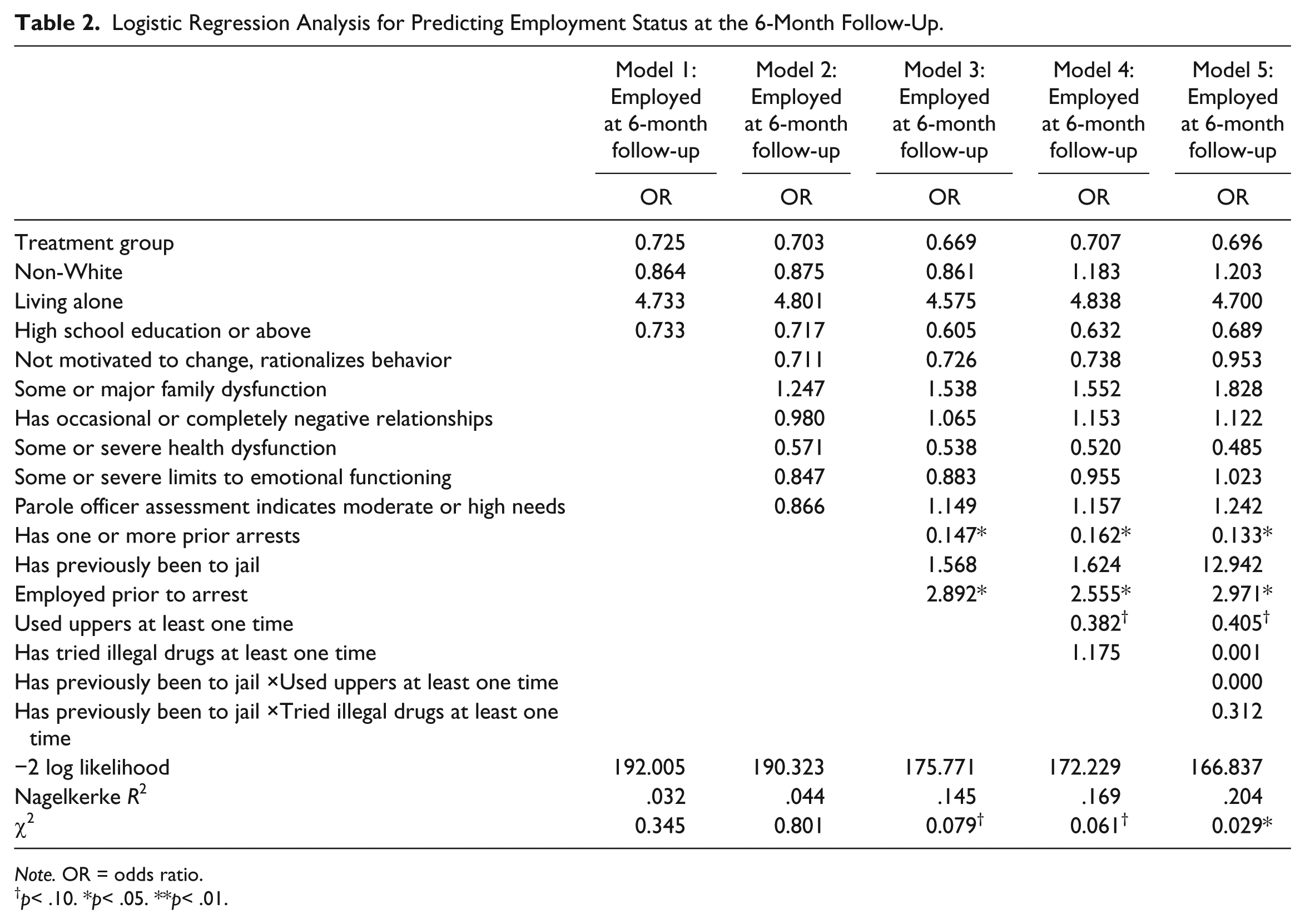
Note. OR = odds ratio.
p< .10. *p< .05. **p< .01.
In Table 3, we observe a statistically significant model for predicting employment outcomes at the 12-month follow-up when all of the control and predictor variables are inputted into the third model using hierarchical logistic regression (p< .05). We will be interpreting the findings from Model 3. We observe that probationers who indicated being assigned to the treatment group increased their odds of gaining employment by 3.411 times at the 12-month follow-up compared with probationers who were assigned to the control group (p< .05). Probationers who indicated some or severe health dysfunction had decreased their odds of employment by 0.377 times compared with probationers with good health at the 12-month follow-up (p< .10). Probationers who indicated having previously been to jail had decreased their odds of employment by 0.324 times compared with probationers with no jail history at the 12-month follow-up (p< .05). We found no significant interaction to support our moderation hypothesis. The Nagelkerke pseudo R2 demonstrates that our third model explains a moderate 19% of the variation in the employment outcome at the 12-month follow-up. The subsequent Models 4 and 5 were only marginally significant (p< .10). Adding the substance use history and interaction variables into the final model did not statistically significantly improve the final models predictability of employment outcomes.
Logistic Regression Analysis for Predicting Employment Status at the 12-Month Follow-Up.

Note. OR = odds ratio.
p< .10. *p< .05. **p< .01.
Multiple regression analysis for predicting gross earnings at the 6- and 12-month follow-up
We observe a statistically significant model for predicting gross earnings outcomes at the 6-month follow-up when including all of the predictor and control variables into the final model (p< .01). In Table 4, we observe a statistically significant finding that probationers who live alone make 367.33 dollars more than probationers living with one or more individuals (p< .01). We observe a marginally significant finding that probationers with negative relationships make 136.19 dollars less than probationers with positive relationships (p< .10). We observe a marginally significant finding that probationers who have moderate or high needs make 261.36 dollars more than probationers with little or no needs (p< .10). We observe a statistically significant finding that those probationers who have employment prior to their arrest make 283.98 dollars more than those probationers with no employment prior to their arrest (p< .01). We observe the marginally significant finding that those probationers who indicated using uppers at least one time make 201.20 dollars less than those probationers who have never tried uppers (p< .10). We found no significant interaction to support our moderation hypothesis. The R2 for our final model indicates that our predictors explain a moderate 13% of the variance in the earnings outcome variable at the 6-month follow-up.
Multiple Regression Analysis for Predicting Gross Earnings at the 6-Month Follow-Up.

p< .10. *p< .05. **p< .01.
We observe a statistically significant model for predicting gross earnings outcomes at the 12-month follow-up when including all of the predictor and control variables into the final model (p< .01). In Table 5, we observe the marginally significant finding that probationers who live alone make 272.82 dollars more than probationers living with one or more individuals (p< .10). We observe a statistically significant finding that probationers with a high school education or greater make 217.10 dollars more than probationers with less than a high school education (p< .05). We observe a marginally significant finding that probationers who have negative relationships make 184.01 dollars less than probationers who indicate having mostly positive relationships (p< .10). We observe a statistically significant finding that probationers who indicate experiencing health dysfunction make 331.38 dollars less than probationers who report good health (p< .05). We observe a statistically significant finding that probationers who indicate having been previously to jail make 231.99 dollars less than probationers who have not been to jail before (p< .05). We found no significant interaction to support our moderation hypothesis. The R2 for our final model indicates that our predictors explain a moderate 17% of the variance in the earnings outcome variable at the 12-month follow-up.
Multiple Regression Analysis for Predicting Gross Earnings at the 12-Month Follow-Up.

p< .10. *p< .05. **p< .01.
Conclusion
Discussion
Findings from our analysis demonstrate that probationers’ employment and earnings outcomes are moderately and negatively affected by having criminal and substance use histories. We found that both criminal and substance use histories have main effects on employment and earnings outcomes at the 6- and 12-month follow-up periods. However, we did not find empirical evidence to support our moderation hypothesis that indicators of substance use will strengthen the relationship between indicators of criminal history and unemployment onlow gross earnings outcomes. We did not find any significant statistical interactions between criminal history and substance use indicators.
In our models, we controlled for theoretical and empirical correlates of employment and earnings outcomes using socio-demographic and psychosocial indicators. When examining employment outcomes at the 12-month follow-up, we observed that probationers assigned to the treatment group had increased odds of being employed compared with probationers assigned to the control group. This finding is important because it provides empirical support for intensive drug treatment interventions that are leveraged by the criminal justice system and their ability to produce numerous pro-social outcomes that go beyond the standard goals of reducing drug use and recidivism (Andrews & Bonta, 2010; Deschenes & Greenwood, 1994; Friedmann et al., 2012). Andrews and Bonta (2010) provide a strong and substantial theoretical framework for reducing offender recidivism by identifying and treating criminogenic risk factors through their Risk-Needs-Responsivity model.
Interestingly, at the 12-month follow-up, when examining the gross earnings of probationers, we observe that education status is a significant predictor of gross earnings. Probationers with a high school diploma or greater are predicted to make 200 dollars more than probationers without a high school education. This finding replicates the previous empirical literature that demonstrates the pro-social and economic advantages of increased education on employment and earnings outcomes for offenders (Adams et al., 1994; Makarios, Steiner, & Travis, 2010).
When examining employment outcomes, we controlled for psychosocial indicators and found that those indicators were not significantly predictive of employment at both the 6- and 12-month follow-up periods. However, when examining gross earnings outcomes, we did find that reporting having negative peer-relationships and poor health were predictive of decreased earnings at the 12-month follow-up. These findings are important and problematic for our study. They are important because they highlight that psychosocial indicators are important empirical correlates of socio-economic performance, particularly for predicting gross earnings. However, these findings are problematic because they are not a consistent set of indicators across our analysis of both earnings and employment outcomes. Therefore, we are unable to definitively conclude whether our psychosocial indicators may have a deeper and more meaningful significance for explaining substance use history, criminal history, employment outcomes, and earnings outcomes.
It is possible that there is a latent or unobservable behavioral, cognitive, or personality construct that may serve to minimize spurious relationships between both our predictor and outcome variables in this study. Future studies of employment and earnings outcomes among offenders should consider measuring the dimensionality of low self-control or social learning and its effects on offending and analogous behaviors (Akers, 1997; M. R. Gottfredson & Hirschi, 1990). Although research demonstrates substance use and criminal history are viewed by employers as negative credentials and barriers to employment, our primary concern is that substance use and criminal history may be symptomatic of deeper psychopathological dispositions among offenders (Pager, 2003, 2005).
When examining the relationship between indicators of criminal history and employment outcomes in our study, we found that having one or more priors arrests significantly decreased the odds of having employment at the 6-month follow-up. Similarly, we found that having a history of having been to jail significantly decreased the odds of employment at the 12-month follow-up. Although we did not observe our indicators being consistently significant across our models, we do have strong empirical evidence to suggest that criminal history indicators have a main effect on odds of employment. When including commonly controlled for contextual factors into our model, such as, race and education level, our findings remain significant and robust. This finding is important because it demonstrates that employability among probationers is significantly reduced by repeated contact with the criminal justice system. Our findings support Pager’s (2003) hypothesis that criminal records serve as negative credentials by signaling to employers that the prospective employee is unreliable and a potential liability.
Limitations
The primary limitation for our study is related to missing data. The amount of missing data in this study may be resulting in Type II errors, where we are failing to reject the null hypothesis as a result of unreliable and small coefficient estimates. We acknowledge that missing data are problematic in our study; nevertheless, we observe that indicators of criminal history and substance use are marginally and statistically significant predictors of employment and earnings outcomes in a number of our models. We do not believe that data imputation would be appropriate because it may result in manipulation of coefficient estimates and standard errors that do not validly reflect the true nature of our sample data. We want to preserve the integrity of the data and present it in its original form (Fox-Wasylyshyn & El-Masri, 2005).
A secondary limitation of our study is that we did not conduct a factor analysis of possible latent constructs or theoretical dimensions. We used dichotomously coded variables as indicators rather than creating composite indicators using factor analysis or confirmatory factor analysis. We avoided creating composite measures for substance use and criminal history using factor analysis and confirmatory factor analysis because we wanted to identify, isolate, and model individual variables and examine their relationships with post-treatment employment and gross earnings outcomes. We are interested in understanding the relationship between specific indicators of substance use and criminal history among probationers and to measure their effects on specific outcome variables. We believe that our use of concrete indicators will allow for more parsimonious interpretation and replication of our models.
Ethical Considerations
This study was designated as exempt by the Institutional Review Board at California State University, Stanislaus. This study used secondary data that were publicly available from ICPSR (Deschenes, Turner, & Greenwood, 2013).
Footnotes
Appendix
Independent Sample t-Test Results Summary for Gross Earnings at the 6- and 12-Month Follow-Up Using Criminal History and Substance Use Variables.

| Variables | Gross earnings at 6-month follow-up:M(n, SD) | p value | Gross earnings at 12-month follow-up:M (n, SD) | p value |
|---|---|---|---|---|
| Criminal history | ||||
| Has one or more prior arrests | 793.32 (221, 619.26) | .484 | 782.39 (149, 628.86) | .559 |
| No prior arrest | 852.16 (61, 406.83) | 845.95 (41, 566.08) | ||
| Has one or more prior misdemeanor convictions | 822.59 (177, 546.33) | .535 | 729.29 (119, 529.14) | .053 † |
| No prior misdemeanor convictions | 778.16 (105, 633.98) | 907.89 (71, 727.23) | ||
| Has one or more prior felony convictions | 766.53 (45, 524.62) | .619 | 769.07 (30, 498.88) | .794 |
| No prior felony convictions | 813.55 (237, 590.43) | 801.09 (160, 635.60) | ||
| Has previously been to jail | 800.26 (85, 567.20) | .919 | 672.05 (65, 560.21) | .026* |
| No prior jail record | 808.28 (178, 608.91) | 886.50 (115, 645.59) | ||
| Has previously been to prison | 692.32 (19, 495.81) | .377 | 658.00 (16, 426.88) | .350 |
| No prior prison record | 814.27 (263, 585.37) | 808.72 (174, 628.84) | ||
| Employed prior to arrest | 869.80 (218, 590.13) | .001** | 859.57 (142, 632.99) | .011* |
| Not employed prior to arrest | 575.15 (60, 446.81) | 595.61 (44, 467.68) | ||
| Engaged in drug sales/drug dealing | 752.41 (58, 490.31) | .454 | 871.46 (39, 503.74) | .393 |
| No recorded history of drug sales/drug dealing | 816.49 (226, 699.82) | 777.10 (152, 638.51) | ||
| Drug history prior to arrest | ||||
| Used alcohol | 796.48 (229, 584.91) | .510 | 800.66 (148, 613.92) | .986 |
| No history of alcohol | 857.40 (48, 567.91) | 798.67 (39, 637.35) | ||
| Used marijuana | 827.031 (161, 588.43) | .484 | 790.95 (107, 674.738) | .813 |
| No history of marijuana | 777.95 (120, 571.72) | 812.37 (82, 812/37) | ||
| Used uppers | 688.21 (47, 479.161) | .074 † | 810.17 (35, 500.95) | .881 |
| No history of using uppers | 833.62 (235, 594.96) | 792.84 (155, 639.28) | ||
| Used cocaine | 827.05 (97, 625.86) | .660 | 888.80 (66, 718.21) | .130 |
| No history of cocaine use | 795.04 (185, 555.58) | 746.65 (124, 549.05) | ||
| Used crack | 867.69 (13, 695.27) | .695 | 710.55 (11, 598.64) | .635 |
| No history of crack use | 803.07 (269, 575.01) | 801.28 (179, 617.21) | ||
| Used heroin | 897.85 (13, 898.64) | .560 | 628.40 (10, 364.56) | .377 |
| No history of heroin use | 801. 61 (269, 562.04) | 805.34 (180, 625.28) | ||
| Used any drugs | 799.99 (249, 583.84) | .625 | 805.62 (172, 607.36) | .703 |
| No history of any drug use | 853.41 (32, 563.62) | 745.82 (17, 693.98) | ||
| Was enrolled in substance abuse treatment during arrest | 822.73 (233, 569.94) | .230 | 789.75 (156, 613.27) | .754 |
| Not enrolled in SA treatment during arrest | 715.10 (51, 489.05) | 825.85 (35, 621.87) | ||
| Has previously been enrolled in substance abuse treatment | 833.49 (117, 544.45) | .462 | 805.57 (75, 526.37) | .892 |
| Never enrolled in SA treatment | 781.86 (166, 605.75) | 791.11 (115, 668.64) | ||
Note. SA = substance abuse.
p< .10. *p< .05. **p< .01.
Declaration of Conflicting Interests
The author(s) declared no potential conflicts of interest with respect to the research, authorship, and/or publication of this article.
Funding
The author(s) received no financial support for the research and/or authorship of this article.