




Abstract
Little is understood about the impact of level of motor competence on self-perceptions in adolescence, in particular how this may differentially affect girls and boys. A sample of 1,568 14-year-old participants (766 girls and 802 boys) were grouped into four motor competence levels (very low to high) based on the McCarron Assessment of Neuromuscular Development (MAND). Self-perceptions were assessed using the Self-Perception Profile for Adolescents. Boys had higher self-perceptions of global self-worth, athletic competence, and physical appearance, whereas girls had higher scores for close friendships and behavioral conduct. Main effects in the predicted direction were found for motor competence for self-perceptions of global self-worth, athletic competence, physical appearance, close friendships, social acceptance, and romantic appeal. These findings indicate that level of motor competence is important in many aspects of self-perceptions, affecting girls and boys differently. Higher motor competence has a protective effect on psychosocial health, particularly for girls.
Introduction
Psychosocial development and healthy self-esteem are influenced by self-perceptions of competence originating from personal, social, and environmental experiences. Self-esteem is now generally conceived as a multi-dimensional construct encompassing a range of domain-specific self-perceptions (Bracken, 1992; Harter, 1999; Marsh, 1988; Marsh, Craven, & Debus, 1991; Marsh, Craven, & Martin, 2006). Within this multi-faceted framework, Harter (1999) proposed a number of self-esteem domains related to perceptions of academic, social, and physical competence, as well as global self-worth, which represents an individual’s overall perception of his or her value as a person. Harter (2012) asserts that actual competence in a particular domain is a major contributor to self-perceptions, with strong implications for motivation of future behavior.
Little is understood of the impact of level of motor competence on self-perceptions in adolescence, and in particular how this may differentially affect girls and boys. Although research has demonstrated adverse psychosocial consequences of low motor competence in children, it is often overlooked that in the transition through adolescence into adulthood, lowered self-perceptions across a range of domains associated with low motor competence may persist. Although not diminishing childhood as an important stage in psychosocial development, Kirby (2004) highlighted low self-perceptions in early adolescence as being particularly pertinent to those who have low motor competence. With the transition into secondary school, early adolescence is a period of biological (Malina, 1990), social, and cognitive change (Montmeyer & Flannery, 1990), where relationships undergo dramatic transformations. As a result of these changes, self-perceptions become particularly malleable (Brinthaupt & Lipka, 2012; Finkenauer, Rutger, Engels, & Oosterwegel, 2002; Harter, 2012). Accompanying these psycho-biological changes, the early adolescent’s perception of gender role intensifies, which, according to Harter (1993), occurs differently for boys and girls.
Although it is logical to assume that actual level of motor competence affects perceptions of physical competence, studies with children have shown that low motor competence also affects other domains resulting in lowered social competence, academic and behavioral problems, and overall low self-esteem (Geuze & Borger, 1993; Gillberg & Gillberg, 1989; Losse et al., 1991; Rose, 1994). Whether the impact of low motor competence is similar on self-perceptions during early adolescence is relatively less clear. For example, Cantell, Smyth, and Ahonen (1994) found that the impact of motor competence was limited to physical and academic self-perception domains. Others, however, report that the negative impact of low motor competence extended to the social self-perception and global self-worth domains (Losse et al., 1991; Piek, Dworcan, Barrett, & Coleman, 2000). Overall, the problems for adolescents with low competence appear poorly acknowledged or overlooked.
Another issue that has received scant attention in the self-perception and motor competence literature is that of gender differences, which are rarely considered when comparing levels of motor competence. Given that girls generally have lower self-perceptions than boys and that this difference extends across the life span (Harter, 1999; Kling, Hyde, Showers, & Buswell, 1999; Labbrozzi, Robazza, Bertollo, Bucci, & Bortoli, 2013; Wigfield, Eccles, Iver, Reumann, & Midgley, 1991), it is probable that the relationship between motor competence and self-perceptions may be influenced in adolescence by gender. Rose (1994) conducted one of the few studies that examined gender differences as well as motor competence levels and self-perceptions in 8- to 11-year-old children. She found that gender differences existed across a wide range of self-perceptions and motivational orientation toward physical activity. Those who were female and poorly coordinated had the lowest scores. Furthermore, this may compound with age. Labrozzi et al. (2013) found that, compared with younger girls, 13-year-olds had a poorer physical perception, lower intrinsic motivation, and enjoyment of physical activity. It is not known whether the coupling of being female and having low motor competence creates a further disadvantage for girls’ self-perceptions in early adolescence.
In this study, we aimed to examine self-perceptions of 14-year-old boys and girls who differed in level of motor competence from very low to very high. We hypothesized that actual level of motor competence would not only affect the self-perceptions of athletic competence but also extend to all domains. Furthermore, we predicted that the self-perceptions of adolescents with low levels of motor competence would be lower than their better coordinated peers.
Method
Participants
Participants were drawn from the longitudinal Western Australian Pregnancy Cohort (Raine) Study (http://www.rainestudy.org.au). Between 1989 and 1992, 2,900 pregnant women were recruited into the study. The initial study methods have been reported elsewhere (Newnham, Evans, Michael, Stanley, & Landau, 1993). Data were collected from the cohort in follow-up surveys at 1, 2, 3, 5, 8, 10, 14, 17, 20, and 23 years of age. This article reports data for 1,568 of the cohort at 14 years of age (766 girls and 802 boys) who completed both the motor competence and self-perception components of the survey. Raine study families are broadly representative of the general Western Australian population: 10.7% of parents never married (vs. 9.8%), a lower proportion of fathers employed in managerial positions and a higher proportion employed in professional positions, 7.5% children were born <37weeks (vs. 6.5%), and slightly more children were born <2,500g (vs. 6.5%) (Li et al., 2008).
Measures
Motor competence was measured using the McCarron Assessment of Neuromuscular Development (MAND; McCarron, 1997) that comprises five fine motor tasks (placing beads in box, placing beads on rod, sliding a rod along a bar, screwing a bolt through a nut, and finger tapping) and five gross motor tasks (heel toe walking, grip strength, standing broad jump, one foot balance and touching from finger, to nose, to finger). The overall measure of motor competence, the Neuromuscular Developmental Index (NDI), was derived from participants’ performance on the 10 motor tasks, by scaling each task according to chronological age and gender (M = 100, SD = 15). The participants were grouped into one of four motor competence groups based on the NDI score: very low (NDI < 71, n = 67), low (NDI < 71-85, n = 354), average (NDI > 86-114, n = 895), and high (NDI > 115, n = 252; see Table 1). Test–retest reliability coefficients of the MAND tasks are reported by McCarron (1997) at 0.99 overall, and researchers have found the MAND to be a reliable indicator of motor coordination in Australian children (Hoare & Larkin, 1990). Validity of the MAND as a measure of motor competence was also established when the test was directly compared with two other commonly used motor coordination tests, Bruininks Oseretsky Test of Motor Proficiency and Movement Assessment Battery for Children (Tan, Parker, & Larkin, 2001).
Descriptive Statistics for Total Sample, Males, and Females.

Note. NDI = Neuromuscular Developmental Index.
Self-perceptions were assessed using Harter’s (1988) Self-Perception Profile for Adolescents. This is a 45-item questionnaire comprising a four-level, structured, alternate-response format to measure perceptions of nine domains: Athletic Competence, Physical Appearance, Social Acceptance, Close Friendship, Romantic Appeal, Behavioral Conduct, Job Competence, Scholastic Competence, and Global Self-Worth. Each domain score is derived from the average of five statements distributed within the questionnaire. The participant first decides which statement is “most true for her/him,” for example, “Some teenagers have a lot of friends BUT other teenagers don’t have very many friends.” They then decide whether the statement is “really true” or “sort of true.” The score for each statement ranges from 1 (lowest) to 4 (highest) with some items being negatively coded to ensure greater validity of responses. Validity and reliability of the questionnaire with Australian adolescents have been reported (Rose, Hands, & Larkin, 2012).
Parents or guardians provided written informed consent. The Human Research Ethics Committee at Princess Margaret Hospital provided approval to carry out the research. Participants completed the questionnaire before participating in the MAND test, and all testing was carried out by trained research assistants.
Data Analysis
Two-way (Motor Competence [4] × Gender [2]) ANOVAs were applied to each of the self-perception domains. Where significant main effects, but no significant interactions, were revealed in that analysis, follow-up one-way ANOVAs were conducted for each gender separately across the range of competence. These secondary analyses were to identify whether the pattern in self-perception domain scores across motor competence levels was the same for males and females. To reduce the chance of Type 1 error, given the same data set was used for multiple statistical analyses, the statistical significance was set at a more conservative p < .01 for all analyses.
Results
In overview, the Motor Competence (4) × Gender (2) ANOVAs revealed significant main effects for both motor competence and gender in four domains: Athletic Competence, Physical Appearance, Close Friendships, and Global Self-Worth. Motor competence was the only main effect for Social Acceptance, Scholastic Competence, and Romantic Appeal, and gender, the only main effect for Behavioral Conduct. In general, across all self-perception domains, the mean ratings were lowest for the very low or low (Physical Appearance) motor competence groups and highest for the average (Behavioral Conduct) or high motor competence groups (Table 2). Boys had higher self-perceptions of global self-worth, athletic competence, and physical appearance, whereas girls had higher scores for Close Friendships and Behavioral Conduct. There were no significant interactions (Table 3).
Mean (SD) Ratings of Harter Self-Perception Subscales for Gender and Motor Competence Groups.
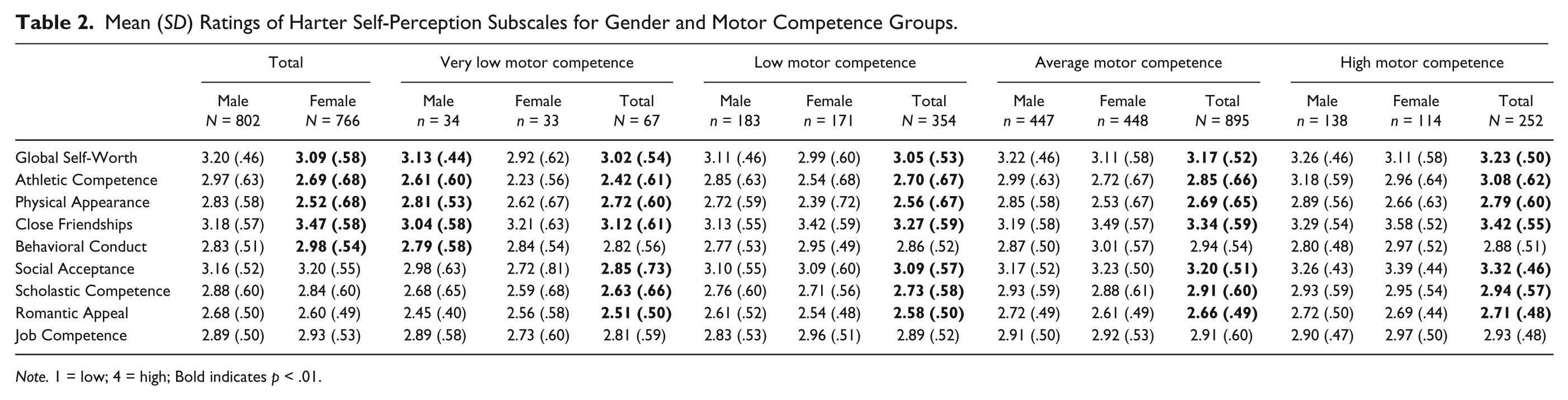
Note. 1 = low; 4 = high; Bold indicates p < .01.
Univariate Analyses for Self-Perception Subscales for Gender and Motor Competence Groups.

Note. Bold indicates p < .01.
Following is a more detailed description of the post hoc analyses for the group differences. Only those group differences where p < .01 is reported. Tukey post hoc comparisons showed that all groups were significantly different in self-perceptions from each other for Athletic Competence (p < .006 to p < .001) and Social Acceptance (p < .007 to p < .001). For Global Self-Worth and Physical Appearance, the low, but not the very low, competence groups were significantly lower than the average (p < .003 and p < .006, for each domain respectively) and the high competence groups (p < .000 for both domains). For Scholastic Competence and Close Friendships, the very low (p < .001 for both domains) and low (p < .001 and p < .01, respectively) groups were significantly lower than the high competence group. For Scholastic Competence, the very low and low groups were also significantly lower than the average group (p < .001 for both contrasts). Finally, for Romantic Appeal, the low competent group was significantly lower than the high competent group (p < .009).
Motor Competence Differences Within Gender
For the four domains for which both motor competence and gender were main effects, the secondary analysis of self-perceptions was often different for each gender (see Figure 1). For Athletic Competence, the profile of self-perceptions was the same for males compared with females, with higher perceptions at each successive motor competence level. For Physical Appearance, this analysis showed an increase in self-perception between the low and high motor competence groups for girls only. In the Close Friendships domain, although females were significantly higher than males overall (p < .001), those in the very low motor competence group had lower self-perceptions than those in the high group (p < .007) compared with males who showed no significant change in Close Friendships across motor competence levels. Although males rate their Global Self-Worth as significantly higher than females overall (p < .002), there were no competence group differences for either males or females (see Figure 1).

Plots of self-perception domains separated for males (blue) and females (red).
Discussion
We found that motor competence had a pervasive influence on self-perceptions of young, 14-year-old adolescents that extended beyond the physical to social and scholastic domains, as well as to global self-esteem. Similar findings have been reported not only for children (Rose, Larkin, & Berger, 1997; Schoemaker & Kalverboer, 1994) but also for adolescents (Skinner & Piek, 2001).
Within the physical domain, our results showed that self-perceptions of Athletic Competence and Physical Appearance of those with higher motor competence were higher whereas those with lower motor competence were lower, and that girls’ self-perceptions were consistently lower at any competence level. Given that Athletic Competence is the perception of ability to perform skills in sports and games (Harter, 1999), such a self-perception profile is predictable and consistent with other studies (Cantell et al., 1994, 2003) and conceptual models linking actual and perceived motor competence (L. M. Barnett, Morgan, Van Beurden, Ball, & Lubans, 2011; Stodden et al., 2008). This also concurred with Harter’s (2012) conclusion that actual competence in a domain is a major contributor to the associated self-perception. Also, as ability in sport is highly valued in Australian society, low motor competence is difficult to hide, and we suggest that those with low motor competence avoid social comparison wherever possible by withdrawing from physical activities. Skinner and Piek (2001) reported those with low motor competence had higher anxiety and perceived themselves as less competent with poorer social support. One might speculate that low self-perceptions of physical competence may be a significant contributor to the commonly reported sports drop-out during adolescence (Australian Bureau of Statistics, 2009, 2012)
The higher perceptions of athletic competence among boys is not surprising given that as girls enter adolescence, they often demonstrate lower intrinsic motivation and enjoyment of physical activity than those younger in age (Labrozzi et al., 2013). However, it was noteworthy that the self-perception scores of Athletic Competence by girls in the two higher motor competence groups exceeded scores of boys in the two lower groups. The boys’ higher perceptions of Physical Appearance may be explained by Paquette and Underwood’s (1999) findings that girls had lower perceptions of attractiveness and greater fear of being talked about than boys, although one might also contend that motor competence has an important role in personal grooming, posture, and moving confidently.
We found that motor competence and gender affected self-perceptions in other domains besides those aligned with the physical domains. Self-perceptions of Close Friendships were positively affected by motor competence for both boys and girls, but in this case, girls in all groups had consistently higher self-perceptions than boys. In fact, the mean self-perception scores of girls as a group for Close Friendships were the highest of any domain. As this domain tapped the ability to make close friends and to share personal thoughts, and given that girls are more likely than boys to seek out one best friend (Harter, 1999), this result could be expected.
A number of self-perception domains were influenced solely by motor competence. Scholastic Competence self-perception was higher for those with higher motor competence. Many other studies (Cantell et al., 1994; Losse et al., 1991; Rigoli, Piek, Kane, & Oosterlaan, 2012; Skinner & Piek, 2001) also reported that being a competent mover appears to be a distinct advantage in the classroom, particularly in childhood, and was associated with positive self-perceptions of academic ability. Our results demonstrate this continues into early adolescence. Although one might think that those with poor motor competence might naturally shun physical activity and focus on academics, our results suggest that if such a focus has occurred, then actual motor competence is still a persistent influence on perceptions of scholastic ability.
Developing positive relationships with the opposite sex both in and out of school is increasingly important during adolescence. We found that perceptions of Social Acceptance and Romantic Appeal were both influenced by motor competence only, not gender. There are social occasions such as school dances and recreational activities that require moving with confidence and skill, and one could surmise that those with low motor competence would feel more inhibited, less confident, and less socially adept to engage with their peers. Cantell et al. (1994) had earlier reported that although adolescents with poor motor competence did not express dissatisfaction with their romantic appeal, they were nevertheless less sociable and chose solitary leisure time activities. Such choices could likely inhibit the development of positive perceptions of one’s social relationships.
The one domain affected solely by gender was Behavioral Conduct, one that relates to behaving in the correct manner. Regardless of motor competence, girls as a group had significantly higher self-perception scores than the boys as a group. In early adolescence, many other societal influences that define gender role and societal expectations of girls as compared with boys would contribute to girls scoring this domain higher than boys.
The final domain to consider is that of Global Self-Worth. This domain taps the degree that one likes and values oneself as a person and the way one is leading his or her life and feels good about himself or herself, and, according to Harter (1999), arises from both the relative contributions of the domain-specific self-perceptions and the importance of each in the individual’s life. Importantly, Harter (1999) contends that Global Self-Worth is also the most difficult perception to alter. Accordingly, this domain provides an important, wholistic picture of a relatively stable self-perception. Our results showed that perception of Global Self-Worth was not only significantly higher for boys—similar to previous research by Harter (1988), Kling et al. (1999), and Marsh (1988)—but that the profile of perceptions for boys and girls across motor competence groups was the same. As motor competence increased, the self-perception scores increased also. This was similar to Skinner and Piek’s (2001) study that showed low motor competent children and adolescents had lower self-worth than those with normal motor coordination. Again, motor competence appeared to be an enhancer of self-perceptions in this domain.
Besides Global Self-Worth, we found that three quarters of the other domain-specific perceptions were positively influenced by motor competence, the exceptions being Behavioral Conduct and Job Competence. Motor competence, however, is a personal factor that is not fixed, unlike gender, and is a factor that can be changed and improved. In light of possible improvements in domain-specific self-perceptions with improved motor competence and that Global Self-Worth arises from the relative contributions of these domain-specific perceptions, we argue that self-worth may not be as resistant to change as Harter (1999) asserts. Our findings lead us to assert that motor competence is a pervasive factor likely to strengthen perceptions of self-worth in young adolescents. This hypothesis could be tested in future intervention studies in which motor skills of those with low motor competence are improved and self-perceptions monitored.
In summary, having low motor competence and being a girl were double hindrances in young adolescents forming high perceptions of their physical self. However, being a girl was an advantage for higher perceptions in the friendship and conduct domains. Therefore, it appears that actual motor competence has a pervasive, supportive effect that strengthens self-perceptions in adolescent girls, not only of their physical self but also in global self-esteem.
Strengths and Limitations
The current study has several strengths. First, motor competence was measured using the NDI, an objective, standardized, and normalized score (M = 100, SD = 15), which enabled the large number of participants to be categorized into four levels of competence. This larger range enabled a greater ability to discriminate self-perception characteristics among a wider range of motor competence. Many of the conclusions have been drawn from other studies with either dichotomized (low compared with competent; Piek, Baynam, & Barrett, 2006) or three groupings (significant motor problems, minor deficiency, and normal competence; Cantell et al., 2003).
Furthermore, it is rare in the motor competence literature to have a large participant sample that is representative of the population and covering both genders across the full range of motor competence. Studies that recruit clinically based samples typically underrepresent females in comparison with male participants, and consequently, gender comparisons are not common in the literature.
However, there are several limitations in this study that may affect the generalizability of findings. First, although a very large sample was measured, these data were derived from a single year snapshot within a longitudinal study design. Although it seems unlikely that self-perceptions are the genesis of poor motor coordination, reverse causal relationships are less clear. Of the many studies that have examined motor coordination problems in children, only a handful are longitudinal (for example, Cantell et al., 1994). More longitudinal tracking of the psychosocial development of children across a full range of motor coordination is needed to clarify causality. Future studies should also consider the intricate and potentially circular relationship between gross motor impairment and perceived competence across a range of psychosocial domains, with the explicit aim of delineating cause and effect (Emck, Bosscher, Beek, & Doreleijers, 2009).
Second, the chosen measures may not be sufficiently sensitive to fully explain the relationship between the two variables of interest. Although Harter’s Scale has demonstrated reliability and validity, the forced choice scale based on “sort of true for me” or “really true for me” gives only a score range from 1 to 4 and does not allow for a neutral or “not applicable at all” response. Potentially, real psychosocial–behavioral differences might be masked by the narrow range of values derived from the scale. Alternately, statistical significance in scores might not relate to real significance in psychosocial behaviors. Furthermore, we do not know the relative importance of these domains in the lives of young adolescents nor do we know to what extent the importance placed on a domain is affected by level of motor competence. If one was aiming to improve psychosocial health of young people with poor motor competence, then understanding which areas of self-perception are more important to them could result in more targeted interventions and more meaningful outcomes. Unfortunately, although Harter’s (1988) Scale enables such a measure to be collected, this aspect was not included in the questionnaires used in the longitudinal Raine study. We recommend that investigations into self-perceptions in the future measure not only the strength of perceptions but also the importance of the domains to participants.
Finally, although the MAND is used widely as a measure of motor competence, it may not fully capture some aspects of motor competence as it does not include any object control skills. This omission may be important in seeking to better understand the different associations we identified between motor competence and gender. A number of studies have identified gender differences in the performance of many ball skills (for example, L. M. Barnett, van Buerden, Morgan, Brooks, & Beard, 2010; Thomas & French, 1985).
Summary and Conclusion
Developing healthy self-esteem is affected by many personal, social, and environmental factors, and in the transition from childhood into adolescence, the influence of motor competence on self-perceptions, in concert with gender effects, is not well-understood. Our results clearly indicate that motor competence in early adolescence is an important factor in psychosocial health and that its effect differs between males and females in a number of self-perception domains, including Global Self-Worth. Together, motor competence and gender in early adolescence were significant effects in about half the self-perception domains measured by Harter’s Self-Perception Profile for Adolescents Scale and, alone, motor competence had a significant influence in the majority of these domains.
In conclusion, although we have investigated the mutual effects of only two possible influences on self-esteem, our findings have important implications for building psychosocial health in adolescents. First, motor competence is a pervasive influence in young adolescents’ self-perceptions across a number of physical, social, and academic domains; second, actual motor competence enhances self-perceptions; and third, the lower self-perceptions typical of girls are boosted by higher motor competence. This more nuanced picture may assist practitioners and educators to provide more appropriate interventions for girls and boys at all levels of motor competence. We conclude that to build healthy self-esteem, particularly for young adolescent females, one key way could be to facilitate their participation in sports and recreation, teach motor skills, and present opportunities to improve their actual motor competence.
Footnotes
Acknowledgements
We are grateful to all the Raine study participants and their families who took part in this study and the Raine Study Team for cohort coordination and data collection. We would also like to acknowledge the wonderful contribution of Dr. Dawne Larkin (deceased) who was a world-renowned expert in motor control and the impact of movement difficulties among children and adolescents. Her wisdom and guidance in the conceptual development of this article were much appreciated.
Declaration of Conflicting Interests
The author(s) declared no potential conflicts of interest with respect to the research, authorship, and/or publication of this article.
Funding
The author(s) disclosed receipt of the following financial support for the research and/or authorship of this article: Funding for Core Management of the Raine Study has been provided by the Telethon Kids Institute, the University of Western Australia (UWA), Raine Medical Research Foundation, UWA Faculty of Medicine, Dentistry and Health Sciences, Curtin University, Women and Infants Research Foundation, and Edith Cowan University.