




Abstract
In recent years, the promotional discourse has grown more versatile due to the emergence of new social media. YouTube influencer marketing is of increasing significance for brands’ promotion, especially in the beauty category. Many studies on the effect of influencer marketing used self-reported surveys, the results of which provide limited help in formulating effective videos. The current study aims to characterize YouTube influencer marketing videos through speech act analysis and genre analysis and then determine the features significantly associated with audience response through correlation analysis. The study collects 12 videos from 8 YouTubers in the beauty category and finds that the overall speech act composition is 56% assertives, 26% expressives, 10.1% commissives, and 7.4% directives. The study also proposes a 10-move structure. Significant positive correlations are reported between audience response and the percentage of directives and three moves, advising YouTubers to utilize more directive speech acts, share more personal experience, and spend more time preparing the audience in the opening of videos soliciting subscription.
Introduction
With the recent economic downturn and the growing competitiveness of professional and academic activities, promotional discourse becomes increasingly significant for individuals, companies, institutions, and even countries. From the printed advertisements to nowadays the new media marketing, promotional discourse has turned from the “hard selling” style to the more subtle and personal type of persuasion. YouTube, the highly influential social media platform, has made it possible for brands to achieve effective marketing at a lower cost (Aziza & Astuti, 2019; Duffett et al., 2019; Roy et al., 2020; Schwemmer & Ziewiecki, 2018). One significant way for brands to engage YouTube for promotion is influencer marketing, which is considered more trustworthy by consumers than professionally generated content (Wei & Lu, 2013). Previous studies mainly used self-reported surveys to investigate the effect of YouTube influencer marketing and were successful in determining significant underlying factors (Aziza & Astuti, 2019; T. Y. Chen et al., 2021; Duffett et al., 2019; Ko & Wu, 2017; Rasmussen, 2018; Reinikainen et al., 2020; M. Xiao et al., 2018). However, those subjective opinions from interviewees may not be specific enough for brands and influencers to formulate effective marketing videos. To further break down the video content, the current study makes use of speech act analysis (Searle, 1969) and genre analysis (Bhatia, 1993, 2005), which are proposed as two crucial approaches to study promotional discourse (Bhatia, 1993, 2005, Ludwig & de Ruyter, 2016) and are widely adopted by empirical papers to analyze promotional discourse (Ansari & Gupta, 2021; Bhatia, 1993; Hajeer, 2020, 2021; Huang & Liu, 2022; Izquierdo & Blanco, 2020; Jiang, 2017; McVeigh, 2020; Villarroel Ordenes et al., 2019; Wang & Guo, 2005, 2006; Zhang, 2018). In addition, correlation analysis is used to verify the relationship between audience response in terms of the number of fans, views, comments, and likes and the speech acts as well as the moves determined by genre analysis. The three analyses combined enable the current study to first characterize the influencer marketing videos on YouTube with the speech acts and move structure and then identify the significant speech acts and moves associated with audience response. In this way, the present study not only serves to provide a template for popular influencer marketing videos but also points to the specific features of content that should be paid extra attention to. These analyses could be helpful for influencers and brands to formulate more effective marketing videos and could also further current understanding on this newly emerging promotional discourse of YouTube influencer marketing.
Literature Review
YouTube Influencer Marketing
As one of the most influential social media platforms, YouTube has been used as a powerful marketing tool by brands from various industries. According to a survey by Wyzowl (2021), 87% of the video marketers said that they had used YouTube for marketing and approved of its effectiveness, making YouTube the most popular and effective platform among video marketers. In comparison, Tiktok, the short-video platform had only been used by 20% of the video marketer and only 67% of them thought Tiktok is effective in marketing. In a study on 200 U.S. national advertisers, a similar 84% used YouTube for advertising (Park & McMahan, 2021). It was also reported that in some companies, YouTube marketing expenditure took up 25% in the total marketing budget (Chadha, 2018). YouTube Official Blog recently reported that the popular video website could reach a wide range of potential consumers as it had over 2 billion logged-in users every month. Such popularity contributes to a marketing legend in generating revenue and promoting public image for commercial brands (Aziza & Astuti, 2019; Duffett et al., 2019; Roy et al., 2020; Schwemmer & Ziewiecki, 2018).
Among the many ways that brands engage YouTube for promotion, influencer marketing is of utmost importance due its user-generated nature, which is deemed more trustworthy and unbiased by consumers than professionally generated content (Wei & Lu, 2013). The main benefit of influencer marketing is that influencers maintain a close connection with their fans, which makes it easier for them to publicize and persuade than through the traditional hard-selling measures. YouTubers could collaborate with brands in the form of direct sponsorship, discount codes, affiliated links, and free product sampling (Wu, 2016). It was reported that in terms of boosting brand familiarity, YouTube creators could be four times more effective than celebrities (Nazerali, 2017). Studies have approached the effect of influencer marketing from the perspective of parasocial relationship. The term, parasocial relationship, was first proposed by Horton and Wohl (1956) to describe the relationship fostered between audience and distant media figures. Frequent virtual interactions make audience feel like they are in a real relationship with the media figures. Studies have shown that a positive parasocial relationship could enhance brand trust, brand loyalty, purchase intention, and actual purchase behavior (T. Y. Chen et al., 2021; Ko & Wu, 2017; Rasmussen, 2018; Reinikainen et al., 2020).
Influencer marketing is especially common among beauty brands as they are the first ones to collaborate with creators on YouTube. About 86% of the top 200 beauty videos on YouTube were made by creators rather than brands themselves (Nazerali, 2017). Rasmussen (2018) reported that among US women from 18 to 34 years old, the most widely consumed category on YouTube was beauty videos. The significance of beauty videos among consumers and the prevailing influencer marketing in beauty category make it necessary to further investigate influencer marketing using YouTuber marketing videos in the beauty category. Product reviews, tutorials (or demonstrations), recommendations are the three common video forms adopted by YouTubers to market beauty brands (J. L. Chen & Dermawan, 2020). Consistent with other marketing videos on YouTube, beauty YouTubers also provide more detailed information about the products than professionally generated content by brands (De Veirman et al., 2017). Rasmussen (2018) confirmed the existence of parasocial relationship between beauty YouTubers and the interviewees and found that increased popularity was associated with higher level of credibility. Strengthened parasocial relationship was also found to improve the effectiveness of marketing in beauty YouTube channels with a large fan base (Lee & Lee, 2022; Rosara & Luthfia, 2020).
Speech Acts in Marketing Communication
Previous studies mainly investigated the effects of YouTube influencer marketing videos through surveys (Aziza & Astuti, 2019; Duffett et al., 2019; T. Y. Chen et al., 2021; Ko & Wu, 2017; Rasmussen, 2018; Reinikainen et al., 2020; M. Xiao et al., 2018), which indeed captured the subjective opinions of interviewees as researchers could pin down the crucial factors with several well-formulated questions. For example, by rating statements such as “This person is willing to interact with me/This person interacts with me frequently”, participants could report their perceived interactivity of YouTube videos (M. Xiao et al., 2018). However, survey studies provide limited help to influencers and brands in terms of forming effective marketing videos because it remains vague what aspects of a video makes it effective. To this end, a detailed analysis on the transcript of YouTuber marketing videos may help to better generate specific suggestions on forming impactful videos. One way to do this is through speech act analysis.
The theory of speech act was first proposed by John Austin. In his view, speech acts were defined as the utterances that carry meaning and could spur people into specific actions (Austin, 1962). Austin distinguished between constative and performative utterances in that the former describes the process or the status of things while the latter aims to accomplish an action and is not truth-evaluable (Austin, 1962, p. 3). On this basis, speech acts were divided into three types (Austin, 1962, pp. 149–150): (1) locutionary act (the act of making a meaningful utterance); (2) illocutionary act (the act performed in saying something, i.e., the intention of the speaker); (3) perlocutionary act (the consequential act of saying something). According to Austin (1962), all utterances could simultaneously accomplish these three types of speech acts. Furthermore, he also proposed a taxonomy for illocutionary acts in which five types of acts were divided: verdictives, expressives, commissives, behabitives, and exerctives.
Later, Searle developed Austin’s taxonomy and put forward a new framework by classifying illocutionary acts into assertives, directives, commissives, expresssives, and declaratives. According to Searle (1969, p. 16), communication was composed not only by words and sentences but also by the actions accomplished through language. Assertives inform listeners of facts and convince them of certain ideas or beliefs and directives aim at getting the receivers to do something by giving a command or making a request. Commissive speech acts are about speakers’ behaviors in the future. Expressives involve the mental status of speakers and are mainly used to communicate speakers’ emotions and feelings to the listeners. Declaratives serve to inform the listeners of institutional information. In 1996, Clark developed Searle’s classification by further breaking down declaratives into effective and verdictive speech acts. The latter is about the judgment or the determination of affairs while the former can virtually alter the institutional status of affairs.
Ludwig and de Ruyter (2016) maintained that “speech act theory is a primary foundation for decoding social media speak and the basis for developing research avenues of interest to marketing scholars and practitioners” (pp. 6–7). Through a fine-grained speech act analysis, researchers could better decode marketers’ intentions when sending out marketing messages and how different intentions encoded in these messages would affect consumer response. Some studies investigated the use of speech acts in social media discourse and marketing discourse (Ansari & Gupta, 2021; Carr et al., 2012; Huang & Liu, 2022; Jiang, 2017; Nastri et al., 2006; Villarroel Ordenes et al., 2019; Zhang, 2018). Ansari and Gupta (2021) reported that speech acts could influence customers’ perception of trustworthiness of online product reviews. In a study on social media brand messages, consumers were found to share assertive and expressive messages more often than directive messages on Twitter (Villarroel Ordenes et al., 2019). Huang and Liu (2022) investigated the computational advertising on Chinese social media platform, Weibo, and found that assertive speech acts (objective advertising) led to higher conversion rate (the rate of sales conversion per click) and that directive and expressive speech acts (subjective advertising) led to higher click-through-rate. It could be inferred that studies on the impact of speech acts upon consumer response remain limited and were mostly confined to marketing communication on social platforms with textual messages. It hasn’t been fully understood how speech acts are used on video social platforms such as YouTube and how different speech acts could affect audience response in the marketing communication on these video platforms.
Generic Structure of Marketing Discourse
Another way to offer specific suggestions on formulating impactful marketing videos is through genre analysis, which helps to identify the organization of video content.
Swales (1990, p. 58) proposed genre as a class of communicative events with some shared set of communicative purposes. Similarly, Bhatia (1993, p. 13) contended that genre was a highly conventionalized communicative event with distinctive internal structural features and that the communicative events and their linguistic features were restricted to the communicative purposes. The school of ESP (English for Special Purposes) of genre analysis was centered around the moves and steps of the communicative events and its framework has been widely adopted in the studies of various types of discourse. Many have also looked into the generic structure of promotional discourse. Generally, promotional discourse can be divided into many genres: book reviews, advertisements, sales letters, and job application (Bhatia, 2005). According to Wang and Guo (2006), these four types of promotional discourse share many similar moves as they have one mutual purpose: to make a good impression in front of the recipients and to persuade them into reading, purchasing, or hiring the subjects of discourse. Early studies mainly analyzed the move structure of traditional “hard-sell” type of printed advertisements (Bhatia, 1993, 2005; Wang & Guo, 2005, 2006). Bhatia (2005) deemed the promotional genres as “the most versatile and fast developing areas of discourse” (p. 213). With the emergence of new media platforms, marketing communication is taking on various forms, from the traditional printed and TV ads to online posts and to user-centered promotional videos. More recent studies have paid attention to online marketing discourse. McVeigh (2020) analyzed 793 marketing emails from 17 companies and presented their rhetorical moves. Focusing on the cultural dynamics, Izquierdo and Blanco (2020) compared and summarized the major promotional strategies used in English and Spanish herbal tea promotional website through a move-analysis method. Studies have also focused themselves on the online course descriptions, which are also of promotional nature and aim at capturing the attention of potential students (Hajeer, 2020, 2021). Few studies have looked into the move structure of influencer marketing videos, nor have studies associate the video structure with audience response. However, studies in consumer behavior and psycholinguistics suggest that discourse comprehension and decision making are susceptible to the organization of linguistic information (Ariely, 2000; Barnitz, 1986). Therefore, to deepen the understanding of influencer marketing videos, it is vital to summarize the move structure of popular videos and associate the structuring of video with audience response.
The current study first adopts Searle’s speech act taxonomy to analyze the speech acts of popular influencer marketing videos on YouTube, aiming at characterizing how influencers communicate their intentions on sentence level. Then the study applies the framework proposed by Swales (1990) and Bhatia (1993) for ESP and summarizes the move structure of marketing videos, with the aim of setting a template for influencers and brands to effectively structure their content. Finally, the study does a correlation analysis between the percentage of speech acts and moves and the audience response (number of views, subscribers, comments, and likes), which is helpful for identifying the relationship between them. The following research questions are raised for the study:
What speech acts and moves are there in YouTube influencer marketing videos and how are they distributed?
How do speech acts and moves characterize each other in YouTube influencer marketing videos?
What are the relationships between audience response and speech acts as well as moves in YouTube influencer marketing videos?
Methodology
Theoretical framework
The current study first analyzed the speech acts in the YouTube influencer marketing videos using the coding scheme presented in Table 1. This scheme was adopted from Searle’s theoretical framework of speech acts (Searle, 1969, 1976). Additionally, messages that were quoted by the speakers are coded separately as “Quotations” so as not to confuse with the speech acts (Nastri et al., 2006).
Coding Scheme for Analyzing Speech Acts and Quotations.

After the analysis on the speech acts, the study followed the framework of ESP genre analysis proposed by Swales (1990) and Bhatia (1993) to figure out the generic structure of YouTube influencer marketing videos. Bhatia (2005, p. 214) stated that the most traditional generic structure of promotional discourse is found in printed ads. The results of Bhatia’s work were as follows: Move 1: Headlines; Move 2: Targeting the market; Move 3: Justifying the product or service by establishing a niche; Move 4: Detailing the product or service; Move 5: Establishing credentials; Move 6: Endorsement or testimonials; Move 7: Offering incentives; Move 8: Using pressure tactics; Move 9: Soliciting response; Move 10: Signature line and Logo etc. The current study used these previous results as a reference in assigning the moves to YouTube influencer marketing videos. Nevertheless, because YouTube influencer marketing videos and printed ads served different marketing purposes, adaptations were made. The final coding scheme for move structure is in Table 2.
Coding Scheme for Analyzing Moves.

Data Collection
The study collected promotional videos uploaded in the recent 3 years from eight different YouTubers, whose channels were all centered around makeup and fashion. Videos were included in this study as promotional videos only if they contained direct sponsorship, discount codes, affiliate links, or free product sampling (Wu, 2016). Compared with videos that received less attention, the videos that were more frequently viewed by the audience proved to be more meaningful and instructive in their way of promoting. As a result, all videos collected have reached over 1 million views each. After putting in the search word “makeup,” the first 12 videos fitting the criteria were selected. The length of these videos amounted to 3 hr and 36 min and they are transcribed into text version by iFlytek tools (Xie et al., 2016). After careful proofreading, a small corpus of 37,715 words was established for analysis.
In order to account for how audience responded to the videos, the study also collected the number of fans of different YouTubers as well as the number of views, comments, likes of each video from their YouTube webpage. These attributes are consumer behaviors at the upper funnel of sales stages (Huang & Liu, 2022) and could reflect the public attention that the videos receive as well as the marketing effectiveness of these videos. (See Table S1 in the Supplemental Appendix for details of videos.)
Data Analysis
The study used NVivo to annotate first the speech acts and then the recurring structural moves in the transcripts. The two annotations were done manually by the first two authors after a pilot. The speech acts were first determined for their numbers and then for their attributes. As for the genre analysis, only moves that appeared in more than 75% of the videos were considered as a move in the structure. Moves that were significant and typical yet occurred in less than 75% of the videos were regarded as subsidiary moves. The inter-annotator reliability Cohen’s Kappa for the speech act annotation was 0.91 and 0.93 for the move annotation.
The study took a further step to explore the relationship between audience response (number of fans, views, likes, and comments) and the percentage of each coded feature (speech acts and moves) in each video. Because the sample size was rather small (n = 12), the study resorted to permutation test when doing correlation analysis, which was proven robust in the case of small sample (Bishara & Hittner, 2012). Permutation test was also recommended in the case of nonnormality, as “the probability from a permutation test is computed by comparing the obtained test statistic against the ‘permutation’, rather than theoretical, distribution of the test statistic” (Bishara & Hittner, 2012). Therefore, the study used the R package jmuOutlier (Garren, 2016; Higgins, 2004) when calculating the p-value of correlation test (number of simulations = 10,000) and the R package ggplot2 for plotting figures (Wickham et al., 2016).
Results and Discussion
Speech acts in YouTube Influencer Marketing Videos
Table 2 describes the total number of different types of speech acts and their proportion. The most frequently occurring speech acts were assertives, which took up 56% of all the speech acts. The communicative goals of the assertives in YouTube influencer marketing videos are similar to those in Weibo marketing (S. H. Xiao, 2013). However, coupled with an average time length of 18 min, the fact that more than half of the YouTube influencer marketing videos consist of assertive acts show that these videos are more informative. They provide viewers with more details about the products and the brand than the printed advertisements, TVs, and short-video platforms like TikTok. The increasing informativeness of promotional videos on these newly emerging social media, therefore, was found to boost the effectiveness of promotion compared to traditional TV ads (Van-Tien Dao et al., 2014; Table 3).
Total Number of Speech Acts.

The next significant type of speech acts were expressives, whose proportion reached 26%. In the current corpus, expressive speech acts were found mainly to show YouTubers’ thanks toward the audience and the brands as well as their compliments or complaints of makeup products and techniques. The third most frequently used speech act was the commissives, whose percentage is 10.1%. Makeup YouTubers in this study used commissive speech acts to prepare the audience with their later moves in the video. The last type of speech acts, directives, took up 7.4% of all the speech acts. In the videos, directive speech acts appeared when YouTubers wanted to make the audience accomplish certain actions, such as looking at a specific area or imitating the gestures of the YouTubers. Interrogatives are considered by Searle (1976) as a special type of directives in which speakers ask questions and seek answers from the listeners. In the current study, the questions asked by the YouTubers could be considered as the solicitation of comments from all viewers watching the video. They could also be viewed as an approach to interact with the audience (Jiang, 2017).
Lastly, quotations reached a proportion of 0.6%. In the corpus, they were mainly used to quote the product introduction on the packaging or other people’s words in the daily lives of YouTubers.
Table 4 here works as a summary and shows how moves could be used to characterize speech acts. To be clearer, for example, the “7.4%” in the second row indicates that the assertive acts in the first move “Opening” took up 7.4% of all assertive acts in total. In such an analysis, the specific communicative goals of speech acts in the YouTube influencer marketing videos could be better understood.
Characterization of Speech Act with Move Composition.

From Table 4, it could be inferred that the assertive speech acts mainly appeared in four moves: “Details of the product” (38.4%), “Usage guidance” (37.1%), “Sharing of personal experience” (10.3%), and “Opening” (7.4%). Therefore, the assertive speech acts in this study mainly served to introduce the products, demonstrate the usage of products, narrate the personal stories of YouTubers, and explain the reasons for creating the videos.
As for expressive speech acts, 59.8% of them occurred in the move “Details of the product,” which were used to express YouTubers’ personal feelings and evaluations about the products. Another major function of the expressives (14.5%) in YouTube influencer marketing videos was to convey YouTubers’ thoughts about the usage of products. What’s more, 8% of the expressive acts lay in the “Closing remarks,” which further indicates YouTubers’ appreciation toward their viewers.
The next type of speech acts, commissives, was mainly found in “Usage guidance” (70.5%), “Opening” (9.2%), “Details of the products” (8.7%), and “Sharing of personal experience” (6.3%). This shows that the more specific goal of the commissive speech acts in this study were preparing the audience with YouTubers’ next move, previewing the video, and sharing YouTubers’ future personal plans.
Moreover, most of the directive speech acts were spotted in moves such as “Usage guidance” (37.1%), “Details of the products” (21.9%), “Sharing of personal experience” (15.8%), and “Invitation for comments” (9.0%). Hence, the directives in this study mainly work to attract viewers’ attention to certain products or area, order the viewers to follow YouTubers’ actions, and provide suggestions based on YouTubers’ personal experience. These three types of directives, requesting, ordering, and suggesting, are also found in other studies on the speech acts of advertisements (Jiang, 2017; S. H. Xiao, 2013).
Lastly, the quotations in the videos collected were only found in “Details of the product” (54.5%), “Sharing of personal experience” (40.9%), and “Additional information” (4.5%). The quotations here were used to repeat the product description on the packaging and quote others’ words in YouTubers’ personal lives.
Generic Structure of YouTube Influencer Marketing Videos
Table 5 summarizes the characterization of moves with speech acts and the number of speech acts included in each move. To be clearer, for example, the “57.6%” in the second row indicates that the assertive acts took up 57.6% of all assertive acts in the first move “Opening”.
Characterization of Moves With Speech Acts.

The first move was the opening of the YouTube influencer marketing videos, whose speech acts number was 271, and took up 7.2% of all speech acts. This move occurred in all 12 videos collected. The table shows that in this move, 57.6% of the speech acts were assertives, 24.7% were expressives and 12.9% were commissives. To be more specific, the assertive speech acts in the opening part were mainly used to state the reasons for creating the video and the expressives were used to express greetings from the YouTubers. As for the commissives, they appeared mainly when the speakers previewed the video. Different than video ads and micro-videos which only last for several minutes, YouTube videos last for 10 to 20 min on average. YouTubers tend to spend 1 or 2 min on introducing the video and explaining the reasons for making it. In this process, the audience can build more understanding toward the video and the YouTuber, which is a significant sign of the deviation from the traditional hard selling that rarely prepares the audience for the promotion (Tuten, 2020).
The second move, “Details of the product,” contained the most speech acts (1,501, 39.8%) of all moves. More specifically, 53.9% of its speech acts were assertives, which reported information related to the products in question, such as their packaging, price, capacity, color, scent, etc. The high informativity of YouTube influencer marketing videos could be evidenced by this move as viewers could learn about the products as much as possible. Another major type of speech act in this move were expressives, which took up 39.0% and worked to express YouTubers’ personal feelings of the products. In the annotating process, it was found that even though a large part of the expressive speech acts concerning the products were positive, some YouTubers still gave their honest opinions by pointing out the flaws of these products. For example, a YouTuber in a product review video tried the product for the first time and expressed doubts toward the product at the beginning of the trial, claiming the product felt “weird”. This reaction was quite immediate and real and the YouTuber didn’t cut it out for the sake of promotion. Such negative comments showed the honesty and candidness of YouTubers and they might also help to build credibility. In the latter parts of the video, the YouTuber approved of the quality of this product despite its “weird texture,” which fulfilled the promotional purpose without being contradictory. This is an important distinction between YouTube promotion and traditional promotion as a little negativity on YouTube will instead help to build credibility rather than undermine the promotion of the products (Brown & Hayes, 2008).
The third move was “Usage guidance,” which contained the second most speech acts (1,295) of all moves. The proportion of the speech acts in this move was 34.4%, which were made up of 60.4% assertives, 20.7% commissives, 11% expressives, and 8.0% directives. In this move, YouTubers informed viewers of how to use the products or demonstrated the way they applied the products on camera. The acts of informing the audience and reporting their past or present moves were all accomplished through assertives. As for the actions YouTubers were about to execute, they were communicated through commissive speech acts. Moreover, YouTubers also shared their personal feelings about the makeup techniques in the talking-through usage guidance, which led to the 11% expressives. Sometimes in such a process, YouTubers made use of directive speech acts so that they could ask the audience to follow their actions or draw the audience’s attention to a specific area.
The three moves above contained more than 80% of all speech acts, which evidenced their utmost significance in the YouTube influencer marketing videos. Though the next seven moves only took up approximately 20%, they were as crucial in communicating the promotional purposes to the audience. For instance, Move IV, “Recommendation to a targeted group,” though containing only 1.2% speech acts, worked similarly to the move “targeting the market” in Bhatia’s (2005) structure. YouTubers in promotional videos would also mention the specific group that were suited to a certain product as the traditional advertisements. Such recommendation was mostly accomplished through assertive and expressive speech acts, in which YouTubers described the targeted group, stated the reasons for recommendation and complimented on how well the products would work on certain people.
Apart from high informativeness, another distinctive feature of YouTube promotional video lay in its level of interaction. Compared with the traditional form of advertisements, promotional videos on YouTube involves a much greater deal of interaction with the audience as the YouTubers are usually speaking directly to the audience. They would share their personal experiences and preferences with the audience and even ask for their opinions (Move V & VI). For instance, in a wedding makeup tutorial, a YouTuber shared that she wouldn’t wear false lashes because she was “a very emotional person” and would “definitely cry at the wedding.” She also asked the audience who had been a bride before to give her some advice on the wedding. Correspondingly in the comment section, many viewers shared their own experiences as a bride and gave many suggestions to the YouTuber. This was a typical example of the improved personal interaction between the viewers and the YouTubers. Their relationship is far less similar to the traditional business relationship between a brand advocator and a customer. In the fifth move, “Sharing of personal experience,” 62.0% of its speech acts were assertives, which were used to depict the personal lives of YouTubers to the audience. The 16.0% expressives mainly worked to convey their own emotions about the experiences while the 12.6% directives communicated their suggestions to the audience concerning the incidents under discussion. Some may consider this move as unnecessary to the promotion, but such personal interaction did prove to build trust among the audience and enhance the persuasiveness of the promotion (Hwang & Zhang, 2018; Sokolova & Kefi, 2020).
Apart from asking audience’ opinions on YouTubers personally life, YouTubers invited comments by seeking the audience’ thoughts about the current video or their interested topics for future videos. Directives took a large part of the sixth move (69.4%) as many YouTubers use imperative sentences like “Please leave a comment down below” or “…let me know in the comments down below” to invite comments from the viewers.
The seventh move, “Reminder of future videos” and the eighth move, “Solicitation of subscription” worked to attract more attention to YouTubers’ channel. In the seventh move, the 40% assertives reported the content of future videos and the 30% commissives showed YouTubers’ promise to “meet” the viewers in their next videos. The 15% expressives were used to express how YouTubers’ feel about their future videos, which were usually expression of compliment and excitement. The remaining 15% were directives in which YouTubers asked the viewers to “make sure to check out the next video”. As for the composition of the speech acts in the eighth move, it was similar to that of the fifth move as 64.7% are directives in which YouTubers use imperative sentences such as “please subscribe to my channel.”
The ninth move, “Other Interactions,” was a combination of the subsidiary moves that appear in less than eight videos collected. The first subsidiary move, “Encouragement of clicking” “thumb-up,” functions similarly as “Solicitation of subscription” and its most significant speech act was also directive (66.7%). The second subsidiary move, “Acknowledgment of the brand,” was unique to promotional videos on social media such as YouTube. In traditional advertising, the brands initiate the advertisement themselves. However, in YouTube videos, YouTubers perform only as a promoter or a collaborator of the brand. They make profits off the promotion and their future sponsorship relies on their relationship with the brand. By acknowledging the brand, YouTubers not only help to make a good impression of the brand in front of their audience, but they also show their willingness to cooperate with the brand in the future, which is beneficial to their career as YouTubers. As a result, expressive speech acts took up the most part in this subsidiary move (63.6%). YouTubers either thanked the brand directly for their sponsorship or complimented on the brand as a way to express thanks. The remaining 36.4% of the speech acts went to assertives because sometimes YouTubers spoke of their experiences to reflect their appreciation toward the brand. The two subsidiary moves above were important to increase the brand endorsement as well as the YouTubers’ income (Munnukka et al., 2019).
The next subsidiary move was “Incentives to purchase”. In YouTube videos, some YouTubers don’t explicitly remind the audience to click the affiliate links or use the discount code. They sometimes just leave the links and codes in the description area below the video in order to avoid sounding too commercial and less personal. As for the YouTubers who mention these incentives, they tend to put it in a way that the purchase is more beneficial to the audience rather than to themselves. For example, in one video, the YouTuber mentioning the code told the audience they didn’t have to use the discount code if they didn’t want to, but that using the code was a way to save money during the holiday season. What’s more, the move “using pressure tactics” in the move structure by Bhatia (2005) was rarely found in the YouTube videos collected. YouTubers seldom mentioned the deadline of the discounts to drive up sales. Therefore, it could be concluded that YouTube videos tend to be more implicit than the traditional advertisement in offering incentives to purchase. Moreover, this move was mostly made up of assertive speech acts, in which YouTubers simply mention the fact that there are websites, affiliate links or discount codes for the viewers to click.
The last subsidiary move was “Additional information,” which included 62 speech acts and took up 1.6% of all. Unlike YouTubers’ personal experiences which are related to the theme of video (such as wedding related experience in a wedding makeup tutorial), this move was about something completely irrelevant to the theme of the video. The content of this move usually appeared at the end of the video as a specially added section. For example, a Dutch YouTuber shared the usage of a new Dutch word at the end of every video and called this section “Dutch word of the day”. Some YouTubers answered random questions selected from the comment area and made it an extra section called “Question of the day”. Though irrelevant to the theme of the video, this move was still a way for the YouTubers to interact with the audience and build up their relationship, which could also be helpful to their future persuasion. This move was mostly composed of assertive speech acts (62.9%) for information sharing and partly of expressive speech acts (21.0%) for conveying YouTubers’ emotions.
The last move, “Closing remarks,” contained 124 speech acts (3.3% of all) in the corpus. The 62.9% expressive speech acts worked to express how the YouTubers felt about the current video, their wish that the viewers enjoy their video, and their thanks to the viewers. Such remarks can facilitate maintaining the good relationship between the audience and the YouTubers, which are similar in communicative function to the expressive speech acts in convivial business letters (Zhang, 2018). In the closing part, some YouTubers tended to be expressive and enthusiastic. They refer to the viewers as “you guys,” “sisters,” or “babe,” and sometimes said “I love you” at the end of the video. Previous study has shown that as social distance shortens, the frequency of familiar terms of address increases (Keshavarz, 2001). In turn, these more intimate address terms used in YouTube videos indicate YouTubers’ wish to shorten the social distance between them and the audience. What’s more, the 28.2% assertives were used to summarize the video. The summary brought the videos to a natural ending and gave the audience a sense of closure.
Correlations With Audience Response
In order to further understand the relationship between the content of marketing videos and audience response, correlation analyses were conducted. Audience response was reflected by the number of fans, views, comments, and likes. Content features included all coded properties (5 speech acts and 10 moves). The percentage of different speech acts in a video was calculated based on the number of words contained in each type of speech acts, which was the same case for calculating the percentage of moves.
For speech acts, significant positive correlations were found between the percentage of directives in a video and its number of views (r = 0.73, p = .009, Figure 1a), comments (r = 0.60, p = .036, Figure 1b), and likes (r = 0.77, p = .003, Figure 1c). This shows that when YouTube influencers used more directives in their videos, audience tended to respond more actively to them. As mentioned in previous analysis, the directive speech acts in the YouTube videos collected mainly appear in the moves “Move III: Usage guidance” (37.1%), “Move II: Details of the products” (21.9%), “Move V: Sharing of personal experience” (15.8%), and “Move VI: Invitation for comments” (9.0%). This goes to show that directives were used to draw the attention of viewers to specific information, ask viewers to follow certain actions, and suggest viewers to do something based on YouTubers’ personal experience. M. Xiao et al. (2018) found a positive correlation between interactivity and perceived information credibility. They maintained that audience might consider interactive influencers more easy-going and candid. The present study proposes that the percentage of directive usage of content could serve as an effective indicator of videos’ interactivity (Jiang, 2017). Similar to our results, De Vries et al. (2012) also found that increased level of interactivity (coded as categorical variable) could help brand posts to receive more comments and likes. Therefore, in order to make videos more interactive and therefore more popular, YouTubers are advised to increase their use of directive speech acts (such as requesting, ordering, suggesting, and questions).
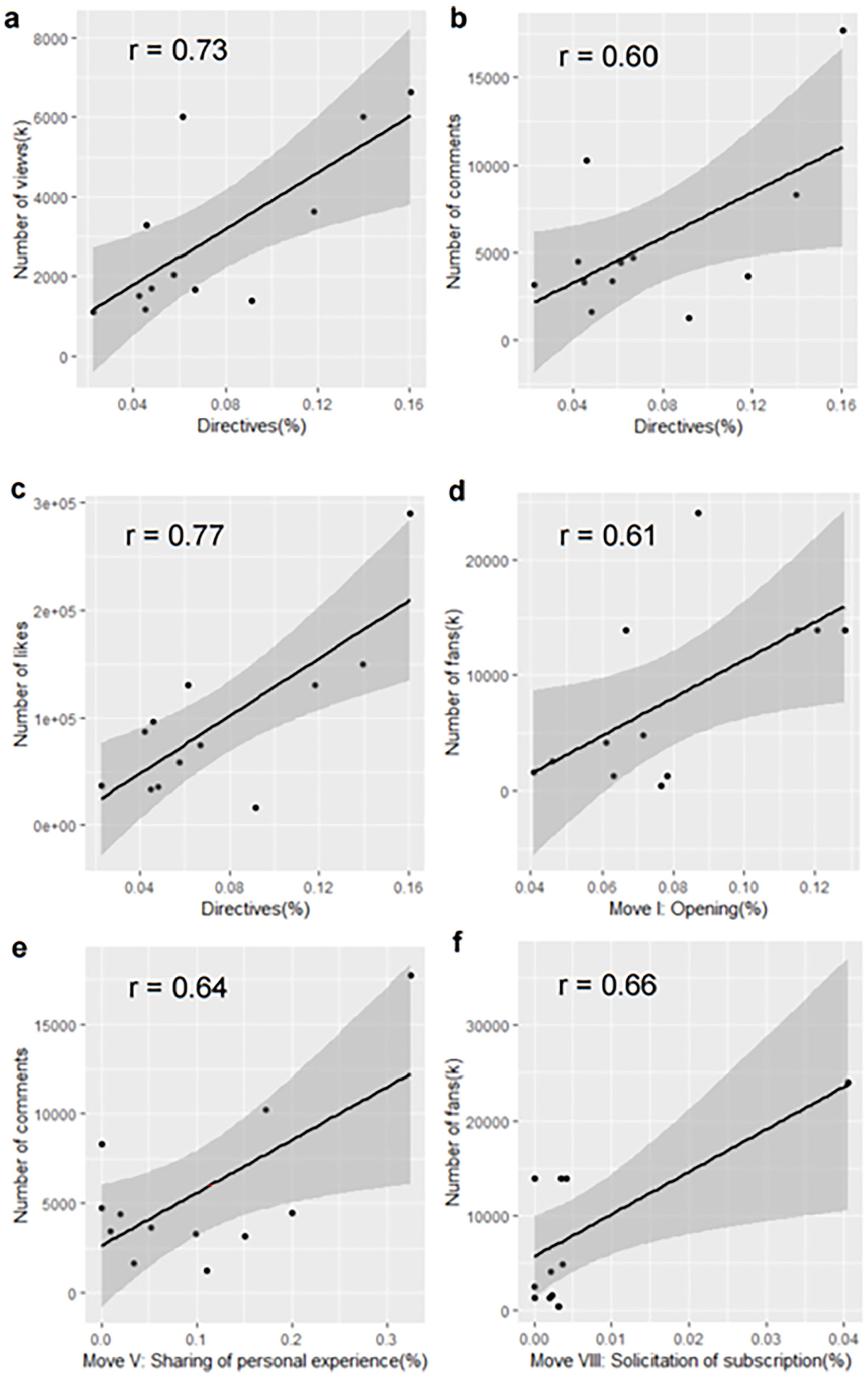
Correlation plots. (a) Correlation between video’s number of views and percentage of directive speech acts (r = 0.73, p = .009). (b) Correlation between video’s number of comments and percentage of directive speech acts (r = 0.60, p = .036). (c) Correlation between video’s number of likes and percentage of directive speech acts (r = 0.77, p = .003). (d) Correlation between video’s number of fans and percentage of “Move I: Opening” (r = 0.61, p = .037). (e) Correlation between video’s number of comments and percentage of “Move V: Sharing of personal experience” (r = 0.64, p = .033). (f) Correlation between video’s number of fans and percentage of “Move VIII: Solicitation of subscription” (r = 0.66, p = .041).
For the percentage of moves, there were significant positive correlations between the number of fans and the percentage of “Move I: Opening” and (r = 0.61, p = .037, Figure 1d), and also the percentage of “Move VIII: Solicitation of subscription” (r = 0.66, p = .041, Figure 1f) which could indicate that more popular YouTubers utilized more of the video content to prepare their audience with the entire video and solicit subscription. These moves may also help the YouTubers to gain more subscribers in return.
Positive correlation was also present between “Move V: Sharing of personal experience” and the number of comments (r = 0.64, p = 0.033, Figure 1e). This “sharing of personal experience” was consistent with the concept of “self-disclosure” in previous studies of social relationship (Liu et al., 2016). The positive correlation between Move V and the number of comments was in line with previous studies that self-disclosure of influencers would help to build better parasocial relationships (Auter, 1992; Kim & Song, 2016) and in turn enhance the loyalty toward brands (Ko & Wu, 2017) or even increase impulse purchase behaviors (T. Y. Chen et al., 2021). Therefore, it is crucial for YouTubers to share more personal experience with the audience to enhance perceived credibility and the effectiveness of marketing videos.
Conclusion
In conclusion, the current study offers meaningful insights into the YouTube influencer marketing videos. According to the results of the speech act analysis, assertive speech acts took up 56.0% of the total speech acts. The expressive speech acts came in second with the 26% proportion. Commissive and directive speech acts accounted for a smaller proportion, taking up respectively 10.1% and 7.4%. Quotations occupied merely 0.6% of all speech acts.
Through a cross-analysis of the speech acts and the moves, the moves could be grouped into four types based on their speech act composition. Firstly, moves that mostly consisted of assertives and expressives were “Move I: Opening,” “Move II: Details of the product,” “Move IV: Recommendation to a targeted group,” “Move V: Sharing of personal experience.” Subsidiary moves “Incentives to purchase” and “Additional information” were also of this kind. These moves were most informative and expressive. Their first priority was to provide viewers with all aspects of details concerning the videos, products, and the YouTubers themselves and their second goal is to share YouTubers’ personal feelings and opinions. The second type of moves contained mostly the assertive and the commissive speech acts: “Move III: Usage guidance” and “Move VII: Reminder of future videos”. This showed that the two moves not only offered useful information but also focused on preparing or reminding the audience with YouTubers’ future moves. The third type of moves were made up of more than 60% directives and approximately 20% assertives. These moves included “Move VI: Invitation for comments,” “Move VIII: Solicitation of subscription” and one subsidiary move “Encouragement of clicking ‘thumb-up’,” which were all approaches to boost the popularity of the YouTube video and the channel. These moves often made use of imperative sentences to ask viewers to accomplish corresponding actions. The last type of moves had over 60% of expressive speech acts and about 30% of assertive speech acts: “Move X: Closing remarks” and the subsidiary move “Acknowledgment of the brand”. These two moves were mainly used to show appreciation to the supporting brand and the viewers. They also provided some details of the brand and the summary of the entire video.
The grouping above offers a conclusion of the characterization of moves using speech acts. As for the major communicative goals of speech acts, the assertives in the YouTube influencer marketing videos mainly serve to fulfill product introduction and usage demonstration. Expressive speech acts are used mostly to express YouTubers’ feelings and opinions about the products and makeup techniques. As for commissive speech acts, they work to prepare the audience with YouTubers’ future moves and preview the YouTube video. Directives aims at directing viewers’ attention and ordering specific actions. Quotations in this study are mainly used for describing the products and sharing personal stories.
Compared with traditional advertisements, the main communicative purposes of YouTube videos are not only to promote the brands and boost sales, but also to maintain the good relationship between the YouTubers and the audience. Therefore, in comparison with the framework by Bhatia (2005), the move structure of YouTube influencer marketing videos adds the moves that can enhance interaction and relationship and reduces the moves that sound too commercial and could distance the YouTubers from the audience. Moreover, because of their lengthiness and the fact that more than half the moves contain over 50% assertive speech acts, YouTube videos are also found to be more comprehensive in providing product details. It could be concluded that the major features of YouTube influencer marketing videos compared with traditional printed and TV advertising are the increased informativeness, interactivity, and personal touch as well as the reduced commerciality.
The study also did correlation analyses and found that with more directive speech acts used, videos may receive higher popularity (in terms of increased comments, likes, and views). For YouTubers with more fans, the percentage of “Move I: Opening” and “Move VIII: Solicitation of subscription” increased. Adding more content about “Move V: Sharing of personal experience” may also boost the number of comments. According to these results, YouTubers are advised to use more directive speech acts in their videos (such as requesting, ordering, suggesting, and questions) and share more about their personal experience. YouTubers could also spend more time in the opening of the video to mentally prepare their audience with the following content and in soliciting subscription.
The findings of the study could help brands and influencers in making more popular and effective marketing videos. Specifically, the move structure summarized by the study could work as a template to provide reference as well as guidance in the future collaboration of the brands and the YouTubers. The correlation results enable the current study to provide more specific suggestions on how to make popular marketing videos than previous survey studies in the field of marketing. The current study would benefit YouTubers in building a more successful career and also benefit companies in boosting their sales as well as brand image.
However, despite the benefits for companies and YouTubers, limitations still remain. Due to the difficulty of transcription and manual proofreading, the study only collected 12 videos from eight beauty YouTubers, the results of which may not be generalizable enough for videos in other topics, despite the pervasiveness of influencer marketing in beauty category. Moreover, although the study used permutation test to ensure the robustness of correlation analyses, it is advisable for future studies to collect more samples and enhance the generalizability of their results. Statistical methods regarding the newly emerging types of data of network content should also be further validated. What’s more, because sales data of videos were inaccessible, the study could not make direct inferences about how these videos would affect actual sales. If future studies can access sales data, they could further study the relationship between sales performance and the speech acts as well as the moves in YouTube influencer marketing videos.
Supplemental Material
sj-docx-1-sgo-10.1177_21582440231152227 – Supplemental material for How YouTubers Make Popular Marketing Videos? Speech Acts, Move Structure, and Audience Response in YouTube Influencer Marketing Videos
Supplemental material, sj-docx-1-sgo-10.1177_21582440231152227 for How YouTubers Make Popular Marketing Videos? Speech Acts, Move Structure, and Audience Response in YouTube Influencer Marketing Videos by Gong Chen, Yi Li and Ya Sun in SAGE Open
Footnotes
Acknowledgements
The authors express gratitude to the journal editors and the anonymous reviewers for their valuable feedback to this article.
Declaration of Conflicting Interests
The author(s) declared no potential conflicts of interest with respect to the research, authorship, and/or publication of this article.
Funding
The author(s) disclosed receipt of the following financial support for the research, authorship, and/or publication of this article: This work was supported by the Program for Young Excellent Talents, UIBE, under Grant 20YQ07.

Supplemental Material
Supplemental material for this article is available online.
References
Supplementary Material
Please find the following supplemental material available below.
For Open Access articles published under a Creative Commons License, all supplemental material carries the same license as the article it is associated with.
For non-Open Access articles published, all supplemental material carries a non-exclusive license, and permission requests for re-use of supplemental material or any part of supplemental material shall be sent directly to the copyright owner as specified in the copyright notice associated with the article.
