




Abstract
This study sought to investigate the role of transfer at the initial states of the third language (L3) acquisition. The following hypotheses were investigated in this study: (a) the second language transfer hypothesis (“L2 Status Factor”) proposing that L2 impedes transfer from L1 into L3; (b) the Cumulative Enhancement Model (“CEM”), proposing selective transfer from the previously learned languages, here L1 and L2; and (c) the Full Transfer/Full Access Hypothesis (FT/FA), suggesting that the Universal Grammar (UG) is available in acquiring the succeeding languages. The data were elicited via two experimental groups: one, Persian learners of English as a second language, and the other, Turkmen learners of English as a third language who had already acquired Persian as a second one. The structures tested in this study were simple present and present progressive tenses across the languages mentioned above. The L2 and L3 learners were tested at the initial state of their English acquisition. Data were gathered through grammaticality judgment and translation tasks. The results demonstrated that there is a significant advantage of L1 transfer in L3 acquisition.
Introduction
Although multilingual people are known and determined through their habitat and the region where they are in, nowadays due to increased mobility and globalization, the use of more than two languages has become a normal part of daily life for most human beings, and there are lots of researchers and linguists interested in multilingualism to check and find some evidence to test both Second Language Acquisition (SLA) and linguistic theories.
In recent times, both the awareness of multilingualism and research in this area has become increasingly conspicuous. A significant amount of findings that look deeper into various aspects of contemporary multilingualism and third language acquisition have appeared on third or additional language acquisition (De Angelis, 2005), language awareness (Jessner, 2006), cross-linguistic similarity in foreign language learning (Ringbom, 2007), multilingual education (Cenoz, 2009), language attitudes, and use of multiple languages (Lasagabaster & Huguet, 2006) in European context and the Handbook of Multilingualism and Multilingual Communication by Auer and Li Wei (2007) are some of the recent and the more prominent ones.
As was pointed out above, research on L3 acquisition has reached the extent where Aronin and Hufeisen (2009) call it “coming of age of trilingualism” (p. 2). Third language acquisition differs from second language acquisition in various respects. The cognitive advantages of bi- and multilinguals over monolinguals are often related to an increased level of metalinguistic awareness, which is assigned a crucial role in holistic approaches to multilingualism (e.g., Cook, 1991; Grosjean, 1985; Herdina & Jessner, 2002).
The aim of this study is to find out which language, L1 or L2, has the most effect on the acquisition of the third language (i.e., L3). To this end, the acquisition of English simple present and present progressive tenses by Turkmen and Persian students was investigated. It should also be mentioned that Turkmen people live in Iran and have Turkmen as their first language, Persian as the second, and the participants of this study, have English as their third language. The differences concerning the tenses among the languages under study will be explained in detail later in this article.
This article is organized in the following way. The concept of L3 acquisition and a brief background about it is presented. Then Turkmen, Persian, and English present and present progressive tenses are compared and contrasted. Finally in methodology section the main study, the results, and the conclusion are discussed, respectively.
Theoretical Background of L3 Acquisition
Bilingual and multilingual individuals present a different type of linguistic competence as compared with that of monolinguals (Cook, 1995; Grosjean, 1989; Jessner, 1999). Much of the current research suggests that learning a third language is not the same as learning a second language (Cook, 1995; Jessner, 1999). Herdina and Jessner (2002) propose that the acquisition of more than two language systems leads to the development of new skills such as learning how to learn; it also facilitates subsequent additional language acquisition as learners use metalinguistic awareness to explore the cognitive and linguistic mechanisms underlying language.
Three major hypotheses have been raised to account for third language acquisition: the Cumulative Enhancement Model (CEM; Flynn, Foley, & Vinnitskaya, 2004), the L2 Status Factor Hypothesis (LSFH; Bardel & Falk, 2007), and the Full Transfer/Full Access Hypothesis (FT/FA; Schwartz & Sprouse, 1994, 1996; White, 1989, 2003). The CEM (Flynn, 2009; Flynn et al., 2004) suggests that all the previously learned languages can be transferred into the Ln. The L1 or the mother tongue acts as a default language; that is, it is transferred into the L3 if it is available in the L1, and in case the structure is not present in the L1, then it gets transferred from the other languages.
The LSFH (Falk & Bardel, 2010) suggests that an L2 is favored as a transfer source independent of the typological similarity or genetic relatedness of the languages involved. The L2 status factor has its origin in Williams and Hammarberg’s (1998) study on L3 acquisition of the lexicon where it was explained as a general tendency to activate a previously learned (second) language, rather than to activate the L1 in the acquisition of a third one. Bardel and Falk (2007) found in their first study that the same holds for the acquisition of L3 syntax.
Finally, according to the FT/FA hypothesis (Schwartz & Sprouse, 1994, 1996; White, 1989, 2003), L1 determines what will be transferred into L3 acquisition. The proponents of this hypothesis believe that the Universal Grammar (UG) is there in acquiring any new languages to help the learners with the syntax of that language. This behavior might lead to either target-like structures or non-target-like structures; this is what distinguishes this model from the CEM (see also the results from Rothman & Cabrelli-Amaro, 2010, where both the L2 status factor and the CEM are supported). Contrary to the findings of Falk and Bardel, 2010 (2010), in this article, we will prove that there is no impeding role for the L2 in the L3 acquisition, and the L1 plays a significant role in acquiring the L3, which is in line with the FT/FA Model.
Turkmen, Persian, and English Present Tenses
Simple Present Tense in Turkmen, Persian, and English
Table 1 illustrates the formation of the present tense in three different languages under study, namely, Turkmen, Persian, and English.
Simple Present Tense in Turkmen, Persian, and English.

Source. Adapted from Fallahi (1991, p. 159), with Turkmen samples added by the authors.
The following table illustrates the formation of the present tense in three different languages under study, namely, Turkmen, Persian, and English.
English simple present is formed by the verb stem (e.g., ask) plus the conjugational form -s in the third person singular (e.g., he, she, it asks). In Persian, the particle mi- precedes the present verb stem (e.g., pors) plus the personal inflectional suffixes (i.e., -æm, -i, ad, -im, -id, - ænd) forming simple present tense. The format of the Turkmen language is somehow similar to that of the Persian language with the exception of the lack of any particle before verb stem. We can infer the following rule from Turkmen structure: the present stem of the verb (e.g., soro from the infinitive soromaq (i.e., to ask) plus the personal inflectional suffixes (i.e., -ýan, -ýaň, -ýa, -ýas, -ýazýňiz, -ýalar).
The tree diagrams, illustrated below, will show the simple present tenses in the languages:
Comparing this diagram to those of the other two languages under study, we see that in both English and Turkmen languages, the head of TP is morphologically zero, while that of the Persian language is explicitly marked with preverbal mi-.
As it is clear, Turkmen and Persian look somehow similar to each other in case of simple present structure, but later on, we will see that Persian speakers might face difficulty distinguishing English simple present from English present progressive.
Present Progressive Tense in Turkmen, Persian, and English
Table 2 indicates the Present progressive tense in English, Persian, and Turkmen languages.
Turkmen, Persian, and English Present Progressive Tense.

Source. Adapted from Fallahi (1991, p. 160), with Turkmen samples added by the authors.
In English, the present progressive tense is composed of the present forms of the auxiliary “be” plus the present participle (-ing form) of the main verb (e.g., I am writing), while that of Persian is a little bit complicated. The common form of the present progressive in Persian is identical to that of the simple present, that is, the prefix mi- precedes the present stem of the principle verb plus the personal inflectional suffixes, for example, mi-nevis- æm.
It is proved that the Persian language forms the present progressive tense in two different manners; as it is illustrated in Table 2, one form resembles that of the simple present tense in Persian, and the other one, which is the concern of this part and the whole article, is the conjugated form of the verb ‘daštæn’ (have; that is, it is similar to “be” in English and shows the action in progress). But this form is rarely used in formal usage. Rather, it is mostly used in informal collocations.
Back to the structure of the three languages under study, the present progressive in Turkmen language is composed of the verb stem “ýaz” plus the progressive marker ‘-ib’ and the inflectional suffixes (-in, -iň, -Ø, -is, -siňiz, -lar). It should be borne in mind that in Turkmen, personal inflectional suffixes vary according to the different tenses and the last segment of the verb stems, that is, the pitch of the word determines different kinds of suffixes in Turkmen language, which is not the concern of the current study.
These structures will be demonstrated in tree diagrams to have a more vivid view (see figures 1-6).

English simple present tense.

Persian simple present tense.

Turkmen simple present.

English present progressive tense.

Persian present progressive tense.
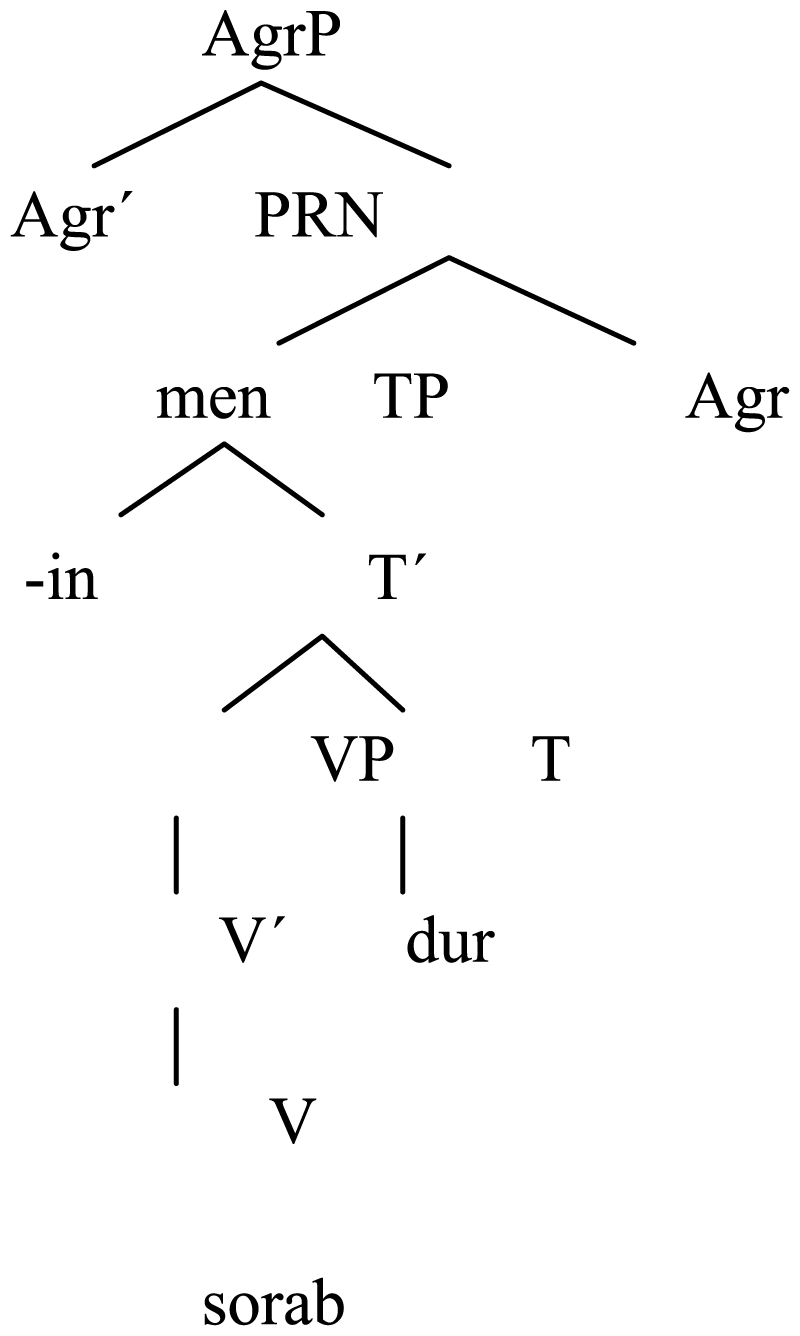
Turkmen present progressive tense.
‘In Persian, daštæn’ (have) acts like “be” in English, and as it can be seen from Figure 5, it is optional in Persian, and it is this kind of double-functioning in Persian present progressive tense that causes some difficulties for Persian learners of English language in deciding whether to use simple or progressive tenses in specific situations, and due to this reason, they tend to use these two structures interchangeably without being aware of the differences.
Turkmen present progressive has a totally different structure from its counterpart in English and Persian, but as it was mentioned earlier, it is rather beyond the scope of this article, and we will only focus on the use variation of these structures here. Although the Turkmen language has a different structure, at least it differentiates between the simple and present progressive tenses like those of the English language and unlike the Persian structure. This kind of similarity between Turkmen and English languages can help Turkmen learners not to face difficulty acquiring the English present tenses.
It should be borne in mind that Persian speakers are second language learners of English, while those of Turkmen speakers have already acquired Persian as their second language, and they are currently learning English as a third language. This study investigates the role of transfer in learning English simple present and present progressive tenses by two groups of learners to determine whether these structures in learners’ L1, L2, or both are significantly more effective. We could assume that the simple present in L1 Turkmen and that of L3 English somehow correspond to each other. Then, if the participants transfer this tense from their background language (L1) into L3, one can infer that FT/FA will gain support. However, L2 Persian present progressive corresponds to that of L3 English. If the learners transfer this structure from L2 Persian into L3 English, then L2 Status Factor will win.
Method
Participants
In this study, the data were elicited from two experimental groups: Persian learners of English as a second language and the Turkmen learners of English as a third language. The L2 and L3 learners were tested at the initial state of their English acquisition. The Oxford Quick Placement Test (OQPT) was given to 50 participants of whom 26 learners were selected and further divided into two groups of 13. The participants’ language level was determined by their scores on OQPT. Their score range was between 10 and 19, and they were categorize as elementary according to the OQPT scoring system. All the participants whose age range was between 14 and 22 at the time of testing were selected from the Iran Language Institute (ILI), one of the leading institutes in teaching English in Iran. All the participants took part in this study voluntarily.
Experiment 1: Grammaticality Judgment Task (GJT)
There were two types of tasks: a GJT and a production task. Table 3 represents the number of correct and incorrect sentences in GJT. In this task, the students were asked to judge the English sentences by rating them from −2 (completely impossible) to +2 (completely possible). In line with the aim of the study, the sentences were in the simple present and present progressive forms of which five sentences were correct English and nine sentences were incorrect according to the English grammar. The purpose was to find out if the two groups of learners (Turkmen and Persian) could differentiate these two structures. Data are provided for the following types of sentences.
Distribution of Test Items in the GJT.

Note. GJT = grammaticality judgment task.
Experiment 2: Production Task
This task tests the ability of both Turkmen and Persian learners of English in producing the language, specifically the simple present and present progressive. The students were given some sentences in their own languages, that is, Turkmen learners in Turkmen and Persian learners in Persian, and were asked to translate them into English. In this task, the students were provided the meanings of all the unknown words.
Sentence types 4 to 6 below represent the Persian exemplars, and sentence types 7 to 9 show the Turkmen ones.
4. Ou daræd dær ra baz mikonæd
He is door ACC opening
He is opening the door.
5. Ma jomeha be jængæl mirævim
We Fridays to jungle go
We go to the jungle on Fridays.
6. Xahæræm dær bank kar mikonæd
Sister-my at bank works
My sister works at the bank.
7. Ol qapini ačip-dur
He door-ACC opening
He is opening the door.
8. Ol otobus-e gozešip-dur
He bus-ACC waiting
He is waiting for the bus.
9. Ol gijeler-ne kitab oqiyar
He nights-ACC book reads
He reads books at nights.
In production task too, 14 sentences, simple present tense (7 items), and present progressive (7 items) were given to the participants to be translated from Persian into English. Table 4 demonstrates the distribution of the sentences in this task.
Distribution of the Items in the Production Task.

Results and Discussion
Experiment 1
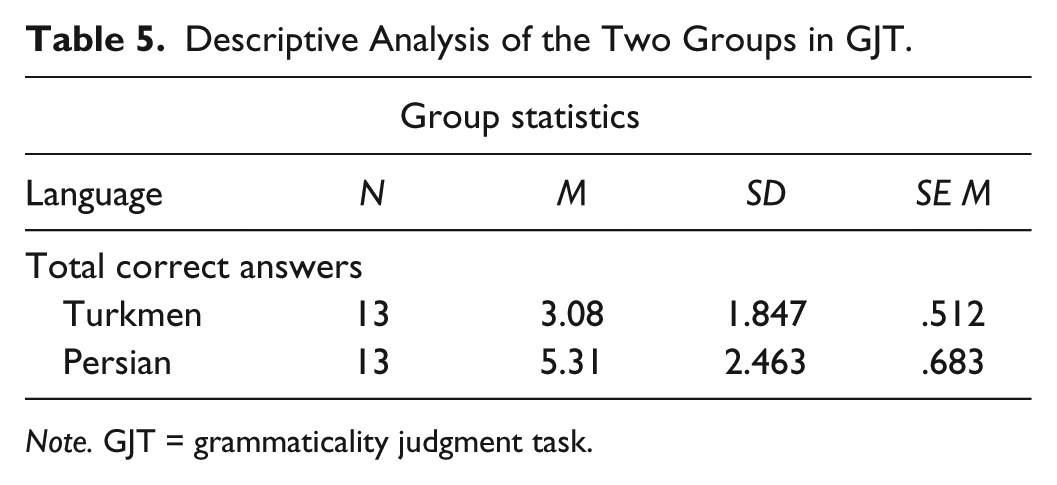
GJT elicited the overall ability of the learners in comprehending English tenses. We were expecting Turkmens to perform better than Persians in this task and also in the production task, but the results showed the reverse, and it was the Persians who outperformed Turkmens. Table 5 shows the mean differences of the two groups in GJT.
Descriptive Analysis of the Two Groups in GJT.
Note. GJT = grammaticality judgment task.
As it is clear, Persians ranked higher than Turkmens in this task. One reason for this might be the presence of UG for the Persian learners of English at the initial state of learning a new language. Although, they have no strict distinction in using the tenses under study in their own language, they can differentiate them in English due to the effect of UG. The question which arises is why Turkmens were not endowed with UG. As they have acquired Persian before English and know two distinct languages before starting the third one, they may be following one of the previous acquired languages, which does not align with the third language. Moreover, it is generally accepted that comprehension precedes production. The results of GJT indicate that the learners dissociate L1 and L2 transfer in L3 acquisition, following their own interlanguage system. We suggest “Cumulative Suppression” as the best account for L3 acquisition. An independent samples t test was conducted to see the differences between these two groups (Table 6).
Independent Samples t Test on Groups’ Performance in GJT.

Note. GJT = grammaticality judgment task.
The results of this analysis revealed that there was a statistically significant difference between the two groups in GJT, t(24) = 2.61, and p < .05. The magnitude of the difference in the means was large (η2 = .142). Figure 7 represents the mean difference of the groups via a bar graph.

Participants’ performance in GJT.
Although English and Turkmen have the same system of using the simple present and present progressive tenses which is somehow overlapping in spoken Persian language, Turkmens could not do well in differentiating the two systems. Turkmens were totally undecided, and this fact is against what Flynn et al. (2004) recognized as the “Cumulative Enhancement Model.” They believed in selective transfer from previously learned languages into a new one, but they did not consider the negative effect of using more than one system at the initial state of a totally new language. Our study reveals that having learned two languages may cause some difficulties for the students at least in tasks like GJT. We would call this “Cumulative Suppression” and use it for the situations where previously learned languages cause a kind of suppression rather than transfer.
Experiment 2
In this task, the students were given some sentences and were asked to translate them into English. As it is shown in Table 7, Turkmens did well on this task and outperformed the Persians with the mean difference of about 2.62.
Descriptive Analysis of the Two Groups in Production Test.

As it was mentioned earlier, Persian and English languages differ in using the tenses under study (i.e., simple present and present progressive tenses), and Persians prefer to use them interchangeably, while this is not allowed in English. As such, Persians have no recourse other than their mother tongue to help them in the initial state of second language acquisition, so they unwillingly transfer the concepts from their L1 (i.e., Persian). However, Turkmen and English languages do not differ in using the above-mentioned tenses and in both, the speakers are not allowed to use them interchangeably. As, in this task, unlike GJT, the learners were not provided with any target language structures to cause difficulty, Turkmens acted well. It should be borne in mind that this study does not focus on the correct grammatical forms in this study, rather, we were aiming at the correct use of the tenses under study. As a result, it is reasonable that the findings are not that much in line with the previous studies (e.g., Bardel & Falk, 2007; Flynn et al., 2004).
To see the differences between these two groups in producing English sentences, a t test was conducted, and the results revealed that there was a statistically significant difference between the groups in the production test, t(24) = 3.48, and p < .05. The magnitude of the difference in the means was large (η2 = .157). Table 8 represents the data of the t test in the production test.
Independent Samples t Test on Group Performance in Production Test.
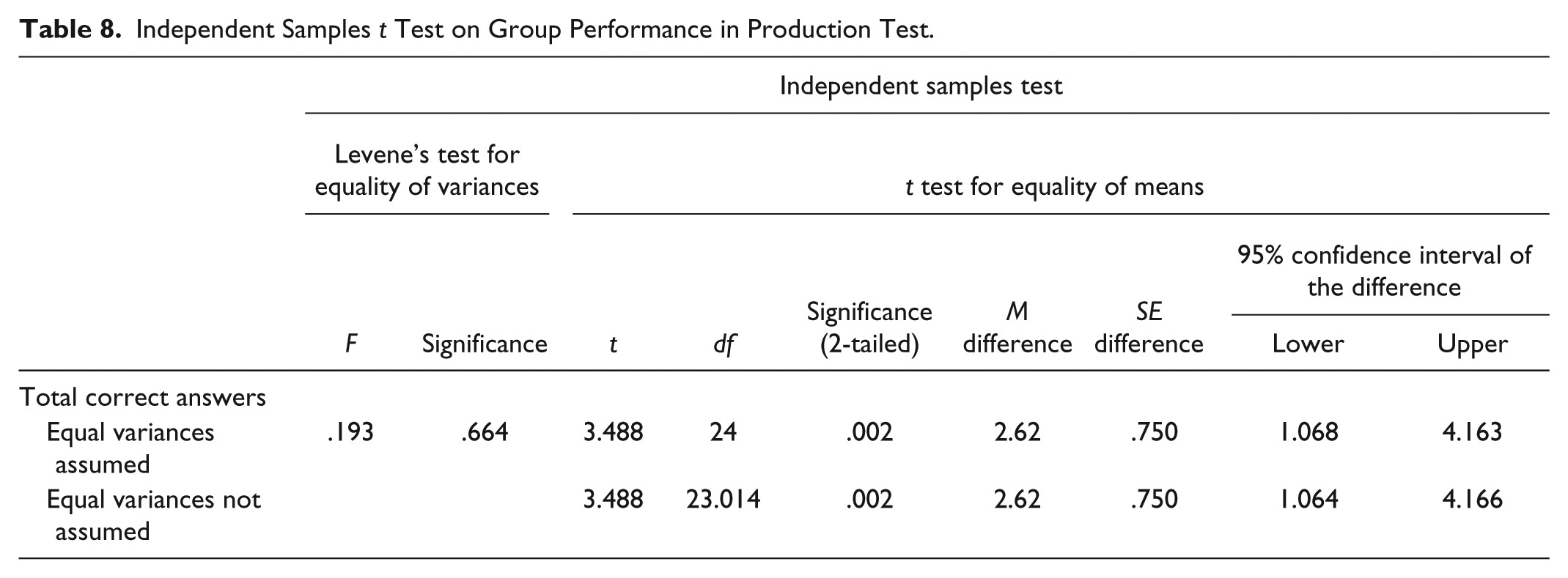
Also, the results are presented through a graph in Figure 8.

Participants’ performance in production test.
Conclusion
This study aimed at investigating the differences in using the “simple present” and “present progressive” tenses by two groups of Iranian learners of English (i.e., Persians learning English as a second language, and Turkmens, equipped with Persian as a second language and learning English as a third). The results revealed that we should be cautious about deciding the sources of transfer in language acquisition, and there is an enormous difference between comprehension and production. As it was discussed earlier, as Turkmens were provided with both forms of use in GJT, they faced problems differentiating them and could not decide on the correct form of use. That is, they were exposed to language forms they were familiar with in their previously learned languages. However, Turkmens had no difficulty in translating the sentences, as they were not imposed to choose from among the overlapping structures, as it was the case in GJT; rather, they were free to choose whatever they considered as correct from their linguistic repertoire. The results of GJT revealed that, unlike the “Cumulative Enhancement Model” proposed by Flynn et al. (2004), “Cumulative Suppression,” proposed in this study, is the leading element in L3 acquisition and should be dealt with in further research. However, the results of the Production Test proved the role of L1 transfer in the acquisition of third language
Footnotes
Declaration of Conflicting Interests
The author(s) declared no potential conflicts of interest with respect to the research, authorship, and/or publication of this article.
Funding
The author(s) received no financial support for the research and/or authorship of this article.