




Abstract
The study was designed to compare availability and use of information technology in the subject of education in public and private universities of Islamabad and Rawalpindi. The objectives of the study were, first, to highlight the status of information technology in public and private universities of Islamabad and Rawalpindi; second, to compare the availability and utilization of resources for information technology in public and private universities of Islamabad and Rawalpindi; third, to find out the problems in the use of information technology in public and private universities of Islamabad and Rawalpindi and to recommend strategies for better use of information technology in public and private universities of Islamabad and Rawalpindi. The design of the study was descriptive, and it was a survey study. Two questionnaires were used for data collection: one for teachers and one for students. A stratified random sampling technique was used. Two groups of teachers were selected from public and private universities, and 50% teacher and 10% students were selected from the population. The data were analyzed in terms of percentage, and t test was also applied. A significant difference was found between the availability and usage of equipment in education departments of public and private universities of Islamabad and Rawalpindi. Difference between the students learning and teachers training skills was not significant.
Introduction
North Dakota Century Code (NDCC) 54.59.01 defines information and communication technology (ICT) as the use of both hardware and software services by persons or groups to perform various functions. It is not a product but a process to support infrastructure and manage it for delivering information by using voice, visuals, and video. The use of technology at large scale is changing the pattern of life that includes working, learning, communicating with each other, and other daily activities.
In all types of education, the gadgets of technology had long-lasting impacts on the process of teaching and learning. This dual-way process can be speeded and supported by using information technology for both faculty and students. The easy access to new dimensions of technologies have placed the institutions and individuals on an advantaged place to follow rapid changes
Udvari-solner and Thousand (1996) described that, in the past, technology was in the hand of “few alerts,” the lone computer lab teacher, or the specialists who knew how to program the “mysterious” augmentative communication device used by students with communication limitation. In the new vision of university education in Pakistan, information technology has become an integral part, because this century belongs to a high tech era where both teachers and students need to be ready for new changes and challenges. This era has special needs and requirements of particular level of knowledge and skills as compared with the previous industrial era. There are different and changing learning environments that require special kinds of flexibility to be more effective. Media, particularly electronic media, has more strength and scope to develop conceptual understanding and analytical ability among teachers and students, and it is imperative for teachers and students to use this medium for making teaching–learning more result oriented. In future, teacher’s success in the class would be judged through media, their competency, and performance by using modern gadgets of technology. Hence, there is an urgent need for incorporation of advanced media in the teaching–learning process. Its availability and skills to use it would enhance teachers teaching skills and quality.
There is no doubt that technology-enhanced education is more effective as proven by many researches; computer-based chat rooms, different level course-based websites, and emails are some of the glimpses of technology-enabled resources. This type of learning develops interaction, team work, collaborative learning, and problem-solving skills among learners and teachers, apart from easing the tasks of collaborative designs, peer writing groups, and geographical barriers. It has removed distances as well as cultural barriers from one continent to another continent. There is a big challenge for universities and school administrations to train faculty and staff for maximum utilization of technology that seems still unaccomplished. It is obvious that availability of physical facilities of technology is not adequate because of the need for development of human resources to accomplish the desired and demanded fruits of technology.
There is no doubt that technology in the classroom has a large number of benefits but is not free of drawbacks. These disadvantages are related to the training of teachers and other staff, access to technology gadgets, and time required to implement its proper use. The above mentioned are a few of the reasons that prevent extensive use of technology in classrooms. Training is vital whenever we take up a new endeavor, and this is so with technology in education. The educationists do not consider it an end goal but a means to accomplish the goals. The expertise and skills in its use will enhance and improve the teaching–learning process; otherwise, it can be a hindrance and obstacle in achieving goals.
The inappropriate allocation of resources for classroom like fixing up computers or providing laptops in classroom may create fuss for teaching–learning process. Technology is changing rapidly, and hence, meeting new challenges and innovation is costly and may not be feasible for institutions to accommodate themselves with these resources. Quality material is available, but finding the appropriate one with relevant subjects is difficult, and hence, it is imperative to design and develop course contents as per requirement of the learner and teacher. This study was helpful in finding problems in the use of information technology in the education departments of public and private universities and gave a long-term strategy for better use of information technology.
Statement of the Problem
The study was designed to compare the availability and the use of information technology in the subject of education in public and private universities of Islamabad and Rawalpindi
Objectives of the Study
The objectives of the study were
to highlight the status of information technology in public and private universities of Islamabad and Rawalpindi,
to compare the availability and utilization of resources for information technology in these universities, and
to find the problems in the use of information technology in these universities.
Research Questions of the Study
Education
The United Nations Educational, Scientific and Cultural Organization (Leu & Price-Rom, 2006) defined education as “an organized and sustained instruction designed to communicate a combination of knowledge, skills and understanding valuable for all the activities.” Education is transformation of knowledge skills and values that are required to make citizens well adjusted in the society.
Information Technology
The information technology foundation defined it as “the technology used for the study, understanding, planning, designing, testing, distributing, supporting and operating of software, computers and computer related systems that exist for the purpose of data, information and knowledge processing” (Gorgone, Davis, Valacich, Topi, Feinstein, & Longenecker, 2003, p. 1).
Basic Computer Training Skills
Learners, particularly those knowing fundamentals of computers, feel comfortable using computers in the classrooms. But the interaction with computers can make these newly inducted learners’ concepts about technology vocabulary, including different operating systems, and their file and folder management techniques, more clear. By exploring and interacting with technology gadgets, one can also understand the functioning of the following heads:
Folders and files organization
Drag and drop skills
Keyboard use
Recycle bin
Using different browsers
Developing and saving different types of files and folders
Effects of Educational Technology
Krotoski (2004) found “Educational technology has a significant positive impact on achievement in all subject areas, across all levels of education, and in regular classrooms as well as those for special-needs students.”
Information Superhighway
Sacramento School District in California (1987-1992) reported that “students using multimedia and telecommunications showed improved attitudes toward reading, social studies, and science, and became more active and independent in learning. Some also showed improved reading scores” (Sivin-Kachala & Bialo, 1994). A survey of 550 teachers who use telecommunications technology in the classroom reported that Inquiry-based analytical skills—like critical thinking, data analysis, problem solving, and independent thinking—develop when students use a technology that supports research, communication, and analysis. However, telecommunication does not directly help their performances on state- or city- mandated tests.
Technology’s Impact on Learning
There is a strong relationship between technology-based instruction and academic test scores of the students, which advocated that the institutions need to focus on development of technology skills to enhance their learning and improve sources of open access learning to become successful in this world.
If we look at past researches, they showed mixed results as many researchers such as Angrist and Lavy (2002), Goolsbee and Guryan (2006), and Banerjee, Cole, Duflo, and Linden (2004) found that there were no evidences of key roles of information and communication technology in higher education. They also supported the traditional teacher-oriented pattern of teaching and learning. Whereas, Kulik (1994); Sosin, Blecha, Agawal, Bartlett, and Daniel (2004); Fuchs and Woessmann (2004); and Coates et al. (2004) believed that there is a real impact of ICT on students learning at this level. They are strongly in favor of using ICT in education at higher level.
Hargreaves (2003) advocated that, A knowledge society has three dimension; first expanded scientific, technical and educational sphere, second complex ways of processing and circulating knowledge and information in service based economy and third entailing basic changes for continuous innovation in products and services by developing systems, teams and cultures that promote mutual benefit and learning. Education becomes essential to answer the needs of technology and society. (p. 11)
Selwyn (2002) called technology as techno-romance as people are trying hard to avail and adopt technology in educational setting. Bennett and Bennett (2003) concluded that willingness to integrate ICT in education by the faculty members was not found, so it was not due to absence of technological infrastructure but less motivation on the side of the faculty in using ICT. The areas that have to be focused are motivation and satisfaction of the faculty to adopt and use ICT in their daily work.
Medlin (2001) analyzed that personal motivation is mandatory to incorporate ICT in teaching–learning process. The authorities can be successful when they motivate students and teachers to implement technology-based teaching–learning processes. Ma, Andersson, and Streith (2005) concluded that “teachers’ perceived usefulness of computer technology had a direct effect on their intention to use with ease of use” (p. 388). If motivation and facilities of training are provided to faculty, they will easily follow technology gadgets.
Research Method
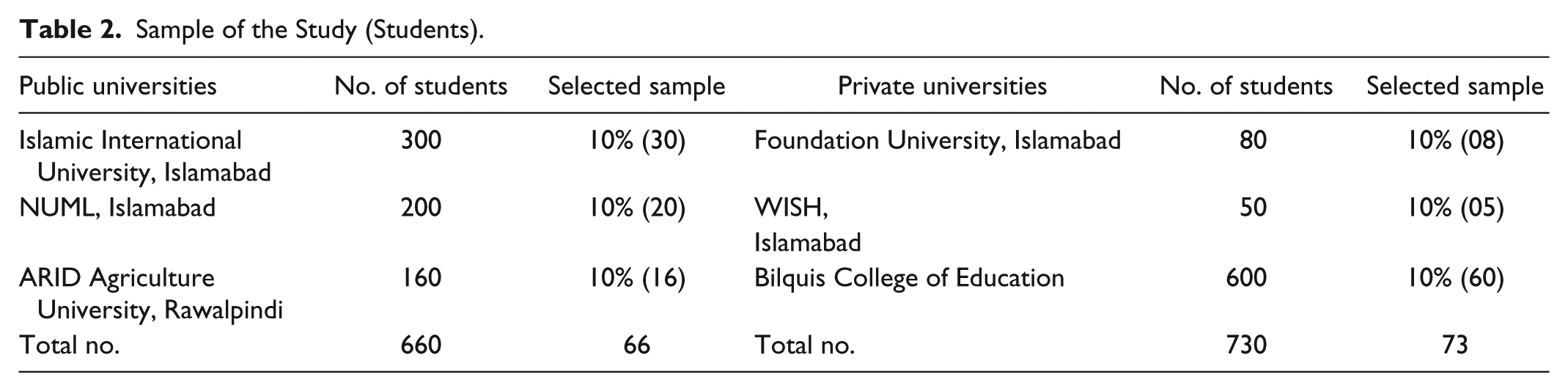
This article was descriptive, and it followed the below-mentioned procedure. The population of the study consisted of all the teachers and students of education departments of public and private universities of Islamabad and Rawalpindi.
Sample
Two groups were randomly selected as samples for the study; one of the groups consists of teachers teaching at university level, and the other group was selected among students of graduate level in education departments of public and private universities offering education programs. The researcher selected six universities from Islamabad and Rawalpindi cities with three universities from the public sector and three from the private sector offering education programs, and 50% teachers and 10% students were selected from each university.
Two questionnaires (one for teachers and the other for students) were developed on the basis of literature review.
Questionnaire for Teachers
It consisted of 42 items on a 2-point scale out of which the researcher has selected only six items for this article. The university teachers of education departments were selected as a sample, and they were given the following questionnaire. The first two items were used for analysis in this article.
Teacher’s questionnaire had the following breakup:
Availability of equipments, 11
Usage of information technology, 16
Students learning, 08
Teacher training and skills, 07
Student Questionnaire
The questionnaire for students consisted of 25 items keeping the same above-mentioned heads. The questionnaire was distributed among teachers respondents to assess their opinion about ICT access, use, and availability.
Validation of the Research Instrument
The researcher conducted pilot testing for validity of the instruments. Ten teachers and 20 students were selected for pilot testing; as a result, the changes in the format and language of the questionnaires were made. The suggestions given by teachers were incorporated in the final version of the questionnaires.
In teacher questionnaire, question numbers 9, 10, and 22 were modified according to the suggestions of teachers. Data were collected in quantitative form by questionnaire which was administered by the researcher personally. It was tabulated, analyzed, and discussed category wise. For statistical treatment, t test was applied at .05 level of significance. If it is below .05 level, it is not significant. The last item was analyzed by using simple percentages of the respondents. The data have been presented item wise. As mentioned in the research questions, t test was used to analyze the data, which were presented in the form of tables.
Table 3 presented the calculated t value as 1.748, which is more than 1.68 at table value at df(35). It indicates a significant difference between availability of equipment between public and private universities.
Sample of the Study (Teacher).

Sample of the Study (Students).
Availability of Equipment.

Note. df = 35.
p < .05.
Table 4 pointed out a calculated t value (0.748), which is less than 1.68 at table value at df(35). It displayed no significant difference between the usage of information technology between public and private universities.
t Test: Usage of Information Technology.

Note. df = 35.
p < .05.
Table 5 founded a calculated t value (0.547), which is less than 1.68 at table value at df(35). It suggested no significant difference between the student learning between public and private universities
t Test: Student Learning.

Note. df = 35.
p < .05.
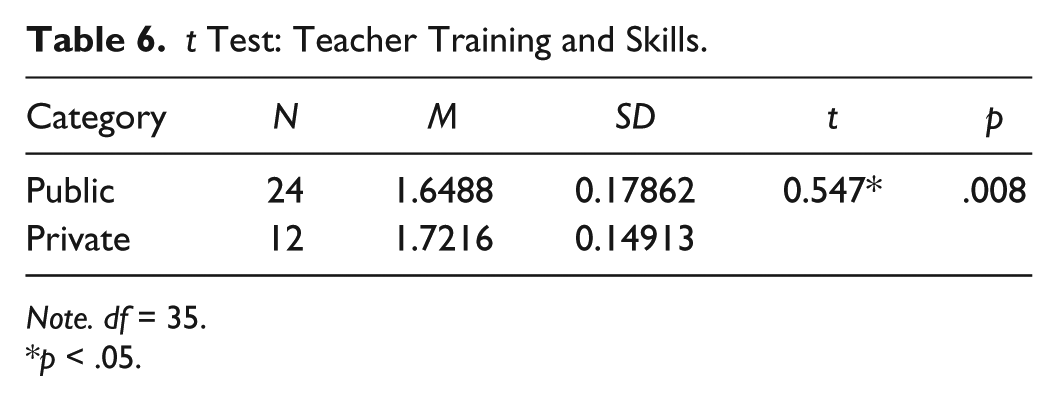
Table 6 indicated calculated t value (0.547), which is less than 1.68 at table value at df(35). It means no significant difference between the teachers training and skills between public and private universities.
t Test: Teacher Training and Skills.
Note. df = 35.
p < .05.
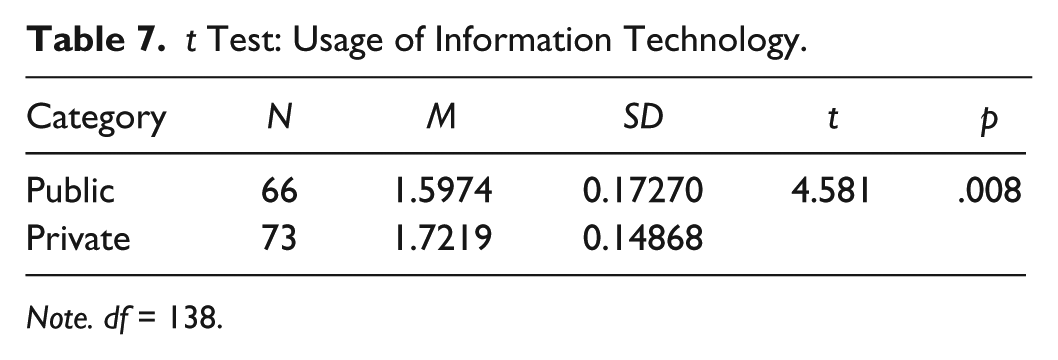
Table 7 found calculated t value (4.581), which is more than 1.96 at table value at df(138). It indicated a significant difference between the usage of information technology between public and private universities.
t Test: Usage of Information Technology.
Note. df = 138.
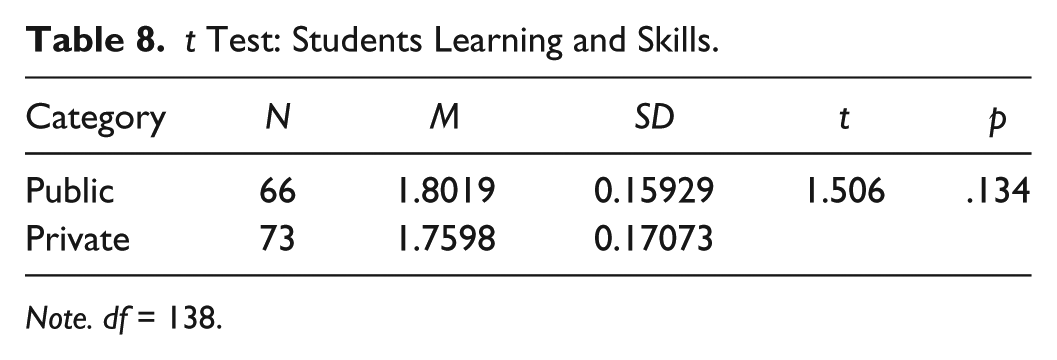
Table 8 pointed out calculated t value (1.506), which is less than 1.96 at table value at df(138). It can be interpreted as no significant difference between the teachers learning and skills between public and private universities.
t Test: Students Learning and Skills.
Note. df = 138.
Table 9 shows percentage of frequencies of the problems mentioned in the questionnaire by both teachers and students. Seventy-one percent of respondents stated that their university had no updated computers. The high speed Internet connection is another problem as 67% marked they did not have high speed Internet connection. The next was enough time to use computer lab: Majority of them said they had no time for the lab due to one or the other reason. The item numbers 4 and 5 were responded to negatively as 82% respondents said they did not have video conferencing and interactive white board facilities in the university. The last item was about multimedia availability in the class as 59% said they did not have it.
Problems in Use of ICT Facilities.

Note. ITC = information and communication technology.
Findings
Table 3 is about the data on availability of equipment in public and private universities. Calculated t value in the data is 1.748, which is more than table value (1.68) at .05 level of significance, showing a significant difference in the availability of equipment in public and private universities. It is evident that the private universities are better equipped with respect to the availability of equipment.
Table 4 is about the data on use of information technology in public and private universities. Calculated t value in the data is 0.748, which is less than table value (1.68) at .05 level of significance. It means that there is no significant difference in the use of information technology in public and private universities. It is evident that both students of public and private universities equally use information technology.
Table 5 is about the data on learning of students by using information technology in public and private universities. Calculated t value in the data is 0.547, which is less than table value 1.68 at .05 level of significance. It means that there is no significant difference in the learning of students by using information technology in public and private universities. It is evident that both public and private university teachers need information technology for better students’ learning.
Table 6 is about the data on teacher training and skills in public and private universities. Calculated t value in the data is 0.547, which is less than table value (1.68) at .05 level of significance. It means that there is no significant difference in the teachers training and skills in public and private universities. It is evident that both public and private universities need teacher training and skills.
Table 7 is about the data on use of information technology in public and private universities by teachers. Calculated t value in the data is 4.58, which is more than the table value (1.96) at .05 level of significance, which means that there is significant difference in the use of information technology by teachers in public and private universities. It is evident that private university teachers are better learned with respect to the use of information technology.
Table 8 is about the data on teachers learning and skills in public and private universities. Calculated t value in the data is 1.506, which is less than table value (1.96) at .05 level of significance. It means that there is no significant difference in teacher learning and skills in public and private universities. It is evident that teacher learning and skills in public and private universities are equal with respect to information technology.
Table 9 found that the students had many problems related to availability of information technology as no updated computers are available in the computer labs, no high speed Internet connection was available, they do not have enough time to use labs, no video conferencing facility, no interactive board, and no multimedia available in the class. Although the percentage varies, it is crystal clear that they had problems availing these facilities.
Conclusion
The data analysis, interpretation, and findings of the study can be concluded in the following lines.
It was concluded that there was a significant difference between the availability of equipments in education departments of public and private universities of Islamabad and Rawalpindi and that the availability of equipment in education departments of private universities are better than public universities
It was revealed through analysis of the data that there was no significant difference between the usage of information technology among the students of education departments in public and private universities.
The university teachers are not provided training in the university. As it is observed in Table 6, there is no significant difference in the teacher training and skills in public and private universities. It is evident that both public and private universities need teacher training and skills.
Teachers of education departments in public and private universities have the ability to use computer, Internet, multimedia, and overhead projectors, and used these technologies for teaching, for office work, and for other academic purposes.
Table 7 shows that private sector university teachers are well aware of computer technology as compared with teachers of public sector universities.
Another important factor is observed among teachers learning skills in Table 8. As teachers learning skills in public and private universities are equal with respect to information technology, so both type of teachers use information technology in limited scale.
In Table 9, it could be concluded that the students face difficulties in availability of updated computers, high speed Internet connection, enough time, video conferencing facility, interactive board, and multimedia in the classrooms
Recommendations
The following recommendations were made in the light of above conclusions:
According to research, it was proven that the availability of equipment in the public sector is less than that of the private sector; hence, it is recommended that university authorities provide equipment of technology to education departments, similar to their own departmental computer labs, with fully equipped latest computers, and that these are accessible to every student.
High speed Internet facility may also be provided for the departments of education in public and private universities.
The students may also be provided first of all, training of information technology; then, they may be given IT-based assignments and projects so that the students pay more attention to it and use it frequently.
The teachers need to be provided IT training so that they become better users of it and could enhance student learning as well.
A collaboration of public and private university teachers may also strengthen their knowledge, skills, and computer abilities.
Updated computers and high speed Internet connection need to be made available to the students and teachers.
Access to video conferencing facility may also be provided to students, especially research students, so that they could get benefit of national and international expertise.
The authorities may provide interactive boards and multimedia to the education departments to make the teaching–learning process effective.
Footnotes
Declaration of Conflicting Interests
The author(s) declared no potential conflicts of interest with respect to the research, authorship, and/or publication of this article.
Funding
The author(s) received no financial support for the research and/or authorship of this article.