




Abstract
Self-control is required when the pursuit of focal goals conficts with the desire to indulge in temptations. As such, the characteristics of one’s focal goals may influence the likelihood of their attainment. The present work explored the hypothesis that highly restrictive goals increase the desire for, and the likelihood of indulging in, goal-damaging temptations. Highly restrictive goals can engender psychological reactance, a motivation to restore threatened freedom, by placing salient restrictions on the freedom to indulge in temptations. Consequently, one may indulge in those temptations in order to restore the threatened sense of freedom. Three experiments supported this hypothesis: Framing goals as highly restrictive caused greater desire for (Studies 1 and 2), and more behavioral indulgence in (Study 3), goal-damaging temptations. Theoretical and practical implications are discussed.
Introduction
Self-control is required when the pursuit of focal goals conflicts with the desire to indulge in temptations (Fishbach, Friedman, & Kruglanski, 2003). When focal goals are defined in terms of their restrictive exhortations (e.g., I must do this; you must not do that) psychological reactance, the motivation to restore a threatened freedom (J. W. Brehm, 1966), can play a role in one’s failing to exert self-control to maintain focal goal pursuit. Specifically, indulging in the very temptations that the highly restrictive focal goal sets to inhibit may act to reestablish a threatened sense of personal freedom.
Goals
In the late 1960s, Mischel began a series of landmark studies on the delay of gratification (see Mischel & Ayduk, 2004, for a review). The experimenter made a simple proposition to his 4-year-old participants: “Have one marshmallow now or wait until I return and you can have two marshmallows.” Some children waited for the experimenter to return, many did not. Perhaps more intriguing than his initial findings, however, is what Mischel discovered in follow-up studies conducted years later. Individuals who were able to delay gratification as children were rated as more rational and socially competent, scored higher on the Scholastic Aptitude Test (SAT), and were better able to cope with frustration and stress as adults (Mischel, Shoda, & Peake, 1988; Mischel, Shoda, & Rodriguez, 1989). Mischel and Ayduk (2004) proposed that a common mechanism, self-control, underlies the relationship between delay of gratification and future success.
Self-control helps us to navigate our environment, taking us past salient temptations and toward the attainment of our goals (Gailliot et al., 2007). As desirable end states that one intends to attain through action (Kruglanski et al., 2002), goals dictate the deployment of self-control. Indeed, Baumeister, Schmeichel, and Vohs (2007) considered goals so important that in a review of self-regulation, they posited that without a goal to direct our efforts “ . . . self-regulation would be random and pointless” (p. 523).
As cognitively stored structures, goals influence behavior through the transference of motivational and attentional resources to their accessible means of pursuit (Kruglanski & Kopetz, 2009). For instance, activating the goal of becoming more physically fit may lead to greater intensity, persistence, and duration of pursuing means such as jogging. The transference of these resources is not constant, though, and can be influenced from moment to moment by a variety of factors (Bargh, 1990), including the presence or absence of competing goals (Kruglanski et al., 2002). Shah and Kruglanski (2002) investigated the potential harmful effects of competing goals, and found that the activation of alternative goals (i.e., goals conflicting with a focal goal) reduced focal goal commitment, focal goal progress, and inhibited the development of effective means of focal goal pursuit. In addition, Van Hook and Higgins (1988) demonstrated that people holding discrepant (i.e., conflicting, discordant) goals experienced significantly more frequent feelings of indecisiveness, inhibiting effective goal pursuit.
The presence of competing goals can pull a variety of resources away from one’s focal goals, reducing their likelihood of attainment (Shah & Kruglanski, 2002). Consequently, one must monitor the current focal goal pursuit (e.g., to be fit, to be moral) as well as the potential activation of alternative goals during that pursuit. Goals that are framed in terms of strict requirements, including overt prohibitions (e.g., I will never eat another cheeseburger, you must always help others before helping yourself), may arouse the alternative goal to restore one’s behavioral freedom (i.e., psychological reactance). Activating the goal to restore one’s sense of freedom (J. W. Brehm, 1966; S. S. Brehm & Brehm, 1981) may lead to goal conflict.
Psychological Reactance
According to reactance theory, if one feels that a previously free behavior is threatened with elimination, a motivational state will be aroused and directed toward the restoration of the freedom to engage in that threatened behavior (J. W. Brehm, 1966; Miron & Brehm, 2006). This motivational state is referred to as reactance (J. W. Brehm, 1966). S. S. Brehm and Brehm (1981) posited that the magnitude of reactance experienced is a function of the number & proportion of freedoms threatened. Highly restrictive goals imply the restriction of a sizable proportion of previously held freedoms given their stringent demands, making them likely to arouse reactance.
There are two consequences of arousing reactance, which may occur individually or in concert. One possible consequence is directly attempting to restore a freedom by engaging in the threatened behavior. When a freedom is threatened in a manner that makes engaging in the behavior difficult or costly, however, indirect restoration is more likely. Indirect restoration attempts include increasing the subjective desirability of the threatened behavior and decreasing the subjective desirability of any imposed alternative (S. S. Brehm & Brehm, 1981).
Goals, Reactance, and Temptations
The present research explores what happens when reactance is activated by the demands of a highly restrictive goal. In this case, the goal to restore one’s freedom (i.e., reactance) would conflict with the original (highly restrictive) goal. As previously discussed, this type of goal conflict is a factor involved in some instances of self-control failure (Gollwitzer & Moskowitz, 1996). An aim of the current investigation is to determine when a person will indulge in a focal goal-damaging temptation to restore a sense of personal freedom.
It is likely that the answer to the preceding question depends on several factors, among them the motivational force of reactance, the desirability of the temptation, and one’s commitment to the focal (highly restrictive) goal. If the force of commitment to the focal goal is greater than the force of motivation for personal freedom, then it is likely that the highly restrictive goal would not promote temptation indulgence (Kruglanski et al., 2012). Goal commitment is not a static force, however, and will wax and wane across situations (Kruglanski et al., 2002). We argue that, in situations marked by salient focal goal restrictions, goal commitment will wane and not serve to protect focal goal pursuit by inhibiting temptation indulgence. Some existing empirical evidence supports this prediction.
For example, people are generally quite concerned with their health and well-being, but Liberman and Chaiken (1992) have found that warnings of potential health problems often lead to dismissive or defensive reactions rather than engaging in health directed actions. One possible explanation for such behavior is that being warned of potential health problems implies the need to give up previously free behaviors, arousing reactance. The resultant devaluing, or outright dismissal, of the health warning can be interpreted as a way for individuals to reduce their experienced reactance. Similarly, Roosa and Christopher’s (1990) investigation of a sexual “abstinence-only” program found that the program actually increased rather than decreased rates of sexual behavior among adolescents. As abstinence-only programs advocate a highly restrictive goal, it is possible that the program requirements activate reactance, which is reduced by directly engaging in the threatened behavior (i.e., sex).
Legault, Gutsell, and Inzlicht (2011) experimentally tested the influence of a demanding or suggesting anti-prejudice message on relevant attitudes, and found that participants ironically displayed greater prejudice when their ability to engage in prejudiced behavior was explicitly restricted. Restricting participants from engaging in prejudiced behavior seems to induce psychological reactance and correspondingly participants may have become more prejudiced as a means of restoring that threatened freedom.
Even more recently, Stok, de Vet, de Wit, Renner, and de Ridder (2015) found that restrictive eating rules led to increased unhealthy consumption. During an initial task, participants were told they were not allowed to eat any M&Ms, that it was best if they did not eat the M&Ms, or were not presented M&Ms (as a control). During a second task, all participants were allowed to eat the M&Ms freely. Participants who were explicitly restricted from eating the M&Ms during the initial task consumed significantly more of them during the second task than the suggested non-eaters or the control group. Furthermore, suggested non-eaters did not consume more of the M&Ms during the second task than the control group. As the rebound effect of increased M&M consumption was observed in the restricted but not suggested rule condition, the most likely explanation for Stok et al.’s (2015) results is that the restrictive eating rule induced psychological reactance and correspondingly eating M&Ms served as a means to the goal of freedom restoration.
As discussed previously, reactance motivation is not the only force that must be overcome to ensure successful pursuit of a highly restrictive goal. A highly restrictive goal forcefully implies an elimination, or reduction, of a range of temptations. Temptations, though, are by definition desirable behaviors in which people are motivated to engage (Leander, Shah, & Chartrand, 2009). In the context of pursuing a highly restrictive goal, then, self-control is needed to overcome the combined force of the desire for any salient temptations and the motivation to restore one’s sense of freedom.
Consequently, one action, indulging in a temptation (e.g., eating a cheeseburger after being placed on a strict diet), allows one to attain two goals simultaneously: restoring a sense of personal freedom and engaging in an appealing behavior. Chun and Kruglanski’s (2005) research on the “multifinality” effect has demonstrated that people show a preference for choice options that allow them to attain multiple goals simultaneously. A single behavior or “means,” which allows one to attain multiple goals, is perceived as more desirable than options that attain only a single goal (Chun & Kruglanski, 2005). Simonson’s (1989) research on the compromise effect demonstrated a similar principle; people have a general preference for choice alternatives that allow them to partially attain several goals rather than completely attain a single goal at the expense of other goals. Finally, S. S. Brehm and Brehm (1981) theorized that reactance aroused in regard to a threatened behavior will add to the total motivation to attain that choice alternative. Thus, the total “impelling” force (see Kruglanski et al., 2012) toward a goal-damaging behavior is supported by two sources (i.e., the desire to indulge in an attractive temptation and the desire to restore freedom), whereas the total “restraining” force is supported by one source (i.e., goal commitment).
The foregoing analysis provides support for the notion that a goal can either promote focal goal pursuit or temptation indulgence. If one’s goal is perceived as highly restrictive, it should activate reactance and lead to temptation indulgence. If one’s goal is not perceived as highly restrictive, it should guide efforts and promote goal-directed actions. Interestingly, this analysis also implies that the same goal (e.g., to eat well) can intermittently facilitate and inhibit self-control, and one reason may be an individual’s fluctuating perception of its restrictiveness.
The Present Research
We designed three studies to examine the hypothesis that highly restrictive goals are more likely to promote temptation indulgence than less restrictive goals. Highly restrictive goals provide salient threats to one’s behavioral freedom, increasing the likelihood of reactance. The consequences of reactance involve either the direct engagement in a threatened behavior (a temptation) or the indirect changing of one’s attitudes about a threatened option and/or its imposed alternative (S. S. Brehm & Brehm, 1981).
Study 1
Goals generally help to guide one away from damaging temptations and toward desirable states of affair (Kruglanski et al., 2002). Highly restrictive goals, however, may activate reactance because they increase the likelihood of perceiving a threat to previously held freedoms. As one consequence of reactance is a greater desire for the threatened freedom, and highly restrictive goals threaten the freedom to indulge in temptations, we predicted that highly restrictive goals would cause an increased desire for temptations. Study 1 activated a common goal for undergraduate students (academic success), manipulated goal restrictiveness, and then measured attitudes toward three common temptations to an academic goal.
Method
Ethics statement
The authors’ institutional review board (IRB) approved this experiment. Participants completed written informed consent questionnaires.
Participants
Ninety-seven undergraduate (71 female, 26 male) students from a large research-intensive university in the Mid-Atlantic region of the United States participated in exchange for course credit. The age of participants ranged from 18 to 37 years, with a mean age of 20.66 years.
Procedure
Participants were told that the study was investigating college students’ daily activities as they relate to goal attainment. To do so, participants would be asked to complete a series of short questionnaires. The first questionnaire asked for demographic information, including participant grade point average (GPA). GPA was included as a measure of participant academic ability.
Goal restrictiveness
The second questionnaire was described as a “Goal Characteristics” survey, and served as the experimental manipulation of goal restrictiveness. Participants were randomly assigned to receive a survey that required them to list five ways that their academic goals restricted their behavior (e.g., “They do not allow me to socialize with friends on a weekday night.”) or guided their behavior (e.g., “They cause me to manage my time so that I can get all of my work done.”).
Temptations
The third and final questionnaire was the dependent measure, described as a “Daily Preferences Report.” Participants were told that the experimenters had to control for each individual’s daily preferences to clarify how his or her goal characteristics, as measured by the prior questionnaire, related to the entire population of college students. Participants were instructed that they should be as honest as possible.
The dependent measure consisted of three Likert-type scale items asking participants how desirable they found three goal-damaging temptations (e.g., skipping a class, procrastinating, “hanging out” with friends instead of working) with response options from 1 (extremely undesirable) to 7 (extremely desirable). The mean of all three items served as a composite score of temptation desirability (Cronbach’s α = .63), with higher scores indicating a greater desire for temptations. After the dependent measure was completed, participants were checked for suspicion, fully debriefed, and thanked for their participation.
Results
A preliminary analysis showed that there were no effects due to gender, so it is excluded from further analyses.
Temptation accessibility
A possible alternative explanation for the expected differences in participants’ desire for temptations could be that the measured temptations (the temptations listed on the dependent measure) were more cognitively accessible for participants in the “goal restricts” condition than for participants in the “goal guides” condition. The argument being that as participants in the “goal restricts” condition were thinking about the temptations that their academic goals render them unable to do, they might have more frequently thought of the exact temptations contained on the dependent measure than did the participants in the “goal guides” condition. The increased accessibility of these temptations, then, and not reactance, might have caused any differential effects found on the measure of temptation desirability.
To investigate this concern, independent coders, blind to hypothesis and condition, coded participant responses to the “Goal Characteristics” survey for instances of the three temptations contained on the dependent measure (a desire to skip class, to procrastinate rather than work, or socialize with friends). If participants in the “goal restricts” condition did not more frequently list the aforementioned temptations on the “Goal Characteristics” survey than participants in the “goal guides” condition, then the temptation accessibility alternative explanation is unlikely. An independent-samples t test revealed that there were no significant differences between the “goal restricts” (M = 1.09, SD = 0.90) and “goal guides” conditions (M = 1.19, SD = 0.91), t(95) = −0.53, p > .05.
Temptation desirability
To investigate the influence of the experimental manipulation on temptation desirability, we conducted a one-way between-subjects ANCOVA, using participant GPA
1
as a covariate. This analysis revealed a significant main effect for goal restrictiveness, such that participants in the “goal restricts” condition reported a significantly greater desire for goal-damaging temptations (M = 5.35, SD = 1.07) than participants in the “goal guides” condition (M = 4.81, SD = 1.34), F(1, 94) = 5.55, p = .02,

The effect of goal restrictiveness on desire for temptations (GPA covariate).
Discussion
The results from Study 1 provide experimental support for our hypothesis. Specifically, it was predicted and found that when participants perceived a goal as restricting their behavior they reported a greater desire for goal-damaging temptations than did participants who perceived a goal as guiding their behavior. Including participant GPA as a covariate did not affect the results, indicating that ability in the goal-relevant domain is unlikely to influence the goal restrictiveness effect. Furthermore, the temptation accessibility alternative explanation is unlikely because the specific temptations measured were equally likely to be thought of by participants in both conditions.
It is still unclear, however, whether perceiving a goal as highly restrictive increases desire for temptations (consistent with the activation of reactance) or if perceiving a goal as guiding behavior decreases the desire for temptations (Fishbach et al., 2003). Therefore, our next study manipulated the activation as well as the restrictiveness of a goal and measured desire for temptations.
Study 2
Study 2 investigated the interaction between goal activation and goal restrictiveness on attitudes toward temptations. To increase confidence in the generalizability of our results, Study 2 also utilized an alternative goal (health/fitness) and a new operation of goal restrictiveness. Goal restrictiveness was manipulated with the introduction of a freedom-threatening (vs. neutral) message. Goal activation was manipulated using a modified version of Fishbach et al.’s (2003) goal priming procedure.
Method
Ethics statement
The authors’ IRB approved this experiment. Participants completed written informed consent questionnaires.
Participants
Sixty-three undergraduate (50 female, 13 male) psychology students from a large research-intensive university in the Mid-Atlantic region of the United States participated in exchange for course credit. The age of participants ranged from 18 to 26 years, with a mean age of 19.1 years.
Procedure
Participants were told that the study was investigating how different personality variables influence the efficacy of consumer advertisements and to do so, participants would be shown three mock advertisements (ostensibly initial drafts of advertisements that could be sold for use in the future) and would have to complete several questionnaires. First participants provided demographic information. Then they viewed the three advertisements, one at a time for 20 s each (see Supplemental Materials for images). Participants were informed that they would subsequently answer questions about each advertisement. The first two advertisements were identical for all participants; the final advertisement served as the manipulation of goal activation.
Goal activation
Bargh, Gollwitzer, Lee-Chai, Barndollar, and Trotschel (2001) have demonstrated that primed goals behave identically to explicitly activated goals (e.g., goal pursuit intensity, resumption, and persistence increase), and therefore we used a goal priming procedure to activate a health/fitness goal. Specifically, we used a modified version of Fishbach et al.’s (2003) goal priming procedure. Participants were randomly assigned to receive an advertisement for a health/fitness-related product (a health food bar made up by the researchers) or a product unrelated to health/fitness (a bathroom faucet), serving as a control condition.
Goal restrictiveness
Goal restrictiveness was manipulated via the introduction of a message. Consistent with the methodology of Regan and Brehm (1972), half of the participants were randomly assigned to receive a freedom-threatening message (i.e., “You have no choice . . . ”) as part of the final advertisement. This message was intended to create the perception of a highly restrictive goal (i.e., dieters are allowed to eat only healthy food). Participants in the control condition received a non-threatening message (i.e., “It is your choice . . . ”).
Goal commitment
As discussed previously, goal commitment is a possible moderator of the goal restrictiveness–temptation indulgence relationship. Therefore we measured commitment to a health/fitness goal in a mass-testing questionnaire that is completed by all psychology participant pool eligible students at the beginning of the semester.
Temptation desirability
We used a modified version of Fishbach, Dhar, and Zhang’s (2006) procedure to measure temptation desire. Fishbach et al. (2006) measured intentions to consume fresh fruit, green vegetables, and pizza (reverse scored) to create an index of health goal consistent behavior. We described our dependent measure as a Consumer Evaluative Summary (CES) report, and told participants that it was an individual difference variable that had to be controlled. It asked participants how desirable they found, and their behavioral intentions toward, 12 consumer items. Of the 24 total questions (2 questions per consumer item), 4 were of theoretical interest. The 20 additional items were included to bolster the cover story and to disguise the intention of the questionnaire.
Similarly to Fishbach et al. (2006), a healthy food item (salad 2 ) and an unhealthy food item (ice cream) constituted our dependent measure. The items were selected for two theoretical reasons: First, according to S. S. Brehm and Brehm (1981), the subjective effects of reactance result in a more positive evaluation of restricted behavior (ice cream) as well as a more negative evaluation of imposed alternatives (salad). Second, self-control involves simultaneously controlling one’s attitudes toward the means to goals (eating salad is a means to attain the goal of being healthy) and toward temptations (eating ice cream is detrimental to the goal of being healthy) to goals (Schmeichel, Harmon-Jones, & Harmon-Jones, 2010). Participants responded on a Likert-type scale, with options ranging from 1 (not desirable/do not want) to 7 (very desirable/very much want). After the two “salad” items were reverse scored, the mean of all four items served as the operationalization of attitudes toward temptations (Cronbach’s α = .64), with higher scores indicating attitudes consistent with greater temptation desire (Fishbach, 2009; Leander et al., 2009).
Afterwards, participants completed an eight-question “advertisement reaction report” about the three advertisements, ostensibly the focus of the experiment. Among the questions was an item that served as an awareness check (“The third advertisement was for a bathroom fixture”). Participants responded to this question on a Likert-type scale with end points from 1 (disagree) to 10 (agree). Finally, participants were checked for suspicion, fully debriefed, and thanked for their participation.
Results
A preliminary analysis showed that there were no effects due to gender, so it is excluded from further analyses.
Awareness check
Responses to the awareness check item were analyzed to check on participants’ awareness of the final advertisement, which contained the experimental manipulations. A 2 (goal activation: health/fitness vs. non-health/fitness) × 2 (goal restrictiveness: high vs. low) between-subjects ANOVA revealed a significant main effect for goal condition, such that participants in the health/fitness goal condition reported significantly greater disagreement (M = 1.00, SE = 0.45) than did participants in the non-health/fitness goal condition (M = 6.48, SE = 0.46), F(1, 59) = 72.44, p = .00,
Temptations
To investigate the influence of the experimental manipulations on attitudes toward temptations, a 2 (goal activation: health/fitness vs. non-health/fitness) × 2 (goal restrictiveness: high vs. low) between-subjects ANCOVA was conducted, using goal commitment as a covariate. As shown in Table 1, this analysis revealed a main effect for goal activation, F(1, 58) = 5.12, p = .02,
Study 2 Summary of Analysis of Covariance.

Note. SS = sum of squares; df = degrees of freedom; MS = mean squares.
covariate.
p < .05.
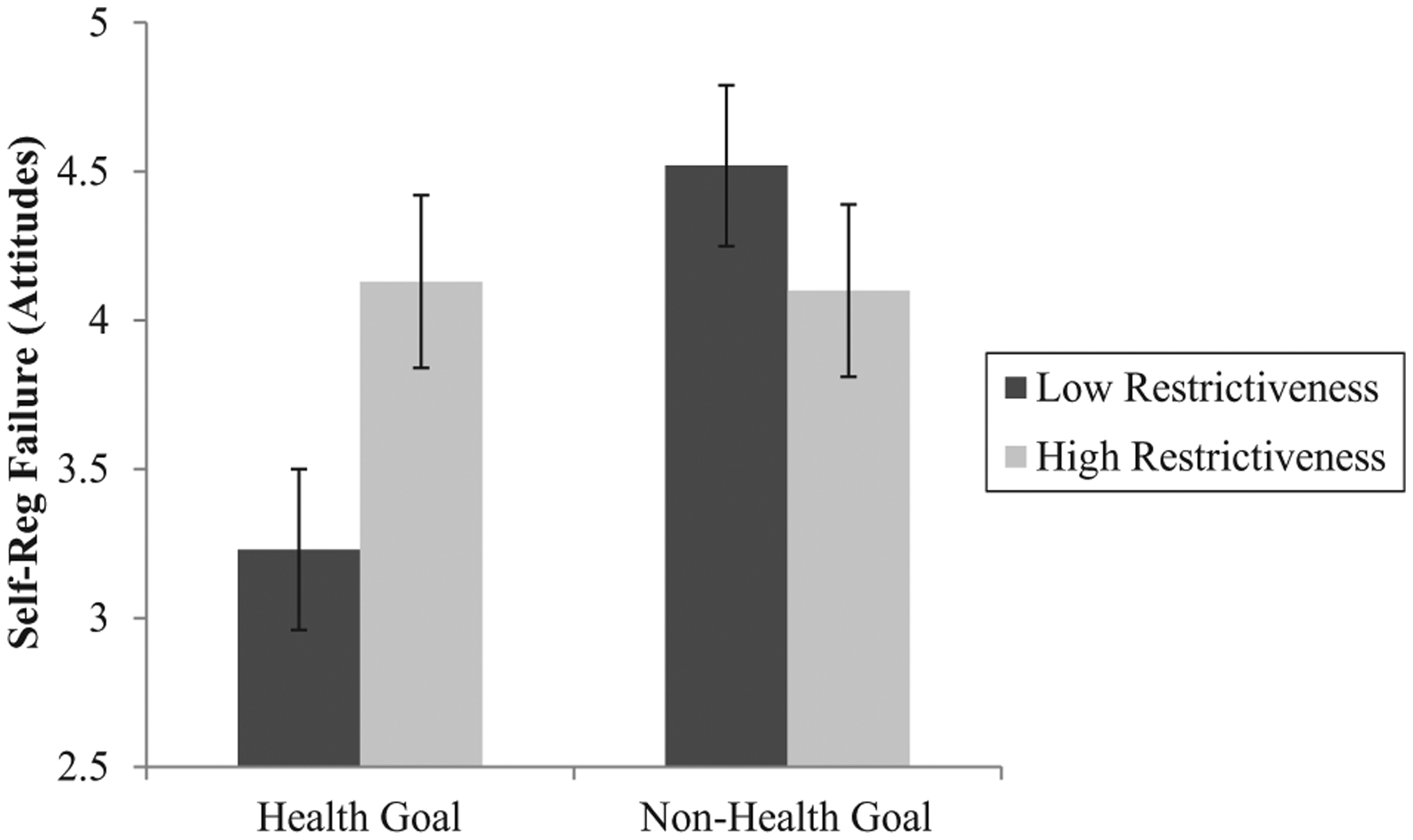
The effect of goal activation and goal restrictiveness on temptation desirability (goal commitment covariate).
Discussion
When a goal is activated, self-control is used to facilitate its attainment (Bargh, 1990; Bargh, et al., 2001; Fishbach et al., 2003), one consequence of which is a greater valuation of the goal and a devaluation of temptations (Trope & Fishbach, 2000). Study 2 replicated this pattern of effects only when the activated goal was not perceived as highly restrictive. When presented with a less restrictive health/fitness goal, participants exhibited attitudes consistent with goal pursuit, but when that goal was highly restrictive, participants reported attitudes more consistent with temptation indulgence. Indeed, their reported attitudes were similar to participants without any active health/fitness goal at all. These findings provide further support for our hypothesis. High goal restrictiveness caused a shift in participant attitudes away from their goal and toward temptations.
Although the results from Study 2 are consistent with our hypothesis, participants were asked to report their attitudes, which, according to counteractive self-control theory, are antecedents of behavioral engagement (Fishbach, 2009). Ultimately, self-control involves behaving in a manner that helps one to attain or maintain some goal (Schmeichel et al., 2010). Therefore, a third study was designed to test the influence of goal restrictiveness on actual temptation indulgence.
Study 3
The purpose of Study 3 was to investigate whether highly restrictive goals will cause people to indulge in a temptation. Study 3 conceptually replicated and extended the findings of Study 2 by investigating a behavioral rather than attitudinal consequence of high goal restrictiveness. Study 3 used methods similar to those used in Study 2.
Method
Ethics statement
The authors’ IRB approved this experiment. Participants completed written informed consent questionnaires.
Participants
Fifty-seven undergraduate psychology students (46 female, 11 male) from a large research-intensive university in the Mid-Atlantic region of the United States participated in exchange for course credit. The age of participants ranged from 18 to 22 years, with a mean age of 18.95 years.
Procedure
Study 3 used the same cover story and demographics measure as were used in Study 2. Goal activation (health/fitness vs. non-health/fitness) and the restrictiveness of that goal (high vs. low) were manipulated using the same procedure as was used in Study 2.
After viewing the final advertisement (see Supplemental Materials for advertisements) participants were asked several questions about their preferences regarding the ads (e.g., “Which ad had the best color scheme and why?”). The items were not of theoretical interest and were intended to support the cover story. After answering these items, participants were informed that the experiment was “over,” but because they had registered for an hour-long experiment time slot, and much of that hour remained, they would be asked to participate in an unrelated pilot study for another researcher. The experimenter then left the room to get the materials for the “pilot study,” which served as the dependent measure.
Temptation indulgence
The dependent measure, adapted from the procedures of Dalton, Chartrand, and Finkel (2010), was a behavioral measure of temptation indulgence: cookie consumption. Participants were told that the task was designed to help a colleague pretest the desirability of a range of food items and that they were assigned to evaluate snack-sized cookies. Consistent with the methodology of Dalton et al. (2010), a small bowl of snack-sized Chips Ahoy cookies was then placed in front of the participants along with a questionnaire titled “Food Evaluation Survey.” Participants were informed that they could have as many cookies as they would like but to eat at least one before filling out the questionnaire. To minimize participants’ concern of being evaluated while eating, the experimenter then left the room for exactly 5 min to “set up materials for the next participant.” Self-control was required to minimize the amount of tempting cookies that participants ate 3 (Dalton et al., 2010) because a health/fitness goal requires individuals to monitor their level of caloric intake. Therefore, the primary dependent measure was the number of cookies participants ate during the 5-min period.
The Food Evaluation Survey included three items to check on participants’ attitudes toward the temptation (cookies). These items were, “I would eat this food item in the future,” “This food item is one of my favorite types of food,” and “I do not like this food item (R).” Participants responded on a Likert-type scale with response option from 1 (strongly disagree) to 7 (strongly agree). After the last item was reverse coded, the three items were averaged to create an index of participants’ attitudes toward the temptations (Cronbach’s α = .77). After completing the questionnaire, participants were checked for suspicion, fully debriefed, and thanked for their participation.
Results
A preliminary analysis showed that there were no effects due to gender, so it is excluded from further analyses.
Temptation indulgence
To investigate the influence of the experimental manipulations on temptation indulgence, a 2 (goal activation: health/fitness vs. non-health/fitness) × 2 (goal restrictiveness: high vs. low) between-subjects ANOVA was conducted. As shown in Table 2, this analysis revealed a marginally significant main effect for goal restrictiveness, F(1, 53) = 3.03, p = .09,
Study 3 Summary of Analysis of Variance: Behavior.

Note. SS = sum of squares; df = degrees of freedom; MS = mean squares.
p < .10. *p < .05.

The effect of goal activation and goal restrictiveness on temptation indulgence.
Furthermore, to check participants’ attitudes toward the temptation, a 2 (goal activation: health/fitness vs. non-health/fitness) × 2 (goal restrictiveness: high vs. low) between-subjects ANOVA was conducted. As shown in Table 3, this analysis revealed the expected interaction between goal activation and restrictiveness, F(1, 52) = 6.32, p = .01,
Study 3 Summary of Analysis of Variance: Attitudes.

Note. SS = sum of squares; df = degrees of freedom; MS = mean squares.
p < .05.

The effect of goal activation and goal restrictiveness on temptation desirability.
Discussion
The results from Study 3 conceptually replicated Study 2 and extended the goal restrictiveness effect to a behavioral measure of temptation indulgence. When a health/fitness goal was activated, a highly restrictive goal frame caused participants to consume significantly more cookies than a less restrictive goal frame. When a health/fitness goal was not activated, high goal restrictiveness had no effect on cookie consumption. Moreover, an investigation of participants’ attitudes about the temptation (cookies) in Study 3 yielded results consistent with those of Study 2. Overall, Study 3 replicated classic goal activation effects (e.g., less positive evaluation of temptations) only when the goal was less restrictive. When the goal was highly restrictive, participant attitudes and behaviors were more consistent with the desire to indulge in temptations.
General Discussion
Goal characteristics exert a great deal of influence over goal pursuit (Kruglanski et al., 2002). Across three studies, we have attempted to provide support for the notion that setting goals containing highly restrictive demands or exhortations (e.g., no more cake, ever) is likely to lead to goal-damaging temptation indulgence. Unfortunately, many people, programs, and entire communities still abide by the commonsense logic that the “tougher” a goal, the more quickly and completely goal progress can be made. That is, if some restriction is good (e.g., have cake only on special occasions), then complete restriction must be better (e.g., no more cake, ever). This intuitive logic is likely buttressed by the many community-wide “zero-tolerance” (e.g., of drug use) programs and “cold turkey” (e.g., quitting smoking) approaches utilized in our culture.
Goals framed in this manner, however, are likely to create a sense of restricted personal freedom. This sense, in turn, will activate psychological reactance (J. W. Brehm, 1966), which is characterized by the motivation to restore one’s personal freedom. Reactance typically leads to an increased valuation of restricted behaviors, decreased valuation of imposed alternatives, and/or an increased engagement in restricted behavior (S. S. Brehm & Brehm, 1981). Reactance activated by highly restrictive goals, then, should be negatively related to goal progress, causing an increased desire for temptations (the restricted behavior), a decreased desire for means to the goal (imposed alternatives), and increased temptation indulgence (the restricted behavior).
To examine the proposed causal relationship between high goal restrictiveness and temptation indulgence, Study 1 randomly assigned people to focus on a goal’s restrictions or guiding properties. Those who focused on a goal’s restrictions subsequently reported a greater desire for temptations compared with those who focused on guiding properties. Study 1 provided experimental evidence that framing a goal as restrictive (vs. guiding) causes significantly more positive attitudes toward temptations, but it remained unclear whether goal restrictiveness reduced the positive effects of goal activation, eliminated them completely, or if goal activation caused a decrease in positive attitudes in the guiding condition.
Study 2 sought to address this question by adding a control goal condition. Consequently, Study 2 investigated the interaction of goal activation and goal restrictiveness on attitudes toward temptations. Further supporting our hypothesis, Study 2 demonstrated that participants with a highly restrictive goal reported attitudes consistent with greater temptation desirability than participants with a less restrictive goal. In fact, there was no difference in attitudes between the highly restrictive health/fitness goal condition and the highly restrictive control goal condition, indicating that high restrictiveness can completely eliminate the positive influence of goal activation. Ultimately, though, attitudes are antecedents of goal-directed actions (Fishbach, 2009), and we were interested in the potential impact of goal restrictiveness on behavioral indulgence.
Study 3 therefore utilized a behavioral measure to determine whether or not high goal restrictiveness would cause actual temptation indulgence. Supporting our hypothesis once again, participants with a highly restrictive goal indulged in temptations to a significantly greater extent than participants with a less restrictive goal, and similarly to participants with no relevant, active goal at all.
All three studies provide support for the goal restrictiveness effect, whereby highly restrictive goals cause one to restore a sense of freedom by shifting relevant attitudes and behaviors away from focal goal pursuit and toward temptations; a finding with significant theoretical and pragmatic implications. Notably, these studies contribute to the reactance literature by demonstrating that reactance can overcome the force of an opposing goal, at least in some situations. To the best of our knowledge, no other reactance research has systematically manipulated the presence of such an opposing goal. These studies also contribute to the goals literature by showing that restrictive framing can essentially eliminate the positive psychological consequences of an active goal. Finally, the goal restrictiveness effect also provides clear practical advice: Do not make your goals too restrictive or you risk activating reactance and pursuing temptations instead.
Reactance Versus Goal Difficulty
We have argued that highly restrictive goals activate reactance and that reactance leads to goal-damaging temptation indulgence. An alternative possibility might be that the participants construed the highly restrictive goals as more difficult to accomplish than the less restrictive goals, and that the perception of difficulty, rather than reactance, is what caused the observed results. Whereas this logic sounds plausible, both previous research and elements of our findings strongly suggest that reactance is more consistent with the observed pattern of results than perceptions of goal difficulty.
Specifically, Locke and Latham’s (1990, 2002) goal setting theory, which argues that goals perceived as difficult to accomplish lead to performance gains, is consistent with the reactance explanation. Locke and Latham (2002) have found that highly difficult goals increase performance on more than 100 different experimental tasks, including behavioral measures of self-control, like persistence on an ergometer (Bandura & Cervone, 1983). To our knowledge, more difficult goals alone have not been shown in the literature to lead to temptation indulgence when compared with less difficult goals. There are, however, two moderators of the goal difficulty and performance relationship: ability and goal commitment (Locke & Latham, 2002). When ability, or commitment, is low, highly difficult goals lead to performance decrements rather than performance gains. Applying this knowledge to the present research, if goal difficulty and not reactance explains our pattern of findings, then differences in ability and commitment should significantly alter the influence of our experimental treatments on temptation desire and indulgence. We tested this idea by using academic ability and health/fitness goal commitment as covariates in Studies 1 and 2 respectively. Neither variable significantly altered the goal restrictiveness and temptation indulgence relationship. In other words, the effect of goal restrictiveness on temptation desire persists even after controlling for general differences in ability and commitment. Thus, it is unlikely that the perception of goal difficulty is driving the results. Rather, the most convincing explanation is that high goal restrictiveness activated reactance, leading to increased temptation desire and indulgence.
Goal Restrictiveness and Ego Depletion
Much empirical research has supported the notion that an initial act of self-control reduces an individual’s ability or motivation to efficiently exert self-control on a subsequent act. It is hypothesized that a single self-control resource exists, such that an initial exertion of self-control results in self-control decrements across all domains of actions, thoughts, and behaviors. The term “ego depletion” refers to the state following an initial exertion of self-control, in which the single resource is diminished (Baumeister, Vohs, & Tice, 2007).
One potent moderator of the ego depletion effect is expectation. If an individual expects to exert self-control in the future, he will conserve resources by exerting less self-control on a present task. Such conservation leads to performance decrements on the present task but performance improvements on the future task (Muraven, 2012). Muraven, Shmueli, and Burkley (2006) referred to this as the conservation model of ego depletion. In terms of the goal restrictiveness effect, one could imagine that perceiving a goal as highly restrictive might imply the need to conserve one’s energy to comply with all salient restrictions. Ultimately, though, we do not believe that resource conservation model can account for the goal restrictiveness effect. Most notably, participants were not initially depleted in any of our three studies, nor were they explicitly informed of any future tasks. Both of these conditions were necessary to find resource conservation effects in prior research.
We do believe, however, that a potentially profitable avenue of future research involves examining the influence of highly restrictive goals on the development of an ego depleted state. Research has demonstrated that as the required exertion of self-control during an initial task increases, the amount of self-control displayed during a subsequent task diminishes (Baumeister, Vohs, & Tice, 2007). We have demonstrated that highly restrictive goals cause people to assign greater desirability to goal-restricted temptations than less restrictive goals, making it relatively more difficult to inhibit indulgence. In this context, a greater exertion of self-control would be required to stop oneself from indulging due to the increased force of desire. Consequently, the same task may result in greater ego depletion–like effects for the person who sets a highly restrictive goal than for one who sets a more reasonable goal.
Conclusion
This research provides evidence that highly restrictive goals cause increased desire for temptations and temptation indulgence. These results offer important insight into the process of goal pursuit and suggest one potential pitfall to avoid. In addition, they provide a potential avenue of future research investigating the relationship between goal restrictiveness and ego depletion.
Footnotes
Acknowledgements
We would like to acknowledge our undergraduate research assistants for their hard work and dedication to this project.
Declaration of Conflicting Interests
The author(s) declared no potential conflicts of interest with respect to the research, authorship, and/or publication of this article.
Funding
The author(s) received no financial support for the research and/or authorship of this article.