




Abstract
This study investigated a key claim of risk regulation theory, namely, that psychological internalizing of a relationship threat will serve as a mediator of the link between self-models (self-esteem and attachment anxiety) and relationship responses (moving closer to a partner vs. distancing from a partner). Participants (N = 101) received feedback that threatened their current romantic relationship (or no feedback) and then completed measures of internal–external focus, relationship closeness–distancing, and acceptance–rejection of the feedback. Results showed that participants with negative self-models responded to the relationship threat by becoming more internally focused and by distancing from their partners, whereas those with positive self-models became more externally focused and moved closer to their partners. Mediation analyses indicated that the link between self-models and relationship closeness–distancing was partially explained by internal focus.
Dependence on a romantic partner is a necessary component of well-functioning relationships; but dependence also carries with it risks such as rejection, disappointment, and hurt. Thus, individuals must balance relationship-promotion goals, which foster closeness and interdependence, with self-protection goals, which minimize the risk of hurt and rejection. Ironically, people who prioritize self-protection goals are actually more vulnerable to eventual rejection compared with those who prioritize relationship-promotion goals (Downey, Freitas, Michaelis, & Khouri, 1998; Murray, Griffin, Rose, & Bellavia, 2003; Stinson, Cameron, Wood, Gaucher, & Holmes, 2009).
Risk regulation theory suggests that individual differences in mental representations of the self play an important role in determining which goals are prioritized (Murray, Holmes, & Collins, 2006). According to the theory, people with negative self-models (NSMs)—who doubt their self-worth and expect rejection—will tend to adopt a self-protective interpersonal style aimed at limiting the pain of anticipated rejection (Cameron, Stinson, Gaetz, & Balchen, 2010). When threats are detected, they are likely to (a) question their partner’s acceptance, (b) internalize the threat (e.g., internal focus, internal attributions), and (c) reduce dependence on their partner and their relationship. In contrast, those with positive self-models (PSMs)—who are high in self-worth and confidently expect acceptance from others—are likely to adopt a more risky, relationship-promoting interpersonal style aimed at fostering closeness with others (Cameron et al., 2010). They are likely to respond to relationship threat by (a) increasing their confidence in their partner’s acceptance, (b) externalizing the threat (e.g., external focus, external attributions), and (c) drawing closer to their partner and their relationship.
Consistent with these assumptions, studies have shown that people with NSMs respond to relationship threats by defensively distancing from their partners (e.g., Collins, 1996; Collins, Ford, & Guichard, 2006; Downey et al., 1998; Murray, Rose, Bellavia, Holmes, & Kusche, 2002). For example, when dating participants were led to believe that their partner found them to have many faults (a relationship threat), those with low (vs. high) self-esteem felt less accepted by their partner, rated their partner more negatively on a series of interpersonal traits, and reported feeling less close to their partner (Murray et al., 2002; Study 3). In another study, dating participants who were high (vs. low) in attachment-related anxiety (who worry about being rejected or unloved) responded to partner transgressions by making more relationship-threatening attributions and reporting behavioral intentions that were likely to weaken their relationship (Collins et al., 2006).
The goal of the current study was to examine one important mechanism through which self-models regulate responses to threat. Specifically, risk regulation theory posits that the link between self-models and partner closeness/distancing following relationship threat should be mediated by internalization/externalization of the threat (Murray et al., 2006). For those with NSMs, self-doubts and concerns about rejection should lead them to focus on the implications of the threat for their personal well-being (in an egocentric fashion) and to look for internal explanations for the threat (for example, locating the cause in a flawed self). Turning inward and processing the threat from a self-immersed perspective should then foster defensive distancing (Ayduk & Kross, 2010). In contrast, for those with PSMs, their confidence in their worth and expectations of acceptance should lead them to respond to relationship threat in a less egocentric and more interdependent fashion and to look for external explanations for the threat (perhaps locating the cause in external events). Turning outward should allow them to maintain confidence in their relationship and should promote movement toward the partner. Although these theoretical claims have not been tested within ongoing relationships, Ford and Collins (2010) provided some initial evidence in a study of strangers in which participants were exposed to an ambiguous rejection from a potential dating partner. Participants with low (vs. high) self-esteem made more internal, self-blaming attributions for the rejection, experienced greater cortisol reactivity (a physiological indicator of self-threat), and were more likely to derogate their interaction partner. Importantly, self-blame attributions mediated self-esteem differences in cortisol reactivity and partner derogation.
It is important to investigate this same mediation process in ongoing relationships, as risk regulation theory is primarily designed to explain processes in relationships where some degree of dependence on a partner has already been established. Does this same mediation process explain defensive distancing in ongoing relationships? To investigate this question, we assessed two novel measures of internalizing–externalizing responses to relationship threat, (a) implicit self-focus (vs. other focus) and (b) self-conscious emotions (e.g., guilt, shame). First, we reasoned that increased internalization would be revealed in heightened self-focus following a relationship threat. Self-focus involves a focusing of attention inward (toward features of the self), rather than outward (toward other people or toward the situation). Based on risk regulation theory, individuals with NSMs (compared with those with PSMs) should become more self-focused following a potential relationship threat as they turn inward to find an explanation for the event. To our knowledge, no study has examined focus of attention following relationship threat. Second, we reasoned that internalization would be reflected in emotional responses to the threat. In particular, we focused on self-conscious emotions, which are a set of emotions triggered by a failure of the self or one’s behavior. Two closely related and frequently co-occurring self-conscious emotions are shame, which involves a negative evaluation of the self, and guilt, which involves a negative evaluation of one’s behavior (Tangney, Youman, & Stuewig, 2007). According to social self-preservation theory, threats to the social self (such as relationship threat) will evoke self-conscious emotions as the focal emotional response (Dickerson, Gruenewald, & Kemeny, 2004). This should be especially true for those with NSMs who are more likely to become self-focused following a social threat, resulting in heightened awareness of their negative self-aspects and increased self-blame for the social threat (Ford & Collins, 2010). In contrast, individuals with PSMs should be less likely to turn inward and to blame themselves for the potential threat, and should be comparatively buffered from feelings of shame or guilt. Importantly, for our study, self-conscious emotions following threat are associated with withdrawal and disengagement (to prevent further loss of social self-esteem; Dickerson et al., 2004), as well as defensive behavior (Tangney et al., 2007).
In summary, self-focused attention and self-conscious emotions should go hand in hand as two important indicators of internalization. These markers of internalization should, in turn, help explain relationship-distancing behavior following threat. To the extent that self-focused attention heightens awareness of negative self-aspects and increases feelings of shame and guilt for individuals with NSMs, they should be likely to prioritize self-protection goals and distance themselves from their partner. In contrast, if individuals with PSMs turn their attention outward in response to threat, they should be less likely to experience self-conscious emotions and more likely to view the threat in a broader, less self-focused perspective that enables them to approach their partner and to protect or enhance their relationship.
The Current Study
The primary aim of this study was to explore the role of psychological internalizing of a relationship threat as a mediator of the link between self-models and relationship responses. To accomplish this aim, we conducted a two-part study. During Session 1, participants completed measures of general and relational self-models (self-esteem and attachment-related anxiety). During Session 2, they were randomly assigned to a “relationship threat” or a “no threat” condition (described below). Cognitive and emotional responses were then assessed.
We predicted that individuals with PSMs and NSMs would respond differently to the relationship threat. Those with NSMs should report more internalization as reflected in increased self-focus and increased self-conscious emotions. They should also move away from the partner following relationship threat by derogating their partner, making pessimistic predictions for the future of their relationship, and reducing closeness. In contrast, those with PSM should report less internalization and more movement toward their partner following relationship threat by maintaining positive images of their partner, making optimistic predictions about the future, and maintaining or increasing closeness. Finally, we predicted that movement toward/away from the partner would be mediated by differences in internalizing/externalizing responses.
Method
Participants
Participants were 101 undergraduate students (65 females) ranging in age from 18 to 24 (M = 18.6 years, SD = 1.0). All were recruited from a large public university in California. Sixty-nine percent of participants were White, 14% were Asian/Pacific Islander, 9% were Latino/Hispanic, 2% were Black/African American, and 6% were of a different race than those listed. All participants were in a romantic relationship for at least 3 months (M = 15 months, SD = 11.92). They received US$15.00 or course credit for their participation.
Procedure
Session 1: Questionnaire session
Groups of one to four participants completed measures of general and relational self-models (described below).
Session 2: Experimental session
One week later, participants reported individually to the lab and were randomly assigned to the relationship threat or no threat condition. To create a relationship threat, we adapted a methodology used by Murray et al. (2002) in which participants completed a bogus relationship scale and received false feedback. The questionnaire asked participants to rate how often their partner engaged in various behaviors. There were 18 items that varied by condition. In the threat condition, 13 items described negative partner behaviors (e.g., “How often does your partner seem emotionally distant?”) and the remaining 5 items described positive (e.g., “How often does your partner laugh at jokes you make?”) or neutral (e.g., “How often does your partner discuss current events with you?”) behaviors. In addition, participants responded on a skewed response scale that was anchored in a way that elicited high scores (responses ranged from “never” to “a few times a month”). In the control condition, 5 items were negative, 10 items were positive, and 3 items were neutral.
After completing the questionnaire, participants in the relationship threat condition received false feedback. The experimenter ostensibly scored the questionnaire and told participants that their score was a “70” and that this score was quite a bit higher than average. They were told that this reflected a low level of involvement on the part of their romantic partner and that over time this would be likely to lead to disillusionment or dissatisfaction. Participants in the control condition did not receive feedback.
All participants then engaged in a filler activity (labeling states on a blank map) and completed the dependent measures, including implicit self-focus and self-conscious emotions (measures of internalization), ratings of the partner, predictions for the future of the relationship and inclusion of the partner in the self (measures of partner closeness/distancing), and acceptance/rejection of the threatening feedback (the manipulation check). Finally, participants were carefully debriefed.
Session 1 Measures of Self-Models
Self-esteem
Self-esteem was measured with the 10-item Rosenberg Self-Esteem Scale (Rosenberg, 1965; α = .93), which assesses global self-evaluation (e.g., “On the whole, I am satisfied with myself”). Participants rated each item on a scale from 1 (strongly disagree) to 7 (strongly agree).
Attachment-related anxiety
Because chronic attachment-related anxiety and relationship-specific attachment-related anxiety both play an important role in shaping responses to relationship events (Collins, Guichard, Ford, & Feeney, 2004), we assessed both constructs. To measure chronic anxiety, participants completed a shortened (14-item) version of the anxiety subscale of Brennan, Clark, and Shaver’s (1998) Experiences in Close Relationships (ECR) Scale, which measures the extent to which a person is worried about being rejected, abandoned, or unloved (e.g., “I worry about being abandoned,” “When others disapprove of me, I feel really bad about myself”). Participants responded to each item on a scale from 1 (not at all like me) to 7 (exactly like me) in terms of their general orientation toward close relationships (α = .94). The relationship-specific scale contained identical items except that some items were re-worded to refer to the current partner (e.g., “When my partner disapproves of me I feel really bad about myself”) and participants responded in terms of their specific orientation toward their current relationship (α = .92). The chronic and relationship-specific anxiety scales were strongly correlated with each other, r = .837, p < .001.
Self-model
To achieve the most valid and reliable assessment of self-models, we standardized and combined scores on self-esteem, chronic attachment anxiety (reverse-coded), and relationship-specific attachment anxiety (reverse-coded) into a single index (average r = .68, α = .86), with high scores indicating a more positive model of self. This composite self-model variable allowed us to capture various facets of individuals’ self-models, including general self-worth (self-esteem), general self-worth in relationships (chronic attachment anxiety), and self-worth in one’s specific relationship with one’s own romantic partner (relationship-specific). All three of these measures have been investigated as important predictors of risk regulation processes (Collins, 1996; Jaremka, Bunyan, Collins, & Sherman, 2011; Mikulincer, 1998; Murray, Derrick, Leder, & Holmes, 2008; Overall & Sibley, 2009; Simpson, Rholes, & Phillips, 1996). Rather than presenting the findings for each measure of self-model separately, we will present findings in terms of this composite self-model variable to avoid complexity and space issues. It should be noted that even when these variables are investigated individually, the overall pattern of results is comparable across the three measures.
Session 2 Dependent Measures
As mentioned previously, all dependent measures were assessed following the delivery of the relationship threat feedback (or no feedback, in the case of the control condition).
Measures of internalization/externalization
Self-conscious emotions
Participants described how they were feeling “right now” by rating a series of emotions on a scale from 1 (very slightly) to 5 (extremely). For the current investigation, we computed a two-item index of self-conscious emotions (guilty, ashamed; α = .68). 1
Implicit self-focus
Participants completed a 12-item implicit measure of self-focus based on a measure created by Wegner and Giuliano (1980). Participants completed a series of sentences by choosing among three pronoun alternatives, one of which was first-person singular (e.g., “The noise got to us/them/me before long,” “I/he/she spent the day at the beach”). We computed an implicit self (vs. other) focus score by computing the proportion of first-person, singular responses chosen. Scores ranged from 0 to .667.
Composite measure of internalization
To provide the most valid assessment of internalization, we created a composite measure by standardizing and combining scores for self-conscious emotions and implicit self-focus. Although these two variables were only modestly correlated (r = .18, p = .07), the combined index enabled us to capture different facets of internalization, thereby increasing the sensitivity of our measurment. 2 High scores indicate more internalization.
Measures of movement toward/away from the partner
Ratings of partner traits
Participants rated their romantic partner on a series of positive and negative interpersonal traits (adapted from Murray et al., 2002) using a scale from 1 (not at all characteristic) to 9 (completely characteristic). We computed an eight-item index of positive partner evaluations (α = .89; kind and affectionate, considerate, loving, warm, understanding, tolerant and accepting, responsive, and forgiving).
Predictions for the future
Participants were presented with a series of positive and negative relationship events (adapted from Murray et al., 2002) and were asked to predict how frequently they thought each event would occur in the next 6 months, using a scale from 1 (rarely, if ever) to 7 (frequently). We computed a six-item index of optimistic predictions (α = .75; for example, “My partner will provide needed support if I am feeling down,” “I will be tolerant and generous if my partner behaves badly.”) 5 .
Inclusion of other in the self
Participants completed the inclusion of other in the self scale (Aron, Aron, & Smollan, 1992), which is a pictorial measure of closeness consisting of a series of progressively overlapping circles. Scores range from 1 (non-overlapping circles, suggesting very little closeness) to 7 (highly overlapping circles, suggesting a great deal of closeness). Participants chose the picture that best represented their relationship.
Composite measure of movement toward/away from the partner
A composite measure of partner closeness/distancing was created by standardizing and combining measures of positive partner ratings, positive predictions for the future of the relationship, and inclusion of other in the self (α = .67). 3 High scores indicate increased closeness to the partner.
Measure of perceived partner involvement
Finally, participants responded to the question “How involved is your partner in your relationship?” using a scale from 1 (much less involved than average) to 7 (much more involved than average). This was the final item on the questionnaire and it was intended to serve as a manipulation check and to measure the extent to which participants in the relationship threat condition accepted the threatening feedback.
Results
Regression Analyses
To examine the effect of self-models on responses to relationship threat, we conducted moderated regression analyses. We entered the main effects of self-model (continuous) and experimental condition (0 = control, 1 = threat) on Step 1, and the Self-Model × Condition interaction on Step 2. To follow-up on significant interactions, we computed simple slopes and predicted means at ±1SD from the mean on self-models (Aiken & West, 1991). As mentioned previously, we predicted that the threat manipulation would move participants in different directions depending on their self-models—those with NSMs would become more negative/pessimistic in the threat condition compared with the control condition, whereas those with PSMs would become less negative (and more positive) in the threat versus control conditions.
Perceived partner involvement (manipulation check)
There was no main effect of experimental condition (β = .008, p = .930), a significant main effect of self-model (β = .349, p < .001), and a significant Self-Model × Condition interaction (β = .287, p = .049). As shown in Figure 1, there was no association between self-models and perceived partner involvement in the control condition (β = .131, p = .368), but there was a significant association in the threat condition (β = .507, p = <.001); those with NSMs rated their partner as significantly less involved than those with PSMs. These findings indicate that those with NSMs tended to accept the threatening feedback, whereas those with PSMs tended to discount or reject it.

Manipulation check by self-model and condition.
Composite measure of internalization
There were significant main effects of experimental condition (β = .310, p < .001) and self-model (β = −.441, p < .001), and a Self-Model × Condition interaction (β = −.855, p < .001). As shown in Figure 2, the threat manipulation moved people in different directions depending on their self-models. Participants with PSMs reported less internalization in the threat (vs. control) condition (β = −.249, p = .007), whereas those with NSMs reported more internalization in the threat (vs. control) condition (β = .879, p < .001). Viewed another way, in the threat condition, those with PSMs reported less internalization relative to those with NSMs (β = −.913, p < .001), whereas in the control condition, the opposite pattern was seen (β = .211, p = .034).

Internalization by self-model and condition.
Composite measure of movement toward/away from the partner
There was no main effect of experimental condition (β = .076, p = .433), a significant main effect of self-model (β = .278, p = .005), and a significant Self-Model × Condition interaction (β = .424, p = .004). As shown in Figure 3, participants with PSMs reported greater movement toward the partner in the threat (vs. control) condition (β = .354, p = .009) whereas those with NSMs showed an opposite (non-significant) trend (β = −.206, p = .127). Viewed another way, in the threat condition, those with PSMs (vs. those with NSMs) reported more movement toward the partner (β = .512, p < .001), whereas in the control condition, those with PSMs and NSMs did not differ in terms of the amount of movement toward the partner (β = −.046, p = .752).

Movement toward the partner by self-model and condition.
Mediation Analyses
We conducted a mediated moderation analysis to test whether internalization of threat mediated the Self-Model × Condition interaction on movement toward (or away from) the partner, following procedures outlined by Baron and Kenny (1986) and Hayes (2013). As summarized in Figure 4, prior analyses revealed a significant Self-Model × Condition interaction predicting both movement toward the partner (the outcome) and internalization (the mediator). Internalization in turn, significantly predicted movement toward the partner (b = −.326, β = -.324, p = .03), and the original Self-Model × Condition effect was no longer significant. This mediated (indirect) effect was statistically significant as indicated by the bootstrapped, bias-corrected confidence interval for the unstandardized indirect effect (95% CI = [.1129, .5678]). 4 Together, these findings are consistent with the idea that movement toward (or away from) the partner following threat is mediated by internalization. Those with NSMs were more likely to internalize the threat and were then more likely to move away from (vs. toward) their partner. In contrast, those with PSMs were less likely to internalize the threat and were then more likely to move toward (vs. away from) their partner.
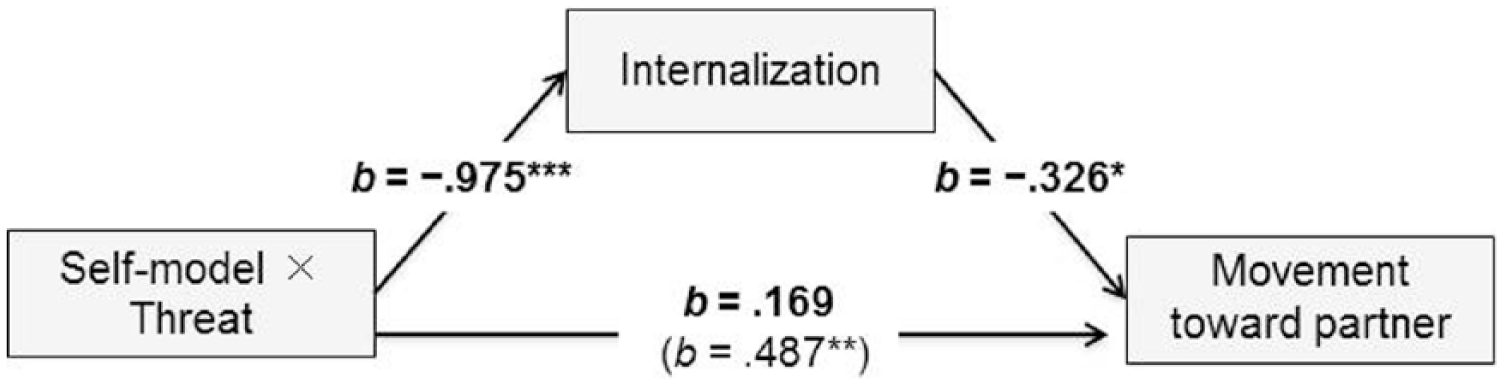
Summary of the mediated moderation model.
Supplemental Analysis
In a final analysis, we wanted to rule out the possibility that the observed effects for self-models might reflect pre-existing differences in relationship quality. There was a modest positive correlation between our self-model index and relationship satisfaction (r = .34, p = .001) indicating that those with more PSMs were in happier relationships. Thus, it is possible that the moderating effects of self-models were due to differences in the quality of participants’ relationships rather than self-models per se. Therefore, we repeated all analyses controlling for relationship satisfaction. The results remained the same as those reported above. Only the interaction effect for perceived partner involvement (our manipulation check) changed from significant to marginal. Thus, the observed findings for self-models cannot be explained by differences in relationship quality.
Discussion
Findings from this study provide evidence for a key assumption of risk regulation theory, namely, that internalization of relationship threat is one important pathway through which self-models motivate self-protection versus relationship-promotion goals. In the current study, those with NSMs were more likely to engage in responses reflecting internalization (namely, focusing on the self and experiencing self-conscious emotions) following relationship threat. These responses in turn predicted distancing from the partner by rating the partner less positively, making less positive predictions for the future of the relationship, and reporting less closeness to the partner on a measure of inclusion of the partner in one’s sense of self. Although this pattern of responses is motivated by self-protection concerns, it has been shown to paradoxically increase the risk of being rejected by one’s partner (Downey et al., 1998; Murray, Bellavia, Rose, & Griffin, 2003). Thus, this pattern of behavior has important implications for the interpersonal outcomes experienced by individuals with NSMs.
Although most research on risk regulation has focused on the vulnerabilities associated with NSMs, the current findings highlight the importance of PSMs as a source of strength and resilience in the face of relationship threat. These findings confirm that the moderating effect of self-models on responses to relationship threat are not simply fueled by the harmful responses of those with NSMs (Murray, Griffin, et al., 2003). When faced with a relationship threat, those with PSMs do not simply avoid the downward, self-protective spiral of those with NSMs but rather they engage in active coping responses to protect and even boost their relationship. Researchers should continue to identify the specific relationship-boosting responses that those with PSMs engage in following relationship threat, as well as the mechanisms that lead to these responses.
In addition, the current findings underscore the importance of an external focus in response to relationship threat and the benefits that a less egocentric point of view can bring. Work investigating the benefits of an external focus has largely been done in the context of participants recalling an intense negative event (Kross & Ayduk, 2011). The current study illustrates that for vulnerable groups, such as those with NSMs, a less intense event (even a suggestion of a threat to one’s relationship) is enough to trigger an internal focus and subsequent movement away from one’s partner. Perhaps if individuals with NSMs can be trained to focus externally following a relationship threat and to engage in reflection from a self-distanced perspective, they will avoid the negative mental, physical, and interpersonal outcomes (Ayduk & Kross, 2010; Finkel, Slotter, Luchies, Walton, & Gross, 2013; Kross & Ayduk, 2011) associated with internalization. Future work should investigate whether training those with NSMs to take a less self-immersed perspective following relationship threat can help them achieve better interpersonal outcomes.
Although the current findings were largely consistent with our hypotheses, a few unpredicted findings deserve comment. First, our manipulation check (ratings of partner involvement) did not show the expected main effect of condition, but rather an interaction effect; participants with PSMs defended against the threatening feedback by rating their partner as more rather than less involved in the threat (vs. control) condition. This finding is not entirely surprising. It is consistent with predictions of risk regulation theory and with findings from other studies which show that people with PSMs overestimate acceptance in risky social situations (Cameron et al., 2010; Murray et al., 2002). Rather than viewing this finding as a limitation, we view it as further evidence of the tendency for those with PSMs to actively defend their relationship against external threats by discounting concerns about relationship threat and maintaining (and even increasing) a sense of confidence in the relationship.
Finally, it is important to comment on a possible alternative interpretation of our findings. Might the current findings reflect pre-existing differences between those with PSMs and NSMs in terms of relationship quality? This is unlikely given that in the absence of threatening feedback (in the control condition), those with PSMs and NSMs rated their partners as equally involved. In addition, when we repeated all analyses controlling for relationship satisfaction, the results remained largely the same. Thus, we feel confident that the observed effects for self-models do not merely reflect differences in the quality of the relationships in which those with PSMs and NSMs reside.
Limitations and Future Directions
It is worth noting a few limitations to the current study. First, as is often the case with laboratory studies of close relationships, our sample was a college student sample. Thus, care should be taken in generalizing beyond this sample to other groups of individuals, such as older adults. Future studies should test risk regulation processes in various age groups. In addition, because our sample had a mean relationship length of 15 months, care should be taken in generalizing these findings to those in relationships of much greater length. Future studies should investigate whether the interaction between self-model and relationship threat affects internalization and movement toward/away from the partner in a similar way for those in relationships of greater length. It is possible that over time, as partners grow more confident in each other’s commitment, those with NSMs are less likely to internalize threats and subsequently less likely to distance from the partner. In addition, it should be noted that all measurements in the current study were self-report measures. Future work should use more objective measures that are less prone to bias or to social desirability effects. For example, behavioral measures of partner distancing and physiological measures of internalization could be incorporated into future work.
Finally, the current findings are based on a limited conceptualization of internalization and movement toward/away from the partner. Future work should incorporate additional measures of internalization and movement toward/away from the partner in tests of the mediational model investigated here. For example, additional measures of internalization may include rumination and reductions in state self-esteem, and additional measures of movement toward/away from the partner may include reductions in self-disclosure to the partner and non-verbal signs of withdrawal/distancing. This would allow for a more complete understanding of the specific pattern of responding that leads to better or poorer relationship outcomes for those with positive and NSMs.
Conclusion
The current findings provide empirical support for an important assertion of risk regulation theory, namely that looking inward following a relationship threat will motivate self-protective responses, and that looking outward will motivate relationship-promoting responses. Because internalizing a social threat has been associated with poor psychological and physical outcomes (Dickerson, Mycek, & Zaldivar, 2008; Ford & Collins, 2010), our findings suggest that people with NSMs may be at higher risk for negative personal and interpersonal outcomes in response to social threat. In contrast, those with PSMs are able to take life’s lemons and make lemonade by responding to threat in ways that increase both personal and relationship well-being.
Footnotes
Declaration of Conflicting Interests
The author(s) declared no potential conflicts of interest with respect to the research, authorship, and/or publication of this article.
Funding
The author(s) received no financial support for the research and/or authorship of this article.