




Abstract
Adult separation anxiety disorder (ASAD) is classified under anxiety disorders in Diagnostic and Statistical Manual of Mental Disorders (5th ed.; DSM-5). However, the reasons for ASAD are uncertain. The relationship between ASAD and childhood experiences is one of the frequently debated issues. The purpose of this study was to develop a model that would examine the mediating roles of insecure attachment dimensions—avoidance and anxiety—in the relationship between adults’ retrospective perceptions of parental acceptance–rejection in childhood and separation anxiety. A total of 1,534 participants completed Parental Acceptance–Rejection Questionnaire, Experiences in Close Relationships–Revised, Adult Separation Anxiety Questionnaire, and personal information form. The results of the structural equation model indicated that insecure attachment dimensions—avoidance and anxiety variables—fully mediated the relationship between perceived parental acceptance–rejection and separation anxiety. These findings shed new light on the relationship between adults’ retrospective perceptions of childhood experiences and adult separation anxiety.
Keywords
Introduction
Adult separation anxiety disorder (ASAD) is classified under anxiety disorders in Diagnostic and Statistical Manual of Mental Disorders (5th ed.; DSM-5). Separation anxiety is defined as a developmentally unfavorable extreme level of fear and anxiety about the separation from people to whom they are attached (American Psychological Association, 2013). DSM-5 reports that it can be observed among adults, children, and adolescents. ASAD occurs as adult-onset SAD or childhood-onset SAD (Fagiolini, Shear, Cassano, & Frank, 1998; Manicavasaga, Silove, & Curtis, 1997; Manicavasagar, Silove, Curtis, & Wagner, 2000; Ollendick, Lease, & Cooper, 1993; Shear, Jin, Ruscio, Walters, & Kessler, 2006). In adult-onset SAD, the attachment figure may be the spouse, the romantic partner, and children or parents of the individual, whereas the childhood-onset SAD shows extreme sensitivity to separation from the maternal parenting attachment figure (Marnane & Silove, 2013). The separation anxiety was first conceptualized by Bowlby (2014) within the framework of attachment theory.
In the attachment theory, childhood separation anxiety and its effects on the child are explained in the framework of parent–child interaction. Separation anxiety is considered to be an evolutionarily adapted mechanism that allows the child to feel closer to the adult attachment figure for the sense of security (Bowlby, 2012, 2014). The sense of security the infant perceives shapes internal working models that determine attachment formation (Bowlby, 2012).
There are individual differences in the attachment orientations of individuals. Individuals in the dimension of avoidance have difficulty in developing attachment to people in their lives. Avoidant individuals avoid establishing intimacy. Anxious individuals are concerned that they will not be loved or will be abandoned by the people they care about. As a result of this anxiety, they focus on enhancing contact with individuals they are close to in order to obtain a sense of security (Collins & Feeney, 2004; Hazan & Shaver, 1987; Hazan & Shaver, 1994). Anxiety and avoidance attachment are defined as insecure attachment dimensions.
Bowlby (2014) stated that anxious attachment may lead to various psychopathologies. Separation anxiety and anxious attachment reveal protest behaviors among children when they need to leave the attachment figure. Because attachment has a lifelong effect on the individual, protest behaviors exhibited against separation in adulthood can take the form of various mental health problems. The studies on the relationship between separation anxiety and attachment figures have reported that separation anxiety is associated with anxiety disorders among parents (Manicavasagar, Silove, Rapee, Waters, & Momartin, 2001; Slattery et al., 2002), parents’ beliefs about their children (Herren, In-Albon, & Schneider, 2013), and genetic and shared environment (Feigon, Waldman, Levy, & Hay, 2001). In addition, it has been reported that individuals diagnosed with childhood SAD may be in the risk group of panic disorder and depression (Aschenbrand, Kendall, Webb, Safford, & Flannery-Schroeder, 2003; Lewinsohn, Holm-Denoma, Small, Seeley, & Joiner, 2008) and multiple anxiety syndrome (Lipsitz, Martin, Mannuzza, & Chapman, 1994) in adulthood. In this respect, the existence of a relationship between the theory of attachment and SAD can be said to be partly revealed. These mental health problems can be the adult extension of protest behavior that results from the inability to reach the attachment figure. On the other hand, the relationship between SAD and attachment dimensions is controversial for several reasons. First, although SAD is nomothetic as a diagnostic category, attachment dimensions are based on the attachment theory and are idiographic concepts (Marnane & Silove, 2013). Another reason is that it has been observed that the relationship between anxious attachment dimension and SAD is moderate and that the scores of anxious attachment dimension do not explain the SAD variance (Manicavasagar, Silove, Marnane, & Wagner, 2009). All these carry the relationships between SAD and the theory of attachment to a controversial point. Yet, it is known that both the SAD and the attachment theory are related to the attachment figure.
Sensitivity of the attachment figure is the determinant of individual differences in attachment (Ainsworth, Blehar, Waters, & Wall, 2015). Parental acceptance or rejection, such as parental sensitivity to the child in the early years of life, can lead to differences in individual orientations (Chyung & Lee, 2008; Cournoyer, Sethi, & Cordero, 2005; Erkman, 2006; Kim, 2013; Rohner & Khaleque, 2002; D. Sarıtas, Grusec, & Gençöz, 2013). Parental acceptance and rejection studies are conceptualized under “PARTheory” or parental acceptance–rejection theory.
PARTheory, which is based on the evolutionary developmental psychology approach, is based on the basic assumption that every human being emotionally needs to be loved and accepted by the significant others of their lives. In a sense, it can be called as the warmth dimension of parenting (Rohner, 2004). In PARTheory, the concept defined as “significant others” corresponds to the attachment figure in attachment theory. The attachment figure in PARTheory is the significant other, with whom the adult or the child has a long-term emotional attachment (Rohner, 2005). In PARTheory, interpersonal acceptance and rejection together constitute the warmth dimension of relationships between individuals and significant others. Warmth and acceptance dimension includes the warmth of the parent or the attachment figure. Warmth behaviors are love, care, affection, nurturance, and emotional support. In contrast to the rejection dimension, which includes the parent’s indifference/neglect, loveliness symbolizes the opposite end of the warmth dimension (Khaleque, 2012; Rohner & Lansford, 2017). Individuals define themselves at a point between these two dimensions.
The prospective effects of parental rejection on individuals are a matter of debate. Parental rejection was observed to be associated with mental health. These include depression, behavior problems, delinquency, substance abuse, suspiciousness and self-doubt, and low self-esteem (Baker & Hoerger, 2012; Kim, 2013; Rohner & Britner, 2002). Furthermore, it was reported that parental rejection, which is perceived retrospectively in adulthood, is related to anxiety (Sarıtaş Atalar & Gençöz, 2015) and psychological adaptation (Türkdoğan, 2017).
The Current Study and Overview of the Present Research
ASAD is a common anxiety disorder, and adult-onset SAD was shown to be highly comorbid with other psychiatric disorders (Gesi et al., 2017). There is a very broad clinical context in the diagnosis of ASAD (Strawn & Dobson, 2017). Revealing the relationships between adult separation anxiety, attachment dimensions, and family-related factors will present the reasons for ASAD and contribute to the distinguishing of causes of ASAD from other mental problems. In the present research, Bowlby’s (2014) attachment theory and Rohner’s (1980) PARTheory are studied in terms of adult separation anxiety. Bowlby (2014) suggested the hypothesis that the interaction between attachment figure and child is related to separation anxiety and insecure attachment. In addition, Rohner (2004), using the concept of warmth of attachment, which is a parallel concept to the sensitivity of the attachment figure in the attachment theory, suggested that parental rejection is related to mental health within the scope of PARTheory. In summary, it has been reported that relationships with the attachment figure and the attachment formation may shape the individual’s other relationships with others throughout life (Hazan & Shaver, 1987). It is emphasized that if this basic relationship is unhealthy, this will lead to some psychopathologies. Within this framework, the purpose of the present research is developing a model for explaining the mediating role of insecure attachment dimensions between retrospective perceptions of parental acceptance–rejection in childhood and adult separation anxiety.
Materials and Methods
Participants and Procedure
The participants were convenience-sampled from university students attending 61 departments at 20 faculties in a large-sized city in the middle part of Turkey. In all, 1,534 questionnaires were validly completed and collected. Regarding gender, 48.9% (n = 750) were females and 51.1% (n = 784) were males. The participants ranged in age from 18 to 25 years (M = 21.22 years; SD = 1.35). Regarding their classroom level, a total of 242 participants (15.8%) reported that they were in first year, 464 (30.2%) were in second year, 416 (27.1%) were in third year, and 412 (26.9%) were in fourth year. Paper/pencil-based questionnaires were distributed to students in their classroom. The anonymity of the study was stressed in advance. Participants were also aware that their participation was completely voluntary and that they could withdraw from the study at any time.
Measures
Adult Parental Acceptance–Rejection Questionnaire (PARQ)
PARQ is a self-report questionnaire designed to assess adults’ retrospective remembrances of the degree to which they experienced parental (maternal and paternal) acceptance or rejection in childhood. There are two versions of the adult PARQ. The mother version of the questionnaire assesses adults’ remembrances of their mothers’ accepting–rejecting behaviors in childhood. The father version assesses remembrances of their fathers’ accepting–rejecting behaviors in childhood. The scale consists of 60 items (e.g., “He said good things about me”). Individuals provide answers to each item on a 4-point Likert-type scale, ranging from (4) “almost always true” to (1) “almost never true” (Rohner & Khaleque, 2005). Turkish version of PARQ was found to be valid and reliable (Türkdoğan, 2017; Varan, 2003). High scores indicated greater perceived efficacy in romantic relationships. High scores indicated perceived parental rejection. In this study, the internal consistency reliability coefficient of the mothers’ accepting–rejecting behavior was found to be .95 and that of fathers was found to be .96.
Experiences in Close Relationships–Revised (ECR-R)
ECR-R is an attachment inventory designed to assess attachment patterns. The scale assesses two dimensions: anxiety and avoidance. An 18-item (e.g., “I’m afraid that I will lose my partner’s love”) subscale measures each dimension (Fraley, Waller, & Brennan, 2000) in a Likert-type scale ranging from 1 (“strongly disagree”) to 7 (“strongly agree”). Turkish version of ECR-R was found to be valid and reliable (Selçuk, Günaydın, Sümer, & Uysal, 2005). High scores indicate insecurity attachment. In this study, the internal consistency reliability coefficient of anxiety and avoidance was found to be .83 and .85, respectively.
Adult Separation Anxiety Questionnaire (ASA-27)
This questionnaire was designed to assess adults’ diagnoses of SAD. This scale consists of 27 items (e.g., “Have you been worrying a lot about people you care about leaving you?”) and self-report measure (Manicavasagar, Silove, Wagner, & Drobny, 2003). The items were measured on a Likert-type scale ranging from 0 (“this has never happened”) to 3 (“this happens very often”). Item scores (0-3) are added to yield a total instrument score ranging from 0 to 81. Turkish version of ASA was found to be valid and reliable (Diriöz, Alkin, Yemez, Onur, & Eminağaoğlu, 2012) . In this study, the internal consistency reliability coefficient of separation anxiety was found to be .88
Data Analysis
Statistical analysis was conducted using IBM SPSS Statistics 22 and AMOS Graphics. First, descriptive statistics (means, standard deviations, skewness, and kurtosis) were carried out on all variables. Then, Pearson’s bivariate correlations examined associations between parental acceptance–rejection, attachment avoidance, attachment anxiety, and separation anxiety for all participants. After descriptive statistics and correlations, structural equation modeling (SEM) analyses were used to examine the mediating role of avoidance and anxiety attachments in the association between parental acceptance–rejection and separation anxiety. Item parceling method was used to control for inflated measurement errors due to multiple items for the latent variable (Little, Cunningham, Shahar, & Widaman, 2002). Also, the item parceling method allows us to decrease the number of observed variables and to improve reliability and normality of the resulting measures (Nasser & Wisenbaker, 2003). Two item parcels for parental acceptance–rejection and three item parcels for adult separation anxiety, attachment avoidance, and attachment anxiety were created using an item-to-construct balance approach, the goal of which is to derive parcels that are equally balanced with regard to their difficulty and discrimination (Little et al., 2002).
The SEM was conducted following a two-step process by recommendation (Anderson and Gerbing, 1988). First, the measurement model to be used was confirmed via a confirmatory factor analysis. When the measurement model was confirmed, mediation was analyzed by the structural model. The fit indexes used in this study are (a) chi-square, (b) comparative fit index (CFI), (c) incremental fit index (IFI), (d) standardized root mean square residual (SRMR), and (e) root mean square error of approximation (RMSEA). To compare two or more models, chi-square difference test (Δχ2) was used to determine which model was preferred. In addition, Akaike information criterion (AIC; Akaike, 1987) and expected cross-validation index (ECVI; Browne & Cudeck, 1993) were examined, with smaller values representing a better fit of the hypothesized model. To control for the potentially inflated measurement errors caused by multiple items and to improve the psychometric properties of the variables (Ronald, Daniel, & Paul, 2000), three parcels were identified for separation anxiety, attachment anxiety, and attachment avoidance. Cutoff points were used as acceptable criteria—CFI and IFI >.90, SRMR and RMSEA <.08—for assessing the models (Hu & Bentler, 1999; MacCallum, Browne, & Sugawara, 1996; Tabachnick & Fidell, 2006).
In addition, indirect effects of parental acceptance–rejection on separation anxiety through its effect on attachment avoidance and attachment anxiety were estimated using the bootstrapping method with 10,000 resamples to compute the 95% bias-corrected confidence intervals (CI). For the indirect effect, 95% bootstrap CI without “zero” indicated the significant mediation effect (Preacher & Hayes, 2008).
Results
Descriptive Statistics
Means, standard deviations, and intercorrelations for all the observed variables are presented in Table 1. Also, gender differences in variables are explored. Regarding the normality, skewness (range: 0.01-1.12) and kurtosis (range: –0.42 to 1.23) values were found to be within critical values as Finney and DiStefano (2006) suggested. The results indicated that all variables were significantly associated with each other. Parental acceptance–rejection positively correlated with separation anxiety, attachment avoidance, and attachment anxiety. Also, separation anxiety positively correlated with attachment avoidance and attachment anxiety.
Correlations and Descriptive Statistics for the Variables.
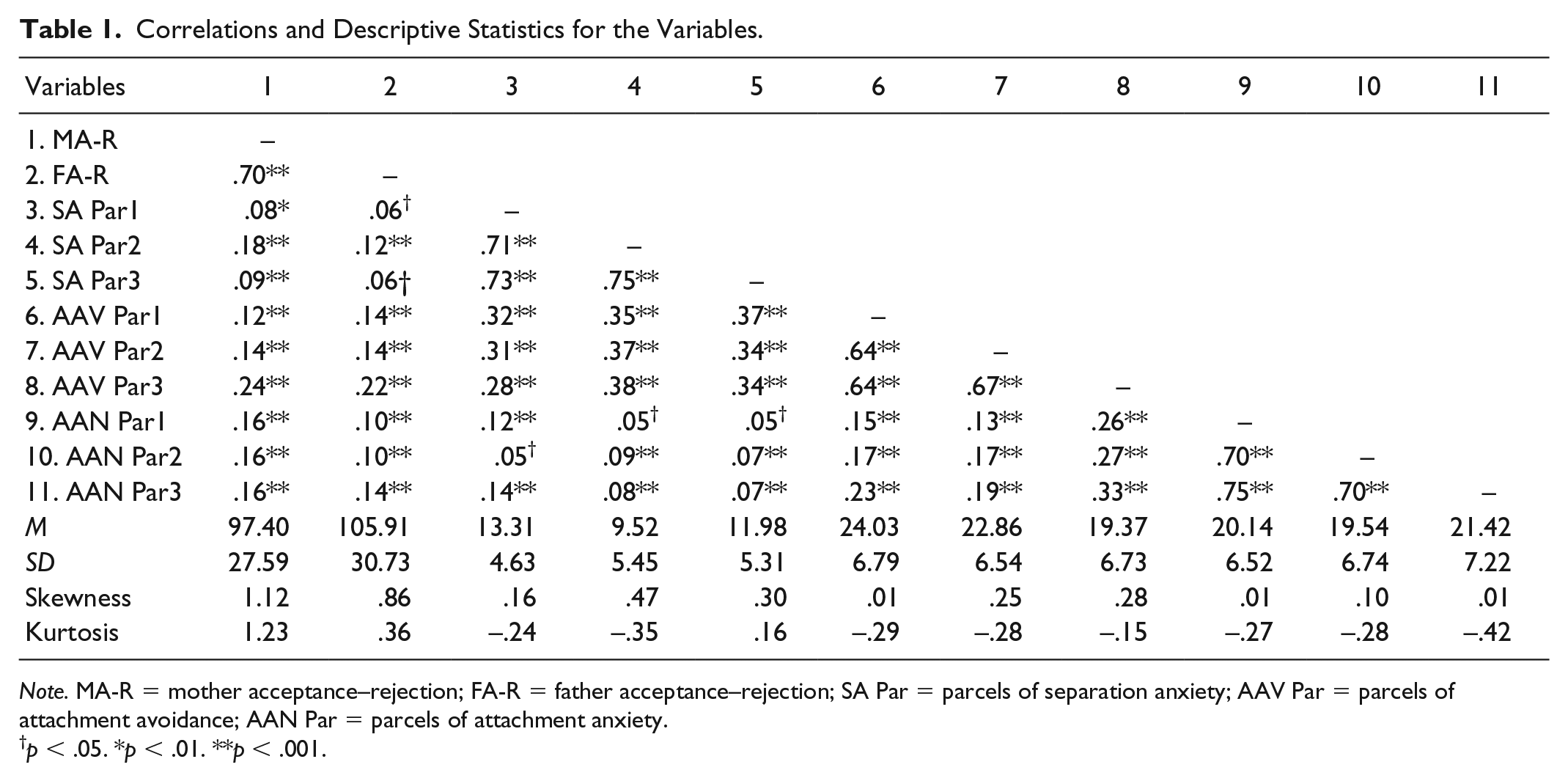
Note. MA-R = mother acceptance–rejection; FA-R = father acceptance–rejection; SA Par = parcels of separation anxiety; AAV Par = parcels of attachment avoidance; AAN Par = parcels of attachment anxiety.
p < .05. *p < .01. **p < .001.
When gender differences are addressed, the t test showed that males (M = 98.98, SD = 26.86) had a higher level of mother acceptance–rejection than females (M = 95.74, SD = 28.26), t = −2.30, p < .05. In addition, males (M = 108.51, SD = 29.52) reported significantly higher levels of father acceptance–rejection than females (M = 103.19, SD = 31.75), t = −3.40, p < .05. On the other hand, the t test indicated that females (M = 38.13, SD = 13.90) had a higher level of separation anxiety than males (M = 31.65, SD = 13.30), t = 9.33, p < .05. Similarly, females (M = 64.40, SD = 19.06) reported significantly higher levels of attachment avoidance than males (M = 57.95, SD = 17.30), t = 6.95, p < .05. Finally, males (M = 66.32, SD = 17.63) and females (M = 66.21, SD = 17.49) did not differ significantly on levels of attachment anxiety, t = 0.12, p > .05.
Measurement Model
Before exploring the SEM, a measurement model was conducted to investigate the association between latent variables. The measurement model included four latent factors (parental acceptance–rejection, separation anxiety, attachment avoidance, and attachment anxiety) and 11 observed variables. Measurement model fit was checked: χ2(38, N = 1,534) = 192.61, p < .001; CFI = .98; GFI = .97; IFI = .98; SRMR = .031; RMSEA = .052. These indices showed that the measurement model had an acceptable fit to the data. Also, the factor loading ranged from .77 to .91, and the indicators on the latent variables were significant (p < .01). Thus, the four latent variables seemed to have been sufficiently measured by their respective indicators.
Structural Model
After being verified that the observed variables measured the latent variables, the structural model was performed to examine how attachment avoidance and attachment anxiety mediated the association between parental acceptance–rejection and separation anxiety. Therefore, in the fully mediated model, paths were drawn from parental acceptance–rejection to attachment avoidance and attachment anxiety and from these to separation anxiety. The GFIs for the structural model revealed the following results: χ2(40, N = 1,534) = 286.90, p < .001; CFI = .97; GFI = .96; IFI = .97; SRMR = .078; RMSEA = .063. These results verified the model fit. In the partially mediated model, direct paths were added from parental acceptance–rejection to separation anxiety. The results indicated an acceptable fit to the data: χ2(39, N = 1,534) = 286.12, p < .001; CFI = .97; GFI = .96; IFI = .97; SRMR = .078; RMSEA = .064. However, the path between parental acceptance–rejection and separation anxiety was not significant (β = −0.06, p > .05). The chi-square comparison indicated that adding a path from parental acceptance–rejection to separation anxiety (partially mediated model) did not improve the model fit (Δχ2 = 0.78, df = 1, p > .05). In addition, the fully mediated model’s AIC (338.90) and ECVI (.221) values were smaller than partially mediated model’s AIC (340.122) and ECVI (.222) values. Therefore, the more parsimonious fully mediated model was preferred (Figure 1).

Standardized factor loading for the fully mediated structural model.
Bootstrapping
The bootstrapping method was conducted to assess the mediating roles of attachment avoidance and attachment anxiety (Table 2). Results of mediation analyses using the bootstrap method indicated that attachment avoidance and attachment anxiety significantly mediated the relationship between parental acceptance–rejection and separation anxiety [bootstrap estimate = .12, 95% CI = (.09, .16)].
Parameters and 95% CI for the Paths of the Fully Mediated Model.

Note. A-R = acceptance–rejection; AAV = attachment avoidance; AAN = attachment anxiety.
Discussion
The role of attachment dimensions in the relationship between parental rejection retrospectively perceived by individuals and adult separation anxiety was examined in the present study (Figure 1). According to the findings, anxiety and avoidance, which are attachment dimensions in intimate relationships, act as full mediators in the relationship between parental rejection retrospectively perceived by individuals and adult separation anxiety.
ASAD has only recently been recognized as a stand-alone disorder. A fairly limited number of studies are available regarding the origins of ASAD. For this reason, the literature to be used to interpret the findings revealed in the present study is quite limited. Findings regarding the relationship among perceived parental acceptance–rejection, insecure attachment dimensions, and ASAD were discussed based on the studies examining the variables of parent–child relationship, mental health, and attachment orientation, which are considered to be associated with these constructs.
As the system in which not only physical but also psychological birth of the individual takes place, family is one of the structures that shapes the life adventure of the human being. It is known that the negative interaction between the parent and the child could be related to the separation anxiety that may occur in the childhood or the following years in the lives of individuals (Manicavasagar et al., 2001). In the studies on PARTheory carried out worldwide, it was observed that parental rejection was associated with mental health problems both in children and in adults (Rohner & Britner, 2002). In their meta-analysis compiling the results of the studies on risky families and the mental and physical health of the children raised in these families, Repetti, Taylor, and Seeman (2002) defined risky families as characterized by conflict and aggression and by relationships that are cold, unsupportive, and neglectful and stated that children coming from these families carried significant risks regarding lifelong mental and physical health problems. In addition, similar results were also obtained in the studies conducted to explain the quality of the parent–child relationship in childhood and its association with mental health. For example, in their study on the effect of parent–child relationship in childhood on attachment orientation and mental health of adults, Widom, Czaja, Kozakowski, and Chauhan (2018) suggested that childhood neglect and physical abuse was one of the factors that explained the mental health problems 30 years later in adulthood through the mediation of insecure attachment dimensions. In another study, Ruiz, Harris, Martinez, Gold, and Klimes-Dougan (2018) examined the mediating role of attachment anxiety and avoidance in the relationship between maternal depression and functional impairment of young adult offspring. Their results indicated that maternal depression and functional impairment predicted the young adult offspring’s functional impairment. These findings identify the relationship between parental rejection and the individual’s risk of developing mental disorders throughout life and the effects of attachment formation on this relationship. From this point, it is considered that the relationship between parental rejection and ASAD presented in the theoretical framework is also supported by empirical studies in parallel with the findings of the present study.
According to the model, anxiety and avoidance act as full mediators in the relationship between parental rejection retrospectively perceived by individuals and adult separation anxiety (Figure 1). It is stated in the literature that parental acceptance, which is the basic construct of PARTheory, and maternal sensitivity, which is the basic construct of attachment theory, are related concepts. The correlation between the measurement of parental behavior and attachment classification of both theories is also at a high level (Marcia, Marjolijn, Rohner, & Britner, 2005). Salahur (2010), who discusses the relationship between PARTheory and attachment theory in her study, found that there was a relationship between parental rejection and anxiety and avoidance dimensions, and parental rejection was a significant predictor of anxiety and avoidance dimensions. A similar finding was also reported by Güngör and Bornstein (2010). Bowlby (2012) suggested that anxiety in children could be associated with the attitudes of the primary attachment figure, namely, parental attitudes. Parental indifference to the needs of the child or parental rejection may cause anxious attachment or severe separation anxiety. It is considered that anxious attachment could be the cause of both adult separation anxiety and many other psychopathologies. It was reported that individuals who experience separation anxiety in childhood could be prone to experiencing adult anxiety disorders (Ceyhan, 2006; Manicavasagar et al., 2000; Manicavasagar, Silove, & Hadzi-Pavlovic, 1998). This relationship, which was stated in the theoretical framework and proven by empirical studies, is parallel to the findings of the current study.
Finally, the findings show that anxiety dimension has a stronger effect on adult separation anxiety compared with avoidance dimension, and this effect decreases the effect of avoidance dimension. Similarly, Bucci et al. (2012) found in their study that ASAD was associated with insecure attachment. At the same time, Manicavasagar et al. (2009) found a strong correlation between anxious attachment and separation anxiety, and ASAD was reported to be primarily associated with anxious rather than avoidant attachment styles. Widom et al. (2018) and Ruiz et al. (2018) stated in their studies that anxious attachment acted as a partial mediator of the relationship between the variables regarding parental attitudes and mental health and adult depression, whereas they found that avoidant attachment did not have a mediating role in these relationships. When the findings of the present study are evaluated together with the results of the previous studies, it is considered that the role of avoidant attachment in the relationship between retrospectively perceived parental rejection and separation anxiety should be reexamined.
Conclusion
According to the findings of the present research, perception of parental rejection results in the emergence of adult separation anxiety through insecure attachment. The present research found that anxious attachment is more effective than avoidant attachment on the relationship between parental rejection and adult separation anxiety. As a result, just as early anxiety about separation is influenced by parent–child relationships, so too is adult separation anxiety related to retrospectively perceived parental rejection.
There are some limitations to the sample and measurement tools in the present research. The study group of the present research consisted of individuals who were not diagnosed with a mental disorder during adolescence. For this reason, generalizations can be made for similar samples. As the attachment characteristics of the individuals were studied in the present research, the basic insecure attachment dimensions of the attachment inventory measured in close relationships were taken into consideration. No categorical measurements were done. Therefore, the relationship between adult separation anxiety and attachment is defined and interpreted dimensionally. Another limitation is that the romantic partner was studied as the attachment figure in the study, and the parent, friend, and global attachment features were not used. The findings of the present research should be interpreted in view of the fact that individuals may exhibit different attachment characteristics in different types of relationship. Finally, limitations on chi-square must be expressed. Normally, the chi-square value is expected to be low. However, in this study, the chi-square is relatively high. This result is due to the very large sample size. With very large sample sizes, this statistic loses its meaning, given the acceptable values of the other fit index. However, this high figure in the model is due to the sample size. It is therefore useful to look at other adaptation indices beyond those in large samples.
In further studies, the structural model presented in the present research can be examined on samples diagnosed with ASAD. Although not as strong as anxious attachment according to the findings of the present research, it was found that avoidant attachment was associated with adult separation anxiety. This finding contradicts the findings of the previous studies. Further studies should reexamine the relationship between avoidant attachment and separation anxiety. Relationships between characteristics of the adult attachment to the parents, parental rejection perception, and adult separation anxiety can be studied. A similar research can be conducted on groups diagnosed with obsessive-compulsive disorder (OCD), major depressive disorder (MDD), generalized anxiety disorder (GAD), social anxiety disorder, and simple phobia.
Supplemental Material
Indirect-Effect – Supplemental material for Parental Acceptance–Rejection and Adult Separation Anxiety: The Mediation of Adult Attachment Insecurity
Supplemental material, Indirect-Effect for Parental Acceptance–Rejection and Adult Separation Anxiety: The Mediation of Adult Attachment Insecurity by Hatice Deveci Şirin in SAGE Open
Footnotes
Author’s Note
This paper was presented as an oral presentation at the Education and Social Science Congress (INESS – 2017) under the title “The Mediating Roles of Insecure Attachment Dimensions in the Relationship Between Parental Acceptance–Rejection and Adult Separation Anxiety.”
Declaration of Conflicting Interests
The author(s) declared no potential conflicts of interest with respect to the research, authorship, and/or publication of this article.
Funding
The author(s) received no financial support for the research, authorship, and/or publication of this article.

Supplemental Material
Supplemental material for this article is available online.
Author Biography
References
Supplementary Material
Please find the following supplemental material available below.
For Open Access articles published under a Creative Commons License, all supplemental material carries the same license as the article it is associated with.
For non-Open Access articles published, all supplemental material carries a non-exclusive license, and permission requests for re-use of supplemental material or any part of supplemental material shall be sent directly to the copyright owner as specified in the copyright notice associated with the article.

