




Abstract
Contextual research on delinquency is primarily based on the idea that residential areas provide a major ecological setting that (indirectly) shapes observed differences in delinquency. Just like neighborhoods, schools differ in terms of their level of structural characteristics such as the concentration of immigrant children and children from disrupted families. Such characteristics may also shape delinquency. The present study aims to test the relationship between structural characteristics of schools and child antisocial behavior, using a sample of elementary school children (N = 779, aged 10-12 years in the urban context of Ghent, Belgium). This study found that the concentration of children from disrupted families has an independent effect on child delinquency, independent of social bonds, moral cognitions, and moral emotions. The contextual effect is fully mediated by exposure to peer delinquency.
Keywords
Introduction and Goal of the Study
In contemporary criminology, many scholars acknowledge that one must always take into account the impact of ecological settings (such as neighborhoods and schools) when studying adolescent offending (Bernburg & Thorlindsson, 2004). Out of all ecological setting characteristics, the negative effects of neighborhood disadvantage (the concentration of poor people in areas of residence) have been studied most intensively (Oberwittler, Rabold, & Baier, 2013; Sampson, 2012). Very often, the “contextual effects” literature is conducted from the social disorganization perspective. This perspective highlights the negative effects of the spatial concentration of disadvantage, such as concentrated disadvantage, immigrant concentration, residential mobility, and family disruption. In the present study, we translate key ideas developed in the rich social disorganization tradition to the school context. Shaw and McKay (1942) were among the first to empirically demonstrate that neighborhood structural characteristics were correlated with delinquency rates. It was argued that neighborhood social disorganization weakens the ability of local social institutions to control residents’ behavior and results in the breakdown of informal control in the community. These ideas have been further developed by Sampson and Groves (1989), Grasmick, Tittle, Bursik, and Arneklev (1993), and Sampson, Raudenbush, and Earls (1997). Especially, collective efficacy theory spawned a rich body of empirical research (Sampson, 2012). One of the key local institutions that is affected by structural disadvantage is the (elementary) school in the local community. Reiss (1995) noted, “Schools are rarely a microcosm of the communities in which they are located” (p. 307). Given that structural characteristics of schools are affected by both local and extra-local factors (such as policy decisions taken at the regional and national level), it is reasonable to assume that the same mechanisms that apply to neighborhoods as ecological units also apply to schools as ecological units. Schools may indeed have an impact on youth behavior that is independent of neighborhood and family influences. From a historical point of view, school contextual effects have been less studied than neighborhood effects (Sellström & Bremberg, 2006). Arum (2000) and Kirk (2009) have stressed that scholars often—implicitly or explicitly—neglected school contextual effects because they sometimes assume that schools vary predominantly as a function of the demographic and social organizational characteristics of neighborhoods, or that school-level variation in antisocial behavior is inconsequential and insignificant. Thus, to fully comprehend the etiology of antisocial behavior, scholars should not ignore school contextual effects. Just like neighborhoods, schools are an important agent of socialization, which may be of relevance for the unfolding of antisocial behavior (DiPietro, Slocum, & Esbensen, 2014; Herrenkohl, Hawkins, Chung, Hill, & Battin-Pearson, 2000). Pupils pass substantial hours per day in schools. Thus, the amount of time that pupils are exposed to different features in the school setting may leave a mark on the adolescent who takes part in a school context. Contemporary European research on adolescent offending suggests that unique contextual effects of school-level characteristics on offending exceed neighborhood contextual effects (Oberwittler, 2007; L. Pauwels, 2013; L. J. R. Pauwels, Weerman, Bruinsma, & Bernasco, 2014).
Structural Determinants of School-Level Disorganization and Delinquency
There exists an ongoing debate about the negative consequences of concentrations in schools of economically disadvantaged adolescents together with collective and subcultural values with regard to offending (Bernburg & Thorlindsson, 2005; Boxford, 2006; Bruinsma, 1992; Felson, Liska, South, & Mcnulty, 1994). Building on previous work of Bradshaw, Sawyer, and O’Brennan (2009); Sapouna (2010); and L. Pauwels (2013), we apply social disorganization theory to the school context and search for (a) independent contextual effects of structural determinants of school-level social disorganization such as immigrant concentration and family disruption at the school level on offending and (b) mediators of school contextual effects such as informal controls, moral beliefs, moral emotions, and exposure to peer delinquency.
Social disorganization theory has long been recognized as a fruitful theoretical background to study the effects of segregation in neighborhoods and schools (D. Gottfredson, 2001). Social disorganization theory deals basically with the negative consequences of segregation and the weakening of traditional institutions of socialization (Bruinsma, Pauwels, Weerman, & Bernasco, 2013). The theory has pointed to family disruption as one of the major structural characteristics that has implications for informal control (Sampson & Groves, 1989). Applying social disorganization theory to schools, we hypothesize that structural characteristics of schools impede the maintaining of informal controls (such as attachment and commitment to parents and schools), which in turn may impede the development of prosocial moral beliefs and moral emotions, and stimulate unstructured routine activities and exposure to peer delinquency (Laub & Sampson, 2003; Osgood, Wilson, O’Malley, Bachman, & Johnston, 1996). However, much of the evidence is based on samples of youths in early- to midadolescence (Vynckier & Pauwels, 2010). It is less common that school effects of disadvantage on antisocial behavior are tested on samples of elementary school children. Using hierarchical multilevel models, we evaluate the independent effects of two key structural characteristics of schools that originate from social disorganization theory. The focus of this study lies on school-level family disruption (i.e., the percentage of children from a one-parent family) and school-level immigrant concentration (the percentage of children who have an immigrant background). 1
The contextual effects literature points to distinct individual-level mediators of the relationship between structural characteristics of schools and delinquency: Control theorists have stressed the importance of informal controls such as social bonds and prosocial beliefs, while social learning theories (R. Akers, 2006) and the routine activities theory of general deviance (Osgood et al., 1996) have stressed the importance of exposure to peer delinquency and unstructured socializing. There exists a tremendous body of evidence of the inhibiting effects of pupils’ attachment to school and positive relationships with teachers on adolescent delinquency (Kempf, 1993; Loeber & Farrington, 1998; Lucia, Killias, & Junger-Tas, 2012) and deviant beliefs and delinquency (R. Akers, 2006). The relationship between peer delinquency, unstructured socializing, and juvenile delinquency has been established in numerous studies. Spending time with peers in an unstructured setting and in the absence of adult supervision may seduce adolescents to take opportunities to break rules for symbolic rewards like status and reputation (Haynie & Osgood, 2005; Osgood et al., 1996). Peers are assumed to influence juvenile delinquency by providing definitions and attitudes which are favorable to the violation of laws, and by reinforcing delinquent behavior through group processes (R. L. Akers & Jensen, 2006; Warr, 2002; Weerman, 2004). In addition, these aforementioned characteristics have been identified as mediators of school characteristics in previous multilevel studies (L. Pauwels, 2013). This means that they were able to account for school contextual effects on antisocial behavior. While many studies have established a relationship between moral beliefs (either prosocial or antisocial moral beliefs) and antisocial behavior (for a discussion, see Svensson, Pauwels, & Weerman, 2011), only a few studies have focused on moral emotions such as shame and guilt (Blackwell, 2000; Hosser, Windzio, & Grev, 2008; Nagin & Paternoster, 1993; Rebellon, Piquero, Piquero, & Tibbetts, 2010; Svensson, Weerman, Pauwels, Bruinsma, & Bernasco, 2013; Tibbetts, 1997; Wikström, Oberwittler, Treiber, & Hardie, 2012). 2 However, none of the above-mentioned studies investigated to what extent the moral emotions of anticipated guilt and shame can account for school-level differences in child antisocial behavior. To summarize, the unique goal of the present study to the empirical literature is (a) to evaluate contextual effects of school characteristics from social disorganization theory on child antisocial behavior and (b) to evaluate the unique contribution of potential mediators from different theoretical traditions, that is, social bonds, prosocial moral beliefs and moral emotions, and exposure to peer delinquency.
Context or Composition?
The study of school contextual stems comes originally from educational research. Much attention in educational research has been given to understanding how internal school ties influence school effectiveness. Theory and research in this area are often categorized under the rubric of communal school organization, that is, the social organization of schools as a community with a set of traditions, values, and a shared existence (Bryk & Driscoll, 1988; Bryk, Lee, & Holland, 1993; G. D. Gottfredson, Gottfredson, Payne, & Gottfredson, 2005; Payne, Gottfredson, & Gottfredson, 2003). Structural and organizational characteristics of a school, as well as its social climate, consistently correlate with unsatisfactory exam results (Goldstein & Sammons, 1997), school failure (Kauppinen, 2008; Van Houtte, 2004), and psychological well-being (De Fraine, Van Landeghem, & Van Damme, 2005). Many scholars have investigated the role of the school context in the explanation of juvenile delinquency (Demanet & Van Houtte, 2011; Fiqueira-Mcdonough, 1986; D. Gottfredson, 2001; Parcel, Dufur, & Zito, 2010; L. Pauwels, 2013). The literature reviews by Sellström and Bremberg (2006) and D. Gottfredson (2001) point to the fact that the effects of structural characteristics of schools (such as disadvantage) on delinquency vary between countries, from small-sized to nonexistent. Baerveldt (1992), Bruinsma (1992), and Ousey and Wilcox (2005) found that all of the differences between schools are due to their differential composition. However, some scholars have found substantial contextual effects. Lindström (1995) found small but substantial contextual effects on juvenile delinquency, but only for boys. Bernburg and Thorlindsson (2004, 2005) found contextual effects of the school social climate (values) which were independent of individual-level conventional beliefs of adolescents. A study by Sapouna (2010) showed that school-level collective efficacy is significantly related to school bullying. Some Belgian studies found that school-level disadvantage was related to violent youth group involvement (L. Pauwels, 2008) and juvenile delinquency in early adolescence (L. Pauwels, 2013).
Many explanations have been given for the observed differences between findings: Studies differ in terms of the population of interest (adolescents, children), units of analysis (the classroom vs. school effect), sampling design and sampling error, the measurement of concepts, measurement error, and model specifications. Despite the differences between studies, it seems fair to conclude that—if school contextual effects are found on measures of antisocial behavior—they are usually small and the magnitude of the effect is depending on the measure of offending: Intra class correlations seem to be somewhat larger for serious offending versus more common offending (L. Pauwels, Hardyns, & Van de Velde, 2010).
Social Bonds, Moral Beliefs and Emotions, and Peer Exposure as Mediators of School Effects
The conceptual theory-driven model outlined in Figure 1 is based on insights from integrated theories (e.g., Laub & Sampson, 2003; Wikström et al., 2012) and argues that contextual effects are rather indirect and should be mediated through a series of individual-level mechanisms. Social bonds, moral beliefs, and moral emotions are key mediators that are stressed in control theories. The development of moral beliefs and moral emotions of shame and guilt emerge during the process of primary socialization, and the family is essential for the development of these emotions (e.g., Abell & Gecas, 1997; Elster, 2007). The secondary socialization through school and the peer group may consolidate or adjust these emotions (e.g., Elkin & Handel, 1989; Gecas, 2000). If the socialization process is completed, norms are internalized and the individual develops a moral sense of what is right or wrong in a given context. This leads the individual to feel ashamed in relation to significant others and experience the painful feeling of guilt when the individual breaks a moral rule (e.g., by committing an offense; see Svensson, 2004).

Micro–macro links between school structural characteristics and child antisocial behavior.
In short, in today’s influential integrative theories of offending, such as Laub and Sampson’s (2003) age-graded theory of informal control and Wikström’s (2010) situational action theory, social bonds are seen as important mechanisms with implications for the youth’s moral beliefs and emotions, which in turn have implications for unstructured routines, exposure to peer delinquency, and offending. In situational action theory, moral beliefs together with moral emotions, such as shame and guilt, are seen as a “moral filter” through which seeing crime as an alternative is affected. In short, situational action theory argues that juvenile delinquency is any action that is guided by (moral) rules about what it is right or wrong to do, or not to do, in particular circumstances. Acts of crime are actions that breach moral rules defined in law (Wikström, 2010). To explain acts of crime is essentially to explain moral action. Whether crime is perceived as an action alternative depends on the individual’s perception of what it is right and wrong to do. Moral evaluations of criminal behavior and associated emotions such as anticipated shame and guilt are three important dimensions that make up one’s overall morality in this theoretical framework.
Although attitudes that are supportive of lawbreaking are stable covariates of offending that mediate the relationship between social bonds and offending (Svensson et al., 2013), less is known empirically from criminological inquiries about the mediating role of moral feelings.
Shame emerges when an individual commits an act that violates internalized norms, and feels that he or she fails to live up to the norms of the group (Elster, 1999; Svensson, 2004). The individual feels ashamed in front of other people. It has been pointed out that “we often do everything we can to avoid the feeling of shame . . . the anticipation of shame acts as a powerful regulator of behaviour” (Elster, 1999, p. 154). Guilt, on the contrary, emerges when an individual commits a specific act that violates prevailing norms and values and then judges the violation of the norm as a morally wrong act (Elster, 1999). Guilt is considered as less painful than shame as the emotion of guilt is related to a specific act while shame relates to the individual’s perception of the self through the eyes of others and of these others’ disapproval (Elster, 2007).
Finally, exposure to peer delinquency is considered as a mediating mechanism. Exposure to peers can be interpreted from different angles: From a social learning perspective, peers act as role models (e.g., R. Akers, 2006; Warr, 2002; Weerman, 2011), but from a routine-activities/lifestyle perspective, crime prone individuals selectively are drawn toward delinquent peers, who in turn act as situational instigators. Although we acknowledge the complexity of the peer delinquency and offending relationship, we consider exposure to peer delinquency to be both a consequence of selection effects and consider the effect of peers on delinquency at the same time as a situational trigger (see Wikström & Butterworth, 2006; Wikström et al., 2012, for a detailed discussion).
Hypotheses
To analyze whether school-level family disruption and immigrant concentration are relevant factors that explain child delinquency, a series of blockwise multilevel negative binomial regression models are run. Several hypotheses are tested as follows:
Data
The data used in the present study come from a self-reported delinquency study conducted in the urban context of Ghent, Belgium. Ghent is one of the Belgian cities that has more than 100,000 inhabitants. It is a city located in the Flemish region of Belgium. It is the capital and largest city of the East Flanders province. Currently, Ghent comprises of nearly 300,000 inhabitants. There is a huge disparity between Ghent neighborhoods with regard to its crime rate.
The sample consists of elementary school children, that is, children who are in the primary compulsory education in the Belgian educational system. The focus is restricted to children in the two highest grades of primary compulsory education. These children are typically between 10 and 12 years old. The two highest grades were chosen from a developmental criminological perspective, that is, these pupils are evolving from being children to adolescents (Eisenberg, Damon, & Lerner, 2006). Many studies have shown that childhood antisocial behavior predicts offending during later stages of human development. From a methodological point of view, selective nonresponse has been shown to be lower among children in primary education compared with adolescents in secondary education (Rovers, 1997).
The obtained sample is a convenience sample, with a lot of variation in school context, educational level, and ethnic background. It was not possible to draw a random sample representing the youth population in the area exactly. In the beginning of 2012, a letter was written to all school principals of primary education schools located in Ghent. In this letter, the goals of the study were explained and participation was requested. The main reason to refuse participation was that schools already participated in other studies and/or received too many requests from agencies. A questionnaire for self-administration was handed out to the schoolchildren in separate classrooms; most of the surveys were conducted by staff, and some questionnaires were administrated with the help of the schools. Passive informed consent was obtained from the parents. Schools in the inner-city districts of Ghent (postal code area: 9000) were somewhat oversampled as these schools tend to have higher concentrations of poor children and children from ethnic minorities, but sufficient schools in the surrounding districts that are administratively part of Ghent were reached.
In all, 884 children turned in a questionnaire and after careful data cleaning, data from 779 children in 18 schools were used to test the hypotheses. Unit nonresponse is still considered a more serious problem in self-report studies (Kivivuori, 2011). Fifty-two percent of the net-sample are girls. Fifteen percent of the respondents live in a single-parent household. Forty-six percent of the respondents have at least one non-Belgian parent. By that, we mean that these households are comprised of at least one parent who is not from Belgian descent. Forty-nine percent of the pupils were attending a school of the Catholic network (i.e., the most common free subsidized network in Belgium). The other pupils were either attending community education or officially subsidized education. 3
The sample of 18 schools represents 39.13% of the theoretical population of Ghent elementary schools at the time of the fieldwork. It is rather difficult to address the response level in relation to the population as many pupils who attend schools in Ghent do not live in Ghent. Furthermore, elementary schools consist of six grades and data are not available per grade. As the sample is a convenience sample, it cannot be seen as a representative sample of Belgian youth, but it is sufficiently varied in terms of immigrant background and educational level. In random population-based surveys, respondents with an immigrant background are sometimes underrepresented. In our sample, children who live in one-parent families, have an immigrant background, and live in inner-city areas are slightly overrepresented.
In the part-taking schools, unit-nonresponse was consistently below 2% per school. The consequences of unit-nonresponse are well known: Biased results may arise from selective unit-nonresponse, but such selection bias is much more problematic when the aim is to extrapolate findings from the school study outside the sample frame. The study of school variation in child antisocial behavior may be less affected as the goal of the study is to detect effects of school-level characteristics (of the participating schools that exhibit sufficient differences in social structure) on pupils’ outcomes.
Measurement of Key Constructs
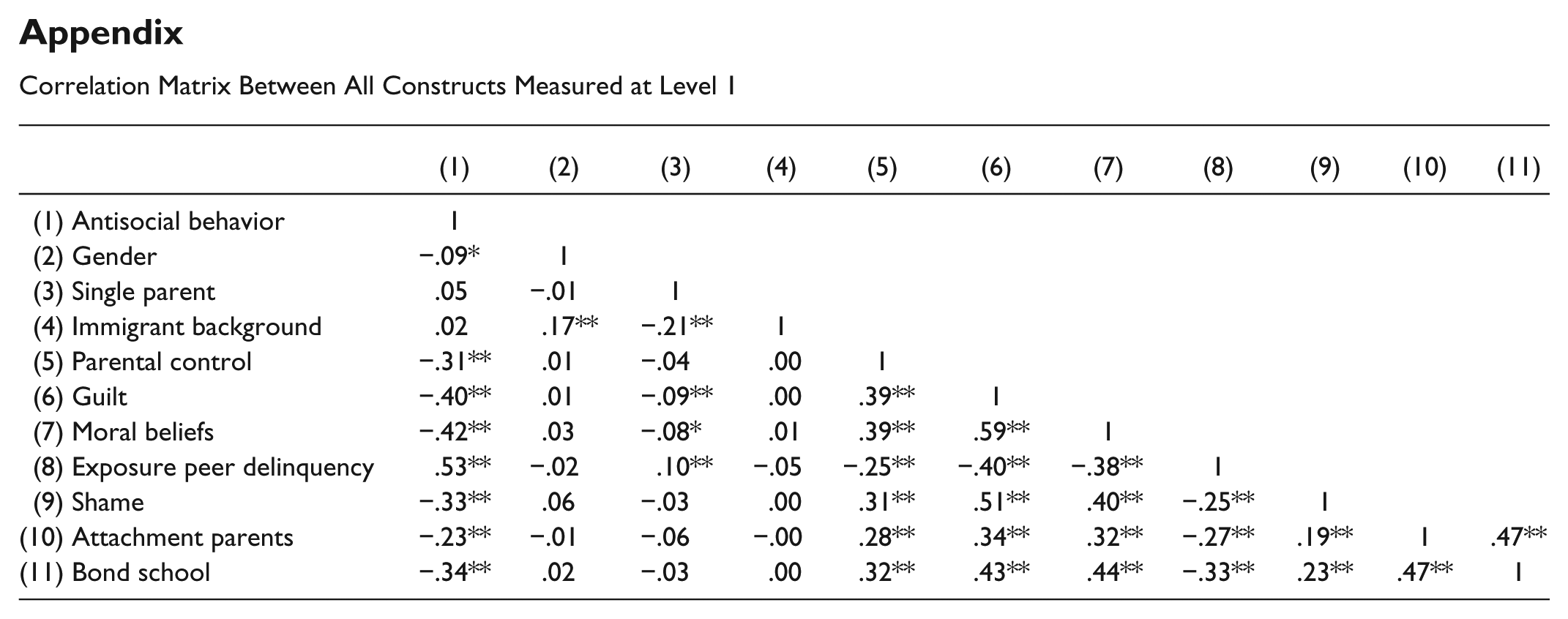
The questionnaire that was administered to adolescents in the PADS+Panel study (Peterborough Adolescent and Young Adult Development Study) of Wikström and colleagues (2012) was used. This questionnaire has been tested on reliability and validity several times (see Wikström & Butterworth, 2006; Wikström et al., 2012). All scale constructs are summative scales of several items; most of them can be regarded as Likert-type scales. Theoretical considerations as well as factor analyses (forced one-factor solutions in an exploratory principal-axis factoring analysis) and reliability analyses were used to evaluate the reported scales. Although the item nonresponse was extremely low per item (<2%), imputation to assign acceptable values to missing data (using the expectation–maximization [EM] method) was used to minimize loss of information (L. Pauwels & Svensson, 2008). 4 First, we discuss the measures of the individual-level variables. The correlations between the variables can be found in the appendix.
Dependent Variable
Child antisocial behavior is an overall scale of antisocial behavior that measures a combination of serious and common forms of delinquent behavior. It is a general frequency scale that is based on the respondents answers on 12 delinquency items that measure how often in the last year they have “stayed away from school without a valid reason (played truant)”; “sprayed graffiti on walls, doors, bus stops or elsewhere”; “thrown in a window”; “damaged on purpose something that does not belong to you, for example, a bicycle, a bus stop, a street lantern, a traffic sign, a garbage can, . . .”; “set fire to something on purpose (e.g., a public trash can, a barn, litter, . . .)”; “stolen something from a shop that is worth less than 5 euros (e.g., candy, a pen, or something else)”; “stolen something from a shop that was worth more than 5 euros, for example, clothes, DVDs, or something else”; “stolen something that belonged to a classmate, a teacher at your school”; “stolen money from your parents”; “stolen a bicycle”; “taken somebody’s wallet, purse, mobile phone, or something else”; and “used a knife or other weapon to scare or threaten somebody.” Alpha is .80. Although the scale contains two subscales, they are analyzed as an overall scale for several reasons: Methodologically, although both subscales (Vandalism and Property Offenses) and violent offending are highly correlated (r = .80, p < .001), the results do not differ by dimension, and from a theoretical point of view, much evidence exists for the fact that offending among children and young adolescents is rather versatile (McGloin, Sullivan, Piquero, & Pratt, 2007). All items were measured on a 6-point scale (0 = not, 1 = 1 time, 2 = 2 times, 3 = 3-5 times, 4 = 6-10 times, and 5 = more than 10 times).
Independent Variables
Parental attachment is measured by “How often do you talk to your parents (or stepparents) about how you do in school or get along with your friends?” (answering codes: almost never, a few times a months, a few times a week, and almost every day), “Do you talk to your parents if you have a problem or feel sad about something?” (no, almost never, sometimes; usually I do, yes, always), “How often do you something nice or fun together with your parents?” (almost never, a few times a year, once or a few times a month, once or a few times a week), and “How often do you eat evening meals together?” (almost never, a few times a week, several times a week, and almost every day). Alpha is .66. The items were measured on a 5-point scale ranging from completely disagree to completely agree.
Parental control is a combined index of both parental supervision and perceived parental control. Parental supervision measures the degree in which parents know the whereabouts of the adolescents (in fact, it indicates the amount of adolescent’s disclosure to their parents). It consists of three items asking whether the parents of the respondent “know where he or she is when out of home,” “what he is doing,” and “with which friends he or she is hanging out.” Perceived parental control indicates how likely it is that parents intervene in rule-breaking behavior. The measurement consists of four items: “If you were skipping school, would your parents try to do something about it?” “If you had spray-painted graffiti on the wall of a building, would your parents tell you off or punish you?” “If you had been beating up or threatening somebody at school, would your parents tell you off or punish you?” and “If you showed any disrespect to one of your parents, would he or she tell you off or punish you?” Alpha is .68 for the combined scale. The items were measured on a 5-point scale ranging from completely disagree to completely agree.
Moral beliefs measures the adolescent’s attitude toward moral rule breaking. High scores indicate high morality. The construct is an additive index of the respondent’s evaluation of 15 situations of potential wrongdoing. Respondents were asked to indicate how wrong it is to “ride a bike through red light”; “skip doing homework for school”; “skip school or work without an excuse”; “lie, disobey, or talk back to teachers”; “go skateboarding in a place where skateboarding is not allowed”; “tease a classmate because of the way he or she dresses”; “smoke cigarettes”; “consuming alcohol”; “hit another young person who makes a rude comment”; “steal a pencil from a classmate”; “paint graffiti on a house wall”; “smash a street light for fun”; “steal a CD from a shop”; “break into or try to break into a building to steal something”; and “use a weapon or force to get money or things from another young person.” Alpha is .87. The items were measured on a 4-point scale (completely disagree, disagree, agree, and completely agree).
Anticipated shame measures the extent to which an adolescent would feel ashamed toward significant others when he or she would have been caught for committing an offense. High scores indicate high levels of shame feelings. Four items were used: “If you were caught shoplifting and your best friends found out about it, would you feel ashamed?” “If you were caught shoplifting and your parents found out about it, would you feel ashamed?” “If you were caught damaging a car and your best friends found out about it, would you feel ashamed?” and “If you were caught damaging a car and your parents found out about it, would you feel ashamed? Alpha is .82. The items were measured on a 3-point scale (1 = no, 2 = yes, and 3 = yes a lot).
Anticipated guilt measures the extent to which an adolescent would feel guilty when he or she would have broken moral rules. A high score indicates a high level of guilt. The following six items were used: “Would you feel guilty if you did something your parents (stepparents) have told you absolutely not to do?” “Would you feel guilty if you cheated on a test in school?” “Would you feel guilty if you teased another pupil so he or she started to cry?” “Would you feel guilty if you stole something in a shop?” “Would you feel guilty if you hit another pupil who made a rude remark to you?” and “Would you feel guilty if you damaged a car?” Alpha is .75. The items were measured on a 3-point scale (1 = no, 2 = yes, and 3 = yes a lot).
Exposure to peer delinquency measures the amount of delinquent and risky behavior of the adolescent’s friends. It is measured by an index of six questions about the frequency of breaking rules by peers: How often do your friends “skip school without excuse,” “get drunk,” “use drugs,” “steal something from others or from shops,” “destroy things that do not belong to them,” and “beat up or get into fights with others?” Cronbach’s alpha is .70. The items were measured on a 4-point scale (1 = none of my friends, 2 = few of my friends, 3 = some of my friends, and 4 = [almost] all of my friends).
Sex is coded as 0 for males and 1 for females. Immigrant background is coded 0 when the child is born in Belgium and both parents are born in Belgium and 1 if at least one of the parents were born abroad. Family structure is coded as 0 if the respondent is living with two parents and one if the respondent is living in a single-parent family. Background variables are seen as the background of action, while social mechanisms are supposed to account for eventual differences between demographical categories.
School-level family disruption is the proportion of children who come from a one-parent family, and school-level immigrant concentration is the proportion of children who come from a family with a non-Belgian background (see Table 1).
Univariate Descriptives.

Note. N = 779 (Level 1, listwise deletion and scale imputation); n = 18 (Level 2).
Analysis Plan
As the respondents are grouped in 18 schools, multilevel modeling is used (Goldstein, 1995; Snijders & Bosker, 1999). Multilevel modeling is concerned with detecting contextual statistical effects of higher level characteristics on behavioral and attitudinal outcomes at lower levels, and with discerning true contextual effects from compositional effects, or consequences of segregation or selection. Grouping the children per class and studying classes as Level 2 units was not considered as the classes do not represent distinct ecological settings: Classes are constantly being regrouped, depending on the courses that are given, for example, sometimes Class A and Class B are grouped together, sometimes Class B and Class C are grouped together. Thus, in situations where classes do not represent distinct groups, it might be better to use another clustering level, which can be interpreted straightforward. The demographic background variables at the individual level are included to control for confounding compositional effects. In school studies, the contextual effect represents the situation where school characteristics have a direct effect and can be equated with “genuine ecological effects.” Children differ with regard to their family structure and schools may differ regarding the proportion of children who come from a single-parent family and with regard to the percentage of children with an immigrant background.
Negative binomial multilevel regression models were used to assess the effects of the independent variables on self-reported offending (see Table 2). Negative binomial regression models are used to model over-dispersed count data (Hilbe, 2011). Such a model fits the distribution of count data such as self-reported offending better than ordinary least squares (OLS) regression models. All beta coefficients are unstandardized coefficients of standardized variables. The analyses are run using Mplus 7.3.
Blockwise Multilevel Negative Binomial Regression Models of Offending (N = 779).

Note. The negative binomial regression models are run using the population average model (not including the robust standard errors as the data do not meet this criterion). ICC = intraclass coefficient.
p < .05. **p < .01. ***p < .001. (*)p < .10.
Cross-classified multilevel analysis was not considered, as this technique demands large neighborhood and school cross-classifications. In the present study, the number of schools is already rather restricted from the standpoint of multilevel modeling and the number of neighborhoods is considerably smaller than the number of schools. This is due to the fact that in Ghent, schools somewhat tend to be clustered in some inner-city areas. Under the condition of very few neighborhoods and schools in cross-classified multilevel models, it is suggested to apply Bayesian bootstrapping techniques, resulting in robust standard errors (Hox, 2010). Besides that methodological argument, it should be stressed that multilevel studies of neighborhoods (defined as census tracts or larger areas) have generally failed to demonstrate contextual effects on adolescent offending (Pauwels et al., 2010).
Findings
The empty model represents a multilevel model that only includes the intercept. It is therefore also called an intercept-only model (Hox, 2010). Schools significantly differ from each other with regard to self-reported offending, in line with previous studies. The random intercept is statistically significant from zero. Model 1 is the statistical model where control is held for compositional effects of gender and family structure. There is still significant variation between elementary schools independent of the demographic makeup of the schools. Significant effects are found for girls (B = −0.53) and immigrant background (B = 0.28). The effects of family structure are only marginally significant (B = 0.25, p < .10). Model 2 is a two-level model including two school-level variables: school-level immigrant concentration (not significant) and family disruption (B = 0.28). The analysis suggests that only family disruption is significantly related to child antisocial behavior, independent of the demographic composition of the schools. Including these Level 2 variables changes the effects of Level 1 variables: Family structure has now lost significance, and immigrant background is only marginally significant (p < .10). Model 3 includes the mechanisms of informal control (parental attachment, the school social bond, and parental control). Parental control (B = −0.39) and the school social bond (B = −0.40) are significantly and inversely related to child antisocial behavior, while parental attachment is not significantly related to self-reported offending. The contextual effect of family disruption at the school level (B = 0.28) remains significant and unchanged. Therefore, we cannot say that mechanisms of informal control mediate the contextual effect of family disruption. In Model 4, we have added moral beliefs, anticipated guilt and anticipated shame. These dimensions of morality cannot account for the contextual effect of family disruption. Moral beliefs and moral emotions partially mediate the effects of parental control and the school social bond. Moral beliefs (B = −0.27), anticipated guilt (B = −0.18) and anticipated shame (B = −0.11), have independent effects. The negative binomial regression coefficient of moral beliefs is higher than the regression coefficients of shame and guilt.
Finally, exposure to peer delinquency is entered into the equation. The introduction of exposure to peer delinquency can fully account for the contextual effect of family disruption at the school level. Exposure to peer delinquency (B = 0.40) also partially accounts for the effects of moral beliefs and moral emotions.
Discussion and Conclusion
The present study assessed the relationship between specific conditions of disadvantage at the school and individual level and child antisocial behavior. Although self-reported delinquency studies usually sample youth in compulsory secondary education, this survey sampled children in the fifth and sixth grades of the primary compulsory education in Belgium. As far as we know, no other Belgian self-report study of school contextual effects has been conducted among elementary school children. Although the sample is limited to children attending classes in schools in the urban context of Ghent, the sample actually reflects the diversity of pupils that can be observed in schools in highly urbanized areas. The sample is therefore highly appropriate to identify school contextual effects.
Most of the variation in child antisocial behavior exists between individuals, rather than between schools. School-level factors explain only a small amount of the total variance in child antisocial behavior. This indicates that the differences in child antisocial behavior are, to a much greater extent, due to individual factors rather than the school context. But, simultaneously, school-level family disruption has a moderate direct effect on the school-level differences in child antisocial behavior attending an elementary school in an urban context. This effect remains significant when controlling for informal controls, moral beliefs, and moral emotions. The effect is fully accounted for by exposure to peer delinquency.
Structural background characteristics measured at the individual level are not significantly associated with children’s self-reported offending, with the exception of gender. Males are more likely to report offending than females, independent of their immigrant background and family structure. Children who live in a one-parent family and in families of immigrant background are not likely to have higher levels of antisocial behavior than children living in traditional families and children from a fully native family background, when control is held for gender. Self-report studies usually find small effects of demographic background characteristics that refer to the family social position and structure (see Wikström & Butterworth, 2006, for a discussion). This may be due to the fact that family structural background characteristics are mostly attributes or causes of the causes of antisocial behavior, that is, they do not bring about action.
In general, these findings are in line with previous studies that studied school contextual effects on youths in early adolescence: Moral beliefs partially mediate the effects of informal controls (L. Pauwels, 2013). Moral beliefs and moral emotions have direct effects on child antisocial behavior. These results are fully in line with the findings of Svensson et al. (2013). This study is the first Belgian study that demonstrated the effects of moral emotions on childhood delinquency. Exposure to peer delinquency exhibits the strongest direct effect on child antisocial behavior: This mechanism alone was able to account for the school-level variation in school-level family disruption. Exposure to peer delinquency was also able to mediate a substantial part of the effects of moral beliefs and moral feelings.
The present study has some important limitations that need to be taken into account when interpreting the results. First of all, one might wonder to what extent this study overestimates the effects of the school context. Indeed, the present study did not simultaneously assess neighborhood and school effects. This may seem problematic as poor schools may be concentrated in poor neighborhoods. However, we do not believe that the school effect is overestimated in our study for a number of reasons. European cross-classified multilevel studies that assessed contextual effects of neighborhood characteristics (i.e., effects of the residential area where the child lives) and school-level characteristics found that the inverse was true: Neighborhood effects either disappear when simultaneously controlling for school effects or turn out to be smaller than school-level effects (Oberwittler, 2007). Of course, neighborhood effects may also exist with regard to the school location area. A cross-classified analysis (that takes into account the neighborhood context that refers to the neighborhood where the school is located) was not considered to be a viable alternative for a two-level hierarchical multilevel study, due to the fact that a number of schools were located in the same neighborhood. Our data did not match the criteria for a stable cross-classified analysis. However, we recognized the viability of a potential confounding mechanism and, therefore, we additionally controlled for dummy variables to capture at least a part of this problem. Controlling for census tract characteristics did not lead to the detection of neighborhood effects. Similarly, controlling for higher level areas (postal code areas did not yield any effects either) did not yield any effect.
Although we found small but substantial school-level effects, it is important for future studies to reconceptualize contextual effects. As recent studies have revealed, it is important to take into account the area where one really spends a lot of leisure time. Contextual effects are best studied by simultaneously taking into account the amount of time one actually is exposed to the setting (Wikström et al., 2012).
Another issue is that the present study is cross-sectional and therefore causes and effects are measured at one point in time. Although this is still the case in the majority of studies, we believe this is a limitation, especially with regard to the contextual effects. From a theoretical point of view, contextual effects can be divided into short-term contextual effect and long-term developmental effects (Wikström & Sampson, 2003). The study of long-term developmental effects requires panel studies. Unfortunately, longitudinal studies of school contextual effects on offending are not typically found. Longitudinal studies in educational studies have shown much larger contextual effects than cross-sectional studies. It may thus well be possible that our study underestimates contextual effects.
Footnotes
Appendix
Correlation Matrix Between All Constructs Measured at Level 1
| (1) | (2) | (3) | (4) | (5) | (6) | (7) | (8) | (9) | (10) | (11) | |
|---|---|---|---|---|---|---|---|---|---|---|---|
| (1) Antisocial behavior | 1 | ||||||||||
| (2) Gender | −.09* | 1 | |||||||||
| (3) Single parent | .05 | −.01 | 1 | ||||||||
| (4) Immigrant background | .02 | .17** | −.21** | 1 | |||||||
| (5) Parental control | −.31** | .01 | −.04 | .00 | 1 | ||||||
| (6) Guilt | −.40** | .01 | −.09** | .00 | .39** | 1 | |||||
| (7) Moral beliefs | −.42** | .03 | −.08* | .01 | .39** | .59** | 1 | ||||
| (8) Exposure peer delinquency | .53** | −.02 | .10** | −.05 | −.25** | −.40** | −.38** | 1 | |||
| (9) Shame | −.33** | .06 | −.03 | .00 | .31** | .51** | .40** | −.25** | 1 | ||
| (10) Attachment parents | −.23** | −.01 | −.06 | −.00 | .28** | .34** | .32** | −.27** | .19** | 1 | .47** |
| (11) Bond school | −.34** | .02 | −.03 | .00 | .32** | .43** | .44** | −.33** | .23** | .47** | 1 |
Declaration of Conflicting Interests
The author(s) declared no potential conflicts of interest with respect to the research, authorship, and/or publication of this article.
Funding
The author(s) received no financial support for the research and/or authorship of this article.