




Abstract
Verbal and non-verbal interactions that occur daily between teachers and headteachers, teachers and pupils, and among pupils can generate conflict that may adversely affect teaching, learning, and schooling effectiveness. Little attention is, however, paid to the quality of relationships that exists between teachers and pupils, among teachers, among pupils, between teachers and their school heads, and between schools and their local communities. This study sought to investigate conflict prevalence in Ghana’s primary schools, and how relationship conflict is understood to affect teaching and learning at the level of headteachers as administrators, teachers as classroom managers, and pupils as learners, and direct beneficiaries of primary education. Using data gathered via interview, questionnaire administration, and observation in 30 public primary schools in 10 circuits of one district of Ashanti Region, the findings revealed a high prevalence of fighting, heckling, bullying, and other forms of relationship conflict among pupils; strained teacher–pupil relations due to insolence, indiscipline, and use of offensive language; and teacher–parent arguments and quarrels due to harsh punishment and verbal assault of pupils. Teacher–pupil conflicts may extend to teachers excluding the affected pupils from teaching and learning activities, denying them the rights to ask and answer questions, and have their class exercises marked, leading to lowered pupil self-esteem, reduced concentration during lessons, and passive involvement in learning activities, which could result in truancy and school dropout. Strengthening guidance mechanisms and encouraging peer mediation could significantly curb conflict in school environments and thereby raise educational standards in the district.
Introduction
Relationship Conflicts
Conflict is a natural aspect of most ongoing close relationships, probably due to the high value placed on individualism (Olson & Defrain, 2001). Conflict occurs between people in all kinds of human relationships and in all social settings. Because any aspect of living or working together contains the seed of situational conflict, relationship conflicts can occur between family members, friends, and staff in an organization (Tizard, Blatchford, & Burke, 2000). Conflict inherently involves some struggle, incompatibility, or perceived differences in values, goals, or desires; characteristics, beliefs, and lifestyles; and power of influence and action between two or more parties in a relationship, combined with attempts to control each other and antagonistic feelings toward each other (Hart, 2002; Ivancevich & Matteson, 2002; McShane & Von Glinow, 2000; Meeks, Heit, & Page, 2005). The incompatibility or difference may exist in reality or may only be perceived by the parties involved. Nonetheless, opposing actions and hostile emotions are very real hallmarks of human conflict (Deutsch & Coleman, 2000). This happens because people’s values and needs have been shaped by different socialization processes that depend on differing cultural and family traditions, levels of education, breadths of experience, and lifestyles, which make individuals see the world differently (Ivancevich & Matteson, 2002).
Individual differences add pleasure and richness to life, but they can also create conflict (Covey, 2002). Disagreement between people or choices can arise whenever the perceived interests of an individual or a group clash with those of another individual or a group in such a way that strong emotions are aroused and compromise is not considered to be an option (Meeks et al., 2005). Similarly, power can also generate conflict where an individual or a group tries to influence or exert power to get another person or group to agree with an entrenched position (L. Larson & Mildred, 2002). Conflict may not only take a toll on the physical body but it often occupies the mind and causes a great deal of emotional stress; conflict behavior does not only affect those involved, but it may even extend to those who have no part in it (Hart, 2002). Conflict also has the potential for either a great deal of destruction or much creativity and positive social change, and for positive change and innovation (Owens, 2001; Robbins, 2000). It is essential therefore to understand the basic processes of conflict so that we can work to maximize productive outcomes and minimize destructive ones (Kriesberg, 1998, as cited in Lòpez Fernández-Cao et al., 2010).
Conflict and Education
Conflict in the school environment can have adverse effects on the academic environment, including affecting the morale of educators, the pace at which they work, and increasing absenteeism (Jennings & Wattam, 2004). Unless colleagues understand personal differences and accept each other’s point of view, needs, priorities, and approach to work and problem solving (Robbins, 2000), conflict will occur. In schools, conflict usually occurs between headteachers and teachers, teachers and teachers, teachers and pupils, teachers and parents, pupils and pupils, and schools and their community (Siann & Ugwuegbu, 2000; Whetten & Cameron, 2005). The quality of relationships between teachers and their pupils is critical because it affects how well a student adjusts in the school environment (Pianta & Stuhlman, 2004). This notion is emphasized by the finding that children who experience teacher–student relationships with conflict in first grade demonstrated lower achievement in mathematics over the following 2 years (Buyse, Verschueren, Verachtert, & Van Damme, 2009, as cited in R. Larson, 2012). Good interpersonal relationships in the school situation, which include how well teachers relate with pupils, how teachers relate with each other, how the school relates to the pupils’ parents or guardians and to the community as a whole, are recommended (Kyriacou, 1999) because they promote effective teaching, learning, and school administration (R. Larson, 2012).
Method
This study adopted a combination of qualitative and quantitative research methods (Leedy & Ormrod, 2005) with interview, observation, and questionnaire administration to investigate conflict behavior in 30 public primary schools located in 10 different educational circuits in one district of Ashanti Region, Ghana. The focus was on how interpersonal conflict is understood at the level of headteachers as administrators, teachers as classroom managers, and pupils as learners and direct beneficiaries of primary education, and perceived to affect teaching and learning. Data were sought from the 30 headteachers (19 men, 11 women) of the schools, 120 teachers (54 men, 66 women), and 130 pupils (73 girls, 57 boys) across the 30 schools. The pupils were randomly selected from the six class levels with the assistance of the class teachers (Basic 1 and 2 = 5, Basic 3 and 4 = 12, Basic 5 and 6 = 113). Personal interviews were held with the 30 headteachers because only three (or 10%) of them returned the questionnaire that was initially administered. Observation of classroom and playground activities by the authors also provided additional data for the study. The interviews, questionnaire administration, and observation were done concurrently over 52 school days.
Focus-group interviewing was adopted with the 130 pupils because while negotiating access to the schools, it was realized that many of the pupils could neither read nor understand spoken English well. As a cost-effective way of investigating the underlying meanings that inform the perceptions of people about certain issues (Robinson, 1999), focus-group interviewing in Twi, the local language, provided opportunity for the pupils to articulate their experiences of conflicts. The pupils’ language deficiency confirms Sellers’s (2007) finding that, in practice, teachers in some areas of Ghana use the local language in instruction because pupils at primary school are not proficient enough in the English language. Adopting Twi in this face-to-face verbal communication with the pupils responds to the call for social researchers to pay attention to local languages to get to valuable data from the large number of illiterates in sub-Saharan Africa (King’ei, 2006).
A 15-item questionnaire comprising both open- and closed-ended questions meant to access the strengths in each form of method (Reja, Manfreda, Hlebec, & Vehovar, 2003) was administered to 135 teachers. Questionnaire administration made it easy to reach all the teachers within a short time and with less effort; the return rate was 88.9%. Besides, the results of the piloted instrument revealed that the teachers were more upbeat about answering the questionnaire than agreeing to be interviewed. Additional data were sought through direct observation (both participant and non-participant) of classroom and school activities to gain insight into the natural occurrence of conflict in the schools and to also validate data gathered from the questionnaire and interviews. This was done by sitting at the back of each class keenly observing teaching and learning processes for two instructional periods of 30 min in each school. This provided opportunity to scan the classroom environment for conflict incidents as the lessons went on in the participating teachers’ classrooms.
Observation was also done by moving around the school compounds during the first and second break periods as the pupils were engaged in different activities such as eating and playing, to gather firsthand data on actual conflict situations as they occurred. These methods of triangulation helped to produce a more thorough understanding of the phenomenon studied and thereby improve the authenticity of the research findings (Hesse-Biber, 2010; Leedy & Ormrod, 2005).
Discussion
Prevalence of Conflicts
There was consensus among the teachers, headteachers, and pupils in the sampled schools that disagreements and other types of relationship conflict occur among the pupils, among teachers, and between teachers and pupils, teachers and headteachers, teachers and parents of pupils, and schools and their local communities. As to its prevalence, 99.2% (119) of the 120 teachers and all 30 headteachers and 130 pupils described conflict as a daily occurrence, particularly among the pupils. This corroborates Siann and Ugwuegbu’s (2000) finding that relationship conflicts occur among these key players in the school system, all of which have direct negative consequences for teaching, learning, and educational standards. This is despite efforts made by the headteachers and guidance and counseling committees to apply existing conflict resolution guidelines to deal with disagreements, quarrels, fights, and other relationship conflicts that erupt in the schools. The study however, points to the established conflict resolution structures being ineffective for resolving relationship conflicts that occur among personnel who function in the school environment, which calls for further research into Ghana’s policy and procedure for conflict management in the basic school system.
Forms of Conflict
Conflicts that were identified in the schools manifested as quarreling, fighting, yelling, heckling, confrontation out of anger, jostling, and bullying among the pupils; verbal abuse, caning, and excessive punishment meted to pupils by teachers; angry teachers and parents quarreling or exchanging harsh words and insults; angry parents chasing their children to school to punish them or report offenses caused at home to get them punished; as well as heated arguments, quarrels, and strong disagreements between headteachers and teachers.
Pupils’ Perceptions of Conflict
Interviews with the 130 pupils revealed four types of relationship conflict that frequently occur in the sampled schools: 82 (representing 63.1%) of them reported pupil–pupil conflicts, 21 (or 16.2%) mentioned teacher–pupil conflicts, 10 (or 7.6%) pupils identified teacher–parent conflicts, while 17 (or 13.1%) of them cited pupil–parent conflicts. The data show pupil–pupil conflicts as the most rampant relationship problem prevalent in the 30 sampled schools. Table 1 provides the factors that are perceived to cause these types of conflicts.
Causes of Conflicts Identified by Pupils.
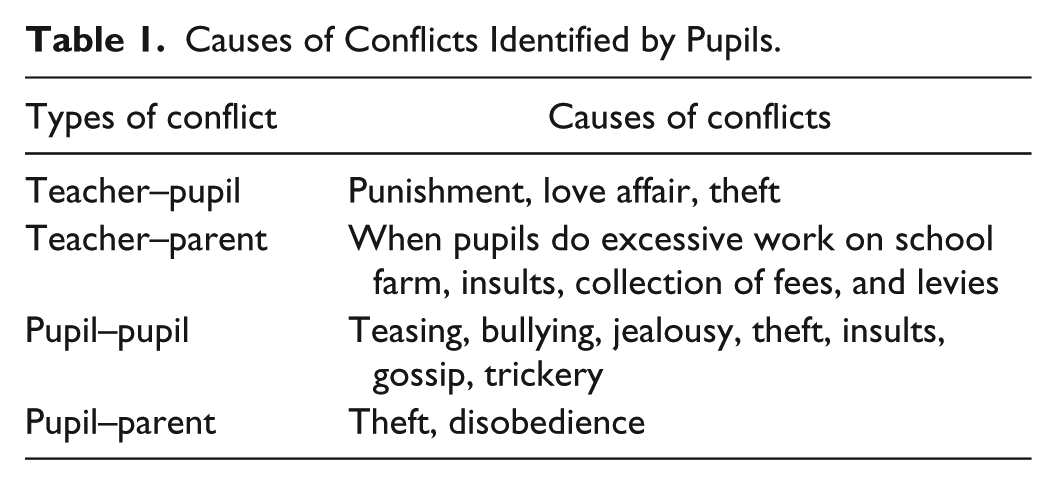
As Table 1 indicates, the pupils pointed out teasing, gossiping, trickery, and jealousy as the significant factors that generate the most relationship conflicts among them. Further probing revealed that most quarrels, insults, and fighting emerge from pupils teasing each other because they are too tall or short, too fat or thin, or they are unable to answer questions in class. Bullying of younger pupils by the older ones both on the playground and on the way home from school, jealousy over unequal personal resources, and stealing of other pupils’ pocket money, erasers, and writing materials also feature prominently as sources of friction, tension, and fights among the pupils.
The pupils attributed conflicts that occur between teachers and pupils to teachers venting anger with their parents on them; teachers punishing pupils who steal, fight, or use abusive language; and pupils who gossip over suspected amorous relationships between male teachers and the older female pupils that they are too afraid to talk openly about. They also ascribed conflicts that occur between teachers and parents to teachers insulting their parents for the pupils’ wrongdoings, which often get reported at home and cause parents to retaliate; teachers being too harsh on pupils; teachers punishing pupils with excessive weeding on the school farm; and harassment over unpaid fees and levies. Last, pupils reported that conflict between pupils and parents arise from angry parents following their children to school either to punish them for disobedience, theft, or misbehavior at home, or reporting such offenses to get them punished by their teachers. It is important to indicate that at some points of the focus group conversation, some of the pupils expressed grave concern over unsavory comments some of their teachers make when they have difficulty understanding what is taught.
The most unpleasant comments were made by pupils whose teachers often insult their parents over their mistakes, conduct, or learning difficulties. Expressions of disgust were obvious from interjections such as, “Why should my teacher insult my mother who is at home when I am the one in the classroom?” “What at all can I do wrong for my mother to be insulted like that?” “Sometimes you don’t know what you do wrong for a teacher to extend your insult to your mother,” and “It is as if they did not bring us up well enough to please our teachers.” Asked why they report school happenings to their parents, some of the pupils’ answers were, “My parents brought me to school so they have the right to know what goes on here,” “They want to know how the teachers treat us in school; it is important,” and “I must report the punishment the teacher gives me before my brother or friend goes to tell my mother otherwise she will whip me for misbehaving in school.” Others do not report “bad” happenings to prevent more quarrels from ensuing between teachers and members of the local community, which often brings about quarrels and insults that make it difficult for pupils to enjoy school.
Asked what happens when they report school occurrences to their parents, many of the pupils replied with, “They don’t say anything or do anything to those teachers,” “Even if I report the teacher’s bad behavior, my mother only says ‘don’t mind them,’ which makes me ashamed for making that report,” and “My parents only tell me to work hard so the teacher will be happy with me.” Some of the pupils insisted their reports anger their parents and cause tension that some relatives and community members follow up with confrontation that worsen school–community relations, which makes the teachers hate them. Although many of the pupils’ reports attract strong conflict behaviors and responses, many of the pupils’ parents ignore their children’s negative reports. This however, does not negate the fact that teacher–parent conflicts exist in the sampled communities.
The variety of responses that emerged from the pupil interviews show the importance pupils attach to both family and school ties; they cherish both home and school relationships. The emotional attachment with their mothers, the pupils said, makes it difficult for them to refrain from disclosing embarrassing and hurtful incidents that occur in school to them. Essentially, if a teacher insults a pupil’s parents for the child’s wrongdoing in school, the pupils concerned felt obliged to respond the best way, which is to report the insult or incident to their parents for redress.
Effects of Conflict on Teaching and Learning
Teacher–Pupil Conflict
According to the pupils, if a conflict emerges between a teacher and a pupil or pupils and it is resolved, some teachers refuse to let go of the issue but use it as a weapon to punish the offending pupil by relating poorly with them. This makes the affected pupil unhappy, embarrassed, and uncomfortable in the teacher’s presence both inside and outside the classroom. Even after conflicts have been settled, the pupils reiterated that “some teachers keep on making references to whatever caused the conflict they had had with the pupils even during lessons, which causes us much embarrassment and makes us want to run away from the presence of our classmates.” In some situations, it was reported that a teacher could hate the offending pupil to the extent of refusing to mark exercises those pupils present in class, refusing to call on those pupils to answer questions they ask during lessons, and more irritatingly, refusing to call on such pupils who dare to raise their hands either to ask or answer questions, or they simply ignore them in all class activities. The apt response to such a situation was, “This hurts so much you don’t want to come to school the next day if your friends don’t come to get you,” which portends the possibility of pupils dropping out of school if this denial persists.
The pupils intimated that when their teachers deny them these rights in class, they feel awkward in the midst of their peers, which also adversely affects their ability to learn. According to the pupils, such conflict aftermath makes it difficult for those pupils to assess their performance in class; in this case, the timid pupil may decide to stay out of the teacher’s way by not coming to school just to avoid that situation, and may eventually drop out of school if no one goes after them.
The pupils also made it clear that sometimes when a conflict occurs between a teacher and a pupil, other teachers join the fray, and in solidarity with their colleague, they also harass the pupil in school. Such a pupil becomes very uncomfortable in the school environment and cannot go to see their siblings and friends in other classrooms. The implication is that pupils in conflict with particular teachers could end up being unnecessarily punished by other teachers in their school. This scenario runs contrary to the expectation that teachers would act in loco parentis (as surrogate parents) to their pupils and that this parenting role would compel pupils to replicate the feelings they have for their parents to their teachers (Orlich, Callahan, & Gibson, 2001).
Close interactions between teachers and pupils should rather forge bonds of trust and mutual support between them so that the teachers could exert their influence to control the classroom environment to significantly reduce tension and increase the probability of successful learning and social progress for their pupils (Orlich et al., 2001). After all, the Education for All program implies children coming to school and enjoying the experience of learning, and developing their full potential through education to ensure their full and equal participation in building a better world (Oxfam, 2005). Relationship conflict is therefore a risk factor to consider as far as Ghana’s attainment of the Millennium Development Goal 2 of “increased primary enrollment by 2015” (Ministry of Education, Youth and Sports [MOEYS], 2004) is concerned.
The sentiments the pupils expressed over the aftermath of conflicts that occur in the sampled schools corroborate Siann and Ugwuegbu’s (2000) assertion that negative attitudes of teachers lower their pupils’ self-esteem, which calls for attention and intervention by education officials in the study area, especially where primary school teachers in Ghana are assigned to specific classes only and, as generalist classroom practitioners, also teach all subjects on the timetable (Boafo-Agyemang, 2010). Knowing that positive teacher–child relationships serve as a protective factor for positive social and academic development of children implies that tension may undermine the pupils’ willingness to stay in school and achieve their educational and life goals (Rudasill & Rimm-Kaufman, 2009).
It is important to state here that the pupils’ description of conflict occurrences and their effects on teaching and learning in the 30 schools were almost the same. Except for the 6- to 10-year-old pupils who had few or no conflict stories to narrate, the 12- to 13-year-olds were very vocal about the episodes they had observed in their own classrooms or other classes, and even mimicked the behavior of some of the teachers who had engaged in such confrontations. The narrations showed that interpersonal conflict is a regular feature in the sampled schools and a great source of worry to the pupils who also pointed out the threat of conflict on their educational aspirations. Including conflict studies in teacher development programs would equip newly trained teachers in particular with the basic knowledge to understand the effects of relationship conflicts and to also acquire some skills for conflict prevention and peace building in the schools.
Teacher–Parent Conflict
The pupils reported that after some teachers have had a confrontation with a parent, those teachers displace their anger on the children of those particular parents although they may have played no role in it. This, the pupils said, adversely affects their absorbing capacity for the day. Another worrying issue was that some teachers take delight in constantly mentioning the wrongdoings of parents during lessons just to spoil their day and embarrass them. What bothered the pupils most was that those teachers waste instructional time just hammering on whatever a parent had done and, sometimes, they insult those parents as well. The burning questions the pupils kept asking were, “Why should my teacher insult my parent at all in the classroom?” and “What wrong did they do?” Sincerely, a teacher who uses instructional time to fan a conflict would certainly not be able to complete the assigned syllabus, which invariably has adverse effects on all the pupils’ ability to assimilate what is taught and, in the long term, their academic achievement and educational opportunities.
The findings suggest that pupils in the district suffer unduly from the effects of “made-in-the-community” conflicts that get carried into the classroom, which could prevent the pupils from attaining the full benefits of schooling. The level of conflict occurrence also contradicts the expectation that teachers would collaborate with parents to promote the social, emotional, and academic growth of their pupils to motivate them to stay in school and complete their education (Orlich et al., 2001). Sour relationships between parents and teachers, the two key figures at the center of children’s education, suggests inadequate interpersonal and conflict management skills for dealing with issues of conflict in the study area. These significant adults in the children’s lives may also not be fully aware of the complementary role they play as far as the children’s education is concerned. Besides, pupil achievement in primary school depends largely on teacher goodwill (Boafo-Agyemang, 2010) and active monitoring of teaching effectiveness (Opoku-Asare, 2006); hence, achieving quality primary education must necessarily entail education officials focusing much attention on promoting good interpersonal relationships in the schools.
Teachers’ Perceptions of Conflict
Understanding of Conflict
The teacher is a very crucial element in attaining quality education. Achievement of the objectives of any curriculum depends to a great extent on teachers who have a strong commitment to teaching so that they might be a source of inspiration to their pupils and effective facilitators of learning (Colker, 2008). The teachers’ responses to the questionnaire revealed three views of conflict: 108 (representing 90.0%) of the 120 respondents defined conflict as “a misunderstanding or disagreement between two or more people or groups of people.” This reflects the basic definition provided in the literature, which shows that the large majority of the teachers understand what conflict means and could identify conflict situations in the schools.
Nine (or 7.5%) of them defined conflict as “a fight between two or more people,” which suggests that this group of teachers could ignore early signs of conflict and would intervene only when it escalates into physical assault or violence. These teachers could find it difficult to resolve conflict because they might not see it brewing as a serious matter or a threatening situation at its early stages of development. Being handicapped in conflict identification from the grassroots puts the pupils of these teachers at risk if they should experience any psychological problems that do not manifest as physical assault or overt actions.
The remaining three teachers defined conflict as “a mere argument between two or more people.” This view of conflict suggests that these teachers would interpret any argument as an issue of conflict and address it as such. This perception could create unnecessary relationship problems with their colleagues, pupils, and people they may come in contact with on the basis that they could regard any expression of ideas or merely arguing one’s views out on an issue of mutual interest as a conflict. Consequently, lessons taught by these teachers might generate conflict where pupils or other teachers need to debate issues or express views that are different from theirs.
Types of Conflicts Identified
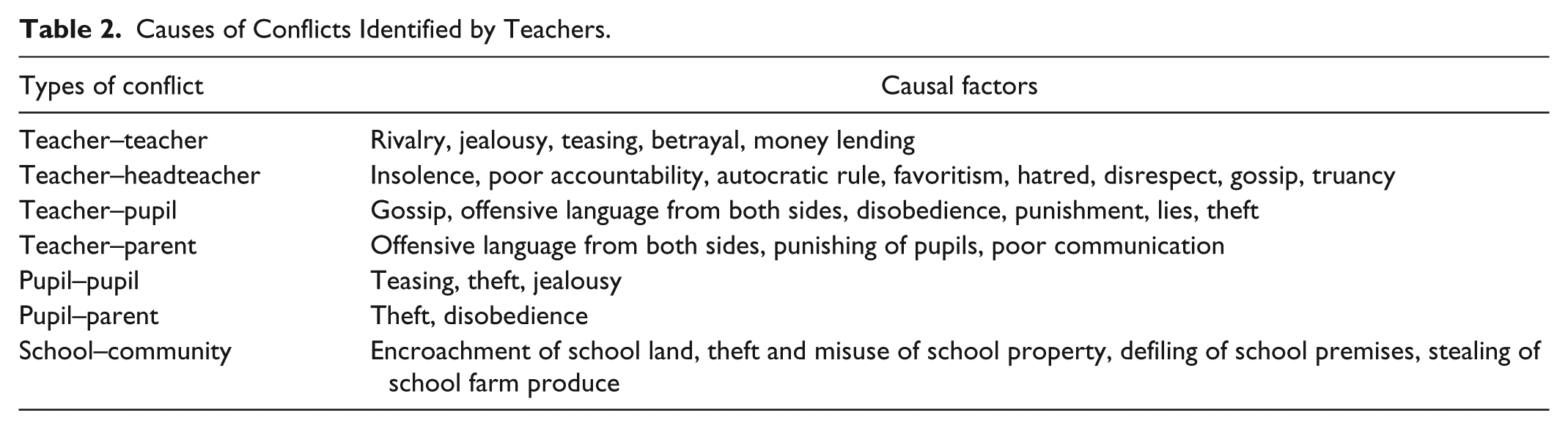
The types of conflicts and the frequency of responses that highlighted the respective conflicts in response to the questionnaire are as follows: conflict among pupils (81 responses), conflict between teachers and parents (75 responses), conflict between teachers and headteachers (63 responses), conflict between teachers and pupils (45 responses), conflict between pupils and parents that gets carried into school (39 responses), conflict among teachers (34 responses), and conflict between schools and their local communities (20 responses). Causal factors of these seven types of conflicts the teachers identified are summarized in Table 2.
Causes of Conflicts Identified by Teachers.
Perceived Effects of Conflict on Teaching and Learning
Of the 120 teachers surveyed, 114 (representing 95%) reported that conflicts that occur in their schools have direct negative effects on teaching and learning. The remaining six (or 5%) respondents were of the view that conflict in their schools produce positive results on teaching and learning as the teachers and pupils try to prove their point on issues of mutual interest and also bring out their values and personal differences in relation to work ethics. Similar to Whetten and Cameron’s (2005) assertion, these teachers believe conflict can yield positive results to those involved. Pervasive conflicts have both short- and long-term implications for educational opportunities of children in Ghana. The high incidence of conflict among teachers and pupils in the sampled schools could partly be attributed to the high population (55%) of 20- to 30-year-old, less experienced teachers working with a few (15%) elderly, more experienced, and soon-to-retire teachers aged 50 to 60 years old in the schools.
The senior teachers could serve as role models for the younger teachers to emulate; they could also use their traditional knowledge, class management experience, and skills in parenting to help the younger teachers deal with their relationship problems so they can help to prevent conflict from emerging in the classroom. However, having a small population of experienced teachers in the schools implies insufficient mentors for the younger teachers to turn to for advice in case of difficulties, for ideas about how to address specific students’ needs, or for insight in their subject areas. The scenario also suggests the schools have inadequate “traditional elders” to mediate or arbitrate “made-in-the-community” conflicts and prevent them from adversely affecting academic work and relationships in the schools.
All things being equal, the senior teachers could use their “I-have-been-there-before” experience (Opoku-Asare, 2000) to coach younger teachers posted to their schools to help their pupils resolve relationship and behavioral problems they encounter, or even serve as arbitrators to mediate conflicts that occur between individuals who function in the school system.
These “elders” could also motivate their younger colleagues to adopt more pragmatic strategies to help their pupils to understand the need for maintaining healthy relationships and promote peaceful school environments that promote quality living. Nonetheless, inadequate classroom management skills among both sets of teachers could also push conflict and its management out of the limelight and thereby cause minor disagreements to escalate and destroy existing peaceful relations in the schools. This notwithstanding, opposing ideas, decisions, or actions relating directly to how to curb conflict on the job, expression of different values and work practices, as well as individual personality differences (Ivancevich & Matteson, 2002) could generate intragroup conflict between the older and younger generation of teachers. The good thing, however, is that 54 (or 45%) of the 120 teachers were married, which implies having sufficient numbers of “mother” and “father” figures for the pupils to look up to for support in dealing with the issues of life on a daily basis, and adequate numbers of adults with relevant social and parenting skills to guide the pupils to handle relationship problems amicably without resorting to aggression, physical fights, or verbal assaults.
Nonetheless, as the pupil interviews revealed, some of the teachers have poor rapport with their pupils to the extent of refusing to teach them or mark their class work, which creates opportunity for some pupils to drop out of school. The situation clearly undermines teachers’ position in loco parentis (Orlich et al., 2001) so that as role models, their pupils would emulate their behavior to build good relationships and also work out their differences harmoniously. The many teacher–pupil, teacher–parent, and pupil–pupil conflicts are simply out of touch with effective schooling.
The remaining 6 of the 120 teacher respondents were of the view that conflict in their schools produce positive results on teaching and learning as the teachers and pupils try to prove their point (Whetten & Cameron, 2005) on issues of mutual interest, and the values that relate to their personal differences. The problem however, seems to hinge on adults in the schools being unable to deal with their own personal differences and thereby become role models for the pupils to emulate. Laxity in the practice of school supervision (Opoku-Asare, 2006) can contribute to high levels of interpersonal conflict in the schools.
The teachers’ responses to the questionnaire revealed that when teachers and parents are in conflict, the teachers refuse to show love to the wards of those parents, which goes a long way to negatively affect the learning capacity of the pupils concerned. In the same way teachers who get involved in conflict with their headteachers tend to feel awkward in school, often becoming withdrawn or unwilling to teach, and if they do it at all, they do not put in much effort to deliver the lessons as they are expected to do. This reduced level of teacher productivity impinges directly on the quality of curriculum delivery, learning effectiveness, pupil academic achievement, and opportunity for secondary education. The situation reflects Owens’s (2001) view that conflict in the school situation often develops into hostility that can take the form of alienation, apathy, and indifference, which directly affects the quality of relationships and educational achievement for the pupils.
The questionnaire also revealed that pupils who get involved in conflict with teachers tend to have low concentration or even divided attention in class; instead of concentrating on what the teacher is teaching, their thoughts tend to dwell on the conflict and its repercussions, which takes their minds off the lessons and makes it difficult for them to absorb what is taught in class. Those pupils’ thoughts tend also to get disturbed by the possible outcome of the conflict, which invariably reduces their learning capacity and academic performance over time. If such a conflict is not resolved as early as possible, it may lead to overt and covert enmity between the pupils and the teachers, which may increase the potential for some pupils to become truants or even drop out of school. Moreover, the use of instructional periods to settle conflicts in the classroom leads to lost time for lessons, inability to adhere to timetables, how much of the syllabus will be covered and invariably, how much the pupils will learn.
It emerged from the interviews that where pupils in conflict are in the same class, such pupils are reluctant to work in the same groups, and also refuse to respond to questions asked in class for fear of making mistakes and giving the other pupils a cause to laugh, tease, or make fun of them outside the classroom. These attitudes affect educational outcomes negatively because their class teachers would not know whether pupils who do not answer or ask questions have understood the lessons or not. The Circuit Supervisors responsible for the sampled district ought to pay regular visits to the schools, effectively monitor teaching and learning activities, and help the headteachers, teachers, and pupils implement existing conflict resolution structures and thereby promote a school culture of respect, harmony, collaboration, and peace to enhance productivity in the schools. They could also implement alternative dispute resolution strategies to enable school personnel to deal effectively with the early warning signs of conflict and how to mitigate their adverse effects from affecting teaching, learning, and the school environment.
Confrontation poses a great threat to interpersonal relationships in the school system, the pupils’ education, and future livelihood; it also has dire consequences for Ghana’s attainment of the Millennium Development Goal 2 of increased primary enrollment by 2015 (MoEYS, 2004).
Headteachers’ Perspectives of Conflict
One of the fundamental administrative functions of the school head is to continually reduce barriers and consolidate strong relationships between the school and parents and the community at large so as to harness community support and loyalty to improve teaching and learning, and thereby bring about change in learner behavior. It is also the responsibility of headteachers to create, nurture, and maintain an environment that invites teachers and students to expend their effort into teaching and learning, and to implement the curriculum, programs, and policies of the Ghana Education Service (Afful-Broni, 2004; Mankoe, 2002; Umude, 2012). Consequently, interviews were held with all the 30 headteachers, which revealed the prevalence of persistent relationship conflicts in their respective schools.
In identifying the types of conflicts experienced in the schools, 25 (83.3%) of the 30 headteachers cited pupil–pupil conflicts as the most rampant; two each cited teacher–pupil and teacher–headteacher conflicts, respectively, while one mentioned conflicts that emerge between teachers and parents. The headteachers intimated that any kind of conflict that emerges in the school environment has direct consequences for teaching and learning, with 27 or 90% of them attesting that conflict also undermines school administration. They conceded that headteachers find it very difficult to assign duties to teachers they are in conflict with, particularly when a teacher is absent and one of them must step in to enable the pupils do profitable work for the day. They recounted that where conflict arises between a teacher and a pupil, the teacher usually stops teaching to address the conflict; when conflict occurs between pupils of the same class during teaching periods, their teachers also spend part of the instructional periods settling the conflict, which wastes time. Table 3 summarizes the factors the headteachers attributed to conflicts that occur in their schools.
Factors Perceived to Cause Conflicts.

According to the 30 headteachers, what makes the situation worse is that primary school teachers in Ghana are generalist teachers who teach all the subjects on the primary school timetable and are also assigned to one class of pupils only (Boafo-Agyemang, 2010; Opoku-Asare, 2000), so pupils who get into conflict with their teachers cannot benefit fully from what is taught in all the subjects that constitute the primary curriculum. In some cases, the headteachers intimated that the pupils could convey distorted messages of such relationship conflicts in school to their friends at home and create unnecessary tension. In the worse situation, offended pupils could get their friends to assault the teachers involved. Eventually, a teacher could be transferred from a school in which they have had problems, which ends up negatively affecting the staffing situation in the school, particularly rural schools to which many qualified teachers refuse to accept postings (The President’s Committee on Review of Education Reforms in Ghana Report, 2002).
On the contrary, 3 (10%) of the 30 headteachers reported during the interviews that conflicts that occur in school can also positively affect academic work and the individuals involved. They explained that conflict brings out individual differences in people and highlights the need for cooperation; if conflicts are amicably resolved and both parties are satisfied, their productivity increases (Jennings & Wattam, 2004; Owens, 2001; Robbins, 2000). This implies that conflict aftermath could impact positively on teaching and learning. Nonetheless, the 90% affirmation of the adverse effects of conflict on schooling by the headteachers suggests that conflict poses more problems for classroom and administrative work than it yields any positive effects.
Observation
Although the questionnaire responses provided by the 120 teachers and evidence from interviews with the 30 headteachers and 130 pupils hinted the existence of different types of relationship conflicts in the schools, no significant teacher–pupil and teacher–teacher conflicts were observed in any of the 30 schools. It is possible that collegial responsibility to maintain cordiality among the teachers and mutual respect that requires that personal differences should not interfere with professional practice, particularly where “outsiders” whose intention of visit they knew were present, was the motivation for the teachers to behave civilly to each other during the period of observation. It was obvious that the teachers simply acted unnaturally to avoid any conflict occurring between them and their pupils, suggesting that the teachers are better positioned to prevent others from driving them into conflict. As adults, they are more likely to consider alternative strategies to deal with conflict situations they encounter, especially where “strangers” are present in their working environment. Nonetheless, the high levels of conflict that occurred among the pupils in class and at play suggest the pupils’ lack of self-control and adequate numbers of role models to show them the proper way to address their grievances. The good thing is that children easily make up after disagreements, and even after fighting, they quickly forget such disputes and resume their play.
The apparent absence of conflict occurrences between the sampled schools and their local communities suggests little or no interaction or peaceful co-existence between the schools and their communities. It is also possible that the traditional leaders apply arbitration, mediation, and consensus building strategies to resolve conflicts that erupt between the school and the communities. Unfortunately, this seeming harmonious co-existence does not reflect in the behavior of the pupils who often resort to fighting, heckling, and other physical forms of abuse to resolve their differences, particularly on the playground and on their way home from school where no adult supervises them. The level of observed conflicts on the playground could be attributed to the absence of teachers on supervisory duties (Owusu-Mensah, 2007). Pervasive conflict among the pupils could also be a reflection of the level of conflicts they encounter in their communities, which they had learned as acceptable means of handling disagreements.
Few issues of teacher–headteacher conflicts were, however, observed at staff meetings that were held in the headteachers’ offices in all 30 schools, to which the researchers were invited. Conflicts also erupted between teachers and parents, between headteachers and parents, and also between the headteachers and Parent–Teacher Association (PTA) officials at scheduled PTA meetings in 15 schools. The teacher–parent conflicts emerged from parents being angry because their children were being unduly harassed over delayed payment of PTA dues, school fees, and other levies; frequent high-handed punishments meted to pupils who break school rules, steal or fight in school; parental complaints about teacher lateness or irregular attendance to school; and perceived amorous relationships between male teachers and the older female pupils in some cases. Strong arguments and quarrels occurred between some headteachers and their schools’ PTA officials for lack of transparency in disbursing PTA funds and the government’s Capitation Grant, which is meant for basic schools to offset their recurrent expenditure.
Interestingly, the researchers’ presence in the schools did not stop the PTA meetings or prevent the occurrence of intense disagreements and strong arguments because the agenda for those meetings were set long before the researchers negotiated access to the schools; the parents and officials concerned were compelled to attend with no option to do otherwise. Having “outsiders” at those meetings did not seem to matter as differences had to be resolved and misunderstandings cleared; the people simply made every effort to make their voices heard, and many did not mince words in expressing how strongly they felt with the issues discussed.
Conclusion and Recommendations
Primary schools in the study district experience persistent conflict, which has direct adverse consequences for teaching and learning, whether it occurs between a teacher and a pupil or pupils, between a teacher and the head of a school, or between teachers and parents. Conflict between a teacher and headteacher can lead to a teacher’s reluctance to provide quality teaching to their pupils and cause them to lose out on what they should gain from the curriculum. School–community conflict can also slow down the cordial relationship between school authorities and the communities. The state of affairs in the study area points to laxity in the practice of school inspection (Arthur, 2011; Opoku-Asare, 2006) and perhaps also accounts for ineffective curriculum delivery, low pupil achievement, and lowered standard of education in the district (Owusu-Mensah, 2007).
The idea is that when schools, families, and communities work together to support learning, pupils tend to do better in school, stay longer in school, and show greater commitment to learning (Levin & Young, 1994, as cited in Mankoe, 2002). It is necessary therefore that the district education office takes steps to improve the leadership skills and managerial effectiveness of the headteachers to enable them to build positive working relations with their staff so that they can liaise to curb conflict occurrence in the schools and promote academic productivity.
Knowing that conflict in primary schools, irrespective of the type, affects the pupils’ education, and having found that conflict between pupils occurs every day in the sampled primary schools suggest the urgent need to adopt measures to educate schools in the district on conflict and its negative impacts on their academic performance. Resolving these issues will improve peace building and ease tension between the key players in the education enterprise. The level and nature of conflicts experienced in the schools also suggests that the School Management Committees and PTA officials are not visiting the schools regularly to monitor the performance of pupils and to help in solving school problems (Addae-Boahen & Arkorful, 2001; Owusu-Mensah, 2007). District level checks to monitor supervisors’ performance in ensuring quality standards in the district could detect tensions that militate against teacher efficiency and pupil learning, and thus help enhance the educational experience for the pupils. These are issues that directly affect relationships and make it difficult for effective teaching and learning to go on.
It is important also that school authorities complement pupils’ good behaviors and reward them somehow to encourage them to continue to behave well in school. Instituting peer mediation teams comprising well-behaved pupils and equipping them with conflict resolution skills would enable these role models to help their schools handle interpersonal conflict more effectively. This group could be trained periodically by the district education office, civil society, or any community based or non-governmental organization, which is interested in conflict management so that schools in the district would have relatively reduced conflict environments. It is also necessary for pupils to be educated on existing conflict resolution mechanisms in the schools and the associated sanctions for offenses.
Conflict resolution bodies such as the Disciplinary, and Guidance and Counselling Committees in the schools (Addae-Boahen & Arkorful, 2001; Owusu-Mensah, 2007; Umude, 2012) should be strengthened to enable them to educate the pupils on better ways of handling conflict to promote good neighborliness among the pupils and thereby curb intractable issues of conflict and create an enabling environment for teaching and learning to occur in the schools. Instituting peer mediation teams and peace clubs with pupils who are disciplined and well behaved could help the schools manage relationship conflicts. Further research on conflict in Ghanaian schools would identify effective intervention strategies that would be appropriate for minimizing or curbing conflicts that occur in the schools.
Footnotes
Declaration of Conflicting Interests
The author(s) declared no potential conflicts of interest with respect to the research, authorship, and/or publication of this article.
Funding
The author(s) received no financial support for the research and/or authorship of this article.