




Abstract
This study explores factors that influence Swedish civil society organizations’ (CSOs) degree of activity at different geographical and administrative levels and, in particular, how they are affected by processes of Europeanization in the social welfare policy area. The present study is based on a national survey and includes approximately 1,600 Swedish CSOs. Despite the often claimed mismatch between the Swedish welfare model and European Union (EU) level social policy measures, EU membership has opened a new level of opportunities for activities for Swedish CSOs. The results show that Swedish CSOs are mostly active at the local level and very seldom at the European level. The strongest factor contributing to Swedish CSOs’ degree of activity at the European level is the perceived relevance of this level. Furthermore, resources have a great impact. CSOs that can claim strong representativeness and that have access to employed staff are more likely to be Europeanized.
Keywords
Introduction
This study explores the extent to which Swedish civil society organizations (CSOs) are active at different geographical and administrative levels and which factors influence the processes of the CSOs’ Europeanization. Previous research into interest groups’ advocacy and lobbying activities has studied how such activities are spread over different administrative levels and has focused on the Europeanization of interest groups and/or their access to the European Union (EU; for example, Beyers, 2002; Beyers & Kerremans, 2007; Chalmers, 2013; Dür & Mateo, 2012; Klüver, 2010). Such literature explores the ways in which interest groups become Europeanized and how different degrees and types of Europeanization can be explained. Some of the factors emphasized in such literature will be explored in this article as well.
Previous research on interest groups’ Europeanization has focused mostly on lobbying (e.g., Dür & Mateo, 2012; Klüver, 2010), but this article approaches the question of Europeanization from a broader perspective. It explores at what administrative level Swedish CSOs are active in general, regardless of which activities or strategies they use or the purpose of their activities. In this sense, Europeanization is interpreted as the degree to which organizations are active at the European level. This article explores the organizations’ own perceptions of their activities at different levels, which is different from an assessment based on measuring how and what activities are taking place (e.g., lobbying EU institutions). Thus, the CSOs that are the focus of this study might be engaged in a range of activities at the European level, including lobbying, participating in campaigns, applying for funding, or being active in umbrella organizations.
Our way of understanding Europeanization also requires a different methodological approach. Because the types of activities the organizations engage in might be different from case to case, we would also expect the motives behind “going European” to vary between organizations. It becomes essential, therefore, to include a broad range of organizations in our analysis. Thus, the sample on which the study is based has been developed with the purpose of including not only interest groups or those organizations that are “most likely” to be Europeanized, as has often been the case in previous research (e.g., national organizations as in Klüver, 2010 and Dür & Mateo, 2012 or elite organizations as in Beyers & Kerremans, 2007). This study includes 1,677 local, regional, and national Swedish CSOs working with interest representation (within a broad range of issues), solidarity, social service and care, and religious activities. Many of these organizations are active in policy areas that are mostly regulated at the national and local level such as disability and gender equality issues and the labor market, which we will refer to in general as the “social welfare area.”
Sweden is a particularly interesting case for studying the Europeanization of CSOs due to its ambivalent relationship with the EU. The opinion in the country has been divided since EU membership was confirmed by a small majority in a referendum in 1994. Recent national attitude surveys undertaken by the Swedish SOM Institute indicate a declining support for EU membership since the economic crisis of 2010, and support for adopting the common currency (which was rejected by voters in a referendum in 2003) seems to be at an all-time low in Sweden (Holmberg, 2014).
Scholars have argued that Sweden represents “another awkward partner” in the EU family (Johansson, 2003) following the same pattern as the United Kingdom in its “…sense of detachedness and removal from EU institutions” (Olsson, Nordfeldt, Larsson, & Kendall, 2009, p. 178). The Swedish skepticism about the EU has been argued to have its roots in a profound mismatch between the way in which the EU institutions are perceived and the core values of the Swedish polity that are institutionalized in the Swedish welfare model (Olsson et al., 2009). In particular, the Swedish popular movements (folkrörelser), which form the backbone of organized civil society in the country, have been argued to be critical of the potential changes that EU influence might have on national and local welfare policies. However, very few studies have focused on the Europeanization of Swedish CSOs. A recent study (Hedling & Meeuwisse, 2015) suggests that Swedish CSOs active in the social welfare policy area might be Europeanized as well. Such Europeanization seems to take place more through engagement in EU-based umbrella organizations and by receiving EU funding than through direct lobbying.
This article aims to contribute to research about the Europeanization of interest groups by testing the relevance of different organizational factors, some of which have not been considered in previous research. Because we did not limit our study to organizations that are “most likely” to be Europeanized, we will include in our explanatory model a cognitive dimension describing whether the CSOs deem working at the European level to be important for solving the problems or questions the organizations works with, which is a factor that is often overlooked in previous research. Such a variable is particularly relevant considering the alleged Swedish skepticism toward EU institutions.
In contrast with much previous research (see, for example, Dür & Mateo, 2012), this study focuses on CSOs in one country (Sweden) and does not include factors related to different national systems of interest representation. It also has a special focus on organizations that are active in the social welfare area and will not compare different policy areas or take into consideration factors relating to the ways in which different policy areas are regulated at different levels in a multi-level system of governance.
The organizations chosen for this study include interest organizations, which are working for a specific social issue and are mobilizing “service users”; trade unions, which are active in the labor market and organize groups of workers that are sometimes referred to as “producers” (as opposed to “users”; Feltenius, 2008); solidarity organizations, which are active in the social welfare area both through advocacy and service provision and without the intent of representing specific groups; service organizations, whose primary goal is to provide social welfare services; and religious associations and congregations working with advocacy, social service, and care from a religious perspective. This article will address the following research questions:
Background: Swedish CSOs in the Social Welfare Area and Europeanization
It is clear that EU membership has opened up a new level of opportunities for activities for Swedish CSOs. The EU is often taken as a clear example of how CSOs are embedded in a multi-level governance system (e.g., Hooghe & Marks, 2001) because the EU has been given greater authority to decide over policy areas that formerly were decided only within nation-states. However, the allocation of policy making and implementation to different geographical levels is not new. In most nation-states, local and regional political and administrative bodies have considerable power over how regulations decided at the national level are implemented locally and regionally. Especially for the social welfare policy area, the sub-national levels can often be said to be of even greater importance than the nation-state level (which is especially the case in Sweden with its far-reaching local autonomy). This multi-layered structure of political decision making and policy implementation requires CSOs to make strategic decisions about which levels they should focus on.
The social welfare policy area is a relevant focus area because it is still highly dependent on national and local government regulations and subsidies. Beyers and Kerremans (2007) show that the division of competences between the EU and the member states affects the Europeanization of national interest groups and that the social security policy area is one of the less Europeanized. Other studies show, however, that certain political processes at the EU level related to the social welfare area—such as the anti-discrimination clause in the Amsterdam treaty (Holzhacker, 2007) or the Open Method of Coordination on social policy and the creation of the National Action Plans on social inclusion (Kröger, 2006)—have engaged national CSOs to a certain degree (see Erneberg, 2013 for an overview).
The organizations that are analyzed in this study belong to the part of Swedish organized civil society that grew in interaction with the development of the modern welfare state. Some of the organizations are old enough to have their roots in the Swedish pre-welfare state society, others have developed during the “golden age” of the Swedish welfare model, while yet others have started their activities in more recent times when the state monopoly on welfare service organization and production had begun to be challenged.
Up to the 1930s, most welfare service provision in Sweden was organized and delivered by traditional charity organizations. With the development of the welfare state, however, public authorities eventually took over many CSOs’ service provision. Such a development placed most CSOs’ activities “outside the social welfare domain, especially in culture, recreation and non-service-providing advocacy organizations” (Olsson et al., 2009, p. 160; see also Salamon, Sokolowski, & List, 2004). In the social welfare domain, the division of responsibilities between the public and the civil society sector was quite clear, albeit never quite formalized: While the public sector would provide the welfare services, the civil society sector would be advocating for interest groups’ rights, critically scrutinizing the functioning of the public sector, and formulating new ideas. Advocacy, evaluation, and innovation were the domains in which Swedish CSOs were most active. Such a model earned strong support in public opinion, including in the civil society sector itself (Olsson et al., 2009; see also Lundström & Svedberg, 2003; Lundström & Wijkström, 1997).
As part of this process, the Swedish civil society sector has, since the early 20th century, been defined through the concept of “popular movements” (folkrörelser) rather than the “third sector,” the “social economy,” or other concepts that have been more popular in central and southern Europe. The concept of “popular movements” emphasizes the important democratic function of Swedish CSOs rather than their significance in economic terms, and the focus is on membership and representativeness rather than on service provision and employment (Olsson et al., 2009).
Since the early 1990s, the Social Democratic state-oriented welfare system has been increasingly exposed to criticism and subsequent reforms. A welfare-mix model and a transition from “welfare state” to “welfare society” have in recent years been embraced by significant actors who have seen this transition as a desirable development for the Swedish welfare state. External service delivery options have been made possible through consequent reforms inspired by principles of privatization and marketization, and these have opened the way for non-state actors—both for-profit and non-profit—to provide social welfare services on behalf of the public sector in many different areas. From 2003 to 2010, the percentage of workers in the social welfare sector who were privately employed rose from 10% to 17%. Only a small share of this increase took place within the civil society sector (Hartman, 2011).
Europeanization of Swedish CSOs
The increased interest in the more service-oriented activities of Swedish CSOs, a process often described in the literature as “from voice to service” (e.g., Lundström & Wijkström, 1995, 2012), has coincided with intensified economic globalization and Sweden’s membership in the EU in 1995. One clear connection between EU membership and the changing role of Swedish CSOs is the introduction of the “social economy” concept in the Swedish context and the adoption of the “partnership model” in the implementation of social welfare projects (Olsson et al., 2009). Such concepts and organizational logics have been introduced and spread in the Swedish civil society sector not least through the many funding programs of the European Social Fund such as the EQUAL program (Scaramuzzino, Heule, Johansson, & Meeuwisse, 2010).
To what extent are Swedish CSOs active at the European level? A qualitative research project published in 2009 (Olsson et al., 2009) shows that such Europeanization is quite modest. Accordingly, because of the evident mismatch between the Social Democratic values so central to the Swedish model and the perceived character of the EU as an institution that is market-enhancing, market-oriented, and essentially neo-liberal, Swedish CSOs see EU interventions “as potentially upsetting the national policy rhythm without democratic legitimacy” (Olsson et al., 2009, p. 179).
A study of Swedish CSOs’ participation in the EU-financed EQUAL program (2001–2007) showed that about 260 Swedish CSOs participated in the program as formal partners in 71 development partnerships. The EQUAL program can be seen as an example of how the European social welfare and employment strategy is implemented through the funding of experimental projects led by so-called development partnerships between public, private, and CSOs in all EU member states. The aim of EQUAL was to support new methods for preventing discrimination and inequalities in the labor market (Scaramuzzino, 2012; Scaramuzzino et al., 2010).
A more recent unpublished qualitative study conducted among Swedish CSOs that participated in a civil dialogue process at the national level in the social welfare area showed that many organizations had indeed undergone a process of Europeanization. The most common activities were membership and activities in CSO networks at the European level, participation in EU-funded projects, lobbying activities at the EU level, and making use of specific key persons as facilitators in contact with EU institutions (Hedling & Meeuwisse, 2015).
Theoretical Framework
Europeanization might be interpreted as both a top–down and a bottom–up process. Besides a strand of research focusing on how EU institutions exert adaptive pressure on national CSOs, we find a growing interest in collective actors and their keenness to address the EU institutions and make “usage” of the opportunities they offer (e.g., Woll & Jacquot, 2010). The Europeanization of collective actors has been addressed from different theoretical perspectives and with different approaches both by interest groups research, upon which the present study draws heavily, and by social movements research (e.g., della Porta & Caiani, 2007; McCauley, 2011; Monforte, 2014; Ruzza, 2011).
We have chosen to operationalize the Europeanization of Swedish CSOs as the degree to which they are active at the European level. Such Europeanization is measured by the answer to the question “How often is your organization active at the following levels?” This question made it possible for the respondents to indicate to which degree their organizations are active on several geographical levels, including the “European level.” 1 We interpret the fact that CSOs are active at the European level as a strategic choice irrespective of how these activities are understood by the organizations themselves. These activities might include not only direct lobbying of EU institutions, or participating in EU-funded projects, but also being members of or active in umbrella organizations that gather CSOs from European countries (also from non-EU countries). Thereby, Europeanization does not necessarily imply direct interaction with EU institutions. Thus, we have chosen to direct our questions to activities at the European level rather than at the EU level. In our analysis, we will compare interest organizations, trade unions, solidarity organizations, service organizations, and religious associations and congregations.
Interest organizations work for and represent the specific interests of a particular group in the population, which is also the case for trade unions. We have, however, chosen to separate trade unions into a specific category to be able to compare them with interest groups representing client groups. In fact, it has been argued (e.g., Feltenius, 2008) that client interest groups and organizations have a weaker position vis-à-vis the state than so-called producer interest groups (employers’ organizations and trade unions). According to this logic, the state can ignore client interests to a higher degree than producer interests, which might make the former more eager to seek influence at the European level to compensate for lower access at the national level (cf. Klüver, 2010). A few Swedish studies have shown, however, that organizations representing the disabled, pensioners, and migrants have been able to establish long-term relationships and exert some—albeit limited—influence on national policy in their respective fields of interest (Aytar, 2007; Feltenius, 2004; Markström, 2003).
Compared with interest organizations, solidarity organizations (e.g., humanitarian associations) do not seek to primarily represent a specific group. The distinction is based on a common way of distinguishing between voluntary social welfare organizations “to divide them into those that build on self-organization and self-help and those whose main task is to organise activities and perform services for others” (Lundström & Svedberg, 2003, p. 227; see also Meeuwisse & Sunesson, 1998). Service organizations instead have the primary aim of providing specific social welfare services (e.g., social care and child care). These types of associations are a relatively new phenomenon in the Swedish organizational landscape and are mostly a product of the deregulation of the system of welfare service provision over the last two decades. Religious associations and congregations are usually engaged in social welfare issues regardless of their denomination. Organizations related to the Swedish Church are also, since the separation of church and state in 2000, voluntary organizations with the same legal status as other CSOs. They are traditionally engaged in social welfare issues mostly through diaconal activities (Linde, 2010), but they are also present in the public debate as a critical theological voice (Bäckström, 2014).
This article has its basis in theories developed in interest group research focusing on Europeanization. In our review of such research, we have found that organizational strategies are influenced by different factors. One important factor that has proven to be relevant is the interests of the organization’s constituents, and the distinction between specific and diffuse interests has proven to be especially relevant. Organizations with diffuse interests tend to seek and gain less access to EU institutions because of their broad and scattered constituencies and a less institutionalized and weaker position in many European countries (Beyers, 2004). Thus, our first hypothesis is as follows:
Literature about the Europeanization of interest groups highlights the importance of organizational resources for being able to access the EU. According to such theories, CSOs that interact with EU institutions exchange resources for influence. In such exchanges, the organizations need to meet certain requests and demands for resources that are crucial for the EU institutions’ functioning, and this creates a relationship based on interdependency (Bouwen, 2002). Klüver (2010) mentions three types of resources that are relevant for meeting the demands of the EU: financial resources, personnel resources, and interest group representativeness. Because the EU institutions are often understaffed, they need the interest organizations that interact with them to compensate for their own lack of expertise. Furthermore, the EU institutions’ democratic deficit might be compensated by the CSOs with which they interact if the CSOs can claim a strong representativeness and can thus legitimize political processes at the EU level. The importance of organizational resources for accessing EU funding has also been highlighted in previous research (Sanchez-Salgado, 2010; Scaramuzzino, 2012). Thus, our second hypothesis is as follows:
The notion that resources per se influence the behavior of interest groups has been challenged; however, “Even though it is often argued that especially resourceful organizations Europeanize, we argue that it is not necessarily size or resources that matter. More important is how organizations are structurally connected or tied to their environment” (Beyers & Kerremans, 2007, p. 464; see also Beyers, 2008). According to this “critical resource dependency approach,” we should look at not only the extent to which CSOs have access to resources but also—from a more relational point of view—how resource mobilization embeds them in their environment (e.g., in relation to public and private sponsors at the local level). Because resource mobilization requires a certain effort and interaction with the environment, it might be possible that organizations that are locally well funded and embedded do not have the propensity to expand their activities outside the national context (Beyers & Kerremans, 2007). Mobilizing resources from members, from public authorities, and through providing services on behalf of the public sector might be considered activities that create an embeddedness in the national and local level that make organizations less eager to seek access at the European level. Thus, our third hypothesis is as follows:
One of the Swedish studies about Europeanization (Hedling & Meeuwisse, 2015) has also argued that different generations of CSOs Europeanize in different ways. The study found that organizations founded before 1920 were more internationally oriented than specifically oriented toward the EU level, that organizations founded between 1921 and 1980 were more nationally oriented, and that organizations founded after 1980 were more aware of and oriented toward the EU. Such findings seem to reflect the above-presented organizational conditions and challenges of the Swedish civil society sector that have been connected to the development of the welfare state over time. Thus, our fourth hypothesis is as follows:
Because the social welfare area is regulated to a high degree at the local and national levels, we have also investigated the importance of a more cognitive factor, namely, whether the organization perceives the European level as important for solving the problems or questions with which the organization works. We cannot assume that the CSOs included in our study deem the European level as relevant. Therefore, we have considered as an explanatory factor whether the organizations perceive opportunities at the European level as relevant. By doing so, we have been able to assess the importance of the perceived opportunities offered by such a policy level instead of the actual opportunities, which have been the primary focus of most previous research (e.g., Beyers & Kerremans, 2007). Our fifth hypothesis is as follows:
In summary, we intend to contribute to research on the Europeanization of CSOs
by applying a broader interpretation of the concept of being active at the European level.
by including a larger sample of CSOs, not only those “most likely” to be Europeanized.
by focusing on the case of Sweden, a relatively new EU member state, which previous research has described as a clear “mismatch” with EU policy (Olsson et al., 2009) and which has never been the focus of quantitative studies of Europeanization of CSOs.
by testing three hypotheses based on previous research (type of interest, resources, and resource dependency) and two hypotheses that have not been extensively tested before in interest group research on Europeanization (time of founding and perceived importance of the European level).
Method and Data
The present study is based on a large quantitative data set resulting from a national survey that received responses from 2,791 Swedish CSOs. The survey was carried out in 2012-2013 as part of the research program “Beyond the Welfare State: Europeanization of Swedish Civil Society Organizations (EUROCIV)” financed by The Swedish Research Council.
Sampling
The sample for the survey was based on the categories used by Statistics Sweden (SCB) in their register of Swedish organizations (Företagsregistret) that was used to get contact information and register data about Swedish CSOs. The aim with the original sample was to target the categories of Swedish CSOs that one could expect to be engaged in social welfare issues and interest representation. In line with this aim, we included two types of organizations: associations (ideella föreningar) and religious congregations (registrerade trossamfund).
Most non-profit organizational forms are to some extent given specific economic and/or other benefits by Swedish legislation, and to have access to these, most CSOs register with the authorities as belonging to one of these categories. An association is the most common organizational form, and it provides a legally simplified framework for certain activities (e.g., making limited economic transactions without being taxed).
We decided to include in the survey’s sample only the CSOs that were categorized by SCB as being involved primarily in the types of activities that corresponded to our research interests: associations involved in “social service and care,” associations involved in “interest representation,” and religious congregations. Among the “social service and care” associations, one can find, for instance, the Red Cross, Save the Children, Alcoholics Anonymous, women’s shelters, crime victim advocacy organizations, and disability organizations. Among the “interest representation” associations, one finds trade unions, professional and employers’ organizations, political parties, immigrants’ and pensioners’ organizations, and cultural associations. Religious congregations have been chosen because they are often involved in social welfare activities on behalf of families living in poverty, undocumented migrants, and other marginalized groups. Among these registered CSOs, one can find local or regional chapters of national federations as well as the national federations themselves because most Swedish CSOs register their local bodies as separate associational entities. Also among these registered CSOs, one finds quite small CSOs that do not belong to any federation.
By targeting the CSOs belonging to these three categories of SCB’s register of organizations, we deliberately chose not to include other categories of organizations, for instance, sports and recreation and leisure associations. Through these choices, our total population of CSOs included 80,015 associations, which can be said to represent approximately 40% of formally organized Swedish civil society. 2 Because the actual numbers of organizations differed significantly between the three categories constituting our population, we decided to make a stratified sample so as not to end up with insufficient numbers of cases for some of the smaller categories. With this stratified sampling procedure, we gave the CSO categories different weights during the analysis so that the presented results of univariate and bivariate analyses would be the same as if we had analyzed a non-stratified sample.
The survey questionnaire was sent by mail to 6,180 randomly chosen Swedish CSOs, and 2,791 questionnaires were returned. Because of faulty postal addresses and because some organizations had ceased to exist or changed their associational form, these CSOs were excluded from the sample because they no longer belonged to our population, and the final response rate was 51.3%. 3
Operationalization
The three categories of CSOs from SCB described above were used to create a sample in accordance with the overall aims of our research project. For this article, however, we grouped the cases of our data set according to theory-driven typologies that more clearly corresponded to this article’s aims. Thus, in our analysis, we compared “interest organizations,” “solidarity organizations,” “service organizations,” “religious associations and congregations,” and “trade unions” on the basis of survey data from 1,677 CSOs. 4 To focus our analysis on the types of CSOs that are working with issues clearly related to the social welfare area, we excluded the 1,037 cases in our original sample that did not meet this criterion. The categories used in the following were as follows:
Interest organizations: 505 cases. Of these, 33% are disability organizations, 18% are women’s organizations, 16% are pensioners’ organizations, 14% are temperance organizations, 11% are victim support organizations, 7% are immigrant organizations, and 1% are lesbian, gay, bisexual, and transgender (LGBT) organizations.
Solidarity organizations: 450 cases. Of these, 59% are chapters of Red Cross Sweden, 15% are chapters of Save the Children Sweden, and the remaining 26% are various solidarity and charity organizations (e.g., Lions, Rotary, Emmaus, and Majblommans riksförbund).
Service organizations: 78 cases. Of these, 44% provide social care services, 28% provide child care services, and 28% provide other types of social services.
Religious associations and congregations: 534 cases. Of these, 63% are groups and congregations of the (Lutheran) Church of Sweden, 26% are various Free Church congregations and associations (i.e., nonconformist Lutheran churches), 4% are other Christian churches (Catholic and Orthodox), and 3% are other churches and religious associations.
Trade unions: 110 cases. Of these, 44% are unions belonging to TCO (The Swedish Confederation for Professional Employees), 44% are blue-collar trade unions belonging to LO (The Swedish Trade Union Confederation), 11% are unions belonging to Saco (The Swedish Confederation of Professional Associations), and 4% are other trade unions.
As previously stated, these 1,677 organizations can be argued to represent Swedish organizations involved in social welfare issues and in interest representation and thus “less likely” to be Europeanized when viewed as a group.
The data analysis below includes only cases from the associations/congregations that answered positively to a question about whether the organization had had any activities at all during 2012 (this meant that we excluded 40 cases from the analysis).
The five hypotheses presented above were tested through a set of variables and related questions from our survey.
The first hypothesis was tested through our typology of five types of organizations in relation to three questions that measured different aspects of the CSOs’ degree of Europeanization.
The second hypothesis was tested through two questions where the organizations stated the number of individual members and organizational members separately and the number of employees converted into full-time equivalent terms (i.e. two half-time workers count as one full-time).
The third hypothesis was tested using two questions in the survey. The first question asked about the importance of different sources of funding for the CSO’s budget. The second question concerned to what extent the organization provided services on behalf of public institutions.
The fourth hypothesis was tested using a question about the year in which the organization was founded. The organizations were divided in three categories according to time ranges. The ranges were chosen to symbolize the time before the development of the welfare state (prior to 1930), the “golden age” of the Swedish welfare state (1931-1994), and the time since Sweden became a member of the EU (1995 until the present) as described in the “Background: Swedish CSOs in the Social Welfare Area and Europeanization” section.
The fifth hypothesis was tested using a question about the degree to which the organization perceives the European level as important for solving the problems or questions with which the organization works.
In our final analysis, we scrutinized how our main dependent variable—the CSOs’ degree of activity at the European level, that is, their level of Europeanization—was affected by the above-mentioned variables through five linear regression models. We evaluated the regression models according to normal regression diagnosis (e.g., multicollinearity) and did not find any significant misspecifications.
The variable for CSOs’ degree of activity at the European level was derived from the answers to our survey’s question about how often the CSOs engage in activities on the European level (where the respondents could answer “often,” “sometimes,” “rarely,” or “never”). For the precise wording of this and all other questions (and their sub-items) used in this article, and the response alternatives, see the appendix.
Results
In this section, we will describe the main results of the analysis. First, we will analyze the Swedish CSOs’ degree of Europeanization. The main focus will be on our dependent variable, the CSOs’ degree of activity on the European level. We will also focus on other aspects of Europeanization such as the use of advocacy, membership in networks, and economic support. Second, we will introduce and analyze our independent variables. These primarily concern not only the CSOs’ availability of various resources but also the degree to which they perceive the European level as important for solving the issues they work with. Finally, we will present a regression analysis of our dependent variable to determine which factors contribute most strongly to the Swedish CSOs’ degree of Europeanization.
As discussed earlier in this article, Europeanization can be understood as a many-faceted phenomenon. Tables 1 and 2 show some variables that indicate different relevant aspects of the CSOs’ degree of Europeanization. To more easily assess whether the degree of Europeanization is extensive or not, we have also included, in the presentation, corresponding variables that show the CSOs’ degree of activity at other geographical levels. These variables include the local/municipal level and the national level as well as other relevant supranational geographical levels such as the Nordic and the international level.
The CSOs’ Degree of Activity and Use of Advocacy on Different Geographical Levels.

Note. CSOs = civil society organizations.
The Five CSO Types’ Degrees of Activity, Use of Advocacy, and Membership in Networks/Federations on Different Geographical Levels.

Note. Used measure of association between the variables is Cramer’s V. CSO = civil society organization.
5% significance. **1% significance. ***0.1% significance.
Table 1 shows the CSOs’ degree of activity at different geographic levels, including our dependent variable, the European level.
The upper part of Table 1 shows that most Swedish CSOs are active at the local level. Almost half of the organizations are never active at the national level. Less than one in three organizations is active at the three supranational levels, and the European level is the least common level of activity. Only 11% of the CSOs are often or sometimes active at the European level, and 77% are never active at this level.
The lower part of Table 1 shows the degree to which the CSOs have tried to influence politicians or officials at different political levels for achieving the organization’s goals, that is, the extent to which they have used advocacy. The overall pattern is quite similar to the variables about the CSOs’ degree of activity at various levels. Only one organization in five has not tried to influence politicians and officials at the local/municipal level, whereas the opposite is true for the three supranational levels. Around half of the CSOs have tried to influence representatives of institutionalized politics at the national level.
Table 2 shows a bivariate analysis of whether the degree of activity, use of advocacy, and membership in networks on different geographical levels differ between the five types of CSOs that our article focuses on. To simplify the presentation of the variables about degree of activity and use of advocacy, we have combined the figures for those answering “often,” “sometimes,” and “rarely” into one single variable, thus highlighting those that have engaged in these activities at all.
The upper part of Table 2 shows that the five CSO types’ degree of activity at the European level does not differ because no statistical significance can be seen. There is, however, a difference regarding the degree of activity at the international level. Solidarity organizations and religious associations and congregations tend to have a much higher degree of activity on the international level compared with the European level, which is not the case for the three other types of CSOs.
The middle part of Table 2 shows that the five types of CSOs use advocacy at the European level to different degrees. Although 26% of the trade unions had contacted politicians and officials at the European level, only 4% of the service organizations and 11% of the religious associations and congregations had done this. In between, and close to the average of all CSOs, we find interest and solidarity organizations.
The lower part of Table 2 shows that only 11% of the CSOs in the sample are members of networks, federations, or umbrella organizations at the European level, which indicates a low degree of organizational Europeanization. As many as three in four organizations are, however, members of national networks or federations, and 57% are members of local networks or umbrella organizations. When it comes to differences between the five types of CSOs, it is foremost the trade unions that stand out as having the highest degree of organizational Europeanization (27%), while only 4% of the service organizations belong to European networks.
When it comes to membership, we can divide the CSOs into three types: those that have only individuals as members, those that have only organizations as members, and those that have both. Having individuals as members is the most common type of membership. Only 3.7% of the organizations do not have any individual members. The mean membership base for the Swedish CSOs in the sample is 2,553 individuals if we exclude those organizations that do not have any individuals as members. The median membership base, however, is 100 individuals, which shows that our sample contains a few very large CSOs while most of them are relatively small. The largest CSO has more than 1 million individual members (the Diocese of Stockholm, the largest diocese of the Church of Sweden). Only 11% of the CSOs have organizations as members, and among them, the mean membership base is 17 organizations, while the median membership base is 5 organizations.
The majority of the CSOs (69% of the sample) do not have any employed staff. Among those organizations that have employed staff, the mean number of full-time employees is 24, and the median is 2. The largest workforce in a CSO is 1,200 employees (once again the Diocese of Stockholm). The high levels of membership in Swedish CSOs and the low level of professionalization of such organizations have been highlighted in previous comparative research (Salamon et al., 2004; Svedberg, von Essen, & Jegermalm, 2010; see also Ungdomsstyrelsen, 2013, for a more recent quantitative study on the Swedish civil society sector).
Table 3 shows the level of dependency of Swedish CSOs on different sources of non-public funding. The table shows that the large membership base of Swedish CSOs is also an important economic factor because 75% of the CSOs stated that members’ fees are very or somewhat important for the organization’s budget. Sales of goods and services and private donations are deemed less important by a majority of the CSOs. When it comes to public support, 43% of the CSOs stated that economic support from local municipalities is very or somewhat important, and the corresponding figures for support from the state is 19% and for support from EU bodies is 3%. In another question (not shown in Table 3), 84% of the CSOs in the sample stated that they do not provide services on behalf of public institutions. The overall picture is of a Swedish civil society sector active in the social welfare area that relies to a high degree on internal resources and much less on external funding, including from public authorities. Swedish CSOs are also seldom involved in direct production and provision of social welfare services on behalf of public institutions. This image is consistent with the traditional role of Swedish CSOs in the Swedish welfare model as described at the beginning of this article. The link between the development of the welfare state and the rise of Swedish CSOs is also expressed by the fact that 51% of the organizations in the sample were founded during the “golden age” of the Swedish welfare model, that is, between 1931 and 1994. A total of 34% were founded before 1931 and 16% were founded after 1994.
The CSOs’ Dependency on Sources of Funding.

Note. CSOs = civil society organizations; EU = European Union.
A brief analysis of our last independent variable (see Table 4) shows that only 8% of the CSOs in the sample deem the European level as very important and 8% as somewhat important for solving the issues or problems they address in their activities. In contrast, 16% deem the European level as not very relevant and 68% deem it not relevant at all, which shows a general skepticism toward the relevance of European institutions. Such an image is consistent with the weak mandate of European institutions in the social welfare area. However, as one can notice in Table 4, there are still differences between the five types of CSOs regarding how important they deem the European level. Among the trade unions, only 43% deem the European level as not important, while the corresponding figure for service organizations is 90%. In the next section, we test our different hypotheses and see which sets of variables might explain why some Swedish CSOs are going European.
The Five CSO Types’ Perception of the Importance of the European Level.

Note. CSOs = civil society organizations.
5% significance. **1% significance. ***0.1% significance.
Why Are Swedish CSOs Going European?
In the following regression analysis, we used linear regression to assess which factors might be underlying the CSOs’ Europeanization. For some of the variables, the original values have been inverted for the purpose of always making the high values measure an increase in the factor. This analysis allows us to see the relative impact of different factors on the organizations’ choice of being active at the European level (see Table 5). The type of Europeanization that we have analyzed in this regression is, therefore, how often the CSO engages in activities at the European level.
Regression Analysis of CSOs’ Degree of Activity at the European Level.

Note. Linear regression. Standardized beta-coefficients are shown in the columns. CSOs = civil society organizations.
10% significance. *5% significance. **1% significance. ***0.1% significance.
The regression shows five different models, with each model introducing new independent variables. The first four models mirror the four hypotheses that were formulated in the theoretical part of this article, while the fifth model introduces the variable of the perceived importance of the EU level. For each model, we present the standardized beta-coefficient. Positive coefficients indicate a positive correlation with the dependent variable, while negative coefficients indicate a negative correlation. The last two rows of the table show the number of CSOs included in the model (N) and the level of explanatory power (adjusted R2) of the different models, which increases each time we add more factors. The fourth model explains 9% of the variation in the dependent variable, while the fifth model explains 22%.
We do not find support for the first hypothesis—that interest organizations and trade unions should be more Europeanized than solidarity organizations, service organizations, and religious associations and congregations. Instead, religious associations and congregations are more active at the European level than service organizations.
In accordance with the second hypothesis, we find that strong membership-based organizations and professionalized CSOs are more likely to be active at the European level. These variables are strong explanatory factors in all models in which they are included.
The third hypothesis is only partly corroborated. Dependency on economic support from the state has a positive impact on Europeanization, while dependency on economic support from the local municipalities has a negative impact.
We find no support for the fourth hypothesis—that older generations of organizations are less active at the European level—because no significant correlation could be shown between different generations of CSOs and their degree of activity at the European level.
The fifth hypothesis is strongly supported by our findings. The most important factor, in fact, is the perceived importance of the EU level. Introducing such a factor raises the explanatory power of the model by 13%, and the standardized beta-coefficient shows a strong correlation between this variable and the level of Europeanization. Introducing such a factor slightly influences the significance of the other factors but without affecting the overall results.
Conclusion
This study has shown that although they are embedded in a multi-level system, most Swedish CSOs involved in the social welfare area are locally active. Half of the CSOs are active at the national level, and fewer than one in four are active at the European level. These results must be understood in light of the fact that the social policy area is still very much regulated at the national and local levels, and fewer than one in five CSOs perceive the European level as very or somewhat important for solving the problems and issues with which they are working.
A surprising finding is the lack of significant differences between types of CSOs when it comes to the organizations’ degree of Europeanization. When addressing different forms of Europeanization, however, we find that trade unions tend to be more Europeanized than the other types of CSOs both through the use of advocacy and membership in umbrella organizations. Resources in terms of membership do have a great impact. CSOs that can claim strong representativeness, both through affiliated individuals and organizations, tend to be more Europeanized. The relevance of membership for the Europeanization of CSOs is also confirmed for Swedish CSOs, even when the sample includes organizations that are less likely to Europeanize. Having access to human resources in the form of employed staff is slightly less important, although it is still significant.
Private sources of funding do not affect the level of Europeanization of CSOs. Public funding, instead, can be both enabling and hindering. While public funding from local authorities makes the organizations less likely to Europeanize, public funding from the state makes them more likely to Europeanize. Thus, it seems that this type of local embeddedness is a disincentive for CSOs to be active at the European level. This trade-off might be explained not only by rational use of time and resources but also by a strategic choice to address the policy level that gives the best opportunities to mobilize resources. This trade-off seems to be absent when it comes to the national level where embeddedness instead incentivizes Europeanization. This is consistent with a recent study about the Europeanization of organizations that were engaged in political consultations at the national level (Hedling & Meeuwisse, 2015).
While the time period during which the CSOs were founded does not explain the degree of Europeanization, the perceived importance of the European level does. It is in fact the strongest factor for explaining why certain Swedish CSOs are active at the European level while others are not. In this sense, we find both a cognitive threshold, that is, perceived relevance, and a structural threshold, that is, membership and national funding, for Europeanization. The perceived low relevance of EU institutions might also be interpreted in the light of what previous research has described as a general skepticism of Swedish CSOs toward the EU (Olsson et al., 2009). Despite efforts by the EU to present itself as a relevant actor for CSOs in the social welfare area, such a perception does not, in fact, seem to be endorsed by the majority of Swedish CSOs. This might be connected to a perceived mismatch between the Swedish social welfare model and the policies promoted by the EU institutions. On a more structural level, for those CSOs that agree on the importance of the European level, the lack of resources required for interacting with the European level together with local embeddedness seems to be a barrier to Europeanization.
It might, however, be important to add that the reason why the variables “degree of activity at the European level” and “perceived importance of the European level” are interrelated is not self-evident. On one hand, certain knowledge about EU institutions might be important for assessing their relevance, but on the other hand, such knowledge might be difficult to obtain if the CSO does not engage in activities at that level and does not deem it as relevant at all.
This study has taken a broader definition of Europeanization and has included a broader range of organizations than most previous research about interest groups’ Europeanization, which has mostly focused on lobbying strategies. The theories about organizational resources and resource dependency indeed have some explanatory power. To identify the factors that make it more likely for a CSO to Europeanize, we have conducted a cross-sectional study among all types of CSOs working in relation to the social welfare area. A prerequisite for making such analysis was to include all CSOs, including those that were not Europeanized (or were Europeanized to a very low degree if one uses a non-dichotomous variable as we did). Because the relevance of the European level could not be assumed beforehand for the CSOs included in the study, we have been able to show that the perception of the relevance of the European level is by far the most important factor for explaining the strategic choice of being active at the European level. This cognitive factor has largely been overlooked in previous research that has instead focused on actual rather than perceived opportunities.
This article has not thoroughly addressed which types of Europeanization or “usages of Europe” the CSOs actually consider when claiming they are “active at the European level” and whether the same factors as those highlighted in this article are relevant for the participation in such activities. Such topics should be addressed in future studies.
Footnotes
Appendix
Survey Question Wordings and Response Alternatives.
| Variable | Survey question | Response alternatives |
|---|---|---|
| Degree of activity on different geographical levels | 12. How often does your organization have activities on the following geographical levels? (Local or municipal level, National level, Nordic level, European level, International level) | Often, Sometimes, Rarely, Never, Don’t know |
| Use of advocacy at different political levels | 23. How often do you try to influence politicians or officials at the following levels of decision making, regarding issues that are central for your organization? (Local or municipal level, National level, Nordic level, European level, International level) | Often, Sometimes, Rarely, Never, Don’t know |
| Membership in networks and federations at different geographical levels | 13. Which of the following types of networks, federations, or umbrella organizations is your organization a direct member of? (Local networks or umbrella organizations, National networks or federations, Nordic networks or federations, Networks or federations at EU or European level, Other international networks or umbrella organizations) | Yes, No, Don’t know |
| Perceived importance of various levels for achieving the CSO’s goals | 21. How important are the following levels of political decision making for solving the problems or issues that your organization works with? (Local or municipal level, National level, Nordic level, European level, International level) | Very, Somewhat, Not very, Not at all, Don’t know |
| Number of members | 7. How many members does your organization have? (Individuals, Organizations) | — |
| Employed staff | 9. How many full-time employed staff does your organization have? | — |
| Generation of CSOs | 2. In which year was your organization founded in Sweden? | — |
| Importance of different sources of funding | 14. How important are the following sources of funding for the budget of your organization? (Members’ fees, Sales of goods and services, Economic support from the local municipalities, Economic support from the state, Economic support from EU bodies [e.g., European Social Fund or European Regional Development Fund]; Private donations) | Very, Somewhat, Not very, This is not a source of funding for us, Don’t know |
| Service provision on behalf of public organizations | 17. To what extent do the following statements describe your organization in an accurate way? (We are an organization that provides service on behalf of the local municipalities, the region/county, or the state.) | Very much, Somewhat, Not very much, Not at all, Don’t know |
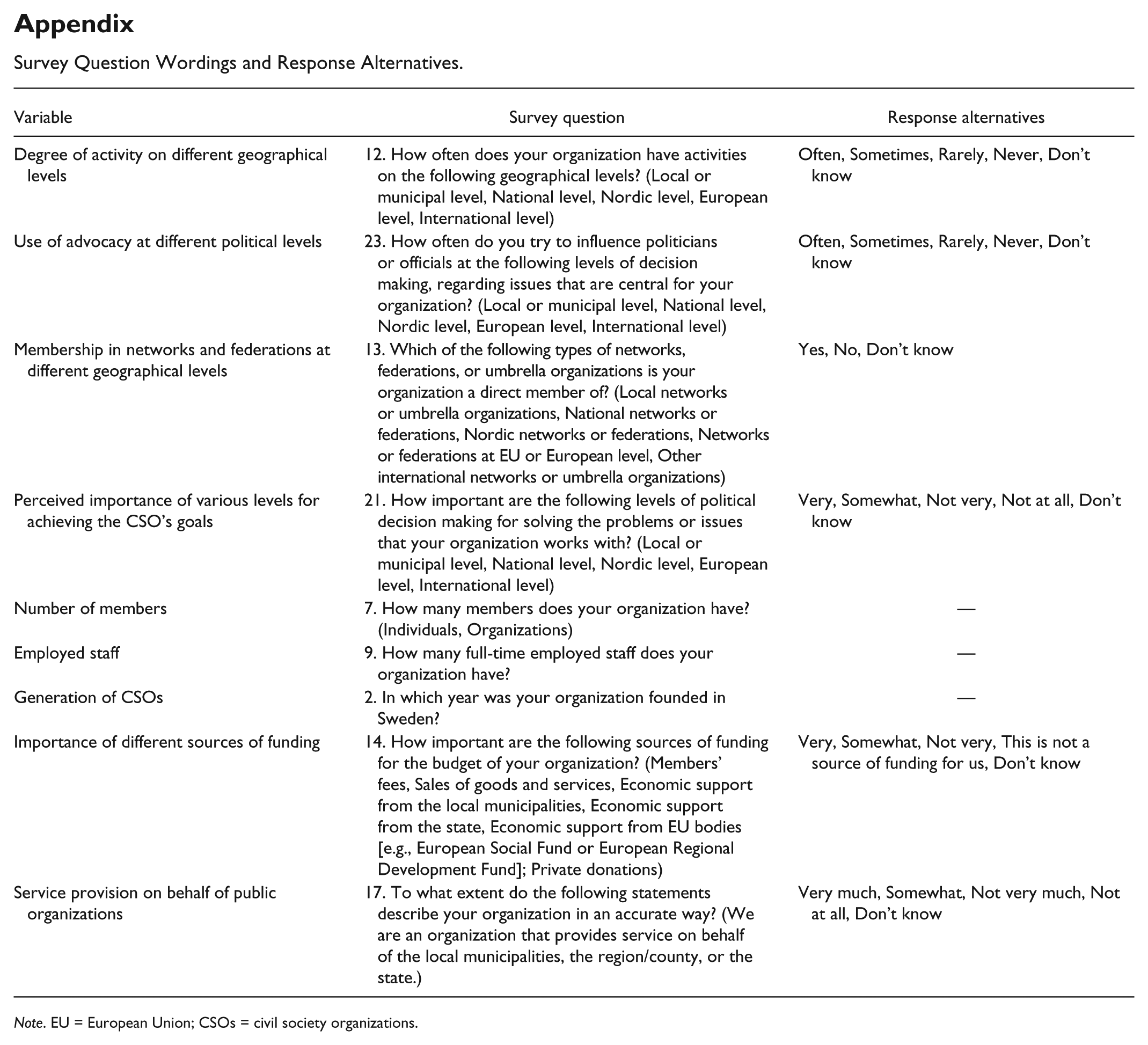
Note. EU = European Union; CSOs = civil society organizations.
Declaration of Conflicting Interests
The author(s) declared no potential conflicts of interest with respect to the research, authorship, and/or publication of this article.
Funding
The author(s) disclosed receipt of the following financial support for the research and/or authorship of this article: This research has been funded by the Swedish Research Council (Grant 2010-1678).