




Abstract
Participants read a procedural text describing how to make a wind-up spool toy while only reading, reading and watching the experimenter do the task, or reading and doing the task themselves. Afterward, task performance (measured by time to complete the task without the instructions and number of errors) and memory for/understanding of the text (measured with a Multiple Choice Test) were assessed. Participants then completed a packet that included the Need for Cognition and Boredom Proneness scales. Task performance was better under the Read & Do and Read & Watch conditions, indicating that those participants were more engaged in the task than Read Only. Need for Cognition was positively related to Multiple Choice Test score (after controlling for boredom proneness and task experience) only under the Read & Do conditions (and marginally for Read & Watch). This suggests that level of task engagement may moderate the relationship between need for cognition and test performance. The Boredom Proneness subscales of Perception of Time and Affective Responses were negatively related to need for cognition.
Keywords
The present study investigated the relationship between need for cognition, boredom proneness, and cognitive performance under three levels of task engagement. Negative correlations between need for cognition and boredom proneness have been found (Watt & Blanchard, 1994); how can they be explained? How might these personality variables relate to cognitive performance? It may be that those high in boredom proneness have attentional lapses that make it difficult to focus on the task at hand (e.g., Malkovsky, Merrifield, Goldberg, & Danckert, 2012). People who are high in boredom proneness may not seek out engaging activities (such as people who are high in need for cognition do; Cacioppo & Petty, 1982) because they have difficulty sustaining attention, so complex activities are not satisfying. Using an instructional text, we manipulated task engagement to see whether it moderated the relationship between need for cognition and cognitive performance when controlling for boredom proneness.
Need for Cognition
“I am always doing that which I cannot do, in order that I may learn how to do it.” (Pablo Picasso)
Need for cognition (Cacioppo & Petty, 1982) is a measure of cognitive motivation that assesses the extent to which a person looks for and likes engaging in mentally stimulating activities. Cacioppo, Petty, Feinstein, and Jarvis (1996) described those low in need for cognition as chronic cognitive misers and those high on the trait as chronic cognizers. Need for cognition has been found to be related to a large number of variables. For example, it has been shown to be positively correlated with performance on an academic task (Coutinho, Wiemer-Hastings, Skowronski, & Britt, 2005), to mediate the relationship between openness to experience and intelligence (Furnham & Thorne, 2013), and to be mediated by the given environment in its relationship to academic engagement (Cole & Korkmaz, 2013). Cacioppo and Petty (1982) established predictive validity of their measure in part by demonstrating that, when doing an extremely boring task, those high in need for cognition found the task more enjoyable when they had to use a more complex rule (which all participants rated as requiring more effort than the simple rule) to complete it. Those low in need for cognition enjoyed the simple task more.
Cacioppo, Petty, and Morris (1983), after having participants read an editorial in favor of the implementation of a proposed graduation requirement, found that those high in need for cognition later recalled more of the arguments and rated themselves as having expended more effort than those low in need for cognition. Verplanken (1993), using a time pressure manipulation, also found that those high in need for cognition expended more cognitive effort than those low on the variable. Using expository texts that varied in the presence of organization signals, Kardash and Noel (2000) found that those high in need for cognition recalled more information from the texts than those low in the variable.
These findings suggest that in the present study, participants high in need for cognition will engage in more effortful processing of the text regardless of condition, and will therefore comprehend and remember the written procedural text that they process early in the study better than those who are low on the measure.
Need for Cognition and Task Engagement
In an earlier study, Diehl and Mills (1995) used a number of conditions to test van Dijk and Kintsch’s (1983) text representation theory. This theory suggests that, when reading, the reader develops both propositional and situational mental representations. Propositional representations (also known as the textbase) contain information about the text itself. Situational representations hold information about the situation described by the text. With a procedural text (the type used in the present study), the textbase holds propositional information from the text, and the situation model contains information about how to do the task described by the text. As an example, take the sentence, “If the rubber band is not taut, wind it several times around the drag to take up the slack.” To simply remember the ideas contained in that sentence does not necessarily imply that the individual genuinely understands the instruction and will be able to carry it out. Diehl and Mills’s (1995, Study 2) task engagement conditions included Read Only (only reading the procedural text), Read & Watch (reading and watching the experimenter do the task), and Read & Do (reading and doing the task themselves). As predicted, participants in both the Read & Do and Read & Watch conditions did well on the task performance measure because they were both forced to be engaged with doing the task. However, the Read & Do participants did best because they could engage in transfer-appropriate processing. The Read & Watch participants performed second best because they had an opportunity to observe task performance. The Read Only participants’ task performance was poor; they did not have access to the task device and therefore had low levels of task engagement.
As noted earlier, we expect that, over all, there will be a positive relationship between need for cognition and Multiple Choice Test performance. However, the strength of this relationship will depend on the level of task engagement. Those high in need for cognition prefer more complex tasks, while those low in need for cognition prefer simple tasks (Cacioppo & Petty, 1982). Processing the text while being engaged with the task is more complex than simply reading the text, so those high in need for cognition will score high on the recognition test under Read & Do. Those low in need for cognition will process the text only insofar as it is required for task completion in the Read & Do condition, and will therefore perform more poorly on the (text-based) recognition test.
Participants in the Read & Watch condition will be less engaged with the task than those in Read & Do. They must watch the experimenter do the task, but they don’t have to do it themselves. Everyone under Read & Watch will have more attentional resources to devote to the procedural text (compared with Read & Do) because these participants do not have to do the task, and this will benefit those low in need for cognition, weakening the correlation (compared with Read & Do) between need for cognition and recognition task scores under this condition. Under the Read Only condition, all participants only have to process the text (and therefore have no task engagement), and so the strength of the relationship will be more modest.
Boredom Proneness
The question of what boredom is has not yet been settled. Eastwood, Frischen, Fenske, and Smilek (2012) recently developed a comprehensive model of boredom that centers on attentional deficits (e.g., poor orientation, inadequacies of executive control processes) but which also takes experiential and psychological factors into account (e.g., negative affect and nonoptimal sensitivity to stimulation). Mikulas and Vodanovich (1993) defined boredom as “a state of relatively low arousal and dissatisfaction, which is attributed to an inadequately stimulating situation” (p. 1), but Merrifield and Danckert (2014) showed that boredom involves a higher level of arousal. Using video clips that elicited specific emotions, they recently demonstrated that boredom has a physiological signature distinct from sadness. They showed that those who were induced to feel bored had lower skin conductance and salivary cortisol levels, and a marginally higher heart rate, than those induced to feel sad. They concluded that boredom is a complex state that combines higher arousal levels (as indicated by higher heart rate and lower cortisol) and greater inattentiveness (as shown by lower skin conductance). Malkovsky et al. (2012) identified two types of boredom proneness: apathetic (an inability to keep or disinterest in keeping oneself mentally stimulated) and agitated (seeking stimulation, but finding it wanting). Farmer and Sundberg (1986) developed the 28-item Boredom Proneness scale (BPS) that, among other things, measures the extent to which a person is paying attention to what is going on in his or her environment.
Cheyne, Carriere, and Smilek (2006) described boredom proneness as including a propensity toward inattentiveness, a general inability to keep one’s attention on anything. Is there evidence that one’s level of boredom proneness is related to attentiveness? Using the Cognitive Failures Questionnaire (CFQ; Broadbent, Cooper, Fitzgerald, & Parkes, 1982), which measures a tendency to make routine cognitive errors and which has been shown to be positively related to actual measures of attentional errors, Wallace, Vodanovich, and Restino (2003) found a positive relationship between the BPS and cognitive failures. In separate studies, Malkovsky et al. (2012) and Carriere, Cheyne, and Smilek (2008) used the Attention-Related Cognitive Errors Scale (ARCES; Cheyne et al., 2006) and the Mindful Attention Awareness Scale (MAAS; Brown & Ryan, 2003, modified); in both studies, participants with greater inattention and reports of a larger number of mental errors due to inattention tended to have higher BPS scores. Together these studies provide support for the notion that there is a meaningful relationship between inattentiveness, cognitive errors, and boredom proneness. This is consistent with the notion that boredom proneness has an important attentional component. If those higher in boredom proneness are more inattentive, this should lead to poorer performance on cognitive tasks. We predict that in the present study, there will be a negative correlation between boredom proneness and performance measures on cognitive tests.
Boredom Proneness and Need for Cognition
In their summary of previous research, Watt and Blanchard (1994) noted that people who are prone to be bored tend to take a more simplistic view of things, have difficulty maintaining an optimal level of stimulation, and perceive time as passing more slowly than those who are not prone to be bored. Using the BPS, a number of researchers have found different factor-analytic solutions, suggesting that its factor structure is not stable. For example, Craparo, Faraci, Fasciano, Carrubba, and Gori (2013) found a 3-factor solution, whereas Melton and Schulenberg (2009) and Ahmed (1990) found different 2-factor solutions. Using a 12-item short form, Vodanovich, Wallace, and Kass (2005) also found a 2-factor solution. Vodanovich and Kass (1990) found five factors: External Stimulation (requiring stimulation from external sources), Internal Stimulation (providing adequate stimulation from within), Affective Responses (feelings in response to boredom), Perception of Time, and Constraint (restless feelings when waiting). This 5-factor solution was used in the present study.
Using a median split on the Need for Cognition Scale (Cacioppo & Petty, 1982), Watt and Blanchard (1994) found that those participants low in need for cognition scored higher on the Boredom Proneness (Farmer & Sundberg, 1986) subscales of Internal Stimulation, Affective Responses, and Perception of Time. That these elements of boredom are negative correlated with need for cognition makes sense; those high in need for cognition work to keep themselves mentally stimulated, are more successful at maintaining comfortable levels of stimulation, and enjoy more complex types of thinking. This may keep them from feeling trapped by what they have to do, which may make time seem to go more quickly. In the present study, we expected to find these same relationships between Need for Cognition and the Boredom Proneness subscales.
Aims of the Present Study
We manipulated task engagement to see whether it moderated the relationship between need for cognition and cognitive performance. We hypothesized that those high in need for cognition would perform better than those with low scores when they were forced to be more engaged with the task. We also investigated the relationships between the need for cognition, and the five subscales of the BPS (Farmer & Sundberg, 1986), and expected to replicate Watt and Blanchard (1994).
Method
Participants
The participants were 61 undergraduate students (39 female) from a Midwestern university who participated for extra credit in a psychology course. They were randomly assigned to one of three task engagement conditions: Read Only (20), Read & Do (23), and Read & Watch (18).
Materials
For the task engagement manipulation, all participants read How to Make and Use a Spool Vehicle (from Herbert, 1980, see Appendix A; see also Diehl & Mills, 1995, 2002; Mills, Diehl, Birkmire, & Mou, 1993, 1995), which described how to make and use a rubber-band-propelled children’s toy. This text was chosen because reading it creates a mental representation of both the text itself (i.e., the textbase) and the task described by the text (the situational representation). Therefore, in the present study we were able to tap both of these mental models with the Multiple Choice Test (textbase) and task performance time and number of errors made while performing the task (situational representation).
Making the toy involves putting a rubber band through a hole in the spool, tacking one end of the rubber band to the top of the spool, and putting the other end through a washer and attaching it to a pencil. The pencil is turned to wind up the rubber band, and the unwinding causes the spool to move. This text contained 17 sentences and had 297 words. It included both the steps involved in constructing the vehicle and in making it go. It also contained some explanation-type sentences.
The materials associated with the spool text were used in the Read & Do and Read & Watch conditions; these parts were the spool, a rubber band, a washer, tack, and a matchstick. The Multiple Choice Spool Vehicle test (see Appendix B, modified from Diehl & Mills, 1995, 2002) was a 20-item quiz with questions based on the information from the Spool Vehicle text. The score was the number correct.
Boredom proneness was measured with the 28-item BPS (Farmer & Sundberg, 1986). The original scale had a true/false response format, with a coefficient alpha equal to .79, and a test–retest reliability of .83. It showed the expected relationships with a variety of related constructs (e.g., the Boredom Susceptibility Scale [Zuckerman, Eysenck, & Eysenck,1978] and classroom boredom ratings). In the present study, we used a 7-point scale (see, for example, Watt & Blanchard, 1994) which ranged from “1” (highly disagree) to “7” (highly agree). In our sample, using this format, we found Cronbach’s alpha to be equal to .79. Example items include “It is easy for me to concentrate on my activities” (reverse scored) and “I often find myself at ‘loose ends,’ not knowing what to do.” Total score was determined by first reverse scoring those items and then summing the rating scales for each item.
We also looked at boredom proneness broken down into the five factors extracted previously by Vodanovich and Kass (1990): External Stimulation (which contains such items as “It takes a lot of change and variety to keep me really happy” and “Unless I am doing something exciting, even dangerous, I feel half-dead and dull”), Internal Stimulation (including “It would be very hard for me to find a job that is exciting enough” and “I would like more challenging things to do in life”), Affective Responses (which contains such items as “I am often trapped in situations where I have to do meaningless things” and “Frequently when I am working I find myself worrying about other things”), Perception of Time (which contains such items as “Time always seems to be passing slowly” and “Much of the time I just sit around doing nothing”), and Constraint (including “I am good at waiting patiently” reverse scored). In the present study, Cronbach’s alphas for the five factors were External Stimulation = .71, Internal Stimulation = .69, Affective Responses = .36, Perception of Time = .68, and Constraint = .68. Because of the low alpha with Affective Responses, correlations with this subscale must be qualified.
To measure the need for cognition, the 18-item Need for Cognition Scale (short form; Cacioppo, Petty, & Kao, 1984) was used. This consists of 18 items intended to measure how much a person seeks out and likes cognitive challenge. The short form has been found to be strongly correlated with the original 34-item scale (r = .95), and internal consistency is high (Cronbach’s α = .90). Cacioppo and Petty (1982, Study 2) established the original 34-item scale’s validity by finding it correlated positively with related constructs (e.g., field independence) and did not correlate with unrelated constructs (e.g., test anxiety). In the present study, participants responded to items on a 9-point scale ranging from 9 (very strong agreement) to 1 (very strong disagreement), and Cronbach’s alpha was equal to .88. Example items include “I would prefer complex to simple problems” and “I would rather do something that requires little thought than something that is sure to challenge my thinking abilities” (reverse scored). Total score was determined by first reverse scoring those items and then summing the rating scales for each item.
A Task Familiarity Questionnaire (see Appendix C; Diehl & Mills, 1995, 2002) consisted of three questions. The first asked about familiarity with similar toys, the second probed whether they had experience with this specific toy, and the third asked the participants to describe their experiences (if any).
Procedure
The 61 participants were randomly assigned to one of the following task engagement conditions: Read Only (only read the procedural text, no task materials present), Read & Watch (read each step of the procedure then watch the experimenter perform it), or Read & Do (read each step of the procedure and then perform it). After a practice phase in which they went through their condition with a simple text that described folding a piece of paper and then paper-clipping one of the edges, they did it again, this time using the How to Make and Use a Spool Vehicle text. All participants first read the text (presented on a piece of paper) through once. For the next part, a timer was set for 4 min, and each participant carried out their task engagement condition for the whole time. The time was based on previous research (Diehl & Mills, 1995, 2002). The text was presented on index cards, with one card for each step (although in some cases there were explanatory sentences before the step on the same card). In the Read Only condition, they read the text for 4 min. In the Read & Watch condition, during the second reading, after reading each step, the participant looked up and watched the experimenter (the second author) perform the step. In the Read & Do condition, the participants were given the materials to make the toy, and after reading each step, the participant performed the step himself or herself. If the participant finished early in these last two conditions, he or she was asked to reread the text until the 4 min had elapsed. After the learning phase, all participants did the task without instructions. The experimenter kept track of the time it took for the participant to complete the task and on which steps (if any) the participants made completion errors. The study instructions asked the participant to try to figure out each step on his or her own, but if no progress was being made, or if the participant asked for help, the experimenter intervened and told the participant how to complete the step. These interventions were noted. Participants then completed the Multiple Choice Spool Vehicle test (see Appendix B), and a packet containing the BPS, the short form of the Need for Cognition Scale, and two other questionnaires not reported in this article. Finally, they completed the Task Experience Questionnaire (see Appendix C).
Results
Data Preparation
The Need for Cognition Scale was on the back page of the questionnaire packet, and eight of the participants failed to complete it. One person skipped the BPS. The researcher failed to record task errors for one participant, and for another, the participant could not figure out the task, even with help (and so no task error or performance time scores were available).
Several of the variables were not normally distributed and were therefore transformed. We used a log 10 transformation for Performance Time, and reflection and square root transformations for Multiple Choice Test score and Need for Cognition. After transformation, the variables approximated a normal distribution: Performance Time skewness = .29 (SE = .31), kurtosis = −.49 (SE = .61); Multiple Choice Test score skewness = .30 (SE = .31), kurtosis = −.70 (SE = .60); and Need for Cognition skewness = .23 (SE = .33), kurtosis = −.38 (SE = .66). Number of Task Errors could not be normalized, so nonparametric statistics were used in the analyses. Table 1 shows descriptive statistics for the study variables, broken down by condition.
Means and Standard Deviations (SDs) for Each of the Variables by Condition.

Note. The only significant F ratio was for Performance Time, F(2, 57) = 12.71, p< .001. The Kruskal–Wallis test was significant for Number of Task Errors, χ2(2, N = 60) = 16.23, p < .001.
In seconds.
Out of 7 possible.
Out of 2 possible; a higher score indicates more experience.
Number correct out of 20 possible.
Out of 162 possible.
Out of 196 possible.
Data Analyses
Table 2 shows the correlations between the variables. As expected, there was a positive correlation between Need for Cognition and Multiple Choice Test score and a negative correlation between Need for Cognition and Boredom Proneness. The expected negative correlations between Boredom Proneness and the performance measures (Multiple Choice Test score, Performance Time, and Number of Task Errors) were not found.
Summary of Intercorrelations for Scores on the Measures.
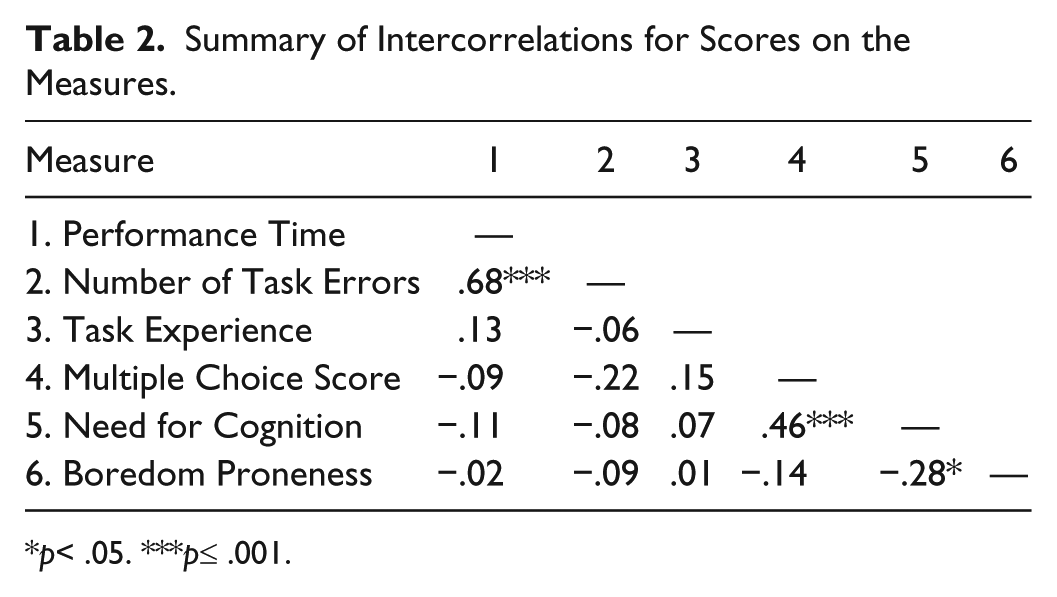
p< .05. ***p≤ .001.
Looking at the Boredom Proneness factors individually, we expected negative relationships between the three factors of Internal Stimulation, Affective Responses, and Perception of Time and Need for Cognition. As expected, Need for Cognition was negatively correlated with both the Affective Responses boredom proneness factor, r(48) = −.37, p< .01, and the Perception of Time factor, r(48) = −.41, p< .01. The expected negative correlation between Internal Stimulation and Need for Cognition was not significant, r(48) = −.17, p> .05. The Affective Responses factor was also negatively correlated with Multiple Choice Test score, r(58) = −.30, p = .02. The other Boredom Proneness factors were not significantly correlated with the study variables.
There were main effects of the extent of task engagement during reading on number of errors made while performing the task without the instructions, Kruskal–Wallis χ2(2, N = 60) = 16.23, p< .001, and on time spent doing the task, F(2, 57) = 12.71, p< .001. Post hoc tests revealed that Read Only participants made more errors and took more time than did those in the Read & Do and Read & Watch conditions. These results are neither surprising nor interesting, but establish that participants were less engaged with the Spool Vehicle task in the Read Only condition. It is noteworthy that, although the differences were not significant, the means for the Read & Watch condition fall between Read Only and Read & Do.
To test the hypothesis that the positive correlation between Need for Cognition and Multiple Choice Test score depends on the level of task involvement, we looked at the correlations broken down by condition. We predicted that, under Read & Do, those low in need for cognition would process the text less because they would not need to process it deeply to get the task done, and they prefer simple (as opposed to complex) activities, and would therefore perform more poorly on the textbase Multiple Choice Test, as compared with those high on need for cognition. The Read & Watch participants would not have to do the task while reading, and they would not have to process the text deeply. There would be less task engagement for all participants (compared with Read & Do), but those high in need for cognition would process the text more deeply (because they prefer more complex tasks), so they would perform slightly better than those low in need for cognition, leading to a weaker correlation between the variables. Under the Read Only condition, all participants would only have to process the text. There is no required task engagement, so we predicted the weakest correlation in this condition. 1
When looking at each condition separately, this relationship was only significant in Read & Do, r(16) = .62, p< .01, and was marginally significant in Read & Watch, r(15) = .43, p = .08. The correlation under Read Only was not significant, r(14) = .36, p = .17. Controlling for Boredom Proneness and Task Experience, the correlation for Read & Do was unchanged, r(13) = .61, p< .05, but was slightly reduced for Read & Watch, r(12) = .32, p = .25. For Read Only, the partial correlation was .27.
Discussion
The present study served to confirm previous work (e.g., Cacioppo et al., 1983; Kardash & Noel, 2000) that has shown that people who are high on need for cognition score higher on recall and recognition tasks than those low on need for cognition. Why is this the case? Verplanken (1993) and Cacioppo et al. (1983) demonstrated that those high in need for cognition generally spend more effort on their cognitive activities than do those low in need for cognition. This likely causes better memory for the material.
The present study raised the question of whether this aforementioned positive relationship depends on level of task engagement. Based on Diehl and Mills (1995, Study 2), we expected that participants would perform the task most quickly and accurately in the Read & Do condition, second most in Read & Watch, and slowest and least accurately in Read Only. We found this pattern with respect to the means, but the only significant difference was between Read Only and both Read & Do and Read & Watch. We used these results as a manipulation check for our independent variable of task engagement. Because participants performed the task better in the situations where they did the task themselves or watched the experimenter do it, compared with those who only read the text, we inferred that they were more engaged with the Spool Vehicle task under the former conditions.
On the Multiple Choice Test, there was no effect of task engagement. While reading time and number of errors during task performance were measures of performance on the Spool Vehicle task, the Multiple Choice Test evaluated participants’ knowledge of the textbase (van Dijk & Kintsch, 1983), that is, their memory for the text. We performed a moderation analysis, testing for whether the relationship between Multiple Choice Test score and need for cognition depended on level of task engagement. If we can assume that, given an opportunity for task engagement (to some extent in Read & Watch, but most strongly in Read & Do), those high in need for cognition were more likely to take advantage of it (because they enjoy complex tasks), they probably put in more effort and learned the material better than those low in need for cognition. Those low in need for cognition (who prefer simple tasks) in the Read & Do condition used the text as a means to get the task done but were unlikely to process the text effortfully. Therefore, we predicted the strongest positive relationship between need for cognition and multiple choice score in Read & Do, second strongest in Read & Watch (because they did not have to do the task themselves), and least strong in Read Only (because task engagement was not a part of it). Unfortunately, this moderation analysis was not significant (see Footnote 1). Nonetheless, there was some suggestive evidence for such an interaction effect. Under the highest level of task engagement, when participants had to do the task themselves while reading, those with a higher need for cognition did better on the Multiple Choice Test than those with a low need for cognition. The correlation was not significant under Read Only and was marginally significant under Read & Watch.
Pekrun, Goetz, Titz, and Perry (2002) found a negative correlation between boredom and self-regulation. This might explain our negative correlation between need for cognition and boredom proneness. If those who are high in boredom proneness are also low in the ability to self-regulate, this may have “looked like” a low need for cognition in the present study. 2
Cacioppo and Petty (1982) found negative correlations between need for cognition and the Affective Responses, Perception of Time, and Internal Stimulation subscales of the BPS. In the present study, we replicated the first two correlations. This makes sense because people who are high in need for cognition, when possible, choose activities that involve mental stimulation, and so are less likely feel trapped and more likely to be able to focus on what they are doing. Because they are more likely to be engaged, they are likely to experience time as passing quickly. The correlation involving the Internal Stimulation subscale was negative but not significant. As noted earlier, the factor structure of the BPS is inconsistent across research studies, so these findings should be interpreted cautiously.
Affective Responses was negatively correlated with the Multiple Choice Test score. The items on the Affective Responses subscale involve having negative feelings about tasks: perceiving tasks as monotonous, feeling trapped, and being easily distracted. Under these circumstances, a person would not be focused on what they are doing. In the present study, this would apply to the procedural text that all participants read at the beginning of the study. If participants are less likely to be focused, they are less likely to do well on a test over the content of the text. Cronbach’s alpha for Affective Responses was quite low in the present study, so relationships with that scale should be interpreted cautiously.
Limitations
Other limitations to the study include the small sample size, especially when broken down by the three levels of task engagement. Also, it is important to note that the personality measures were completed after participants went through the task engagement manipulation and completed the tests associated with the Spool Vehicle. The condition they were in and their performance on those tests may have influenced their responses on the latter measures. For example, if they felt bored during the first part of the study, their responses on the BPS may have been more extreme than is usually the case. 3 In addition, the present study did not include a measure of attentional control, so we were not able to directly investigate the relationships between boredom proneness, attention, and cognitive performance.
Conclusion
Only in the Read & Do condition, where participants had the highest levels of task engagement, was need for cognition a significant predictor of performance on the Multiple Choice Test (even after controlling for boredom proneness and task experience), suggesting that task complexity may moderate the relationship between need for cognition and performance. Those high in need for cognition benefit from having a complex and engaging learning task.
The expected negative relationship between boredom proneness and need for cognition was replicated, and those between the subscales of the boredom proneness measure were partially replicated. It may be that those who are high in boredom proneness have limited attentional resources (Broadbent et al., 1982; Carriere et al., 2008; Malkovsky et al., 2012; Wallace et al., 2003), and so they are unable to successfully engage in the complex tasks that those high in need for cognition seek out. 4 If this is the case, it is somewhat surprising that, except for the negative correlation between the Affective Responses subscale and the Multiple Choice Test, boredom proneness was not found to be related to the cognitive tests in the present study. Boredom is clearly not a simple construct.
Footnotes
Appendix A
Appendix B
Appendix C
Declaration of Conflicting Interests
The author(s) declared no potential conflicts of interest with respect to the research, authorship, and/or publication of this article.
Funding
The author(s) received no financial support for the research and/or authorship of this article.